1867: Presbyterian Church, Melton, Victoria.

The Presbyterians of Melton had previously held their services in a wooden building known as the “Union Church.” which was used by all of Melton’s Christian denominations until they had erected their own.

The foundation stone of the Presbyterian church was laid on the 27th December 1865[1] but it would be nearly two years before it would open for services and the proposed tower and spire in the original designs never eventuated

The stone for the church was quarried free of charge from the nearby property of a “Mr. Corr”[2], who was the first headmaster of the Melton Common School, secretary and treasurer of the Melton Cemetery Trust, Treasurer of the Wesleyan Church and Deputy Registrar of births deaths and marriages[3].

 The Presbyterians held their annual Soiree in the old Union church on the 8th October 1867 and later proceeded to the new incomplete church. Of the windows it was reported;

“…The windows of the church are particularly elegant, especially the principal one at the back of the pulpit, which is fitted with stained glass of a very rich description…”[4]

A month later the Age newspaper published an article specifically mentioning the Ferguson & Urie company of North Melbourne as the makers of the stained glass window in the liturgical east end;

“THE PRESBYTERIAN CHURCH AT MELTON is nearly completed, the glaziers being engaged with the windows. The Bacchus Marsh Express praises the stained glass, the design and colors being beautiful. “Messrs Ferguson and Urie, of North Melbourne, are entitled to great commendation for their workmanship in this respect…[5]

Photos taken: 7th September 2014.

This slideshow requires JavaScript.

[View larger images]

The window is of four lights with smaller tracery windows above to complete the design and is a typical design by Ferguson & Urie from that period. The two centre lights have the ribbons/scrolls in the centre with the following two pieces of scripture:

“Christ is all and in all” – (Colossians 3:11)
“Worship God in the Spirit” – (Philippians 3:3)

The original bluestone nave of the church now sits sandwiched between two newer buildings with doorways to each at the ends. The single light windows in the nave are works of art by the Brooks, Robinson & Co stained glass company from the early 1900’s and later. These windows were originally likely to have been Ferguson & Urie’s simple stained glass bordered designs that have been replaced over more than a century and a half. The historic Ferguson & Urie stained glass window at the east end still lights the nave of the old church building the same as it has since 1867 and creates an amazing kaleidoscope of coloured patterns over the floor when the sunlight strikes it at the right time

Significant transcriptions:

The Age, Melbourne, Vic, Monday 14th October 1867, page 6.

“THE PRESBYTERIAN CHURCH AT MELTON is nearly completed, the glaziers being engaged with the windows. The Bacchus Marsh Express praises the stained glass, the design and colors being beautiful. “Messrs Ferguson and Urie, of North Melbourne, are entitled to great commendation for their workmanship in this respect. It is expected the church will be opened in a month for public worship. The cost is £1000, of which only £100 has to remain as a debt on the building. This speaks well for the Presbyterians of Melton.”

Bacchus Marsh Express, Vic, Saturday 14th September 1867, page 2.

“OPENING OF THE NEW PRESBYTERIAN CHURCH, MELTON.

THE Presbyterians of Melton district have for some years back held divine service in a wooden building known as the Union Church, owing to it having been erected and afterwards used by all denominations. On Sunday last, however, the Presbyterian congregation took possession of their own Church, when the Rev. H. Darling, of Emerald Hill, and the Rev. James Lambie, pastor of the congregation, conducted the services. The former preached in the absence of the Rev. T. McKenzie Frazer, who had been announced to do so. The Wesleyans, who used to use the Union Church, have now a building of their own, and the Church of England congregation have also completed the erection of a handsome Church, with the exception of the windows and seats, so that in a short time the Union Church will be devoted to school purposes only.

THE SOIREE.

The annual soire of the congregation was celebrated in the building known as the Union Church, and after the eatables had been disposed of, the partakers proceeded to the new Church, a short distance away, where the Rev. James Lambie, pastor of the congregation, took the chair. Of the building itself we are not disposed to give elaborate particulars which are perhaps well known to those interested in the matter. Its dimensions are stated to be 50ft. [unreadable characters…] It is apparent to any observer, however that the new Melton Presbyterian Church, both externally and internally, would be a credit to any community; and although it is not yet finished, as a steeple is intended to be erected, yet the absence of this ornament is scarcely noticeable. The windows of the church are particularly elegant, especially the principal one at the back of the pulpit, which is fitted with stained glass of a very rich description. The building is entirely of bluestone, with a slate roof, and the ceiling is a groined one, thereby affording the greatest possible loftiness for ventilation, besides adding to the general ecclesiastical appearance of the interior. The pulpit and platform surrounding it is of a massive kind, having nothing paltry in its appearance, although the usual amount of French polish has not yet been applied. The seats, too, for the congregation are strong roomy ones, made upon a good pattern; and altogether the Church bears evidence that what has been attempted has been done in the best manner, and so far from there being any reason for surprise that the Church has been two years in course of construction, the wonder is that such thorough progress has been made in the time. These preliminary remarks may well be concluded by the addition of a word of praise to the efforts of the choir upon the occasion of the soire, as their performances were really enjoyable.

The CHAIRMAN remarked that while congratulating those assembled, he did not intend to specially address them; he would leave that to his brethren on the platform. It was two years last month since they commenced to built the Church. They had proceeded slowly, but surely. He submitted a statement of the Building Fund.

The subscriptions had amounted to £470. 7s. 4½d.; bazaars, £265.17s.7d.; grant from Assembly , £189.7s.9d.; foundation stone collection, £32. 10s.; loan from Bank, £100. He had little to say further than that the subscriptions had been raised almost entirely from members and adherents of the Church. He did not mention this boastingly. The ladies had purchased the lamps, and the children furnished the precentor’s desk. There had been expended £1049. 11s. 8d., leaving a balance of £11. 0s. 8½.

Mr. BLACKWOOD then read the treasurer’s report for the past year, from which it appeared that the receipts had been £126. 2s. 11d., and the expenditure £124. 0s.5½d., leaving a balance of £2. 2s. 5½d. The speaker referred to the lotting of the seats, and that accommodation would be made for those who did not rent seats. He wished some of the reverend gentlemen to take up the question of whether the congregation should stand or sit at singing. He wished to see uniformity.

The CHAIRMAN intimated that some of the reverend gentlemen who had been invited were absent. They were the Revs. J. Clarke, A McNicol, W. A. Lind, and J. C. Sabine. [Mr. Sabine had desired us to mention that he intended to be present, but the heat of the day prevented him, and he delayed sending an apology hoping that it would moderate].

The Rev. R. HENDERSON was the next speaker. He said that although several gentlemen were absent, he felt assured there would be no lack of speakers. They had Mr. Inglis, who was a host in himself. He would take his cue from Mr. Blackwood, and endeavour to comply with his desire that those learned in Church matters should enlighten them regarding the posture in worship. He believed it had been the practice of their Church for 300 years to sit during singing; but the General Assembly allowed congregations to make their own rules in regard to such matters. If they were unanimous in resolving to stand at singing, there was nothing to prevent them. So far as he was concerned, he preferred to see the congregation standing during singing, as it enabled them to execute their psalmody in a better manner than while sitting. The rev. gentleman then commented upon the necessity of improving the psalmody as much as possible, and was favourable to the use of a harmonium. Many congregations had introduced them, and others were merely putting off the consideration of the question. He agreed with all the encomiums upon their Church bestowed by the Rev. H. Darling, and suggested that all Presbyteries should adopt some definite system in regard to architectural style. He recommended the congregation to assume a reverential demeanour upon entering their Church, and exhorted them also to realise that, although Christians were divided into seats, yet they all had one heaven to receive them. Before sitting down, he must congratulate Mr. Lambie upon his success in raising money to build this Church. As a co-presbyter with him, he desired publicly to acknowledge his earnest and inudable endeavours in this matter. He rejoiced in being present this evening, and wished them God speed in their endeavours.

The Rev. J. W. INGLIS commenced by some humorous remarks, depreciatory of the laudatory manner in which the previous speaker had referred to him, and said that the expectation of the assemblage had been unduly raised. It was twelve years ago since he had attended his first tea meeting at Melton, and there were only five persons present. In fact, he had boiled his billy on the bank of the creek. His next meeting was with their present pastor, and now once again he had the pleasure of meeting them under prosperous circumstances, in their own Church. The Union Church had answered its purpose well, but now Melton possessed three substantial Churches, which they must all rejoice at. Their Church was certainly a handsome one, but no doubt no handsomer than they thought it to be; and he might say that Presbyteries were only beginning to pay proper attention to architectural effect; still they must never forget the higher object of their Church buildings. The speaker exhorted the congregation to take special interest in all that appertained to their Church, and to guard against the deadness which would fall upon a congregation which did not regularly attend at worship every Sabbath. He was more than pleased to hear that they had contributed to all the funds for which the Assembly sought their aid, and he trusted that they would always recollect the claims of such objects. Although a Presbyterian, he was no sectarian, and did not wish his sympathies to remain with that Church only; for there was but one Shepherd, one fold, one House of many mansions, and they should remember that this building was God’s house – not theirs – but dedicated to the God of Zion. Let them enter it as the gate of heaven, thinking of God’s words, “Come to me, all ye that are heavy laden;” and there was nothing which would cheer the adversities of this life but seeking the house of God every Sabbath, where they could have communion with God the Father and His Son Jesus Christ, and feel that there was a place prepared for them where the inhabitants know no tears, and which was the land of everlasting bliss. If they did this, truly this place would be a blessed place. He had but one word to say, in regard to their indebtedness to God for all they had. If they realised this, and were honest in their religious convictions, neither he nor any other minister would have occasion to ask them to give of their substance to the purposes of God’s worship. He hoped that for many years they would worship here, and may the faith they had imbibed enable them to enter into the joy of the kingdom of their Lord. A collection was then taken up, during which the choir sang “How Beautiful upon the Mountain.” They also sang at the conclusion of each speech.

The Rev. J. MEEK would simply make a few remarks in his own way. He had watched their progress as a congregation with considerable satisfaction, and he was here to confess that the career of this congregation had taught him one or two useful lessons. He had at one time serious misgivings as to the success of the effort to establish this congregation, but their prosperity had rebuked him, and taught him to remember that it was right to do one’s duty, and leave the results to God. We at Gisborne would not feel flattered by being compared to Melton; yet they worshipped in a temporary wooden building. He hoped their success in Melton would induce the Gisborne congregation to at least consider the matter of beginning to do likewise. He looked upon this Church as a testimony to the zeal and devotedness of their minister, and as a monument of their liberality; and he trusted most earnestly that on the great day of accounts, their minister might have many from among them as a crown of glory.

The Rev. J. SCOTT had been admonished by the departure of many that the patience of the audience was well-nigh exhausted. He had not come with any desire of speaking, but rather to hear others. However, he must join his congratulations with those of the speakers who had preceded him. Their minister had done what few of his brethren would have attempted. He felt that they had done great things in the past, and he believed it would be an incentive for them to buckle with a will to attend with zeal to all those observances which proved them a Christian people. The rev. gentleman urged the congregation to train their children to build up Christ’s cause in this young country, and concluded by hoping that they and their pastor would enjoy many such meetings as the present.

The CHAIRMAN announced the collection to be £5. 18s. 4d., making upwards of £20 with the collection of the previous day, for which the committee gave their hearty thanks.

Mr. BUCHANAN proposed a vote of thanks to the ladies, and made one of the best speeches of the evening. Carried by acclamation. Mr. BLACKWOOD proposed a vote of thanks to Mr. Corr, for having allowed the Committee to take the stone for building the Church from his property, free of charge. The vote was carried, and ordered to be conveyed to Mr. Corr. The vote of thanks to the visitors was also proposed by Mr. Blackwood.

The Rev. J. W. INGLIS, the Rev. R. HENDERSON, and the Rev. H. DARLING replied. The latter remarked that he was in favour of the congregation standing during singing and sitting during prayer, with the head upon the book board, as the attention was not then distracted as when standing. His congregation followed this practice.

Mr. MACINTOSH replied to a vote of thanks to the trustees. He was delighted to see what had been done, and he hoped that they would all recollect what had been said respecting regular attendance at Church. He was of opinion that the congregation should agree for the future to sit at prayer and stand at singing.

Mr. McPHERSON paid some deserved compliments to the choir in proposing a vote of thanks to them and their leader, Mr. Merchant.

The CHAIRMAN here presented Mr. Oldershaw, a member of the choir, a splendidly-bound edition of Cassell’s Illustrated Bible, as a testimony from the committee of their appreciation of his services.

Mr. OLDERSHAW expressed his thanks in a feeling manner, but was scarcely audible enough. The Rev. J. MEEK proposed a vote of thanks to the Chairman, which was briefly responded to, and the rev. gentleman remarked that henceforth he would be able to give more time to the spiritual wants of the congregation than hitherto.

The proceedings were closed by the choir singing a hymn. The proceeds of the sale of tickets amount to £16.”

Footnotes:

[1] The Australasian, Melbourne, Vic, Saturday 30th December 1865, page 12.

[2] Bacchus Marsh Express, Vic, Saturday 14th September 1867, page 2.

[3] Shire of Melton Heritage Study, Vol 5, page 3.

[4] Bacchus Marsh Express, Vic, Saturday 14th September 1867, page 2.

[5] The Age, Melbourne, Vic, Monday 14th October 1867, page 6.


Short link to this page: http://wp.me/p28nLD-2Fz

© Copyright

1864: St Enoch’s Presbyterian Church, Collins Street, Melbourne, Victoria.

St Enoch’s United Presbyterian Church was built c.1850 to the designs of architects James Blackburn (Jnr) and Arthur Newson at the east end of Collins Street in Melbourne. The church opened on the 30th March 1851 with the Rev Andrew Mitchell Ramsay as the first incumbent.

Extensive renovations and extensions were conducted in 1864 by William Ireland to the designs of architect Charles Webb and it was re-opened on the 31st of July 1864. Part of these renovations in 1864 included the installation of decorative stained glass windows by Ferguson & Urie of North Melbourne.

“…Over the entrance at the tower end is a large circular window, with plaster moulding finished with crisps, and containing a cinquefoil of Bath stone, which is filled in with a stained glass representation of the “Burning Bush,” and motto “Nec Tamen Consumebatur” – the crest and motto of the Church of Scotland. All the windows have been filled in with beautifully stained glass, and have a very fine appearance, as seen from the interior of the church during the day. This portion of the decorations is the work of Messrs Ferguson and Urie, North Melbourne, who have acquired considerable reputation for artistic productions of this description…”[1]

My reasonable assumption is that the Burning Bush window was probably the only figurative stained glass window in St Enoch’s and all the other decorative windows were most likely typical of Ferguson & Urie’s simple stained glass bordered windows of alternating red and blue glass divided by a yellow or white flower. The central diamond-shaped glass quarries in these windows would have been either plain glass or filled with the ‘Fleur De Lys’ or similar Gothic patterns.

Under increasing financial pressure and a dwindling congregation, St Enoch’s was sold in August 1870 to the Presbyterian Church of Victoria for £4,400 who intended to convert it into the Presbyterian Assembly Hall.  The modifications were completed in less than a month and on the 12th of September 1870 it was officially opened by Sir James McCulloch. [2]

Unfortunately, St Enoch’s no longer exists. The church was demolished in early 1911[3] and on its site was built the Auditorium Building next to Kurrajong House at 175 Collins Street)[4].

In 1915 the new Presbyterian Assembly Hall was opened on the opposite side of Collins Street, next to Scots Church, but there is no evidence of any Ferguson & Urie windows that may have been transferred to it.

Nothing is known as to the fate of any of the original Ferguson & Urie stained glass windows from St Enoch’s.

The slideshow photos depict various historic images of St Enoch’s Church between 1864-1911 as well as indicative examples of other ‘Burning Bush’ windows by the Ferguson & Urie company that still exist in other Presbyterian Churches in Victoria.

This slideshow requires JavaScript.

Significant tabloid transcriptions:

The Argus, Melbourne, Saturday 30th July 1864, page 5.

“The additions to the United Presbyterian Church in Collins-street east having been completed the edifice will be re-opened for public worship tomorrow…”

“… The tower, which forms a central feature, is fifteen feet and a half square. On either side of it is a two-light window with appropriate tracery, filled – as are other windows in the new portion of the building – with ornamental glass, executed by Messrs. Ferguson and Urie, of North Melbourne.”

The Age, Melbourne, Vic, Monday 1st August 1864, page 5.

“ST. ENOCH’S UNITED PRESBYTERIAN CHURCH.

St. Enoch’s church, the name adopted by the Rev. Mr Ramsay’s congregation for their place of worship, in Collins street, was re-opened yesterday, having been closed for several weeks pending extensive alterations and improvements…”

“…The chief alteration that has been made on the building consists in the erection of a handsome stone front with a tower and spire in the decorative gothic style, and to this extent it is the second finest specimen of ecclesiastical architecture yet completed in this city. The total width of the front of the building, at the base, is 66 feet. The width of the church is 48 feet, and the remainder of the space is occupied by the manager’s office and gateway approach to the manse. The principal feature is, of course, the tower and spire, which together rise to the height of 110 feet, the spire being about 50[??] feet high. The base of the tower is about twenty feet in front by about seventeen feet in depth to the church. At the front, the sides and outer angles of the tower are supported by buttresses which stand at right angles to each other and are continued to the base of the spire, but are broken at intervals by gablets, water tables, &c. The tower consists of three divisions. The front of the lower division is occupied by an ornamental recessed doorway, enclosed between the front buttresses. The recesses of the doorway are filled in with deeply cut mouldings and pillars, with finely carved foliated capitals. The arch is similarly recessed and ornamented, and covered by a weather moulding with carved bosses. The doorway is crowned by a high gable filled up with quatrefoil and angular trefoil tracery, and surmounted by an encircled stone cross-crosslet standing about two feet in relief from the face of the tower. In a line with the base of the gable, the front and side buttresses on either side are ornamented with gablets, terminated with carved bosses and surmounted with foliated finials. The second division commences with a string-course, and contains in front a small window with a trefoil head, and at the sides quatrefoil windows with trefoil mouldings. The upper divisions, where the course is broken by weatherings, rises above the ridge of the church, and the four sides of the tower are here similarly ornamented, each with two one-light windows with trefoil heads. These windows are connected by moulded labels, and the moulding is also continued round the tower.

            The tower terminates with a cornixe [sic], enriched with ball flowers, and the buttresses are here surmounted by gablets, with foliated finials and carved bosses. The spire falls from the buttresses into an octagonal form. In the lower portion provision is made for a clock. A little above this, on four alternate sides, are one light windows, filled in with louvre slating. These windows are also ornamented with gables containing a trefoil, and the gables themselves are surmounted by foliated finials, and terminated with carved bosses. Above these, on alternate sides, are ornamental trefoil openings, with carved bosses and weatherings. The spire is then carried to a point without further embellishment, and terminates with a moulded apex, which is surmounted by a gilded encircled cross-crosslet, above which extends a lightning conductor.

            The angles of the church are supported by two buttresses, standing at right angles to each other. These are broken at the middle by water tables and are surmounted by gablets, from which spring octagonal pinnacles with foliated terminations. In the front of the church, on either side of the tower, is a two-light window with trefoil heads and a quatrefoil centering. These are further decorated by labels with carved bosses and surmounted by foliated finials.

            The manager’s office, which is built against the east side of the church, is, so far, a separate structure. It occupies part of a gable which is pierced by an arched gateway that leads to the office door in the side, the minister’s residence, class rooms, &c. The office is lighted by an ornamental on-light window, filled with stained glass, over which is a stone trefoil, while the gable is surmounted by a stone cross-crosslet similar to that over the church door.

            The front of the church and the tower are constructed of bluestone, but the ornamental portions, dressings and quoins are of Bath freestone. The spire is of Point Ventenet freestone, with Bath stone dressings. This Bath stone was imported by Messrs Miles, Kingston and Co. in the expectation that it might be chosen for the front of the Parliament Houses. That expectation, however, was not realised, and about twelve months ago a portion of the lot was purchased by Mr Adam Anderson, a member of Mr Ramsay’s congregation, and by him presented to the church for the purpose to which it has been applied.

            Internally the church has undergone a thorough renovation, and is fitted up with polished cedar pews. Over the entrance at the tower end is a large circular window, with plaster moulding finished with crisps, and containing a cinquefoil of Bath stone, which is filled in with a stained glass representation of the “Burning Bush,” and motto “Nec Tamen Consumebatur” – the crest and motto of the Church of Scotland. All the windows have been filled in with beautifully stained glass, and have a very fine appearance, as seen from the interior of the church during the day. This portion of the decorations is the work of Messrs Ferguson and Urie, North Melbourne, who have acquired considerable reputation for artistic productions of this description.

            The building stands considerably back from the street on an elevation about ten feet high, which slopes to within five or six feet of the front of the tower, and thus leaves a level platform which extends across the embankment. This platform is reached by a broad flight of stone steps opposite the main entrance, and from it a few steps within the doorway conduct to the vestibule, which at night is lighted with a beautifully stained glass lamp. The ground is enclosed in a line with the adjacent buildings by a low bluestone wall, with an elegant massive iron railing and gateway with open square pillars. These, which have a correspondence in style with that of the church, were cast at Laughton and Wilson’s (Vulcan) foundry, from designs specially furnished by Mr Webb, the architect of the building. The whole of the work has been completed in a way that affords the highest satisfaction, and reflects the utmost credit upon the builder, Mr William Ireland. The stone carving, which was executed by Mr William Allen, commands the highest admiration, as regards the capitals, bosses, and foliated ornaments, which in some cases are capable of being interlaced with a thread.

            An addition has been made to the building in the rear, which provides a commodious classroom on the ground floor, and a comfortable study in the second floor.”

The Australian News for Home Readers, Vic, Thursday 25th August 1864, page 12.

“ST ENOCHS UNITED PRESBYTERIAN CHURCH”

“St. Enoch’s church, the name adopted by the Rev. Mr Ramsay’s congregation for their place of worship, in Collins street, was re-opened on 31st ult, having been closed for several weeks pending extensive alterations and improvements…”

“… The office is lighted by an ornamental one-light window, filled with stained glass, over which is a stone trefoil, while the gable is surmounted by a stone crosslet similar to that over the church door…”

“…Over the entrance at the tower end is a large circular window, and containing a cinquefoil of bath stone, which is filled in with a stained glass representation of the “Burning Bush,” and the motto “Nec Tamen Consumebatur”[5] – the crest and motto of the Church of Scotland. All the windows have been filled in with beautifully stained glass, and have a very fine appearance, as seen from the interior of the church during the day. This portion of the decorations is the work of Messrs Ferguson and Urie, North Melbourne, who have acquired considerable reputation for artistic productions of this description…”

“…the vestibule, which at night is lighted with a beautifully stained glass lamp…”

Geelong Advertiser, Vic, Wednesday 10th August 1870, page 3.

“St. Enoch’s Church, in Collins-streets Melbourne, has now been handed over to the Presbyterian Church of Victoria, by which body it will be used as an Assembly Hall. The price was £4400, which is to be paid before the 1st of July of next year. The necessary alterations of the building are about to be proceeded with to adapt it to its new use.”

The Bacchus Marsh Express, Vic, Saturday 13th August 1870, page 4.

“THE Telegraph reports that the Church of St. Enoch, in Collins street east, has been purchased by the Presbyterian Church of Victoria as an assembly hall. The price given is £4,400. There is a mortgage of £1,700 on the property. The terms of the arrangement are that the balance of the price amounting to £2,700, and expenses should be paid on or before the 1st July, 1871. It is proposed to turn the building to several uses. Amongst these are primarily as assembly hall. Provision can also be made for committee-rooms, for the custody of the records of the church, for offices of the church, and for a theological library. Accommodation for ministers and elders visiting Melbourne for a day or two, it is suggested, should be provided; and the building can be used to hold meetings of young men’s societies, missionary meetings, &c., which may be expected to bring revenue to the church.”

The Argus, Melbourne, Vic, Tuesday 13th September 1870, page 5.

“Last night the Presbyterian Assembly Hall, Collins-street east, which was formerly St Enoch’s Church, was opened by a tea and public meeting, at which Sir James McCulloch presided. About 400 persons sat down to tea, and more than that number took part in the subsequent proceedings.”

Table Talk, Melbourne, Vic, Thursday 20th April 1911, page 4.

Brief article summary – In mid 1911 the Presbyterian Assembly Hall (formerly St Enoch’s United Presbyterian Church) is to be pulled down to make way for a public amusement hall.

The Age, Melbourne, Vic, Tuesday 18th May 1915, page 11.

“The Governor, attended by Mr. Victor Hood, was present last night at the opening of the New Assembly Hall of the Presbyterian Church of Victoria, in Collins-street.”

(The new Hall was built on the opposite side of Collins Street to the left of Scot’s Church.)

Footnotes:

[1] The Age, Melbourne, Vic, Monday 1st August 1864, page 5.

[2] The Argus, Melbourne, Vic, Tuesday 13th September 1870, page 5.

[3] Table Talk, Melbourne, Vic, Thursday 20th April 1911, page 4.

[4] http://175collinsstreet.com.au/history.htm

[5] The motto of the Church of Scotland is ‘Nec Tamen Consumebatur’ (Latin) – ‘Yet it was not consumed’, an allusion to Exodus 3:2 and the Burning Bush.


Short link to this page: https://wp.me/p28nLD-2AZ

© Copyright

1888: James Urie lays the Foundation Stone of the Flemington and Kensington Presbyterian Church.

James Urie was not only a much respected public figure as a Councillor, Mayor of Flemington and a principal partner of the Ferguson & Urie stained glass firm; he is also credited with being one of the lead instigators for the erection of the Flemington and Kensington Presbyterian Church.

On the afternoon of Monday 25th June 1888 he was bestowed with the honour of laying the foundation stone of the new church in Norwood Street. The ceremony was reported as a grand affair and prior to him laying the foundation stone there was a procession by the Sunday school children after which he generously presented each one of them with a specially struck medallion as a memento of the historic occasion;

“…Prior to the commencement of the ceremony, about 450 Sabbath School children, nicely dressed, and with flags flying marched in procession from the new hall to the ground in Norwood street. Before leaving the mayor presented each child with a neat medal with a design of the church on one side commemorative of the event…”

– Images from private collections, the Melbourne Museum and the State Library of Victoria.

This slideshow requires JavaScript.

The medal included a picture of the proposed church on one side with the words:

“FLEMINGTON AND KENSINGTON PRESBYTERIAN CHURCH.”

On the reverse are the words:

“TO COMEMORATE THE LAYING OF THE FOUNDATION STONE. 25 JUNE 1888. BY JAS. URIE ESQ. J.P. MAYOR OF THE BOROUGH.”

An example of one these historical medallions can be seen at the Melbourne Museum in Carlton. [1] The Downies Numismatic Auction House also sold one of the medals at auction 308, item 945 for $200 circa 2012.

The Presbyterians originally intended to erect a smaller church costing only £1,400 but James Urie was adamant that it was worth the cost and effort to construct a more substantial building that would serve the congregation for many years;

“…Mr. Duguid, the architect for the building, stated in a brief speech that originally it was intended to erect a church costing only £1400 but Mr. Urie was so desirous of seeing a really good building worthy of the district put up, that at length it was agreed to adopt his advice, with the result that eventually the present design was accepted….”

“…Mr Thomson introduced the Mayor (Cr. Urie), who had been connected from the first with the church in the district, and had done all in his power for its advancement. He presented Mr. Urie amidst applause with a very handsome silver trowel, and invited him to lay the foundation stone of the church he had always advocated should be erected…”

“…He always believed in building a good church when they did build one, as it would serve all requirements for a long time to come, which a smaller one would not do. The design, he thought was most appropriate and suitable in every respect, and when completed they would have a church to be proud of. The height from the ground would be 10 feet to the spire, and with the seating the church would cost £2,500. He expressed his thanks for the silver trowel presented to him, and it would be a fitting souvenir of the important ceremony he was about to perform…”

James Urie exhibited the time capsule box, containing the newspapers of the day and undoubtedly many other artifacts. He then placed the box beneath the stone and declared the foundation stone “…to be well and truly laid amidst loud applause…”

His subsequent speech referred to their need to pay off the building as quickly as possible so they could be free of debt. He pointed out the collection plate and once again, as he done so liberally over the years, displayed his generosity;

“He set a most excellent example by placing what looked like two ten pound notes into the plate, and invited those present to follow suit…” [2]

It could be reasonable assumed that the windows for the church would be manufactured by the Ferguson & Urie stained glass company. It’s probably even reasonable to suggest that the designs for the windows would have been the suggestion of James Urie himself and that, as he’d so generously demonstrated in his contribution to the collection plate during the foundation stone ceremony, the windows were probably donated by the firm without cost.

The only obscure clues as to the stained glass windows were published in the North Melbourne Advertiser on the 7th July 1888 where it was stated;

“…The church will be lighted by ten double-light stained glass windows in the side walls, besides a large gable window…”[3]

On Monday the 10th of March 1889 the church was officially opened but very little detail was recorded in the tabloids about the occasion, except for the mention that they had purchased a – ‘”powerful’ bell, whose tones will no doubt remind the people of the borough of the ‘decent church that tops the neighbouring hill’.” .[4]

The Presbyterian Church in Norwood Street Flemington was only a short walk around the corner from James Urie’s house “Glencairn” in Wellington Street. Undoubtedly he would have been proud of the church they had constructed but he would not share long in its history.

James Urie died seventeen months later, on the 21st of July 1890 aged 62. His funeral was recorded as being one of the most imposing ever seen in the Borough of Flemington and Kensington;

“…The employės of Messrs Ferguson & Urie marched in front of the hearse, then came four mourning coaches and upward of fifty vehicles. Immediately following the mourning coaches came a hansom, in which the Hon Alfred Deakin was seated, then next in order a buggy containing the deceased gentleman’s council colleagues…”[5]

Alfred Deakin, later to be Prime Minister of Australia, also played a part as a pall bearer at the grave site.

The last known mention of additional stained glass windows occurred in 1924 when the congregation decided to erect a memorial to the fallen WW1 soldiers from the parish [6]. If the memorial window was actually created as intended then it would most likely have been created by the Brooks, Robinson & Co., stained glass company of Melbourne.

The church survived 81 years before unfortunately being destroyed by fire on the 24th April 1970. It’s not known if any significant historical artifacts survived the fire and there is nothing further known of the stained glass windows.

The whereabouts of the silver trowel presented to James Urie to lay the foundation stone remains a mystery. It was Willed to his daughter Maria as indicated in her mother Grace’s Will of 1899. Maria died a spinster in 1915 but the research trail has ended there and nothing further is known.

Significant tabloid transcriptions:

North Melbourne, Advertiser, Vic, Saturday 30th June 1888, page 4.

“FOUNDATION STONE CEREMONY

The foundation stone of the new Presbyterian Church, at Flemington, of which the above drawing is an excellent representation, was laid on Monday afternoon, by the Mayor (Councillor James Urie), in the presence of a very large assemblage of residents and visitors amongst whom were the Rev. G. D. Buchanan. S. Robinson and James; Professors MacDonald and Rentoul, and other prominent divines. Prior to the commencement of the ceremony, about 450 Sabbath School children, nicely dressed, and with flags flying marched in procession from the new hall to the ground in Norwood street. Before leaving the mayor presented each child with a neat medal with a design of the church on one side commemorative of the event. The proceedings were commenced by the choir singing the hymn “Brightly gleams our Banner,” and afterwards the Rev. John Thomson offered up an earnest prayer for the success of the undertaking.
Professor Rentoul, who was briefly introduced by the Rev. John Thomson, said it gave him very great pleasure to be present at the laying of the foundation stone of such a magnificent church, but especially so because he had the deepest regard for their worthy pastor, the Rev John Thomson, whom he had known years ago as a most earnest worker in the ministry in England. It was a great blessing to a congregation to have such a good and able pastor who took so deep an interest in the welfare of his flock, and it was also a boon to have a good church. Referring to the past career of the Presbyterian Church, Professor Rentoul pointed out that it had never been afraid to stand up for God’s truth when necessity arose, as history proved. It was the church of the people, as it was free to all and fell in more with their ideas of Christianity. Dr. Martineau had even advised his Unitarian congregation in England to embrace the Presbyterian form of Church government, and, in fact, he (Professor Rentoul) considered the Presbyterian Church of Scotland came nearest the beau ideal of what a Christian church ought to be. The grand old German Emperor who so recently passed away was a Presbyterian, and from the rapid manner in which the church was everywhere progressing, it would be, he thought, the church of the future. The foundation stone they were about to lay, was he was glad to say, a proof of the advancement of the Presbyterian cause in the district of Flemington and Kensington. He eulogised the efforts and liberality of the congregation in subscribing toward the erection of such a beautiful church, and referred particularly to Mr. Urie, as being worthy of special thanks for the part he had taken in the movement. He urged all to continue their exertions, and no doubt they would soon succeed in clearing off the remaining portion of the cost. If it had been the proper place, he should have felt impelled to call for three cheers for Mr and Mrs Thomson, and also for Mr. Urie who had been mainly instrumental in having such a splendid edifice built, but as at the present time he could not do this, he would conclude by congratulating the congregation on the success already attained, and urge them all to work in harmony for the good of the church.
Mr Thomson introduced the Mayor (Cr. Urie), who had been connected from the first with the church in the district, and had done all in his power for its advancement. He presented Mr. Urie amidst applause with a very handsome silver trowel, and invited him to lay the foundation stone of the church he had always advocated should be erected. Cr. Urie, who was well received, said that about five years ago the Presbyterians agreed to hold their services in the Flemington and Kensington Hall. They had been exceedingly fortunate in securing the services of their respected pastor, the Rev. John Thomson, and through his excellent capabilities and energy n the cause, the congregation became so numerous that it was thought advisable to take steps for the erection of a suitable church. The congregation were not at all backward in coming forward with donations, and the present site was accordingly purchased at £6 per foot. He always believed in building a good church when they did build one, as it would serve all requirements for a long time to come, which a smaller one would not do. The design, he thought was most appropriate and suitable in every respect, and when completed they would have a church to be proud of. The height from the ground would be 10 feet to the spire, and with the seating the church would cost £2,500. He expressed his thanks for the silver trowel presented to him, and it would be a fitting souvenir of the important ceremony he was about to perform. He then proceeded to mix the mortar, and after exhibiting a box, in which he had stated the periodicals of the day were encased, placed it under the stone, which he then, with great care and in a most workmanlike manner, declared to be well and truly laid amidst loud applause. The Mayor next drew attention to the collection plate, pointing out that paper money, sovereigns or silver would be thankfully received in aid of the building fund, which it was most desirable to pay off as quickly as possible so as to be perfectly free and clear from any encumbrance. He set a most excellent example by placing what looked like two ten pound notes into the plate, and invited those present to follow suit, with the result that for the next few minutes there was a decided rush of well wishers of the church and the Sunday school scholars were very conspicuous with their offerings, in fact it was pleasing to see the eagerness of some of the children to part with their money. At length the funds of the onlookers ‘having been well and truly laid,’ the Rev. John Thomson announced that several gentlemen would like to make a few remarks.
Duguid, the architect for the building, stated in a brief speech that originally it was intended to erect a church costing only £1400 but Mr. Urie was so desirous of seeing a really good building worthy of the district put up, that at length it was agreed to adopt his advice, with the result that eventually the present design was accepted. The land on which the church was to be erected was 80 feet by 180, and had been purchased at £6 per foot. The building would cost £2500, of which sum £900 had been subscribed, and another £150 was promised, provided that an additional £50 was collected by six months.
The Rev. Samuel Robinson, of St. Kilda, said he was pleased to say he been present at the initiation of the movement for the erection of the church, and he could assure them that Mr. Urie deserved the greatest credit for the interest he had taken in the matter throughout, while the Misses Urie, by their exertions in aid of the funds, were entitled to equal praise. Both Mr. and Mrs. Thomson had also by their untiring efforts brought the church to its present state of prosperity, and were deserving of the most hearty thanks of the congregation. He earnestly hoped all would continue to work together without and heartburnings, not only for the erection of the church, but for its after prosperity.
Professor McDonald expressed his pleasure at being present on such an eventful occasion, as it proved that Mr. Thomson had not laboured in vain for the district. The congregation were most fortunate in having Mr. Thomson as their pastor, as there were few superior or more devoted and earnest men in the service of God and man. His thought and scholarly attainments were well-known and appreciated, in fact, he possessed qualifications that entitled him to seek higher places, but he had chosen instead to cast his lot with them. He was truly happy to see that Mr. Thomson’s labours had been so successful and borne such good fruit.

 TEA AND PUBLIC MEETING.

 In the evening a very successful tea meeting was held in the New Hall, and was followed by a public meting and concert, at which there was a very large attendance. The Mayor (Cr. Urie) presided, and on the platform were the Revs. Alex Marshall, Buchanan, Burchett, James and Smith. The meeting having opened with prayer.
The chairman gave an interesting address, in which he described the past history of the Presbyterian Church at Kensington, and the difficulties that at first had to be contended with. Five years ago the congregation commenced to hold services in the new hall, and after some time the Rev. John Thomson was persuaded to cast in his lot with them, and accept a call to the church. The congregation largely increased under his ministration and it was then decided to make an offer to purchase a block of land on which to erect a suitable church. Subscriptions came in the most liberal manner, and a very successful cake fair was also held which materially increased the funds, and with other donations, they were at length in a position to purchase a valuable site in Norwood street at a cost of £520. Designs were then invited for a church to cost about £1400, but the congregation ultimately decided to erect a more imposing building, and the present design by Mr. Duguid was accepted. He believed in erecting a good church while they were about it, as the extra cost, he thought, would be subscribed without very much difficulty, and it was far better to have a building with which they would all be quite satisfied instead of a smaller one, which would not so well answer requirements. He thought if they all did their best the balance of the building fund would soon be collected and then they would have a church free of debt of their own, which they could be proud of (Applause.) The choir then sang the anthem ‘Then wilt thou show’ with excellent affect and Mr. Boreham followed with ‘Nil Desperandum.’
G. D. Buchanan next gave a spirited address, and congratulated the congregation on being able to erect such a splendid church, which proved that they appreciated the efforts of their worthy pastor, who was entitled to their hearty thanks for the energetic manner he had worked to bring the church in the district to its present prosperous state. He urged them all to stick together and do their best to pay off the remaining debt on the church, and if they remained united there was no doubt they would succeed in surmounting all difficulties, and become a strong congregation.
The Rev. Alexander Marshall, of Scot’s Church, the Rev. Jas. Burchett and James also addressed the meeting, and wished the congregation success in their undertaking.
The singing of the choir under the able conductorship of Mr. Townsend was much appreciated, the anthems – ‘Arise and shine’ and ‘I will wash my hands’ being particularly well rendered. A trio – ‘Thou shalt love the Lord’ by Miss Clayton and Messrs. Clayton and Townshend was very nicely given, and a song ‘Calvery,’ by Miss Gray was most successfully rendered. The meeting, which was most enjoyable and successful, closed with the benediction.”

North Melbourne Advertiser, Vic, Saturday 7th July 1888, page 4.

“FLEMINGTON PRESBYTERIAN CHURCH.

The following is a description of the above building. The church when finished will form a handsome and conspicuous addition to the architecture of the borough. In plan it is an amphitheatre in form; the pews radiating from the pulpit in five blocks, and providing accommodation for 360 worshipers. The extreme internal dimensions are 54 ft. wide, 48 ft. long. The width is arranged in a central nave 36 ft. wide, and side aisles 9 ft wide for three fourths of the length. The roof of the nave is supported on cast iron columns, and consist of four massive curved principals, giving a clear height of 28 ft. from floor to ceiling. Running along the top of the columns are heavily moulded beams, supported by curved gothic brackets springing from the caps of the columns, and similar beams and brackets run from the columns to the walls, to carry the roof of the side aisles. The whole of the ceiling will be finished in stained and varnished kauri pine, and the side walls will have a dado of same all round. The principal entrance are by the tower door on the right hand side, and a similar door in a porch on the left, these being connected by a commodious vestibule outside the main building. Besides these doors, there are four others intended more as a means of egress, and those arrangements have met with the fullest approval of Central Board of Health. The church will be lighted by ten double-light stained glass windows in the side walls, besides a large gable window. The main feature of the design externally is, of course, the spire, which rises in graceful proportions to the height of 100 ft. above the floor level, the upper part being slated and surmounted by a handsome cast iron finial. The main gable rises to a height of about 45 feet, and contains the large window before referred to. It is well balanced in effect by a flanking buttress carrying a small pinnacle, and the apex is filled in by coloured tiles. The back gable is filled in with wood and lath and plaster at present, to permit of future extensions, but the rest of the walls are all of brick, tuck-pointed, and having bands, arches, &c., of coloured bricks. It is no discredit to the other churches in the neighbourhood to say that when finished it will be beyond question the most handsome church in the borough, and reflects great credit on the skill and economical planning of the architect that a building of such proportions and style could have been undertaken for the very modest sum of £2150, which is the amount of the contract. The sum does not include fittings, but it includes an ornamental front fence, and a good deal of asphalting in the grounds.”

North Melbourne Advertiser, Vic, Saturday 8th September 1888, page 2.

“In connection with the Flemington and Kensington Presbyterian Church, it has been decided to substitute Victorian patent stone for timber and seating in the erection of the spire of the above building. This will add greatly to the appearance, and also to the durability of the structure. In spite of the scarcety of bricks the erection of the building is making good progress, and it is intended to open it about the middle of December.”

North Melbourne Advertiser, Vic, Saturday 2nd February 1889, page 3.

Summary – On the evening of Thursday the 31st January 1889, the wife of the minister, Mrs. J. Thompson was entertained on the eve of her intended journey to return temporarily to the old country for the benefit of her health. The going away party was organised by the Flemington congregation at which time she was presented with a small token of sovereigns. After some refreshments many songs were sung, including James Urie’s rendition of ‘Oh, steer my bark.’

North Melbourne, Advertiser, Vic, Saturday 23rd February 1889, page 2.

“It has been decided that the opening services in connection with the new Presbyterian Church at Flemington will take place on Monday 10th March. The denomination has purchased a ‘powerful’ bell, whose tones will no doubt remind the people of the borough of the ‘decent church that tops the neighbouring hill’.

The Argus, Melbourne, Vic, Wednesday 30th April 1924, page 9.

“It has been decided by the congregation of the Flemington and Kensington Presbyterian Church to have a memorial window placed in the church in memory of fallen soldiers of the parish.”

Related posts:

23-07-1890: James Urie (1828-1890)

18-09-1885: James Urie’s house “Glencairn”, Wellington Street, Flemington.

Footnotes:

[1] Museum Victoria, Carlton Gardens, Melbourne (accessed 14-08-2014).

[2] North Melbourne, Advertiser, Vic, Saturday 30th June 1888, page 4.

[3] North Melbourne Advertiser, Vic, Saturday 7th July 1888, page 4.

[4] North Melbourne, Advertiser, Vic, Saturday 23rd February 1889, page 2.

[5] The North Melbourne Advertiser, Friday 25th July 1890, page 2

[6] The Argus, Melbourne, Vic, Wednesday 30th April 1924, page 9.


Short link to this page: http://wp.me/p28nLD-2wL

© Copyright

1873: Christ Church Anglican, Geelong, Victoria.

The John Rendall Morris (1820-1872) Memorial Window.

In October 1872 the committee of Christ Church in Moorabool Street, Geelong, requested the Ferguson & Urie stained glass company of North Melbourne to provide some designs for a memorial window to be erected in the liturgical north transept.

“Members of almost every denomination have contributed to the memorial window which it is proposed to place in Christ Church to the memory of the late Mr. J. R. Morris, the total amount received to date being about £112. About £40 more will be required, but, as several friends of the deceased have not sent in their subscription, and as others have intimated their willingness to increase their subscriptions, if found necessary to do so, the committee have requested Messrs Urie and Ferguson to furnish two designs, which are expected to arrive shortly.”[1]

The window was to be a memorial the memory of their much respected Church Warden and Trustee, John Rendall Morris who died aged 53 on the 15th September 1872.

An extraordinary list of prominent citizens of Geelong, including the Mayor, Sir Charles Sladen, was formed as the committee for the erection of the window[2].

By the end of November 1872 a total of £145 had been subscribed for the window of its reported total cost of £160[3] and by early December a design by the Ferguson & Urie stained glass company was on public display at the establishment of Henry Franks, stationer and book seller, of Malop Street in Geelong:

“The coloured design for the stained glass window to be placed in the north transept of Christ Church as a memorial of the late Mr J. R. Morris is now being exhibited at Mr Franks’s. In the centre of the design there is a representation of the Transfiguration of our Saviour, Moses and Elias being on either side, and Peter, James, and John underneath as witnesses. In the tracery there are figures of Abraham, Joshua, and David – representative characters of the patriarchs, judges, and kings of Israel. Next are busts of the twelve minor prophets, and on the outer side lights there are figures of the four greater prophets – Isaiah, Jeremiah, Ezekiel, and Daniel.”[4]

On the 23rd of December 1872 a meeting of the subscribers was held at the Market-Square offices of Geelong accountant, George Bowes Fraser (1810-1881)[5] , for the purpose of approving Ferguson & Urie’s proposed design[6].

The extremely ambitious and complex design contains the figures of twenty six prophets and saints and has the memorial text at the base;

“TO THE GLORY OF GOD – AND IN MEMORY OF – JOHN RENDALL MORRIS – CHURCHWARDEN & TRUSTEE – WHO DIED SEPTR 15 1872”

Exactly when the window was erected or dedicated in early 1873 has not yet been determined but 140 years later, in November 2013, mindless vandals managed to smash the lower centre area of this window and many others with bricks.

The Caulfield stained glass studio of Geoffrey Wallace is undertaking the repair and conservation work.

Photos taken between 2010 and 2013.

This slideshow requires JavaScript.

[View larger images]

The twenty six saints and prophets depicted in the window with Christ are:

Top Row:

ABRAM, ISAAC, JACOB, JOSHUA, SAMUEL, DAVID

2nd Row:

JOEL, AMOS, OBADIAH, JONAH, MICAH, NAHUM, ZEPHANIAH, HABAKKUK, HAGGAI, ZECHARIAH

3rd Row:

ISAIAH, MOSES, (CHRIST) IMMANUEL, ELIJAH, EZEKIEL,

4th (bottom) Row:

JEREMIAH, ST JAMES, ST PETER, ST JOHN, DANIEL


John Rendall Morris (1820-1872).

John Rendall Morris was born 23rd January 1820, Islington, Middlesex, England, the son of John Morris and Jane Frances Watkins[7].

As a young man in his early 20’s he immigrated to Australia where, on the 6th of April 1843, he married Annie Wesley Morris nee Howe (c.1824-1866), daughter of a founder of the Sydney Gazette, Robert Howe, at St Lawrence Church, in Sydney[8].

Circa 1852 they moved to Geelong where he was appointed manager of the Bank of Australasia[9]. He was very active in community and church circles and in 1860[10], 1862[11] and 1869[12] he held appointments as Territorial Magistrate for Geelong. In 1861 he was a member of the Committee of Management for the Geelong Infirmary and Benevolent Asylum[13] but known to be involved in some capacity with that institution as early as 1858. He was also a well-respected member of the Anglican Church community and held the position of Trustee and Warden of Christ Church Geelong where his memorial window is located.

On the 5th June 1866 his wife Annie died at the age of 42[14] and two years later he married Priscilla Emily Ryland at Christ Church Geelong, on the 12th November 1868[15].

John Rendall Morris died on the 15th September 1872 aged 53[16]. He was buried at the Geelong Eastern cemetery on the 17th with his first wife Annie, who died in 1866 and second wife Priscilla, who died in 1891[17]. He is not known to have had any children by either marriage.


Significant transcriptions:

Geelong Advertiser, Vic, Tuesday 24th September 1872, page 2.

“It is proposed to place a large stained glass window in the north transept of Christ Church, in memory of the late Mr J. R. Morris, who was a constant attendant at the church, and an indefatigable office-bearer. That the window will be a valuable one may be judged from the fact that the following influential committee has been formed to carry out the object in view, and will receive subscriptions in its aid, viz:- The Hon. C. Sladen, the mayor of Geelong, and Messrs D. C. Macarthur, J. Bell, M. Elliott, E. Morrah, F. G. Smith, J. Galletly, J. Simpson, A. Buchanan, S. V. Buckland, S. A. Bryant, F. Shaw, M.D., J. B. Wilson, M.A., G. F. Belcher, T. C. Harwood, A. Douglass, C. Ibbotson, T. Roadnight, H. Franks, and G. A. Stephen. Mr A. S. Park, of the Colonial Bank, has been appointed treasurer, and Mr. G. Fraser, hon. secretary of the committee.”

Geelong Advertiser, Vic, Friday 18th October 1872, page 2.

“Members of almost every denomination have contributed to the memorial window which it is proposed to place in Christ Church to the memory of the late Mr. J. R. Morris, the total amount received to date being about £112. About £40 more will be required, but, as several friends of the deceased have not sent in their subscription, and as others have intimated their willingness to increase their subscriptions, if found necessary to do so, the committee have requested Messrs Urie and Ferguson to furnish two designs, which are expected to arrive shortly.”

Geelong Advertiser, Vic, Thursday 19th December 1872, page 3.

“A MEETING of Subscribers to the Memorial Window to be placed in Christ Church, in memory of the late Mr. J. R. Morris, will be held at the office of Mr. G. B. Fraser, Market-Square, on Monday, 23rd instant, at 4 o’clock, to approve of the design. A. STEELE PARK, Hon. Treasurer.”

Other historic Ferguson & Urie windows in Christ Church:

1869: The Chancel window.

1872: The Anglican Diocese 25th Anniversary window.

Footnotes:

[1] Geelong Advertiser, Vic, Friday 18th October 1872, page 2.

[2] Geelong Advertiser, Vic, Tuesday 24th September 1872, page 2.

[3] Geelong Advertiser, Vic, Saturday 30th November 1872, page 2.

[4] Geelong Advertiser, Vic, Monday 9th December 1872, page 2.

[5] Vic BDM: 4555/1881, age 71. Geelong Eastern Cemetery EAS-COE-OLD-A-807-355.

[6] Geelong Advertiser, Vic, Thursday 19th December 1872, page 3.

[7] Vic BDM: 6921/1872.

[8] The Sydney Morning Herald, NSW, Friday 7th April 1843, page 3.

[9] The Argus, Melbourne, Vic, Monday 16th September 1872, page 5.

[10] Victorian Govt Gazette 58, Friday 11th May 1860, page 881.

[11] Victorian Govt Gazette 140, Tuesday 9th December 1862, page 2507.

[12] Victorian Govt Gazette 1, Tuesday 5th January 1869, page 4

[13] Ninth Annual Report of the Committee of Management, Geelong, 1861.

[14] The Argus, Melbourne, Vic, Wednesday 6th June 1866, page 4.

[15] The Argus, Melbourne, Vic, Monday 7th December 1868, page 4.

[16] The Argus, Melbourne, Vic, Tuesday 17th September 1872, page 4.

[17] The Argus, Melbourne, Vic, Friday 16th October 1891, page 1.


1873: St Thomas’ Catholic Church, Drysdale, Victoria.

The original St Thomas Catholic Church in Drysdale was built in 1855 to the designs of architect Richard Abraham Dowden (1829-1868).

It was constructed by Simmie & Mclachlan [1] and was officially opened in 1856.

In June 1873, architect Andrew Williams advertised for tenders for the enlargement of St Thomas [2] and by the end of July significant portions of the south end (liturgical east) were removed to make way for a new chancel, transept and vestry [3].

By October of 1873 a new three light window depicting the Crucifixion was erected in the new chancel by the Ferguson & Urie stained glass company of North Melbourne.

On the 8th of October 1873 a Geelong Advertiser reporter going by the name “G.D.P” wrote:

“…I noticed extensive improvements at the Roman Catholic Church, and was told that a splendid new chancel window was being put in by the celebrated firm of Ferguson, Urie and Lyon, of North Melbourne. I had not time to look at it, but a friend at Drysdale told me it was worth a visit…”[4]

Photos taken 19th June 2014.

This slideshow requires JavaScript.

[View larger images]

If  “G.D.P” had actually seen the window for himself in 1873 then it would certainly have been well worth the visit as his friend had stated.

The three light window still exists in remarkably good condition to this day despite some significant paint loss and water damage in the top third of the window. It is an unmistakeable and typical 1870’s Gothic design by the Ferguson & Urie stained glass company of North Melbourne.

The centre light of the window depicts the Crucifixion. The upper region of the window contains the triquetra symbol which is synonymous with the trinity. Beneath this, on the left, is the Pelican in the act of self sacrifice feeding blood from her chest to her young and on the right is the Paschal Lamb or ‘Agnus Dei’ carrying the victory banner.

The left and right lights contain the “Arma Christi” or “Instruments of the Passion” representing the tools and weapons used in Christ’s Crucifixion.

In the left light, at the top, is the scourging or flagellation post and at the bottom are the crown of thorns and the three nails used to affix Christ to the cross.

In the right light, at the top are other tools used to in the Crucifixion, the hammer, pincers, the sponge on the reed, lance, whips and the three dice that the soldiers used to draw lots to see who would gain Christ’s seamless garment. At the bottom of the window is the Holy Chalice.

The centre light contains the figurative scene of Christ being crucified and beneath his feet is the monogram “I.H.S,” being the first three initials for Christ in Greek.

The whole of the arrangement is filled in with a background of Gothic floral designs using the bold primary colours with alternating borders of red and blue separated by a white or yellow flower.

On the 28th of July 2010 the new modern St Thomas Church, in Peninsula Drive, was officially opened by Archbishop Denis Hart.[5]

The original old St Thomas Church in Wyndham Street, Drysdale is now privately owned and forms part of the Drysdale Grove Nursing Home complex.

Significant transcriptions:

Geelong Advertiser, Vic, Wednesday 8th October 1873, page 3.

“FROM GEELONG TO PORTARLINGTON.

On a short journey for health I took my way to one of my old and favourite places of retreat – Portarlington, and send my jottings of men and things as picked up by bits and scraps from conversation and observation. And first I am sure you will be glad to learn that on my whole journey from Geelong through Drysdale the country looked splendid; crops never looked better even in the best seasons of the past; and the roads – some portions are good, very good; some middling, and part execrable – I believe that is the word. Has the Shire Council not funds to metal the plank road – that abomination of travellers. When driving over it on a very dry day you think every bone in your body will be rattled away from the flesh; and the vehicle! it is a trial to coachmakers – springs, bolts, nuts, shafts, and all fixings are tested. Further on, near the Roman Catholic Church there is a jolting quagmire and pits. The metal is good again after this until you get on another spongy piece, and so it is the remainder of the way through this rising township to Portarlington, alternate clay road and stretches of metalling. On nearing Drysdale I was gratified with a sight of that splendid sheet of fresh water, called Lake Lorn, formed by the shire council by throwing up a bank across the outlet and macadamising the top of the bank. Around this inland lake the land has been selected, and the settler’s improvements are progressing rapidly. The margin for about 200 feet around the water has been reserved by Government, and is studded with large eucalypti, rendering the whole not unlike an old park lake of Britain. Drysdale has improved; the cottage building is of a more comfortable and pleasing style than I saw here three years ago. I noticed extensive improvements at the Roman Catholic Church, and was told that a splendid new chancel window was being put in by the celebrated firm of Ferguson, Urie and Lyon, of North Melbourne. I had not time to look at it, but a friend at Drysdale told me it was worth a visit. The shire hall is now civilised looking. The trees and shrubs have grown in a belt, and the old store like appearance has been altered by some additions and pinnacled gables. It is certainly not the wretched thing it was, but it wants renewing – stock, lock, and barrel – to suit the improvements around. The Buck’s Head is improved in appearance, a new orderly-room for the Drysdale Artillery has been erected on a vacant piece of ground, and some new shops have been built. I was greatly pleased with the new English Church, a pretty building with stained glass windows, about a quarter of a mile from the Buck’s Head. This being on the road side, I took a look inside, and was fairly astonished, everything was different to what I had seen in similar places, but suitable. The benches low, with kneeling-board, the book boards under the seats, and the back rails levelled off to rest on during prayer. There is no “wine glass” pulpit but a convenient service stand for the minister; the table is covered with a short fringed cloth; and the front of table, desk front, chancel arch, walls, and window-bays, is hung on painted with texts. The stained window in the chancel has the centre piece, the women at the tomb after the Resurrection, and the words “He is not here, He is risen,” underneath. The nave windows are filled with thick cathedral and colored glass. The whole work is tasty and reflects credit on the congregation. After leaving the church I got on my way to Portarlington again, but as there is a good deal to say about the improvements and appearances here, I will send you the remainder in a day or two, describing the schools, and jetties, &c., and perhaps some rare characters I have met with but who have not yet figured on the boards, till then I hope to sign myself. G.D.P.”


Footnotes:

[1] http://vhd.heritage.vic.gov.au/reports/report_place/21576 (accessed 1 June 2014)

[2] Geelong Advertiser, Vic, Thursday 12th June 1873, page 3.

[3] Geelong Advertiser, Vic, Monday 28th July 1873, page 3.

[4] Geelong Advertiser, Vic, Wednesday 8th October 1873, page 3.

[5] Kairos: Volume 21, Issue 15, 2010.


Short link to this post: https://wp.me/p28nLD-2uj

© Copyright

1872: Christ Church Anglican, Geelong, Victoria.

The 25th Anniversary Window.

The second historical Ferguson & Urie stained glass window to be erected in Christ Church at Geelong was a three light Gothic decorated design by the company’s senior stained glass artist and partner John Lamb Lyon. It was erected in the liturgical north side of the nave in Christ Church circa August 1872 which was a year before Lyon departed the firm for his own ventures in Sydney.

The instigator for the erection of this window was the Parish Incumbent, Canon George Goodman, who served as Vicar of Christ Church and other ecclesiastic appointments for 51 years from 1855 to 1906. His wife Margaret is credited with the momentum and collection of subscriptions for the window, which cost £50 with a further £5 required for its wire protection.

The three light window was erected to commemorate the twenty-fifth anniversary of the Melbourne diocese and Prelacy of Bishop Charles Perry [1]. It depicts the biblical images of the alter egos of the four evangelists, with the Agnus Dei or Paschal Lamb in the centre light carrying the victory banner.

All of the text on the window is in Latin and the text at the base loosely translates as:

“Feast of St Peter’s Day (29th of June) 1872. Episcopate of Melbourne’s 25th year”.

Photos were taken between 2010 and 2013.

This slideshow requires JavaScript.

[View larger images]

Geelong Advertiser, Vic, Friday 16th August 1872, page 2.

“A few weeks ago it was mentioned that Mrs. G. Goodman was actively bestirring herself collecting subscriptions for an ornamental window, which it was proposed should take the place of a window on the north side of Christ Church, through which the summer sun occasionally shone too powerfully. In addition to this she is desirous that a memorial window should be placed in the church to commemorate the twenty-fifth anniversary of the Right Rev. Dr. Perry’s prelacy. The sum required was £55, not much in itself, but large when the many calls that are being made upon the congregation are taken into consideration, and unassisted, Mrs Goodman accomplished her task. A window was ordered of Messrs Ferguson, Urie, and Lyon, of Melbourne. The artistic talents of Mr Lyon, who has lately returned from following medieval studies in the various cathedrals of Europe, were called into requisition, and the result was that during the past week a window has been placed in Christ Church that cannot fail to be admired. Many may consider there is a preponderance of green about it, but this colour was deemed the best for the powerful sun to shine through. The window, which is of the early decorated order, consists of three light, with two quatrefoils and a small oblong in the arch. The groundwork is a combination of faint yellow, with passion flowers outlined in black, so as to give a greenish hue, which as before hinted, subdues the glare of the northern sun. In a centre light, in a ruby ground, is the lamb and flag emblem of the Agnus Dei, within a vesica piscis. Four circular medallions with green borders are placed in the centre and side lights, so as to combine with the vesica in a cruciform arrangement, containing emblems of the four evangelists, viz.- the human face for St. Matthew, the lion for St. Mark, the ox for St. Luke, and the eagle for St. John. The wings of these emblematic creatures are of a cold blue, edged with green, to act as a foil to the bright ruby and violet distributed over the window. The inscription intimates that the window is erected in honour of the completion of the 25th year of the diocese of Melbourne, bearing date St. Peter’s Day (June 29th), 1872. The words of the inscription, like those of the evangelists’ names and of the Agnus Dei, are in Latin – “Festo S. Petri, MDCCCLXXII, Episcopatur Melbornsi, XXV annos condito.” The net cost of the window was £50, but £5 more was required for protecting it with wire.”

The instigators for the erection of the window:

Margaret Elizabeth Goodman (nee Mortlock 1821-1901) was former governess for the Marquis of Normanby and married Anglican clergyman George Goodman (1821-1908) in St. Bride’s, Fleet Street, London on the 1st July 1853. Just over three weeks later they departed Bristol for Australia aboard the ‘Corfield’ on the 23rd July 1853 and arrived in December of 1853[2].

Margaret died 26th September 1901 aged 80 and Canon George Goodman died 25th June 1908 at the age of 87. Both were interred in the Geelong Eastern Cemetery along with four of their children [3][4].

Of Christ Church itself, it is the only Church in Victoria designed by architect Edmund Blacket. It was opened and dedicated on the 27 June 1847 and consecrated on 25 October 1859.

Other references:

NLA Obituary: Geelong Advertiser, Vic, Friday 26th June 1908, page 3.

Australian Dictionary of Biography: Canon George Goodman (1821-1908).

Other Ferguson & Urie windows in Christ Church:

Other Ferguson & Urie stained glass windows in Christ Church include the Chancel window (c. Nov 1869) and the ‘John Rendall Morris’ memorial window in the liturgical north transept (c.1873).

Footnotes:

[1] Geelong Advertiser, Vic, Friday 16th August 1872, page 2.

[2] http://www.archerfamily.org.uk/family/goodman.htm (accessed 6 Jul 2014). Note: This reference can not be substantiated from any shipping registers.

[3] Geelong Cemetery Register: 5967, EAS-COE-OLD-A-807-051

[4] Geelong Cemetery Register: 4709, EAS-COE-OLD-A-807-072


© Copyright

1869: Presbyterian Church, Coimadai, Victoria.

Tracing the locations of Ferguson & Urie stained glass windows has revealed many interesting stories and facts and taken me to places I’ve never even heard of before. Some quaint little churches exist in tiny townships that are within an hour from home and yet I’ve never been to some of these towns and if I had, I probably blinked and missed it on the way through.

The latest obscure clues on my search for Ferguson & Urie stained glass leads to the historic township of ‘Coimadai’, located about 10km north of Bacchus Marsh and 65km west of Melbourne.

Some of these tiny communities only existed as a result of the 19th century gold rush era, or as a result of fertile farming land, mining or production of a commodity that that would eventually dissipate.

The tiny township of Coimadai in western Victoria still exists on today’s maps but little of its ecclesiastical history or original historic buildings still exist. Its greatest claim to fame would have been the quarrying of lime deposits originally discovered by John Hopgood in the 1850’s and after many later owners was floated in the 1880’s as a public company by the Alkemade Bros as the “Alkemade Hydraulic Lime Company.”[1] There was also the historic Coimadai Brick Works which existed up until the 1960’s.

In early 1868, the Presbyterians of Coimadai began open air church services after having the doors to the Common School at Coimadai closed against them.

After nine months of braving all weather conditions a public meeting was held at Willow Bank on Tuesday the 18th August 1868 for the purpose of discussing the possibility of erecting their own church[2].

Although the word ‘public’ conjures up the idea of the entire township turning up for the discussion, there were actually only eight of the Presbyterians at the meeting. Those present were Malcolm Cameron, Alex Hardy, Hutchinson Allen, George Greive, William McKelvie, Peter W. Train, and David D. Bower. The Rev. James Scott was elected to the chair[3].

Less than three months after that meeting the Hon. Sec, David D. Bower, advertised for tenders for the erection of the Coimadai Presbyterian Church[4] and in February 1869 the Presbytery appointed David D. Bower, Peter Train, Malcolm Cameron, Alexander Hardie, and Hutcheson M. Allen as Trustees for the Church property[5].

The tender of Althorne and Taylor was accepted for the erection of a Brick Church at a cost of about £320, half of which would be covered by the state aid to religion. Additional volunteer labour came from other denominations, including the members of the Catholic and Church of England congregations.

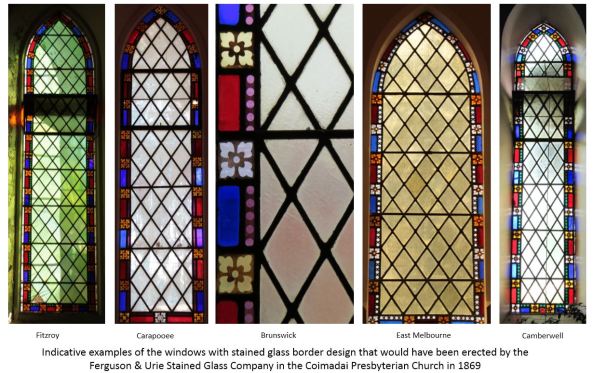
On Sunday 20th June 1869 the Church was opened with the Rev. J. Meek of Gisborne conducting the first service and apart from the religious side of the formalities the committee gave some descriptions of the building and fittings which included the leadlight windows with stained glass borders[6].

“…The church is a neat edifice of brick, occupying a prominent position close to Mr. Bower’s residence. Its dimensions are 40ft. x 20ft., with plastered ceiling and walls. At the rear are two small rooms, with fireplaces, which will be found very convenient for the use of the minister and the committee of management. There are three windows on each side filled with the usual lead lights with a stained glass border. There is also a window on each side of the entrance door and a louvre ventilator above. The angles of the building, the door jambs, and the windows, are faced with pretty freestone of the district, and altogether the building has a very neat and finished appearance…”[7]

The committee’s first annual financial statement for the Coimadai Presbyterian Church for 1869-70 indicated that the Ferguson & Urie Stained Glass Company of Melbourne was paid £19 for windows[8]. Based on the description and the cost of the glass, this leads me to believe that the windows were the company’s simple stock windows containing the simple red and blue stained glass borders with yellow or white flower alternating between each colour. These were the exact same design found in many churches and were usually the first windows to be installed and later replaced when parishioners donated memorial windows. Many of these original stock windows still exist in a small number of suburban and country churches to this day.

COIMADAI Indicative examples


Unfortunately the Coimadai Presbyterian Church no longer exists. Less than thirty years after the first service was conducted in 1869 the building was sold to the Alkemade Brothers in 1898 and was subsequently demolished to make way for a house.

“Alkemade Bros. seem to be doing well in the lime trade. One of them recently purchased the old Presbyterian church, and is now busy taking it down and I believe it is with the intention of erecting a brick villa. We shall have no other place to hold divine service in excepting the school room, which has been kindly lent by Mr. Borlase, the teacher. Week evening services are now held there by the Rev. F. H. Gibbs, which are well attended by the young people of Coimadai. The next service is to be held on August 25th. No doubt when the warm weather comes the Rev. J. A. Stuart will also assist, as in former days…”[9]

Much of the original historic township area of Coidamai is now nearly completely submerged under the Lake Merrimu Reservoir.

Significant tabloid transcriptions:

Bacchus Marsh Express, Vic, Saturday 22nd August 1868, page 2.

“A public meeting of the residents of Coimadai was held at Willow Bank on the evening of Tuesday, the 18th inst., for the purpose of taking into consideration the desirability of erecting a Church in connection with the Presbyterian cause in Victoria. The Rev. J. Scott, on taking the chair, stated the object of the meeting, and requested those present to express their views in the matter…”

The Bacchus Marsh Express, Vic, Saturday 7th November 1868, page 2.

“TENDERS ARE Requested for the erection of the Presbyterian Church, Coimadai, labour only. Bricklayer’s and carpenters work jointly or separately. Plans and specifications may be seen at the office of Mr. James Young, Bacchus Marsh. Tenders, addressed to the undersigned, Post-office, Coimadai, will be received up to 6 p.m. on Thursday, 26th inst., from whom all necessary information may be obtained. The Committee do not bind themselves to accept the lowest of any tender. DAVID D. BOWER, Hon. Sec.”

Bacchus Marsh Express, Vic, Saturday 20th February 1869, page 3.

“The Presbytery appointed the following persons as Trustees for the Church property at Coimadai – Messrs. David D. Bower, Peter Train, Malcolm Cameron, Alexander Hardie, and Hutcheson M. Allen.”

Bacchus Marsh Express, Vic, Saturday 26th June 1869, page 2.

“PRESBYTERIAN CHURCH COIMADAI.

 This place of worship was opened by Divine service being conducted in it on Sunday last by the Rev. J. Meek, of Gisborne, who preached from the text – “And the children of Israel, the priests and the Levites, and the rest of the children of the captivity, kept the dedication of this house of God with joy” – Ezra vi. 16. The sermon was highly appreciated by those who had the privilege of hearing it, and these were not few in number as many persons attended from Melton and Bacchus Marsh…”

“…The church is a neat edifice of brick, occupying a prominent position close to Mr. Bower’s residence. Its dimension are 40ft. x 20ft., with plastered ceiling and walls. At the rear are two small rooms, with fireplaces, which will be found very convenient for the use of the minister and the committee of management. There are three windows on each side filled with the usual lead lights with a stained glass border. There is also a window on each side of the entrance door and a louvre ventilator above. The angles of the building, the door jambs, and the windows, are faced with pretty freestone of the district, and altogether the building has a very neat and finished appearance…”

“…The cost of it will be about £320, of which half is contributed by grant-in-aid…”

“…On the evening of the 11th August, 1868, seven adherents of the Presbyterian Church being in the neighbourhood met, and having called you, sir to the chair, a provisional committee was nominated, whose names I may here mention were – Malcolm Cameron, Alex Hardy, Hutchinson Allen, George Greive, William McKelvie, Peter W. Train, and David D. Bower. I should state that in consequence of having the doors of the Common School closed against us for holding public worship, we felt it our immediate duty to set about erecting a house wherein we (as Presbyterians) might worship the God of our fathers. Since that date, about nine months ago, ladies and gentlemen, our respected Chairman has been holding fortnightly Sabbath services in the open air, and, I think with one exception, in the face of all weathers…”

The Bacchus Marsh Express, Vic, Saturday 13th August 1870, page 3.

“THE PRESBYTERIAN CHURCH, COIMADAI.”
“…First annual statement of the Coimadai Presbyterian Church for 1869-70…”
“…Ferguson, Urie, & Lyon, for windows, £19…”

The Bacchus Marsh Express, Vic, Saturday 6th August 1898, page 3.

“Alkemade Bros. seem to be doing well in the lime trade. One of them recently purchased the old Presbyterian church, and is now busy taking it down and I believe it is with the intention of erecting a brick villa. We shall have no other place to hold divine service in excepting the school room, which has been kindly lent by Mr. Borlase, the teacher. Week evening services are now held there by the Rev. F. H. Gibbs, which are well attended by the young people of Coimadai. The next service is to be held on August 25th. No doubt when the warm weather comes the Rev. J. A. Stuart will also assist, as in former days…”

Additional tabloid articles of interest:

The Bacchus Marsh Express, Vic, Saturday 15th April 1905, page 4.

“COIMADAI AND THE ALKEMADE HYDRAULIC GROUND LIME…”


Footnotes:

[1] The Bacchus Marsh Express, Vic, Saturday 18th November 1916, page 3.

[2] Bacchus Marsh Express, Vic, Saturday 22nd August 1868, page 2.

[3] Bacchus Marsh Express, Vic, Saturday 26th June 1869, page 2.

[4] The Bacchus Marsh Express, Vic, Saturday 7th November 1868, page 2.

[5] Bacchus Marsh Express, Vic, Saturday 20th February 1869, page 3.

[6] Bacchus Marsh Express, Vic, Saturday 26th June 1869, page 2.

[7] Bacchus Marsh Express, Vic, Saturday 26th June 1869, page 2.

[8] The Bacchus Marsh Express, Vic, Saturday 13th August 1870, page 3.

[9] The Bacchus Marsh Express, Vic, Saturday 6th August 1898, page 3.


© Copyright

1853: The Ferguson brothers arrive aboard the Tamerlane

After a jovial night at the “Robert Burns Arms Inn” at Wallacetown in early December 1852, James & David Ferguson departed their native Scotland for a new life in Australia.

The ‘Tamerlane’ departed from Greenock in December 1852 with James and David Ferguson amongst the 110 intermediate and steerage passengers. Their friend and business partner James Urie was not on the same ship but was known to have departed the day prior, yet nothing has yet been found as to which ship he was on or which port he arrived at in Australia. By coincidence, James Urie’s future brother in law, John Yeaman, was also on the ‘Tamerlane’ with the Ferguson brothers.

When James and David boarded the Tamerlane they must have known that their odds of reaching Australia alive were not favourable. In the mid-19th century nearly 1 in 5 children and 1 in 60 adults died on a voyage to Australia[1].

The Ferguson brothers would have been enticed by the many letters from their friends who had departed the old country bound for the “golden land of promise.” There would also have been mixed reports of those that were making their fortune in the Colony and those who perished at sea trying to get there. Yet they still took their chance. James would have been particularly aware of the consequences as he had the most to lose. He was leaving behind a wife and five children with the hope that they would join him once he had established the business in Melbourne ( Jane and the five children arrived aboard the ‘Emma’ in November 1855).

After four and a half months at sea the ‘Tamerlane’ eventually arrived in Port Phillip Bay on the 29th April 1853.

The Argus, Melbourne, Vic, Saturday 30th April 1853, page 4.

“April 29.- Tamerlane, ship 750 tons, Geo. Caldwell, from Glasgow December 12th. Passengers – Cabin: Mr. and Mrs. J. Robertson, Mr. and Mrs. F. Donaldson, Mr. and Mrs. D. Miller, Mrs. Wylie and child, Messrs Davidson, A. Dawson, P. Dawson, D. Fraser, McIntosh, McDonald, Newbigging, Rowley, Rowan, Shirra, A. M. Wylie, Esq., Surgeon, and one hundred and ten in the intermediate and steerage. Dickson , Gilchrist, and Co. agents.”

It was very common for literate passengers on long voyages like this to keep a diary of their once-in-a-lifetime journey to the Antipodes and there are many remarkable diaries in museums and libraries all over Australia. Unfortunately no example of a diary by any passenger of the Tamerlane to Australia in 1852-53 has yet been found during my research.

The first recorded account of the Ferguson brothers’ voyage comes five days after the arrival of the Tamerlane in Port Phillip Bay on the 29th April 1853.

The cabin and steerage passengers of the Tamerlane penned letters of gratitude to Captain Caldwell of the Tamerlane, which were published in the Melbourne Argus on the 4th of May 1853. The Cabin passengers are specifically mentioned by name as signatories to their testimonial, but the letter by those who traveled in steerage is simply mentioned as by the “Committee of the Steerage Passengers.”

The Argus, Melbourne, Vic, Wednesday 4th May 1853, page 12.

“Ship Tamerlane, May 2, 1853.

TO CAPTAIN CALDWELL,

SIR, – We, the undersigned, beg leave respectfully to present you these few lines to testify our approbation of your meritorious and exemplary conduct during the voyage, namely from Clyde to Australia. Allow us to say that you have displayed not only the abilities of a skilful commander, but the manners of a gentleman; also you have faithfully discharged your duties toward us to our entire satisfaction, and your good conduct secured to us that order and contentment which we anticipated. We sincerely wish you all success and happiness. We now bid you heartily adieu, with our thanks to Almighty God for bringing us safely to our destination, after a pleasant and successful passage across the wide ocean in the good ship Tamerlane.

For the cabin passengers.

George McDonald,
Alex Davidson,
John Shirra,
Patrick Dawson, jun,
John McKenzie, A. M.

Ship Tamerlane, Port Phillip.

To Captain Caldwell, Commanding Tamerlane.

Sir,- The steerage passengers beg to thank you for the kindness and attention shown to them during this passage. The length and tediousness of the voyage has in great degree been unfelt from the general opportunities for every kind of amusement, compatible with the situation in which they were placed, and this, they hope, without in any degree interfering with the working of the ship. In an early part of the voyage, you were kind enough to sanction the appointment of a committee of themselves, for the purpose of attending to cleanliness and order. The few regulations which the committee drew up, met your approval, and were enforced by the weight of your authority. All have felt the benefit of this arrangement, and at the same time it may have saved you from being annoyed with petty complaints, which, without doubt, would have arisen among so may crowded together in such a small place. The result of your kind indulgence, attention, and encouragement, by keeping up the spirits of all, together with strict attention to cleanliness and order, is shown in the healthy condition which all have shown during the voyage. With best wishes for your welfare and prosperity, we remain, Sir, your most obedient servants,

Signed by a Committee of the Steerage Passengers.

Report of the Ship Tamerlane, Capt. Caldwell, from Glasgow.

Sailed from Rothsay Bay, January 14th. At the Equator, February 15th. Spoke the ship Sophia Moffat, from London to Adelaide, out 32 days. February 23. Lat. 18 S., long. 25 W., barque Nepaul, from London to the Cape,last from Lisbon; out 77 days. February 27. Sir Henry Pottinger, from Liverpool to Shanghae, in lat. 24 S., long. 28W,; out 45 days. March 8. Arethusa, from Hartlepool to Ade?, lat. 27, long. 26; out 58 days. March 25. Lat 37S., long 29E, barque Halifax from London to madras; out 67 days. April 18. Barque Victor, from Swansea to King George’s Sound; out 109 days. Experienced much calm weather on the passage, and strong easterly winds off the Cape.”

The Journey:

Our pioneering ancestors took gambles with their lives just to have the chance of a new beginning in the Australian Colonies. Many of them died at sea and not even their bodies would make it to their new homeland.

In the mid 19th Century a voyage from Europe to Australia was a perilous journey of sometimes more than four months, depending on your luck with the weather. Fortunately for some, the length of the voyages were often broken by one or more port calls for provisions along the way but the last leg of the voyage to Australia would be the most grueling.

A death at sea was all too common with as many as one in five children and one in sixty adults perishing before they reached their destination. Those who died were buried at sea without delay to prevent the spread of disease. The dispatch of a body at sea was conducted quickly and efficiently. It was was sewn into a canvas sack, or if it was a crew member, his own hammock, and then weighted down with a piece of ballast to help it sink. The body was then placed on a plank and covered with the ensign of their homeland. The plank was balanced over the side of the ship and after a brief service by the Captain, (or clergy if there was one amongst the passengers), it was then tilted towards the water and the body slipped along the plank beneath the ensign and into the depths of the ocean.

Passengers in steerage would have been the most likely to succumb to disease due to the cramped, dark and unsanitary conditions below deck which was a breeding ground for disease. The lucky survivors who made it to the colony would often suffer ill health for many months after. Even on arrival at their destination the ships were often quarantined in the bay for some length of time, preventing  any passengers from going ashore and spreading any disease.

Fortunately the Ferguson brothers survived their voyage to Australia, as did James’ wife and children in 1855.

David Ferguson only lasted four years in the Colony, having decided to return to Scotland in early 1857. James Urie died in Flemington in 1890, followed by James Ferguson in 1894.

The fate of the Ferguson & Urie stained glass company was then in the hands of their sons, James Ferguson Jnr (1861-1945) and William Urie (1864-1907) until it eventually folded in 1899 after a 46 year history.

Footnotes:

[1] Web site; Museum Victoria, “Life at Sea” (accessed 21 Apr 2014)

© Copyright

1881: St Michael and All Angel’s, Porangahau, New Zealand.

The ongoing research to find extant Ferguson & Urie stained glass has revealed many of their works of art in remote locations, sometimes thousands of kilometres from the company’s workshops in North Melbourne.

The latest discovery is in the tiny township of Porangahau on the South East coast of New Zealand’s North Island. The Anglican church of St Michael and All Angels in Porangahau is now the sixth location in New Zealand found to contain an historic Ferguson & Urie stained glass window. This window is the only one known to have been created by the company as a memorial to a soldier who died in an armed conflict in the Antipodes.

Photos:  From St Michaels, Porangahau, NZ, Janice Ball, New Zealand 11th March 2014.

This slideshow requires JavaScript.

[See all attached files]

The idea for a memorial stained glass window in St Michael’s was conceived as early as 1878 when the Porangahau congregation began to raise subscriptions to build the church.

On the 22nd of July 1878 it was reported that a local land owner by the name of John Davis Canning had presented £125 towards the cost of a stained glass window to be erected in memory of his brother, Davis Canning, who fell in action at Ruatikuri during the Maori Wars on the 8th August 1868[1].

Two years later, in September 1880, a tabloid correspondent described the progress of the church construction and of the stained glass window they wrote:

“…The effect, seen when sunlight falls on it, is grand, and the chiaroscuro well defined – in fact the whole would do credit to a large old world cathedral, and is, I believe, not equaled in this colony. It is grand – more cannot be said…”[2]

St Michael’s was consecrated on Friday 11th February 1881 by the Bishop of Waiapu and the following Tuesday the Hawke’s Bay Herald described the three light stained glass window in great detail. The Ferguson & Urie stained glass company of Melbourne were explicitly mentioned as the firm who made it;

“…One great feature, internally is a large stained-glass east window, containing three lights and tracery. The subjects are the baptism of our Lord, the Crucifixion, and the Resurrection. The draperies about the figures are of the richest quality of antique glass the colors being so arranged as to blend harmoniously, while all crude or harsh coloring is avoided. The background is light grisailler work, so subdued as to make the subjects stand out prominently. On the lower panels and in the tracery are suitable emblems and monograms. The general effect is exceedingly rich and handsome. Beneath it is a brass plate bearing the following inscription:- “This window is erected by the family, in memory of Davis Canning, gent., who fell in action at Ruatikuri, 8th August, 1868 whilst leading the advanced guard,” The window is from the firm of Ferguson and Urie, Melbourne…” [3]

The precise description of the window given in 1881 matches that of the east window in St Michael’s today. The photographs taken by Janice on the 11th March 2014 leave absolutely no doubt that it is the work of Ferguson & Urie, but there is a strange anomaly with this window that appears to have gone undetected for possibly fifty years or more!

Beneath each of the biblical scenes is a reference to a chapter and verse from St Mark in the King James Bible which would aptly describe the event depicted above but the chapter and verse beneath the first two are under the wrong windows!

The reference under each window is currently shown as;

“Mark c.15 v.25” – (“And it was the third hour, and they crucified him.”) This reference is located under the first window on the left which depicts Jesus being Baptised by John in the River Jordan. Below this is the Lamb of God or ‘Agnus Dei,’

“Mark c.1 v.9” – (“And it came to pass in those days, that Jesus came from Nazareth of Galilee, and was baptised of John in Jordan”). This reference is located under the centre window depicting Christ being crucified. Below this is the Pelican in the act of self-sacrifice feeding its own blood to her young.

“Mark c.16 v.6” – (“And he saith unto them, Be not affrighted: Ye seek Jesus of Nazareth, which was crucified: he is risen; he is not here: behold the place where they laid him”). This reference is, correctly, located under the right window depicting Christ emerging from the tomb in the Resurrection. Below this is the phoenix rising.

Logically, the reference “Mark c.15 v.25” should be under the centre window depicting the Crucifixion and “Mark c.1 c.9” should be under the first window depicting the Baptism.

On the 27th Feb 2014, descendant Davis Canning wrote:

“It [the window] was completely redone (removed, repaired, releaded and reinstalled, rededicated etc) in the early 1960’s I think and was in good condition even then. I was responsible for the complete restoration of the church in 1998 and the east window was in such good condition it did not need any work done on it. I think it is still sound and has an exterior cage over it so it is not damaged by bird strike…”

The 1960’s restoration would seem to be the most likely point in time that the pieces of the window with the bible verses were re-installed in the wrong order. It could be argued as to whether the lower scenes depicting the Lamb and Pelican are also under the wrong scenes, meaning that possibly the entire lower sections of the window have been swapped.

It’s not known whether there had been any other restoration work done on the window prior to the 1960s, but most historical stained glass windows usually require some significant conservation work every fifty years or so depending on their level of exposure to the weather.

There have probably been many events in the last 130 years that could have decided the fate of this historical window. Its most recent miraculous escape from disaster occurred in December 2011 when a fire broke out in the church and destroyed the altar. Fortunately, the fire was contained to the altar space only and there was no reported damage to the window[4].

Every step of the research draws you deeper into the history of the window. It’s not just a remarkable piece of work by the Ferguson & Urie stained glass company, it has a story to tell of its own, apart from the biblical one, such as who was it dedicated to and who was the donor? There is also the remarkable coincidental link to another memorial stained glass window to the Canning brothers on the other side of the world which I’ll explain further on.

John Davis Canning (1822-1883)

John Davis Canning (1822-1883) was the donor of the stained glass window at St Michael’s in Porangahau.

He was born at Ogbourne, St Andrews, Wiltshire, in 1822 and arrived at Port Cooper (Lyttelton), New Zealand aboard the “Cornwall” on the 10th December 1851with another brother, Charles[5]. He later proceeded to Hawke’s Bay circa 1852 where he took up “Oakburne” located between Waipukurau and Porangahau.

On the 1st of July 1863, he was commissioned to the rank of Ensign in the New Zealand militia[6] and on the 4th of May, the following year was promoted to Lieutenant[7].

The years 1868 and 1869 were tumultuous times for John Davis Canning. In November 1867 his mother Elizabeth (nee Tanner) died aged 74 at Weyhill near Andover[8] and in August 1868, at the height of the Maori wars, his younger brother Davis rode off to join Colonel Whitmore’s troops in the hunt for the Hauhaus and was killed at Ruakaturi on the 8th August 1868.

Just over two weeks after the death of his brother he married Elspeth McQueen (1837-1920) at Mangatarata farmstead in the central Hawke’s Bay area.[9]

Between 1869 and 1872 John and Elspeth had three children but Elspeth became ill and was invalided back to Wiltshire for the benefit of her health. In 1881 John began to make arrangements for his return to England to visit Elspeth and in mid-February of 1881, he placed advertisements in the newspapers to sell a number of his short horn cattle, draught horses, and Cotswold rams at public auction[10]. By late March he was temporarily residing at the Hawke’s Bay Club in Napier and on the 28th of March he advertised that was looking for a suitable house in Napier for short-term lease;

“WANTED, in eligible situation, with a good view and a desirable situation on the hills, a Commodious House (furnished), with good garden and grounds, for a period of at least three months. Apply, stating particulars, to John Davis Canning, Hawke’s Bay Club, Napier. 28th March, 1881”[11]

On the 24th of October 1881 he resigned his commission as a Justice of the Peace[12] and shortly after returned to England. His health declined over the following two years and he died at Marlborough on the 20th September 1883 aged 61. [13]

“News has been received by cable of the death of Mr John Davis Canning at Marlborough, England, on Thursday last. Mr Canning was one of our earliest settlers arriving about 1855 [sic]. At one time he was in partnership with Mr John Harding in the Mount Vernon run, and on dissolving the partnership Mr Canning for some time occupied part of Mr Tiffen’s Homewood run, subsequently removing to Wallingford, where he acquired a considerable tract of native land. There he resided until he left for England, about two years ago. Mr Canning was an excellent judge of stock, and his importations, especially of shorthorns and horses, did much to improve the stock of Hawke’s Bay.”[14]

John was buried in the Ogbourne, St Andrew’s Churchyard in Wiltshire. His gravestone still exists and although the memorial text is fading with time it still can be read;

“John Davis CANNING, Who died Sept 20th 1883, Aged 61 years.”

PORANGAHAU Ogbourne St Andrews 01a

(click for full image)

In 1884 his sister Elizabeth commissioned a stained glass window to be erected in St. Andrew’s in Memory of her brothers John and Davis. Legend has it that the window in St Michael’s at Porangahau was a copy of the window in St Andrew’s in Wiltshire:

“The east window at St Michael and All Angels Anglican Church in Porangahau was given by the family in his memory and is a copy of the window in the church at Ogbourne, St Andrews…”[15]

Unfortunately, this legendary tale is not true. The stained glass window at St. Andrews in Wiltshire was erected three years after the window at St Michael’s at Porangahau in New Zealand and it doesn’t follow the same biblical theme, or resemble the figurative work in any way whatsoever.

The memorial text on a brass plaque at the foot of the Canning memorial  window at St Andrew’s church in Wiltshire reads;

“TO THE GLORY OF GOD AND IN LOVING MEMORY OF JOHN DAVIS CANNING WHO DIED SEPT 20th 1883 AGED 61, ALSO DAVIS CANNING WHO DIED AUGUST 8th 1868 AGED 39. THIS WINDOW IS DEDICATED BY THEIR SISTER, ELIZABETH MARY MOORE, A.D. 1884.”

PORANGAHAU Ogbourne St Andrews 02a

(click for full image)

The upper half of the window at St Andrew’s depicts four women representing “Fortitudo” (Fortitude), “Temperantia” (Temperance), “Justitia” (Justice), and “Sapientia” (Wisdom).

The scenes in the lower half of the window depict what I believe are four of the acts from the Corporal Works of Mercy. On the other side of the world, the Ferguson & Urie window at Porangahau in New Zealand depicts Baptism, Crucifixion, and Resurrection.

John’s wife Elspeth eventually made a full recovery in England and in the early 1890s returned to New Zealand where she resided at Napier in good health into her advanced years[16].

Elspeth died in New Zealand in 1920 at the age of 86[17].

Davis Canning (1829-1868)[18]

The Ferguson & Urie stained glass window in St Michael’s is a memorial to Davis Canning, the younger brother of John Davis Canning.

When Davis actually arrived in New Zealand is not known, but can reasonably be assumed to be 1852 or later. His brothers John and Charles arrived aboard the “Cornwall” from England in December 1851 but Davis was not listed as a passenger on the same ship with them.

Davis resided at “Oakburne” near Porangahau with his brother John. At the age of 39 he was described as a “young man full of adventure.”[19] It was probably inevitable that this adventurous spirit would lead him to joining the militia. Sometime in late September or early August 1868 he rode off and joined Colonel Whitmore’s government forces to fight against the Hauhaus led by the Maori rebel “Te Kooti Arikirangi Te Tūruki.”

On the 8th August 1868, during a battle at Ruakituri, Davis Canning and a Captain Oswald Carr were shot dead[20];

“…On the 8th the force was well up the gorge-like valley of the Ruakituri, and the advance-guard led by Mr. Davis Canning, a gallant settler from Hawke’s Bay, was hot on the trail of the Hauhaus, who were heard shooting pigeons in the distance. Early in the afternoon Captain Carr (Hawke’s Bay), who had been an officer in the Royal Artillery, reconnoitered through the bush along the river-bank, and reported that the Hauhaus were halted a short distance up the river. The swift and ice-cold river was forded several times and the European and Maori force advanced to the attack. Captain (afterwards Colonel) Herrick with part of the force moved on to take the Hauhaus in flank and reverse, and when his men were in position Whitmore directed the advance-guard to push forward. It was soon driven back, leaving both Canning and Carr dead on the field. The former was shot dead while gallantly leading the men…”[21]

Ten years later, in July 1878, his older brother John Davis Canning subscribed the amount of £125 towards a stained glass window to be erected in memory of his brother in the yet to be erected St Michael’s Church at Porangahau[22]. In September of the same year the Hawke’s Bay Herald reported something similar but with a differing cost for the window;

“…J. D. Canning, Esq., of Oakbourne, has given a superb stained glass window of the value of £150…”[23]

St Michael’s was consecrated by the Bishop of Waiapu in 1881 and the Ferguson & Urie stained glass window to the memory of Davis Canning still exists to this day.

Beneath the window is a brass plaque inscribed:

“This window is erected by the family, in memory of Davis Canning, gent., who fell in action at Ruakituri, 8th August, 1868 whilst leading the advanced guard.”

Another memorial to Davis appears at Ruakituri Cemetery Reserve near Wairoa. A brass plaque is mounted on a rock cairn in memory of Davis Canning[24] and Canning family lore has it that this plaque went missing after a flood in the late 1800’s and was missing for over a century until being found in the 1980’s-90’s in a creek bed two miles away.

The plaque has the wording:

“IN MEMORY OF DAVIS CANNING, KILLED IN ACTION 8th AUGUST 1868”.
“NE CEDE MALIS SED CONTRA”
[25]

(Latin: “Yield not to misfortunes, but advance all the more boldly against them”)

Significant historical newspaper  transcriptions:

Hawke’s Bay Herald, NZ, Vol 12, Issue 969, 15 August 1868, page 3.

“IMPORTANT FROM THE FRONT. SEVERE ENGAGEMENT BETWEEN FORCES UNDER COL. WHITMORE AND EX PRISONERS…

…We deeply regret to add that among the killed were Capt. Carr of Petane and Mr. Davis Canning, two esteemed settlers of this province…”

Star, NZ, Issue 97, 4th September 1868, page 3.

“…The advance guard, comprising several of the armed constabulary, and led by Captain Carr and Mr. Canning, advanced to the front of the enemy’s lines and were on the eve of carrying the position when the hau-haus poured in a hot fire, which forced them to take cover. The action then commenced hot on both sides; and in another attempt to charge the position, Mr Canning and Captain Carr lost their lives…”

Hawke’s Bay Herald, NZ, Vol XXI, Issue 5133, Monday 22nd July 1878, page 2

“Our Porangahau correspondent writes: – The need of a church has long been felt and numerous gentlemen having promised subscription to the amount of £365, it is hoped that the good work will speedily be accomplished. It is proposed that the sum of £600 be collected for the above purpose, exclusive of the sum of £125 presented by J. D. Canning, Esq., of Oakbourne, for a stained glass window, in memory of his brother, the late Mr Davis Canning. A series of concerts are to be given for the purpose of raising funds to furnish the sum required. The following gentlemen have already subscribed:- J. Nairn, £100; George hunter, £50; J. D. Ormond, £50; Rev S. Williams, £50; A. St. Hill, £10; J. White, £50; T. Spencer, £5; Trust Fund, £50. Total £365.”

Hawkes Bay Herald, NZ, Vol XXI, Issue 5792, 13th September 1880, page 3.

“PORANGAHAU

[FROM AN OCCASSIONAL CORRESPONDENT]

WAINUI, September 10.

By favour I was permitted to see the memorial window which has just been put in at the Porangahau Episcopalian Church, now in course of erection. As I understand, it was presented by Mr John D. Canning, of Oakbourne, in memory that gentleman’s late brother, Mr Davis Canning, and as a work of art it does great credit tothe artist, and as much to the selector of the design. It is in the mediaeval style, Gothic, with teinte brilliante of the Rennaissance. The effect, seen when sunlight falls on it, is grand, and the chiaroscuro well defined – in fact the whole would do credit to a large old world cathedral, and is, I believe, not equalled in this colony. It is grand – more cannot be said.
Although the church is by no means finished, yet, as far as the work has gone, it is a great credit to the contractor, Mr Holt, of Napier, and also to his foreman of works, Mr. Wm. Smith, for, though I am no judge of builder’s work, I profess to distinguish between conscientious, well finished, straight forward labor, and work done in a slovenly style – and the former is the case with the church. As far as it is finished the work is solid, and, what is more, the acoustic properties promise to be good. To sum up, the work, when finished, will be, and ought to be, a credit to so small a place as Porangahau.”

 Hawke’s Bay Herald, Vol XXI, Issue 5906, 15th February 1881, page 3.

 “CONSECRATION OF PORANGHAU CHURCH.

 On Friday last the new church at Porangahau was consecrated by the Right Rev. the Bishop of Waiapu. The design of the building is striking. It consists of a nave, chancel, tower with spire, and a commodious vestry. It is seated for 100 persons, but there is space for additional seating accommodation when required. One great feature, internally is a large stained-glass east window, containing three lights and tracery. The subjects are the baptism of our Lord, the Crucifixion, and the Resurection. The draperies about the figures are of the richest quality of antique glass the colors being so arranged as to blend harmoniously, while all crude or harsh coloring is avoided. The background is light grisailler work, so subdued as to make the subjects stand out prominently. On the lower panels, and in the tracery are suitable emblems and monograms. The general effect is exceedingly rich and handsome. Beneath it is a brass plate bearing the following inscription:- “This window is erected by the family, in memory of Davis Canning, gent., who fell in action at Ruatikuri, 8th August, 1868 whilst leading the advanced guard,” The window is from the firm of Ferguson and Urie, Melbourne. The services on Friday were three in number, those in the morning and evening being attended by the European settlers, that in the afternoon by the Porangahau natives. The Bishop preached in the morning, and the Rev. De Berdt Hovel in the evening. The Revs’ S. Williams, J. Shearman, and F.E.T. Simcox (the incumbent of the parish) were also present and took part in the ceremonies. The offertories amounted to £31. The church, which is dedicated to St. Michael, was designed by Mr B. W. Mountfort, of Christchurch, the contractor for the work being Mr Robert Holt, and the builder Mr W. Smith, of this town. The building reflects great credit on all concerned in its arection, [sic] and is by far the prettiest ecclesiastical edifice to be seen in the country districts of Hawke’s Bay. The furniture is exceedingly good of its kind, the silver fount [sic]having been given by Mr. J. Nairn, of Pourerere, and the embroidered chancel mat by Mr C. A. M. Hirtzel. The site upon which the church stands was presented by Mrs T. Crosse, of Mangamari.”

Dominion, NZ, Vol 4, Issue 1031, 21st January 1911, page 16.

“Oakburne,” the residence of Mr. Davis Canning, is one of the prettiest homesteads on the road between Waipukurau and Porangahau. It lies a few miles past Wallingford, and on an eminence which admits of a splendid view of the surrounding country. At the back of the residence is a fine plantation of pine trees, while farther down is a big orchard of six hundred trees, some of which are over forty years old. The name of Canning is inseparably linked with the agricultural and pastoral history of Hawke’s Bay. Mr. John Davis Canning, father of Mr. Davis Canning, was one of the early stock-breeders in the district when there were few such, and it is he who gave a lead in the system of using nothing but the best stock. He was one of the exhibitors at the first agricultural and pastoral show held at Havelock North, and he specialised not only on Short-horn cattle and sheep, but also in horses, pigs, sporting dogs, and fowls. A man of very broad and enlightened views, and with an earnest sympathy, which endeared him to all who had the good fortune of his acquaintance, John Davis Canning is described by contemporaries as one of the finest types of the pioneer settlers who built their homes out in the wilderness. In his early days he was a colleague of the late John Harding, of Mount Vernon, and was employed by that equally strenuous pioneer some time in the fifties. Mr. Canning came to New Zealand in 1851, in the good ship Cornwall, and he took up “Oakburne,” about half a century ago, and held big Native leasehold sections, which aggregated 40,000 acres. He was married in 1868 to a daughter of Mr. McQueen, of Inverness. A bereavement clouded the happy memories of his first years of married life at “Oakburne,” It was in 1867 or 1868 and the Maori troubles were blazing in their insurrectionary outbursts. Davis Canning, who resided at “Oakburne” with his brother, was a young man full of adventure. He was smitten with the fever, and one evening rode away with a captain’s commission, through to Napier and on to Poverty Bay, where he was shot dead with Captain Carr at Ruakaturi. It appears that both he and Captain Carr were the victims of their own rashness, and in these days of militarism and threatened war it is interesting to record in what a simple manner two lives were thrown away.

Mr. John Davis Canning.

It is interesting to record some further particulars of Mr. John Davis Canning. He was born at “Ogbourne,” St Andrew, Marlborough, Wiltshire, England, in the year 1822, and was the son of the late M. Davis Canning. The Cannings of “Ogbourne” and of “Oakbourne,” in Hawke’s Bay, are a branch of an old English family of which Lord Canning, a former Viceroy of India, was a member. Mr. John Davis Canning was educated in his native place. He landed first at Lyttelton, and then came up to Hawke’s Bay, where he afterwards selected the present fine property. He introduced the Cotswold variety of sheep, and spent lavish sums of money on good stock. Amongst his horse importations was the draught stallion Dugdale, said to be the finest of his class. In 1883 Mr. Canning went to England to see his wife, who had been invalided there, but the trip resulted in his death. It is satisfactory to record in the face of this severe bereavement that Mrs. Canning regained her health some eight years later, that she returned to New Zealand, and that she now resides in Napier, in very good health.

Mr. Davis Canning.

Mr. Davis Canning, the present owner of “Oakburne,” was borne there, but was educated at the Marlborough Grammar School and at Clifton College, where formerly, by the way, Mr. James Allan, M.P., received some of his first instruction. Mr. Canning went to Clifton College in 1885, and left in 1891. He was an enthusiastic out-door sportsman, and got his cap both for football and cricket, and still takes a keen interest in those pastimes. After leaving England he resided for a time at Hastings, “Oakburne” having been leased, but when the lease expired he returned to his home, and took up the study of farming and agricultural matters with the same keen interest which was evidenced in such a marked degree by his father…”

Acknowledgements:

My thanks to:

My cousins Janice and Cleeve Ball for following up on the clues in New Zealand and undertaking the long trip to Porangahau to meet the Canning descendants and photograph the window.

To Davis Canning for the email correspondence and additional clues on the Canning family history in the Hawke’s Bay New Zealand.

To Duncan & Mandy Ball in England for the correspondence and photos from Ogbourne, St Andrew’s, Wiltshire.


Footnotes:

[1] Hawke’s Bay Herald, Vol XXI, Issue 5133, Monday 22nd July 1878, page 2.

[2] Hawkes Bay Herald, Vol XXI, Issue 5792, 13th September 1880, page 3.

[3] Hawke’s Bay Herald, Vol XXI, Issue 5906, 15th February 1881, page 3.

[4] Hawke’s Bay Today, NZ, On-line edition, Saturday 24th December 2011.

[5] Lyttelton Times, NZ, Vol 1, Issue 49, 13th December 1851, page 5.

[6] Hawke’s Bay Herald, NZ, 27th Jul 1863, page 1.

[7] Hawke’s Bay Herald, NZ, Vol 7, Issue 494, 28th May 1864, page 4.

[8] Nelson Evening Mail, Volume III, Issue 27, 1 Feb 1868, page 2.

[9] Evening Post, NZ, Vol IV, Issue 175, 5th September 1868, page 2.

[10] Daily Telegraph, Issue 3009, 16th February 1881, page 3.

[11] Hawke’s Bay Herald, Vol XXI, Issue 5933, 29th March 1881, page 1.

[12] Daily Telegraph, Issue 3219, 24th October 1881, page 2.

[13] Daily Telegraph, Issue 3804, 20th September 1883, page 2.

[14] Hawke’s Bay Herald, Vol XXI, Issue 6662, 25th September 1883, page 2.

[15] Matatoa: Fathers & Sons, Hilary Pederson, Te Hanganui Partnership 2011.

[16] Dominion, NZ, Vol 4, Issue 1031, 21st January 1911, page 16.

[17] NZ BDM record 1920/5550.

[18] Date of birth 11th July 1829: From Canning family bible. (detail from descendant Davis Canning , via email Janice Ball 26 Feb 2014)

[19] Dominion, NZ, Vol 4, Issue 1031, 21st January 1911, page 16.

[20] Hawke’s Bay Herald, Vol 12, Issue 969, 15 August 1868, page 3.

[21] The New Zealand Wars: A History of the Maori Campaigns and the pioneering Period: VoL II: The Hauhau wars, (1864-72), Chapter 25.

[22] Hawke’s Bay Herald, Vol XXI, Issue 5133, Monday 22nd July 1878, page 2.

[23] Hawke’s Bay Herald, Vol XXI, Issue 8192, 30th September 1878, page 2.

[24] http://www.mch.govt.nz/nz-identity-heritage/national-monuments-war-graves/list-historic-graves-and-monuments

[25] http://www.mch.govt.nz/nz-identity-heritage/national-monuments-war-graves/list-historic-graves-and-monuments


Short link to this page: https://wp.me/p28nLD-2nE

© Copyright

1870: The Convent of Mercy, Albury, New South Wales.

The Convent of Mercy at Albury, New South Wales, has remnants of original Ferguson & Urie stained glass. The main entrance doors originally contained the figures of St Bernard and St Bridget with the Virgin and child in the window above the doorway.

The convent was formally opened on the 4th February 1870 by the Bishops of Bathurst and Maitland and the Freemans Journal of 19th February published very a detailed account of the proceedings.

In December 2013 Fr. Joel Wallace sent me some photos of the entrance windows and the stained glass above the doorway appears to be the most intact. The St Bridget window in the right door panel looks to have had multiple fractures over the last 144 years and there is evidence of many additional lead lines introduced to arrest the past damage. The St Patrick window in the left doorway unfortunately no longer exists.

Photos were kindly supplied by Fr. Joel Wallace, 13th December 2013.

This slideshow requires JavaScript.

Freeman’s Journal, Sydney, NSW, Saturday 19th February 1870, page 10.

“OPENING OF THE CONVENT OF MERCY, ALBURY”
(From a Correspondent)

“On Friday, the 4th February, their Lordships the Bishops of Bathurst and Maitland arrived in Albury to formally open and bless the Convent of Mercy…”

“…On Sunday the 6th the ceremony of opening and blessing the Convent took place, an event marking a new era in the Catholic history of this important and fast rising town not soon to be forgotten…”

“…Entering the hall under the verandah arches, the visitor is struck with the magnificent appearance of the stained glass in the upper panel of doors and fanlights over. In the centre of fanlight is a splendid medallion representing the Blessed Virgin and Child; on one side of the medallion the monogram of St. Bernard, on the other I.H.S. In one panel of the doors a full length figure of ‘St. Bridget,” whose name the Convent bears, the other panel the figure of St. Patrick, both in elaborately wrought canopies. The glass is from the manufactory of Messrs. Farguson [sic], Urie, and Lyon, of Melbourne, on whom it reflects great credit…”


Short link to this page: http://wp.me/p28nLD-2m1

© Copyright