08-06-1881: Holy Trinity Church, Kew, Victoria.

The Australasian Sketcher with Pen and Pencil, Saturday 8th June 1881, page 198.

“INTERIOR OF HOLY TRINITY CHURCH, KEW”.

“The first stone of this church was laid about 20 years ago. It was originally designed to accommodate 400 persons, and then consisted of a nave, a small apsidal chancel, a robing-room and tower (which is still uncompleted), and a south porch. The church is built of bluestone, with white stone dressings. The style selected is early English, about the turn of the 13th century. The nave is covered with a hammer-beam roof having a span of 30ft. 6in. Owing to the increase in the population of the district, and the consequent demand for additional sittings (a demand that was not foreseen when the church was originally designed) it was determined by the church committee abut eight years ago to enlarge the church so as to accommodate 200 additional persons, and after due deliberation it was decided to obtain this accommodation by taking down the old chancel and a portion of the nave, and adding two transepts, a chancel large enough to accommodate the choir and organ chamber on the south side of the chancel, and a vestry on the opposite side. The plan of the building, therefore, as now completed, is cruciform, of which the following are the principal dimensions:- Chancel, 24ft. long by 21ft. wide; nave, 91ft. 6in. long by 36ft. 6in. wide; transepts, each 22ft. long by 28ft. wide. The pulpit, reading desk, choir seats, and pews throughout are all of cedar. In the west end is a fine stained glass memorial window to the late Prince Consort, executed by Messrs. Ferguson and Urie. The internal plastering, carving of the corbels, and the erection of an additional vestry have just been completed. A new organ has also recently been erected at a cost of about £500. The altar is furnished with a handsome frontal, presented by the ladies of the congregation, embroidered in gold and coloured silks by Mrs. Samson, of East Melbourne. The belfry chamber of tower, and the spire (which would complete the church), are not to be carried out at present. The plans, &c., have been furnished by Mr. Barret, of the P.W.D., who made the original designs for the building. The incumbent of he church is the Rev. Canon Vance.”

The Prince Consort (west) window was restored in 2009. The original three light chancel window by Ferguson and Urie now resides in the south transept and has the makers name “Ferguson & Urie” in the lower right corner.

The photos were taken 02/01/2011. Included in the photos is one of the original sketch design for the chancel window circa April 1863.

This slideshow requires JavaScript.

Related posts: 03-04-1863 > 24-03-1864 > 29-04-1864 > 13-08-1867

04-10-1881: Christ Church, South Yarra, Melbourne, Victoria

The foundation stone for Christ Church at South Yarra was laid on Saturday 26th April 1856 by Major General Macarthur[1] .Further enlargements were conducted in the following years and the new North Aisle was opened on Thursday 22 August 1889[2]. The three windows in east wall of the sanctuary were created by Ferguson & Urie and depict the crucifixion, in the centre, mother Mary in the left window and what I believe is Mary Magdalene in the right window. There are three other individual windows by Ferguson & Urie installed at later dates. The two in the south wall of the sanctuary were installed in March 1882, and depict St Peter & St John converting converts at Samaris and the other is Christ  commissioning St. Peter. In the north transept is a memorial window to ‘Justice Thomas Howard Fellows’ depicting the Good Samaritan.

Photos taken 25th March 2012. All six windows are included in the slideshow.

This slideshow requires JavaScript.

The Argus, Melbourne, Tuesday 4th October 1881, page 6.

“ENLARGEMENT OF CHRIST CHURCH SOUTH YARRA. …”

“… At the eastern end has been added a sanctuary of very pleasant proportions, lighted by three dwarf windows, in which there will be stained glass …”.

Justice Thomas Howard Fellows had long associations with the Queenscliff congregation and had, in 1866, donated the magnificent east window of St Georges Church in Queenscliff, and the Twelve Apostle windows in the nave, which were also crafted by Ferguson & Urie.

On the 12th April 1938 the Argus reported[3] (in relation to Christ Church South Yarra) “Historic Church may have to be closed …”. Obviously this never eventuated.

Related posts:

17-03-1882: Christ Church, South Yarra.

07-04-1882: St George’s Church, Queenscliff.

29-01-1866: St Georges Church Queenscliff.

Footnotes:

02-01-1882: Church donations.

The Argus. Melbourne, Monday 2nd January 1882, page 7.

St John’s Anglican Church Toorak, Victoria.

“THE ANGLICAN CATHEDRAL […]”

“The following additional promises and payments have been received at the Diocean Registry:[…]”

“[…]Messrs Ferguson and Urie £3.3[…]”

Over many years Ferguson & Urie made liberal donations to many institutions and churches. Although they were staunch Presbyterians they made no distinction between the faiths when it came to charitable donations.

30-12-1893: St Georges Church Queenscliff, Victoria, Australia.

Charles Cheney Simpson (1835-1892) was born in Derbyshire in 1835, the son of Edward Lloyd Simpson and Maria Cade.

He arrived in Melbourne on the Angelsey in December 1856 at the age of 20. He came to Queenscliff in 1859 and in 1861 married Rebecca Jane Vary (1844-1929) at St Paul’s church in Geelong.

He established himself in Queenscliff as a Chemist opposite the current Queenscliff museum in 1862 and was an avid diarist, photographer, Mason, and treasurer of St George’s Anglican Church. He was elected Mayor of Queenscliff for the period 1882-83.

He died at Queenscliff on the 23rd of December 1892 aged 57 and was buried in the Queenscliff cemetery. In late 1893 a stained glass window to his memory was created by Ferguson & Urie Company of North Melbourne and unveiled in the St George the Martyr church in Queenscliff on Sunday 24th December 1893. Their only child Charles Edward died in September 1879 at the age of 17. His wife Rebecca died in July 1929 aged 85.

Photos were taken 25 September 2010.

This slideshow requires JavaScript.

[View larger images]

Queenscliff Sentinel, Drysdale, Portarlington & Sorrento Advertiser, Saturday 30th December 1893, page 1.

“The window representing St. John the Baptist made by Ferguson and Urie appeared in St. George’s Church on Sunday last and was much admired. Many of Mr C C Simpson’s old friends, and some of the Masonic brethren,

(un-readable line here)

preached by the Rev J H Gregory, which alluded to Mr Simpson in the following terms – “The effigy which represents the Herald of Christ appears for the first time in the window of this church today. It is put up in memory of an esteemed member of this community and of this congregation, Charles Simpson, whom I knew well. I may be permitted to say that our excellent friend resembled the Baptist in one particular, in constantly speaking the truth, and, without which speaking the truth is valueless, in doing the truth. He was for many years manager and treasurer of church affairs. In this capacity he displayed untiring industry, and he also manifested an extreme conscientiousness which would not suffer him to let the church promises and engagements remain for a single day unfulfilled. Requiescat in peace.”

 Queenscliff Sentinel, Drysdale, Portarlington & Sorrento Advertiser, Victoria, Saturday 24th December 1892, page 1.

 “Death of Mr Charles C. Simpson.

 It is with deep regret we record the death of Mr. C. C. Simpson. Although he had been ailing for some time, a fatal termination to his illness was not feared, as he had purchased tickets for trip to New Zealand. But within the past few days serious symptoms set in, and yesterday afternoon he closed a life of usefulness in connection with local affairs which will scarcely be replaced. Born in 1835, Mr Simpson was a native of Derby in England. In 1859 he came to Queenscliff, and started in business as a druggist. His ability was soon appreciated, for shortly after his arrival here he was elected a councillor of the borough, which position he held for 20 years. During that time he was made mayor, and interested himself strenuously in the improvement of the Public Reserves. Appointed Justice of the Peace, he unremittingly fulfilled his duty with care and marked intelligence. But Mr. Simpson, whose death we deplore, was an all round man. Whether as a councillor or in any other capacity, Queenscliff was his home and heart. He lived in and for Queenscliff. Whatever he undertook seemed to prosper in his hands – Library, Church, Bowling Green, and anything else, all were successful, if he gave it his attention. Whether on the magisterial bench or at local meetings, in his own business or anything which had for its end the advancement of the town, his energy was never failing. We must make special mention of the unceasing interest he took in the Public Library. In this respect we scarcely know where to look for his successor. But all the public institutions of the borough will miss his intelligent mind and marked business capacity, especially in the matters of finance. In the death of Mr. Charles C. Simpson, Queenscliff has lost an able man, and we trust that his worth may not be wanting in the younger generation”.

The Sentinel, Queenscliff, Saturday, December 31, 1892, page 1.

“The funeral of Mr C. C. Simpson took place on Sunday and was largely attended. A Masonic service was held in the Lodge room, and then the brethren adjourned to St. George’s, where the coffin was laid in the chancel. Here and at the grave the Rev. H. J. Wilkinson conducted the services. As the procession left the church the sight was a very impressive one, the Masons heading the cortege. A large number of Freemasons belonging to Geelong Lodges were present. The funeral procession was one of the largest ever seen on Queenscliff”.

Related posts:
22-02-186429-01-186613-08-186712-02-1881 07-04-1882 >18-10-1884


Short link to this page: https://wp.me/p28nLD-uT

© Copyright

07-04-1882: St George’s Church, Queenscliff, Victoria.

Launceston Examiner, Tasmania, Friday 7th April 1882, page 3.

“A good story is told me of the late Judge Fellows. The deceased gentleman always took a warm interest in the Anglican Church at Queenscliff, and he sat there one Sunday listening to a long and prosy sermon. A gentleman sitting in a pew behind the great lawyer noted that His Honor was glancing round at the windows, after which he heard him mutter “Twelve, twelve, oh, twelve Apostles, by Jove!” Not long afterwards Mr. Fellows presented a dozen stained glass windows to the little church.”

Photos taken: 6th Jan 2012.

This slideshow requires JavaScript.

Photos of the twelve Apostles are shown first, being: ST BARTHOLEMEW, ST THOMAS, ST JAMES THE LESS, ST PHILIP, ST SIMON, ST JUDE, ST ANDREW, ST JAMES THE ELDER, ST PAUL, ST PETER, ST JOHN, ST MATTHEW. Then photos of all the other Ferguson & Urie windows are shown.

The Church of England Messenger, 2nd December 1878, page 5.

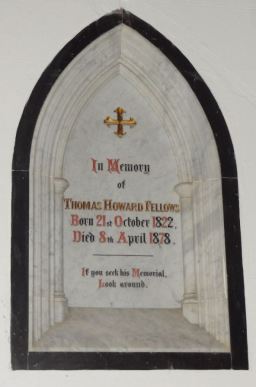
QUEENSCLIFF,- The tablet in memory of the late Mr. Justice Fellows has, during the last week, been erected in St. George’s Church, Queenscliff, to the left of the pulpit, and over the seat he formerly occupied. Mr. Clement Nash, of Geelong, is the sculptor. The tablet is of white marble, with St. George’s Cross in the apex of the arch, and has a margin of black slate 1-in. in width, and bears the following inscription:- “In memory of Thomas Howard Fellows, born October 21st. 1822; died April 8th, 1878. If you seek his memorial, look around.” The letters are black and red, with the exception of the name, which is in gold. The cost of the tablet is about £40, and has been defrayed by subscriptions from inhabitants of Queenscliff and visiting members of the church.”

"In Memory of Thomas Howard Fellows Born 21st October 1822, Died 8th April 1878. If you seek his Memorial, Look around".

“In Memory of Thomas Howard Fellows Born 21st October 1822, Died 8th April 1878. If you seek his Memorial, Look around”.

Despite Justice Fellows donating the great east window and the Twelve Apostle windows in the nave of St George’s, there is no stained glass window in the church as a memorial to him.

In 1881 a window was erected in his memory in Christ Church South Yarra.

Related posts:
22-02-186429-01-186613-08-186712-02-1881 07-04-1882 >18-10-1884 > 30-12-1893

External links:

Biography: Thomas Howard Fellows (1822-1878)

Obituary: Justice Fellows. The Argus, 9th April 1878, page 5

Conservation: The majority of the Ferguson & Urie windows at St George’s Church at Queenscliff were restored or have had conservation work by Bruce Hutton of Almond Glass between 2006-2012.

Below is my rudimentary YouTube video of St George’s windows taken with an iPhone 3GS on 6th January 2012.


Short link to this page: https://wp.me/p28nLD-uQ

© Copyright

12-02-1881: St George’s Church, Queenscliff, Victoria.

The Australasian Sketcher, Melbourne, Saturday 12th February 1881, page 54.

“ST. GEORGE’S CHURCH, QUEENSCLIFF”

“THE church of St. George, Queenscliff, was begun to be built at the end of 1862 through the energy of Dr. Williams, the recent Government health officer at Queenscliff. It was completed in 1863, and opened for divine worship in January, 1864, by the Rev. R. Cummins, of St. Paul’s, Ballarat […]”

“[…] The chancel window is of stained glass, and is illustrative of a portion of the Litany, each pane bearing underneath it the words of some appropriate quotation. It consists of 15 panes […]”

“[…] There are 12 stained glass windows dedicated to the Twelve Apostles, with suitable texts from the Epistles over each […].”

All the stained glass windows in St. Georges were made by Ferguson & Urie between 1864 and 1892. Two windows in the vestry built in 1958 has Derek Pearse windows installed in 1995.

The related posts links below show many of the Ferguson & Urie windows.

Related posts:
22-02-186429-01-186613-08-186712-02-1881 07-04-1882 >18-10-1884 > 30-12-1893


Short link to this page: https://wp.me/p28nLD-uO

© Copyright

07-05-1880: St. George’s Presbyterian Church, St. Kilda East, Victoria.

St George’s Presbyterian East St Kilda opened for divine service on Sunday 3rd October. This was the second opening of the church after extensions. It includes the burning bush window in the north transept. All other windows were also made by Ferguson & Urie.

The Argus, Melbourne, Friday 7th May 1880, page 5.

“The foundation-stone of the enlargement of St. George’s Presbyterian Church, St Kilda East, will be laid at 4 o’clock this afternoon by Sir James McCulloch, in presence of the moderator and other leading clergy of the General Assembly. This church is little more than three years old. Since the arrival from England of its first clergyman, the Rev. J.L. Rentoul, M.A., in June of last year, the building has become overcrowded, and it is now to be enlarged to twice its present size. The nave is to be extended, and chancel and transepts added. The organ chamber will be at the end of the south transept. The chancel will have a beautiful stained-glass memorial window, the gift of lady McCulloch.”

The Australasian Sketcher with Pen and Pencil, Melbourne, Saturday 23 October 1880, page 278.

“… All the windows are filled with stained glass by Ferguson & Urie, the principal windows being gifts from friends of the church…”
“…This church was commenced in 1877, the memorial stone being laid by Sir James McCulloch on 21st April in that year…”

A considerable number of the original Ferguson & Urie windows still exist in St George’s and these are all included in the slideshow.

Photos taken: 6th March 2011.

This slideshow requires JavaScript.

An interesting coincidental note:

The son of the Rev John Laurence Rentoul, John Noel Rentoul, married James Ferguson’s granddaughter, Elsie May Auld, in 1911. Elsie was my Great Grandmothers sister.

RENTOUL Elsie May Auld - John Noel Rentoul 01a

RENTOUL:  Elsie May Auld &  John Noel Rentoul, married Melbourne 1911

External links:

Biography: Sir James McCulloch (1819-1893)

Biography: Rev John Laurence Rentoul (1846-1926)


Shortlink to this page: https://wp.me/p28nLD-tR

© Copyright


03-09-1879: Presbyterian Union Memorial Church, Curzon Street, North Melbourne.

The North Melbourne Presbyterian Church was initially founded in 1854 and the congregation used a temporary iron building until a new bluestone church was erected, the foundation of which was laid by Sir Henry Barkly on Friday the 8th of April 1859[1].

In less than twenty years the church was deemed too small for the growing congregation and plans were afoot to build a new one. The local Brunswick architect Evander McIver was selected as the preferred designer and it was officially opened on Sunday 31st August 1879[2]

Diagonally opposite the church was the Ferguson & Urie stained glass workshops, and it was this firm that the architect Evander McIver chose to create the entire cycle of stained glass windows for the church. As at 2012 the original stained glass workshops building still exists as number 42 Curzon Street but only the facade of the workshop is recogniseable.

Above the Apse of the Union Memorial church is a stained glass wheel window with an outer border of red and blue with a flower separating the alternating colours . The central roundel depicts the motto of the church of Scotland, the “Burning Bush” with the text “nec tamen consumebatur” (‘Yet it was not consumed’). The outer eight lobes surrounding the Burning Bush depict the four reformers and founders of the Presbyterian Church, Martin Luther, John Calvin, John Knox and Alexander Henderson. Each is separated by a roundel with the a geometric trefoil design in the centre. Flanking the wheel window are two single light lancet shaped windows depicting on the left  “The Good Shepperd” and on the right, “Suffer Little Children”.

The Church is closed for renovation as at 2012 and the windows are in storage. The Elm street Hall, located at the rear of the church, is the original church and was removed and re-erected a short distance to the rear to make way for the new 1879 church.

Chancel window Photographs by Adam Cawood (2004) with permission from the Congregation of Mark the Evangelist. Taken for the Sesquicentenary in 2004.

This slideshow requires JavaScript.

As early as 1871 the old Presbyterian Church was the target of vandals and the article below provides an account of the damage to its stained glass windows. Whether the windows in this original church were made by Ferguson & Urie is not known but the Ferguson & Urie stained glass workshop was only across the street facing the church from circa 1860.

The Queenslander, Brisbane, QLD, Saturday 16th September 1871, page 9.

“THE MELBOURNE Age, in a recent issue, reports the following monstrous outrage:—”Last evening, whilst Divine service was being conducted in the Presbyterian Union Church, Hotham, a stone was launched with considerable violence through one of the large stained glass windows in the midst of the congregation. The Rev. A. D. Kinninmont, who was at the time delivering his discourse, remarked that during his thirty years’ experience as a minister of the gospel he never before witnessed an act like this in a civilised community. The church officer and one of the managers immediately made their exit, where they beheld about a dozen half grown men, who scampered away in every direction.”

In 1879 the new Church has been erected and, as expected, the Ferguson & Urie company provided all the glazing for the church.

The Argus, Melbourne, Wednesday 3rd September 1879, page 3.

“NEW PRESBYTERIAN CHURCH, HOTHAM.”

“The new Union Presbyterian Church at Hotham, which was opened for public worship for the first time on Sunday last, forms a prominent and handsome feature in architecture of the town…”.

 “… The church is well lighted from sides and front, with large windows filled with cathedral glass and stained margins, while there are three very handsome memorial windows at the rear end of the church, which are perhaps the most striking features of the edifice. The centre one is a large circular window, alternately filled with floras, and containing the medallions of the reformers, Martin Luther, John Knox, John Calvin, and Alexander Henderson. Another of the stained glass windows has representation of “Christ blessing little children,” with the companion text, “He carrieth His lambs in His arms, and folds them in His bosom …”.

 “…Messrs. Ferguson and Urie executed all the glazing…”

The Argus, Melbourne, Wednesday 15th January 1879, page 6

“UNION MEMORIAL CHURCH, NORTH MELBOURNE.

The congregation attending the Presbyterian Church in Curzon street, Hotham, the foundation stone of which was laid by Sir Henry Barkly in April, 1859 having for some time past felt the need of a larger and more commodious building, determined upon raising the necessary funds for the erection of a new church. Their efforts happily proved successful, and the memorial stone of the new church was laid yesterday afternoon by Mr. James MacBain, M.L.A, in the presence of a large number of spectators. The proceedings were commenced by the suiting of five verses of a metrical version of the 102nd Psalm. The Rev John Clark of Williamstown, then read a chapter from the Book of Kings, descriptive of the manner in which the Temple of Solomon was built. Prayer was offered by the Rev John Cooper of Coburg, and a hymn was sung, after which Dr Gilchrist presented Mr MacBain with an elegantly chased silver trowel, bearing the usual inscription, and a mallet similarly inscribed, and formally requested him to lay the stone. The stone having been declared to be well and truly laid, Mr. MacBain delivered an address congratulating the congregation on the courage they bad displayed in undertaking to build such a large church, which would, when erected, be at the same time an ornament to the town of Hotham, and a credit to the denomination. He was entitled to say that the Presbyterian Church of Victoria had always been a missionary church, and he hoped and believed that the pastor of the church the, the Rev. Dr. Gilchrist, would always be inspired by a missionary spirit. The Presbyterian Church had further claims on public support inasmuch as it had always been identified with educational progress, and had taken a foremost place in the struggle for civil and religious freedom. In the building of this church there would be some difficulties to be met with but he could not doubt that they would be overcome when he saw the crowd that had assembled to witness this ceremony and remembered what had been done towards establishing a college for theological students affiliated to the University. At the conclusion of his address another hymn was sung and a collection vas made in aid of the building fund.
The new church will occupy the same site as the old one which has been pulled down, viz., at the corner of Curzon and Elm streets with frontage to both.  The Early English style of architecture, has been adopted and when finished it will present an elegant and imposing appearance. The principal front of the building is towards Curzon street with a tower and spire at the angle 150ft high. The gable is in height 63ft,, having for its principal feature a large four light traceried window filled with cathedral glass and stained margins, with the main entrance door underneath and a lancet on each side of the door for lighting the main vestibule or corridor. In addition to the main entrance two separate exit doors are to be provided for the galleries, one in the tower, which contains a staircase at the end of the corridor, and the other in a porch, which also contains a staircase at the other end of the corridor. Two exit doors are also provided at the rear of the building, The interior of the church is divided widthways in three parts by columns of iron, which run up to carry the roof, and also support the side and end galleries. The roof over the side galleries and also centre roof are to be boarded and panelled, with deal, varnished. The front of the galleries, choir, stair and platform are to be of light ironwork on a deal base. The church will be 70ft long in the clear by 49ft. wide (exclusive of the area of gallery allotted for the choir and which is placed on the plan immediately behind the platform with, with a stair leading to one of the exit doors at the rear of the church), well lighted with windows in both sides and front filled with cathedral glass and stained margins and at the rear with a large circular window, filled with stained glass. A vestry is also provided contiguous to the platform. The height of the ceiling in the centre is 42ft., and to the side compartments 30ft. The sittings in area will accommodate 560, and in the galleries 350, making a total of 910. The materials for construction are of the best Brunswick bricks faced with the best black and white dressings on a concrete and bluestone foundations. Mr. J. Thurgood, of Hotham is the contractor for the building at the sum of £5,819, and Mr. Evander McIver of Brunswick is the architect. The new church will bear the same name as the old one, viz., the Union Memorial Church, which was built to commemorate the union of the different branches of the Presbyterian Church in the colony. The materials of the old buildings are being utilised in the erection of a commodious schoolhouse at the rear of the church. In the evening a tea meeting was held in the Hotham town hall which was largely attended. General satisfaction was expressed at the excellent manner in which purveying arrangements were carried out by Mr. Thurgood of Swanston-street. The tables being cleared, a public meeting was held at winch the Rev Dr Gilchrist presided and delivered an address Addresses were also delivered by Mr. James MacBain, Mr. Laurens, Mr. Cook, Rev. Duncan Fraser, Mr. Hutchison (mayor of Hotham), and the Rev. J. M. Abernethy. Some choice selections of music were rendered by the church choir”.

The Argus, Melbourne, Vic, Monday 27th September 1954, page 13.

“This was born in a hotel”
By Jim Usher

NORTH MELBOURNE Presbyterian Union Memorial Church, 100 years old yesterday, was born in an hotel. It followed a meeting of 29 Scotsmen in the old Ayrshire Hotel in Chetwynd st. Two publicans, seven stonemasons and a waiter were among the founders. And yesterday more than 700 people attended the 11 a.m. centenary service. There were few seats left in the huge stately church. Worshippers heard Sir Dallas Brooks, Governor, and Mr. Shepherd, Education Minister, read the lessons. The Right Rev. F. W. Rolland, Moderator General of the Presbyterian Church of Australia, said in his sermon that people should never forget the church was a vital part of their daily life. The present church, built in 1879 in a gothic style, has a spire 135 ft. high. An upstair balcony inside the church – and unusual feature of the building – held more than a quarter of yesterday’s congregation. The original church – a sturdy brick building – still stands and is used as a Sunday school. The present church is a memorial to the uniting of the Presbyterian Church in Victoria. It was the first act of “The United Presbyterian Church of Victoria,” which was formed from three sections of the Church – The Church of Scotland, The Free Church and the united Presbyterian Church.”

Related posts:

03-03-1888: St Andrew’s, Brunswick, (F&U window to the memory of Evander McIvor’s wife, Mary)

Foot Notes:

[1] The Argus, Melbourne, Vic, Saturday 9th April 1859, page 5.

[2] The Argus, Melbourne, Wednesday 3rd September 1879, page 3.


Short link to this page: https://wp.me/p28nLD-t3

© Copyright
08-03-1879: St John’s Church, Williamstown, Victoria.

Williamstown Chronicle, Saturday 8th March 1879, page 2.

“The stained glass window to the memory of the late Mr. J. Reid has been placed just opposite the family pew in St John’s Church. It is from the works of Messrs Ferguson & Urie and is a very handsome specimen of the art. We have been requested to state that donations promised and to be made can be paid to the Town Clerk, the mayor, or the Rev. Mr. Scott”.

The window described in the article no longer exists. There are a lot of original windows with plain yellow/amber  diamond quarries and single colour borders by Ferguson & Urie.

There are two small stained glass quatrefoils and a trefoil by Ferguson & Urie in the west and east ends.  At first glance the two quatrefoils above the main west windows look to be the typical Alpha and Omega symbols in rich purple, blue, ruby and yellow but on closer inspection the text symbols are actually “AD” and “1876” which is the year the church was constructed by Crouch & Wilson. The trefoil  window is above a single light near the stairs that lead to the organ loft at the east end.

Photos dated 20th Nov 2011 and 7th Apr 2012.

This slideshow requires JavaScript.

(Post updated updated 7th Apr 2012)

30-08-1879: The Independent Church, Geelong, Victoria.

Illustrated Australian News, Melbourne, Saturday 30th August 1879, page 139.

“INDEPENDENT CHURCH, GEELONG.”

 “This addition to the ecclesiastical edifices of Geelong has been built by the congregation that for many years worshipped in the building in McKillop-street, and which has been purchased by the Government and converted into an orderly-room for the Geelong Volunteer Artillery. The new church occupies a commanding site at the corner of Ryrie and Gheringhap streets, opposite to the post office…”

 “… The church is beautified by three stained-glass windows, made by Messrs. Ferguson and Urie, of Melbourne, designed in the Gothic style, and placed on the northern, southern and eastern sides respectively. The northern one has a life figure of St. Paul designed thereon, and the southern a representation of St. John. Each is divided by two mullions into three sections, with trefoil light in each complete window. In each side section are worked [sic] Greek or Latin inscriptions. The third window is divided into four sections by three mullions. There are at the top three four-leaved lights, emblematic of faith, hope and charity. On the two inner sections of the window there are appropriate inscriptions. The cost of the three windows was £320″.

 “… there are also five small windows…”  “…The ordinary windows of ground glass, with stained glass margins…”

Geelong Advertiser, Vic, Tuesday 25th March 1879, page 3.

“The Independent congregation of McKillop-street will hold divine service in their new church in Gheringhap-street on Sunday next. The building has cost altogether£ 4650, and it will seat 500 persons. The structure is a handsome one, built in the Florentine-gothic style, of dark West Geelong bricks, relieved by Waurn Ponds ston dressings, with bluestone base courses. The roof is slated, and the foundations rest on a deep bed of concrete. The church is also beautified by three as good stained glass windows as could be procured in the colony. The makers are Messrs Ferguson and Urie, of Melbourne, and the windows are works of art. They are designed in the Gothic style, and are placed on the northern, southern and eastern (or street) sides respectively. The two former are almost facimilies of each other, with the exception that the northern one has a life figure of St. Paul designed thereon, while the other has a representation of St. John. Each of the windows in question is divided by two mullions into three sections, with a trefoil light in the apex of each compete window. In the centre sections are the figures as before stated, while in each side section are worked Greek or Latin inscriptions. The window facing the street is situated behind the gallery of the church, and is divided into four sections by three mullions. There are at the top three four leaved lights, emblematic of faith, hope, and charity. On the two inner sections of the window there are appropriate inscriptions. The cost of the three windows was altogether £320. The architect of the building was Mr. H. R. Caselli, of Ballarat, and the clerk of works, Mr. J. Matthews…”

The Argus, Melbourne, Tuesday 1st April 1879, page 6.

“The new Congregational Church in Gheringhap-street, which supersedes the old structure in McKillop-street, was opened yesterday for the first time. Special sermons were preached to large congregations, in the morning by the pastor of the church, the Rev. C. S. Y. Price, and in the evening by the Rev. T. McKenzie Frazer. A tea-meeting to celebrate the event was held in the Mechanics hall this evening, and a public meeting held subsequently in the church, when addresses were given by several clergymen, and selections of music rendered by the choir. The building, which is a very handsome one, is built in the Florentine Gothic style, of West Geelong bricks, relieved by Waurn Ponds stone dressings, with bluestone base coignes. It has cost £4,650, and will seat 500 persons. The seats are placed in the amphitheatre style, similar to those of the Collins-street Independent Church. There are three beautiful stained glass windows, made by Messrs. Ferguson and Urie, of Melbourne, the cost of them being altogether £320.”

Illustrated Australian News, Melbourne, Vic, 30th August 1879, page 141.

Independent Church, Ryrie Street Geelong, 30th Aug 1879.

Independent Church, Ryrie Street Geelong, 30th Aug 1879.