14-11-1899: The Auction of 283 Collins Street Melbourne.

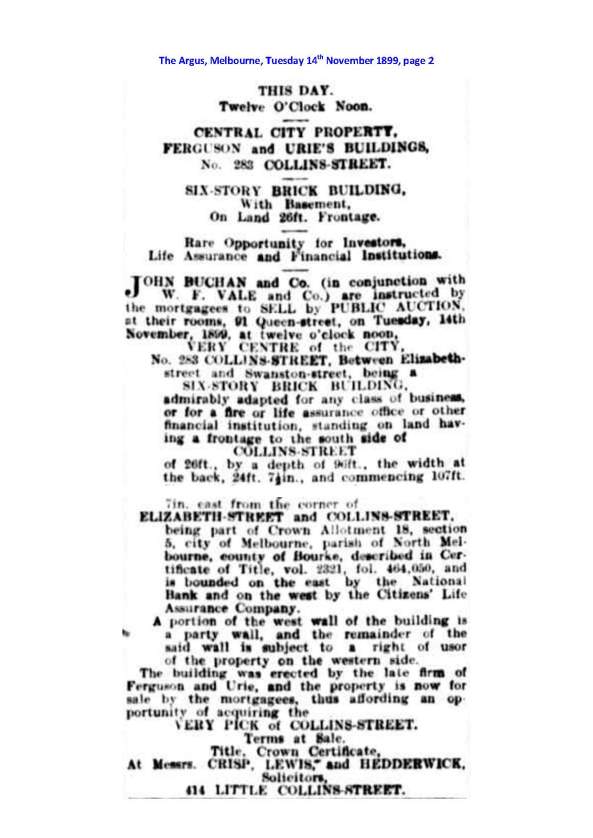
The Argus, Melbourne, Tuesday 14th November 1899, page 2.

On Tuesday the 14th of November 1899, Ferguson & Urie’s flagship 281-283 Collins Street building went up for auction at “twelve o’clock noon” . There were no takers!

It wasn’t until February 1901 that the adjoining Citizens Life Assurance Company brought the building for an “undisclosed sum”. Other obscure reports from West Australian tabloids revealed a price of “between  £600 and £620 per foot frontage”.

The Ferguson & Urie building would eventually be demolished circa 1915 leaving no evidence of one of the first buildings in Melbourne to have the facade approved to have been built of “Hydraulic Freestone“.

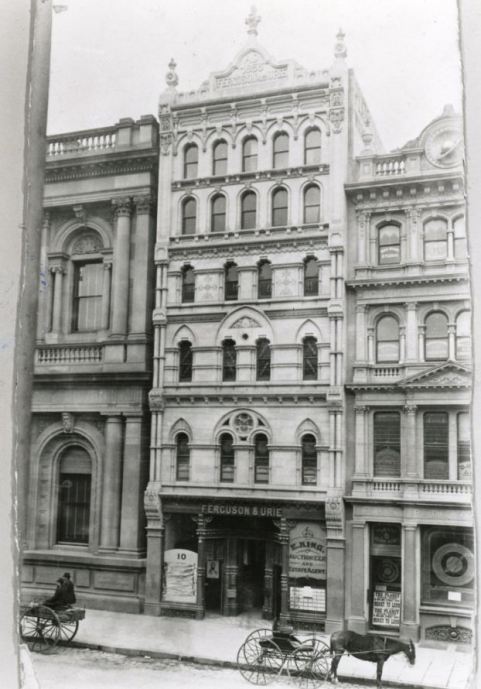
The Ferguson & Urie Building at 10 Collins Street East.

The Ferguson & Urie Building at 10 (later 281-283) Collins Street East.

Related posts:

30-09-1873: For sale, 10 Collins Street.

20-03-1884: Ferguson & Urie building facade approved to be made of Hydraulic Freestone.

22-08-1884: Ferguson & Urie New Premises at 281-283 Collins Street

21-02-1901: The Citizens Life Life Assurance Company purchases the building.


Short link to this page: http://wp.me/p28nLD-ZI

© Copyright


14-06-1894: Probate lodged for the Will of James Ferguson

The Argus, Melbourne, Thursday 14th June 1894.

“WILLS AND ESTATES”

“The will, dated April 2, 1887, and codicils, dated May 8, 1890, and September 27, 1891, of James Ferguson, late of Leonard-street, Royal-park, glass importer, who died on April 17, has been lodged for probate. The estate is valued as £24,317, of which £15,088 is realty and £9,229 personalty. The testator directs that his interest in his Collins-street property shall be sold, and that out of the proceeds a sum of £1,000 shall be invested for the three children of his deceased daughter, Barbara Kier, wife of Crawford Kier, of Sydney, and £1,000 for the benefit of his daughter, Margaret Ferguson, for life, and then to his other daughters now surviving in equal shares. The residue of this fund and the proceeds of his Dryburgh-street and Eden-park properties is to be equally divided among his daughters, Janet Kay Auld, wife of Thomas Auld, of Flinders-street, Melbourne, grocer; Marion Williams, wife of Edward Williams, of Inglewood, Ironmonger; Antonia Wallace Gordon, widow of Alexander Gordon; and Sarah Campbell Gentles, wife of Alexander Gentles, of Moonee ponds, wool-classer. Her directs a sum of £1,000 to be invested for the benefit of his sister, Marion Ferguson Bishop, of Glasgow, Scotland, for life, and then to her son, Thomas Bishop, and the testator’s sister in-law, Barbara Lawson Kennedy, in equal shares. The residue of the estate is left to the testator’s son, James Ferguson, for life, and then to his children, or failing children to the testator’s surviving daughters in equal shares”.


Short link to this page: https://wp.me/p28nLD-Ya

© Copyright

17-03-1882: Christ Church, South Yarra. Melbourne, Victoria.

The Argus, Melbourne, Friday 17th March 1882, page 5.

“Two new stained-glass windows have been placed in the  choir of Christ Church, South Yarra. One representing SS, Peter and John converting converts at Samaris, is erected by some hundred and ten young people of the parish who were confirmed in the church last year. The other represents Our Saviour commissioning St. Peter, who kneels in front of the Twelve Apostles, to “Feed my Sheep.” Some sheep and lambs are depicted in the foreground. This window is placed in the church by the incumbent and his family in commemoration of his induction to the parish. Both windows are the work of Messrs. Ferguson and Urie, of this city.”

The two windows described in the article are depicted in the slideshow. See post 04-10-1881 for other Ferguson & Urie windows in the church.

Photos were taken 26th March 2012.

This slideshow requires JavaScript.

Related posts:

04-10-1881: Christ Church South Yarra.


Short link to this page: https://wp.me/p28nLD-XT

© Copyright

18-10-1884: The Risby Memorial window, St George’s, Queenscliff, Victoria.

The stained glass window by Ferguson & Urie was erected  to the memory of the St George’s church choir member, Susanna  Lavinia Risby who died at the age of twenty seven on the 29th January 1884. The window was  installed in the west wall of St George’s Anglican Church in Queenscliff in early October 1884. It depicts Saint Cecilia, the patroness of musicians and Church music.

Between the year of the opening of the church in 1864 and the year 1892, all the windows of St George’s were fitted with stained glass window by Ferguson & Urie and a number of these were restored by Bruce Hutton of Almond Glass in 2005. In 1958 a vestry was added to the church and in 1995 two modern stained glass windows were placed in the vestry created by stained glass artist Derek Pearse.

Only the Risby memorial window is displayed here. See bottom of page for other related posts for St George’s stained glass. Photos were taken 25th September 2010.

Queenscliff Sentinel, Saturday 18th October 1884, page 1.

“A beautiful lancet-shaped stained glass light, from the factory of Messrs Ferguson and Urie, of Melbourne, having for its centre figure St Cecilia, the patroness of church music, has this week been placed in the West end of St George’s Church, by her relatives in memory of the late Miss Risby, who was one of the members of the choir”.

This slideshow requires JavaScript.

[View larger images]

The Argus, Melbourne, Thursday 31 January 1884, page 1.

“THE remains of SUSANNAH LAVINIA RISBY, of Queenscliff, youngest daughter of the late Thomas Risby, will be interred in the Melbourne General Cemetery THIS DAY (THURSDAY), 31st January, 1884. The funeral will leave the Spencer-street railway station on the arrival of the 10 o’clock a.m. train from Geelong”.

Susannah was buried with her parents at the Melbourne General Cemetery but her name is not mentioned on the memorial stone.

The Queenscliff Sentinel, Saturday 2nd February 1884, page 2.

“We regret to record the death of a young lady, Miss Risby, who during her residence in our community has shown a quiet example of good works, especially in the choir and in the Sunday school of St. George’s Church. Her cheerful disposition and willingness to oblige made her a great favourite wherever she was known. Great men pass away and are missed; but humble workers, by their unselfishness and little deeds of kindness, help in their own way, to make the world happier and better to live in”.

The Queenscliff Sentinel, Saturday 2nd February 1884, page 2.

“TO THE EDITOR OF THE SENTINEL”

“I desire to return sincere thanks on behalf of myself and the late Miss S. Risby’s sisters, to the numerous kind friends on Queenscliff, who have during her long illness shown such constant,  unremitting attention in every way possible for a neighbour to do. To mention names would be invidious, nay, almost impossible, but the loving services will always be present to our minds in connection with the, to us, sad event, – to her the glorious change.

CHAS.  CURTIS. Neptune Cottage, Jan 30, 1884″.

Related posts: 22-02-186429-01-186613-08-186712-02-1881 07-04-1882 >18-10-1884 > 30-12-1893


Short link to this page: https://wp.me/p28nLD-Xy

© Copyright

26-03-1883: St Luke’s Anglican Church, South Melbourne.

The foundation stone of St Luke’s Church of England was laid by Sir Henry Barkly on the 9th of  March 1857 at South Melbourne (at which time it was known as Emerald Hill).  The land the church now resides on was reserved in the original township plan back in 1852. The church was designed by Francis White and had a frontage to Clarendon Street before the church later sold it for retail development in the 1900’s which changed their address to the Dorcas street frontage. Architect Charles Webb added Transepts to the church in 1862 and it is the North Transept that has the Ferguson & Urie stained glass window.

The window depicts “Jesus in the House of Martha and Mary” and was installed in March 1883 to the memory of Mary Skeats (1817-1879) and has the memorial inscription “In Loving Memory of Mary the beloved wife of Charles Skeats, July 24th 1879.”

Photos taken 13th May 2012.

This slideshow requires JavaScript.

[View larger images]

Record, Emerald Hill, Vic, Friday 30th March 1883, page 3.

“…A very fine memorial window has also been placed in the church by Messrs. Ferguson and Urie in their most expensive style, to the order of Mr. Charles Skeats, in memory of his wife, Mary. The subject he has, therefore, very appropriately chosen, is Christ with Mary and Martha – “Mary hath chosen that good part,” &c. It is placed over the seat where Mrs. Mary Skeats used to sit in the church.”

The Argus, Melbourne, Monday 26th March 1883, page 5.

“Great improvements have been recently effected in St. Luke’s Church, Emerald-hill. The temporary arrangements of the east end of the church have been entirely altered, the choir seats, pulpit, and Communion table have all been rearranged, and a carpet and cedar reredos, with Gothic paneling, provided. A memorial window of stained glass has been also placed in the north transept by Mr Charles Skeats, in memory of his wife Mary Skeats, who used to sit in that part of the church. The subject is. “Mary hath chosen that good part,” &c.” 

The Argus, Melbourne, Saturday 26th July 1879, page 1.

SKEATS – On the 24th inst., at No. 10 Romsey-terrace, St Vincent place, Emerald hill, Mary, the beloved wife of Charles Skeats, Esq., aged 61 years. Deeply regretted.

The Argus, Melbourne, Friday 25th July 1879, page 8.

“THE Friends of CHARLES SKEATS, Esq., are respectfully invited to follow the remains of his beloved wife to the place of interment, the Melbourne General Cemetery.
The funeral is appointed to leave his residence, No 10 Romsey-terrace, St Vincent place south, Emerald-hill, on Saturday, the 26th inst., at two o’clock. THOMAS RENTLE, undertaker, 77 Napier-street, Emerald-hill”.

The Mary Skeats gravestone is located at the Melbourne General Cemetery, CofE, section W-189, but it has unfortunately fallen over sometime in the past century. Some of the text is still readable via digital images from beneath.

STH MELB St Lukes 98a

STH MELB St Lukes 98b


Attached documents:

09/03/1857: The Laying of the Foundation Stone of St Luke’s


Short link to this page: https://wp.me/p28nLD-Ws

© Copyright

1864-67: St Peter’s Anglican Church, Ballarat, Victoria.

St Peters Anglican Church in Sturt Street Ballarat was designed by C. D. Cuthbert circa 1864.  The chancel was added in 1877 along with the stained glass windows in the chancel by Ferguson & Urie. The tower was added in 1891 and Soldiers memorial chapel in 1917.

Photos were taken 19th September 2010 & 17th March 2011

This slideshow requires JavaScript.

[View larger images]

Church of England Messenger, 9th August 1877, page 14.

“The stained-glass window for the chancel of St. Peter’s Church has arrived in Ballaarat, and was placed in position. It is a very good specimen of Messrs. Ferguson and Urie’s art, and it is a matter of congratulation that such excellent workmanship can be produced in the colony. The window is divided into three lights, surmounted by tracery pierced with trefoils. These trefoils are filled with richly-coloured glass, bearing upon a starry background the three emblems of faith, hope, and charity; the heart with the sacred monogram, the cross with the crown of thorns, the anchor with the dove and olive branch. The subject of the central light is the “Ecce Homo.” The side lights, having reference to the pious and charitable lives of the ladies in whose memory the chancel was erected. are illustrations of Mark XIV, 8 (“She hath done what she could’) and Matthew XXV. 40 (“Inasmuch as ye have done it unto one of the least of these My brethren, ye have done it unto Me”). In the central light the Saviour stands forth a solemn and mournful figure. Pilate and a Roman soldier occupying the background. Underneath there is a panel with a small but exceedingly well-drawn picture of Christ’s charge to Peter – “Feed my Sheep.” In the apex of the window is the emblem of the Holy Spirit, the dove, descending with rays of light. The right hand picture of Mary wiping the Saviour’s feet with her hair is remarkable for the beauty of the Saviour’s countenance and the grace of His gesture. In the light upon the left-hand side a female figure is casting a garment around an aged man and a child at her feet. The background of both of these pictures is of a similar character – a low wall decorated with scroll-work, overtopped with trees and flowers, the sky space being filled in with ruby glass in irregular lead-work. Underneath are the old church emblems – the Agnus Dei and the Pelican; and above are the Alpha and Omega. The side window, which can be seen only upon entering the chancel, is the more special memorial window, having the upper part a scroll with the text – “Write, Blessed are the dead which die in the Lord;” and at the bottom, a panel with the memorial inscription. The quarries of which the rest of the window is composed are ornamented with fleurs-de-lys, and the effect of the whole is highly satisfactory. The organ has been inspected on behalf of the church authorities, and is pronounced a first-class instrument. No time will now be lost in erecting it in the church.”

The Chancel window:

This is the main three light chancel window that depicts scenes from: MATT 25-40, JOHN 19-5 and MARK 14-8. The tracery above the three main lights shows three trefoil windows depicting the symbolism of Faith, Hope and Charity. The main lights of the window depict the following:

MATT 25-40: The King James version of Matthew 25-40 reads: “And the King shall answer and say unto them, Verily I say unto you, Inasmuch as ye have done it unto one of the least of these my brethren, ye have done it unto me.”  The figure depicted in the window is of a woman covering a beggar man and his daughter with a cloak to shield them from the cold. The most commonly recognised interpretation of Matthew 25-40 would be the old “Golden Rule”; “Do unto others as you would have them do to you” or “One should treat others as one would like others to treat oneself.” Below the scene is the Pelican feeding its young from blood from its chest, which represents sacrifice.

JOHN 19-5: The King James version of John 19-5 reads: “Then came Jesus forth, wearing the crown of thorns, and the purple robe. And Pilate saith unto them, Behold the man!” The scene depicted in the window is of Jesus wearing the crown of thorns. His hands are bound, he’s wearing the purple robe, and he is flanked by Roman guards. In the hours before Christs crucifixion, he was led through what we would call a ‘kangaroo court’ which has no sense of justice. The Roman Governor, Pontius Pilate, had him whipped and had a crown of thorns placed upon his head and clothed him in a purple robe, mocking some sort of regal adoration. Pilate paraded Jesus before the crowd and exclaimed, “Behold, the man!” Below is the scene of Christ as the Good Shepherd with a ribbon of text which reads: “PETER LOVEST THOU ME, YE LORD THOU KNOWEST THAT I LOVE THE, FEED MY SHEEP.” This refers to John 21-17; “He saith unto him the third time, Simon, son of Jonas, lovest thou me? Peter was grieved because he said unto him the third time, Lovest thou me? And he said unto him, Lord, thou knowest all things; thou knowest that I love thee. Jesus saith unto him, Feed my sheep.”

MARK 14-8: The King James version reads: “She hath done what she could: she is come aforehand to anoint my body to the burying.” The scene in the window depicts Mary Magdalene, the alleged prostitute, drying Christs feet with her hair. Nearby is a small ornate jug which is supposed to have contained an expensive aromatic ointment which was to be used to ‘anoint” him before his death. Below is the image of the Paschal Lamb carrying the St George banner.

The two light window in the nave:

The ‘John Laverick Nunn’ Memorial window is a two light window with the memorial text:

“PLACED BY ELIZA NUNN IN MEMORY OF HER HUSBAND JOHN LAVERICK NUNN DIED 1875 AGED 46. | ALSO HER DAUGHTER HANNAH MARY DIED 1883 AGED 23 AND HER SON JOHN LAVERICK DIED 1884 AGED 22”.

This window was erected in St Peters in January 1886.

The scroll text on the left lancets reads:

“THE LORD GAVE AND THE LORD HATH TAKEN AWAY BLESSED BE THE NAME OF THE LORD” (Job 1:21 – “And said, Naked came I out of my mothers womb, and naked shall I returne thither: the Lord gaue, and the Lord hath taken away, blessed be the Name of the Lord.”) “THEN ALSO WHICH SLEEP IN JESUS WILL GOD BRING WITH HIM”. (1 Thessalonians 4:14 – “For if we believe that Jesus died and rose again, even so them also which sleep in Jesus will God bring with him”.) John Laverick Nunn was born in Whitby, Yorkshire, England, in 1830. He married Eliza Newson in Victoria in 1857 and they settled in the Warrenheip area at Dunnstown, near Ballarat circa 1860 where they became store keepers. John contributed to the Buninyong Presbyterian Church building appeal.  He died on the 22nd of Feb 1875 at Dunnstown. His wife Eliza died on the 17th October 1899 at “Ebor” Hawkesburn, South Yarra.


Short link to this page: http://wp.me/p28nLD-Uv

Some of this article has now been superseded by some new research about the chancel windows and a new article was posted to this web site on 24 Sep 2016 and can be seen at: http://wp.me/p28nLD-2Mv

© Copyright

13-08-1872: Wesleyan Church, Golden Square, Sandhurst (Bendigo), Victoria.

The Wesleyan Church (now Uniting), at 19 Panton Street, Golden Square in Bendigo, has a large a large five light Ferguson & Urie window above the main entrance. No specific news articles of the time have been found making any reference to the church windows. The east window is a typical Ferguson & Urie grisaille design and has scroll & ribbon designs in the centre and outer lights with the following text in each. ENTER INTO HIS GATES WITH THANKS GIVING, REMEMBER THE SABBATH TO KEEP IT HOLY, GODLINESS IS PROFITABLE UNTO ALL THINGS

Photos were taken 27th August 2010. (using a compact Pentax Optio S10)

This slideshow requires JavaScript.

Illustrated Australian News for Home Readers, Melbourne, Tuesday 13th August 1872, page 174.

“NEW WESLEYAN CHURCH, GOLDEN SQUARE, SANDHURST”.

This church, now in course of erection, is from designs by Messrs. Crouch and Wilson of Melbourne. […] A portion of the design was erected about two years since; the remainder now in hand is to be completed early next year”.

The foundation stone of the Uniting (former Wesleyan) church in Golden Square was laid on the 5th of January 1870 and the first section was opened on 11th May 1870. Further additions were made in 1872 and the building completed in early 1873. In the gable of the east main entrance is a cement plaque reading ‘Wesleyan Church AD 1872’.


Short link to this page: http://wp.me/p28nLD-UD

© Copyright

22-07-1866: St Paul’s Presbyterian Church, Ballan, Victoria.

St. Paul’s Presbyterian Church in Ballan, eastern Victoria, was officially opened 22nd of July 1866.

The following year, on the 13th August 1867, the Hobart Mercury reported that James Urie, one of the principal partners in the Victorian Stained glass firm of Ferguson & Urie, had been “sojourning” in Tasmania with a catalogue of the firm’s designs for ecclesiastical and secular stained glass. The Presbyterian Church at Ballan, St Paul’s, was mentioned in the article as one of many Victorian Churches that had recently received stained glass windows by Ferguson & Urie.

[…] This gentleman is now in Launceston, and we were much gratified yesterday by inspecting a large portfolio of designs for church and other windows which his firm has executed or has in hand […]

I visited St Paul’s (now a Uniting Church) in Ballan in December 2010 and found that all the windows were original Ferguson & Urie stained glass, none of which appear to have been repaired or restored since they were erected in the church over 140 years ago.

The principle triple light east window has the typical Ferguson & Urie scroll design. In the ribbon of the centre light is the verse from John 14-6: “I AM THE WAY AND THE TRUTH AND THE LIFE”

The text at the bottom of each lancet has the names of each of the donors:
“Ye gift of Mrs John Edols AD 1866” | “Ye gift of Mrs Dugald Macpherson AD 1866” | “Ye gift of Mrs Peter Ingles AD 1866”

Photos were taken 29 Dec 2010.
Some of the dark patches seen in the borders of some windows in the vestry are from a thick carpet of spider webs on the inside and outside of the windows.

This slideshow requires JavaScript.

The Donors:

Edols:

Mrs John Edols (Margaret) was the wife of John Edols Esq (1817-1888)., of Dariwell Park, he was appointed as a trustee[1] of the Ballan Race track and recreational reserve in July 1860, along with Dugald MacPherson and others and also acted as a steward[2] at the Ballan racing events. Margaret Edols (nee Brown) died[3] at “Ingliston” on the 17th of September 1872 and was buried in the Melbourne General Cemetery on the 19th of September 1872 [4]. John Edols left the Ballan area circa 1888 and died at “Bryan O’Lynn”, near Warrnambool on the 28th December 1888 [5]. He was buried at the Tower Hill Cemetery.

MacPherson:

Mrs Dugald MacPherson was Mary Elizabeth MacPherson (nee O’Cock), wife of Ballan Councillor Dugald Macpherson (1820-1901) of Bungeeltap. She died at Bungeeltap-house” at Ballan in August 1916 and was buried at the Ballan New Cemetery on Wednesday 16th August 1916[6]. Dugald MacPherson died at Bungeeltap, Ballan, on the 20th of October 1901 aged 81 [7] .

Inglis:

Mrs Peter Inglis, wife of Ballarat magistrate, Peter Inglis of Ingliston. Peter Inglis died on the 6th of July 1869, aged 73 [8].

HISTORY OF BALLARAT, page 6

“In the year 1843, Mr. Peter Inglis, who had a station at Ballan, took up the Warrenheip run, and shortly after that purchased the Lal Lal station, and throwing them both together, grazed on the united runs one of the largest herds in the colony. The western boundary of Mr. Inglis’ Warrenheip run marched with the eastern boundary of Mr. Yuille’s run, the line being struck by marked trees running from Mount Buninyong across Brown Hill to Slaty Creek. Mr. Donald Stewart, now of Buninyong, was stock-rider for Mr. Inglis, on the Warrenheip and Lal Lal stations, and superintendent during the minority of the present owner of Lal Lal”.

Related posts:  22-07-1866 > 28-07-1866 > 13-08-1867

External links:

Museum Vic: Dugald Macpherson (1820-1901)

Obituaries: Peter Inglis.

The Argus, Melbourne, Vic, Monday 12th July 1869, page 5.

Obituaries Australia

1864: Christ Church, Anglican, Kilmore, Victoria.

There are two historically significant stained glass windows by Ferguson & Urie at Christ Church, Kilmore, Victoria.

The three light chancel window and the “Clifton” memorial window at the liturgical west end are both by the Ferguson & Urie company circa 1864.

The first stone of Christ Church, Kilmore was laid by Bishop Charles Perry on 19th November 1857 and the first service was held in January 1861. The church was consecrated on Monday 20th May 1867 by Bishop Perry.

Photos were taken on 26th December 2011.

This slideshow requires JavaScript.

Kilmore Free Press & Counties of Bourke & Dalhousie Advertiser, Thursday 23rd May 1867, page 2.

“On Monday Morning His Lordship the Bishop of Melbourne, assisted by the Rev. Mr. Watson, the trustees and church wardens, went through the ceremony of consecrating Christ Church, Kilmore. The affair was conducted in a most solemn manner”.

The following two extracts from the Anglican Church Gazette were kindly provided by Catherine Turnbull, Hon Archivist, Kilmore Anglican Parish, 8th Feb 2011.

The Anglican Church Gazette 1864

“…The chancel windows at once attract attention. The principal devices of the side lights are the ruby crosses on a purple ground, with the leaves and fruit of the vine interspersed, the one having the Scripture words, in Anglo-Saxon letters, “I am the Vine,” the other “Ye are the Branches.” In the centre light, over a beautifully finished head of the Saviour, a dove, emblematic of the Holy Spirit, descends, whilst this is surmounted by the ancient sign of the Trinity, the hexalpha or interlacement of two equilateral triangles. The appearance is very rich and splendid, if not gorgeous, and is highly creditable to the artists, Messrs. Ferguson and Urie. The side windows (seven on each side) are diamond-shaped, lead quarry lights, filled in with muffed glass, the borders being of stained glass of various tints …”

The Anglican Church Gazette, June 16, 1864.

“…A very beautiful Memorial Window has been lately erected in Christ Church, Kilmore. In its general construction it is, as intended, emblematical of sorrow, while a rich golden blue, particularly on a sombre day, pervades it. The centre piece is a light blue cross on a crimson ground, entwined by a wreath, on which is inscribed that well known sentence of the Bible, so comfortable to the Christian, “Blessed are the Dead that die in the Lord.” Over and under this are the family crest and coat of arms, elegantly and conspicuously finished.  Underneath is the following inscription annealed in the glass:- “Erected by Wm. Snow Clifton, in memory of his brother, Henry Clifton, who died June 21, 1853, aged 31 years, and was buried in the Kilmore Cemetery. ” The whole is enclosed by a handsome bordering of purple and crimson alternately, with dark leaves between, connected by golden stalks, which form the inner boundary of the border, the outer one being of green. The design and workmanship do great credit to the contractors , Messrs. Ferguson and Urie…”.

Note: There is no known gravestone for Henry Snow Clifton at the Kilmore General Cemetery.

Kilmore Free Press, Vic, Thursday 3rd March 1932, page 2.

(In reference to Christ church, Kilmore)

“…The first place of worship was a building of brick, but as the population was increasing it was deemed imperative that money should be raised to erect a building of much larger and more pretentious character, and the first incumbent the Rev, John Singleton was soon travelling many miles in interviewing squatters and people in outlying parts to collect the necessary money. Soon sufficient funds were in hand to warrant a start with the building which, it was anticipated, would cost some thousands of pounds stirling. The foundation stone was laid by Lord Bishop Perry on the 19th November 1857. The scarcity of funds, however, held up the work from time to time and it was not till 1864 that the church was finished when the Dean of Melbourne, the Rev. Dean Macartney preached the occasional sermon. A writer in the Church gazette of this day states that Christ Church is on an elevated position on the western hill and the style of architecture is English or Lanie of the latter part of the 12th or beginning of the 13th centuries. The architect was a Mr Rudt[1], who gratuitously gave his services. Later the work was carried out by Mr Flury [sic][2], a well known architect of Kilmore. Entering the church the beautiful stained glass windows erected to the memory of loved ones who sleep in that long last sleep command the attention. One is to William Clifton[3] and his brother Henry, the date on which is 1853. It is adorned with the family crest, and bears the motto “Tenez de Droit” [sic] – Hold the Right[4]. This is a very beautiful work of art, and is emblematic of sorrow. The centre piece is a light blue cross on a crimson ground enclosed by a wreath on which is inscribed and appropriate passage of scripture of scripture, and over and under this is the family crest and coat of arms. The designers were Messrs. Fergurson [sic][5] and Urie[6]. “
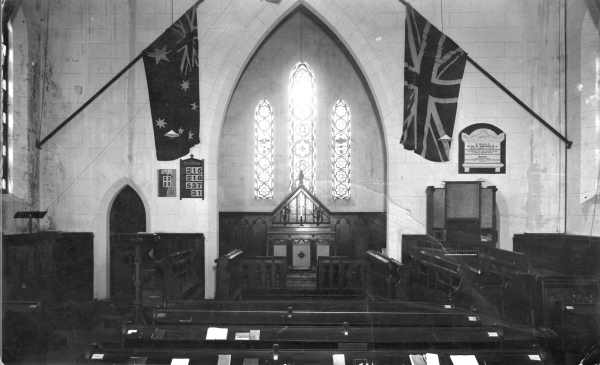
kilmore-christ-church-1920

The Chancel of Christ Church, Kilmore c.1920

William Snow Clifton and his brother Henry Clifton took up the “Arcadia” run[7] in 1848 which was an estimated 80,000 acres along the Goulburn River.

Foot notes:

[1] No record of an architect by the name of Rudt. Three architects were involved in Christ Church being W. Z. Perrot, Charles Kingk and James Fleury,

[2] James Fleury – Architect Sydney Street Kilmore.

[3] William Snow Clifton was the donor of the window. Commanding Officer of the Victorian Yeomanry Corps Melbourne circa 1856.

[4] “Tenez le Droit” – French – ‘Uphold the Right’. (The motto used by the Victorian Police Force to this day)

04-05-1889: Is Marriage a Failure?

This is good for a laugh, but it’s highly likely that the opposing debaters named as Ferguson and Urie, were the sons of James Ferguson (James Ferguson Jnr b. 1861) and James Urie (William Urie b. 1864). The Australian Natives Association (ANA) was formed in 1871 as a friendly society and its membership was only open to Australian born males of which the sons of James Ferguson & James Urie were, and at the time of the debate both were single men. James Urie was a councillor (and Mayor) of Flemington & Kensington and would have been a significant influence in ensuring the young men took an active part in associations such as this.

The North Melbourne Advertiser, Saturday 4th May 1889, page 3

“IS MARRIAGE A FAILURE?”

“An interesting debate on the above subject took place at the ordinary meeting of the Flemington and Kensington branch of the Australian Natives Association, on Friday evening. Mr Roberts, vice president, in the chair.

            Mr Rowe, who opened the debate, did not distinctly affirm that marriage was a failure, but assuming, for the sake of argument, that it was so, then it behoved them to trace some of the causes of the failure. In one case failure was due to the fact that the wife was not domesticated. The young lady, in the spinster stage of her existence, was too proud, too idle, or too indifferent to attend to household duties, and it was only natural that she should develop into ‘the ornamental wife’. Such a woman was unable to cook a chop or even a potato, and the dyspeptic husband was sometimes driven into the bar parlour in disgust. To his thinking, the best wives were the daughters of workmen, and such seldom turned out to be incapable or extravagant. Some women who complained that marriage was a failure, would do well to ask themselves whether they had tried to be as agreeable and as winning towards their husbands as they were in the days of courtship. Then there were instances in which the husband was to blame for marital infelicity. As a lover, a man may be a model of tenderness and devotion, but as soon as the prise is secured, neglect often takes the place of love, attendance at the club is resumed, or it may be, the demon drink steps in to make the home miserable. But if marriage is a failure, the question would naturally arise ‘Where are we to find a substitute?”

            Mr Urie spoke on the affirmative side of the question. He had known young men who were happy and as jolly as possible before marriage, but as soon as they were fairly engaged a change came over their dispositions, and they grew disagreeable and morose. After marriage matters became worse still. You could not get them out for half-an-hour because were required to stay at home to mind the baby – the only time they were allowed out was when the infant required an airing, and they were needed to drive ‘the barrow’. He had known young fellows who, while bachelors, always had a shilling in their pockets, but, after they became married, never seemed to have a penny of their own, and who went around ‘cadging’ tobacco of their single acquaintances. Surely marriage was a failure when it came to that. Of course he was speaking as a single man; he had never been through the mill himself, and he never meant to. Mr Phillips took the negative side of the question. Of course there were individual cases of failure, but the system as a whole was successful enough. When young couples went courting they should find out whether they could trust one another, and the young man should satisfy himself that the young woman was capable of keeping house. In some cases people rushed into matrimony in a hurry and were sorry for it afterwards. A man took a fancy to a woman and made up his mind he would marry her whether she was good or bad. Such a union was a failure as frequently as not. But if the parties were of ‘the right sort’, he knew of nothing happier than the married state. It was desirable that the wife should be domesticated, and, whatever her station in life she should try to ‘save up a little for a rainy day’, should try to put a little by week by week.

            A member – What Building Society do you represent?

Mr Phillips went on to say that a man was not much benefit to the colony if he had not the moral courage to marry. He often pitied the poor man who was not married.

            Mr Mahoney thought marriage was only a failure in the minority of cases, and 99 times out of a 100 the fault was on the side of the man. Sometimes former companions got hold of a married man and enticed him away from his home to the hotel. In the course of time, the wife, weary of being left by herself , went into society and mixed up with other men – and the marriage was a failure. As to getting on in life, a single man had not half the chance a married man had. Before he was married he spent all he earned, but after marriage he found that 5s went as far as £1 used to go. Besides, no one could sympathise with one, either in times of prosperity of adversity, the same as a wife could. He spoke after 15 years experience. Marriage was calculated to make a man happy and moral. Single men rarely we’re respectable. (Laughter.)

            Mr Ferguson doubted that Mr Rowe wanted to prove that marriage was a failure, and probably he could not if he tried, because he had no grounds to go on, being a single man he had no practical experience of the question. Want of means was one cause of the failure of marriage – poverty was a heart rendering thing in the house. Another prolific cause of infelicity was over-indulgence in drink. He would like to know the reason why men married. He considered it was either a question of passion or necessity.

            Mr Maloney – You look at it from a very low standpoint.

Mr Ferguson said – Home was a great English institution. Many persons married to secure a home. In China the woman was the slave of her husband. Amongst the American Indians the female worked while the male went out fishing or shooting. In Turkey, and amongst the Mormons, a man married as many wives as he could afford. In these latter cases marriage was not a failure so long as the husband had the means to keep his establishment going. In certain tribes in South Africa, the men had their wives in common. In the Border land between England and Scotland, in the olden time, men took their wives on trial, but history was silent as to what became of the children. In ancient Sparta, the State took charge of all children; if the child was weakly it was exposed to die, if strong, it was trained up by the State. Under our system of education, children were not fitted for the duties of after life. He was of the opinion that the State should take upon itself the care of all children. Amongst the causes of the failure of matrimony, the mother-in-law was a prominent factor, and should not be overlooked.

            The chairman was of the opinion that in the great majority of cases marriage was anything but a failure. He did not agree with Mr Rowe that the daughters of poor men made the best wives. An old proverb said that if you want a good bird you must go to a good nest. The girls of the better class were, to his mind, better educated and quite domesticated as their humbler sisters, and were therefore more companionable. Mr Urie’s argument re married men staying at home was certainly no proof of connubial infelicity. Nor was there much force in Mr Ferguson’s theory as to the want of means, because most people were agreed that the greatest happiness was to be found in the humble homes. The companionship of a good woman had a most beneficial influence on men. The quarrels of husbands and wives were often retailed in newspapers, but the Press was silent as to the happiness of thousands of married people. He had boarded out for three or four years, and it was the most miserable period of his existence. The mother-in-law difficulty was greatly exaggerated. If a husband put his foot firmly down at the outset, the wife’s mother soon shrank back into her proper position in the household.

            After some remarks, in reply, from Messrs Rowe and Urie, the debate closed.