1864: St Mary’s Anglican Church, Bulla, Victoria

Thirty kilometres north of Melbourne and eleven kilometres east of Sunbury is the township of Bulla which derives its name from the aboriginal word ‘Bulla-Bulla’ and means ‘two round low hills’ or ‘the two breasts.’[1] Most Victorians today probably know the name Bulla for its famous “Bulla Ice cream,” made by the Bulla Dairy Company since 1910.

In late 1842, Royal Navy Officer William Pomeroy Greene arrived in the Bulla area with his wife Anne and their seven children and a portable pre-fabricated house they brought out from England. They settled at ‘Woodlands,’ which is a few kilometres east of the town of Bulla and just north of the Tullamarine airport runway. The “Woodlands Historic Park” and restored homestead is now administered by Parks Victoria and is open to the public. It’s also home of the “Living Legends” which is the International Home of Rest for Champion Horses.

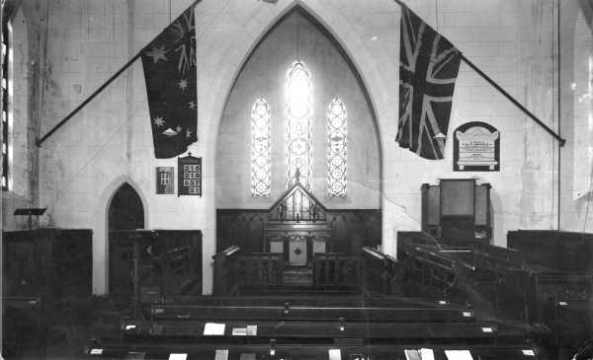
Anne Greene (nee Griffith) donated the land for St Mary’s Anglican Church at Bulla and in the presence of Bishop Charles Perry she laid its foundation stone on Friday 23rd July 1858.[2] The church was consecrated on the 2nd September 1864[3] at which time the new chancel was added and the liturgical east tripartite stained glass window by the North Melbourne firm Ferguson & Urie had been installed. This window was the gift of Anne’s sister in-law, Jane Catherine Griffith, the wife of her late brother Charles James Griffith.

St Mary’s Church was originally located on the corner of Oaklands and Bulla Roads, a few kilometres east of the town of Bulla and a short distance south of Woodlands, but more than a century later the church was in the path of the expanding Tullamarine airport runway. The introduction of the Jumbo jets, 24 hour airport operations, and the extensions to the runway was deemed a significant structural threat to the church and so it had to be moved.

On the 22nd January 1971 the final wedding ceremony was held in St Mary’s before it was dismantled and moved to its present site in the township of Bulla[4]. The church was reopened in its new location on the 24th November 1974 and was consecrated by Rev. Frank Woods in the presence of the Governor of Victoria, Sir Henry Arthur Winneke.

St Mary’s is no longer used for religious services and has been returned to the control of the Anglican Diocese property management. Its unknown what the future holds for the old church or what will become of the historic stained glass windows.

Photos taken: 17th April 2015.

This slideshow requires JavaScript.

[show image library]

The stained glass window is an easily recognised work by the Ferguson & Urie company. The apex of the centre light depicts the descending Dove. The centre contains a crimson floriated cross with an azure blue background containing passion flowers and vine leaves. A  scrolling ribbon which flows around the cross contains the words: “I KNOW THAT MY REDEEMER LIVETH Job 19-25.” The scene in the bottom third of the window depicts the three Mary’s at the empty tomb with an angel proclaiming, as written in the text below the scene, “HE IS NOT HERE”. At the very base of this window is the dedicatory text: “Presented by Mrs Charles Griffith 1864.” The flanking side lights contain identical Gothic floral designs with diamond quarries filled with the Fleur-de-lys pattern. The centre design of these lights is the monogram “I.H.S.” in blue on a crimson background and incorporates the crown of majesty.


Anne Greene (nee Griffith 1795-1865).

Anne Greene laid the foundation stone of St Mary’s at Bulla in 1858 on land that she had donated for the church. Anne was born in Dublin, Ireland, in 1795, the daughter of Richard Griffith and Mary Hussey Burgh. She married former Royal Navy Officer William Pomeroy Greene (c.1797-1845) in Ireland on the 31st March 1826. For the sake of William’s health they emigrated to Australia and arrived at Port Phillip aboard the barque Sarah on the 5th December 1842 accompanied by their seven children and a prefabricated portable house which would be erected at “Woodlands” near Sunbury. William died at Woodlands on the 5th March 1845.

Anne was the sister of Sir Richard Griffith (1784-1878) and Charles James Griffith (1808-1863). Anne died aged 69, on the 13th March 1865 at ‘d’Estaville,’ the residence of Sir William Stawell, at Barry Street Kew, Victoria.

Charles James Griffith (1808-1863):

Jane Catherine Griffith (nee Magee), the wife of Charles James Griffith, was the donor of the Ferguson & Urie stained glass window for the new chancel of St Mary’s Anglican Church at Bulla in 1864[5].

Her husband Charles was born in Millicent, Kildare, Ireland, in 1808, the sixth son of Richard Griffith and Mary Hussey Burgh and was educated in the legal profession at Trinity College Dublin and was admitted to the Irish bar circa 1831. On arrival in Australia in 1840 he settled at ‘Glenmore’ near Bacchus Marsh as a sheep farmer and never practiced in the legal profession in the colony. On a return visit to Ireland in the 1840’s he married Jane Catherine Magee in Dublin on the 16th December 1846. On their return to Australia he began his political career after nominations by Charles La Trobe in the early 1850’s. In 1854 Bishop Charles Perry appointed him Chancellor of the Melbourne Diocese and until the time of his death he was an active member of the Acclimatisation Society[6].

Charles Griffith died at his home ‘Tempe,’ Dandenong Road Prahran, on the 31st July 1863 aged 55[7]. They had no children.

At 11 o’clock on the 4th August 1863 his funeral service moved from St James’s Old Cathedral[8] to his place of interment at the Melbourne General Cemetery. The portion of the Griffith and Greene family headstone at the Melbourne General Cemetery that contains his epitaph reads:

“Sacred to the memory of Charles James GRIFFITH Esq who departed this life on 31 Jul 1863 age 56 years. This headstone is erected by Jane C. GRIFFITH as a tribute of love and affection to her beloved husband for if we believe that Jesus died and rose again even so them also which sleep in Jesus will God bring with him. Thess. iv. IHS.” [9]

His will, dated 2nd Dec 1861, provided modest sums to his wife Jane and other family members as well as a sizeable sum to Bishop Perry for the Church of England;

“…To the Bishop of Melbourne for the time being, one thousand pounds to be applied according to his discretion to the general purposes of the Church of England in the diocese of Melbourne…”[10]

Significant tabloid transcriptions:

The Argus, Melbourne, Vic, Wednesday 28th July 1858, page 5.

“CHURCH OF ENGLAND, BULLA BULLA.- The foundation-stone of the new Episcopal church at Bulla Bulla was laid by Mrs. Greene (the donor of the land which the building is to be erected) on Friday last. Bishop Perry presided at the ceremony. The Church is to have a nave, transept, and chancel, in the early English period of architecture, with a tower and spire at the north-west angle, which will form the principal entrance to the building. The portions at present in course of erection are the nave, tower, and spire, and the whole is being executed in blue stone procured in the neighborhood, and carted to the site free of charge by the settlers in the district.”

The Argus, Melbourne, Vic, Monday 3rd August 1863, page 5.

“We regret to have to announce the death of Mr. C. J. Griffiths [sic], a gentleman who for many years past has taken an active part in the public affairs of the colony, and has also been connected with it in various official capacities. Mr. Griffiths had been ailing for a considerable period, and within the last ten days his complaint, which his medical advisers, Dr. Pugh and Mr. Rudall, decided to be aneurism, assumed a formidable aspect. The death took place at Mr. Griffith’s residence, Dandenong-road, on Friday evening last.”

The Argus, Melbourne, Vic, Tuesday 4th August 1863, page 5.

“MR. C. J. GRIFFITH.

Yesterday, we recorded the death of Mr. Charles James Griffith. The removal – sudden and unlooked for – of one of the first settlers of the colony, a gentleman who, privately, was widely known and highly esteemed, and whose public career was neither brief nor unimportant, demands more than passing notice.

            Mr. Griffith was the sixth son of Richard Griffith , Esq., M.P., of Millicent, Kildare, by Mary, daughter of Lord Chief Baron Hussey Burgh. He was born August, 1808; graduated as M.A. at Trinity College, Dublin; and was called to the bar about 1831. In 1840, Mr. Griffith arrived at Port Philip, and settled at Glenmore, near Bacchus Marsh as a sheep farmer. On the separation of the colony of Victoria from New South Wales, Mr. Griffith was appointed by the Superintendent (Mr. La Trobe) one of the nominee members of the Legislative Council, and afterwards he was elected to Parliament by the constituency of Dundas and Follet. In 1853 he was appointed President of the Board of Commissioners of Water Supply and Sewerage. Under his presidency the board, in the face of continued violent opposition and adverse criticism, carried out the Yan Yean scheme; but after surmounting all the difficulties of the undertaking, Mr. Griffith resigned his office. The ministry of the day conceived they had a right to command the votes of all members of Parliament who were connected with the public service, and Mr. Griffith declined to sacrifice his independence. Upon the new Constitution coming into operation, Mr. Griffith’s friends decided to propose him for the Speakership of the Legislative Assembly. The present Speaker was also nominated, and succeeded in securing the votes of a majority of the House. Continued private and public exertions weakening Mr. Griffith’s health, he paid a visit to Europe, in 1858 and did not return to Victoria until April, 1862. Lately he was a candidate for the seat in the Legislative Council for North-Western Province to which Mr. Jenner was elected, and at the time of his decease he held the appointments of Chairman of the Board of Education and Commissioner under the Real Property Act. Mr. Griffith always took a prominent part in the affairs of the Church of England. From the time of its creation, he filled the office of chancellor of the diocese, and he was an active member of the Church Assembly from the period of the formation of that body. Mr Griffith married in the colony [sic], and leaves a widow without family. Although his health has been declining for some time past, it is but the other day that he was engaged in the active discharge of his duties, and until less than a week of his decease, the fatal termination of the attack which confined him to his chamber was not anticipated.”

The Age, Vic, Wednesday 5th August 1863, page 5.

“The Council of the Acclimatisation Society met yesterday, as usual, and the following resolution was unanimously passed:- “The council of the Acclimatisation Society hereby express their deep regret at the death of C. J. Griffith, Esq., their highly valued colleague, and unanimously resolve that the council do now adjourn, in order thereby to testify their respect for the memory of the departed gentleman; and further, that the minute be entered on the records of the council.” The council adjourned accordingly.”

Bendigo Advertiser, Vic, Thursday 6th August 1863, page 3.

“MELBOURNE NEWS.

(Herald.)

The funerals of two old and highly respected colonists took place on Tuesday, and both were numerously attended. The funeral of the late Mr. C. J. Griffith, Chancellor of the Diocese, took place in the morning. A special service was performed at St. James’s Cathedral, at eleven o’clock, at which the very Rev the Dean of Melbourne officiated, assisted by the Rev S. L. Chase, and the Rev M. H. Becher, incumbent. The Rev C. T. Perks, and the Rev D. Seddon, were also present. The coffin was then borne to the hearse, the following gentlemen acting as pall-bearers:- Sir W. F. Stawell, the hon W. H. Mitchell, M.L.C.; Captain McMahon, M.L.A; hon T. T. A’Beckett, M.L.C; and Sir Redmond Barry. The cortege consisted of four mourning coaches, and about twenty private carriages, including his Excellency the Governor’s, which was closed. The funeral was attended by a large number of the members of both houses of Parliament, and many gentlemen with whom the deceased had been so long associated, and by them held in high esteem. The procession proceeded from the Cathedral along Collins and Swanston streets to the new cemetery, were [sic] the last rites were performed by the Dean.”

Portland Guardian, Vic, Monday 10th August 1863, page 3.

“THE LATE C. J. GRIFFITH, ESQ.

(From the “Herald” of 4th inst.)

Mr. Charles James Griffith, who expired suddenly, on Saturday last from aneurism of the aorta, was a very old colonist. He was a member of the bar, but never practiced his profession in the colony, but was principally engaged in pastoral pursuits; and at the time of his death held, in conjunction with Mr. Molesworth Greene, one of the largest stations in the country. Mr. Griffith has also taken a very active part in public affairs. He was a nominee member of the old Legislative Council, and took a prominent part in debates. When the new Parliament was called into existence Mr. Griffith was chosen as the representative of Dundas and Follet; and on the 21st of Nov., 1856, was nominated for the office of speaker, in opposition to Sir Francis Murphy, who was elected. At that time Mr. Griffith occupied the position of President of the Board of Sewerage and Water Supply, and he continued to fulfil the duties appertaining to the office until the completion of the Yan Yean works. Mr. Griffiths supported the Haines administration, and manifested a great interest in the various questions which came before the House in that session, including the Electoral Bill, the Land Bill, and the bill for the formation of a trunk line of railway. Mr. Griffith long held the appointment of chancellor of the diocese of Melbourne, and was for some time a Member of the Council of the University. About three years since, he visited England, and returned about nine months ago. On the composition of the new Education Board, Mr. Griffith was chosen as one of the members as representing the Church of England interest. On March last he unsuccessfully contested the South-Western Province with Mr. Jenner. Mr. Griffith has, at all times exhibited a warm interest in the cause of Education, and in all matters appertaining to the church of which he was a member. In 1845, he published a short work giving a history of the colony; and while he held the office of President of water supply, he wrote a pamphlet in answer to the many quibbles and objections that were raised at the time in reference to the scheme. Mr. Griffith was highly respected by all classes of colonists. He was connected, by marriage, with the families of Sir W. F. Stawell, the Dean of Melbourne, and Mr. R. F. Greene.

            The Argus says the deceased Mr. Griffith was the sixth son of Richard Griffith, Esq., M.P. of Millicent, Kildare, by Mary, daughter of Lord Chief Baron Hussey Burgh. He was born August, 1808; graduated as M.A. at Trinity College, Dublin; and was called to the bar abut 1831.”

The Argus, Melbourne, Tuesday 14th March 1865, page 4.

“GREENE.- On the 13th inst., at D’Eastaville, Anne Greene, widow of the late William Pomeroy Greene, Esq., R.N., of Woodlands.”

The Argus, Melbourne, Vic, Saturday 22 July 1939, page 9.

“OLD ANGLICAN CHURCH.
Bulla Anniversary

St Mary’s Church of England, Bulla, a link with the pioneers, will celebrate its 81st anniversary at a special service at 3 p.m. on Sunday, July 30. The anniversary service is invariably the occasion for a reunion among families and descendants of families who have been associated with the church. Before the church was erected services were held in the barn at Woodlands, then the property of the late Mr. Rawdon Greene. The church was founded by Mrs. Greene and was built on land which was formerly part of the Woodlands Estate, the foundation-stone being laid on Friday, July 23, 1858, by Bishop Perry. The church was officially licensed on September 2, 1864, when the beautiful east window was presented by the late Mr. Charles Griffiths [sic]. In 1922 a complete set of memorial windows for the nave of the church was given by the prominent families.
Excepting the floor, the church is in excellent condition. Since the Rev. A. G. Mee has been in charge of the parish of Broadmeadows funds have been raised for repairs to the church. The preacher on July 30 will be the Rev. C. Hedly Raymond, vicar of St. Thomas’s, Essendon, and Rural Dean of Melbourne North. The choir of St. Paul’s Church, Ascotvale, will assist.”

External Links:

http://vhd.heritage.vic.gov.au/search/nattrust_result_detail/65967

My thanks to Diedre from the Melbourne Anglican Diocese for arranging access and for her valuable time and patience.

Footnotes:

[1] Sunbury News, Vic, Saturday 4th July 1910, page 2.

[2] The Argus, Melbourne, Vic, Wednesday 28th July 1858, page 5.

[3] The Argus, Melbourne, Vic, Saturday 22 July 1939, page 9.

[4] The Canberra Times, Friday 22nd January 1971, page 3.

[5] The Argus, Melbourne, Vic, Saturday 22 July 1939, page 9.

[6] The Age, Vic, Wednesday 5th August 1863, page 5.

[7] The Argus, Melbourne, Vic, Monday 3rd August 1863, page 4.

[8] The Argus, Melbourne, Vic, Tuesday 4th August 1863, page 8.

[9] Melbourne General Cemetery [CofE, Compartment O, grave 93]

[10] Public Records Office, Vic, Probate file 4/448
 

© Copyright

1864: The Ship Inn Street Lamp, Port Albert, Victoria

The Ferguson & Urie stained glass Company crafted thousands of Ecclesiastical and Secular stained glass windows but little is known of the company’s diversity in other areas of art which extended to ornamental stained glass screens, lanterns, chancel and altar decorations and many other decorative items such as advertising signage.

In June 1864 the historical seaside town of Port Albert had a decorative gas street lamp installed outside the ‘Ship Inn’ and was reported to have had three colourful stained glass ships painted on it.

Gippsland Guardian, Vic, Friday 1st July 1864, page 2.

“The danger which existed on dark nights at the culverts at the intersection of Bay street with the main road, is much reduced by the excellent lamps at each of the hotels immediately adjoining. That at the Ship Inn deserves passing notice as a very excellent specimen of a new process of painting on glass, patented, we believe by Messrs. Ferguson and Urie of North Melbourne. The execution of the three vessels on the lamp is very good, and the colouring gay, striking and indelible.”

No extant examples of this kind of work on public street lighting by Ferguson & Urie have been found to date, although there are unconfirmed examples of lantern covers/shades at the private estates of Werribee Mansion and Rupertswood at Sunbury which are extremely likely to have been replicas of original designs by the company.

Very early Victorian street lamps were erected by private citizens and businesses and were mostly oil or candle powered. As early as 1847 gas street lighting was being erected by Innkeepers in an attempt to reduce the large number of injuries occurring to their patrons as a result of falling into ditches, gutters and culverts after leaving their establishments late at night. Call me sceptical, but I’m reasonably sure that this was not the root cause!  By the late 1850’s it became law within Victorian municipalities for Publicans and Innkeepers to keep a light burning outside their premises from dark to dawn. The city of Ballarat in Western Victoria took great pains to enforce this law and the weekly ‘cause’ list was regularly filled with publicans fronting the magistrate for “not keeping a proper light burning” outside their premises[1]. Overall public safety was the real reason for the proliferation of public lighting. The streets of early Melbourne were rife with drunkards, thieves and vandals who took every opportunity of the darkness to reap their lawless rewards. Any respectable law abiding citizen would have been taking a gamble with their lives or possessions by venturing out after dark in the early streets of Melbourne. In this day and age we’d probably call it an “Extreme Sport” which could have applied to both the victim and the perpetrator as it was a possible death or serious assault for the victim and an almost certain death sentence if you were found and convicted as the perpetrator.

[Some examples of original gas lamps used in Melbourne and country Victoria]

This slideshow requires JavaScript.

The gas jets for the early street lamps were extremely inefficient and each lamp consumed up to a massive six cubic feet of gas an hour to only provide the mere equivalent light output of three candles[2]. By the late 1880’s electric light was the new up and coming invention that would eventually replace gas but the old gas lighting remained for many years past the turn of the century, thanks to the invention of the Welsbach gas mantle, which both increased light power considerably whilst reducing the amount of gas used at the same time. Many wealthy speculators re-invested heavily in the gas companies based on this new efficiency but it would inevitably succumb to electricity.

Public Street lighting had spread throughout Victoria and the other Colonies and the tiny township of Port Albert was just one of many. What is extraordinary though is that the decorated street lamp outside the ‘Ship Inn’ in Port Albert is only three and a half years after the Ferguson & Urie Company had started creating stained glass art on a commercial basis.

About Port Albert:

Port Albert is one of the earliest seaside townships in Gippsland and was discovered in 1841 as a result of the wreck of the steamer ‘Clonmel’ which struck a sandbar off Wilson Promontory, five kilometres south of Port Albert, in the early hours of January 2nd 1841[3].

Fortunately there was no loss of life but the wreck of the Clonmel is recorded as one of the events which lead to the discovery and establishment of the township of Port Albert a short time later.

When rendering assistance to the survivors, the Harbour Master, Captain Lewis, made some important observations in the vicinity of the wreck of the Clonmel and a location known as Corner Inlet which he deemed to be entirely suitable for shipping to enter[4]. This report was probably followed up via a land expedition by explorer Angus McMillan later in the same year and the first inhabitants settled in Port Albert circa May 1841.

The location where the steamer Clonmel was grounded is today called “Clonmel Island,” located about 5km south of Port Albert. A very detailed account of the grounding of the Clonmel was recorded by a Mr. D. C. Simson in early January 1841 as follows:

The Courier, Hobart, Tas, Tuesday 19th January 1841, page 2-3.

“LOSS OF THE CLONMEL.”
“The following is Mr. D. C. Simson’s narrative, who came up from the wreck in an open whale boat:-
On Wednesday afternoon, the 30th December, I embarked on board the team-ship Clonmel, Lieutenant Tollervey, commander, bound from Sydney to Port Phillip. The passengers and crew consisted of seventy-five individuals. At four P.M., rounded the south head of Port Jackson; wind from southward, blowing fresh. Next morning, 31st, found us off Jarvis’s Bay; wind still adverse with a strong head sea, the vessel progressing at an average of seven knots an hour. At daylight, the 1st January, Cape Howe bore W.S.W. of us; in the course of the morning sighted Ram Head, and took a fresh departure, steering for Wilson’s Promontory. The wind was now fair with smooth sea, and our course S.W. ½ W.; the wind and weather continuing favourable during the day and night. A little after 3 A.M., of 2nd January, all the passengers were startled by the ship striking heavily. On reaching the deck I discovered breakers a-head; the captain, who had been on deck during the whole of the middle watch, giving orders to back astern, and doing all in his power to rescue the ship from her perilous situation. Finding that the engines were of no avail in backing her off the bank on which we now found she had struck, orders were given to lighten her by throwing overboard cargo, &c., but without desired effect, the vessel still surging higher upon the reef. The anchors were then let go, when, after a few more bumps, she swung head to wind, taking the ground with her stern, and bedding herself, with the fall of the tide, upon the sand, rolling hard and striking occasionally. During the whole of this trying scene the most exemplary conduct was shown by the crew in obeying the orders of the captain and officers. Daylight had now made its appearance, and we found ourselves on shore on a sand spit, at the entrance of Corn Inlet, about half a mile from the beach, between which and vessel a heavy surf was rolling. It is necessary here to remark, that the course steered and the distance run, would not have warranted any person in believing us so near the shore as we actually found ourselves. The sea was smooth, the wind fair, and the vessel going at the rate of at least 10 knots an hour, and it was impossible for any navigator to have calculated upon such an inset carrying a vessel, under the circumstances above alluded to, 30 to 40 miles to leeward of her course, in eighteen hours. Captain Tollervey’s conduct had hitherto been that of a careful and watchful commander; he was on deck during the whole of the middle watch, which he himself kept, anxiously on the lookout, and was on the paddle box at the time the vessel struck, but the night proving misty, nothing could be seen beyond the length of the vessel. Had it pleased Providence to have retarded our voyage by half an hour, the calamitous event would have been avoided; but it was otherwise ordained.
Captain T., on finding all attempts to get the vessel off, by running kedges and warps out, throwing overboard cargo, &c., unavailing, and a strong sea rising with the flood tide, turned his attention to the safety of the passengers and crew. After several trips by the whale-boats first, and assisted by the quarter-boats afterwards, every soul was landed in safety by 2 p.m., the captain being the last to leave the vessel. A sufficiency of sails, awnings, and lumber, was brought on shore to rig out tents for all hands; and everybody set to work to form an encampment. In a short time the ladies and females were comfortably housed, having beds placed for them in a weatherproof tent; the male passengers and crew were equally accommodated by means of spair [sic] sails and awnings brought from the ship, and we found ourselves at sundown as well provided for as we under the circumstances could desire. A sufficiency of provisions, consisting of live stock, hams, bread, flour, biscuit, rice, tea, sugar, wines, and beer, had been landed during the forenoon, to keep the whole party for about ten days; water was found in abundance by digging, but was rather brackish to the taste. Captain T. now brought order into the chaotic mass, by establishing watches, previously haranguing the passengers and crew, explaining to them the stronger necessity which existed under their unfortunate circumstances for discipline and punctual obedience of orders, than would have been deemed necessary on board of his noble vessel had she been afloat. Universal assent was given to his exhortation, proper watches appointed, provisions, &c., stowed under a boat turned upside down, to guard them as well from petty depredations as from the weather, sentinels being posted in all directions round the encampment, who were relieved every two hours. When order was thus established and provisions distributed for supper, Captain T. and myself laid down in the tent and talked the events of the day over. The anxiety of mind and fatigue of body which our worthy commander must have undergone during that eventful day, were scarcely visible, either in his manner or appearance, whilst we were now quietly discussing the means of getting assistance brought to us. He agreed with me that is would be desirable for a boat to be sent to Melbourne for relief, and having obtained his consent to head the party, I had no trouble in finding a crew of five volunteers to join me in the undertaking. One of my fellow passengers, Mr. Edwards, of the firm of Messrs Edwards and Hunter, also volunteered to join us, and the next morning, amidst the cheers of our fellow sufferers, we were launched from the beach by them in a whale boat. We proceeded in the first instance to the vessel to lay in a store of provisions, not wishing to deprive those on shore of any portion of their scanty stock. Owing to the very heavy surf which was rolling on the beach, we were nearly two hours before we reached our ill-starred ship, being every moment in danger of swamping. The scene which now opened on ascending the deck, was harassing in the extreme; a few hours before, this stately vessel had been cleaving the waters, buoyant, like its living inmates, with life and hope – now an immovable wreck; her cabins that had a short time before been the picture of cleanliness and order, now one mass of confusion, and strewed with luggage and lumber of all descriptions; however, as our time was short, we supplied ourselves with such provisions as came within our reach, and after hoisting the Union Jack to the main-mast upside down we shoved off an committed ourselves to the care of a merciful Providence. At eight a.m., the 3rd instant, we took our departure outside the bank, steering for Sealer’s Cove. Our boat was manner by five seamen, and besides oars we had a small lug-sail made out of the awning; Mr. Edwards and myself made up the number to seven. Our provisions consisted of biscuit, a ham, a breaker of water, three bottles of wine, 12 of beer, and one of brandy; of the latter article I would not take more, dreading its effects upon the crew; the small quantity I took, however, I found very beneficial administered to them in minute portions.
Shortly after leaving the Clonmel the wind came from the westward; we were obliged to down sail and pull, and after six hours’ vain struggling against the wind to reach the mainland, we were under the necessity of running for one of the seal islands, where we found a snug little cove, which we entered, and after refreshing the crew by a three hours’ rest and hearty meal, we once more pulled for the mainland and reached Sealer’s Cove about midnight, where we landed, cooked our supper, and passed the remainder of the night in the boat which we anchored in deep water. We closed our eyes grateful to the Providence which had that day watched over us. At half past three a.m. on the 4th instant, I started three men on shore to get the breaker filled with water; they had scarcely filled them and brought them down to the beach, when I observed the natives coming down upon us; I hurried them on board and got under weigh, the wind blowing hard from the eastward at the time. After a severe pull of four hours we were at last enabled to weather the southern point of the cove to hoist sail and run for Wilson’s Promontory, which we rounded at 10 a.m., the sea running very high. The crew ever since we left the scene of our shipwreck behaved remarkably well, being perfectly satisfied with the scanty allowance which I put them as well as myself and fellow passenger upon, who in this trying time kept up spirits and assisted me in cheering on the men. At 8 p.m. we brought up in a small bay at the eastern entrance of Western Port; we were glad to get on shore to stretch our wearied limbs. After a refreshing night’s repose on the sandy beach we started the next morning at the break of day, happy in finding ourselves so near the end of our voyage. Having a strong and steady breeze from the eastward we sailed along very fast before it, although we were in imminent danger of being swamped, the sea having risen very considerably and breaking over us repeatedly. At 2 p.m. we were abreast of the Port Phillip Heads, but to our extreme mortification when within a mile of being in a secure harbour we found the strong ebb tide created such a ripple and so much broken water that I did not consider it prudent to run over it. We were, therefore, obliged to keep the boat’s head to winward from that time until the flood-tide would make; we were in this tantalizing situation for four hours, when to our inexpressible relief and joy we saw a cutter making for the heads, and bearing down upon her, found her to be Sisters, Captain Mulhall, to whose hospitable reception I cannot do sufficient justice. He took our boat in tow and ourselves on board, and landed us at William’s Town at 11 p.m.; having thus 63 hours from the time we left the ship to the time we landed at the beach. I cannot conclude this narrative without expressing my high sense of the extreme good conduct of the men who accompanied me on this voyage. Not a murmur escaped them, though continually wet and working hard during the whole passage.
Mr. Edwards, on finding himself in safety, was attacked by a spasmodic affection of the heart, which gave me much uneasiness, but from which I hope, by the kind treatment of his Melbourne friends, he will soon recover. The crew suffered much from over exertion and wet, occasioning in some cases dysentery. I suffered much in my eyes and face from constant exposure to the sun and salt water.
It was so early in the morning when I started, and I was so much hurried in making my arrangement, that I could not bring with me a correct list of the passengers on board; it is, however, satisfactory to know that no lives were lost, or bodily injury sustained whilst I was there. The mails were landed in safety, but I did not consider it prudent to bring them away with me.

Since the above was in type we have ascertained the following additional particulars:- Amongst the passengers were Mr. and Mrs. Walker, (Mrs. W. is daughter of Mr. Blaxland, M.L.C., and the present is the second ship wreck she has suffered;) Mr. Goodwin, (of the firm of Hamilton and Goodwin of this town,) to whom one-half of the cargo belonged; Mr. Robinson, of the Union Bank, having in his charge £3,000 of the banks notes, received at Sydney. The whole has been lost and is supposed to have been stolen – the Bank of course will sustain the loss; Mr. and Mrs. Cashmore, newly married, and bringing a large quantity of goods for the new establishment intended to be immediately opened at the corner of Collins and Elizabeth-streets. There were on board 300 tons of coals and 200 tons general cargo. At the time Mr. Simson [sic] left, her false keel and part of the sheathing was floating about the vessel, but she was not making any water, and he is of the opinion that should the weather continue moderate, she would be got off. When she first struck her rate of speed was upwards of 10 miles an hour. We are very sorry to have to add that the firemen, and some others, acted in a most disgraceful manner. – Port Phillip Herald, Jan 8.”

The Sydney Monitor & Commercial Advertiser, NSW, Monday 25th January 1841, page 2.

“The Revenue Cutter ‘Prince George,’ was dispatched on Friday, to the scene of the ‘Clonmel’s’ disaster, to render assistance towards saving that noble vessel.”

The Sydney Monitor & Commercial Advertiser, NSW, Wednesday 3rd February 1841, page 2.

“THE CLONMEL.- The ‘Sisters’ and ‘Will Watch’ have both returned from the ‘Clonmel’ with the passengers and part of the crew of that ill-fated vessel…”

External Links (about the wreck of the Clonmel):

History of the Clonmel:

http://www.dpcd.vic.gov.au/heritage/maritime/shipwrecks/shipwreck-stories/clonmel

Artefacts recovered from the Clonmel:

http://www.flickr.com/photos/heritage_victoria/sets/72157607371474539/

Footnotes:

[1] The Star, Ballarat, Vic, Wednesday 6th April 1859, page 2.

07-01-1907: William Urie (1864-1907)


William Urie was born in North Melbourne on the 19th October 1864. He joined his fathers stained glass firm ‘Ferguson & Urie’ as a boy and in late 1885, aged 21, he accompanied his uncle Alexander Young (1833-1889), who was also a member of the firm, to Brisbane. Queensland, to assist with the installation of the firms largest stained glass window in St Stephen’s Cathedral.

In 1888 William accompanied another uncle, John Yeaman, on a nine month trip back to the ‘old country’ (Scotland) as mentioned at the company dinner in 1888;

“…The event of the evening then took place in the shape of the presentation of a very handsome dressing case containing all the requisites for a gentleman’s toilet to Mr. W. Urie. Mr. Loughrey in handing this present to Mr. Urie said that he was proud to have the honour of making the presentation and proposing the health of the recipient. Mr. Urie was going to the home of his fathers, and he was sure they all wished him a pleasant trip. From his quiet and unassuming manner he had won the hearty good wishes of all with whom he came in contact, and it had been decided that he should not be allowed to leave Australia without some souvenir.

Mr. Loughrey then handed Mr. Urie the dressing case, and the latter gentleman’s health was enthusiastically drank with musical honours. Mr. Urie said he must thank them very much for their kindness, and he would certainly not fail to use the valuable present tendered to him, especially the razors (laughter). He was going to a land that was unknown to him and he would endeavour to keep his eyes open and learn as much as possible of the old country. He hoped to be back among them again soon, and thanked them heartily for their kindness…”

On the 8th of May 1891 William married Rose Emma Smith at the Holy Trinity church in Kensington (Flemington) and they had four children.

William Urie died in 1907 aged 42.

This slideshow requires JavaScript.


The Argus, Melbourne, Vic, Saturday May 9th 1891, page 1.

URIE-SMITH.- On the 8th ult., at Holy Trinity Church, Kensington, William Urie (son of the late James Urie, of Ferguson and Urie) to Rose Emma Smith (daughter of Ralph Smith, of Fletcher and Smith), both of Flemington.

The Argus, Melbourne, Vic, Monday 7th January 1907, page 1.

URIE – On the 5th January, at Finsbury-street, Flemington, William, dearly beloved husband of Rosa Urie, and beloved father of James, Muriel, Grace, and Ralph, also eldest son of the late James and Grace Urie, Flemington.

Related posts:

07-12-1885: St. Stephens Roman Catholic Church, Brisbane, Queensland.

© Copyright

26-10-1864: Wesleyan Church, Kent Town, South Australia.

There has only been a minor reference to Stained Glass windows made by Ferguson and Urie at the Wesleyan Church at  Kent Town, South Australia. The following articles and references aim to add context.

The South Australian Register, Adelaide, Wednesday 26th October 1864, page 5

“KENT TOWN WESLEYAN JUBILEE CHURCH”

“…The foundation-stone of a new church in connection with the Wesleyan body was laid on on Monday afternoon, October 10, at Kent Town…”

“…The Rev. Mr. Ironside having pronounced the stone duly laid, made a short address, in the course of which he observed that it was with great pleasure that he accepted the wish of the trustees of the new building to lay the foudnation stone  and said there was nothing which he had done since his connection with the province that he should look upon with greater gratification…”.

“…The design is transition gothic, lighted by six lancet windows on one side and five on the other, and by two small windows and one large tracery window in front. The former are so arranged that one-half of each window will open, but the latter is to be filled with stained glass…”

The South Australian Register, Adelaide, Saturday 26th August 1865, page 6.

“XI.-RELIGIOUS. KENT TOWN WESLEYAN JUBILEE CHURCH.
“The services in connection with the opening of the Kent Town Wesleyan Jubilee Church were continued on Thursday, August 10…”

The Mercury, Hobart Tasmania, Tuesday 13th August 1867, page 5.

The actual article that mentions Ferguson & Urie was in the Hobart Mercury that had a detailed account of James Urie’s business  trip around Tasmania and the article mentioned many locations that Ferguson & Urie had completed commissions for stained glass windows including:  …the Wesleyan Churches at Daylesford and Kent Town (S. Australia).”

Photos from the Wesleyan Church, Kent Town,  kindly contributed by Mrs Dianne Tucker via Mrs Noelle Nathan, 28th Apr 2012.

This slideshow requires JavaScript.

Related post: 13-08-1867: James Urie visits Tasmania on Ferguson and Urie business.

1864: Christ Church, Anglican, Kilmore, Victoria.

There are two historically significant stained glass windows by Ferguson & Urie at Christ Church, Kilmore, Victoria.

The three light chancel window and the “Clifton” memorial window at the liturgical west end are both by the Ferguson & Urie company circa 1864.

The first stone of Christ Church, Kilmore was laid by Bishop Charles Perry on 19th November 1857 and the first service was held in January 1861. The church was consecrated on Monday 20th May 1867 by Bishop Perry.

Photos were taken on 26th December 2011.

This slideshow requires JavaScript.

Kilmore Free Press & Counties of Bourke & Dalhousie Advertiser, Thursday 23rd May 1867, page 2.

“On Monday Morning His Lordship the Bishop of Melbourne, assisted by the Rev. Mr. Watson, the trustees and church wardens, went through the ceremony of consecrating Christ Church, Kilmore. The affair was conducted in a most solemn manner”.

The following two extracts from the Anglican Church Gazette were kindly provided by Catherine Turnbull, Hon Archivist, Kilmore Anglican Parish, 8th Feb 2011.

The Anglican Church Gazette 1864

“…The chancel windows at once attract attention. The principal devices of the side lights are the ruby crosses on a purple ground, with the leaves and fruit of the vine interspersed, the one having the Scripture words, in Anglo-Saxon letters, “I am the Vine,” the other “Ye are the Branches.” In the centre light, over a beautifully finished head of the Saviour, a dove, emblematic of the Holy Spirit, descends, whilst this is surmounted by the ancient sign of the Trinity, the hexalpha or interlacement of two equilateral triangles. The appearance is very rich and splendid, if not gorgeous, and is highly creditable to the artists, Messrs. Ferguson and Urie. The side windows (seven on each side) are diamond-shaped, lead quarry lights, filled in with muffed glass, the borders being of stained glass of various tints …”

The Anglican Church Gazette, June 16, 1864.

“…A very beautiful Memorial Window has been lately erected in Christ Church, Kilmore. In its general construction it is, as intended, emblematical of sorrow, while a rich golden blue, particularly on a sombre day, pervades it. The centre piece is a light blue cross on a crimson ground, entwined by a wreath, on which is inscribed that well known sentence of the Bible, so comfortable to the Christian, “Blessed are the Dead that die in the Lord.” Over and under this are the family crest and coat of arms, elegantly and conspicuously finished.  Underneath is the following inscription annealed in the glass:- “Erected by Wm. Snow Clifton, in memory of his brother, Henry Clifton, who died June 21, 1853, aged 31 years, and was buried in the Kilmore Cemetery. ” The whole is enclosed by a handsome bordering of purple and crimson alternately, with dark leaves between, connected by golden stalks, which form the inner boundary of the border, the outer one being of green. The design and workmanship do great credit to the contractors , Messrs. Ferguson and Urie…”.

Note: There is no known gravestone for Henry Snow Clifton at the Kilmore General Cemetery.

Kilmore Free Press, Vic, Thursday 3rd March 1932, page 2.

(In reference to Christ church, Kilmore)

“…The first place of worship was a building of brick, but as the population was increasing it was deemed imperative that money should be raised to erect a building of much larger and more pretentious character, and the first incumbent the Rev, John Singleton was soon travelling many miles in interviewing squatters and people in outlying parts to collect the necessary money. Soon sufficient funds were in hand to warrant a start with the building which, it was anticipated, would cost some thousands of pounds stirling. The foundation stone was laid by Lord Bishop Perry on the 19th November 1857. The scarcity of funds, however, held up the work from time to time and it was not till 1864 that the church was finished when the Dean of Melbourne, the Rev. Dean Macartney preached the occasional sermon. A writer in the Church gazette of this day states that Christ Church is on an elevated position on the western hill and the style of architecture is English or Lanie of the latter part of the 12th or beginning of the 13th centuries. The architect was a Mr Rudt[1], who gratuitously gave his services. Later the work was carried out by Mr Flury [sic][2], a well known architect of Kilmore. Entering the church the beautiful stained glass windows erected to the memory of loved ones who sleep in that long last sleep command the attention. One is to William Clifton[3] and his brother Henry, the date on which is 1853. It is adorned with the family crest, and bears the motto “Tenez de Droit” [sic] – Hold the Right[4]. This is a very beautiful work of art, and is emblematic of sorrow. The centre piece is a light blue cross on a crimson ground enclosed by a wreath on which is inscribed and appropriate passage of scripture of scripture, and over and under this is the family crest and coat of arms. The designers were Messrs. Fergurson [sic][5] and Urie[6]. “

kilmore-christ-church-1920

The Chancel of Christ Church, Kilmore c.1920

William Snow Clifton and his brother Henry Clifton took up the “Arcadia” run[7] in 1848 which was an estimated 80,000 acres along the Goulburn River.

Foot notes:

[1] No record of an architect by the name of Rudt. Three architects were involved in Christ Church being W. Z. Perrot, Charles Kingk and James Fleury,

[2] James Fleury – Architect Sydney Street Kilmore.

[3] William Snow Clifton was the donor of the window. Commanding Officer of the Victorian Yeomanry Corps Melbourne circa 1856.

[4] “Tenez le Droit” – French – ‘Uphold the Right’. (The motto used by the Victorian Police Force to this day)

1864: Burke Museum, Beechworth, Victoria.

Amongst the most famous secular stained glass windows created by the Ferguson & Urie company is the Burke memorial window at the Beechworth Museum in Northern Victoria.

In 1861 the former Superintendent of Police at Beechworth, Robert O’Hara Burke (1821-1861), met his demise during the infamous ‘Burke & Wills’ expedition, an event which is well recorded in Australian history.

The expedition was reportedly the most expensive ever undertaken at over £60,000 and the loss of seven lives and was the topic of much discussion at the time and still is after over a century and a half.

Newspapers all over Australia wrote of the expedition in great detail and monuments to Burke an Wills began to appear across the colony.

At Beechworth, in July 1864 it was reported that a design for a Burke memorial stained glass window, submitted by John H. Cuzner (Principal of Beechworth Grammar School and Hon. Sec of the Athenaeum), would be accepted, but the window would not come to fruition for another ten years until 1874.

Photos taken 18 Dec 2011.

This slideshow requires JavaScript.

The window features the Colonial Flag of Australia, the red Cross of St George, the White Rose of England, the emblem of New South Wales in gold within the red cross, the Thistle of Scotland, the Shamrock of Ireland and the Southern Cross in gold stars with the wording “Burke Memorial”. The window was reportedly made for £30 and still exists in remarkable condition and is now the centrepiece attraction in the museum. The museum guides, pamphlets and advertising sign outside the museum all include pictures of the window and there are postcards of the window on sale.

An article on the wall at the Beechworth museum (18th Dec 2011) reads:

“In 1861, when the disastrous fate of the Burke and wills expedition became known in Beechworth it was decided that a monument be erected in memory of Robert O’Hara Burke who, as Superintendent of Police for the whole Ovens district from 1854-1858, has been stationed in Beechworth. The Athenaeum building was extended in 1863 to incorporate a museum and in 1874 the Burke Memorial stained glass window was made to order by Ferguson & Urie of Melbourne at the cost of thirty pounds. The building was further extended with the addition of wings on three sides from 1971-1979.”

“Robert O’Hara Burke was chosen by the Royal Society of Victoria to lead an expedition across Central Australia in 1860-61. Burke succeeded in crossing the Australian continent from south to north, but at a terrible price; the expedition cost him his life. The crossing ranked Burke as one of the most controversial figures in the history of Australian exploration”.

“Some called him ‘The mad amateur bushman’, others said ‘He was betrayed at the hour of success’, The Royal Commission set up to investigate the disaster which overtook the expedition, concluded by issuing the following statement: “We cannot too deeply deplore the lamentable result off an expedition undertaken at so great a cost to the Colony; but while we regret the absence of a systematic plan of operations on the part of the leader, we desire to express our admiration of his gallantry and daring”.

In 1864 the concept of a memorial stained glass window has been adopted and a design by Mr. Cuzner has been approved.

Ovens and Murray Advertiser, Beechworth, Vic, Saturday 2nd July 1864, page 2. 
“BEECHWORTH ATHENAEUM – The first meeting of the new Committee is to be held on Monday evening next, when we are informed, it is contemplated to bring under consideration the desirability of attempting to get up a Bruce Auction for the purpose of obtaining funds to complete the Burke Museum, and render it suitable for the object it is intended to accomplish; also, a better plan than at present adopted for ensuring all subscribers easy access to the books they may desire to take home from the Library. The advantages of a Museum to the district are so apparent that we feel confident the public will liberally respond to any well considered project to give that of the Athenaeum a fair start, and look forward to shortly having to congratulate the town on the possession a collection that will be creditable not only to the Athanaeum, but to this part of the colony, being aware that there are gentlemen on the committee able and willing to render great assistance in its formation. It is considered by many that the subscribers to the building itself should have an opportunity given them of expressing their approval, or otherwise, of the intended memorial to ‘Burke,’ and we are sure the Athenaeum Committee will be anxious to give them satisfaction before definitely determining on the carrying out of the design. We, ourselves, highly approve of the memorial window, designed by Mr Cuzner, as being both useful and ornamental, and merely express the feeling we have heard for the information of the Committee. Steps are also to be taken with the view of commencing the lecture session without unnecessary delay, and from the material of which the Officers and Committee are composed, we have every assurance that all that energy and zeal can accomplish will be done to preserve the Athenaeum in its present efficiency, and to give satisfaction to members of that very useful Institution.”

Mr Cuzner’s design for the window would remain on ice for the next ten years. In 1874 it finally came to fruition.

Ovens & Murray Advertiser, Beechworth, Vic, Saturday 1st August 1874, page 5.
“…The unsightly boarding in the oval aperture in the end wall of the Museum has been replaced by a stained glass window, intended to commemorate the memory of the ill-fated explorer from whom this part of the institution takes its name, and if not everything that could have been desired, your Committee trust it will be considered as a great improvement upon the state of things that previously existed. The cost of this memorial window is £30, which will be augmented by the cost of placing it in the position designed for it…”

The window is the only known extant Ferguson & Urie stained glass in an oval shape and is now artificially lighted from behind.

External Links:

Biography: Robert O’Hara Burke.

National Archives: Burke memorial window.


Short link to this page: https://wp.me/p28nLD-mp

© Copyright

05-01-1865: The Wesleyan Church, Punt Road, Prahran.

The Wesleyan church was opened on the 4th of January 1865.

All glazing, including the principal four light stained glass window over the main entrance facing Punt Road, were executed by the Ferguson & Urie stained glass company of Curzon Street North Melbourne.

As at 2011 or earlier, this church is now a block of apartments with original west window still extant in the façade. The location is in the vicinity of 272 Punt Rd,  now zoned in the suburb of South Yarra.

The Argus, Melbourne, Thursday 5th January 1865, page 5.

 “The opening of the new building erected for the accommodation of the congregation of the Wesleyan Church, Punt-road, Prahran, was celebrated last evening by a tea meeting, given by the ladies of the congregation, in the old church. About 500 or 600 persons took tea, after which a public meeting was held in the new building, Mr. J. Price, the commander of the Great Victoria, in the chair. The chair having been taken, the Rev. F. Neale read a brief financial statement, showing that the erection of the new church had cost on the whole about £2,350, of which £1,100 was yet unpaid. Addresses were then delivered by the Revs. D. J. Draper, J. Eggleston, J. Dare, and G. Mackie, and in the intervals of speaking several anthems were very well given by the choir of he church. The new building is a neat substantial-looking erection, in the perpendicular style; constructed of bluestone, with white brick and cement dressings, from the designs of Messrs. Crouch and Wilson, architects. The contractor for the building itself was Mr. Whatmough, and the glazing, including a very handsome window over the main entrance, and facing the road, was executed by Messrs. Ferguson and Urie. The opening sermons were preached on Sunday, the Revs. D. J. Draper, J. Taylor, and J. Dare preaching in the morning, afternoon, and evening respectively. The services were largely attended, some 800 persons being present in the evening. The building supplies comfortable sitting accommodation for 600 persons.”

This slideshow requires JavaScript.

Wesleyan Church, Punt Rd, South Yarra – Prahran, 25th August 1864. (State Library of Victoria Image No: b48863)


Short link to this page: https://wp.me/p28nLD-51

© Copyright

29-04-1864: Holy Trinity Church, Kew, Melbourne, Victoria, Australia.

South Bourke Standard, Vic, Friday 29th April 1864, page 2.

 1864 ‘NOTES AND NEWS.’, South Bourke Standard (Vic. : 1861 – 1873), 29 April, p. 2, viewed 13 February, 2012, http://nla.gov.au/nla.news-article66905452

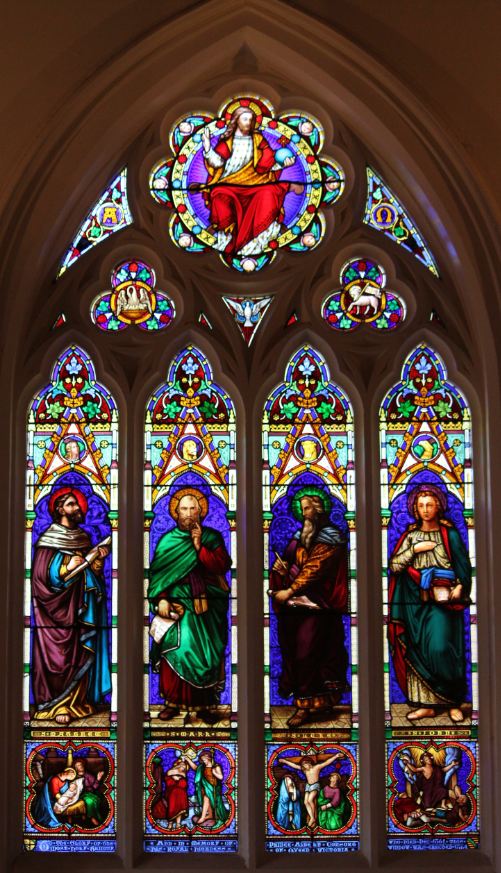
 “A memorial window for H.R.H. the late Prince Consort has been erected in Trinity Church, Kew. It is a four-light window with tracery. The main lights contain figures of the four Evangelists, each surmounted with his emblem and a richly-foliated canopy. Under the figures are four subjects illustrating the birth, baptism, crucifixion and resurrection of our saviour. The principal compartment of the tracery is filled with a representation of our Saviour on a throne surrounded by seven cherubims. The other compartments are filled in with emblems, consisting of the Pelican feeding its young with its own blood, the Lamb and Banner, and the Alpha and Omega. At one end of the inscription at the bottom are the arms of Prince Albert, and at the other end the same, quartered with the Royal arms. The inscription runs thus:- “To the glory of the Most Holy Trinity, and in memory of his Royal Highness Prince Albert, Consort of Queen Victoria, who died A.D. 1861, this window was erected A.D. 1864.” Antique glass has been the material used, the richness of tone and color of which adds to the beauty of the design and workmanship. It has been produced at the works of Messrs. Ferguson and Urie, glass-stainers, Curzon street, North Melbourne, and the finished and superior style of workmanship reflects great credit on the firm”.

Window Text:

MATTHEW, MARK, LUKE, JOHN.

TO THE GLORY OF THE MOST HOLY TRINITY AND IN MEMORY OF HIS ROYAL HIGHNESS PRINCE ALBERT CONSORT OF QUEEN VICTORIA.

This slideshow requires JavaScript.

Related posts: 03-04-1863 > 24-03-186413-08-1867

24-03-1864: Holy Trinity Church, Kew, Victoria, Australia.

The Australian News for Home Readers, Vic, Thursday 24th March 1864, page 3.

 “RELIGIOUS INTELLIGENCE”

 “The ceremony of opening the additional part of Holy Trinity Church, at Kew, took place on the 5th instant, just twelve months after the first part of the building was opened […]”

“[..]A magnificent stained-glass window, to cost about £230, has been ordered for one end of the building. The window will contain figures of the four Evangelists, surmounted with a representation of our saviour […]”

Note: This is in reference to the Prince Consort window by Ferguson & Urie.

Prince Consort Memorial window at Holy Trinity Kew

The Prince Consort Memorial window at Holy Trinity Kew

Related posts: 03-04-186329-04-1864 > 13-08-1867

22-02-1864: St George’s Anglican Church, Queenscliff, Victoria, Australia.

In 1864 the liturgical west three light stained glass window of St George’s Anglican Church at Queenscliff was donated by Dr. David John Williams (1819-1902). He was Trustee and Vestryman of St George’s Church and the first Mayor of the Borough of Queenscliffe in 1863-64. He had served in Russia as part of the English Medical Service and was appointed personal medical officer to Czar Nicholas 1st who awarded him the order of St Ann in 1842. The Czar presented him with an engraved jewel encrusted ring (which sold at auction in 1951 for £270 and at auction in 2012 for $51,000).  Dr Williams also had a lead medical role at the Eureka Stockade at Ballarat in 1854 as well as other government appointed medical positions.

All the Ferguson & Urie stained glass windows were installed  in St. George’s Church at Queenscliff between 1864 and 1892. The window described in this article is the liturgical ‘West’ window which fronts the street and was the first to be erected in the Church and donated by Dr. Williams. The window depicts the Evangelists. Matthew, Mark. Luke and John and the Shield of the Trinity or Apostles Creed.

Photos taken 25th September 2010.

This slideshow requires JavaScript.

The Argus, Melbourne, Monday 22nd February 1864, page 5.

“COUNTRY NEWS. QUEENSCLIFF”.

 ST.GEORGE’S CHURCH. – A large proportion of the visitors to Queenscliff will be well pleased to hear that the episcopal church is completed, and open for public worship. It has been erected – after the designs of Mr. Albert Purchas, of Melbourne – on the summit of Swan-hill, the highest part of the borough …”

 “…At the west end is a three light window, filled with stained glass, designed and executed by Messrs. Ferguson and Urie of North Melbourne…”.

The Australasian Sketcher, Melbourne, Saturday 12th February 1881, page 54.

“ST. GEORGE’S CHURCH, QUEENSCLIFF”

“THE church of St. George, Queenscliff, was begun to be built at the end of 1862 through the energy of Dr. Williams, the recent Government health officer at Queenscliff. It was completed in 1863, and opened for divine worship in January, 1864, by the Rev. R. Cummins, of St. Paul’s, Ballarat. In May of the same year the Rev. H. J. Wilkinson, the present incumbent, was appointed. It was consecrated by Bishop Perry in January, 1868. Its length is 67ft., and its breadth 36ft. 3in.; its height from apex of roof about 40ft. Mr. Purchas, of Melbourne, is the architect. Soon after the commencement of the church the late Judge Fellows took an active interest in it, and continued his liberal help until his death. An Estey organ has just been procured from Messrs, Glen and Co., and is at the entrance of the church. The description of the interior was recently given in a Melbourne daily journal in the following terms:- In Queenscliff itself the principal object is, undoubtedly, St. George’s Church of England, not alone from its internal beauty and perfection of arrangement, but from its being the “outward and visible sign” of the charity of one who was never weary in well doing – the late Judge fellows. The chancel window is of stained glass, and is illustrative of a portion of the Litany, each pane bearing underneath it the words of some appropriate quotation. It consists of 15 panes. The reredos is beautifully coloured, and the whole of the floor of the sanctuary is tiled. There is a marbled credence table, and the sacramental and offertory vessels are of silver, appropriately engraved. There are seats for the assistant priests within the sanctuary, one on the Episcopal, and one on the decanal side. The reading-desk, pulpit, and altar rails are all of polished oak. Over the reading-desk is painted “Pray now unto the Lord,” and over the pulpit, “Preach the Kingdom of God.” There are twelve stained glass windows dedicated to the Twelve Apostles, with suitable texts from the Epistles over each. The pews are slightly raised, as in All Saints’ Church, East St. Kilda, and are arranged so as to leave a centre aisle from the altar gate. Almost immediately over the pulpit is a plain white marble slab, bearing the inscription, “In Memory of Thomas Howard Fellows, Born 21st October 1822 Died 8th April 1878. If you seek his memorial look around.”

The Argus, Melbourne, Vic, Monday 20th January 1902, page 1.

“WILLIAMS.- On the 18th January, at Queenscliff, David John Williams, M.D., F.R.C.S., aged 84.”

The Argus, Melbourne, Vic, Tuesday 19th June 1951, page 3.

THIS jewel of Russia’s Czarist days will be auctioned in Melbourne on Thursday. Czar Nicholas I gave it to Dr. David John Williams, a Victorian surgeon, for service aboard the Imperial yact Queen Victoria in 1847. It is set in gold and diamonds, with an amethyst centre. Dr. Williams, born in Glamorganshire in 1816, came to Australia in 1844 as surgeon-superintendent on the Templar. Two years later he was appointed to the Queen Victoria, which Nicholas had built in England. Dr. Williams returned to Melbourne in 1852. He attended wounded men at Eureka Stockade. Leonard Joel Pty. Ltd. will conduct the auction”.

The Argus, Melbourne, Vic, Friday 22nd June 1951, page 5.

“Czar’s relic for £270.”
“A jewelled order presented to a Victorian surgeon in 1847 by Czar Nicholas I yesterday passed into the keeping of a Malvern art dealer for £ 270.
For the buyer, Mr. John A. Hogan, the value of the order lies in its historic interest. Set in diamonds, with an amethyst centrepiece, it is faced with green enamel. At the base is a double-headed eagle holding a sceptre. “If I break it up the jewels will probably bring only from £10 to £20 each,” Mr. Hogan said. I would have done that a few years ago, but now historic pieces like this find New Australian buyers. They are far keener on them than old Australians.” The inscription on the red leather case reads “Presented by His Majesty, the Emperor of All the Russians, to Dr. J. Williams. MD, surgeon on His Majesty’s yacht, Queen Victoria.” Dr Williams came to Australia in 1844. Two years later he was appointed ship’s surgeon on Czar Nicholas’ yacht. He returned to Melbourne in 1852.”

Fifty seven years later, in July 2008, the Dr D. J. Williams ring, the gift from Czar Nicholas the 1st, again went up for auction. This time it sold for a staggering $51,000.

Noble Numismatics Pty Ltd, Sale 88, Lot 741. 22-24 Jul 2008, Dallas Brooks Centre Melbourne.

“Provenance: The current owner acquired this piece in the late 1950s from a direct descendant of Dr D.J.Williams. David John Williams (1819-1902) Born in Glamorganshire, Wales, in 1819, he studied medicine in England and Scotland, graduating M.R.C.S. Eng., 1841; L.S.A. Lond., 1845; M.D. St Andrews, 1848; F.R.C.S. Eng., 1861. In 1844 he sailed aboard the `Templar’ as Surgeon-Superintendent arriving in Sydney in August of that year. On his return to England he served in Russia as part of the English Medical Service. He was appointed personal medical officer to Czar Nicholas I and spent the summer sailing with the Czar aboard his yacht `Queen Victoria’, and the winter serving in hospitals in St Petersburg. On leaving Russia Dr Williams was presented with the Order of St Anne by Czar Nicholas. Arriving in Melbourne aboard the `Bride’ in May 1853 Williams went first into private practice, then Government service before being posted to the Quarantine Station at Point Nepean in September 1853. Williams was transferred to Ballarat as District Surgeon, whilst there he conducted the inquest into the death of James Scobie on 7 October 1854 and, later that of Henry Powell on 9 December 1854 (who was wounded during the Eureka rebellion). As Camp Doctor Williams attended to the wounded from the Eureka rebellion. Dr Williams remained in Ballarat as coroner when the position of District Surgeon was abolished. He resigned in March 1855, visited England and on his return settled in Queenscliffe serving first as Assistant Health Officer at the Heads in 1858, then as Health Officer in 1867. Whilst in Queenscliffe he took an active part in civic and church affairs, being elected to the Council and becoming the first Mayor of the Borough of Queenscliffe in 1863. Williams died in 1902 and was buried in Queenscliffe. St George’s Church vestry erected a rear window as a memorial to Dr Williams in recognition of his long and invaluable contribution to the church. (References: `Goldrush Doctors at Ballarat’ by Keith Macrae Bowden, Mulgrave, 1977; `Great News Stories of Queenscliff’)”.

(in-line image from noble.com.au)

(in-line image from noble.com.au)

Related posts:
22-02-186429-01-186613-08-186712-02-1881 07-04-1882 >18-10-1884 > 30-12-1893

External Links:

Noble Numismatics:  On leaving Russia Dr Williams was presented with the Order of St Anne by Czar Nicholas.


Short link to this page: https://wp.me/p28nLD-44

© Copyright