25-09-1866: St John’s Anglican Church, Launceston, Tasmania.

St John’s Anglican Church in Launceston contains a three-light Ferguson & Urie stained glass window representing the ‘Ascension’.

This window was originally erected in the chancel of St John’s in 1866 and later moved to the nave in the 1930’s, but in its current configuration it is missing the upper portions of the window above the three main lights which are known as the tracery windows.

The figures or emblems that may have been in the missing pieces have been a mystery until recently. A report of the window in September 1866 described the main body of the windows in detail and “…At the top is the figure of a dove…”[1] As luck would have it I found a copy of Ferguson & Urie’s original design for this window in the State Library of Victoria’s collections. In the original design, the tracery above the three main lights contains three quatrefoil shaped windows with the descending dove in the one at the apex and the symbols Alpha and Omega in the ones below. There are only minor differences in the figurative designs in comparison to the entire window that was actually made and these can be seen in the slideshow of photographs.

Interestingly, the bottom of the original design for the window has the date 1864 which, at minimum, is about nineteen months prior to when it was finally erected in St John’s!

Photos taken: 11th October 2011.
(The copy of Ferguson & Urie’s original design for the window is dated 1864).

This slideshow requires JavaScript.

[View larger images]

Lieutenant George Arthur (1784-1854), Governor of Tasmania, laid the foundation stone of St John’s Anglican Church at Launceston on the 28th of December 1824[2]. On the 19th of February 1826, the church was opened[3] for the first time by Archdeacon Thomas Hobbes Scott (1773-1860) assisted by the first incumbent, Rev John Youl (1773-1827).

Governor Arthur had disapproved of the original plans for St John’s and controversially made an executive decision to have it changed:

“…Sir George ARTHUR, without asking the opinion of any professional man, executive or other council, glanced at the plan, saw that a church built upon it would accommodate as large a congregation as the Colonial Cathedral in his Southern Metropolis[4]. He was a man of action – not words. Assuming at once that Launceston would scarcely ever require so large and extent of Church accommodation as the Architect proposed to provide, he struck a red ink pen mark across the plan of the body of the Church, cutting two windows, or more than one third of the entire length off…”[5]

Some of the most significant and controversial changes to the church began in the mid 1860’s. In February of 1866, in the vestry of St John’s, a meeting was held to discuss the erection of a chancel at the east end with plans and specifications by architect Peter Mills. At the same meeting there was also mention of the new stained glass window to be donated by Mr John Cameron Esq that would be erected in this new chancel:

“The beautiful illuminated window to be presented by John Cameron, Esq., on the enlargement of the church, will be placed in the Chancel. We have seen a photograph of this window, which is richly ornamented. The centre piece is the Ascension of our Saviour.”[6]

The chancel didn’t quite go as expected. It was generally understood by the Rev Dr. Browne and the Wardens that the new chancel would be built up to the height of the original church roof, but miscommunication between the church wardens, the contractor (J. W. Lloyd) and the misinterpretation of the architects plans, caused much confusion between the parties[7].

On Wednesday the 15th August, 1866 John Cameron’s stained glass window arrived from Ferguson & Urie’s workshops in Melbourne aboard the ‘Black Swan’:

The Cornwall Chronicle, Launceston, TAS, Saturday 18th August 1866, page 4.

“The beautiful illustrated window, the munificent gift of the late John Cameron. Esq., arrived here by the Black Swan on Wednesday. The Rev Dr Browne requires the architect’s certificate that the new chancel to St John’s Church is in a fit state to receive this beautiful work of art, and then it can be placed there.”

John Cameron was a staunch supporter and liberal donor to St John’s Church in Launceston. In February 1865 he suffered a serious stroke[8] and although it was reported in the following June that he was recovering[9] he only enjoyed mediocre health for a further year and on the 28th June 1866 suffered another stroke and died at his home ‘Oakburn’ in Launceston, aged 60 years[10]. He never saw his magnificent stained glass window. His obituary was published three days later:

The Cornwall Chronicle, Launceston, TAS, Saturday 30th June 1866, page 4.

“DEATH OF JOHN CAMERON, Esq.
We sincerely regret to announce the demise of John Cameron, Esq, J.P., an old colonist of high standing in this community. Mr Cameron had been attacked with paralytic and apoplectic fits last year, and for a time his recovery to health was doubtful. He soon became convalescent, however, and has enjoyed tolerable good health since. He drove into town almost daily from his residence, Oakburn, Elphin Road, and a short time back paid a visit to Hobart Town. He was in Launceston on Monday, Tuesday and Wednesday last, and said he felt even in better health than usual, but about midnight on Wednesday night he had another fit of apoplexy, and though the usual means were promptly resorted to for his recovery, he sank and died at 10 o’clock on Thursday morning. Mr Cameron amassed a large fortune many years since in this colony by commerce, and since retiring from business he has paid several visits to England. He last returned to this colony some four or five years ago. He was respected and esteemed by all classes for his mild and charitable views and kindly disposition. He was attached to no political sector party; and considered that unanimity amongst the people would tend more to the prosperity of the country than division. Mr Cameron came to this colony about forty years ago at the age of twenty years, and has, therefore, spent nearly two-thirds of his lifetime in Tasmania. He was one of a class of sterling, hard working, successful men who by their energy and perseverance laid the foundations of prosperity in this colony. If the example set by Mr Cameron and other old colonists of his stamp was more closely followed, it would be well for the best interests of Tasmania. Mr Cameron was connected with some of the families of the highest standing in this colony, the present mayor of Hobart Town being his son-in-law, and few men had a wider circle of friends. His removal from amongst them will be felt throughout the colony as a serious loss.”

John Cameron’s funeral was held in St John’s on Tuesday the 3rd of July 1866, two months before his stained glass window was to be erected in the chancel of the church. In late September the Launceston Examiner reported that the window had been erected:

The Launceston Examiner, Tasmania, Tuesday 25th September 1866, page 2.

“RELIGIOUS INTELLIGENCE – CHURCH OF ENGLAND”
“The chancel in connection with St. John’s Church, Launceston, has been finished, and a portion of the service has been conducted in it. The Bishop, it is anticipated, will visit the north in a week or two, when the building will be consecrated. Two handsome stained-glass windows have been erected in the chancel. One is the gift of the late John Cameron, Esq., and represents the Ascension. A half figure of our Saviour is exhibited at the bottom of a centre light, and above that is the Ascension with the words beneath “I go to prepare a place for you.” On either side are the eleven Apostles, looking with wonder and adoration to their ascending Lord. At the top is the figure of a dove. The work does infinite credit to Messrs. Ferguson and Urie, of Melbourne, by whom it was designed and executed. The antique glass – which is a late discovery of the glass used by glass painters in the middle ages – has a very rich although subdued tone, and being heavy in substance gives great additional strength to the window. This contrasts favourably with the smaller window, the resurrection, the gift of the Rev. Dr. Browne, chaplain, in memory of the Venerable Archdeacon Hutchins, the first Archdeacon appointed to the diocese. This window is of common glass, by Headsland
[sic: ‘Hedgeland’]
, of London”.

Seven months after the erection of the window it was subjected to vandalism by boys with slingshots:

The Cornwall Chronicle, Launceston, TAS, Wednesday 8th May 1867, page 5.

“The use of the toy catapult has become a serious nuisance in Town. Schoolboys seem to consider that they have a prescriptive right to do damage to the full extent of the power of the catapult. Whether accidentally or on purpose, the beautiful memorial window in the chancel of St. John’s Church, the gift of the late John Cameron, Esq., has been injured in this way, and ladies and children are daily and hourly subjected to annoyance and danger from the juveniles armed with the catapult. The masters of schools have it in their power to check this nuisance by condemning the use of the catapult in the streets; and the police can also do much to out down this new species of entertainment, so dangerous to persons passing through the streets.”

The lower portions of the window show an extensive number of cracks in the small figure of Christ at the bottom of the window, but whether these were a result of the vandalism from more than a century ago is not known.

In September 2015, David Morris, from St John’s, Launceston, provided the following information in regards to the missing three quatrefoils from the window;

“I was reading your article on your website about a window designed and executed by Ferguson & Urie in 1866 for Mr John Cameron’s donation to St John’s Anglican Church in Launceston. In that article you refer to “the missing three quatrefoils depicting the Dove and Apha & Omega” that were part of the original window. I am happily able to report that those “missing” quatrefoils were saved, and are alive and well, and are on display in the same church, St John’s Church in Launceston, in a history display cabinet available to public view, properly labelled. Your article correctly records that these parts did not fit into the clerestory where the rest of the window has been for many years now.” [11]

Other related posts that mention this window:

13-08-1867: James Urie visits Tasmania on Ferguson and Urie business.
07-08-1867: Decorative Art. James Urie sojourning in Tasmania.

Footnotes:

[1] The Launceston Examiner, Tasmania, Tuesday 25th September 1866, page 2.

[3] Hobart Town Gazette, TAS, Saturday 25th February 1826, page 2.

[4] In reference to St David’s Cathedral in Hobart.

[10] The Cornwall Chronicle, Launceston, TAS, Saturday 30th June 1866, page 4.

[11] David Morris, St John’s, Launceston, Email, 12 Sep 2015.


Article short link: http://wp.me/p28nLD-1E0

© Copyright

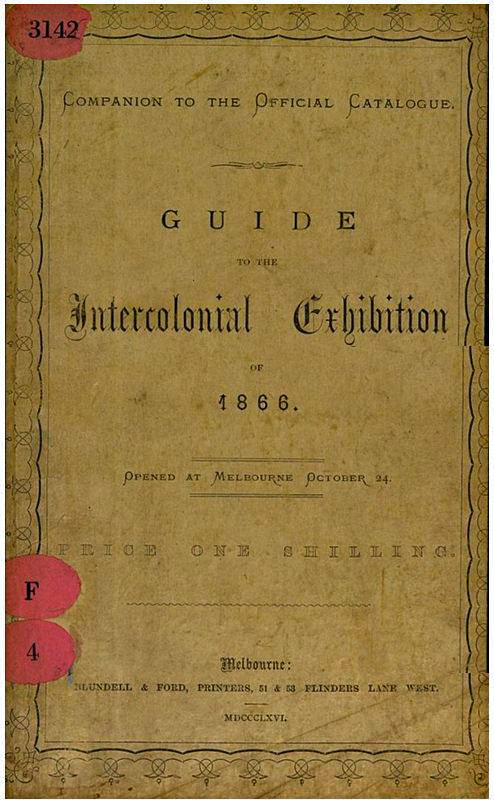
24-10-1866: Guide to the Intercolonial Exhibition of 1866, Melbourne, Victoria.

The Ferguson & Urie stained glass company displayed examples of their workmanship at many exhibitions over a forty year period from 1853.

The 1866 exhibition stands out as the most unique in the company history as being the one that gave them their greatest exposure on the eastern side of Australia and even into New Zealand.

An entire “Medieval Court” was constructed at the 1866 exhibition which included a detailed reconstruction of a church chancel decorated by Ferguson & Urie which was complete with stained glass windows. The idea for the medieval court was based on Augustus Welby Pugin’s Medieval Court, which was first shown at London’s International Exhibition of 1851 and then at the Crystal Palace, Sydenham, between 1852 and 1866. This medieval court reconstruction at the 1866 Melbourne exhibition was the first of its kind seen in the Australian colony and drew and extraordinary crowd.

The most remarkable of the historical artifacts in the medieval court were Ferguson & Urie’s set of five single light stained glass windows depicting the Nativity, Passion, Crucifixion, Resurrection and Ascension. After the exhibition these windows were installed in the chancel of Christ Church at Casterton in Western Victoria and are still in place to this day, although there is a small mysterious anomaly as the the order the windows were installed!

“GUIDE TO THE INTERCOLONIAL EXHIBITION OF 1866”.

“THE MAIN HALL”.

“ON entering this hall from Latrobe-street, visitors who put themselves under our guidance will find, by turning immediately to the left before arriving at the fur trophy, which faces them, that they have come upon perhaps the last thing one might expect to encounter in an exhibition of the products and manufactures of a new colony – to wit, a Mediaeval Court, the whole of the decorations and contents of which are the work of two Melbourne houses, the one that of Mr. John Young, contractor, and the other that of Messrs. Ferguson, Urie and Lyon, glass-stainers, &c. The excellence of this court consists not more in the beauty of the various articles it contains than in the admirable tone of all the decorations, giving to the place that “dim, religious light” befitting the character it assumes. The stained-glass windows let into the partitions surrounding the court are mainly instrumental in producing this effect. The court is filled with statuary, fonts, and elaborately-ornamented wrought-iron articles, suitable for mediaeval church purposes. One of the statues represents the Madonna and Child; others personify St. John, St. Thomas, and St. Theresa. Attached to the walls near the roof are several of the quaintly-carved figures which catch the eye in old churches. These are intended for St. Patrick’s Cathedral, now in course of erection on the Eastern Hill. To complete the ingenious effect of this court as a complete work of art, Messrs. Ferguson, Urie and Lyon have constructed at the side opposite the entrance a recess representing an early English chancel, the decorations of which are most complete. The furniture of the chancel consists of an altar table, an illuminated oil painting of the last Supper, and illuminated tablets of the commandments, creed, and Lord’s Prayer. The light admitted to the chancel pours through five stained-glass windows, representing respectively the nativity, Passion, Crucifixion, Resurrection, and Ascension. These are designed for the Episcopalian Church at Casterton. The walls are also artistically decorated, and altogether this chancel, with the court leading to it, make up one of the most remarkable objects of the Exhibition”.

Related posts: 10-06-1867 > 25-10-1865 > 03-11-1866 > 20-12-1866


Shortlink to this page: https://wp.me/p28nLD-1os

© Copyright

28-07-1866: St Paul’s Presbyterian Church, Ballan, Victoria.

The Bacchus Marsh Express, Vic, Saturday 28th July 1866, page 2.

THE OPENING OF THE NEW PRESBYTERIAN CHURCH, BALLAN”.

“SABBATH last brought with it the long-looked-for day of opening of this beautiful Church. The new building is, perhaps, the most prominent, as it is certainly the finest erection in this rising township. The style of architecture is modern Gothic. The building is of bluestone rubble, every alternate stone having a four inch sneck, and is neatly tuck-pointed. It stands on a base two feet high, while the outer walls are supported by twenty abutments of freestone, with small bluestone snecks let in, and finished at the tops with two weatherings. The fine large window in front of the edifice consists of freestone reveals and arches, and is divided by two mullions nine feet high, being finished in the same way both externally and internally. There are also eleven other windows, while the whole is surmounted by an exceedingly chaste spire, which rises to a considerable height. The spire is likewise built of mixed blue and freestone, which is carried up sixteen feet square, at which point commences an octagon tower, perforated with eight windows four feet high, the interior of which forms the bell-tower. Immediately above the bell-tower stands a circle of freestone moulding, which is destined to receive a very handsome clock. Attached to the main building is a vestry, divided into two rooms, the whole edifice being finished by a freestone water-table. The building occupies a commanding situation, and the effect is altogether very pleasing, as the eye first rests upon it. Unlike many colonial buildings, whether public or private, the new church will bear the closest scrutiny. The grounds have been securely and handsomely fenced in, while great taste and skill have been displayed in laying them out, and planting them with choice trees. The same care and taste which is visible in the exterior of the building, is observable in the furnishing and decorating of the interior. Here all is comfort and elegance. On entering, the first thing which strikes the eye is the highly-elaborate way in which the windows have been filled in with stained glass. They were furnished by Messrs. Fergusson [sic] and Urie, of North Melbourne. With one exception, we question if any building in the colony, whether ecclesiastical or otherwise, will compare in this respect with the new Church in Ballan. The large triple window in front is exceedingly rich, and is the gift of three ladies belonging to the congregation – Mrs. Dugald McPherson of Bungeeltap, Mrs. Peter Inglis of Ingliston, and Mrs. John Edols of Mount Dariwell. The pulpit is of red cedar, elaborately carved, and is surrounded by a rail, supported on twisted pillars, within which stands the desk and chair for use of the precentor. The church is lighted by two bronze chandeliers suspended from the lofty arched ceiling, each bearing four large lights. But to realise the beauty and effect of the whole, one must be present when the noonday sun is streaming through the large triple window which faces the pulpit; then the various windows are seen in all their exquisite beauty of finish and colour. Of course the finest of all is the centre-piece of the large centre window. On an Egyptian scroll which winds round the delicate tendrils of the red rose of Albion, so much celebrated and esteemed by the crusaders of the Holy Wars, there is inscribed these appropriate words of Holy Writ, “I am the Way, and the Truth, and the Life.” We may notice, as a matter of paramount importance in a building designed for public worship, that its acoustic properties are perfect. It is seldom that so complete a public building is seen, and too high praise cannot be accorded to the Presbyterians of Ballan for the spirit and liberality which they have manifested in this undertaking. To the ladies who throughout have manifested such an unwearied interest, great praise is due. It is, perhaps, slightly invidious to mention further any names, where so many have been characterised by such activity and generosity, but we think that all will unite with us in testifying to the special liberality and zeal displayed by the following gentlemen:- Dugald McPherson, Esq., J.P., whose munificence has been of a princely nature, and to whom, more than all others, the Presbyterians in Ballan are indebted for this truly handsome erection; Peter Inglis, Esq., J.P., who from the first has shown the warmest interest in the undertaking, and who, we believe, was the first to head the list with a subscription of £100; Walter Duncan, Esq., J.P., who has been the friend and treasurer of the congregation from the beginning of its history. It is exceedingly gratifying and hopeful to see gentlemen of high character and social standing identifying themselves with the cause, as these and others like them are doing.”

Photos taken: 29th December 2010.

This slideshow requires JavaScript.

The memorial text at the base of the liturgical west three light window has the names of each of the donors:
“Ye gift of Mrs John Edols AD 1866″ | “Ye gift of Mrs Dugald Macpherson AD 1866″ | “Ye gift of Mrs Peter Inglis AD 1866″

The Donors:

Edols:

Mrs John Edols (Margaret, nee Brown) was the wife of John Edols Esq., of Dariwell Park, John was appointed as a trustee[1] of the Ballan Race track and recreational reserve in July 1860, along with Dugald MacPherson and others and also acted as a steward[2] at the Ballan racing events. Margaret died[3] at “Ingliston” on the 17th of September 1872 and was buried in the Melbourne General Cemetery on the 19th of September 1872 [4]. (there is no known gravestone recorded).  John Edols left the Ballan area circa 1888 and died at “Bryan O’Lynn”, near Warrnambool on the 28th December 1888 [5] He was buried at the Tower Hill Cemetery (a gravestone still exists).

MacPherson:

Mrs Dugald MacPherson was Mary Elizabeth MacPherson (nee O’Cock), wife of Ballan Councillor Dugald Macpherson (1820-1901) of Bungeeltap. She died at ‘Bungeeltap-house’ at Ballan in August 1916 and was buried at the Ballan New Cemetery on Wednesday 16th August 1916[6]. Dugald MacPherson died at Bungeeltap, Ballan, on the 20th of October 1901 aged 81 [7] . The Macpherson family grave still exists at the Ballan cemetery but the memorial writing is nearly impossible to read.

External Links:

Museum Victoria: Dugald Macpherson (1820-1901)

Gordon, Egerton and Ballan Advertiser, Vic, Friday 25th August 1916, page 4.

“The late Mrs Macpherson, of Bangeeltap, whose death was reported in last week’s Adverister, was a native of Exeter, England, and a daughter of the late Mr Richard Ocock, solicitor, Ballan. She was married at St Kilda in 1852, and spent the first 2 years of her married life in the Wimmera, and was the first white woman to go to that part of Victoria, which was then inhabited by aboriginies. In 1854, Mr Macpherson, (who died 16 years ago) having purchased Bangeeltap [sic], Mrs Macpherson went there to live, where she resided till her death. Eight sons and five daughters were born at Bangeeltap. During her 62 years residence at Bangeeltap Mrs Macpherson had many and varied experiences, one of which was a corroboree amongst the blacks, which she witnessed. She was one of the first members of the Ballan Presbyterian church, laid the foundation stone, presented a large window, and with her husband was a most liberal supporter for many years. The Rev E. J. Welsh conducted an In Memoriam service in the church on Sunday last. The service was largely attended by many friends of the deceased lady”.

Note: Her mother, Rebecca Mary O’Cock, also has a stained glass window by the Ferguson & Urie Company which was erected in St John’s Anglican Church in Ballan in 1883.

See: 10-03-1883: St John’s Church, Ballan, Victoria.

Inglis:

Mrs Peter Inglis, wife of Ballarat magistrate, Peter Inglis (1796-1869, a native of Glasgow) of Ingliston, near Ballan. Peter Inglis died on the 6th of July 1869, aged 73 [8]. There are also ‘Inglis’ streets in Ballan, Buninyong, and Warrenheip named after the family. The Inglis family memorial exists at the Ballan Cemetery but the text for Peter Inglis side of the memorial has almost faded completely.

Excerpt, HISTORY OF BALLARAT, page 6

In the year 1843, Mr. Peter Inglis, who had a station at Ballan, took up the Warrenheip run, and shortly after that purchased the Lal Lal station, and throwing them both together, grazed on the united runs one of the largest herds in the colony. The western boundary of Mr. Inglis’ Warrenheip run marched with the eastern boundary of Mr. Yuille’s run, the line being struck by marked trees running from Mount Buninyong across Brown Hill to Slaty Creek. Mr. Donald Stewart, now of Buninyong, was stock-rider for Mr. Inglis, on the Warrenheip and Lal Lal stations, and superintendent during the minority of the present owner of Lal Lal”

Minor mention in Biography of: Archibald Fisken (1827-1907)

Obituaries for Peter Inglis.

1. The Argus, Melbourne, Vic, Monday 12th July 1869, page 5.

2. Obituaries Australia

Related posts:  22-07-186613-08-1867

Foot notes:


[8] The Argus, Melbourne, Vic, Thursday 8th July 1869, page 4.


Short link to this page: https://wp.me/p28nLD-1jZ

© Copyright

1868: All Saints Anglican Church, South Hobart, Tasmania.

The Colonial Victorian Stained Glass firm, Ferguson & Urie created the John Henry Foster Memorial Window, and the ‘St Matthew & St Luke’ and ‘St Mark & St Peter’ windows at All Saints Anglican Church, South Hobart, Tasmania.

The vast majority of our historical stained glass memorial windows have an element of tragedy and mystery surrounding them, but over the course of more than a century the story behind who they were memorials to has long faded from memory.

In August 1867, James Urie, a principal partner in the Colonial Victorian Stained Glass firm, Ferguson & Urie, was travelling Tasmania with a portfolio of the companies secular and ecclesiastical stained glass designs. Amongst the many commissions he had received for stained glass windows, was one for Mr John Foster Esq, to be erected as a memorial to his eldest son, John Henry Foster[1].

 “DECORATIVE ART– The admirers of art workmanship will be glad to hear that there has for the last couple of weeks been sojourning in Tasmania, a partner of the Victorian firm of Ferguson, Urie, and Lyon, to whom many ecclesiastical and private edifices in this and the neighbouring colonies are indebted for some of the finest specimens of pictorial decoration on glass, of which they have yet become the possessors…”[2]

“…the firm are in receipt of commissions from John Foster, Esq, for a memorial window to be placed in All Saints’ church, Hobart Town, in remembrance of the donor’s deceased son, and from A. Kennerley Esq[3], for other decorated windows for the same church…” 

Photos taken 8th October 2010.

This slideshow requires JavaScript.

The two light Foster memorial window for All Saints Anglican Church in Hobart was created by Ferguson & Urie and erected circa 1868.

A trefoil above both lights depicts the Lamb of God (Latin ‘Anus Dei”) carrying the Christian banner.

The central figures in each light depict beautifully coloured and intricately designed figures that correspond with verses from Mark 11:22, with the text below: “HAVE FAITH IN GOD” and Luke 18:16 with the text, “SUFFER LITTLE CHILDREN TO COME UNTO ME”.

Above each figure is an angel carrying a ribbon with text from Revelations 14:13 “Blessed are the dead” and “Which die in the lord”

The bottom edge of the window has the memorial text:

“ERECTED BY JOHN FOSTER ESQ. IN MEMORY OF HIS DEAR SON”.

The memorial text on the window doesn’t reveal much information, but the prominent Tasmanian newspapers of the time reveal the sad story of the boys demise.

On the evening of the 3rd of December 1866 a tragic accident occurred near the Foster family home at 94 Davey street Hobart. In the vicinity of the barrack gates in Davey street, the young John Henry Foster was knocked from his pony by a coach and subsequently run over by its wheels and he died shortly after.

“DISTRESSING AND FATAL ACCIDENT.- One of the most distressing and fatal accidents, which it has for some time past been our lot to record, occurred in Davey-street at about half past four o’clock yesterday afternoon. It appears that Master Foster, son of John Foster, Esq., of Davey-street, a promising little lad between six and seven years of age, was riding on his piebald pony along Barrack-street, being accompanied by Master Hinsby, who was also on horseback. When nearing the corner opposite the barrack gate a cab was observed coming down Davey-street at full speed. Master Hinsby kept his right side, taking a full sweep, and passing the cab. He was closely followed by Master Foster, but the cab took rather a wide sweep in turning the corner and ran right into the poor lad, who was struck it is believed by the pole, knocked off his pony and the wheels of the cab passing over him. He was at once picked up, and under the direction of the Hon. R. Q. Kermode, Esq., and Dr. Benson, who were passing at the time, he was conveyed into a cottage near the residence of Captain Clinch…”[4]

Young John Henry Foster was subsequently dispatched to hospital and Dr Bright was in attendance within half an hour but “…on his arrival the poor little fellow had breathed his last.”[5] Equally tragic was the fact that the boys parents were away in Melbourne at the time and it was left to the Hon R. Q. Kermode to contact them and advise of the tragedy.

“Mr. Kermode has, we believe, written to the bereaved gentleman informing him of his terrible loss.” [6]

An inquest was held in the absence of the boys parents, at the Greyhound Inn on Wednesday the 5th of December 1866 [7] before A. B. Jones, Esq,. and a jury of seven. The jury foreman was none other than the long time friend of John Foster, the Hon Alfred Kennerley, Esq.

The inquest found that the cab was not speeding as previously reported and that the pole brace attached to the collar of the cabs outside horse had bumped the rear of the boys pony causing the boy to fall off and go under the wheels. No blame was attributed to any anyone for the accident.

“…The jury would not call upon the coroner to go through the evidence, and returned a verdict that deceased had been accidentally killed, requesting that it might be noticed by the press that no blame was attached to John Newhey, the driver of the cab, nor did the jury attribute any blame to Mr. Hinsby, junior. The inquest was then closed.” [8]

The funeral of Master John Henry Foster didn’t occur until his parents had arrived back from Melbourne some twelve days later and was interred in the Foster family vault at Cornelian Bay Cemetery, Hobart, on the 15th of December 1866 [9].

 Over 144 years has passed since the tragic event and the windows creation by Ferguson & Urie. The newspaper article from 1867 also mentioned that Alfred Kennerley had also commissioned Ferguson & Urie for other decorative windows:

“…and from A. Kennerley Esq[10], for other decorated windows for the same church…”

The windows donated by Alfred Kennerly are the ‘St Matthew & St Luke’ and ‘St Mark & St Peter’ windows. None of these windows appear to be memorials as such and are likely to have been erected at the same time as the Foster memorial window.

Biographies:

John Foster (1792-1875)

Alfred Kennerley (1810-1897)

End Notes:

[1] John Henry Foster, born 27th January 1860. (date as per memorial at Cornelian Bay Cemetery, Hobart)

[2] The Mercury, Hobart Tasmania, Wednesday 7th August 1867, page 2.

[3] The Hon. Alfred Kennerley. Alfred Kennerley (1810-1897)

[4] The Mercury, Hobart, Tasmania, Tuesday 4th December 1866, page 2.

[5] ibid

[6] ibid

[7] The Mercury, Hobart, Tasmania, Thursday 6th December 1866, page 3.

[8] Ibid

[9] The Mercury, Hobart, Tasmania, Saturday 15th December 1866, page 1.

[10] The Hon. Alfred Kennerley.

Restoration/Conservation:

The Ferguson & Urie windows are undergoing restoration in 2013 by Gavin Merrington. The Foster memorial is the first in the series to be restored and has been removed as at May 2013.


Short link o this page: https://wp.me/p28nLD-1a3

© Copyright

14-12-1866: St Luke’s Anglican Church, Yea, Victoria.

“Oh, Lord, I am shot”

Sometimes Stained Glass windows commemorate a life taken in tragic circumstances.

On the 14th of December 1866, a thirteen year old boy named Edmund George Taylor accidentally shot and killed himself  on the road to Yea in north east Victoria.

“…He was on the dray with a gun in his hand, when by some means or other it went off, and he contents were lodged in his chest, causing almost instantaneous death. His companions did not observe the gun go off, but only heard the report, and saw the deceased fall off the dray. He exclaimed, “Oh, Lord, I am shot,” and never spoke afterwards…”

It can only be assumed that his father, George Henry Taylor, a solicitor from Upper Hawthorn near Melbourne, had commissioned Ferguson & Urie to create the memorial stained glass window to his son. The window was erected in St Luke’s Anglican Church in Yea in North east Victoria. Whether the Yea Church was considered symbolic as the place to erect the window is not known, but it’s the destination his son never reached.

The date the window was actually created and erected in St Luke’s is not known. The Anglican Church of St Luke at Yea wasn’t constructed until 1869 and so it’s likely that the window was one of the first to be erected in the church and is also the window you see immediately on entering the church.

The central symbol in the window is an intricately designed blue cross on a rich ruby red background with floral and vine leaf designs in various colours. The cross is surrounded by the verse from Ecclesiastes 12:7.
THE DUST SHALL RETURN TO THE EARTH AS IT WAS AND BE SPIRIT UP TO GOD WHO GAVE IT”.

The memorial text at the bottom of the window reads:
IN MEMORIAM – EDMUND GEORGE TAYLOR – DIED DECEMBER 14th 1866”.

Photos taken 26th December 2011.

This slideshow requires JavaScript.

The Age, Melbourne, Vic, Tuesday 18th December 1866, page 5.

“A boy, named Edmund George Taylor, aged thirteen years, the son of Mr. Taylor, solicitor, living at Boroondarra, was accidently killed last Friday. It appears that, together with his brother, he was in company with a man named John McCessey, who was taking a bullock dray to Yea. He was on the dray with a gun in his hand, when by some means or other it went off, and he contents were lodged in his chest, causing almost instantaneous death. His companions did not observe the gun go off, but only heard the report, and saw the deceased fall off the dray. He exclaimed, “Oh, Lord, I am shot,” and never spoke afterwards. An inquest was held upon the body on Sunday, by Mr Candler, when Mr Bragge, Surgeon, deposed that he made a post mortem examination of the body, and found a most extensive gun-shot wound in the stomach and chest, the third, fourth, and fifth ribs being shattered, and the right lung broken up, and in the apex witness found a mass of wadding and shot. There were some detached shots by the side of the spine. The direction of the wound was upwards and inwards. The firearm causing it must have been quite close to the person of the deceased. The jury returned a verdict of accidental death.”

The Argus, Melbourne, Wednesday 19th December 1866, page 5.

“The name of the unfortunate lad who was lately accidentally shot while traveling in a dray in the neighbourhood of Boroondara, should have been Edmund George Taylor, and not Charles Frederick Taylor. The latter – the brother of the deceased – was present, and unfortunately, a witness of the accident”.

The Argus, Melbourne, Tuesday 18th December 1866, page 5.

“On Thursday last an accident, which terminated fatally, occurred to a lad thirteen years of age, named Charles Frederick Taylor, the son of Mr. Taylor, solicitor, of Boroondara. It appears that between eight and nine o’clock on the morning of the day named the deceased was seated in a dray with a gun in his hand, when the piece suddenly went off, and the boy immediately afterwards cried out, “My God! I’m shot.” No one knows exactly how the accident occurred; but as the deceased was attempting at the time to get off the dray, with the gun in his hand, it is probably that the lock struck against something. There was a large wound in the chest where the charge had entered. Mr. Chandler held an inquest on the body yesterday, when the jury returned a verdict of “Accidental Death”.

The Argus, Melbourne, Monday 17th December 1866, page 4.

“TAYLOR.- On the 14th inst., on the road to Yea, accidentally killed when carrying a loaded gun, Edmund George, the fifth son of George Henry, and Maria Taylor, of Upper Hawthorn, aged fourteen years.


Short link to this page: http://wp.me/p28nLD-14l

© Copyright

22-07-1866: St Paul’s Presbyterian Church, Ballan, Victoria.

St. Paul’s Presbyterian Church in Ballan, eastern Victoria, was officially opened 22nd of July 1866.

The following year, on the 13th August 1867, the Hobart Mercury reported that James Urie, one of the principal partners in the Victorian Stained glass firm of Ferguson & Urie, had been “sojourning” in Tasmania with a catalogue of the firm’s designs for ecclesiastical and secular stained glass. The Presbyterian Church at Ballan, St Paul’s, was mentioned in the article as one of many Victorian Churches that had recently received stained glass windows by Ferguson & Urie.

[…] This gentleman is now in Launceston, and we were much gratified yesterday by inspecting a large portfolio of designs for church and other windows which his firm has executed or has in hand […]

I visited St Paul’s (now a Uniting Church) in Ballan in December 2010 and found that all the windows were original Ferguson & Urie stained glass, none of which appear to have been repaired or restored since they were erected in the church over 140 years ago.

The principle triple light east window has the typical Ferguson & Urie scroll design. In the ribbon of the centre light is the verse from John 14-6: “I AM THE WAY AND THE TRUTH AND THE LIFE”

The text at the bottom of each lancet has the names of each of the donors:
“Ye gift of Mrs John Edols AD 1866” | “Ye gift of Mrs Dugald Macpherson AD 1866” | “Ye gift of Mrs Peter Ingles AD 1866”

Photos were taken 29 Dec 2010.
Some of the dark patches seen in the borders of some windows in the vestry are from a thick carpet of spider webs on the inside and outside of the windows.

This slideshow requires JavaScript.

The Donors:

Edols:

Mrs John Edols (Margaret) was the wife of John Edols Esq (1817-1888)., of Dariwell Park, he was appointed as a trustee[1] of the Ballan Race track and recreational reserve in July 1860, along with Dugald MacPherson and others and also acted as a steward[2] at the Ballan racing events. Margaret Edols (nee Brown) died[3] at “Ingliston” on the 17th of September 1872 and was buried in the Melbourne General Cemetery on the 19th of September 1872 [4]. John Edols left the Ballan area circa 1888 and died at “Bryan O’Lynn”, near Warrnambool on the 28th December 1888 [5]. He was buried at the Tower Hill Cemetery.

MacPherson:

Mrs Dugald MacPherson was Mary Elizabeth MacPherson (nee O’Cock), wife of Ballan Councillor Dugald Macpherson (1820-1901) of Bungeeltap. She died at Bungeeltap-house” at Ballan in August 1916 and was buried at the Ballan New Cemetery on Wednesday 16th August 1916[6]. Dugald MacPherson died at Bungeeltap, Ballan, on the 20th of October 1901 aged 81 [7] .

Inglis:

Mrs Peter Inglis, wife of Ballarat magistrate, Peter Inglis of Ingliston. Peter Inglis died on the 6th of July 1869, aged 73 [8].

HISTORY OF BALLARAT, page 6

“In the year 1843, Mr. Peter Inglis, who had a station at Ballan, took up the Warrenheip run, and shortly after that purchased the Lal Lal station, and throwing them both together, grazed on the united runs one of the largest herds in the colony. The western boundary of Mr. Inglis’ Warrenheip run marched with the eastern boundary of Mr. Yuille’s run, the line being struck by marked trees running from Mount Buninyong across Brown Hill to Slaty Creek. Mr. Donald Stewart, now of Buninyong, was stock-rider for Mr. Inglis, on the Warrenheip and Lal Lal stations, and superintendent during the minority of the present owner of Lal Lal”.

Related posts:  22-07-1866 > 28-07-1866 > 13-08-1867

External links:

Museum Vic: Dugald Macpherson (1820-1901)

Obituaries: Peter Inglis.

The Argus, Melbourne, Vic, Monday 12th July 1869, page 5.

Obituaries Australia

20-12-1866: The Medieval Court at the 1866 Melbourne Exhibition

The Chancel windows of Christ Church Anglican at Casterton in Western Victoria were displayed at the 1866 Melbourne Exhibition.

The Ferguson & Urie stained glass company created and decorated an entire chancel for the Exhibitions ‘Medieval Court’ display and the stained glass windows were the central exhibit before being installed in the Casterton Church. Who was actually contracted to install them is still a mystery as the first two windows were installed out of sequence with the ‘Passion’ preceding the ‘Nativity’. Also of note is that Joseph does not appear in the Nativity scene.

The coloured photos were taken 8th January 2011.

This slideshow requires JavaScript.

The Australian News for Home Readers, Vic, Thursday 20th December 1866, page 8.

“MEDIEVAL COURT”

“One would scarcely expect to find a Medieval Court in an exhibition of the products, of a new colony; but such a court there is, intended to illustrate portions of ecclesiastical architecture; and it constitutes, perhaps, the most pictorially effective part of the whole building. Messrs Ferguson, Urie and Lyon, glass stainers, Curzon-street, North Melbourne, exhibit a decorated chancel, the ceiling of which has for a centrepiece the Agnus Dei, surrounded with scriptural texts and gothic clouds. The other portion of the ceiling is divided into twelve compartments, having the emblems of the twelve Apostles. The walls are diapered with simple but chaste pattern. It is lighted with five stained glass windows, the subjects of which are the Nativity, Passion, Crucifixion, Resurrection and Ascension. These windows are made for the chancel of the church at Casterton, and are exhibited by permission of the Rev. Dr. Russell. At the altar are two richly illuminated tablets of the commandment, Lords prayer and creed; also an illuminated painting of the Last Supper. A considerable quantity of stained glass is exhibited, consisting of ecclesiastical and domestic styles; also, numerous samples of stained and embossed borders and small subjects. On the right hand side of the court is a carved baptismal font in Caen stone, designed and executed by Mr John Young, contractor, Melbourne. It is all colonial workmanship. The upper portion is octagonal, representing the four Evangelists. At the top of the shaft are masses of carved foliage with heads interspersed, while at each angle of the shaft, which is double, are buttresses wreathed and moulded. The outer one has got headed open panels cut entirely through showing the centre shaft of the interior. In the splays of he base are clusters of foliage carved from real flowers and leaves, but Gothicised after the decorated period. The base represents evil spirits in the form of dragons, emblematical of the Sacrament of baptism casting them down. The lid of the font is of carved colonial blackwood, polished, ornamented with wrought iron to suit the general workmanship of the whole. In this department are also some highly ornate water fonts, sculptured by Mr. F. Utyco; a number of figures carved in wood for the internal decoration of St. Patrick’s cathedral, an altar and fittings, some hand rails, and several statues of saints.”

The 1866 Melbourne Intercolonial Exhibition was held in a specially built ‘Great Hall’ on a site behind the State Library’s Queens Hall in Swanston Street Melbourne.

Casterton Christ Church 99A


Short link to this post: https://wp.me/p28nLD-6V

© Copyright

03-11-1866: The 1866 Intercolonial Exhibition.

The Brisbane Courier, QLD, Saturday 3rd November 1866, page 6.

“VICTORIA”

“Our files from Melbourne are October 25. The Age of that date contains the following description of the Intercolonial Exhibition opened on that date:- […]”

“[…] In class 4- the manufacturers and the useful arts- special and deserved mention must be made of the exhibits of Messrs. Ferguson, Urie, and Lyon, glass-stainers, North Melbourne. This firm were exhibitors in 1854, but have evidently made great strides during the last twelve years. Their display is unique, and will form one of the attractions of the Exhibition, particularly during the evening, when the illuminated paintings and stained glass windows have their effects brought into prominence by a profuse display of gas light. […]”

25-10-1865: The 1866 Melbourne Exhibition.

 The Argus, Melbourne, Thursday 25th October 1866, page 5,
The Argus, Melbourne, Saturday 27th October 1866, page 2s.
The Launceston Examiner, Monday 29th October 1866, page 3,
The Goulburn Herald and Chronicle, NSW, Saturday 3rd November 1866, page 2.

“OPENING OF THE EXHIBITION”.

“The third Melbourne Exhibition of natural products and works of art was formally opened by His Excellency the Governor at noon yesterday, in the presence of a large concourse of ladies and gentlemen. […]”

“THE VICTORIAN COURTS MAIN HALL”.

“The centre and left side of the main hall are occupied entirely by Victorian products. The display in these courts is extensive and varied. It is natural that the wealthiest and most populous of the colonies should be the largest contributor to the exhibition;…”

“… At the interior side of the mediaeval department, Messrs. Ferguson, Urie, and Lyon, glass stainers, North Melbourne, exhibit and early English chancel, decorated in a highly artistic style. In the centre of the ceiling is the Agnus Dei, surrounded with inscription and Gothic clouds. Radiating from this are twelve panels each containing an emblem of the twelve apostles. The walls are neatly diapered. Over the altar table is an illuminated oil painting of the “Last Supper,” on each side of which are illuminated tablets of the Commandments, creed, and Lord’s Prayer. The windows, five in number, are of stained glass and illustrate the Nativity, Passion, Crucifixion, Resurrection, and Ascension, intended for the Episcopalian Church at Casterton. Over the windows is the scripture text, “Blessed be the Lord God of Israel, for he hath visited and redeemed his people. In the medieval court, the same firm exhibit a variety of stained glass windows, the principal of which are a Salvator Mundi, a memorial , and a heraldic device, besides numerous samples of stained and embossed glass. In embossed plate, they exhibit two samples- one with stained borders, and suited for a hall window; the other a large plate, nine feet by four, for the staircase of Mr. W. J. Greig, of Toorak. In the fine-arts court, they exhibit numerous coloured designs of windows they have executed during the past five years. The whole of the articles shown by this firm are made on their own premises, and show a very satisfactory state of art in this department…”

Nothing further is known about the staircase window mentioned for W. J. Greig of Toorak.

27-10-1866: The Victorian Deaf & Dumb Institution, Melbourne, Victoria.

The foundation stone of the Victorian Deaf and Dumb Institution St Kilda was laid by the Governor of Victoria Sir Charles Henry Darling (1809-1870) on the 6th March 1866 and was formally opened ten months later by his successor, His Excellency Sir Henry Manners Sutton (1814-1877) on Saturday the 13th October 1866. The building still contains a stained glass window created by the Ferguson & Urie company of North Melbourne.

Photo of window courtesy of Mrs Noelle Nathan April 2011.

The general theme of the window is Faith, Hope, and Charity with appropriate scriptural texts from the King James Bible associated with those afflicted by speech and hearing impairments.

1. The left light depicts the Scotch Thistle at the top and below is a cherub holding a scroll with the text: “And in that day shall the deaf hear the words of the book“.
[From the King James Bible Isaiah 29:18 “And in that day shall the deaf hear the words of the book, and the eyes of the blind shall see out of obscurity, and out of darkness.”]
A roundel beneath depicts a crimson cross with a gold crown in the centre and the words ‘FAITH’ below.

2. The apex of the centre light depicts the English Rose. An Angel below it holds a scroll which reads: “The tongue of the dumb shall sing.
[From King James Bible, Isaiah 35:6, “Then the lame man leap as an hart, and tongue of the dumb sing: for in the wilderness shall waters break out, and streams in the desert”].
Below is the stylised interwoven letters “IHS”, an abbreviation for “IHESUS,” the way Christ’s Name was spelled in the Middle Ages. The text in the outer ring of the roundel surrounding it “CHARITY”.

3. In the right light the Irish Shamrock appears at the top and central below it a cherub hold scrolls with the text: “He maketh both the deaf to hear, and the dumb to speak.
[From the King James Bible Mark 7:37 – “And were beyond measure astonished, saying, He hath done all things well: he maketh both the deaf to hear, and the dumb to speak”]
The roundel below depicts the ships anchor with the word “Hope”.

The Telegraph, St Kilda, Prahran and South Yarra Guardian, Vic, Saturday 3rd March 1866, page 2.

The memorial stone of the new Victorian Deaf and Dumb Institution will be laid by His Excellency Sir Charles H. Darling on Tuesday next, on the site recently granted by the Government at the junction of the St. Kilda-road and High-street, Prahran. A large number of ministers and other gentlemen have signified their intention of being present, some of whom will take part in the proceedings.”

The Argus, Melbourne, Monday 15th October 1866, page 5.

“…One of the staircase windows is of stained glass, by Ferguson and Urie. The central square is ten or eleven feet high and there is a figure on it and angel on a sphere proclaiming “The deaf shall hear…”

The Age, Monday 15th October 1866, page 11.

“…A very fine stained glass stair-case window has been erected by Ferguson and Urie, the central square of which is nearly eleven feet high, showing the figure of an angel on a sphere, proclaiming “?the deaf shall hear,” with other scriptural texts of an appropriate character in the other squares,,”

The Australian News for Home Readers, Vic, Saturday 27th October 1866, page 6.

 “OPENING OF THE VICTORIAN DEAF AND DUMB INSTITUTION”

 “The Victorian Deaf and Dumb Institution, the memorial stone of which was laid in March last by his Excellency Sir Charles Darling, was formally opened on the afternoon, of Saturday the 13th inst, by his Excellency Sir J. H. T. Manners-Sutton, in the presence of a numerous assemblage of ladies and gentlemen….”

 “…A very fine stained glass stair-case window has been erected by Ferguson and Urie, the central square of which is nearly eleven feet high, showing the figure of an angel on a sphere, proclaiming “The deaf shall hear.” with other scriptural texts of an appropriate character in the other squares…”

The Australian New for Home Readers, VIC, Saturday 27th October 1866, page 6

“OPENING OF THE VICTORIAN DEAF AND DUMB INSTITUTION.

The Victorian Deaf and Dumb Institution, the memorial stone of which was laid in March last by his Excellency Sir Charles darling, was formally opened on the afternoon, of Saturday the 13th inst., by his Excellency Sir J. H. T. Manners-Sutton, in the presence of a numerous assemblage of ladies and gentlemen. The building is situate adjacent to the St. Kilda road, having a large frontage to High-street, and contiguous to the Wesleyan College, which was also opened during the present year. Its handsome and somewhat elaborate external appearance, surmounted by a lofty tower, entitles the building to rank as another ornament to the colony, and reflects honor upon its promoters; the Government and Parliament, who afforded them such substantial assistance, and the charitably disposed in our community, who have liberally aided the institution. The opening ceremonial was fixed to take place at two p.m., and to be followed by a banquet. His Excellency, Lady Manners-Sutton, together with the private secretary and aide-de-camp, were received at the entrance by the committee of management and the secretary, Mr Moss, and escorted to the dining room, which was temporarily decorated for the ceremonial and banquet. Amongst those present were Bishop Perry and Mrs Perry, his Honor Mr Justice Pohlman, the hon. The Minister of Mines, the hon. Mr Fellows, the Rev. Dr. Cairns, the Rev. J. S. Waugh, the Rev. Mr Macdonald, the Rev. Mr Dare, his Worship the Mayor of Melbourne, Messrs McBain, Balfour, Henty and Langton, M.L.A’s; the mayor of Emerald-hill, the mayor of Williamstown, and numerous other gentlemen connected with the municipal institutions of the suburbs, and many ladies and gentlemen well known for their philanthropic and charitable disposition. The proceedings were opened by his Honor Mr Justice Pohlman taking the chair.

            The Rev. Mr MACDONALD invited all present to join in singing the 355th hymn in the Church psalter, commencing “Before Jehovah’s awful throne.”

            Bishop PERRY delivered and extempore prayer, invoking the blessing of God upon the labors of those who had been instrumental in raising such an institution for the unfortunate children confided to their care.

            Rev. Mr Moss, secretary to the institution, gave a brief report of its rise and progress. Six years ago, he said, Mr Rose went to England in order to ascertain the working of the deaf and dumb institutions in England and on his return to the colony submitted a project for the establishment of such an institution in Victoria, to the present secretary, (the Rev. Mr Moss) who advised him to prosecute it, and after some delay and difficulty a small cottage was obtained about a stone’s throw distant from the present building. The experience then derived established the painful fact that there was a large number of deaf and dumb children residing in the neighbourhood whose parents were unable to pay for their education. It was therefore deemed advisable to extend some assistance to such children, and a meeting was held at the Scots’ Church, at which a provisional committee was appointed for the purpose of establishing a deaf and dumb institution on a scale commensurate with the wants of the colony. Two gentlemen who attended that meeting, viz., the Rev. Mr Macdonald and himself, were now present rejoicing in the success which had attended their efforts. (Applause.) Many difficulties, at the outset, beset them. It was not supposed by many that any necessity existed for such an institution, but when sufficient information had been afforded the public, their sympathies were aroused, and in August, 1862, a public meeting was convened, over which his Excellency Sir Henry Barkly presided, when the project was fairly launched. Since then the efforts of he committee had prospered. They had received general support from the Government, the Parliament, the board of education and the charitable. At the beginning of last year arrangements were made for the erection of a permanent building. An application was made to the Government for a grant of land, and the present site, consisting of six acres, was given. Plans of a suitable building were prepared by Messrs Crouch and Wilson, architects; and Mr Ireland undertook the erection of the building, which had been completed to the satisfaction of the committee. The cost of the present building, including the fencing and outbuildings, was £6800. Towards the liquidation of that amount, the Parliament had voted £4000; a sum of £1800 had been received from private subscriptions; leaving £1000 still to be provided. Of this amount, £500 had been asked of the Government for next year, and the balance it was proposed to raise by private subscriptions. The number of children who had been under the institution since it was first initiated was 58. At present there were 46 children under training, and the number would shortly be increased to 50. It was hoped that the present building would be adequate to the requirements of the colony for many years. The committee, at one time, had hoped to be able to open the building free of debt; but this would have necessitated so serious a delay and it was thought advisable to forego that determination, and trust to the generosity of the public to liquidate the present liabilities. The institution was undenominational in its character and was intended to receive and educate the deaf and dumb without respect to creed. There were three classes of children under tuition: those whose parents only bore a portion of the expense, and those who were wholly educated and supported by the institution. The latter class had been the largest, and had perhaps the strongest claim upon the sympathies of a generous people. There were no means provided for their education apart from the institution, and he felt confident no appeal to the generosity of the public on their behalf would be made in vain. (Applause.)

            The Rev. Dr. CAIRNS offered up a prayer.

 At the request of the chairman his Excellency declared the building open with the following prefatory observations:- Mr Chairman, ladies and gentlemen, in performing the duty which it is my privilege now to perform, it is not my intention to detain you long. Even if I had a desire to enter at greater length than it is my intention to do into the history of the institution, I should feel that I was only weakening the force of that simple and most admirable statement which the secretary has just made. (Applause.) You will bear in mind that that statement, short as it was, gave you a full history of the progress of the institution hitherto, and closed with a most eloquent appeal to your sympathies. (Applause.) It informed you from what a small beginning the present noble institution has sprung, and the energy, perseverance and spirit which those interested in the development of the institution have shown. I avail myself of the privilege to express the sympathy which, individually, I feel with those who have aided in this benevolent object; and I think, ladies and gentlemen, by your presence to day, you have also shown your participation in that sympathy, and before I declare this building open, I hope you will authorise me, as your spokes-man, to carry to the committee your, as they have my warmest congratulations at the success which, by the blessing  of God, has attended their efforts, and your continued support. (Loud applause.) Mr Chairman, ladies and gentlemen, I declare this building open. (Applause.)

            An interval of a quarter of an hour followed, during which his Excellency and family, and the ladies and gentlemen present proceeded to examine the internal arrangements of the building. The present structure comprises the centre and the whole of the southern wing, and has a frontage of 200 feet to the St. Kilda-road. The southern wing, fronting High-street, is 94 feet in extent. The centre building consists of three stories surmounted by a tower and spire 100 feet high. The principal entrance is under the tower, ascended by a flight of stone steps. On the left of the doorway a memorial stone of grey granite, bearing the inscription of the institution, is sunk. The remaining portion of the building is only of two stories. On the basement are the kitchen, pantries, and store rooms. The ground floor is occupied by the rooms of the committee of management, the masters’ dining and sitting rooms, girls’ workrooms, measuring 18 feet and 20 feet by 16 feet each. The boys’ and girls’ school rooms are each 66 feet long by 22 feet wide, with lavatory and clothes rooms at the south-east angle. On the first floor above the school rooms will be the dormitories, &c., and in the master’s division, drawing room, bedroom, bath, &c. The girls’ lavatory and bath room is on the second floor, or third story, and over the grand stair-case. Great attention has been paid to the ventilation. A very fine stained glass stair-case window has been erected by Ferguson and Urie, the central square of which is nearly eleven feet high, showing the figure of an angel on a sphere, proclaiming “The deaf shall hear.” With other scriptural texts of an appropriate character in the other squares. Throughout the building gas and water has been laid on. The visitors were much pleased with their inspection and on returning to the schoolrooms, in which the banquet was laid out, the chair was resumed by his Honor Mr Justice Pohlman, and after grace by the Bishop, the substantial repast was partaken of by 200 ladies and gentlemen. The tables were profusely supplied with good things by the committee, under the superintendence of Mr Bauer, formerly cook to his Excellency Sir Henry Barkly. The head-quarters band played selections of music during the repast. The inner man being comforted, a few toasts were given.

            His Excellency, family, and suite, were accompanied to the board by the officers of the institution, and on his departure the head-quarters band, which was in attendance, played the national Anthem”.

About some of the names mentioned in the above article:

Justice Pohlman:

Ferguson & Urie were commissioned to create a stained glass memorial window to Judge Pohlman circa 1867. This window has not been located to-date. It’s believed that it may have been erected in either the former St Paul’s Church (prior to the erection of the Cathedral in 1888) or in St Enoch’s, Collins Street (demolished on unknown date). Some other Ferguson & Urie windows that were in the St Paul’s Church prior to 1888 have been located in St John’s, Sorrento and St Paul’s at Warragul.

Mr. Fellows:

The Hon Thomas Howard Fellows MLC was a liberal benefactor of St George’s Church at Queesnscliff. He donated the three light chancel window of the church in 1866 and the twelve Apostle windows later. Christ Church in South Yarra has a memorial stained glass window to Thomas Howard Fellows who died 8th April 1878.

Scots’ Church:

The two largest windows in Scot’s Church, Collins Street, were created by Ferguson & Urie. The “Eight Episodes from the Gospels” window was installed in the west end in 1876 and was gifted by Sir Samuel Wilson. The “Last Supper” window was gifted by John Wilson. Esq, J. P of Woodlands (brother of Samuel) and was installed in the South Transept in 1879.

Crouch & Wilson:

A considerable number of buildings designed by Crouch & Wilson contain Secular & Ecclesiastical stained glass windows by Ferguson & Urie. Whether there was any formal agreement between the two companies is not known but similar agreements like this did exist between architects and stained glass companies in England. T. J. Crouch of the architectural firm had also designed Ferguson & Urie’s Collins street premises in 1884.

The Argus, Melbourne, Vic, Wednesday 7th March 1866, page 5.

“LAYING OF THE MEMORIAL STONE OF THE VICTORIAN DEAF AND DUMB INSTITUTION.

Among the many charitable institutions which do honour to the Victorian metropolis there are few more deserving of support than the Institution for the Deaf and Dumb. Its history, from the first attempt to set up a private school, at Windsor, a few years ago to the present time, is a very interesting one, and its career has been marked by great usefulness and success. For a long time past, the building has been found too small and incommodious for the increased number of inmates, and various efforts have been made to enlist private sympathy and secure Government aid, with the view of raising a more suitable structure. The result of the movement has been very satisfactory. Government granted a site of six acres for the erection of a new building, very prettily situated, at the junction of the St. Kilda-road and High-street, Prahran, besides a sum of £3,000. A sum of £1,300 has been raised by private subscription, and, as the estimated cost is £6,500, there remains a balance to meet of only £1,200. A considerable number of spectators assembled yesterday afternoon upon the site of the new building, to witness the laying of the memorial-stone by His Excellency Sir Charles darling. At three o’clock, His Excellency, accompanied only by his aide-de-camp, Captain Tyler, arrived. There were present the Rev. Messrs. J. S. Waugh, D. Macdonald, S. L. Chase, J. Eggleston, and M. H. Becher; Messrs. J. Balfour, M.L.A., H. Henty, M.L.A, and a large number of others gentlemen interested in the institution. The children of the institution were also on the ground.

            The Rev. S. L. CHASE opened the proceedings with prayer.

The Rev. J. DARE having read a passage of Scripture suitable to the occasion.

The Rev. W M. MOSS delivered a long address, in which the early fortunes of the institution and its humble beginning of the year 1864. The number admitted into the institution since that time was fifty-two; the number at present residing in the institution was forty-two. The branches taught to the children were reading, writing, and arithmetic, with the rudiments of drawing, and the other elements of an English education suited to their condition. The rev. gentleman then gave a history of the rise and progress of the movement for procuring the erection of a new building. In concluding his remarks, he said that the institution was not organised to meet imaginary wants. From a calculation based on the returns for the mother country, there must be at least 200 persons among us who could neither hear nor speak. It must be borne in mind that a number of these unfortunates must annually increase, not only by the increase of the population, but through the agency of those diseases to which infancy in this colony is peculiarly subject. The majority of the children upon the platform were not born deaf and dumb, but became so either by disease of by accident.

            Mr. H. HENTY, M.L.A., having, after a few brief remarks, presented the trowel. His EXCELLENCY said it gave him great pleasure to listen to the narrative of Mr. Moss. Mr. Henty only estimated his feelings aright in supposing that he had taken a great interest in the progress of the institution. He accepted the trowel, and would always retain it as a memento of that interesting occasion. (Cheers.) The memorial-stone, with an inscription commemorative of the occasion cut upon it, was then lowered, the whole audience joining, with heads uncovered, in singing the “national Anthem.” The stone having been lowered, a leaden box containing the following documents was placed within it:- Copies The Argus, Age, and Herald, 6th March, 1866; the Telegraph, 3rd march, 1866; Supplement Bendigo Advertiser, 28th January, 1865; annual reports of the institution for the years 1863, 1864, and 1865; and scroll containing and account of the ceremonial, and the names of the office-bearers of the institution. His Excellency then, with the usual ceremonies, declared the memorial-stone to be well and truly laid. He could not permit this ceremony to be performed altogether in silence. Not only as patron of the institution, and Governor of he colony, but as a Christian man desirous of promoting all true works of benevolence he rejoiced in the progress made by the institution, and which was indicated by the ceremony just concluded. It could not be laid to the charge of this colony that it was indifferent to the wants of suffering humanity. Already no less than twenty-four public hospitals, six benevolent asylums, four orphan asylums, and one lunatic asylum – intended very shortly to be supplemented by a second – attested the sense which had pervaded the Government of this colony of their great obligation to relieve the poor and afflicted. (Cheers.) These institutions gave relief to 17,000 people within their walls, and extended assistance to 30,000 or 40,000 people out of doors. The amount which the public contributed to the support of these and kindred objects could not be estimated at less than an annual sum of 100,000. He trusted that this institution would successfully accomplish the great object of encircling within its four walls all persons afflicted with the infirmities it was intended to relieve. Till it was established, one link was wanting in the series of necessary charitable institutions. There was no form in which human distress presented itself in a more pitiable aspect than in the case of the deaf mutes, for whose education this institution was intended. (Cheers.) Having expressed these sentiments, it only remained for him to hope that Almighty Providence would in all time come dispose the hearts of the people of this colony to the recognition of the duties incumbent upon them, in the way of charity. They had hitherto responded nobly to the calls of benevolence, and in the bosom of the community there had sprung up a large number of noble men, both clergy and laity, who devoted their best energies to the doing of good, and the promotion of works of a character kindred with the Deaf and Dumb Institution. (Loud applause.)

            On the conclusion of His Excellency’s address, the Rev. Mr. MACKIE, of South Yarra, called for three cheers for the representative of Her Majesty, which were given with great good-will by those present.

            The rev. Mr. MACDONALD having thanked His Excellency for his attendance, a verse of the hymn “Praise God from whom all blessings flow” was sung, and the proceedings were brought to a close by a short prayer by the rev. M. H. BECHER.

__________

            As an account of the new building may not be without interest, the following sketch is appended:-

            The building is in an advanced stage of progress, and is being erected from the designs prepared by Messrs. Crouch and Wilson, architects, I the style known as Early English. The portion already in hand comprises the centre and the whole of the southern wing, being fully two-thirds of the completed design. When finished, the edifice will present a façade of 200 feet in length to the St. Kilda-road. The southern wing, now to be erected, will have a frontage to High-street, Prahran, of ninety-four feet. The centre portion is three stories high, exclusive of rooms in the basement, and is surmounted by a tower and spire, rising to the height of 106 feet. Beneath the tower is the principal entrance, where also the memorial-stone is laid. The rest of the structure is only two stories high, exclusive of rooms in the basement.

            The basement is devoted to stores, pantries, kitchen, and play-room. On the ground floor are the committee-room, master’s dining and sitting room, and girls’ workroom, measuring eighteen feet and twenty feet by sixteen feet each. In the wing now going up will be boy’s and girls’ school-rooms, each sixty-six feet long by twenty-two wide, with lavatory and clothes rooms at the south-east angle.

            On the first floor above the school-rooms will be the dormitories, &c.; and in the master’s division, drawing room, bedroom, bath, &c. The girls’ lavatory and bath-room is on the second floor, or third storey, and over the grand staircase. Great attention has been given to the ventilation, and there is no lack of stairs to the several floors. The walls are being carried up with blue-stone, in a most substantial manner, in what is technically termed “snecked work,” with pressed brick and cement dressings; and judging from the present appearance, will present, when completed, a very bold and handsome exterior.

            The trowel used on the occasion was made by Messrs. Brush and Macdonnell, of Collins-street. The blade is of silver, and is chased with a rich border encircling the following inscription:- “Presented to His Excellency Sir Charles Henry Darling, K.C.B, on the occasion of his laying the memorial-stone of the Victorian Deaf and Dumb Institution, on the 6th March, 1866.”


Short link to this page: https://wp.me/p28nLD-6s

© Copyright