1876: All Saints, Church of England, Learmonth, Victoria.

On Monday the 5th of September 1859, the members of the Church of England at Learmonth held a public meeting at the Wesleyan School Room to consider the purchase of land to erect their church[1].

The new Church of England building was erected under the supervision of the Ballarat architect, Henry Richards Caselli (c1816-1885), and was opened on Sunday 20th January 1861 by the first incumbent of the church, the Rev Henry Newton Woollaston[2].

The church was originally known as “Wycliffe Church of England[3], after the Church of England reformer John Wycliffe (1320-1384)[4] but more than ninety years later was consecrated as “All Saints”  in July 1952 by Bishop Johnston[5].

At the liturgical east end of the church, behind the altar, is the oldest window in the church. It is a three light stained glass window crafted by Ferguson & Urie of North Melbourne. Even though the church was opened in 1861, the chancel window was not erected until 1876 when the new chancel was added.

This is confirmed by a couple of newspaper articles in 1876. The first, published in the Ballarat Star in April 1876 chronicled the event of the church Bazaar held on Easter Monday 1876. At the conclusion of the bazaar Mr. James Robertson of Mount Mitchell gave a £20 donation which was later considered by the church committee for use in purchasing a stained glass window.

In August of the same year the tabloids reported on the “Opening Ceremony” at which specific mention was made of the chancel window of stained glass supplied by “Urie & Ferguson”;

“…The whole of these improvements are heightened in their effect by one of Urie & Ferguson’s stained glass windows inserted in the chancel – as pretty, harmoniously pure, and pleasing a little work of art as one could wish to see…”

But despite the previous intimation that Mr Robertson’s £20 donation at the bazaar would be used to purchase the window, the donor was described as being a lady artist from the congregation:

“…This window is, we understand, the gift of a lady of the congregation, as a result of the disposal by art-union of several pictures painted by her for this purpose…” [6]

Photos taken: 2nd January 2013.

This slideshow requires JavaScript.

The window is typical of early Ferguson & Urie colouring and geometric designs. The centre light has a scrolling ribbon with the text: “I am the living bread which came down from heaven” (John 6-51). The flanking windows have the symbols of Alpha and Omega, and stylised geometric designs of the Passion Flower in roundels at the top and bottom of each light. Above the three lights is a quatrefoil window depicting the cross with the intertwined letters “I.H.S.

Foot Notes:

[5] The Chronicle, Newspaper of the Anglican Diocese of Ballarat, Vol 121 No.5, October 2011, p6.

[6] The Ballarat Star, Vic, Tuesday 15th August 1876, page 3.


Acknowledgements:

Thanks to Joy and Norma Whittenbury for their assistance and enthusiasm for the history and for organising access to the church.


Short link to this article: http://wp.me/p28nLD-1xI

05-08-1876: St Peters, Eastern Hill, Melbourne, Victoria.

The foundation stone of St Peter’s was laid by the Superintendent of the Port Phillip district, Charles Joseph La Trobe[1], on 18 June 1846[2], on the corner of Albert and Gisborne Streets on the eastern hill of Melbourne. The building was used for services as early as 1847, and was formally opened on the 6th August 1848[3].

The first stages of the church were designed by architect Charles Laing and the contractors were Ramsden & Brown (Samuel Ramsden – stone mason, and Charles & Henry Brown –bricklayers, contracted for a reported £820) [4]. In 1853-54 the Chancel & Transepts were added to the designs of Charles Vickers.

In June 1876, the chancel of St Peter’s was extended to the designs of architects Terry and Oakden, and the five figurative Ferguson & Urie windows were installed[5] at this time. An engraving showing the new chancel was published in the newspaper on the 5th August 1876[6] and it shows five single lancet figurative windows surrounding the chancel. The centre window of the five, depicting the “Ascension”, was moved to a small chapel in the south west corner of the church, possibly during further alterations in 1927-29[7]. Other single lancet windows in the nave are of Ferguson & Urie’s simple diamond quarry with stained glass borders.

Originally the chancel windows were installed (left to right) as, The Prophet Elias, St Peter, Christ & The Ascension, St Paul, and The Prophet Moses. The design and artwork of the Ascension window seems to be extremely at odds with that of the other flanking prophets and saints windows. Whether there has been been conservation on this window is not known but it’s design and artwork do not fit within the period equaling the other prophet and saint windows of the time.

Photos taken: 26th September 2010.

This slideshow requires JavaScript.

The Melbourne Argus, Vic, Friday 19th June 1846, page 2.

“The foundation stone of the new English Episcopal Church on the Eastern Hill was laid yesterday, in due form by his Honor the Superintendent, in the presence of a large concourse of people assembled to witness the ceremonial. The arrangements were presided over by the Rev. A.C. Thomson, Minister of St. James’s Church, who conducted the services, aided by the Rev. Mr. Collins, of Geelong. The inscription on the plate was as follows:- “The Foundation Stone of St. Peter’s Church, In the Town of Melbourne, District of Port Phillip, Colony of New South Wales, Built by Local Subscriptions, Aided by an equal amount from the Colonial Government, Was laid by His Honor Charles Joseph La Trobe, Esquire, Superintendent of Port Phillip, On the 18th day of June, A.D. 1846, And in the Ninth Year of the Reign of Queen Victoria. Adam Compton Thomson, Minister of St. James’ Parish of Melbourne. James Simpson, James Denham Pinnock, Robert Williams Pohlman, Esquires, Trustees. Charles Laing, Architect”

The Australasian Sketcher with Pen and Pencil, Melbourne, Vic, Saturday 5th August 1876, page 70.

THE INTERIOR OF ST. PETER’S CHURCH, EASTERN-HILL: THE NEW CHANCEL.

The alterations and improvements which have lately been made to St. Peter’s Church (Church of England), Eastern-hill, consist of the extension and completion of the chancel, which now includes an additional space of 31ft. from the east wall of the church. On the north side of this, and communicating with it, a vestry has been built for the use of clergymen and choristers, and at the south side a chamber has been erected for the organ, which formerly stood near the western entrance. The organ has been reconstructed in its chamber by Mr. Fincham, the organ builder, of Bridge-road, and is hidden from the greater part of the congregation. The choir seats are placed within the new chancel. By means of the alterations thus effected a s space is gained which furnishes 80 additional sittings, and in course of time still further room will be made by filling in with seats that part of the western gallery which was formerly blocked by the top of he organ. The addition is a great improvement to the church internally, and will add much to the convenience of the congregation as well as to that of the choir and clergy. The cost of these alterations, which have been carried out on the plans and under the supervision of Messrs. Terry and Oakden, architects, amounts to £920, of which £750 is the expense of the new building; the balance is for removing the organ and furnishing the choir. The opening of he chancel was celebrated on June 29, St. Peter’s Day, and the thirtieth anniversary of the laying of the foundation of the church. Divine service was held, the musical portion of which was under the control of Mr. Summers, and was admirably given.”

21-08-1876: St Martin’s Church, Muskerry, Victoria.

St Martin’s Catholic Church, known as St Martin of Tours,  is located at Muskerry, about 30km North East of Bendigo and 7km South East of Goornong in western Victoria. The foundation stone was laid by the Rev. Dr. Crane the Catholic Bishop of Sandhurst (Bendigo) on the 19th September 1875 [1], and less than a year later the church was consecrated by Rev. Crane on the 20th August 1876 [2]. All the glazing and stained glass was supplied by Ferguson & Urie of North Melbourne.

Unfortunately there doesn’t appear to be any remaining Ferguson & Urie windows in St Martins as they have all been replaced over the course of more than a century with stained glass by artists such as Auguste Fischer (the O’Keefe windows c.1905), and William Montgomery, and the simpler nave windows most likely by E. L. Yencken & Co [3]

This slideshow requires JavaScript.

Photos by Ray Brown: Updated 20190208

Bendigo Advertiser, Vic, Monday 21st August 1876, page 3.

“THE CONSECRATION OF ST. MARTIN’S ROMAN CATHOLIC CHURCH, MUSKERRY.”

“The ceremony above referred to took place yesterday, and, the weather being fine, many of our citizens availed themselves of this as an excuse for taking a trip in the country, while adding éclat to an event of no everyday occurrence in the neighbourhood of the Campaspe…”

“…Acting on the Dean’s suggestions, a committee was formed and an active canvass undertaken, and some twenty months since the foundations of the new church were laid (on the 19th September, 1875). The site – a magnificent one, well elevated, situated about a half-a-mile from the Clare Inn, and about three acres in extent – was generously given, free of all cost, by Mr. Ed Cahill. On the day of the laying of the foundation £104 was collected, and this amount, in conjunction with the free site, encouraged the committee to erect St Martin’s Church, at a cost of £1,480 7s 1d. The building has, at present, a debt amounting to about 947, which, by yesterday’s collection, was reduced by close on £160….”

“There are circular windows in each gable of ground and stained glass, and all the other windows are glazed with the same material, supplied by Messrs Fergusson [sic] and Urie, of Melbourne…”

“Great credit is due to the several contractors for the admirable manner in which they have completed their contracts from the designs and under the superintendence of Mr. J. M. Brady, the architect, of Pall Mall, Sandhurst. The service of consecration was conducted by the Rev. Dr. Crane, Roman Cathlilic Bishop, assisted by the Very Rev. Dean Backhaus and Dr. Revell…”

1876: Werribee Park Mansion, Werribee, Victoria.

Werribee Park Mansion was built for the Scottish brothers, Andrew (1818-1890) and Thomas Chirnside (1815-1887) [1] between 1874 and 1876 to the designs of Colquhoun and Fox [2].

“…the contractor for the building. Mr. P. Colquhoun – has been the chief designer, assisted by Mr. Fox, architect, and by the Messrs. Chirnside themselves… [3]

The most striking features of the mansion are the large acid etched picture windows, in, and surrounding the stairwell which was the work of the colonial Victorian stained glass firm, Ferguson & Urie (1853‐1899) of North Melbourne[4].

Photos taken: 20th October 2012.

This slideshow requires JavaScript.

[View larger images]

In October 1876 the Mansion was reported to be nearing completion and an extremely detailed account of the architecture, decorations and embellishments was reported in the Bacchus Marsh Express. On the windows it reported:

“…At the end of the staircase hall there is an immense window, for which Messrs. Fergusson [sic] & Urie are making a quantity of embossed glass, portions of which will contain large figures of St. Andrew and St. George…[5]

The St. Andrew and St. George windows appear on the bottom floor flanking the first flight of stairs. Beneath the St George window is the Latin Motto “HONI SOIT QUI MAL Y PENSE”, a French phrase meaning “Shamed be he who thinks evil of it”. On the opposite side of the stairs is the St. Andrew window, and beneath is the Motto “NEMO ME IMPUNE LACESSAT,” meaning ‘No one attacks me with impunity’ or ‘No one can harm me unpunished’. Interestingly, the exact same cartoon used for the St. George window was also used for the full colour stained glass stairwell window extant in the Tolarno Hotel in St Kilda.

The centrepiece window of the Chirnside’s mansion is in the stairwell. The window contains an intricate reproduction of the famous 1869 wildlife painting of “Red Deer at Chillingham” by Sir Edwin Landseer (1802‐1873). It depicts a majestic stag in full profile with a deer and faun in the foreground, intricately acid etched into a single pane of glass of nearly five feet in height. Surrounding the central picture are twelve smaller panels depicting game that can be hunted in each month of the year. “…each representing the class of game obtainable here and in the old country… [6]

These smaller panels make up the wide outer border with each class of game alternately separated by a panel of floral designs with birds. At the apex of the window appear the initials of Andrew and Thomas Chirnside as an interwoven logo of the letters “ATC”. Near the base of the window is the interwoven numbers of the year “1876”, the year the mansion was completed. Flanking the main window are two smaller arched windows. On the left is Britannia, wearing a medieval helmet and carrying the trident, and on the right side is depicted Victoria. Many other acid etched windows appear throughout the mansion.

“…the embossed glass, for instance, being extremely rich, and freely employed… [7]

Various designs appears in doorways and fanlights and the conservatory includes a large cycle of windows from floor to ceiling depicting flowers in vases adorned with birds and other floral designs and an intricate bowl of fruit in a roundel above.

The concept and designs for the windows at Werribee Park began circa mid‐1875, at the time when the Ferguson & Urie stained glass windows for Sir William Clarke’s mansion “Rupertswood” at Sunbury were in course of erection.

“…Messrs. Chirnside are also adopting stained glass decorations; and if the design submitted be approved of, they will have “The twelve months of the year,” each representing the class of game obtainable here and in the old country, have made an elegant border. Many sketches, all in colors, some lay, others ecclesiastical, are to be seen in the establishment of Messrs. Fergusson [sic] and Urie, the bulk of which have been accepted and executed.- Age [8]

It appears that Ferguson & Urie’s ideas and sketches were to be adopted as described in the historic newspaper articles, although not as expected in traditional full coloured stained glass. Although the company displayed full colour designs of the windows at their workshops in Curzon Street North Melbourne, the entire cycle of windows for the Chirnside’s mansion was eventually created in acid etched glass with no coloured stained glass whatsoever. This cycle of windows currently represents the single largest collection of acid etched windows known to have been created by the firm. Other smaller examples of the same kind of work by the company are extant at Mandeville Hall in Toorak (Flora & Pomona, in the doors to the conservatory, c.1878) and the entrance doors to the Deaf Children Australia building erected on St Kilda Road in 1866.

Above the sandstone eagle in a banner above the entrance to Werribee Mansion, and also in gold painted plaster in the vestibule, are the latin words “FAC AUT MORERE” which translates to “To do or Die”. The latter part of the saying dictated the next few years of Chirnside history.
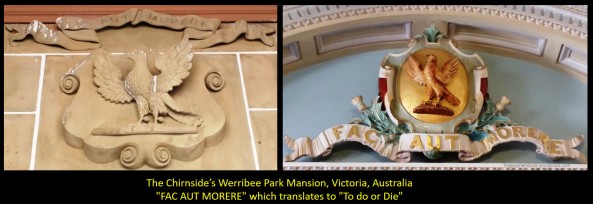
WERRIBEE PARK MANSION 99d

After a long illness, and believing himself bankrupt, Thomas Chirnside shot himself in the laundry of the mansion on the 25th June 1887 [9]. After a lengthy illness, Andrew Chirnside died at his daughters residence at Irrewarra near Colac on the 30th of April 1890 [10].

Six years after Andrew’s death, his widow, Mary (nee Begby), commissioned Ferguson & Urie to create a memorial stained glass window for the Presbyterian Church at Werribee [11]. The Chirnside’s were liberal donors to the church and Thomas had originally donated the land for it. The three light chancel window was eventually erected in 1896 and depicts “The Last Supper” which, whether by design or coincidence, includes the characters St. Thomas and St. Andrew amongst the apostles portrayed in the window.

Mary Chirnside died at Colac aged 80 on the 4th of March 1908 [12]. A report published in the Bacchus Marsh Express [13] stated that she had died at Dr. Brown’s private hospital at Colac as a result of blood poisoning from an earlier knee injury.

By 1922 there was no Chirnside family involvement in the mansion and it was subsequently used as a Catholic Seminary until the Victorian Government acquired it in 1973 and is now managed as a tourist attraction by Parks Victoria.

The Bacchus Marsh Express, Vic, Saturday 14th October 1876, page 2.

“The mansion for Messrs. T. and A. Chirnside, which has been in course of erection for them upon their Werribee park estate, Wyndham, since February, 1874, is now nearly completed, the only work remaining to be done being the fixing of a few mantelpieces, a portion of the grand staircase, and some flagging of the arcade fronting the ground floor of the building. We have given occasional notices of this mansion during the course of its erection, and our readers may probably recollect that it is built of Barrabool freestone principally, so far as the ornamental work is concerned, and of bluestone in the rear portions. The quantity of dressed stonework is immense, an has added very much to the cost of the building and the time occupied in erecting it, and in this stonework lies the great beauty of the building, for nothing can equal the rich grandeur of cut stone, unless it be polished marble. The style of architecture adopted is Ionic, and the general appearance of he building is, so far as one word can convey an idea of it, stately. It will be a pity if an illustration of it is not given in one of the Melbourne illustrated papers, for, in our opinion, it is one of the few buildings in the colony which an architect can look upon with pleasure, especially one who prefers the solid beauties of the old orders of architecture to the more foreign-looking adaptions of the present day, known as Venetian-Gothic, &c. The house consists of a main building, facing the east, with about 100 feet frontage, by the same depth, and two stories high, with a basement beneath and a tower 80 feet high at the main entrance. All round the building and arcade is carried, composed of beautifully-proportioned freestone arches supporting a balcony fronted with the usual Ionic balustrade and cornices, and giving a promenade of 300 feet by 11 feet wide, a promenade of the same dimensions existing below, of course, in the arcade. The balcony is laid with Minton’s encaustic tiles, of elaborate pattern, showing seven colours. Ample and very ingenious provision is made for carrying off the rain water, which flows into a filter in the courtyard, whence it is taken to an immense 40,000 gallons tank, from which it can b pumped to five cisterns placed somewhere in the various roofs of the mansion, and possessing altogether a capacity of 5,000 gallons. Each cistern is provided with a gauge showing its contents, and visible from the central courtyard between the two wings which flank the main building. This courtyard is 40 feet by 80 feet, and could be used for a ballroom by laying down a floor in sections and covering it with an awning. The wings are about 80 feet by 30 feet, and in addition to these, and the main building, there are a billiard room 30 feet by 22 feet and a conservatory 30 feet by 14 feet, besides a number of substantial out-buildings. Returning to the arcade and balcony, it should be mentioned that the ceiling of the arcade is beautifully panelled and painted, and the floor or promenade is laid with Malmsbury rubbed flagging down the centre, with dove and white marble slabs at each side. The tower is of useful proportions, being 14 feet square as high as the roof of the mansion, and the two stories above are 12 feet square. This tower is a work of sculpture more than of masonry, and reflects very great credit indeed upon the artist (Mr. Samuel Peters) who has put so much beautiful work into it. One feature is specially noticeable – namely, the bunches of grapes and vine leave, which stand out from the stone as naturally as though hanging pendent from a vine. Over the main entrance the escutcheon of the Chirnsides is cut out, showing a hawk upon a shield, and the motto “Facaut Morere” (Do or Die!) beneath. This device also appears on each side of the entrance hall, in a portion of the cornice, and upon the centre of the very handsome white marble mantelpiece in the drawing room. From the principal doorway a hall 15 feet by 30 feet and 17 feet high is entered, profusely ornamented with cement work executed by Mr. Mackennal, and to be further embellished with stags’ heads, statues, and hall furniture. The whole of this hall, with a staircase hall beyond, 30 feet by 19 feet, is floored with Minton’s tiles of elaborate and handsomely illuminated pattern, which contrasts well with the snowy whiteness of the cement work of the walls. The doorways hereabout are all massively panelled in polished blackwood, with what are known as pyramid headings, supported on trusses. The staircase hall contains, of course, the grand staircase, which is of polished blackwood, 6 feet 6 inches wide in the central portion, and turning to the right and left to the first floor in 6 feet wide portions. The handrail, and iron-work beneath, are, as may be conjectured, a prominent feature in this part of he house. At the end of the staircase hall there is an immense window, for which Messrs. Fergusson [sic] & Urie are making a quantity of embossed glass, portions of which will contain large figures of St. Andrew and St. George. The portions of the building upon the first floor corresponding with the two halls below will form a picture gallery and museum, and are beautifully ornamented in cement work. In fact wherever the eye rests costly and yet severely chaste decorations are to be seen, and among them some exquisite Corinthian pillars and cornices. Niches have been left for statues, and nothing seems to have been overlooked to add a stately elegance to the general effect, without anything obtrusively gaudy, the embossed glass, for instance, being extremely rich, and freely employed. The domed ceiling to the tower at this floor is beautifully proportioned and embellished. Double doors from it give access to the balcony. To describe the 50 or 60 rooms in the house, exclusive of the basement cellars, would make these remarks too lengthy, although a description of each would show that all contain some special feature reflecting credit upon those who had the designing of them, and here we may say that the contractor for the building 0 Mr. P. Colquhoun – has been the chief designer, assisted by Mr. Fox, architect, and by the Messrs. Chirnside themselves. The dining room and the drawing room are both on the ground floor, and are each 30 feet by 22 feet, exclusive of bay windows 6 feet deep, and of grand proportions and decorations. These rooms have elaborately moulded cornices, and marble mantelpieces of special design. Next to the dining room, and forming part of it if need be, is the breakfast room, 24 feet by 18 feet 6 inches. The passages connecting these rooms with the butler’s department are very conveniently arranged, and several folding doors are provided to shut off the series of kitchen apartments (which are on a lower level) from the principal ground floor. In the same way separate suites of apartments are provided up-stairs for night and day nurseries. All the floors below stairs are laid with 3 inch Oregon boards, forming an exceedingly smooth and firm flooring. Upstairs 2 ½ inch Kauri boards have been used. In several of the principal rooms a 20 inch border has been laid down in polished rosewood and oak parquetry work, which has a noble appearance. All the passages in the house are 6 feet wide and 12 feet high, so that abundant ventilation is given even by this means and there is an appearance of roominess everywhere which is most gratifying, none of the rooms being less than 11 feet high, and the principal ones are 18 feet high. The baths in various parts of the house are most complete, and very numerous, the servants being provided with two. The principal baths are fitted with electric bells, of which there are thirty four altogether, and two speaking tubes. In one of the storeys of the tower there is a smoking room, and upon the top of the tower a 25 feet kauri pine flagstaff is erected, sheathed with copper, to act as a lightening conductor. The staircase in the tower, and the provision made for closing in the head of the stairway, are details which have been attended to with more than ordinary care for the comfort of persons ascending the tower, and for the protection of the building. From the top of the tower a fine view of Melbourne can be obtained, also of the bay, and the various ranges to the west and north. The grounds surrounding the building are at present being brought into cultivation as ornamental shrubbery, &c., by Mr. Webley, the gardener, who has a difficult task, as the soil is poor and the surface is almost dead level. Thirty acres have been laid off for present operations, and the design includes a small lake in the south-eastern corner. A sunk fence will divide the ornamental grounds from the rest of the estate, and a handsome lodge will be erected at the end of the principal carriage drive. Provision has been made for lighting the whole house with gas, which will have to be made somewhere adjacent. The cost of the building alone is estimated at £40,000, and of course a very large sum will be required for properly furnishing it, and improving the grounds surrounding it. We think the Messrs. Chirnside deserve commendation for having spent so much money and time in erecting a building which has given profitable employment for a long time to nearly every branch of he building industry in the colony, and the maintenance of which cannot fail to cause a large annual expenditure. They are frequently abused for being wealthy, as though it were a crime, but they have shown in a variety of ways that they desire to make their wealth of considerable benefit to individuals other than themselves, and to the colony at large, and especially to the neighbourhood in which they have made for themselves a home of such princely proportions”.

Conservation work:

Both sidelights to the front entry door at the mansion are the reproduction artwork of Bruce Hutton of Almond Glass based on the original  designs from the smashed originals in 2012 (The hydrofluoric immersion was conducted in Sydney).
(re: email, Bruce Hutton & Ray Brown 10th April 2013)

Related posts:

1875: Rupertswood Mansion, Sunbury, Victoria.
31-10-1878: Mandeville Hall, Toorak, Victoria.
23-05-1896: Presbyterian Church, Werribee, Victoria.

Other related links:

An album of my recent sepia photos of Werribee Mansion.

Footnotes:

[1] Biography: Andrew Spencer Chirnside (1818-1890) & Thomas Chirnside (1815-1887).

[2] London born and Hamilton based architect and designer, James Henry Fox. He also designed Holy Trinity Church at Coleraine which also has F&U windows.

26-08-1876: St John’s Church, Wagga Wagga, New South Wales.

Australian Town and Country Journal, Saturday 26th August 1876, page 10.

 “WAGGA WAGGA”

 “…A very handsome and costly window has just been added to the new building of St. John’s Church. It was presented by Mrs. H. S. Moxham, and was designed by Messrs. Fergusson [sic] and Urie, of Melbourne…”

Photo taken circa 1990’s. Thanks to Dr. Bronwyn Hughes, September 2012.

This slideshow requires JavaScript.

External links:

St John’s Anglican Church, Wagga Wagga, New South Wales (photo from Wikipedia Commons)

Short link to this page: https://wp.me/p28nLD-1hC
S.SSh
© Copyright

19-08-1876: Memorial Church, Brisbane, Queensland.

The Brisbane Courier, Queensland, Saturday 19th August 1876, page 4.

“Several of the Anglican clergy who came down for the Synod are still remaining in town. Of these the Rev. H. J. Hughill, of Leyburn, will preach to-morrow at the Memorial Church, in the morning; and the Rev. E. Moberly, of Gympie, in the evening. The occasion is, we believe, the improvement of the church by various additions, and especially by windows, the gift of an anonymous gentleman, which were ordered specially from Messrs. Ferguson and Urie, of Melbourne, and are highly ornamental.”

14 Oct 2013 – A great clue from Dianne Parker reveals this is the historic wooden church located in the shadow of Suncorp Stadium at Milton…..investigations continue!

06-12-1876: Scots’ Church, Collins Street, Melbourne, Victoria.

This article covers the two largest stained glass windows in Scots Church, Collins Street, Melbourne. Both windows were made by the North Melbourne stained glass firm, Ferguson & Urie.

The window facing Collins Street depicts the “The Eight Episodes from the Gospels” and was donated by Sir Samuel Wilson in 1876. The window in the liturgical south transept, facing Russell street, depicts “The Last Supper” and was donated by John Wilson (brother of Sir Samuel) in 1879.

The Argus, Melbourne, 6th December 1876, page 5.

 “The large window in front of Scots’ Church, Collins-street, has just been filled in with stained glass. The window is in four compartments, with Gothic tracery over each of them. Each compartment is filled in with two Scripture illustrations, with canopies and ornaments in accordance with the style of architecture. The subjects in the first compartment are “Christ Preaching to the Multitude from the Ship”, and the parable of “The Sower”. In the second compartment “Christ Rebuking the Pharisees”, and “The Pharisee and the Publican in the Temple”; in the third “Christ at Meat in the Pharisee’s House”, and the parable of “The Lost Sheep”; and in the fourth, “Christ Weeping over Jerusalem”, and the parable of “The Un-just Steward”, The tracery is filled in with angels bearing scrolls. The subjects illustrated were suggested by the Rev. C. Strong, the minister of the church and in the style of decoration was under the superintendence of Messrs. Reed and Barnes, architects. The work was executed by Messrs Ferguson and Urie, Collins-street, at the cost of £500, to the order of Sir Samuel Wilson, and bears the following inscription at the bottom of the window:- “Presented to Scots’ Church by the Hon. Sir Samuel Wilson, A D, 1876”

Riverine Herald, Echuca, Vic, Tuesday 19th December 1876, page 3.

“A magnificent new stained glass window has been completed to the order of Sir Samuel Wilson, and fitted in the front of Scots’ Church Collins street. It is a beautiful work of art, the design being appropriate, and the execution exquisite.”

The second largest window in Scots church, “The Last Supper”, in the south transept, was also the work of Ferguson & Urie and was donated by Samuel Wilson’s elder brother, John Wilson, in 1879.

Photos taken 12th December 2010;

This slideshow requires JavaScript.

THE EIGHT EPISODES FROM THE GOSPELS:

The west window is known as “The Eight Episodes from the Gospels” and has its own individual National Trust Classification granted in November 1992. It was donated by Sir Samuel Wilson and installed in 1876 at a cost of £450 (this differs from the newspaper articles reported cost of £500).

At the very top of the tracery is a trefoil with the cross and crown depicted. On the lower left and right off that are floating angels with ribbons of text that read:

‘HOSANNA | HALLALUIAH’

Further down are two quatrefoils depicting angels with ribbons of text that read:

‘THY KINGDOM COME | THY WILL BE DONE’

The text at the bottom of the window reads:

‘THIS WINDOW WAS PRESENTED | TO THE SCOTS CHURCH BY THE | HONBLE SIR SAMUEL WILSON | ANNO DOMINI 1876.’

The scenes, chapters, and verses displayed on the window are; from top left to right and bottom left to right are:

1:  (Matt 13-2) Jesus teaching the people from a boat.
2:  (Luke 11-37) Jesus teaching the people.
3:  (Luke 7–37) A woman wiping Jesus’ feet with her hair.
4:  (Luke 19-41) Jesus weeping over the City of Jerusalem.
5:  (Matthew 13–3) The parable of the Sower.
6:  (Luke 18–10) The parable of the Pharisee and the Publican.
7:  (Luke 15 -3) The parable of the Shepherd with Lost Sheep.
8:  (Luke 19-20) The parable of the Talents (or Minas).

THE LAST SUPPER WINDOW:

The Last Supper window is the second largest window in the church and was gifted by John Wilson. Esq, J. P of Woodlands (brother of Sir Samuel), it cost of £350 and was installed in the South Transept in 1879.

There were some reservations about who should be commissioned to create the window. Mrs Judith Kilmartin from Scots Church kindly provided this information 7th February 2011:

An excerpt from the Scots’ Church Board of Management Minutes of 9th August 1878 reads:-“The subject of the gift of a stained glass window for the East (South) Transept promised by Mr John Wilson came up for discussion and fear was expressed lest its execution should be trusted to inferior makers.  Eventually, Mr B??  moved that the Board convey to the Trustees the expression that the manufacture of this window should be entrusted to some leading English firm”.

Obviously the trustees ignored the advice of the board and the work was subsequently entrusted to the local Melbourne firm Ferguson & Urie who had previously done the magnificent eight episodes from the gospels window in 1876. Why the board were considering an English firm to create the window will probably remain a mystery forever!

Text on the Last Supper window reads:

In the upper three trefoils. above the main five lights, are three trefoils with emblems representing Faith, Hope and Charity. Below that are two quatrefoils with an angel in each holding a ribbon banner with the text:

‘THIS IS MY COMMANDMENT | THAT WE LOVE ONE ANOTHER’

The main three lights read:

‘THIS IS MY BODY | WHICH IS GIVEN FOR YOU | THIS DO IN | REMEMBRANCE OF ME’

‘THIS WINDOW WAS PRESENTED | TO THE SCOTS CHURCH | BY JOHN WILSON ESQ J.P | OF WOODLANDS’

Sir Samuel Wilson’s mansion “Longerenong” (Crouch & Wilson 1862), and John Wilson’s mansionWoodlands(Crouch & Wilson 1867), both also contain magnificent secular stained glass windows created by Ferguson & Urie.

Related posts:

1868: John Wilson’s ‘Woodlands’ at Ararat

External links:

Biography: Sir Samuel Wilson (1832-1895)

Death Notice: John Wilson (1813-1888)

Wikipedia: Scots’ Church Melbourne

National Trust: Scots’ Church Melbourne


Short link to this page: http://wp.me/p28nLD-pW

© Copyright


18-11-1876: St. Stephen’s Anglican Church, Richmond, Melbourne, Victoria.


The foundation stone of St Stephen’s Church was laid in June 1850 and the incomplete church opened in November 1851. In 1863 the north aisle, designed by Nathaniel Billing, was erected and the west wall rebuilt. The south aisle and chancel were erected in 1876 and the choir vestry in 1923.

The Argus, Melbourne, Saturday 18th November 1876, page 7.

“The Church of England in Richmond celebrated its 25th anniversary on Wednesday evening by a festive gathering in the local hall […]”.

 “….The following list of special gifts was also read:- Chancel and stone work of east window at two friends’ joint cost; chancel window, Mr. George Coppin, M.L.A…”

 “… The Rev. C. T. Perks, the incumbent, in his address, said that an old friend had, unsolicited, offered to give a handsome memorial window to commemorate the 25th anniversary. The work was entrusted to Messrs. Fergusson (sic) and Urie.…”

There are four instances of Ferguson & Urie windows in St Stephens church:

1. The west 25th Anniversary window (1851-1876) is a three light window with the outer lancets having geometric designs with the year 1851 in the left window and 1876 in the right. The centre light depicts the Ascension in the top half with the words “HE ASCENDED INTO HEAVEN” below it and the letters “IHS” in the lower half.  The text at the bottom of the windows reads:  ”GIFT OF JOHN AND MARY J PATERSON LONDON, MARRIED JULY 26th 1859″.

The Argus, Melbourne, Vic, Thursday 28th July 1859, page 4.

“On the 26th inst., at St. Stephen’s, Richmond, by the Rev. C. Perks, John Paterson, Esq., merchant, Melbourne, to Mary Jane, eldest daughter of the late William Mungo Glaister. Esq., London.”

2. The east five light window in the chancel  was donated by entertainer and politician George Selth Coppin. It depicts a full length figure of St. Stephen, the patron saint of the church, in the centre light. The outer lights, of geometric designs, have in each a medallion of the four evangelists, St Matthew as the winged man, St Mark as a winged Lion, St Luke as the winged Bull and St John as an Eagle. Above the five lights is a roundel depicting the Agnes Dei or Paschal lamb carrying the flag of St George and is surrounded by six round lobes of flora with the heavenly Dove in the top lobe.

3. On the South side of the church there is also a quatrefoil window that depicts the holy dove within a Hexagram, or Star of David, and surrounded by floral designs.

4. On the North side there is a quatrefoil that depicts the gold crown in the centre of floral designs.

This slideshow requires JavaScript.

Related posts:

12-07-1862: The Shakespeare window at the Haymarket Theatre, Melbourne (also commissioned by Coppin).

External links:

Biography: George Selth Coppin (1819-1906)

Obituary : Coppin, George Selth (1819–1906) (I submitted this transcription to Obituaries Australia on 13-03-2012).


Short link to this page: https://wp.me/p28nLD-pn

© Copyright

24-10-1876: St Stephen’s Church, Portland, Victoria, Australia.

The Rev. James Yelverton Wilson memorial stained glass window at St Stephen’s Anglican Church, Portland, Victoria.

Portland Guardian, Tuesday 24th October 1876, page 2

“IN MEMORIAM – A beautiful memorial window has been inserted in St Stephen’s Church during the past week which, if it does not surpass, at least rivals any of he already brilliant collection. The subject is described in a central scroll, “I am the Good Shepherd,” and the remarkable combination of colours that seems, at first sight, to set all the accepted rules of contrast at defiance, becomes from closer familiarity as a union of light and shade as is the whole illumination a correct conception of the scripted idea in its minutest details. The window, which occupies a position on the north side of the chancel, corresponding to that erected to the memory of the late Mr. P. Scott on the south, bears the following inscription – “In memory of the Rev. James Yelverton Wilson, 27 years Incumbent of this parish, who died January 20, 1875, aged 64 years.” This elegant work of art is from the studio of Messrs. Ferguson and Urie, of Melbourne, who may fairly claim to rank amongst the first ecclesiastical decorative artists.”

This slideshow requires JavaScript.

[view larger images]

The Rev James Yelverton Wilson (1811-1875), arrived in Portland in 1839 and died on the 20th January 1875 at his residence in Lygon Street Carlton.

I visited St Stephen’s in 2011 and photographed all the windows but I don’t seem to have a photo of this particular window! I’m fairly certain that I didn’t miss any but I’ve emailed St Stephen’s on 06/03/2012 to ascertain whether this particular window exists.

There are many modern windows by Auguste Fischer, John Orvall and others that may have replaced some older ones.

Related posts:

29-12-1888: St Stephen’s Anglican, Portland, Victoria.The historic Stephen George Henty and Philip Scott memorial windows.

15-07-1876: St. Thomas’ Church, Port Lincoln, South Australia.

The South Australian Register, Saturday 15th July 1876, page 7.

“CONSECRATION OF ST. THOMAS’S CHURCH PORT LINCOLN”
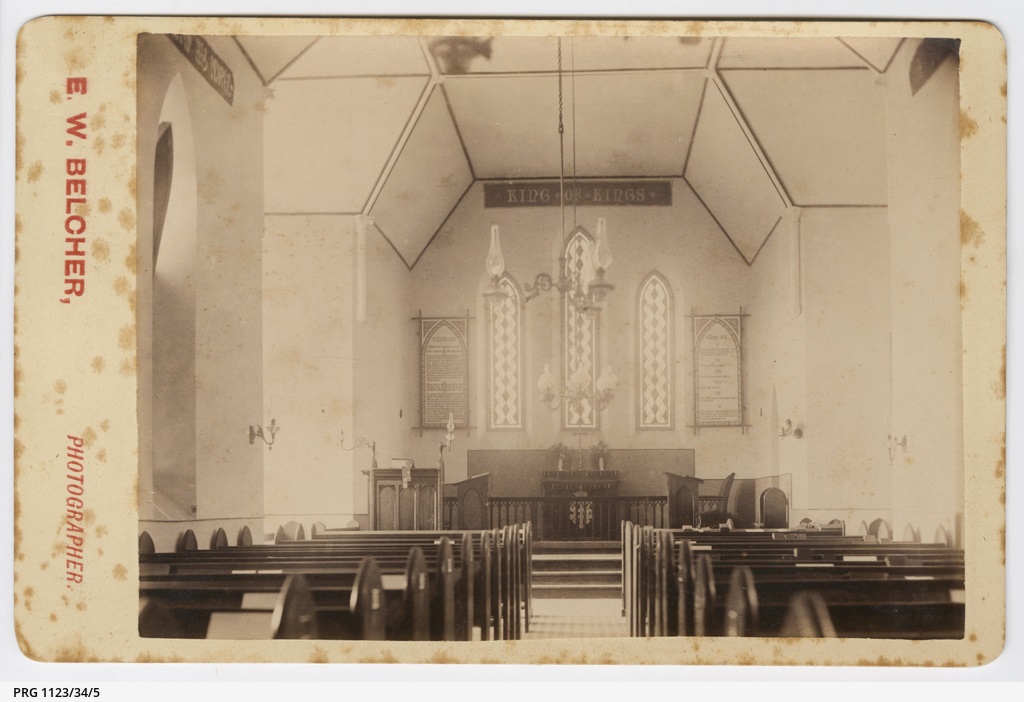
“… Over the communion table in the chancel there are three lancet-headed splay windows fitted with stained glass, and on each side are very chaste tablets of the Commandments, chosen by the Dean of Melbourne, and supplied by Messrs. Ferguson & Urie, of Melbourne …”.

“…The stained windows had been glazed by Mr. Soar, with glass supplied by Messrs. Ferguson and Urie, of Melbourne …”.

The original stained glass and tablets of the Commandments by Ferguson & Urie no longer exist. The tablets were an offering by the company but rarely advertised. These were usually painted in gold or gold leaf with red and black text in old English type lettering. Originals of these decorations are extremely rare to find as they were often painted over or replicated as renovations occurred over the course of time.

The image below shows the chancel of St Thomas’s circa 1885 depicting the original three light stained glass windows flanked by the tablets of the Ten Commandments by Ferguson and Urie.

Source: Collections South Australia: PRG 1123/34/5. Photographer: E. W. Belcher, circa 1885

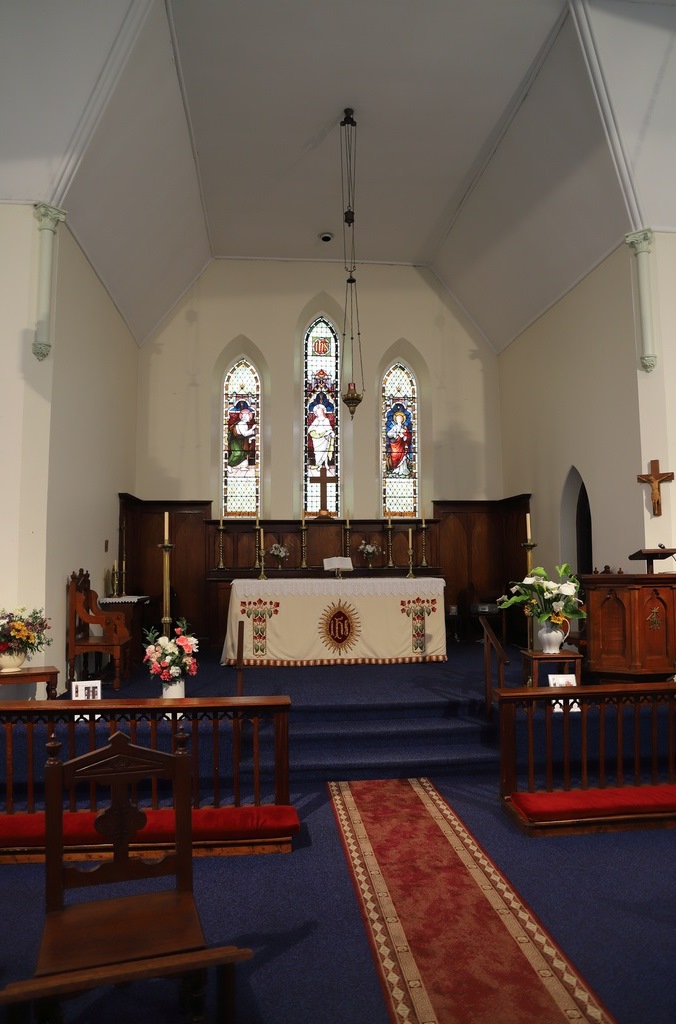
In 1893 the three lights in the chancel were replaced by figurative stained glass from Montgomery & Grimbly and were dedicated to Mr. F. S. Sison. The windows depict Christ flanked by St Thomas and St John.

St Thomas’s Port Lincoln, SA. Stained Glass by Montgomery & Grimbly 1893.
Source: Collections South Australia B77612 Photographer: Jenny Scott 18 Aug 2019

Evening Journal, Adelaide. SA, Tuesday 17th Oct 1893, page 2.

“A MEMORIAL IN STAINED GLASS.- Messrs. Montgomery & Grimbly, stained glass artists, of Waymouth street, have just completed a handsome memorial window to the order of the trustees in the estate of the late Mr. F. S. Sison, one of the founders of the firm of Messrs. Syme & Sison, brewers, and who died at Port Lincoln about two years ago. The window consists of three lights, the height of the central one being 10ft. 6 in., and those of the sides 8ft. each. The subject represented on the panels is the incredulity and conversion of Thomas and the figures portrayed are those of the Saviour, St Thomas, and St John. The figures, drapery, and surroundings are commendably finished, and as a work of art reflect great credit on Messrs. Montgomery & Grimbly. Part of the inscription hereon reads – “In memory of Frederick Samuel Sison, died December 29, 1891.” The window cost L150, and is intended for presentation to St Thomas’s Church, Port Lincoln, where it will be placed in the chancel, and will no doubt be appreciated for the excellence of its design and colouring.”

Updated: 18th July 2021

Short link to this page: http://wp.me/p28nLD-pa

© Copyright