1853: The Ferguson brothers arrive aboard the Tamerlane

After a jovial night at the “Robert Burns Arms Inn” at Wallacetown in early December 1852, James & David Ferguson departed their native Scotland for a new life in Australia.

The ‘Tamerlane’ departed from Greenock in December 1852 with James and David Ferguson amongst the 110 intermediate and steerage passengers. Their friend and business partner James Urie was not on the same ship but was known to have departed the day prior, yet nothing has yet been found as to which ship he was on or which port he arrived at in Australia. By coincidence, James Urie’s future brother in law, John Yeaman, was also on the ‘Tamerlane’ with the Ferguson brothers.

When James and David boarded the Tamerlane they must have known that their odds of reaching Australia alive were not favourable. In the mid-19th century nearly 1 in 5 children and 1 in 60 adults died on a voyage to Australia[1].

The Ferguson brothers would have been enticed by the many letters from their friends who had departed the old country bound for the “golden land of promise.” There would also have been mixed reports of those that were making their fortune in the Colony and those who perished at sea trying to get there. Yet they still took their chance. James would have been particularly aware of the consequences as he had the most to lose. He was leaving behind a wife and five children with the hope that they would join him once he had established the business in Melbourne ( Jane and the five children arrived aboard the ‘Emma’ in November 1855).

After four and a half months at sea the ‘Tamerlane’ eventually arrived in Port Phillip Bay on the 29th April 1853.

The Argus, Melbourne, Vic, Saturday 30th April 1853, page 4.

“April 29.- Tamerlane, ship 750 tons, Geo. Caldwell, from Glasgow December 12th. Passengers – Cabin: Mr. and Mrs. J. Robertson, Mr. and Mrs. F. Donaldson, Mr. and Mrs. D. Miller, Mrs. Wylie and child, Messrs Davidson, A. Dawson, P. Dawson, D. Fraser, McIntosh, McDonald, Newbigging, Rowley, Rowan, Shirra, A. M. Wylie, Esq., Surgeon, and one hundred and ten in the intermediate and steerage. Dickson , Gilchrist, and Co. agents.”

It was very common for literate passengers on long voyages like this to keep a diary of their once-in-a-lifetime journey to the Antipodes and there are many remarkable diaries in museums and libraries all over Australia. Unfortunately no example of a diary by any passenger of the Tamerlane to Australia in 1852-53 has yet been found during my research.

The first recorded account of the Ferguson brothers’ voyage comes five days after the arrival of the Tamerlane in Port Phillip Bay on the 29th April 1853.

The cabin and steerage passengers of the Tamerlane penned letters of gratitude to Captain Caldwell of the Tamerlane, which were published in the Melbourne Argus on the 4th of May 1853. The Cabin passengers are specifically mentioned by name as signatories to their testimonial, but the letter by those who traveled in steerage is simply mentioned as by the “Committee of the Steerage Passengers.”

The Argus, Melbourne, Vic, Wednesday 4th May 1853, page 12.

“Ship Tamerlane, May 2, 1853.

TO CAPTAIN CALDWELL,

SIR, – We, the undersigned, beg leave respectfully to present you these few lines to testify our approbation of your meritorious and exemplary conduct during the voyage, namely from Clyde to Australia. Allow us to say that you have displayed not only the abilities of a skilful commander, but the manners of a gentleman; also you have faithfully discharged your duties toward us to our entire satisfaction, and your good conduct secured to us that order and contentment which we anticipated. We sincerely wish you all success and happiness. We now bid you heartily adieu, with our thanks to Almighty God for bringing us safely to our destination, after a pleasant and successful passage across the wide ocean in the good ship Tamerlane.

For the cabin passengers.

George McDonald,
Alex Davidson,
John Shirra,
Patrick Dawson, jun,
John McKenzie, A. M.

Ship Tamerlane, Port Phillip.

To Captain Caldwell, Commanding Tamerlane.

Sir,- The steerage passengers beg to thank you for the kindness and attention shown to them during this passage. The length and tediousness of the voyage has in great degree been unfelt from the general opportunities for every kind of amusement, compatible with the situation in which they were placed, and this, they hope, without in any degree interfering with the working of the ship. In an early part of the voyage, you were kind enough to sanction the appointment of a committee of themselves, for the purpose of attending to cleanliness and order. The few regulations which the committee drew up, met your approval, and were enforced by the weight of your authority. All have felt the benefit of this arrangement, and at the same time it may have saved you from being annoyed with petty complaints, which, without doubt, would have arisen among so may crowded together in such a small place. The result of your kind indulgence, attention, and encouragement, by keeping up the spirits of all, together with strict attention to cleanliness and order, is shown in the healthy condition which all have shown during the voyage. With best wishes for your welfare and prosperity, we remain, Sir, your most obedient servants,

Signed by a Committee of the Steerage Passengers.

Report of the Ship Tamerlane, Capt. Caldwell, from Glasgow.

Sailed from Rothsay Bay, January 14th. At the Equator, February 15th. Spoke the ship Sophia Moffat, from London to Adelaide, out 32 days. February 23. Lat. 18 S., long. 25 W., barque Nepaul, from London to the Cape,last from Lisbon; out 77 days. February 27. Sir Henry Pottinger, from Liverpool to Shanghae, in lat. 24 S., long. 28W,; out 45 days. March 8. Arethusa, from Hartlepool to Ade?, lat. 27, long. 26; out 58 days. March 25. Lat 37S., long 29E, barque Halifax from London to madras; out 67 days. April 18. Barque Victor, from Swansea to King George’s Sound; out 109 days. Experienced much calm weather on the passage, and strong easterly winds off the Cape.”

The Journey:

Our pioneering ancestors took gambles with their lives just to have the chance of a new beginning in the Australian Colonies. Many of them died at sea and not even their bodies would make it to their new homeland.

In the mid 19th Century a voyage from Europe to Australia was a perilous journey of sometimes more than four months, depending on your luck with the weather. Fortunately for some, the length of the voyages were often broken by one or more port calls for provisions along the way but the last leg of the voyage to Australia would be the most grueling.

A death at sea was all too common with as many as one in five children and one in sixty adults perishing before they reached their destination. Those who died were buried at sea without delay to prevent the spread of disease. The dispatch of a body at sea was conducted quickly and efficiently. It was was sewn into a canvas sack, or if it was a crew member, his own hammock, and then weighted down with a piece of ballast to help it sink. The body was then placed on a plank and covered with the ensign of their homeland. The plank was balanced over the side of the ship and after a brief service by the Captain, (or clergy if there was one amongst the passengers), it was then tilted towards the water and the body slipped along the plank beneath the ensign and into the depths of the ocean.

Passengers in steerage would have been the most likely to succumb to disease due to the cramped, dark and unsanitary conditions below deck which was a breeding ground for disease. The lucky survivors who made it to the colony would often suffer ill health for many months after. Even on arrival at their destination the ships were often quarantined in the bay for some length of time, preventing  any passengers from going ashore and spreading any disease.

Fortunately the Ferguson brothers survived their voyage to Australia, as did James’ wife and children in 1855.

David Ferguson only lasted four years in the Colony, having decided to return to Scotland in early 1857. James Urie died in Flemington in 1890, followed by James Ferguson in 1894.

The fate of the Ferguson & Urie stained glass company was then in the hands of their sons, James Ferguson Jnr (1861-1945) and William Urie (1864-1907) until it eventually folded in 1899 after a 46 year history.

Footnotes:

[1] Web site; Museum Victoria, “Life at Sea” (accessed 21 Apr 2014)
© Copyright

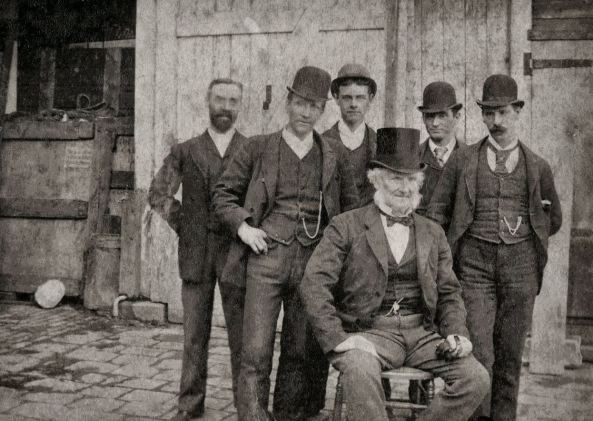
1890: Curzon Street, Ferguson & Urie Employees circa 1890.

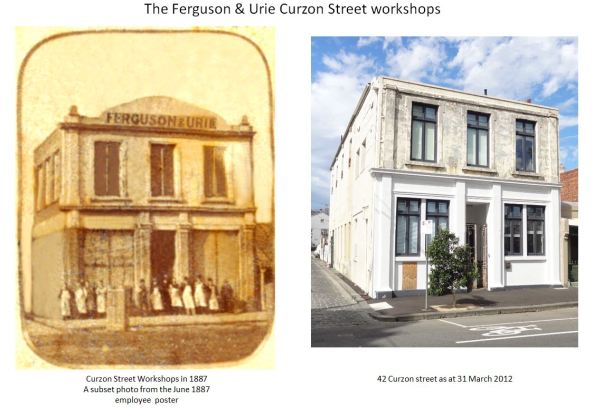
This is a magnificent historical photo of James Ferguson and five of the Ferguson & Urie employees circa 1890. I would guess this photo may have been taken at the rear of the Curzon street workshops North Melbourne which was their first workshops when they started business in 1853. They advertised from the site as early as 1853 but the workshop building wasn’t erected until after 1858 as indicated in the diaries of stained glass artist David Relph Drape. The building still exists as at 2012 but the interior has been converted to individual apartments and only the shell and facade remain as it appeared in the Ferguson & Urie employee photos of June 1887.

The only two positively identified men in the photo are, James Urie Jnr,  James Ferguson Snr and James Ferguson Jnr. The other identifications are based on a likeness from the 1887 employees photos that were taken for the company dinner held on the 22nd January 1887.

CURZON Street Photos 01a

1.D. Morris, 2. unknown, 3. James Urie Jnr (1870-1896), 4. James Ferguson Snr (1818-1894), 5. J. M. Gilligan, 6. James Ferguson Jnr (1861-1945). Photo kindly contributed by my 3rd cousin Errol Vincent from New Zealand 2010.

CURZON Street Photos 02a

The Curzon Street workshop building as it appeared in June 1887 and photo taken 2012.

When the building was being converted to apartments in 2012 the sales brochures indicated that the building had been “remodeled circa 1875 to become the North Melbourne Masonic Lodge”. This incorrect. Ferguson & Urie retained the building as their workshops until the company demise in 1899.

18990506

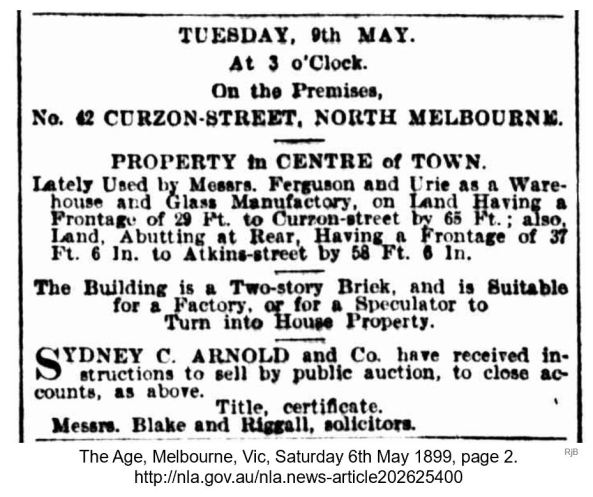
In May 1899 an advertisement was placed in the Melbourne Age advertising the auction of their stained glass workshops at 42 Curzon Street would occur at 3p.m. on the 9th of May 1899.

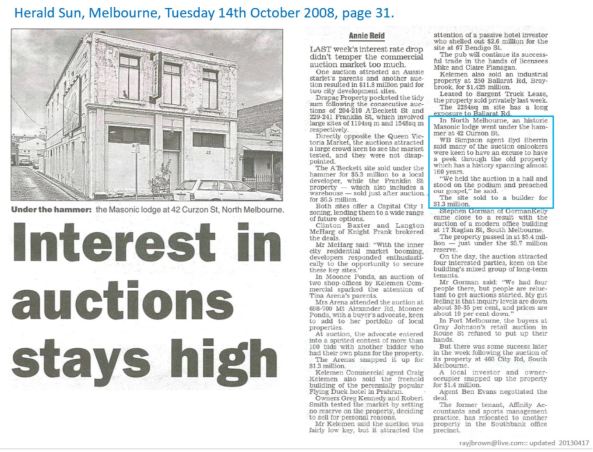
The first tabloid article indicating the building had become the North Melbourne Masonic Lodge appeared in the North Melbourne Courier & West Melbourne Advertiser in September 1902 and it remained in their possession until 2008 when it was put up for auction and sold for $1.3m.

20081014 Curzon

Related posts:

1887 Ferguson & Urie Company Dinner


Short link to this page: https://wp.me/p28nLD-1aP

© Copyright

14-06-1894: Probate lodged for the Will of James Ferguson

The Argus, Melbourne, Thursday 14th June 1894.

“WILLS AND ESTATES”

“The will, dated April 2, 1887, and codicils, dated May 8, 1890, and September 27, 1891, of James Ferguson, late of Leonard-street, Royal-park, glass importer, who died on April 17, has been lodged for probate. The estate is valued as £24,317, of which £15,088 is realty and £9,229 personalty. The testator directs that his interest in his Collins-street property shall be sold, and that out of the proceeds a sum of £1,000 shall be invested for the three children of his deceased daughter, Barbara Kier, wife of Crawford Kier, of Sydney, and £1,000 for the benefit of his daughter, Margaret Ferguson, for life, and then to his other daughters now surviving in equal shares. The residue of this fund and the proceeds of his Dryburgh-street and Eden-park properties is to be equally divided among his daughters, Janet Kay Auld, wife of Thomas Auld, of Flinders-street, Melbourne, grocer; Marion Williams, wife of Edward Williams, of Inglewood, Ironmonger; Antonia Wallace Gordon, widow of Alexander Gordon; and Sarah Campbell Gentles, wife of Alexander Gentles, of Moonee ponds, wool-classer. Her directs a sum of £1,000 to be invested for the benefit of his sister, Marion Ferguson Bishop, of Glasgow, Scotland, for life, and then to her son, Thomas Bishop, and the testator’s sister in-law, Barbara Lawson Kennedy, in equal shares. The residue of the estate is left to the testator’s son, James Ferguson, for life, and then to his children, or failing children to the testator’s surviving daughters in equal shares”.


Short link to this page: https://wp.me/p28nLD-Ya

© Copyright

19-04-1894: The funeral of James Ferguson Snr.

The Argus, Melbourne, Wednesday 19th April 1894, page 1.

“THE Friends of the late Mr. JAMES FERGUSON (of Ferguson and Urie, glass stainers) are respectfully invited to follow his remains to the place of interment in the Melbourne General Cemetery. The funeral will leave his late residence, Leonard street, Royal-park. Tomorrow (Thursday, 19th inst.), at 3 o’clock. ALFRED ALLISON, Undertaker, 221 Victoria street west, Melbourne; Mount Alexander road; Moonee Ponds; and Racecourse road, Newmarket. Telephone 980.”

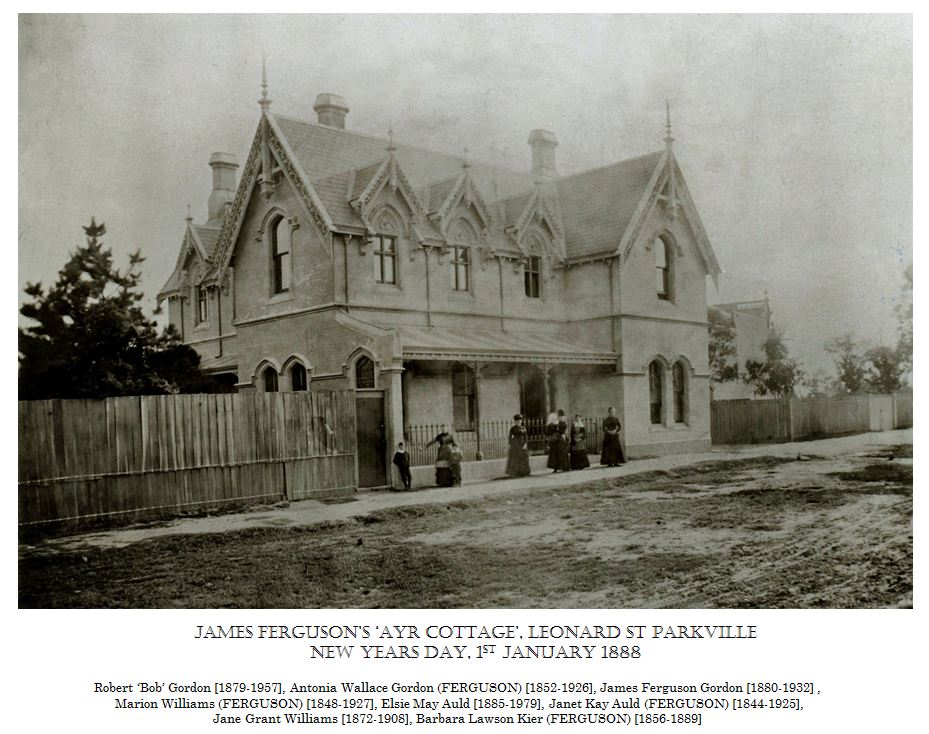
Ayr Cottage, Leonard street Parkville (Royal Park), 1st January 1888

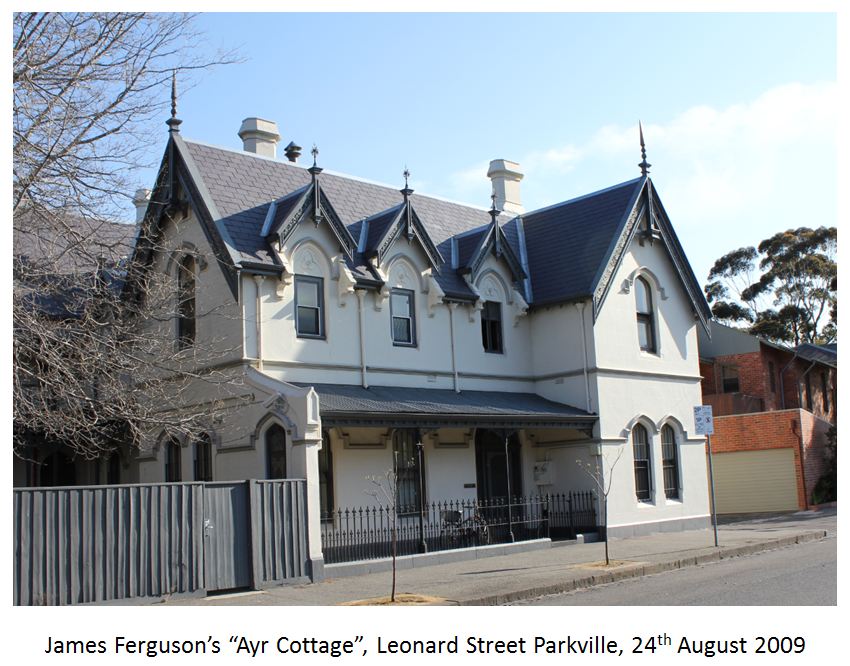
Ayr Cottage 2009


Related posts: 18-04-189420-04-1894

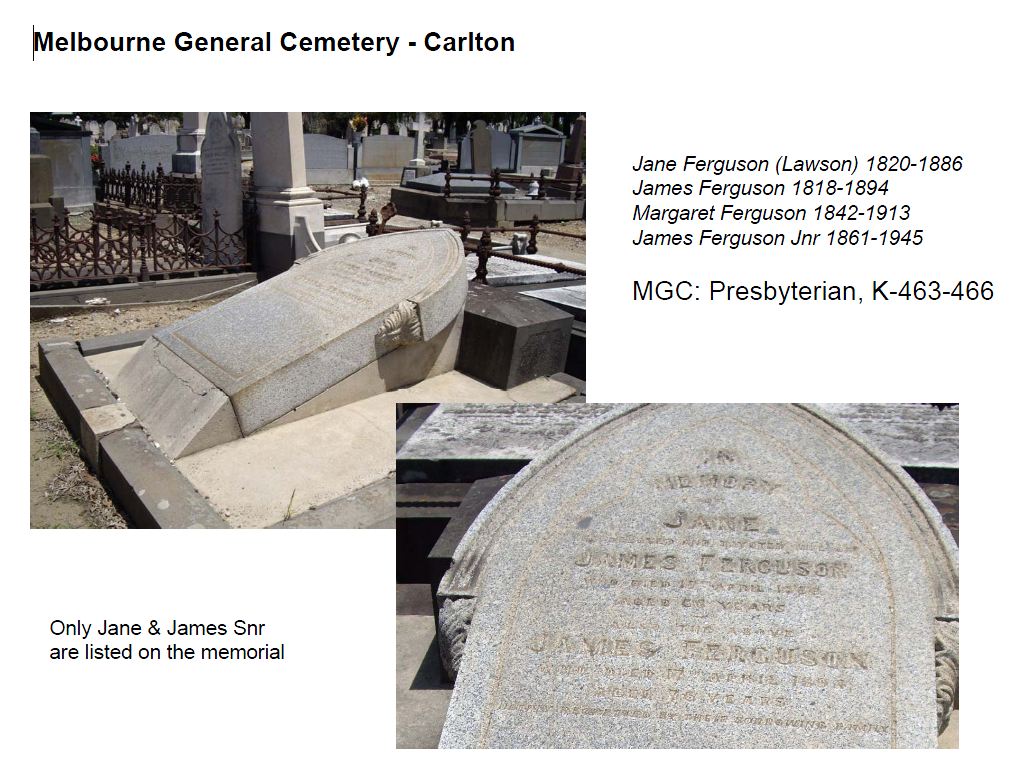
18-04-1894: James Ferguson (1818-1894)

From a family history perspective there is quite a lot known about James Ferguson, his family, and his colonial colonial stained glass company from North Melbourne.

I have many historical artifacts which include photographs, pieces of furniture, documents, and many other interesting items which make up a magnificent collection of colonial history as well as my own family history.

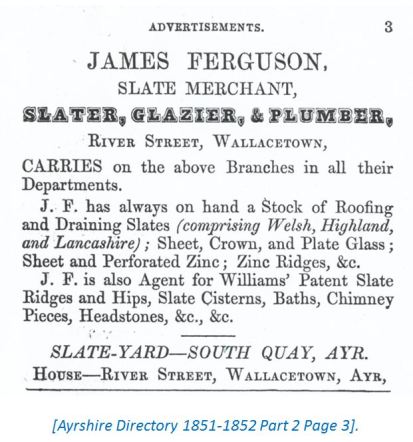
James Ferguson was born in Ayr, Scotland circa 1818. His parents were Janet Kay (1791-1860) and Master Slater & Glazier, James Ferguson Snr (1777-1886).

On the 13th of June 1841 he married Jane Williamson Lawson (1820-1886), the daughter of Gavin Lawson and Margaret Williamson and between 1842 and 1852 five girls and a boy were born in Wallacetown;
Margaret (1842-1913) who was mentally disabled from birth, Janet Kay (1844-1925), Jane Williamson (1846-1875), Marion (1848-1927) and Antonia Wallace (1852-1926). A son named James was born in 1851 but died as an infant in the same year.

On the night of the 1851 Scottish Census (30/31 March) his future business partner, James Urie, was recorded as a visitor at his cottage in John Street Wallacetown. Whether this was one of many meetings the two men would have to discuss their bold plans for the future can only be speculation but only nine months later their plans would come to fruition.

In early December 1852 James Ferguson was given a farewell party at the Robert Burns Arms Inn at Wallacetown prior to his departure for Australia.

“…After the usual preliminaries, Mr John Templeton, watchmaker, in neat and appropriate terms, proposed the health of Mr Ferguson and, in name of many friends, present and absent, presented him with a splendid purse containing 25 sovereigns…”

James and his younger brother David departed Greenock on the 12th of December 1852 aboard the ‘Tamerlane’ and after more than four an a half months at sea they arrived in Port Philip on the 29th of April 1853.  James’s wife Jane would remain in Wallacetown for two years with the children whilst James established the business in North Melbourne. She arrived  aboard the ‘Emma’ with the five girls in November 1855.

In August 1853 the first business advertisements for the company, “Ferguson & Urie”, began in the Melbourne Argus Newspaper. The rest of the Ferguson & Urie history forms the basis of this entire web site.

This slideshow requires JavaScript.

The Argus, Melbourne, Wednesday 18th April 1894, page 5.

“The death is announced of Mr. James Ferguson, the surviving partner of the well known firm of Messrs. Ferguson and Urie. Mr. Ferguson was a colonist of about 40 years’ standing, and for many years carried on business with his partner in Collins-street near the National Bank. Mr. Ferguson died at his residence, Parkville, early yesterday morning, at the advanced age of 84 [sic].”

(James Ferguson was 74 years of age at death).

The North Melbourne Advertiser, Friday 20th April 1894, page 2.

“DEATH OF MR. J. FERGUSON”

“We regret to have to record the death of Mr. James Ferguson, the surviving partner of the well known glass staining firm of Ferguson and Urie. Mr. Ferguson was a colonist of about forty years’ standing, and for many years carried on business with his partner, Mr. Urie (deceased about six years ago) [sic: 1890], in Collins Street, near the National Bank. Mr. Ferguson passed away at his residence, Parkville, early on Tuesday morning, his death being simply a decay of nature, as he was in his seventy-first year [sic: 74]. For the past four years the business of the firm has been carried on in Franklin Street and Curzon Street, North Melbourne. Mr. Ferguson was a member of the Presbyterian Church, and was much respected as a private citizen, but never aspired to enter public life. He died a widower, and leaves a grown up family. The funeral took place yesterday afternoon, deceased being interred in the Melbourne general cemetery and the cortege was followed by a large number of mourners. The body was conveyed to the grave in a panelled hearse, and enclosed in a plain coffin. There were three mourning coaches. Mr. Ferguson was buried in the Presbyterian compartment, the arrangements being carried out by Alfred Allison, of 221 Victoria Street, West Melbourne.”

Related posts:

19-04-1886: Jane Ferguson (nee Lawson) (1820-1886)

19-04-1894: The funeral of James Ferguson Snr.

1886: The History of ‘Ayr’ Cottage, 1 Leonard St. Parkville, Melbourne, Victoria.

08-10-1887: ‘Ayr Cottage’, 1 Leonard Street, Parkville, Melbourne, Victoria.

01-01-1888: The Ferguson Clan at Ayr Cottage, Parkville.

04-07-1901: The sale of Ayr Cottage, Parkville, Melbourne.

19-02-1874: The Hotham (North Melbourne) School of Art.


Short link to this page: http://wp.me/p28nLD-Jf

© Copyright

01-01-1888: The Ferguson Clan at Ayr Cottage, Parkville.

On the new years day in 1888 the Ferguson family clan assembled at James Ferguson’s ‘Ayr Cottage’ in Leonard street Royal Park (now Parkville) for festivities and a family photo.

The first photo shows the front of the house from Leonard street with eight of the family members out front and the second photos is of of the entire family on the east side of the house with James Ferguson in the centre with grey hair and bow tie.

The family photo was kindly contributed by Errol Vincent from New Zealand and he and his wife Ann also assisted with the extensive identification of all the family members in the photo.

This slideshow requires JavaScript.

Related posts:

1886: The History of ‘Ayr’ Cottage, 1 Leonard St. Parkville, Melbourne, Victoria.

08-10-1887: ‘Ayr Cottage’, 1 Leonard Street, Parkville, Melbourne, Victoria.

18-04-1894: James Ferguson (1818-1894)

04-07-1901: The sale of Ayr Cottage, Parkville, Melbourne.


Short link to this page: https://wp.me/p28nLD-EU

© Copyright

1852: The James Ferguson farewell at the Robert Burns Arms.

In 2002 the Scottish TROON TIMES newspaper began reprinting some historic news articles from more than a century ago in their series: “Look back at the old news in your Advertiser series.

One article reprinted from December 1852 detailed the farewell party for James Ferguson given by his friends and loyal employees on his decision to emigrate to Australia:

The Troon Times, Scotland, 25th December 2002, page 11.

“NOT a few of our townsmen and country neighbours are still leaving for Australia, big with the prospects held out to them by every successive mail from that golden land of promise of pushing their fortunes more rapidly there than in “the old country”. To the number of those who have already gone, and whos names have appeared in our columns in connection with paragraph reports of testimonials of respect given them on the eve of sailing by their friends, we have now to add that of Mr James Fergusson Jnr, long known and respected in Ayr as a master Slater, plumber and glazier. Previously to his departure, he was entertained on Monday in the Robert Burns Arms Inn, New Bridge Street by about 40 of his friends who had convened for the occasion from a circuit of country bounded on one side by Prestwick and by Doon water on another. The room was neatly decorated with flags and evergreens. Mr Affleck, cabinetmaker, occupied the chair, and Mr Caldwell, blacksmith, did the duties of croupier. After the usual preliminaries, Mr John Templeton, watchmaker, in neat and appropriate terms, proposed the health of Mr Ferguson and, in name of many friends, present and absent, presented him with a splendid purse containing 25 sovereigns. Mr Fergusson [sic] feelingly replied. Many other toasts followed and the party spent a social and happy evening together.”

This is a magnificent article that sets the scene for the beginnings of the Ferguson & Urie stained glass company in Australia.

The ‘Robert Burns Arms Inn’, mentioned in the article as at ‘New Bridge street’ Ayr is not positively identifiable via Google Street view these days. In the directories of the time it was listed as the ‘Burns Tavern, 20 New Bridge Street’ address with Robert Malcolm as the publican.

It’s known that James and his brother David departed Greenock aboard the ‘Tamerlane’ on Sunday 12th December 1852. This reasonably leads me to believe that the party at the Burns Arms was held on the evening of Monday 6th December 1852. The next recorded account of the voyage to Australia occurred three days after their arrival on the 29th April 1853 when the committee of passengers penned their letters of thanks to the Captain Caldwell of the Tamerlane.

WALLACETOWN James Ferguson River Street 00a


Short link to this page: https://wp.me/p28nLD-E8

© Copyright

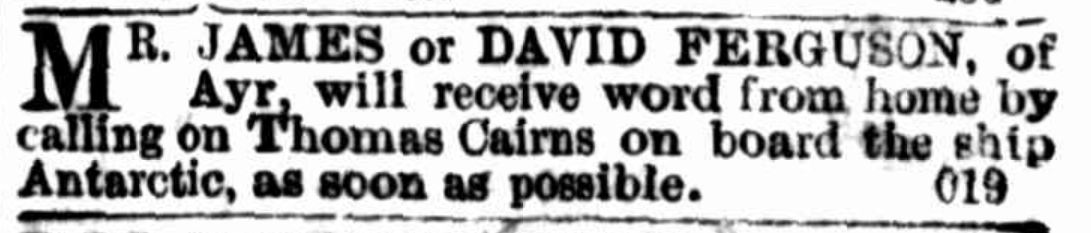
23-10-1856: The Ferguson brothers receive word from home.

The Argus, Melbourne, 23rd October 1856, page 1.

“MR. JAMES or DAVID FERGUSON, of Ayr, will receive word from home by calling on Thomas Cairns on board the ship Antarctic, as soon as possible”.

The Argus, Melbourne, 23rd October 1856, page 1.

What the ‘word from home’ was has never been ascertained but three months later David Ferguson would dissolve his partnership with his brother and James Urie and he return to Scotland.

See: 30-01-1857: David Ferguson returns to Scotland.

Or, had David had enough of the lawlessness and stench of Melbourne’s Streets? His elder brother James almost met his maker a year earlier when he was held up at gun point and robbed of a significant amount of money, so was this his David’s response to colonial Australia?