1877: St Peter’s Anglican Church, Sturt Street, Ballarat.

James Fry (1821-1903) is credited as the donor of the historic stained glass windows in the chancel of St Peters Anglican Church in Ballarat.

The windows were made by the Ferguson & Urie stained glass company of North Melbourne in 1877 at the time when extensions and renovations were being made to St Peter’s. Amongst these improvements was the addition of a new chancel complete with the stained glass windows. James Fry donated £500 towards the chancel and windows on the provision that the church raise the additional funds for a parsonage and a new organ and chamber. [1]

The Ballarat Star, Vic, Wednesday 20th June 1877, page 3.

“ADDITIONS TO ST. PETERS CHURCH.

We mentioned recently that some extensive improvements were being made at ST. Peter’s Church, and the approaching completion of the works warrants their being noticed. The church as it stands at present has in use a nave, and on the western side a transept, the original design being for another transept on the east, and an apse at the rear. As regards the apse, Mr Oakden (of Terry and Oakden), Melbourne, altered the design when he was drawing the plans for the western transept, and a chancel was projected instead of the apse. The requirements of the church have now necessitated this plan being carried out, and the work will soon be completed. Messrs James and Creber are superintending the work, and Messrs Llewellyn and Roberts are the contractors. The chancel is built of bluestone, to correspond with body of the church, and the inside measurements are:- Width, 18 feet; depth, 12 feet 6 inches; height of side walls, 20 feet 6 inches. The chancel window is a fine specimen of the stonemason’s art, the tracery being done in Waurn Ponds freestone. Stained glass is now being prepared in Melbourne to fill the window. There will be a small window on each side of the chancel, and a door on the east leads to the vestry. From the floor of the church there will be a step upwards before the chancel arch, and two others within it leading to the altar. An organ chamber is also being built, which will form part of the future eastern transept. The amount of Messrs Llewellyn and Roberts’ contract is about £480, but this amount will be considerably augmented before all the work is done in fitting up the chancel, &c. Mr Fincham, of Melbourne, is building the organ, whose largest pipe will be 16 feet, and the cost of the organ, we understand, will be about £500, so that it will be seen that the church authorities have launched into an expenditure of over £1000, towards which sum, as we mentioned a short time since, Mr. James Fry has contributed the handsome donation of £500. It is expected that all the new works will be finished, and the organ erected, in a little over a month’s time from the present.” 

In early August 1877 the three light stained glass window had arrived from the workshops of the renowned Melbourne stained glass firm of Ferguson & Urie and was erected in the chancel. The Church of England Messenger published a very detailed description of the window:

The Church of England Messenger and Ecclesiastical Gazette for the Diocese of Melbourne and Ballarat, Vic, Thursday 9th August 1877, page 14.

“The stained-glass window for the chancel of St. Peter’s Church has arrived in Ballaarat, and was placed in position. It is a very good specimen of Messrs. Ferguson and Urie’s art, and it is a matter of congratulation that such excellent workmanship can be produced in the colony. The window is divided into three lights, surmounted by tracery pierced with trefoils. These trefoils are filled with richly-coloured glass, bearing upon a starry background the three emblems of faith, hope, and charity; the heart with the sacred monogram, the cross with the crown of thorns, the anchor with the dove and olive branch. The subject of the central light is the “Ecce Homo.” The side lights, having reference to the pious and charitable lives of the ladies in whose memory the chancel was erected. are illustrations of Mark XIV, 8 (“She hath done what she could’) and Matthew XXV. 40 (“Inasmuch as ye have done it unto one of the least of these My brethren, ye have done it unto Me”). In the central light the Saviour stands forth a solemn and mournful figure. Pilate and a Roman soldier occupying the background. Underneath there is a panel with a small but exceedingly well-drawn picture of Christ’s charge to Peter – “Feed my Sheep.” In the apex of the window is the emblem of the Holy Spirit, the dove, descending with rays of light. The right hand picture of Mary wiping the Saviour’s feet with her hair is remarkable for the beauty of the Saviour’s countenance and the grace of His gesture. In the light upon the left-hand side a female figure is casting a garment around an aged man and a child at her feet. The background of both of these pictures is of a similar character – a low wall decorated with scroll-work, overtopped with trees and flowers, the sky space being filled in with ruby glass in irregular lead-work. Underneath are the old church emblems  – the Agnus Dei and the Pelican; and above are the Alpha and Omega. The side window, which can be seen only upon entering the chancel, is the more special memorial window, having the upper part a scroll with the text – “Write, Blessed are the dead which die in the Lord;” and at the bottom, a panel with the memorial inscription. The quarries of which the rest of the window is composed are ornamented with fleurs-de-lys, and the effect of the whole is highly satisfactory. The organ has been inspected on behalf of the church authorities, and is pronounced a first-class instrument. No time will now be lost in erecting it in the church.”

ballarat-st-peters-01a4

ballarat-st-peters-01a5

ballarat-st-peters-01a6

ballarat-st-peters-01a7

The new chancel of St Peter’s was consecrated on Sunday 12th August 1877 [2]

Whilst there were significant descriptions of the three light chancel window in the tabloids, there was only a minor mention of the smaller single light memorial window erected in the liturgical south wall.

“…The side window, which can be seen only upon entering the chancel, is the more special memorial window, having the upper part a scroll with the text – “Write, Blessed are the dead which die in the Lord;” and at the bottom, a panel with the memorial inscription…”[3]

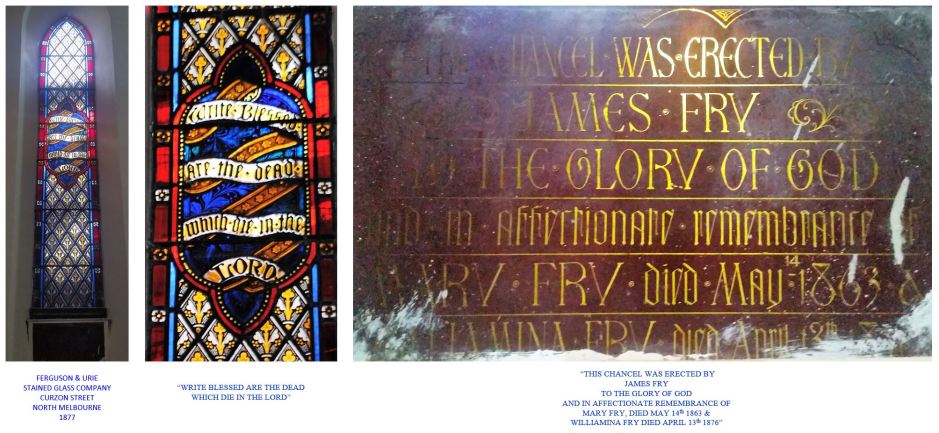
The memorial text on the lower panel of the window provides the historic clues about the donor, James Fry, and his generosity to the church and the dates of death of his first two wives, Mary & Williamina.. As stated in 1877, unless you are standing in the chancel of St Peter’s you would not know the window was there. The Gothic design is recognisable as the work of Ferguson & Urie which includes a central scrolling ribbon design containing a piece of scripture from the King James Bible, Revelations Chapter 14, verse 13;

“WRITE BLESSED ARE THE DEAD WHICH DIE IN THE LORD”

Unfortunately, the memorial text at the bottom of the window no longer has back lighting from outside so it can only be read when artificially illuminated from behind. I managed to do that via the simple trick of utilising the smart-phone flashlight function and dangling it down the back of the vent which was sufficient to highlight the text enough to be read. There are many unfortunate paint splatters on the window and the fact that the memorial text cannot be read at all unless illuminated from behind gives the impression that it probably hasn’t been seen or known for many years. Probably not known for longer than I have been alive!

“THIS CHANCEL WAS ERECTED BY
JAMES FRY
TO THE GLORY OF GOD
AND IN AFFECTIONATE REMEMBRANCE OF
MARY FRY, DIED MAY 14th 1863 &
WILLIAMINA FRY DIED APRIL 13th 1876”

ballarat-st-peters-03d

James Fry (1821-1903) was a native of Somersetshire in England and he can be credited as a colonial pioneer of Victoria’s grain growing and flour milling in western districts of Victoria.

His official biography[4] records that he came to Australia with his wife Mary in 1854 aboard the ‘Brilliant’ but there is no record of their names on the passenger list.

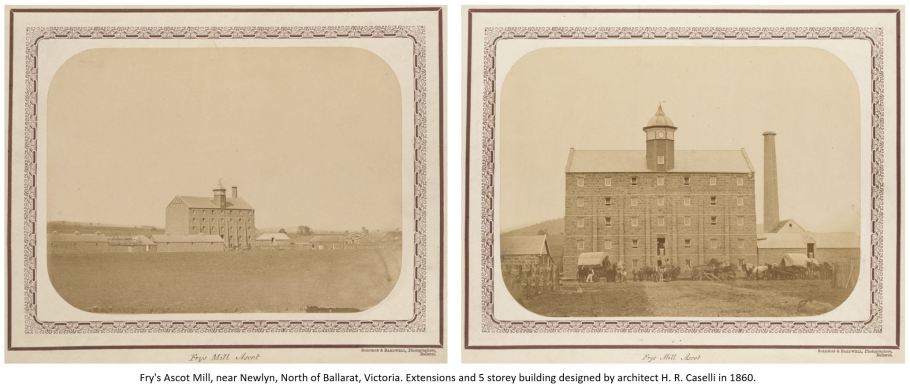
After successfully pioneering as a grain grower in the Wimmera region in the late 1850’s, he began his own flour milling operations and entered in partnership with Thomas Creed in the Ascot Flour Mills north of Ballarat. In May of 1857 they dissolved their partnership[5] by mutual consent and James became the sole owner. The mill was known for many years as “Fry’s Ascot Mills” and he expanded it in 1860 by erecting a massive five storey bluestone building to the designs of Ballarat architect Henry Richards Caselli.[6]

frys-mill-c1860-01a

In 1857 the first family tragedy struck when his infant daughter, Mary Grimstead Fry, died on the 2nd of July. James obtained a family grave site at the Miners Rest ‘Dowling Forrest’ cemetery, 10km North West of Ballarat, where his daughter was interred. An imposing monument was later erected on the site which would provide an historic record of the family’s tragedies and history.

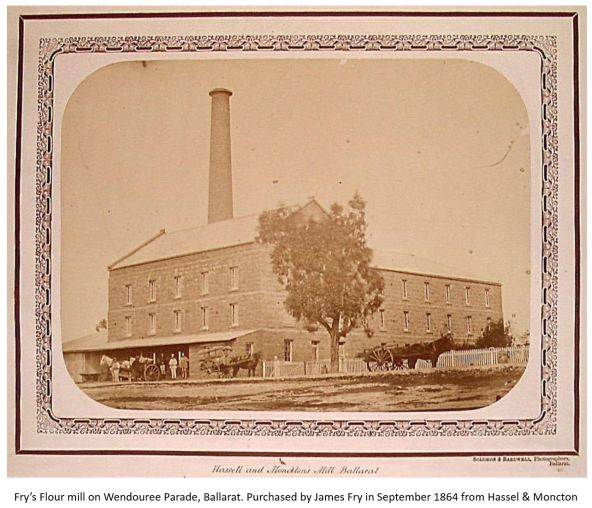
By the early 1860’s James’s milling empire was expanding. In September 1864 he purchased a flour mill at Ballarat opposite Lake Wendouree from “Hassell & Monckton” for £4500 [7]. He expanded the business further via leasing or purchasing mills all over the western districts at Ararat, Donald, St. Arnaud, Horsham, Nhill, Kaniva, Dimboola, and Natimuk[8]. His favoured estate, Sutton Park, at Newlyn near the Ascot mill remained a central hub to all his operations.

Fry’s prize winning ‘Ascot Mills’ flour was exhibited at the International Exhibition in London of 1862[9] and by the 1880’s it became a household staple throughout the colony known as Fry’s “Five Stars Flour”.

On the 14th May 1863 his first wife Mary, nee Gear[10], died at his Sutton Park estate near the Ascot Mills. She was only 45 years old and was interred in the family vault at Miners Rest with their infant daughter Mary Grimstead.

Being a widower was not a part of James’s future plans and he wasted little time in finding a new companion. On the 21st April 1864, at Brompton Cottage in Brighton, Victoria, he married Williamina Smith (nee Hay), the widow of Mungo Park Smith, Engineer and city surveyor of Melbourne[11].

James’s generosity was not just confined to the church. In October 1864 he and Williamina hosted a luncheon for his employees and their families. About 60 people were transported to Lake Burrumbeet in four decorated wagons where the best part of the day was taken up by games and; “At noon, a sumptuous dinner was spread and was partaken of with the best of appetites.” Wine and Spirits were supplied in generous quantities and later in the day, as heavy rain set in, the whole party returned to the Ascot mill where singing and dancing continued to a late hour[12]. This was undoubtedly one of the many occasions that James displayed his generosity towards his employees. Some of them would later join him as partners in his milling operations for many years.

frys-flour-mill-wendouree-ballarat-01a
On the 12th of July 1869 a tragic accident occurred at the Wendouree flour mill. On the Monday at about 7:30am a massive 36ft long boiler exploded at the mill. The sound of the explosion could be heard over three miles away and a huge plume of steam and debris could be seen in the air above the mill for many miles around. James’s nephew, Albert Hill, who was acting superintendent at the time, was unfortunately standing next to the boiler when it exploded. Albert was killed instantly. His mangled near naked and disembowelled body was blown more than one hundred yards away and landed in the Swamp on the other side of Wendouree Parade.

“…The clothing was torn into shreds, while the skull was completely smashed in. Both legs were broken, and besides several other terrible wounds, the body was almost disembowelled…”

When his body was recovered it was taken to Fry’s residence near the mill. Williamina was so traumatised by the horrific scene that she became seriously ill.[13] The inquest on Albert’s body was held the following day at the Wendouree Parade Hotel, where, coincidentally, some small portions of brick had been thrown a few hundred yards from the explosion and had landed in the bar. Albert’s funeral was held on the 14th and he was interred with James’s first wife Mary and their infant daughter Mary Grimstead at the Miners Rest Cemetery.

“The procession started from Mrs Fry’s residence, Wendouree-parade, and consisted of about thirty well-filled mourning coaches, buggies, &c, and several horsemen.”[14]

James’s second wife, Williamina died at his Sutton Park estate on the 13th April 1876. Coincidentally she was also only 45 years of age. Williamina was interred with James’s first wife and his nephew Albert at Miners Rest.  Whether by coincidence or design, some scriptural text from Revelations 14:13 which appears on their memorial stained glass window at St Peter’s in Ballarat is from the same chapter and verse as that on their monument at Miners Rest:

“Blessed are the dead who die in the Lord: even you saith the Spirit that they may rest from their labours.” Rev. XIV:13″

fry-grave-miners-rest-01a
In June of 1877, the year following Williamina’s death, James Fry donated £500 to St Peter’s Church for the construction of a new chancel and the stained glass windows. Shortly after this he departed Victoria aboard the ‘Northumberland’ for London[15]. James had been back to the old country a number of times before but this venture would secure his third wife.

At St. Mary’s, Stoke Newington, London, on the 27th December 1877 he married Louisa Anne Coles[16], the widow of Edward Coles. James and Louisa returned to Melbourne aboard the ‘Chimborazo’[17] in March the following year and she would be his companion for the next twenty three years.

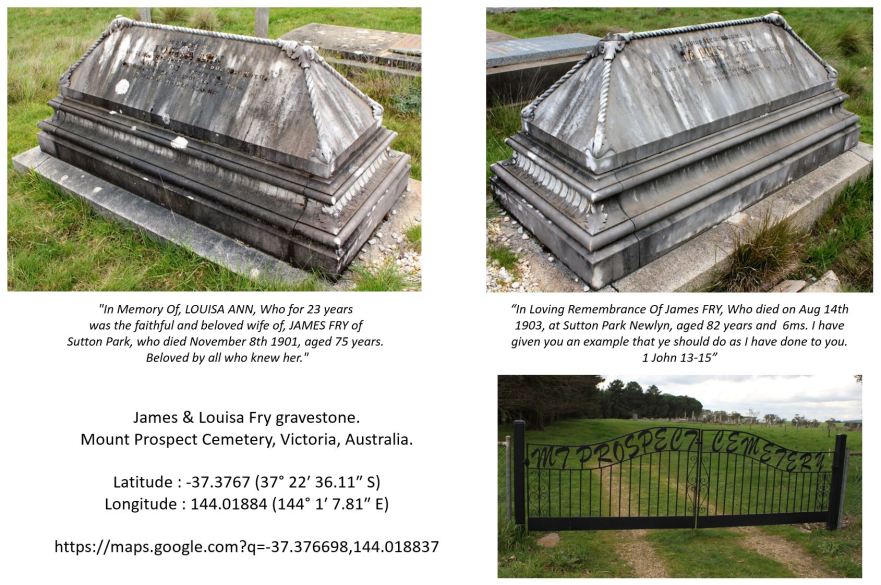
On the 8th November 1901 Louisa died at Sutton Park aged 75. James had now outlived three wives. Louisa was interred at the Mount Prospect cemetery north of Ballarat and a marble casket type grave-stone was erected over the grave. After more than a century most of the lead letters in the inscription have gone and it’s now almost unreadable:

“In Memory Of, LOUISA ANN, Who for 23 years was the faithful and beloved wife of, JAMES FRY of Sutton Park, who died November 8th 1901, aged 75 years. Beloved by all who knew her.”

James was now in his early eighties and had not taken an active interest in the flour milling operations since he floated the company on the stock exchange in 1884. He devoted his time to agricultural pursuits at his estate near Newlyn. On Friday the 14th August 1903 James died there at the age of 82 and was buried with his third wife Louisa at Mount Prospect.

The Ballarat Star, Vic, Monday 17th August 1903, page 1.

“DEATH OF MR. JAMES FRY.

One of the earliest pioneers of the grain trade in Victoria, Mr James Fry, died on Friday at Sutton Park, Newlyn, at the advanced age of 82. Deceased was a native of Somersetshire, and came to the colony in 1854 in the ship Brilliant, settling first at Geelong with his wife and family, where he purchased a property. After various experiences on the Ballarat goldfields, in 1856 he purchased a property at Ascot, and shortly after secured a flour mill near Geelong, which he removed to that point, as the Talbot shire was fast becoming the centre of a large agricultural district. Beginning in a small way, he built up a very extensive business among the various mining townships, and erected plant and machinery at that time considered to be as complete an establishment as then existed in Australia. In 1865 he purchased a mill near Lake Wendouree, Ballarat, from Messrs Hassell and Monkton, and went there to reside. In 1868 he acquired a freehold property in the Wimmera, situated between Glenorchy and Banyena. He was the first to grow wheat to any extent on the Wimmera Plains, and demonstrate that it could be cultivated there at a profit. From Ballarat, as his centre, he followed up the settlement of the selectors on the land, first around Ararat, and then on to Stawell, having business relations with both places. When growers commenced to select on an extensive scale in the Wimmera, he opened at Horsham, in anticipation of the railway line being continued from Stawell to that centre, and intimately to the border, and as the movement spread, extended his operations till they gradually embraced all the centres in that far-reaching territory. In addition to the large grain business, Mr Fry erected, brought or leased flour mills at Ballarat, Ararat, Donald, St. Arnaud, Horsham, Nhill, Kaniva, Dimboola, and Natimuk. In 1884 the grain and milling business having reached large dimensions, with its head office in Melbourne, and branches in all the leading grain growing districts of the Wimmera and other parts of the colony, he decided to float it into a limited company, which was successfully accomplished, and shortly afterwards retired from the active management, devoting most of his time thenceforth to grazing and agricultural pursuits.

            At St. Peter’s Church yesterday, notice was taken of the death of Mr Fry. Mr Fry gave the land on which St. Peter’s Vicarage stands; the chancel, with a stained glass window; the tower and the bells, to St. Peter’s Church. The flag was flown at half-mast throughout the day, and muffled peals were rang on the bells. Before the service in the morning, the rev. Dr Pritchard alluded to the sad event. He reminded the congregation of all the late Mr Fry’s generous gifts, and said that he was a regular and frequent worshipper at ST. Peter’s when resident in the parish. Such a good example of generous help to the house of God should cause his name to be ever held in honored remembrance at St. Peter’s and they should pray that others might emulate such generous deeds. At the evening service similar reference was made, and special music was sung at the offertory. Mr L. Richardson played Mendelssohn’s Funeral March at the close of service.”

On the opposite side of the gravestone to Louisa’s memorial words are his;

“IN LOVING REMEMBRANCE OF JAMES FRY, WHO DIED ON AUG 14th 1903, AT SUTTON PARK NEWLYN, AGED 82 YEARS AND 6ms. I HAVE GIVEN YOU AN EXAMPLE THAT YE SHOULD DO AS I HAVE DONE TO YOU. 1 JOHN 13-15”

fry-grave-mount-prospect-01a

James Fry’s total estate was valued at £128,400 and it was distributed to many family members in Australia and England. It included provisions for his daughter, step daughters, step granddaughters, the Ballarat Church of England, and his surviving son, James Rood Fry. 

The Sutton Park Estate was left to his son James but by 1918 it was under control of the government for soldier settlement purposes.[18]

Today, on a lonely dirt intersection amongst the farmland at Newlyn, you will find the original gates that once framed the entrance to Sutton Park. They now form part of an historic memorial of the district and nearby a stone cairn holds a plaque showing how the estate was divided for soldier settlement.

The gravesites at Miners rest and Mount Prospect, some of the old crumbling mill buildings around the district, the old gates to Sutton Park, and the stained glass windows at St Peter’s Church in Ballarat are the last physical reminders of a Colonial Pioneer and his family who shaped the western district of Victoria.

sutton-park-gates-01a

Footnotes:

[1] The Ballarat Star, Vic, Monday 11th June 1877, page 3

[2] The Ballarat Star, Vic, Monday 13th August 1877, page 3.

[3] The Church of England Messenger and Ecclesiastical Gazette for the Diocese of Melbourne and Ballarat, Vic, Thursday 9th August 1877, page 14.

[4] Australian Dictionary of Biography: Fry, James (1821-1903)

[5] The Star, Ballarat, Vic, Tuesday 26th May 1857, page 4.

[6] The Star, Ballarat, Vic, Tuesday 14th August 1860, page 4.

[7] The Star, Ballarat, Vic, Friday 30th September 1864, page 2.

[8] The Ballarat Star, Vic, Monday 17th August 1903, page 1.

[9] Victorian Govt Gazette, Tuesday 14th April 1863, page 842.

[10] Daughter of John Gear (or Gean) and Jane Grimstead.

[11] The Age, Melbourne, Vic, Monday 25th April 1864, page 4.

[12] The Star, Ballarat, Vic, Saturday 29th October 1864, page 2.

[13] The Ballarat Star, Vic, Tuesday 13th July 1869, page 2.

[14] The Age, Melbourne, Vic, Friday 16th July 1869, page 4.

[15] Geelong Advertiser, Vic, Tuesday 19th June 1877, page 9.

[16] The Bath Chronicle, Somerset, England, Thursday 10th Jan 1878, page 5.

[17] The Argus, Melbourne, Vic, Monday 11th March 1878, page 5.

[18] The Age, Melbourne, Vic, Saturday 24th October 1903, page 11.


Short link to this page: http://wp.me/p28nLD-2Mv

This is a new research article based on new information.
The old article can be seen at: http://wp.me/p28nLD-Uv

© Copyright

1875: St Peter’s Anglican Church, Akaroa, New Zealand.

St Peter’s Anglican Church in Akaroa contains one of only seven rare examples of Ferguson & Urie stained glass found in New Zealand to date.

The window in St Peter’s was erected circa 1877 in the east sanctuary as a memorial to two young men, C. Allan Nalder a Solicitor, and Randal Sayle a district surveyor, who both drowned as a result of a boating accident when their yacht “Ripple” capsized in Tikau Bay on the 12th January 1875.

Photos taken 2nd October 2010 and kindly contributed by Errol Vincent, NZ.

This slideshow requires JavaScript.

[View larger images]

The first Anglican Church at Akaroa was built c.1852 in Church street to the designs of Samuel Charles Farr (1827-1918). Circa 1863, the Resident Magistrate at Akaroa, John Watson[1], donated the land for the new Church at Rue Balguerie, Akaroa, and builders Checkley, Bates and Newton began construction of St Peter’s in 1863. It was consecrated by the Bishop of Christchurch, Henry John Chitty Harper (1804-1893), on the 27th of November 1864[2].

In response to the need for more room, in 1876 architects Cane and Drewett (Thomas Cane 1830-1905 & John W. Drewett) presented the plans for the enlargement of the church, which included transepts and extended sanctuary, and on completion of these extensions, it was officially re-opened for services on St Mark’s day on the 25th April 1877[3].

In relation to the date the Ferguson & Urie window was erected, noted historian Dr. Fiona Ciaran records that the following was reported in the Lyttelton Times of 1875:

“…The LT records the studio and the arrival of the window [(6 April 1875, p2]…”[4]

In April 1877, two years after the arrival of the window, a statement of subscriptions and expenditure was published with mention of an amount paid to Ferguson & Urie:

Akaroa Mail and Banks Peninsula Advertiser, Vol 1, Issue 78, 17th April 1877, page 3.

“ACCOUNT OF SUBSCRIPTIONS AND EXPENDITURE MEMORIAL WINDOW…”
“…Paid Ferguson and Urie…£46-3-1…”

Transcriptions of some significant source records:

Colonist [NZ], Volume 1861, issue 1861, 12 January 1875, page 3.

“Monday.

“Mr. Randall Sayle, late of Nelson, was drowned on Saturday afternoon, at Akaroa, during a trial trip of the yacht Ripple, which he had just purchased. Mr Nalder, junior, a lawyer, was also drowned. A squall struck the yacht, which sank in deep water”.

Star, [NZ] Issue 2133, 12 January 1875, page 2.

“THE FATAL ACCIDENT AT AKAROA”.

“The following is a detailed account of this sad accident, of which a brief telegraphic account was published yesterday.
As has been already stated, the yacht Ripple, which was built at Port Chalmers, was brought to Lyttelton to compete at the late regatta in the yacht race, which she won. Mr Sayle, who was at the regatta as captain of the Akaroa four-oar crew, taking a fancy to the yacht negotiated for and purchased her, got her unrigged and sent down to Akaroa by the Bruce on Jan. 7. The day following her arrival at Akaroa, Mr Sims, one of the survivors of the accident, commenced to re-rig her, and finished his work on the morning of the 9th. Mr Sayle was very anxious and excited to get the work done so that he could have a trial trip of his purchase, and, accordingly, in the afternoon, himself, Mr C. Allan Nalder, Mr A. Westenra of the bank of New Zealand, and Mr W. Sims started for a cruise. The yacht was narrowly watched at starting and for some time afterwards by different persons on shore as she appeared to some who understood those matters not so stiff under canvas as she had been represented to be. At starting, two reefs were taken in the mainsail, and, subsequently, another one, the jib being also replaced by a smaller sail. The wind at the time was from the north-east, blowing rather gustily and fresh on the Akaroa side of the bay; on the opposite side it appeared as if the wind was stronger. The first part of the cruise was run down the harbour past the buoy of Green’s point, then a tack was made to winward, when the yacht fetched near Tikau Bay, she was then again put about. Mr Sayle was at the tiller and holding the main-sheet in his hand, when Mr Sims, noticing that she was heeling over too much, called out to Mr Sayle to let go of the sheet. As this was not done, Mr Sims twice more made the same request, but Mr Sayle was as one paralysed, looking at the others, but apparently unable to do what was required of him. The vessel heeling over more, the ballast shifted, and the yacht immediately filled and went down at, about a mile from the shore, in some six fathoms of water. The four, who were all swimmers, having got clear of the vortex caused by the sinking vessel, at once struck out for the shore. Mr Westenra and Mr Nalder being near each other, and Mr Sims and Mr Sayle a little distance from them. As they swam, Mr Nalder addressed Mr Westenra more than once, and wished he could get his coat off, which Mr Westenra told him was impossible, but kept cheering him up with hopes of their reaching shore safely. Mr Westenra supposes they must have swam nearly half way to shore when he heard a call from his fellow swimmer. He turned round and found he was alone, Mr Nalder having sunk to rise no more. At this time the beach was not to be seen, but struggling on, Mr Westenra at last reached the shore, exhausted and almost insensible. In the meantime, Mr Sims had kept near Mr Sayle, and they had been swimming some time, when Mr Sims noticed his companion apparently losing strength, and faltering and saying that he was afraid he could not keep on. Mr Sims then swam behind him, and catching hold of the serge coat which Mr Sayle wore, held him up whilst still swimming toward the shore, until he found they were both sinking, and that unless he let go, they must both go down together. Thoroughly exhausted, but reluctantly, Mr Sims let go his hold, and shortly afterwards Mr Sayle must have sunk. At this time, Mr Sims knew nothing of the others. He had heard a cry which he thought came from Mr Nalder, but whether it was of encouragement or despair he could not tell. Resting a little, and getting himself free from his boots, he again commenced swimming towards shore, which he ultimately, with great difficulty reached, and there found Mr Westenra. After taking off and wringing their clothes, they started for the Maori pah, and when on the hill, they noticed that Mr Bridge’s yacht, the Scud, had started from Akaroa, and was making for the scene of the accident. The Maoris treated them very kindly and hospitably, making them tea, and wanting them to change their clothes, which both declined to do; the Natives volunteered also to take them to Akaroa in a dingy. A fire was then lit to draw attention of those on board the Scud, but, owing to the peculiar haziness of the atmosphere, it could not be seen. However, the Natives getting out their dingy, took them, and, succeeding in drawing attention, put them safely on board. Mr Nalder was well known throughout the province, but Mr Sayle was not so well known. Both gentlemen were single, and the latter held the appointment of district surveyor at Akaroa. The fatality occurred about five o’clock in the evening, and, when known, caused quite a consternation in Akaroa, both gentlemen being held in more than ordinary esteem and respect.”

Lyttelton Times [NZ], Volume XXII, issue 1325, 1 December 1864, page 4.

“CONSECRATION OF ST. PETER’S AKAROA

On Sunday morning, the 27th day of November, the Bishop of Christchurch was met at the usual hour for divine service by the minister, churchwardens, and some of the inhabitants of Akaroa after the form prescribed, when the Rev. William Aylmer, M.A., the incumbent, read the petition praying his Lordship to consecrate their building, to which petition, consent was given according to the prayer therein contained. The ceremony of consecration and the dedication immediately followed. The Bishop having received the instrument of conveyance, presented to him, by which we learnt that the area of ground upon which the church was erected had been the gift of Mr. John Watson, the Resident Magistrate at Akaroa, declared the same to be dedicated to the use of the Episcopal Church, and henceforth to be known by the style of St. Peter. Being the first Sunday in Advent the psalms and Lessons for that day were read instead of those usually chosen at a consecration in this diocese; the second Lesson, containing the narrative of the cleansing of the Temple by our Redeemer. His Lordship afterwards preached from Matthew ix. Chapter and 29th verse – “According to your faith, be it unto you.” His sermon was a plain, but forcible explanation of the nature and quality of a saving faith, remarkable for the earnest tone in which he strove to bring home the necessity of such a faith to his hearer’s apprehension while he dwelt strongly upon the privileges which they would henceforth enjoy in making public prayer and supplication unitedly to Him who had promised that wheresoever two or three were met together there to be present with them. After the conclusion of the sermon, the Holy Communion was administered. The choir had prepared a musical treat, and sang Jackson’s noble Te Deum in F – in a manner which, if it left anything open to regret, was only that so inspiring a composition should not be the rule instead of the exception. The chants and hymns chosen for the day, were also well sung – the congregation joining throughout, intelligibly bearing their part in the service. After evening service, the Bishop administered the rite of confirmation, and addressed in his happy, affectionate, and impressive manner, those upon whom he had laid his hands, exhorting them, and all those who had preceded them, to help one another to fight the good fight and never be ashamed of he glorious calling whereunto they had been called. If another regret again obtruded, it was only that his Lordship was not able to be a more frequent visitor to the district of Akaroa.”

Akaroa Mail &Banks Peninsula Advertiser [NZ], Vol VII, Issue 704, 13 April 1883, page 2

“OBITUARY NOTICE

On the authority of a letter received by the last mail from England, we hear from Mr. A. H. Westenra of the decease of Mr John Watson, for many years the Resident Magistrate of Akaroa, and for some years the only Stipendiary magistrate in all of what is now Canterbury. It appears almost like going back to pre-historic times to write of the deceased gentleman, and his connection with Akaroa and the public service of the Colony, more especially, too, as but few who are now among us had the opportunity of hearing from his own lips the reminiscences of his earlier Colonial career.
From what we remember and have heard of our deceased fellow-colonist and former kindly neighbour, we understand that he was born at Ballydarton, in the County of Carlow, Ireland, his father being John Watson, Esq., who was then considered the first and best master of foxhounds in the United Kingdom[5]. This love of sport and horsemanship has descended, the present master of the Melbourne pack, which position he has honourably held for many years, being a half brother[6] of the deceased; while every old Akaronian must well remember the late gentleman’s pride in horses, even to breaking them in, the last one, we believe, that he owned and broke here being a horse named by him Blarney.
Mr Watson, we believe, came to this colony in November or December, 1843, with Captain – afterwards Admiral – Fitzroy, but in what capacity we do not know. It is a matter of colonial history that he distinguished himself at Kororareka, in the Bay of Islands, at the contest with the then redoubtable chief Heki. Shortly after this he must have been sent to Akaroa, succeeding Mr C. B. Robinson, the first R.M. here. From that date until 1869 or ’70 Mr Watson was one of us, strict in his duties and straightforward in his intentions, Like other men, he had his official peculiarities, but for unostentatious kindness, in which his widow was always a ready and eager helper, and more than aid, his name was in those days proverbial. The site of St. Peter’s Church section was a present from the deceased gentleman, who always, while he was amongst us, took a deep interest in Church matters, and otherwise interested himself in the advancement of the town and district; in fact, his and Mrs Watson’s aid and advocacy, combined with the Rev. W. Aylmer’s efforts, resulted in the present Church being built. Many and very many of the “old identities” of this district will be very sorry to read of Mr’s Watson’s bereavement, and though she is far away will still sympathise with her as a friend, although out of sight, but not out of mind to them. Most of us know that although a non resident the deceased gentleman still held property among us, notably the residence or Mr H. C. Jacobson, and a freehold on the German Bay hill. To quote Mrs Hemans:-

“Leaves have their time to fall, And flowers wither at the North wind’s breath, And stars to set; but all Thou hast all seasons for thine own, O Death!”

Stained Glass windows of Canterbury, New Zealand, Ciaran, Fiona. Dunedin, N.Z.: University of Otago Press, 1998, p153.

W370. E sanctuary, 3L, 2740mm x 1630mm.
The Risen Christ Blessing in Majesty.
Unsigned:
[Ferguson, Urie, and Lyon, Melbourne].

Undated: 1875.
Commemoration: C. Allan Nalder and G.R.F. Sayle, drowned in Akaroa Harbour, 9 Jan 1875 [plaque]. Both worked in Akaroa, Nalder as a solicitor and Sayle as a surveyor [MDCB N3, S74].
Donor: Public subscription.
Documentation: The LT records the studio and the arrival of the window [(6 April 1875, p2]. NZCN reported that more money was needed for the window which would cost approximately £60 [5, no. 9 (July 1875), p.103]. At a vestry meeting on 29 Sept 1877, which he attended while on a visit to the parish, Bp Harper noted that this window had been installed without a faculty. A formal request for a faculty was to be made [VMB (unpaginated)], but there is no faculty entry in the BR.
Note: This window may have been obtained from this studio as a result of an advertisement first placed by Ferguson, Urie and Lyon in NZCN, 1, no 5 (Feb 1871), p.16.”

(Abbreviations: BR: Christ Church Anglican Bishop’s Register. NZCN: New Zealand Church News. MDCB: Macdonald Dictionary of New Zealand Biographies. LT: Lyttelton Times. VMB: Vestry Minute Book).

Footnotes:

[1] Akaroa Mail &Banks Peninsula Advertiser, Vol VII, Issue 704, 13 April 1883, page 2

[6] George John Watson (1829-1906)

Acknowledgements:

Thanks to Errol Vincent for contributing the photos and for his and Ann’s enthusiasm for the history.  Errol is a great great grandson of James Ferguson of the stained glass firm ‘Ferguson & Urie’.

Thanks to Dr. Fiona Ciaran for signing my copy of her book ;-), ‘Stained Glass windows of Canterbury, New Zealand,’ which has been an invaluable resource for this article.


Short link to this page: https://wp.me/p28nLD-1X8

© Copyright

05-08-1876: St Peters, Eastern Hill, Melbourne, Victoria.

The foundation stone of St Peter’s was laid by the Superintendent of the Port Phillip district, Charles Joseph La Trobe[1], on 18 June 1846[2], on the corner of Albert and Gisborne Streets on the eastern hill of Melbourne. The building was used for services as early as 1847, and was formally opened on the 6th August 1848[3].

The first stages of the church were designed by architect Charles Laing and the contractors were Ramsden & Brown (Samuel Ramsden – stone mason, and Charles & Henry Brown –bricklayers, contracted for a reported £820) [4]. In 1853-54 the Chancel & Transepts were added to the designs of Charles Vickers.

In June 1876, the chancel of St Peter’s was extended to the designs of architects Terry and Oakden, and the five figurative Ferguson & Urie windows were installed[5] at this time. An engraving showing the new chancel was published in the newspaper on the 5th August 1876[6] and it shows five single lancet figurative windows surrounding the chancel. The centre window of the five, depicting the “Ascension”, was moved to a small chapel in the south west corner of the church, possibly during further alterations in 1927-29[7]. Other single lancet windows in the nave are of Ferguson & Urie’s simple diamond quarry with stained glass borders.

Originally the chancel windows were installed (left to right) as, The Prophet Elias, St Peter, Christ & The Ascension, St Paul, and The Prophet Moses. The design and artwork of the Ascension window seems to be extremely at odds with that of the other flanking prophets and saints windows. Whether there has been been conservation on this window is not known but it’s design and artwork do not fit within the period equaling the other prophet and saint windows of the time.

Photos taken: 26th September 2010.

This slideshow requires JavaScript.

The Melbourne Argus, Vic, Friday 19th June 1846, page 2.

“The foundation stone of the new English Episcopal Church on the Eastern Hill was laid yesterday, in due form by his Honor the Superintendent, in the presence of a large concourse of people assembled to witness the ceremonial. The arrangements were presided over by the Rev. A.C. Thomson, Minister of St. James’s Church, who conducted the services, aided by the Rev. Mr. Collins, of Geelong. The inscription on the plate was as follows:- “The Foundation Stone of St. Peter’s Church, In the Town of Melbourne, District of Port Phillip, Colony of New South Wales, Built by Local Subscriptions, Aided by an equal amount from the Colonial Government, Was laid by His Honor Charles Joseph La Trobe, Esquire, Superintendent of Port Phillip, On the 18th day of June, A.D. 1846, And in the Ninth Year of the Reign of Queen Victoria. Adam Compton Thomson, Minister of St. James’ Parish of Melbourne. James Simpson, James Denham Pinnock, Robert Williams Pohlman, Esquires, Trustees. Charles Laing, Architect”

The Australasian Sketcher with Pen and Pencil, Melbourne, Vic, Saturday 5th August 1876, page 70.

THE INTERIOR OF ST. PETER’S CHURCH, EASTERN-HILL: THE NEW CHANCEL.

The alterations and improvements which have lately been made to St. Peter’s Church (Church of England), Eastern-hill, consist of the extension and completion of the chancel, which now includes an additional space of 31ft. from the east wall of the church. On the north side of this, and communicating with it, a vestry has been built for the use of clergymen and choristers, and at the south side a chamber has been erected for the organ, which formerly stood near the western entrance. The organ has been reconstructed in its chamber by Mr. Fincham, the organ builder, of Bridge-road, and is hidden from the greater part of the congregation. The choir seats are placed within the new chancel. By means of the alterations thus effected a s space is gained which furnishes 80 additional sittings, and in course of time still further room will be made by filling in with seats that part of the western gallery which was formerly blocked by the top of he organ. The addition is a great improvement to the church internally, and will add much to the convenience of the congregation as well as to that of the choir and clergy. The cost of these alterations, which have been carried out on the plans and under the supervision of Messrs. Terry and Oakden, architects, amounts to £920, of which £750 is the expense of the new building; the balance is for removing the organ and furnishing the choir. The opening of he chancel was celebrated on June 29, St. Peter’s Day, and the thirtieth anniversary of the laying of the foundation of the church. Divine service was held, the musical portion of which was under the control of Mr. Summers, and was admirably given.”

1864-67: St Peter’s Anglican Church, Ballarat, Victoria.

St Peters Anglican Church in Sturt Street Ballarat was designed by C. D. Cuthbert circa 1864.  The chancel was added in 1877 along with the stained glass windows in the chancel by Ferguson & Urie. The tower was added in 1891 and Soldiers memorial chapel in 1917.

Photos were taken 19th September 2010 & 17th March 2011

This slideshow requires JavaScript.

[View larger images]

Church of England Messenger, 9th August 1877, page 14.

“The stained-glass window for the chancel of St. Peter’s Church has arrived in Ballaarat, and was placed in position. It is a very good specimen of Messrs. Ferguson and Urie’s art, and it is a matter of congratulation that such excellent workmanship can be produced in the colony. The window is divided into three lights, surmounted by tracery pierced with trefoils. These trefoils are filled with richly-coloured glass, bearing upon a starry background the three emblems of faith, hope, and charity; the heart with the sacred monogram, the cross with the crown of thorns, the anchor with the dove and olive branch. The subject of the central light is the “Ecce Homo.” The side lights, having reference to the pious and charitable lives of the ladies in whose memory the chancel was erected. are illustrations of Mark XIV, 8 (“She hath done what she could’) and Matthew XXV. 40 (“Inasmuch as ye have done it unto one of the least of these My brethren, ye have done it unto Me”). In the central light the Saviour stands forth a solemn and mournful figure. Pilate and a Roman soldier occupying the background. Underneath there is a panel with a small but exceedingly well-drawn picture of Christ’s charge to Peter – “Feed my Sheep.” In the apex of the window is the emblem of the Holy Spirit, the dove, descending with rays of light. The right hand picture of Mary wiping the Saviour’s feet with her hair is remarkable for the beauty of the Saviour’s countenance and the grace of His gesture. In the light upon the left-hand side a female figure is casting a garment around an aged man and a child at her feet. The background of both of these pictures is of a similar character – a low wall decorated with scroll-work, overtopped with trees and flowers, the sky space being filled in with ruby glass in irregular lead-work. Underneath are the old church emblems – the Agnus Dei and the Pelican; and above are the Alpha and Omega. The side window, which can be seen only upon entering the chancel, is the more special memorial window, having the upper part a scroll with the text – “Write, Blessed are the dead which die in the Lord;” and at the bottom, a panel with the memorial inscription. The quarries of which the rest of the window is composed are ornamented with fleurs-de-lys, and the effect of the whole is highly satisfactory. The organ has been inspected on behalf of the church authorities, and is pronounced a first-class instrument. No time will now be lost in erecting it in the church.”

The Chancel window:

This is the main three light chancel window that depicts scenes from: MATT 25-40, JOHN 19-5 and MARK 14-8. The tracery above the three main lights shows three trefoil windows depicting the symbolism of Faith, Hope and Charity. The main lights of the window depict the following:

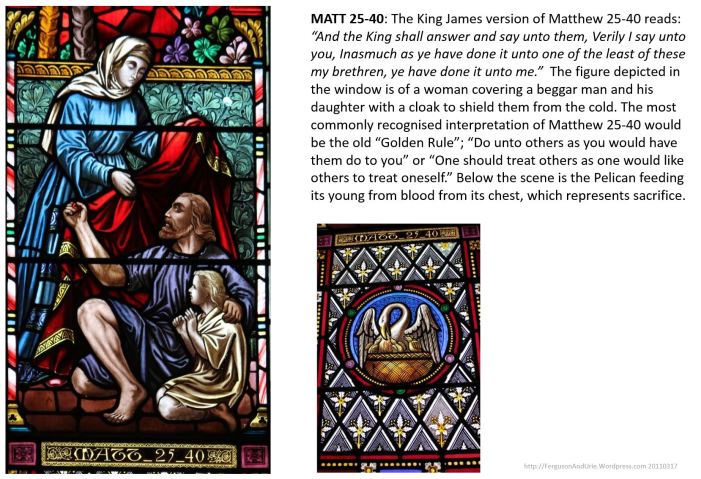
MATT 25-40: The King James version of Matthew 25-40 reads: “And the King shall answer and say unto them, Verily I say unto you, Inasmuch as ye have done it unto one of the least of these my brethren, ye have done it unto me.”  The figure depicted in the window is of a woman covering a beggar man and his daughter with a cloak to shield them from the cold. The most commonly recognised interpretation of Matthew 25-40 would be the old “Golden Rule”; “Do unto others as you would have them do to you” or “One should treat others as one would like others to treat oneself.” Below the scene is the Pelican feeding its young from blood from its chest, which represents sacrifice.

JOHN 19-5: The King James version of John 19-5 reads: “Then came Jesus forth, wearing the crown of thorns, and the purple robe. And Pilate saith unto them, Behold the man!” The scene depicted in the window is of Jesus wearing the crown of thorns. His hands are bound, he’s wearing the purple robe, and he is flanked by Roman guards. In the hours before Christs crucifixion, he was led through what we would call a ‘kangaroo court’ which has no sense of justice. The Roman Governor, Pontius Pilate, had him whipped and had a crown of thorns placed upon his head and clothed him in a purple robe, mocking some sort of regal adoration. Pilate paraded Jesus before the crowd and exclaimed, “Behold, the man!” Below is the scene of Christ as the Good Shepherd with a ribbon of text which reads: “PETER LOVEST THOU ME, YE LORD THOU KNOWEST THAT I LOVE THE, FEED MY SHEEP.” This refers to John 21-17; “He saith unto him the third time, Simon, son of Jonas, lovest thou me? Peter was grieved because he said unto him the third time, Lovest thou me? And he said unto him, Lord, thou knowest all things; thou knowest that I love thee. Jesus saith unto him, Feed my sheep.”

MARK 14-8: The King James version reads: “She hath done what she could: she is come aforehand to anoint my body to the burying.” The scene in the window depicts Mary Magdalene, the alleged prostitute, drying Christs feet with her hair. Nearby is a small ornate jug which is supposed to have contained an expensive aromatic ointment which was to be used to ‘anoint” him before his death. Below is the image of the Paschal Lamb carrying the St George banner.

The two light window in the nave:

The ‘John Laverick Nunn’ Memorial window is a two light window with the memorial text:

“PLACED BY ELIZA NUNN IN MEMORY OF HER HUSBAND JOHN LAVERICK NUNN DIED 1875 AGED 46. | ALSO HER DAUGHTER HANNAH MARY DIED 1883 AGED 23 AND HER SON JOHN LAVERICK DIED 1884 AGED 22”.

This window was erected in St Peters in January 1886.

The scroll text on the left lancets reads:

“THE LORD GAVE AND THE LORD HATH TAKEN AWAY BLESSED BE THE NAME OF THE LORD” (Job 1:21 – “And said, Naked came I out of my mothers womb, and naked shall I returne thither: the Lord gaue, and the Lord hath taken away, blessed be the Name of the Lord.”) “THEN ALSO WHICH SLEEP IN JESUS WILL GOD BRING WITH HIM”. (1 Thessalonians 4:14 – “For if we believe that Jesus died and rose again, even so them also which sleep in Jesus will God bring with him”.) John Laverick Nunn was born in Whitby, Yorkshire, England, in 1830. He married Eliza Newson in Victoria in 1857 and they settled in the Warrenheip area at Dunnstown, near Ballarat circa 1860 where they became store keepers. John contributed to the Buninyong Presbyterian Church building appeal.  He died on the 22nd of Feb 1875 at Dunnstown. His wife Eliza died on the 17th October 1899 at “Ebor” Hawkesburn, South Yarra.


Short link to this page: http://wp.me/p28nLD-Uv

Some of this article has now been superseded by some new research about the chancel windows and a new article was posted to this web site on 24 Sep 2016 and can be seen at: http://wp.me/p28nLD-2Mv

© Copyright

24-06-1879: St Peter’s Church of England, Hamilton, Tasmania.

The three light chancel window at St Peter’s Church of England at Hamilton in Tasmania was created by the Ferguson & Urie stained glass company of North Melbourne circa 1880 and is a memorial to Ann Jane Wright (c.1835-1879). The original sketches for this window were done by Ferguson & Uries senior glass painter David Relph Drape and are held in the State Library of Victoria’s manuscripts collection. Photos of Drapes sketches and the window are included in the slideshow of images below.

St Peters is one of the oldest existing churches in Australia and even pre-dates the founding of Melbourne in Victoria. The church was designed by Edward Winch, Chief Clerk of the Colonial Architect’s Department, with some modifications by architect John Lee Archer (1791-1852). The cost was stated at £700 minus the tower and the first committee for the construction of the church was appointed with Mr.D.Burn as Secretary. The Government agreed to pay half the cost of the church and construction began in 1834 with J.J.Turnbull as builder. Apparently the walls had to be rebuilt in 1835, just after the laying of the foundation stone by Lieut. Governor Arthur in June, 1834 and the new builder contracted to complete it was W. Sibley. The church was consecrated on May 8th, 1838, by the first and only Bishop of Australia, the Rev Dr. W. G. Broughton, who also consecrated the burial ground. The first confirmation service was held on the same day at 10:30.

Photos were taken 7th October 2010.

This slideshow requires JavaScript.

[View all images]

The Reverend George Wright arrived in Van Diemen’s Land on the ‘Fortune’ on the 21st March 1838, and became the third incumbent of St Peter’s circa 1844. He remained there for 30 years until failing eyesight forced him to retire from active work in 1875, but he still took an active role in many ceremonies alongside the new incumbent, the Rev Charles Andrews, from 1875 until mid 1878. The Rev George Wright’s wife, Anne Jane, died on the 24th of July 1879 and a minor reference to the triple light east window was mentioned in the Mercury in 1934, “The east window is a handsome “In memoriam” window erected by the parishioners and friends in memory of the wife of the Rev. Geo. Wright”. The memorial text on the window states:

“IN MEMORIAM | ANN JANE WRIGHT | DIED JULY 24th 1879”.

The three scenes depicted in the windows with accompanying chapter and verse are are:

MARK 10-14: (Suffer Little Children to come unto me).
LUKE 22-6: (Judas betrays Jesus).
MATT 26-7:  (The woman with the Alabaster box of precious ointment).

The Rev George Wright died on the 23rd of August 1893 and he and his wife Anne are buried in St Peter’s graveyard which surrounds the church.

An original sketch of this  windows design, by Ferguson & Urie’s senior stained glass artist, David Relph Drape, was found in the manuscripts collection at the State Library of Victoria. The style and colours are very typical of Ferguson & Urie’s work from the mid 1870’s to 1880’s. The glass painting also exhibits some signs of degradation of the brown medium used in facial features on the glass which at that time was a typical failing seen in other similar examples of Ferguson & Urie work of the same period. A copy of the original sketch and the window are depicted in the slideshow of photos.

The Mercury, Hobart, Monday 14th June 1937, page 9.

“ST. PETER’S, HAMILTON. Established 100 Years”.

“The 100th anniversary occurs this month of the completion of St. Peter’s Church of England, Hamilton, one of the oldest country churches in Tasmania. According to available records, it was reported in August, 1836, that the church would be completed in two months. This must have referred to the stonework, for a later report stated that the church was completed and inspected in June, 1837, a bill for the interior fittings having been dated June 14. In 1831 a movement was inaugurated with a view to the erection of an Anglican Church at Hamilton. The prime movers appear to have been Messrs. W. A. Bethune, of Dunrobin, William Roadnight, of Hamilton, David Burn, of Rotherwood, and Thomas Marzetti, of Cawood. A building committee was appointed, and in 1833 this included Messrs. W. S. Sharland, and Edward Lord jun., of Lawrenny, and other well-known pioneers. The foundation stone of the building was placed in position on June 26, 1834, by the then Lieutenant-Governor of Tasmania (Col. George Arthur), and the church was completed in 1837. The first rector was the Rev. M. J. Mayers, who came out from England with the first Archdeacon, the Venerable William Hutchins, in the Fairlie, which arrived at Hobart on January 6, 1837. Another passenger on the ship was Sir John Franklin, the new Lieutenant-Governor of Tasmania. St Peter’s Church was consecrated on May 8, 1838, by the Rt. Rev. Dr. W. G. Broughton, the first Bishop of Australia.

The Mercury, Hobart, Tasmania, Friday 29th June 1934, page 6.

“[…] The east window is a handsome “In memoriam” window erected by the parishioners and friends in memory of the wife of the Rev. Geo. Wright […]

The Mercury, Hobart, Tasmania, Wednesday 31st March 1875, page 2.

[In reference to Bishop Davies address to the Synod]:

“… I have ordained deacon, Mr. C. Andrew, who had previously worked in that diocese as a lay reader. He has undertaken the temporary charge of Hamilton, in order to relieve the Rev. George Wright, who, after many years of valuable service, has been compelled, I regret to say, through a physical infirmity, to abandon his duties for a season entirely…”

The Mercury, Hobart, Tasmania, Saturday 26th July 1879, page 1.

“WRIGHT- On July 24, at Hamilton, in her 44th year, Anne Jane, wife of Rev. George Wright, for thirty years incumbent of the parish. Friends are informed that the burial will take place on MONDAY NEXT, at 2 o’clock p.m.”

Launceston Examiner, Tasmania, Thursday 24th August 1893.

“DEATH OF THE REV. GEORGE WRIGHT. (BY TELEGRAPH)

WESTBURY, Wednesday, The Rev. George Wright, colonial chaplain, and former incumbent of Hamilton for many years, a very old and highly esteemed and Christian minister of the Anglican Church, passed away peacefully at his lodgings, Westbury, about midnight last night. His remains will be removed to Hamilton for interment, where he laboured so long in the service of his Master.”

External links:

Biography: Archer, John Lee (1791–1852)

The history of St. Peter’s Church, Hamilton, Tas., 1834 to 1934. by William George Brown.

13-09-1881: St Peter’s Anglican Cathedral, 27 King William Rd, North Adelaide.

South Australian Register, Adelaide, Tuesday 13th September 1881, page 4.

“MEMORIAL WINDOW – A Very handsome memorial window has been lately completed in the eastern transept of St. Peter’s Cathedral, North Adelaide, in remembrance of the Rev. C. B. Howard, M.A, the first Colonial Chaplain. The window has been constructed by Messrs. Ferguson & Urie, of Melbourne, to designs furnished by Mr. D. Garlick, the subject being the Judgement. Mr. Howard arrived in the colony in 1836, and from thence to his death in 1843 he laboured earnestly and successfully in his vocation as a minister of the Anglican Church”.

The foundation stone of St. Peter’s was laid on Tuesday 25th of June 1869 representing the 22nd anniversary of the ordination of Augustus Short, the first Bishop of Adelaide.

The Rev Charles Beaumont Howard was born in Dublin, Ireland in 1807 and after graduating from Trinity College in Dublin, he sailed to Australia with Governor Hindmarsh aboard the ‘Buffalo’ in July 1836 and he became the first Colonial Chaplain for the province of South Australia.

He died 19th July 1843 aged 36 and was buried in the Adelaide West Terrace Cemetery.

The St Peter’s Church History pamphlet (as at Feb 2012) reads:

“The Dean’s Chapel Windows: The Last Judgement (Matthew 25:3). This window is a memorial to Charles Beaumont Howard, the first Colonial Chaplain. He died at the age of 36 in 1843. Of unknown origin, it was erected approximately 50 years after his death by his few remaining friends”.

The mystery as to the maker of the window is a mystery no more. The window was created by the Ferguson & Urie stained glass company at Curzon Street, North Melbourne, 38 years after his death and not the reported 50 years!

This slideshow requires JavaScript.

The text on the window reads:

“ERECTED BY A FEW REMAINING FRIENDS IN MEMORY OF CHARLES BEAUMONT HOWARD FIRST COLONIAL CHAPLAIN HE ARRIVED HERE 28 DEC 1836 DIED 19 JULY 1843 AGED 36”.

“DURING THE WHOLE OF WHICH TIME HE LABOURED IN THE ADVANCEMENT OF THE HONOUR AND GLORY OF GOD AND WAS UNIVERSALLY RESPECTED BY ALL CLASSES”.

Images: Window photos courtesy of Ben Oborn, SA (10/02/2012), Church photo courtesy of Kerry Kroen SA (02/03/2012) .

External Links:

Biography: Charles Beaumont Howard 1807-1843

Biography: Rev Augustus Short (1802-1883)


Short link to this page: https://wp.me/p28nLD-wt

© Copyright


21-11-1873: St. Peter’s Anglican Church, Robe, South Australia.

South Australia Register, Adelaide, Friday 21st November 1873, page 6.

“ROBE, November 18. A movement is on foot in this district for placing a window in St. Peter’s Church in memory of the late George Ormerod. About £100 will be required for the purpose.”

This stained glass window was eventually created. The two light window dedicated to the memory of George Ormerod was created by the Ferguson & Urie stained glass company of Melbourne circa 1874 and depicts the Nativity, Baptism, Resurrection and Ascension.

The Robe church history book supposedly has reference to this window being made by “Ferguson Will and Nyon” which is incorrect from two facets. It obviously should read “Ferguson, Urie and Lyon” but this would also be technically incorrect as the partner in the firm, John Lamb Lyon, officially dissolved his interest in the business with James Ferguson & James Urie on the 29th August 1873 and left for Sydney shortly afterwards. The date of the article above, 21 Nov 1873, is nearly three months after Lyon left the business so the window that was eventually made for Ormerod would have technically been “Ferguson & Urie” and the artist being David Relph Drape.

The former business partner John Lamb Lyon went to Sydney to take up partnership with Daniel Cottier to become Sydney’s premier stained glass studio “Lyon & Cottier”.

Photos kindly contributed by Liz Harfull 19/02/2012.

This slideshow requires JavaScript.

The Overland Telegraph, South Australia, 20th April 1872, page 5.

THE LATE MR. ORMEROD.- Our Guichen Bay correspondent writes:- “As announced previously by telegram, Mr. George Ormerod, of Ormerod & Co., died at his Robe residence on the 10th inst. The death of one so long and intimately connected with this district could not but cause the most painful sensation. For some years past Mr. Ormerod has suffered from general debility and mental malady, the result of an overwrought brain. Frequent rallies had given hope that he might yet live many years; but during the last fortnight alarming symptoms showed themselves. Many far and near have watched anxiously the fluctuations of this last attack, still hoping his great vitality would carry him through; but he expired on the evening of the 10th. Mr Ormerod was a member of a very old Lancashire family, and was born at Rochdale in 1822. He came out to Victoria in 1842, and amongst the pioneer squatters settled at Naracoorte, about 1845 to 1846, on the station known as the Naracoorte Station. About 18 years ago he settled at Guichen Bay, opening up a large business there, which has aided greatly in the development of the South East. Mr. Ormerod shrunk from a public career, and the only public positions he held were those of J.P. and Chairman of the Local Road Board. These were retained as long as health permitted. The funeral took place on Friday afternoon, the body being interred in the Robe Cemetery. The procession was largely attended, some coming over 50 miles to be present. Many residents from Kingston testified their regard by following the remains to the grave. The Rev. H. Howitt, of St. Peter’s, preached a funeral sermon last Sunday, in which Mr. Ormerod’s many good qualities were appropriately alluded to. Mr. Ormerod has made a will, and it is understood that the business will be continued as heretofore for the benefit of his widow and family.”


Short Link: https://wp.me/p28nLD-lr

© Copyright