26-07-1885: St John’s Anglican Church, Port Albert, Victoria.

On the 14th of January 1884 the tiny wooden church of St John’s at Port Albert was burnt to the ground as a result of a bushfire. Less than a month later a tender of £262 was accepted for its re-construction with the official opening ceremony taking place on the 26th of July 1884.

The Ferguson & Urie three light stained glass window in the chancel is dedicated to Foster Griffiths, the infant son of Griffith Griffiths and Charlotte McCall, who died in October 1872. Griffith commissioned Ferguson & Urie of Melbourne to create a memorial window to his son with the intention of it being installed at a church in the nearby town of Foster but at that time a church had not yet been built at the town. After many years had passed without any action to have one erected it was eventually passed to the Reverend Betts who had it installed in the new St John’s Church at Port Albert in 1885. As at 2012 this is the only Ferguson & Urie window known to still exist in a wooden building.

Photos taken 24th April 2011.

This slideshow requires JavaScript.

The text in the ribbons of the central window reads: “I KNOW THAT MY REDEEMER LIVETH Job 19-25”.

The scene depicting the empty tomb has the text below: “HE IS NOT HERE”. The scene does not specify a particular verse and could be one of four accounts of the resurrection written by Matthew, Mark, Luke or John.

Church Booklet – St John’s Anglican Church Port Albert – Melva F. James, Yarram & District Historical Society 2011, page 20.

“Stained Glass Window – In the Chancel of the Church is a magnificent stained glass window, the principal subject of which is the Saviour’s Resurrection.  The inscription on the bottom states “In Memory of Foster Griffith, died October 5th 1872.” Foster Griffiths was the infant son of Griffith Griffiths who was a prospector at Foster. On the death of his son at the age of six months, Griffiths obtained this window for the nearby town of Foster, but as there was no church in Foster, it was given to Rev. Betts, (who conducted services in the Foster Mechanic’s Hall), and was placed in the Port Albert Church when it was re-built after the fire.”

The window was restored in 1999 and a brass plaque to the left of the window reads:

“This window was restored in memory of Maud Robinson by the ladies guild and her family, in recognition of her service to this church”.

After the restoration of the windows, the memorial text at the bottom of the left lancet no longer has the first few words “In Memory of”, and instead, a duplication of the windows border colours were filled in its place which leads me to assume that this was not any kind of professional restoration but more like a local lead light enthusiast who merely filled the broken gap.

If Griffith had possibly commissioned Ferguson & Urie to create the window in 1873, but not installed until 1885, there would appear to be a 12+ year gap missing in the windows history. The design and grisaille pattern work employed in the window is typical of Ferguson & Urie’s early 1870’s work with the floriated cross. Other extant examples of the floriated cross in Ferguson & Urie windows can be seen at St Luke’s at Yea, St Barnabas at Balwyn, St John’s at Port Fairy, and St James at Drysdale.

Gippsland Times, Vic, Wednesday 29th July 1885. Page 3

“The opening of the new Church of England at Port Albert, which was built to replace the structure that was destroyed by fire in January, 1884, took place on Sunday last, when sermons were preached morning and evening by the Rev. C. P. Thomas, of Rosedale. The choir sang Jackson’s service and hymns appropriate to the occasion in a highly finished manner. There was a large congregation, filling the church both morning and evening to its utmost capacity. Next Sunday the Rev. Mr Groundwater will preach”.

Gippsland Times, Vic, Wednesday 16th January 1884, page 3.

EXTENSIVE FIRES
(BY ELECTRIC TELEGRAPH)
(FROM OUR OWN CORRESPONDENTS)

“PORT ALBERT, Tuesday Evening.

The most destructive fire that has ever occurred in this district was burning from about ten o’clock until sundown yesterday. The fierce north wind commenced to blow early in the morning, and a small fire that sprung up early in the day in the vicinity of the Old Port, increased in power, and came rushing madly on towards Port Albert, sweeping over many miles of country. Mr George Hastings and Mr John Rossiter, of the Standard office, had narrow escapes of losing their houses, situated on the Alberton road, as the wind kept veering round at intervals. However, owing to the timely assistance of a number of residents who turned out, the only loss sustained there was that of a fence enclosing one of Mr Rossiter’s paddocks, the fire being prevented from reaching a stack of hay and house close at hand. From here the fire crossed a metal road, destroying a wooden culvert, and making towards the township. The bells of the English Church were rung as an alarm, but a spark caught the wooden blocks and then the shingle roof, and in less than half an hour the church was completely demolished. The harmonium and seats were saved. The police buildings at Palmerston also caught fire, but they were with great difficulty saved. The escape of the township and the residences in the vicinity of Palmerston is hard to be accounted for”.

South Australian Register, Adelaide, Tuesday 15th January 1884, page 5.

“A destructive bush fire is now raging in the neighbourhood of Port Albert, South Gippsland. The English Church, a wooden building, was seized by the flames and burned to the ground in spite of the great exertions made to save it by the inhabitants.”

The Maffra Spectator, Vic, Thursday 7th February 1884, page 3.

“A special collection will be made at St. John’s, on Sunday evening, to assist in the rebuilding of the church burnt at Port Albert.”

Gippsland Times, Vic, Friday 13th February 1885, page 3.

“The tender of Mr. J. Avery, jun, has been accepted for the erection of the new church of England at Port Albert, the price being £262”.

Gippsland Times, Vic, Friday 29th February 1884, page 3.

“It will be very gratifying to our readers (says the Standard) to learn that the Rev Canon Chase, incumbent of St John’s Church, Melbourne, (acting of course in conjunction with the committee) has paid a very graceful compliment to the Rev. H. A. Betts, who formerly filled the office of curate at St. John’s. Since the destruction of the Port Albert Church by fire Mr Betts has exerted himself in various ways to aid the building fund, and he wrote to some old friends who attended St. John’s Church in Latrobe street during his curacy, asking them for a little private help. But this request appears to have been the signal for combined action, and on Sunday evening last, at a full choral service and harvest thanks-giving, a special collection was made “in aid of the building fund of the rev. H. A. Betts Church at Port Albert,” and the sum of £12 2s was the result. This agreeable surprise comes to us all the more acceptably on account of it’s warm-hearted and spontaneous mode of inception and consummation, and a word of commendation is due to the rev. Canon Chase and his committee (as also to the congregation as a whole) for this proof of good fellowship and kind remembrance towards their late curate, in the practical step they have taken to help a small congregation in the country to erect a building to take the place of that which was reduced to ashes by a bush fire on the 14th ultimo.”


Short link to this page: http://wp.me/p28nLD-175

© Copyright

08-12-1867: St Peter’s Anglican Church, Merino, Victoria.

The opening of St Peter’s Church at Merino was supposed to occur on Sunday the 8th of December 1867[1] but was postponed due to unforseen circumstances. The service was re-scheduled for Sunday the 22nd [2] just before Christmas and the Rev. Dr. Russell officiated. No mention was made of any stained glass window in any articles found to date but the three light east window facing the township was made by Ferguson & Urie of North Melbourne sometime after the Rev Russell’s death in 1876.  St Peter’s is no longer a consecrated church and as at 2011 was undergoing renovation and conversion to a private house.

The triple light window faces the township and the centre light has figurative and geometric designs of stained glass which is flanked by two shorter lancets of plain diamond quarries and red and yellow stained glass borders.

At the top of the central window is the holy spirit depicted by the Dove. Below that is Christ carrying the lamp in the well known depiction of Holman Hunt’s “Light of the world”. Further down is Christ depicted as the “Good Shepherd” carrying  a Lamb and the Crook and surrounded by a flock of sheep. Geometric quatrefoil  designs separate each figurative picture and the very bottom of the window bears gold text on a black background with the memorial text:

“AFFECTIONATE REMEMBRANCE OF THE REV F. T. CUSACK RUSSELL D.C.L WHO DIED AT SEA FEB 7th 1876 AGED 53 YEARS”

The nave of St Peter’s also has a number of other single lancet windows by Ferguson & Urie of plain diamond quarries and coloured borders. Unfortunately all the windows are in extremely poor condition and are in desperate need of restoration.

Photos taken 9th January 2011.

This slideshow requires JavaScript.

Portland Guardian, Vic, Thursday 2nd January 1868, page 2.

“… St PETER’S CHURCH – The opening of this church on the Sunday before Christmas, will form a memorable ere in the history of our town. On this occasion we had influential visitors from all the surrounding towns of Casterton, Coleraine and Digby. The concourse of carriages was immense. At 11 a.m., the hour for divine service, the interior of he church was crowded many unable to find seats. F. Henty, Esq., Merino Downs furnished a harmonium for the occasion, and this in connexion with the singing added considerably to the impressiveness of the services. The Rev. Dr. Russell preached from the text:- “Except the Lord build the house, &c.,” an excellent sermon after which a collection amounting to £24 was made in aide of the building fund.”

Related posts:

1877: Holy Trinity Anglican Church, Coleraine, Victoria.
1864: St John’s Anglican Church, Digby, Victoria.

External links:

Biography: Francis Thomas Cusack Russell (1823-1876)

Parsonage on the Wannon: Rev. Dr. Francis Thomas Cusack RUSSELL 1823-1876

14-12-1866: St Luke’s Anglican Church, Yea, Victoria.

“Oh, Lord, I am shot”

Sometimes Stained Glass windows commemorate a life taken in tragic circumstances.

On the 14th of December 1866, a thirteen year old boy named Edmund George Taylor accidentally shot and killed himself  on the road to Yea in north east Victoria.

“…He was on the dray with a gun in his hand, when by some means or other it went off, and he contents were lodged in his chest, causing almost instantaneous death. His companions did not observe the gun go off, but only heard the report, and saw the deceased fall off the dray. He exclaimed, “Oh, Lord, I am shot,” and never spoke afterwards…”

It can only be assumed that his father, George Henry Taylor, a solicitor from Upper Hawthorn near Melbourne, had commissioned Ferguson & Urie to create the memorial stained glass window to his son. The window was erected in St Luke’s Anglican Church in Yea in North east Victoria. Whether the Yea Church was considered symbolic as the place to erect the window is not known, but it’s the destination his son never reached.

The date the window was actually created and erected in St Luke’s is not known. The Anglican Church of St Luke at Yea wasn’t constructed until 1869 and so it’s likely that the window was one of the first to be erected in the church and is also the window you see immediately on entering the church.

The central symbol in the window is an intricately designed blue cross on a rich ruby red background with floral and vine leaf designs in various colours. The cross is surrounded by the verse from Ecclesiastes 12:7.
THE DUST SHALL RETURN TO THE EARTH AS IT WAS AND BE SPIRIT UP TO GOD WHO GAVE IT”.

The memorial text at the bottom of the window reads:
IN MEMORIAM – EDMUND GEORGE TAYLOR – DIED DECEMBER 14th 1866”.

Photos taken 26th December 2011.

This slideshow requires JavaScript.

The Age, Melbourne, Vic, Tuesday 18th December 1866, page 5.

“A boy, named Edmund George Taylor, aged thirteen years, the son of Mr. Taylor, solicitor, living at Boroondarra, was accidently killed last Friday. It appears that, together with his brother, he was in company with a man named John McCessey, who was taking a bullock dray to Yea. He was on the dray with a gun in his hand, when by some means or other it went off, and he contents were lodged in his chest, causing almost instantaneous death. His companions did not observe the gun go off, but only heard the report, and saw the deceased fall off the dray. He exclaimed, “Oh, Lord, I am shot,” and never spoke afterwards. An inquest was held upon the body on Sunday, by Mr Candler, when Mr Bragge, Surgeon, deposed that he made a post mortem examination of the body, and found a most extensive gun-shot wound in the stomach and chest, the third, fourth, and fifth ribs being shattered, and the right lung broken up, and in the apex witness found a mass of wadding and shot. There were some detached shots by the side of the spine. The direction of the wound was upwards and inwards. The firearm causing it must have been quite close to the person of the deceased. The jury returned a verdict of accidental death.”

The Argus, Melbourne, Wednesday 19th December 1866, page 5.

“The name of the unfortunate lad who was lately accidentally shot while traveling in a dray in the neighbourhood of Boroondara, should have been Edmund George Taylor, and not Charles Frederick Taylor. The latter – the brother of the deceased – was present, and unfortunately, a witness of the accident”.

The Argus, Melbourne, Tuesday 18th December 1866, page 5.

“On Thursday last an accident, which terminated fatally, occurred to a lad thirteen years of age, named Charles Frederick Taylor, the son of Mr. Taylor, solicitor, of Boroondara. It appears that between eight and nine o’clock on the morning of the day named the deceased was seated in a dray with a gun in his hand, when the piece suddenly went off, and the boy immediately afterwards cried out, “My God! I’m shot.” No one knows exactly how the accident occurred; but as the deceased was attempting at the time to get off the dray, with the gun in his hand, it is probably that the lock struck against something. There was a large wound in the chest where the charge had entered. Mr. Chandler held an inquest on the body yesterday, when the jury returned a verdict of “Accidental Death”.

The Argus, Melbourne, Monday 17th December 1866, page 4.

“TAYLOR.- On the 14th inst., on the road to Yea, accidentally killed when carrying a loaded gun, Edmund George, the fifth son of George Henry, and Maria Taylor, of Upper Hawthorn, aged fourteen years.


Short link to this page: http://wp.me/p28nLD-14l

© Copyright

29-12-1888: St Stephen’s Anglican, Portland, Victoria.

Melbourne’s Bishop Charles Perry had originally offered to obtain an Iron Church for the Portland Congregation but at a meeting held on October 6th 1854 the offer was rejected in favour of building a stone church. Apart from funds already collected, the merchant Stephen George Henty had offered an additional £750 towards the building fund. The foundation stone of St Stephen’s was laid by Archdeacon Henry Thomas Braim on the 24th of March 1855 and the incomplete church was opened by Bishop Perry on the 11th May 1856. The Rev James Yelverton Wilson was installed as the first incumbent, retiring  in 1869.

There were three known Ferguson & Urie windows erected in St Stephen’s but only two have been identified as extant so far. The triple light Chancel (east) window was made by the firm and is a memorial to Stephen George Henty (1811-1872) and depicts the significant scenes in the life of Christ.  A single light window depicting ‘The Good Samaritan” is a memorial to the solicitor Philip Scott who died on the 21st of July 1870. The window not located was a memorial to the first incumbent of the church, the Rev. James Yelverton Wilson. A description of the window, it’s memorial text, and reference to the makers as Ferguson & Urie was published in the Portland Guardian in 1876 (see post 24-10-1879).

Detailed images of the Stephen George Henty and the Philip Scott windows are depicted in the slideshow below.

Photos were taken 8th January 2011.

This slideshow requires JavaScript.

Australian Town and Country Journal, Saturday 29th December 1888, page 25.

“… The Anglican Church, an ivy-clad structure, contains many interesting mementos of the Henty family. Upon the walls of the organ chamber a handsome brass tablet is seen, bearing the following inscription – “Edward Henty, who landed on these shores on the 19th November, 1834, became the founder of Portland and the pioneer settler of Victoria; this memorial chamber was dedicated by Anna Maria Henty, his sorrowing widow. He was born at West Tarring, in the county of Sussex, on the 28th march, 1810, and died on the 14th August, 1878.” There is also a splendid brass lectern, presented by Francis Henty, in memory of his wife, who died on November 27, 1881. Several stained glass windows beautify the interior of the building. One is to the memory of Philip Scott, a much respected lawyer. A baptistery has lately been built. It was the bequest of Mary Vine, who died some six years ago, and who wished to have this erected in memory of her husband. The church was formally opened in 1856 …”

Portland Guardian, Vic, Monday 30th August 1943, page 4.

“… A large triple light stained window is a memorial of Stephen George Henty. A similar window adorns the South Wall of the church in memory of Edward Henty and is a beautiful specimen of artistic work. Other stained windows in commemoration of past parishioners include those of Rev. J. Y. Wilson, Phillip Scott, T. Most and his wife. W. Jones, G. Day, wife and sons. W. Corney. F. E. Levett and wife …”

The Scott memorial window.

A prancing Stag appears at the top of the window with the letters “AMO” below, from the Scottish Clan “Scott” meaning “I Love”.
One of the most powerful of the Border families, the name was derived from the Scots who invaded Dalriada (Argyll) from Ireland and the surname is found in all parts of Scotland.

The single light window depicts the Good Samaritan and has the following text:

LOVE THY NEIGHBOUR. LUKE 10th 27.

An angel below holds a banner with the text: “BLESSED ARE THE DEAD WHICH DIE IN THE LORD”

The memorial text at the bottom reads: “IN MEMORY OF PHILIP SCOTT SOLICITOR DIED JULY 21st 1870”

The triple light Stephen George Henty window in the chancel:

Portland Guardian, Vic, Friday 16th May 1873, page 5.

“IN MEMORIAM.- The movement inaugurated earlier this year for a memorial to the memory of the late Hon Stephen George Henty, has resulted in a magnificent memorial window in the chancel of St. Stephen’s Church, completed last week and thrown open to public gaze on Sunday last for the first time. The work is the manufacture of Messrs Ferguson, Urie, and Lyon, Melbourne, and was erected under the supervision of Mr Marshall, the outdoor manager of the firm, and in a way to reflect credit on both firm and manager. As is usual in all works of art, whether in painting or groups of statuary, we have the principal figure in the centre – Christ in his character of Saviour robed in majesty, in one hand a globe or orb with the motto “Salvatore Mundi.” The crucifixion occupies the upper compartment of the window and the Nativity the lower. The design is most elaborately worked out in every case, and the coloring and drapery would do no discredit to some of our medieval cathedrals in Europe. All that the modern critic can say is that the taste in church windows has not deteriorated in Victoria, and that Melbourne artists in glass are fully equal to brother artists in any part of the world. It is hardly necessary to state that the bordering in all three compartments of this memorial window is alike in character and consist of beautifully designed vine branches, leaves and bunches of grapes. On the bottom glass in the third or lowest compartment we have in old Roman characters:- “Erected by subscription to the glory of God, and in memory of Stephen George Henty, who died December 18th, 1872.” The best point of view is from the gallery. The blending of the colors is extremely beautiful, and the window forms a very chaste ornament to that church which Mr Henty so largely helped when living amongst us. The side lights to the memorial window might be so toned as to improve the effect and relieve the picture – which at present is more cramped in compass than desirable, the side lights properly toned will afford greater breadth and add to the effect.”

Left light:

The top scene depicts the Agony in the Garden. An angel below holds a banner with the text: KING OF KINGS – REV 19-16
(And he hath on his vesture and on his thigh a name written, KING OF KINGS, AND LORD OF LORDS.)

The bottom scene depicts Christ being laid down after being taken down from the cross. An angel below holds a banner with the text: “SON OF GOD – JOHN 1-34”
(And I saw, and bare record that this is the Son of God.)

Centre light:

There are three scenes in the centre light:

Top: The Crucifixion

Centre: Christ with the orb and the text below “SALVATOR MUNDY”.

Bottom: The Nativity.

The lower edge of the window has the memorial text:

ERECTED BY SUBSCRIPTION TO THE GLORY OF GOD AND IN MEMORY OF STEPHEN GEORGE HENTY WHO DIED DECr 18th 1872

Right light:

There are two scenes in the right light:

Top: The Ascension with an angel below holding a banner with the text:”LORD OF LORDS REV 19-16″
(And he hath on his vesture and on his thigh a name written, KING OF KINGS, AND LORD OF LORDS.)

Bottom: The Resurrection and Ascension with an angel below holding a banner with the text: “SON OF MAN MARK 10-33”
(Saying, Behold, we go up to Jerusalem; and the Son of man shall be delivered unto the chief priests, and unto the scribes; and they shall condemn him to death, and shall deliver him to the Gentiles)

Related posts:

24-10-1876 St Stephen’s Portland (the missing Rev Yelverton Wilson window!)

External links:

Biography: Stephen George Henty (1811-1872)


Short link to this page: http://wp.me/p28nLD-11T

© Copyright

31-08-1878: St. Matthews Church, Dunedin, New Zealand.

A rare Ferguson & Urie stained glass window exists in St Matthews [1] Church at Dunedin, New Zealand.

On the afternoon of the 21st of May 1878, a young boy by the name of James Ernest Maitland died as the result of a horrific coach accident that occurred between Palmerston and Moeraki.

The memorial stained glass window to the Maitland boy was designed by Ferguson & Urie’s senior stained glass artist David Relph Drape and was selected by Mr. Thomas Austin of New Zealand in 1878. The Otago Witness newspaper in New Zealand ran an article about the window on the 31st of August 1878, with the mention of Ferguson & Urie as the makers. On the 6th of January 2010, the original pencil sketch design for the window was found amongst a collection of Drape’s stained glass designs at the State Library of Victoria. The window has the memorial text at the bottom “IN MEMORIAM JAMES ERNEST MAITLAND 22 MAY ____”. At some time the window’s history the bottom right corner that contained the year “1878” was broken and was replaced with a plain coloured piece of glass.

Photo of the window by Errol Vincent, New Zealand, 5th October 2010.

This slideshow requires JavaScript.

The following are historical accounts of the coach accident as reported in the tabloids of the time:

Otago Witness, New Zealand, Issue 1396, 31st August 1878, page 7.

“A stained-glass window has lately been placed in St. Matthew’s Church, in memory of James Ernest Maitland, son of Mr J. P. Maitland, who was killed in the late terrible coach accident. The window was erected by the choir of St Matthew’s, of which the deceased was a chorister for a long time, and the Carisbrook Cricket Club, in which Ernest Maitland’s name will long be remembered as one of the most promising juniors. The chaste design and colouring of the window reflect credit on the builders, Messrs Ferguson and Urie, of Melbourne, and on Mr Thomas Austin, who selected the plan when recently in Melbourne”.

Otago Witness, New Zealand, Issue 1382, 25th May 1878, page 10.

ADDITIONAL PARTICULARS. (FROM OUR OWN CORRESPONDENT.)

Oamaru, May 23rd.

It is difficult to ascertain fully the extent of the injuries received by the passengers on the coach which met with the accident yesterday. The medical men have been too much engaged to attend to the numerous inquiries. It is equally difficult to arrive at any definite conclusion as to the real cause of the accident. Several passengers give different versions of the matter. Some say that one of the traces broke or got loose, and dangling about the horses legs, caused them to bolt; others that the boy Maitland fell from his seat on the box and dragged the reins out of the driver’s hands in his fall. Others state that a bolt came out, and that the two portions of the coach became severed, and that the horses bolted with fore part of the vehicle, leaving the main body to run down hill as best it might. The latter seems the most probable cause, as all agree in saying that the horses bolted with the fore part of the coach, and that the coach continued to run rapidly down hill, notwithstanding that the brake was applied with all force by the driver and the boy Maitland, who was sitting on the box on the near side. It appears that there were about twenty persons in the coach, including the driver. Of these, nine were inside, six on the box, and the rest at the back and on top. Those on the box were – Maitland, Hill, and Fulton, the two latter having Mr Strode’s two sons on their knees. Mr Nichols and Mr Hunter were on the outside seat at the back, and two others were on the rack below them, and one or two on the top. Most of the passengers had walked up the hill to relieve the horses, and had not long resumed their seats when the accident occurred. When the horses bolted several of the passengers at the back of the coach jumped off, none of them being severely injured by doing so. The coach appears to have run down the hill at a rapid pace. The driver applied the brake on one side, and Maitland did so on the other side, in obedience to the bidding of the driver, but failed to check the speed of the coach. After going about a hundred yards it seems to have swerved, and run off the road, tumbling over and over down the embankment, for a distance of some forty or fifty feet, its further progress being stopped by a wire fence. Just before the coach went over, Mr Bishop, of the Sun newspaper, who was on the top, jumped off and fell with his head against a rock, inflicting a nasty scalp wound. He also sprained his ankle, rolled over the embankment, and was picked up insensible, remaining in that state two or three hours. He is, however, progressing favourably. The extent of the injuries received by Mr Nichols and young Maitland you will find recorded in the evidence of Dr Hazard. The poor lad Maitland, after lying all night at the National Bank, whither he was taken at the request of the Manager, expired shortly after 10 o’clock this morning. From the first it was evident that he was beyond hope of recovery. He never regained consciousness. His body, and that of Mr Nichols, were forwarded to Dunedin this evening by train. Mr Nichols was thrown violently on his head, and expired about a quarter of an hour afterwards. Mr Francis Fulton, in addition to being severely shaken, had one of the small bones of his lame leg broken, and is likely to be laid up for some time. The two sons of Mr A. C. Strode escaped almost miraculously. In addition to bruises and severe shaking, it is said one of them dislocated his arm. They did not come on here, but resumed to Dunedin. I believe Messrs Hill and Hunter were both severely shaken and bruised, the former receiving a cut on the knee-cap which will cause him to be confined to his room for some time, while the latter had one of his arms badly hurt. Another passenger named Connor, brother to one of the witnesses at the inquest, also received severe injuries, but the extent of them I cannot find out. He is in the hospital, and doing very well. Mr Goddard, the driver, received several very severe wounds on the head, one of which is very deep, in addition to other injuries. He ha 3at times during the day teen out of his mind, but is much better this evening. When Borne of the uninjured passengers or those only slightly wounded lifted the coach up, Mr McNicol and others were found underneath it. How they escaped being killed or severely injured is a mystery. According to the statement of one of the passengers, the coach seems to have bounded over several persons in tumbling down the hill. Of all the passengers those inside seem to have fared best. None of them appear to have received any injuries worthy of mention. The spectacle presented after the accident is described as appalling. The sufferers were strewn in all directions, and lying; in every conceivable position, some insensible and some conscious, but unable to move. Blood was freely flowing from most of them. The feelings of those who were injured, but conscious, must have been terrible, seeing that they were far away from any source of help, or any means of sending for assistance, and dependent entirely upon any chance passer-by. It was fortunate that Mr Bell happened to pass by that lonely spot, and for his prompt action in driving to Hampden and telegraphing for assistance he is deserving of praise, as is also Mr Back for speedily responding to the call by tending a special train. Long before the special train arrived in Oamaru, arrangements of a perfect nature had been made at the Hospital for the reception of the sufferers, while abundance of cabs and expresses, with mattresses and blankets, were waiting at the railway station. Goddard has been driving on the same road for seven or eight years, and has always been looked upon as a careful driver. It is remarkable that the only accident of any note he ever met with was reserved for his last trip, and that too when his final journey to Moeraki had nearly been completed.

Otago Daily Times, New Zealand, Issue 5083, 3 June 1878, page 7

THE INQUEST.

An inquest on the bodies of Mr Charles Nicholas and Master J. E. Maitland was commenced on May 22, before Mr Parker, Coroner.

The first witness called was Alexander John Fergusson, duly qualified medical practitioner residing in Dunedin, who deposed that he had seen the body lying in the premises of the Northern Hotel, and identified it as that of Charles Nichols, of the firm of Dalgety, Nichols, and Co. He had also seen the body lying at the National Bank. It was that of James Ernest Maitland, a son of Mr J. P. Maitland. He thought Mr Nichols between 50 and 60 years of age, and Master Maitland about 14 years[2].

John Hazard, duly qualified medical practitioner, at present residing at Oamaru, deposed that he made an examination of the body lying at the Northern Hotel, which had been identified as that of Mr Nichols. He found a comminuted fracture of the bones entering into the formation of the left orbit. The superior maxillary bone was broken into fragments. The left eye-ball was disorganised. These injuries were sufficient to account for death. He had also examined the body of James Ernest Maitland, and found a very severe lacerated wound commencing at the right eye brow and extending to the back of the head, entirely denuding the bone of the forehead. There was also a very extensive comminuted fracture of the frontal bone and right parietal bone. Deceased had also sustained a fracture of the right pelvis, with very severe laceration of the neighbouring parts, and a lacerated transverse wound on the left knee, in addition to several minor contusions in different parts of the body. The injuries received were quite sufficient to cause death.

Thomas Hunter, commission agent, residing at Wellington, deposed that he was a passenger by the coach which left Palmerston about 2 p.m. for Moeraki on Tuesday. He could not say how many passengers were on the coach. He was sitting on the outside back seat with Mr Nichols, two more passengers sat below them on the rack, and two and two others on the roof just above witness and Mr Nichols. The inside appeared to be full. He knew the Horse range. Up to the time of reaching the hill nothing, so far as he was aware, was wrong with the coach. The driver was perfectly sober, and had driven at a steady pace the whole time. When the coach was about a quarter of a mile down the bill, witness became aware that the horses were bolting. Two men below witness dropped off almost immediately, and witness followed them, but Mr Nichols kept his seat. One of the passengers on the roof also dropped down. The coach then went down hill at full speed for about a hundred yards. When he got up he could not see the coach, but the horses with both fore wheels were some distance ahead of him. Three of the horses were standing and another lying down, the pole being partly entangles with its legs. After walking a little distance witness was the remains of the coach down an embankment about 40 or 50 feet from the road. It appeared to have been stopped in its descent by a wire fence. When witness left the scene of the accident the deceased, Charles Nichols, was not dead, but he was frightfully mangled and breathed with great difficulty. He (deceased) was lying at the bottom of the gully. The lad – Maitland was lying close by him.

To the Foreman: There were ten of twelve persons on the outside of the coach, including the driver, and with exception of two on the roof they appeared to be all comfortably seated.

To the Jury: There were only a few parcels on the roof. He did not know how many the coach was supposed to carry. The inside appeared to be full. In jumping off he (witness) sustained some slight bruises on his left side and arm. He could not say whether or not the brake was acting.

W. Connor, lately of Tokomairiro, deposed that he was a passenger by the coach from Palmerston to Moeraki yesterday. He left the latter place about two o’clock. Nothing went wrong until at the top of the Horse Range. He could not say how many were on the box seat or inside the coach. On the roof on the luggage were two passengers. The last witness, Mr Hunter, and Mr Nichols were on the back seat, and he and another sat on the luggage. There were six passengers outside, besides those on the box seat. There was not much luggage on the roof. They had just reached the crown of the hill when some one cried “Trace loose.” After he heard this the coach commenced to go very fast, and he dropped on to the ground, and held on to the vehicle, running behind it. He saw what he thought was a trace loose, flapping on the near side. He could not say whether the brake was acting or not. He heard it grating up to the time he left the coach. From the place where he jumped off to that where the coach fell over there was an embankment for a distance of six or seven chains. Before the coach went over last witness and two others jumped off. He did not see the vehicle fall. When he saw it next it was 40 or 50 feet down the embankment. The top was smashed, and the body on its side, some of the wheels were broken. He saw the fore carriage about five chains farther down the road, with what appeared to be two horses lying beside it. He went back along the road, and at the place where he heard the cry he found a piece of iron, called the tree, that holds the trace, with a link of the trace, lying on the road.

To the Jury: He did not pick them up. When he saw Mr Nichols he was lying three or four yards from the remains of the coach, bleeding profusely from the mouth, nose, eyes, and ears. He was alive then, but died about 20 minutes afterwards. Master Maitland was lying with his feet on Mr Nichol’s legs, and was fearfully cut above the abdomen and head. Witness did not know, of his own knowledge, when he died. Goddard was sober, and drove steadily and carefully. Witness could not say whether the cry came from inside the coach. The horses were, he thought, very steady. His brother, who was an inside passenger, was hurt.

To the Jury: He did not see the pole of he coach after the accident. He and another man removed the coach from the three passengers who were underneath.

The inquest was then adjourned till the 6th June to obtain the evidence of the driver and Mr Fulton.

The Funerals of the late Mr Charles Nichols and Master James Ernest Maitland, who were killed by the recent coach accident, took place on the 24th ultimo, at the Northern Cemetery. There was a large number of mourners, and the bodies were interred close to each other, and the service was read jointly by the Rev. R. L. Stanford and the Ven. Archdeacon Edwards.

Grey River Argus New Zealand, Volume 07, Issue 3061, 7 June 1878, page 2.

COACH ACCIDENT INQUIRY.

Wellington, June 8.

The adjourned inquiry into the cause of the recent coach accident, by which Mr Nicholls and young Maitland, were killed, took place to-day. Goddard, the driver appeared in court with his head bandaged up. He gave evidence, that when the coach had descended the Horse Range about two or three hundred yards, the trace of the offside pole horse came loose, and this caused the horses to take fright, and they broke into a gallop. In crossing a water course on the road the coach jerked violently and the king bolt came out, and the brake then had no control. After going a short distance the coach capsized. The Jury returned the following verdict: “That Chas. Nicholls and James Ernest Maitland, met their death accidentally, and that there is no blame to be attributed.”

Foot notes:

[1] The foundation stone of St Matthews was laid, with Masonic honours, on the 11th of July, 1873 and was opened on the 3rd of December, 1874, costing £4,854 4s 3d.

[2] James Ernest Maitland was age 16 at time of death. Born 1862 (NZ BDM:1862/1889), died 1878 (NZ BDM: 1878/2211)

Acknowledgments:

My gratitude to the late Errol & Ann Vincent for undertaking the massive 2,000 km round trip to follow this up and take the photos of the stained glass window.


Short link to this page: http://wp.me/p28nLD-11u

© Copyright
23-07-1883: St James’s Old Cathedral, Melbourne.

The foundation stone of St Jame’s was originally laid in 1839 by the newly appointed Superintendent of the Port Phillip District, Charles La Trobe, later to be Governor of the Colony of Victoria. The Church was opened in 1842 and the first Bishop, Charles Perry, installed in 1848.

In 1883 the church underwent extensive renovations and one of the alterations was the replacement of the plain chancel window with a handsome stained glass window, enriched with scripture textswhich was made by Ferguson & Urie of North Melbourne.

In 1891 St James’s status changed back to that of a Parish church when St Paul’s Cathedral opened in Swanston Street. When the church was condemned in 1913 there were concerns that the parish could not afford the repairs or rebuilding of St James’s on the current site. Considerable funds were subsequently realised for the sale of the land which enabled the church to be dismantled and moved to a new location. Whelan the Wrecker was contracted to perform the move in 1913 and so it was relocated stone by stone to its present site on the corner of King and Batman streets under the direction of Messrs Thomas Watts and Son, architects. The church was re-consecrated by Archbishop Lowther Clark, and opened on the19th of April 1914.

A close inspection of the stained glass window in the chancel clearly shows that it had been shortened from its original height and this would have most likely occurred as a result of the ceiling height being reduced when the church was reconstructed in 1914.

Photos taken 21st August 2010.


This slideshow requires JavaScript.

The Argus, Melbourne, Vic, Monday 23rd July 1883, page 5.

“St. James’s Church, which has recently undergone extensive repairs, was re-opened yesterday morning by the Bishop of Melbourne, assisted by the Dean. There was a very large congregation. The bishop preached the sermon. One of the alterations is the substitution of a handsome stained glass window, enriched with scripture texts, for the plain coloured glass window that was formerly in the chancel. There is also a new altar cloth, in red velvet, beautifully decorated by some young ladies of the congregation, and the drapery of the reading-desk and pulpit is likewise new and of the same material. The bishop’s throne has been re-covered and the chancel has been re-carpeted, and the whole interior of the church has been brightened up. In the renovations the organ has not been neglected. A tablet in memory of the late Rev. M. H. Becher, who was incumbent of the church for 22 years, has been affixed tot he walls by parishioners. A very interesting relic in this church is the marble font which was formerly in St. Catherine’s Church, London, but was secured by the late Governor Latrobe when that church was pulled down in order to make room for docks, and presented to St. James’s. The age of the vessel is not known, but it has been in use in St. James’s for 35 years.”

The Argus, Melbourne, Wednesday 21st May 1913, page 12.

“ST. JAMES’S OLD CATHEDRAL”

“POSSIBLE DEMOLITION”

Those citizens of Melbourne who are interested in the historic landmarks of the city in the shape of old buildings, will regret to hear that St James’s Old Cathedral, situated between William and King streets, in Little Collins street, Melbourne, is marked for destruction. The information was made public by the incumbent of St James’s, the Ven. Archdeacon Hindley, vicar-general of the diocese, during the course of his sermon on Sunday. The Archdeacon stated that the building had been condemned as unsafe, and that the conduct of services therein would have to be discontinued. It appears that recent rains had left pronounced damp stains on the walls of the chancel, and the trouble became so aggravated that an expert architect’s advice was sought. A close inspection of the building disclosed the fact that the chancel was in imminent danger of collapse. The chancel arch was discovered to be not an arch at all, but a lath and plaster screen covering the stone wall, and resting for support upon an Oregon pine girder. This girder in turn was found to rest upon a layer of mortar, which is crumbling away. The girder itself is badly affected with dry rot, and the whole position was found to be so unsatisfactory that the church wardens decided to suspend worship in the church rather than run any risk of accident. The foundation stone of St James’s Church was laid on November 9, 1839, by Governor C. J. Latrobe, and the church at one time filled a very prominent place in the religious life of the city. However, the residential population which might provide a congregation for St James’s has long since ebbed far out from its area. The question of the reconstruction or demolition of St. James’s church is one for the council of the diocese to settle, and that body will probably consider the matter at its next meeting on June 7. It is certain that the present casual congregation could not raise the funds necessary either for the repair or rebuilding of the church. When speaking on the subject yesterday afternoon, the chancellor of the diocese, Mr. McLennan, said that for a long time past a great city mission, under the aegis of the Anglican Church had been talked of, and this projected movement might influence the determinations with regards to St. James’s. He did not speak officially, but his own views were that the St. James’s site might be found of great value in relation to such a scheme, while the church, as a place of worship, was admittedly very near the Cathedral for rebuilding. In any case, great interest attaches to the fate of the historic edifice”.

 Annear, Robyn. 2005: A City Lost & Found: Whelan the Wreckers Melbourne; Black Inc Publisher, Melbourne, pages 21-22.

 “It was Jim Whelan’s task to dismantle the church and cart it in pieces to the new site, less than a mile away. The solid stones of the outer wall were kept – each one carefully numbered for re-erection – but the inner walls, of compacted shells and rubble, were replaced on the new site with reinforced concrete. Changes were made, too, in the old cathedral’s design. The ceiling was lowered, supporting columns omitted, and the tower altered once more, this time to improve the peal of the bells – it was a long time since it had been safe to ring them.

One stone that didn’t make it to the new site was the foundation stone of the old St James’. Charles La Trobe, newly landed Superintendent of the Port Phillip District, had laid the stone in 1839. There being no monumental mason in the town at that time, the foundation stone had gone unmarked. The words that ought to have been inscribed theron were read aloud by La Trobe from a parchment which, along with a few coins, was poked into a bottle and thence into a niche in the foundation stone. Seventy-five years later, neither bottle nor foundation stone came to light. It was supposed that, being unmarked, the stone had simply escaped notice in the course of relocation and its contents lost – or else, that both had been missing since 1850 when the original foundations were replaced. In 1929, however, the then-minister of St James’s claimed to have discovered the truth of the matter.

‘I found that the carter who transferred the material to the new site was responsible for destroying the foundation stone. He accidentally broke it and then threw the parts on the rubbish heap and gave the contents to his friends, keeping the most valuable himself’.

Had the carter unburdened himself, I wonder, or been unburdened on?. Aside from his fee, Jim Whelan didn’t carry much away from the St James’ job. The only lasting trace would be an in-house joke, that ran like this – One of Whelan’s men wrote to his folks in Ireland: “Australia’s a great country. Back home we wreck Protestant churches for nothing; here, they pay you to do it.” Years later, an alleged relic would occupy pride of place at Whelan the Wrecker headquarters. It was a wrecker’s bar with the inscription: “Used for wrecking Protestant churches.”

Related posts:

27-07-1885: St Paul’s Pro Cathedral, Flinders St, Melbourne, Victoria.


Short link to this page: https://wp.me/p28nLD-10V

© Copyright

26-06-1863: John Knox (Church of Christ), Swanston Street, Melbourne.

In the heart of Melbourne, opposite the State Library in Swanston Street, stands the former John Knox Free Presbyterian Church built in 1863 to the designs of Charles Webb. It contains many original Ferguson & Urie stained glass windows that are now over a century and a half old. The three-light Gothic decorated window facing Swanston Street is also rare, being one of only five extant windows known to have the Ferguson & Urie company name on it.

Photos were taken 16th January 2011.

This slideshow requires JavaScript.

This is the second church erected on the site for the Free Presbyterians; the foundation stone of the first church was laid on Wednesday the 17th November 1847 on the corner of Little Lonsdale and Swanston Streets, Melbourne[1] and opened on the 8th May the following year.

Vandalism was a common occurrence in Colonial Melbourne and the Swanston Street Church was not immune. Four days after Christmas day in 1848 the windows of the church were the target of a supposed band of drunken bushmen who demolished the windows. A reward of three guineas was offered by the trustees for the apprehension of the sacrilegious perpetrators[2]. Fortunately, there is no historical attachment to these windows as there is no record of any historic stained glass this early in Melbourne’s history.

Twenty-six years later the church was deemed unsafe and at a public meeting circa 1862, it was resolved to build a new church on the same site, the foundation stone of which was laid on the 13th February 1863.[3]

The new church was reconstructed to the Neo-Gothic designs of architect Charles Webb and built by contractor Peter Cunningham and opened a mere six months later by the Reverend William McIntyre on the 26th of July 1863.

At a public meeting three days later the treasurer’s report was read:

“…Mr WILLIAM M. BELL, merchant, treasurer to the congregation, then read the report of the managers on the opening of the new church, which was as follows:- “The church built in 1847 having become unsafe, it was found necessary either to repair it at great expense, or build a new one. At a meeting duly called, it was resolved to build a new church, and we procured plans and specifications which were laid before, and approved of, by you. The foundation stone was laid by our pastor, on Friday, the 13th February last.…”[4]

This new church was decorated throughout with ornamental stained glass windows by the historic Ferguson & Urie stained glass company of North Melbourne and were described as follows:

“The stained glass for the ornamental windows was supplied by Messrs Ferguson and Urie, Curzon street, North Melbourne, and is of such a character as will not fail to secure for the firm a high position among the producers of this style of art manufacture….”[5]

All the stained glass windows are likely to have been installed at the time of the church construction in 1863 and the three-light window facing Swanston Street is a rarity amongst the early ecclesiastical windows created by the company as it is one of a rare few found to this date that has the company’s name on it, located in the lower edge of the centre light.

Since 1879 the church has been the home of the Church of Christ congregation and in 1883 the Presbyterians sold the building at auction which the Church of Christ took possession of at £4,500[6].

Significant tabloid transcriptions:

The Argus, Melbourne, Friday 24th July 1863, page 8.

“JOHN KNOX CHURCH, Swanston-street.- The NEW CHURCH will be OPENED for Divine Service upon Sabbath, the 26th inst. The Rev. WILLIAM MCINTYRE, of Sydney, will preach in the morning, at 11 o’clock, evening at 6.30; and the rev WILLIAM MILLER, Minister of the congregation, at 3 o’clock in the afternoon. A special collection in aid of the building fund will be made at these services. A public meeting of the congregation and friends will be held in the church upon Tuesday, the 28th, at 7 o’clock p.m., which will be addressed by several ministers and gentlemen.”

The Age, Melbourne, Vic, Wednesday 29th July 1863, page 6.

“JOHN KNOX FREE PRESBYTERIAN CHURCH, SWANSTON STREET.

A public meeting, in connection with the John Knox Free Presbyterian Congregation, was held yesterday evening, in the new church, which has been built by that body, in Swanston street. The new building, as our readers are aware, was opened for public worship on Sunday last. This edifice, if not of a most imposing character, is an exceedingly neat and elegant erection, and forms an addition to the architectural ornaments of the city, for the design of which Mr Charles Webb deserves much credit. It is in the early decorated style of Gothic architecture; the basement story is constructed of bluestone, the superstructure being of brick, which is already partially, and will be wholly finished with Portland cement. Internally, the church is 76 feet in extreme length, and 41 feet wide. The height of the walls is 21½ feet. The roof is of one span, and is open to the ridge so as to show the construction, and has a very fine effect, the trusses being ornamented with Gothic tracery and pendants. The timbers are stained in a light oak color. The pulpit and precentor’s desk are placed on a platform at the west end of the church, and are constructed of polished cedar, as are also the seats. In the basement story there are erected a vestry, session-house, and rooms for the residence of the beadle. The principal front of the building, facing Swanston street, presents the chief architectural features, consisting of a large “entrance doorway,: approached by a flight of nine steps, and enriched with Gothic columns with foliated capitals; and a handsome three-light window with Gothic tracery, and glazed with ornamental glass. The centre of the front projects so as to form the entrance lobby, and has at each angle an octagonal turret, of very handsome design rising to the height of 62ft. In the rear or west end of the building there is a handsome wheel window, glazed with ornamental glass, and the apex of this gable is surmounted by a neat bell turret. As we have already mentioned the architect was Mr Charles Webb, Collins street, and the contractor was Mr Peter Cunningham, Nicholson street, whose work has been performed most creditably. The stained glass for the ornamental windows was supplied by Messrs Ferguson and Urie, Curzon street, North Melbourne, and is of such a character as will not fail to secure for the firm a high position among the producers of this style of art manufacture….”

Note: This building was classified under the Historic Buildings Act 1974.

Footnotes:

[1] The Melbourne Argus, Vic, Friday 19th November 1847, page 2.

[2] The Argus, Melbourne, Friday 29th December 1848, page 2.

[3] The Age, Melbourne, Vic, Wednesday 29th July 1863, page 6.

[4] The Age, Melbourne, Vic, Wednesday 29th July 1863, page 6.

[5] The Age, Melbourne, Vic, Wednesday 29th July 1863, page 6.

[6] South Australian Register, Adelaide, Wednesday 14th March 1883, page 5.


Short link to this page: http://wp.me/p28nLD-10A

Article updated: 6th Oct 2014.

© Copyright

14-11-1899: The Auction of 283 Collins Street Melbourne.

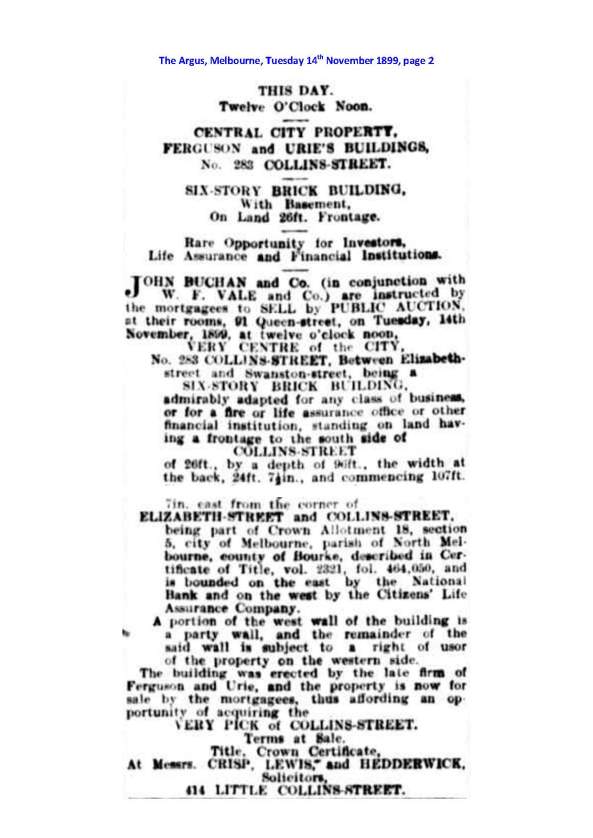
The Argus, Melbourne, Tuesday 14th November 1899, page 2.

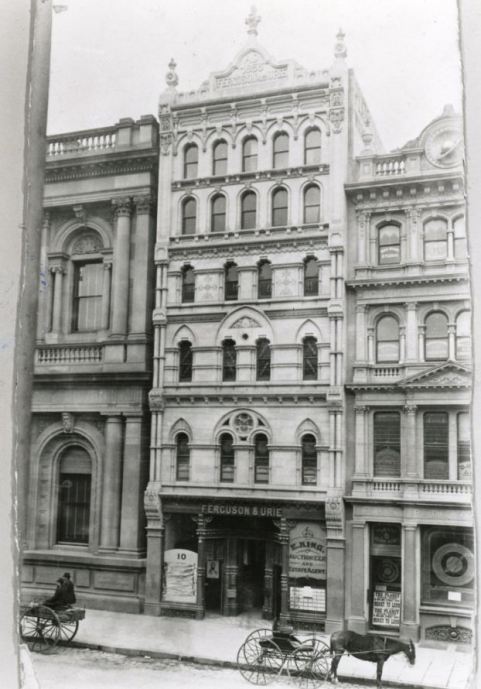
On Tuesday the 14th of November 1899, Ferguson & Urie’s flagship 281-283 Collins Street building went up for auction at “twelve o’clock noon” . There were no takers!

It wasn’t until February 1901 that the adjoining Citizens Life Assurance Company brought the building for an “undisclosed sum”. Other obscure reports from West Australian tabloids revealed a price of “between  £600 and £620 per foot frontage”.

The Ferguson & Urie building would eventually be demolished circa 1915 leaving no evidence of one of the first buildings in Melbourne to have the facade approved to have been built of “Hydraulic Freestone“.

The Ferguson & Urie Building at 10 Collins Street East.

The Ferguson & Urie Building at 10 (later 281-283) Collins Street East.

Related posts:

30-09-1873: For sale, 10 Collins Street.

20-03-1884: Ferguson & Urie building facade approved to be made of Hydraulic Freestone.

22-08-1884: Ferguson & Urie New Premises at 281-283 Collins Street

21-02-1901: The Citizens Life Life Assurance Company purchases the building.


Short link to this page: http://wp.me/p28nLD-ZI

© Copyright


24-09-1924: The Rosalie Grundy window, St James Church, Glenburn (Delamere), South Australia.

In 1889 a memorial window was unveiled by the young boy Archie Grundy to the memory of his mother Rosalie Grundy in St James’s Church Glenburn (now known as Delamere). The window was created by Ferguson & Urie of Melbourne and supposedly took two years to make.

There are actually three windows in the chancel of St James that are by Ferguson & Urie and all are of similar design and layout. The left window is of St James Major, the centre light is of Jesus Christ, and the right light is of St John. It’s not known whether there is specific memorial text below each window that identifies which particular window either side Christ is the memorial to William Gerrard or Rosalie Grundy as the lower portions are obscured from view.

I disagree with the mention in the 1929 news article that the Grundy window “…took two years in making, because of the difficulty of matching the two new lights with the centre figure of St James…”. This is obviously wrong as the centre figure is of Christ not St James (St James Major) which is the left window. It does suggests that that each window was made at different times in history which is not unusual. I would suggest that the statement about the window being “two years in making” has been misinterpreted over the 35 years that followed. It’s more likely that the funds for the window took two years to raise, or it was simply created two years after the other two windows or something similar. It would difficult to imagine Ferguson & Urie not being easily able to match their own work to something they created earlier unless they had completely lost the designs of their earlier work for the church or the time frame between correspondence with Melbourne and Glenburn/Delamere in South Australia was a contributing factor.

Photos kindly contributed by Mrs Noelle Nathan, taken November 2010.

This slideshow requires JavaScript.

Significant transcriptions:

The Register, Adelaide, South Australia, Wednesday 24th September 1924, page 12.

… Rosalie Grundy died at the birth of her only son and child, now Archie Grundy, who has just sold his beautiful property at the Valley, intending to reside in town. In 1889 he unveiled a memorial window to his mother in St. James’s, Glenburn. The window was the work of Ferguson & Urie, of Melbourne, and took two years in making, because of the difficulty of matching the two new lights with the centre figure of St James.…”

Observer. Adelaide, SA, Saturday 11th February 1928, page 48.

“SOME OLD FAMILIES OF RAPID BAY.

By Miss L. Webb.

Among the old hands of Rapid Bay were the Grundy family, whose name has now passed out of the district. The late Joseph Grundy was a well-known pastoralist of the south, and his parents were there before him. His first wife was Rosalie, daughter of the late James Lord. She died a year after marriage, leaving a son, now Mr. Archie Grundy, of Glenelg. The second Mrs. Grundy was Miss Sophia Helen Shillabeer, of an old established family in the district. There were two daughters of this marriage. Mrs. Grundy was a keen war worker, and was on the committee of the Second Valley War Memorial. She was greatly attached to St James’s Church, Glenburn, in which she was confirmed, and in whose church yard she was buried. The east window of St. James’s is in memory of the first Mrs. Grundy, and was unveiled by her son, then quite a child, it was the work of Ferguson & Urie, of Melbourne…”

The Advertiser, Adelaide, SA, Wednesday 21st August 1929, page 15.

 “ST. JAMES’S CHURCH GLENBURN”

 “… The foundation stone was laid on September 19, 1870, by Dean Russell, assisted by the Revs. Green (Port Adelaide), Howell (Port Elliot), Howitt (Robe), and Morse. The building was designed by Mr. William Anderson, C. E., and was opened on May 4, 1871 by Bishop Short, the Governor of the Province (Sir James Fergusson) being present…”

“… The centre light of the east window represents our Lord. One of the sidelights is in memory of Mr. William Gerrard, a foundation member and benefactor of the church. He left it a sum which yields from £30 to £35 per annum. The other light was in memory of Rosalie, first wife of Joseph Grundy, of Second Valley, and was unveiled by her son and only child, Mr. Archie Grundy, then a boy. There are also windows in memory of Frederick William Collins and Egbert Bennett, both baptised and confirmed in the church, and who gave their lives in the Great War…”

Other references:

The Advertiser, Adelaide, SA, Wednesday 21st August 1929, page 15.

Publications not yet viewed:

The Anglican Church of St James, Delamere, 1871-2001 /​ Maurice V. Carter.


17-03-1882: Christ Church, South Yarra. Melbourne, Victoria.

The Argus, Melbourne, Friday 17th March 1882, page 5.

“Two new stained-glass windows have been placed in the  choir of Christ Church, South Yarra. One representing SS, Peter and John converting converts at Samaris, is erected by some hundred and ten young people of the parish who were confirmed in the church last year. The other represents Our Saviour commissioning St. Peter, who kneels in front of the Twelve Apostles, to “Feed my Sheep.” Some sheep and lambs are depicted in the foreground. This window is placed in the church by the incumbent and his family in commemoration of his induction to the parish. Both windows are the work of Messrs. Ferguson and Urie, of this city.”

The two windows described in the article are depicted in the slideshow. See post 04-10-1881 for other Ferguson & Urie windows in the church.

Photos were taken 26th March 2012.

This slideshow requires JavaScript.

Related posts:

04-10-1881: Christ Church South Yarra.


Short link to this page: https://wp.me/p28nLD-XT

© Copyright