09-09-1935: Trinity Church, Camberwell, Victoria, Australia.

In 1935 the West Melbourne Presbyterian Church was dismantled and re-erected as St Andrew’s at Box Hill. St Andrew’s was meant to be a faithful replica of the old West Melbourne Church and so the stained glass windows were included in the reconstruction.

Except for one, which found its new home at Trinity Church, Camberwell.

The Argus, Melbourne, Monday 9th September 1935, page 5.

 “JUBILEE SERVICE”

“Trinity Church, Camberwell”.

 “…During the service Mr. Macaulay announced that in honour of the Rev. P. J. Murdoch’s long ministry in the church Sir Keith and lady Murdoch had decided to provide a stained glass window, of three lights, for the church….”

Albury Banner and Wodonga Express, NSW, Friday 7th February 1936, page 15.

“On Sunday Rev. R. W. Macaulay dedicated a renovated stained glass window at Trinity Presbyterian Church, Camberwell. The window was originally erected in the West Melbourne Presbyterian Church to commemorate the ministry there of Rev. P. J. Murdock, who was also minister at Camberwell from 1887 till his retirement.”

The window mentioned here has been confirmed to be the one the fourteen three-light nave windows that came from the old West Melbourne Church that was dismantled in 1935. It would appear this window was obtained by Sir Keith Murdoch for Trinity Church Camberwell and erected in the name of his father’s long standing ministry in the Church. It was unveiled on Sunday 2nd February 1936. (see post 01-02-1936)

This slideshow requires JavaScript.

The window contains a piece of scripture in the centre of each of the three lights with the relevant bible reference:

“I AM THE WAY AND THE TRUTH AND THE LIFE” “JOHN: 14-6”

“SHEW ME THY WAY O LORD” “PS: 25-4” (Psalms 25-4)

“SEEK YE THE LORD WHILE HE MAY BE FOUND” “IS: 55-6” (Isaiah 55-6)


Biography: Rev Patrick John Murdoch (1850-1940)

Biography: Sir Keith Arthur Murdoch (1885-1952).

Related posts: 29-04-1867 > 02-05-186727-04-1935 > 09-09-1935 > 16-12-1935 > 01-02-1936

To see a slideshow of the entire cycle of windows at St Andrews Box Hill, see post:  27-04-1935

01-02-1936: Trinity Presbyterian Church, Camberwell, Melbourne, Victoria.

The Argus, Melbourne, Saturday 1st February 1936, page 10.

“At Trinity Presbyterian Church Camberwell, to-morrow morning, the Rev. R. Wilson Macaulay will dedicate a large English[sic] stained glass window removed from the old West Melbourne Presbyterian Church. The window is to commemorate the ministry of the Rev. P. J. Murdoch, who was minister at West Melbourne from 1884 to 1887, when he was called to Camberwell, where he occupied the pulpit for many years”.

The article incorrectly reports the window as “English” when it was in fact made by the Ferguson & Urie stained glass company in North Melbourne. All of the stained glass windows in the old West Melbourne church were made by this firm and when it was dismantled in 1935, it was reconstructed as St. Andrew’s at Box Hill and thirteen of the original fourteen nave windows were reinstalled in the Box Hill church. The the other window (mentioned in the above article) went to the Trinity Church in Camberwell. This window was donated by Sir Keith & Lady Murdoch in the name of Sir Keith’s father the, Rev. Patrick John Murdoch, as indicated during the church jubilee service on the 8th September 1935. (see post 09-09-1935).

This slideshow requires JavaScript.

Biography: Rev Patrick John Murdoch (1850-1940)

Biography: Sir Keith Arthur Murdoch (1885-1952).

Related posts: 29-04-1867 > 02-05-186727-04-1935 > 09-09-1935 > 16-12-1935 > 01-02-1936

To see a slideshow of the entire cycle of windows at St Andrews Box Hill, see post:  27-04-1935


Short link to this page: http://wp.me/p28nLD-MZ

16-12-1935: St. Andrew’s, Box Hill, Melbourne, Victoria, Australia.

The Argus, Melbourne, Monday 16th December 1935, page 4.

“The Pulpit – ST. ANDREW’S CHURCH TRANSFERRED. Opened on New Site at Box Hill”.

“With the original key which opened the old Gothic doors of St. Andrew’s Presbyterian Church at West Melbourne, the same doors were reopened on Saturday, when the church, which has been re-erected at White Horse road, Box Hill, was dedicated on its new site in the presence of nearly 1,000 people…”

“…The Apostle window, valued at £1,500, has been placed in the lower portion of the tower, visible within the church above a gallery. Flood-lighting will make it visible at night from the road…”

The Apostle window and all other windows in the Box Hill Church came from the former West Melbourne Church, all of which were made by Ferguson & Urie. The final service in the old West Melbourne Church was held on Sunday 3rd February 1935.

Note: Only images of the Apostle window are shown in this slide show. The photos were taken on the 28th November 2010. There was no access to the gallery for closeup shots and only portions of the windows could be taken from varying angles with a zoom lens.

This slideshow requires JavaScript.

To see a slideshow of the entire cycle of windows at St Andrews Box Hill, see post:  27-04-1935

Related posts: 29-04-1867 > 02-05-186727-04-1935 > 09-09-1935 > 16-12-1935 > 01-02-1936


Short link to this page: https://wp.me/p28nLD-MX

© Copyright

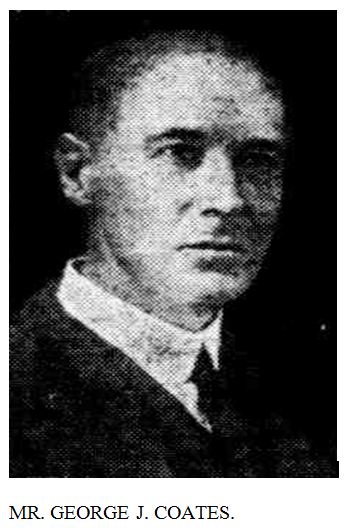
27-07-1930: George James Coates (1869-1930)

George James Coates was born at Emerald Hill (South Melbourne) on the 9th August 1869, the son of John Robert Coates (1842-1877) and Elizabeth Mina Irwin (1847-1902).

His father died when he was eight years old and his mother allowed him to be apprenticed to the Ferguson & Urie stained glass company at age fifteen, circa 1884.

George studied at the North Melbourne School of Design and Hotham School of Art and attended classes under Frederick McCubbin. He won a scholarship in 1896 that enabled him to travel to London then Paris and in 1903 he married artist Dora Meeson (they had no issue). He was also the Australian Governments unofficial war artist during WW1.

In 1937 his wife Dora wrote his biography; George Coates, ‘His Art and His Life’, in which she makes minor mention of his time with the Ferguson & Urie stained glass company and that he had a distaste for the coarse jokes from the other employees.

In all of the Ferguson & Urie windows found to-date,  it is impossible to know which of them, within George’s era at the company, may contain examples of his artwork. The exception to this may be in the house of his employer, James Ferguson, whose house ‘Ayr Cottage,’ in Parkville has a stairwell window containing a detailed portrait of the Scottish bard ‘Robbie Burns‘ which I reasonably suspect may have been done by a young 17 year old George Coates in 1886.

The photo below is of a young George, age 17, as he appeared in the Ferguson & Urie employee poster created for the 1887 company dinner, held at the North Melbourne Mechanics Institute hall on the 22nd June 1887.

George James Coates. Photo taken for Ferguson & Urie company dinner June 1887.

The Register, Adelaide, 23rd September 1921, page 7.

Transcription of article “NOTABLE ARTISTS’ RETURN”

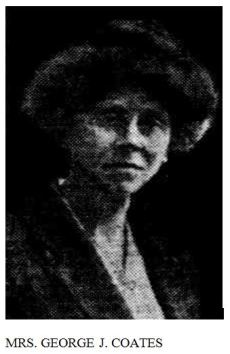
“In the realm of the arts, Australia is proving herself a keen contestant for honours, and during the past few years many Australian painters have obtained public recognition. Mr. and Mrs. George J. Coates (nee Miss Dora Meeson), of Melbourne, went abroad to study, and now have returned to their native land covered with honours. They arrived in Adelaide by the Melbourne express on Wednesday, having reached their own city some months ago. It is 24 years since Mr. Coates set out for the great adventure, and, like many other Australians, he found it a stressful road, full of obstacles, and necessitating the most frugal mode of living. But the painter felt that he had something to impart to lovers of beauty, and so he persevered in London, and then migrated to Paris with such success that to-day he can boast of more significant letters after his name than any other Australian artist.

Among his distinctions may be mentioned:- Member of the International Society of painters, Sculptors, and Gravers, London; Member of the National Portrait Society, London; On the Council of the Royal Portrait Society, London; Member of the Royal Society of Oil Painters, London; Associate of the Nationale des Beaux Arts (New Salon), Paris; Hon. Member Royal Society of Arts, Sydney; and also of he Victorian Artists of Australia. Asked about his first works, Mr. Coates said that as he evinced a leaning towards art at the age of 11 years it was definitely decided that he should be given his chance. That this decision was justified was revealed when the youthful painter won the Victorian Travelling Scholarship, and set out for London.

– The Road to Fame –

After hard work he went on to Paris and studied under Jeans Paul Laurens, Constant, and others. From 1897 to 1900 he exhibited in the salon des Artistes Fracaise (old Salon), and then returned to London, where he and his wife engaged upon some illustrations for the Encyclopedia Brittanica [sic] and the Historian’s History of the World (an American publication). They also contributed to the Royal Academy and the Paris Salon. In 1910 the well-known “Walker Brothers,” a group, was accepted by the Royal Academy of London, and in 1912 by the Associate de Nationale de Beaux Arts (new salon). By some mistake it was sent to the new Salon in stead of the Champ Elysees, as first intended, and was accepted and brought an Associate ship in its ?rain. “So much for a happy accident,” as the creator of the picture modestly remarked. A portrait of Miss Strubelle, an American singer, also won recognition in the old Salon of Paris. At the Grand International Exhibition, Pittsberg, a Diploma of Honour was conferred upon Mr. Coates’s work; and he had the honour to
be specialty incited to again contribute last year and this year too. The Carnegie Institute exhibits only 300 works, and these come from brushes of artists selected by a jury from England, Europe, and America. In reply to a request for further details, Mr. Coates said, “I have painted for the Australian Commonwealth a portrait of Gen. Sir Neville Smythe, V.C., and with natural pride I heard this usually reserved and cold type of man break out into eulogy of the gallantry of the Australians in the war; and, during the sittings he told me that he considered their deeds were equal to those heroic achievements of the Greeks at Salamis and Marathon. I also painted Capt. Jacka, the first Australian V.C; Gen Griffiths, C.O, Australian headquarters in London; Gen. Tivey, Gen. Foott, and other notabilities of the war. These were commissions by the Australian Commonwealth for the War Museum. During the war I spent four years in the R.A.M.C., and so came into personal contacts with realities. I was official war artist to the Canadian Government and to the Australian Commonwealth. It is pleasant to return to our homeland and feel that appreciation awaits my wife and me. When I return to Melbourne various commissions will occupy me, including a group of generals who went to Gallipoli. We have had exhibitions of our work in Melbourne, Sydney, and Brisbane, and in each capital some of our works have been purchased by the national Galleries. Next week we intend to hold an exhibition in Adelaide.” Mrs. Coates (Miss Dora Meeson) has no love for the limelight either; but she had to confess to membership of the Royal Institute of Oil Paintings, London, and also membership of the Mural Decoration and Tempera Society.

– Australia Revisited –

In reply to a query, Mr. Coates said that, of course, he observed a great advance all over Australia, and whether for good or for evil, he was struck with the gradual assertion of independent characteristics in the race as a whole, that seemed to be crowding out English characteristics. Asked about impressionism in art, Mr. Coates said he did not consider that belonged to any particular age or craze, but should be regarded merely as the ordinary impressions of an artist’s mind. The works of men like Manet, Monet, and Pissaro, of the so-called impressionistic school, would live forever. These men gave exquisite beauty through their brushes, and sincerity too. The futurists and cubists were all dead.  It was wisdom, indeed, that made people judge a nation by its art, for literature had no eyes. The Elgin marbles of ancient Greece showed the visitor to the British Museum what a vision that nation had held. Australia was young and immature, but in her natural talent was ahead of the other dominions; and her representatives were in all the big “shows” in England. The Australian climate was so much like that of Italy or Greece, which were the home of fresco, that Mrs. Coates was sure that fresco painting would be a happy style of decoration here. It was an art entirely suited to the dry climate, and Mrs. Coates gave a demonstration in Melbourne with a lecture at the Victorian Artists’ Galleries. Mrs. Coates painted a picture at Southampton of the last Australian wounded to leave England, which has been purchased by the Sydney Gallery. In Australia this gifted couple are represented in the galleries of Adelaide, Melbourne, Sydney, Brisbane, and Bendigo. They look forward to viewing Adelaide from the hills, of which they have heard much. Among many interesting incidents that have occurred in Mr. Coates’s career, none was more remarkable than that associated with a portrait of George Claridge, who sat as a “wounded Tommy,” and then went back to the trenches, won his commission, and was killed. His fiancé in Adelaide recognised his portrait in a catalogue, and sent home to purchase it. It was being exhibited in the Royal Academy. The portrait “King and Empire,” a lovely piece of work, is on loan in our own gallery”.

George Coates, ‘His Art and His Life’, Dora Meeson Coates, Dent & Sons Ltd, London, 1937:

“Lionel Lindsay, in an article on George Coates in Art in Australia, mentions his prowess with the gloves and how a trainer had begged him to give up art and take up a ‘mans’ work, i.e. boxing,’ instead, and become a professional…” [p3]

“He was twelve when he first went to North Melbourne Art School, and at the age of fifteen was apprenticed by his mother to the leading firm of glass-stainers in Melbourne, Messrs. Ferguson & Urie, and he worked there for seven years…” [p5]

“The years in the glass-staining workshop were a great ordeal. Though the work was congenial enough, as good models were set up to be carried out in glass, he hated the coarse jokes of the men, for he had a woman’s sensitive refinement along with his masculine strength.” [p5]

Related posts:

19-02-1874: The Hotham (North Melbourne) School of Art.

External links:

Obituary: George James Coates.

Biography: George James Coates.


Short link to this page: http://wp.me/p28nLD-MD

© Copyright

19-06-1923: Christ Church Yankalilla, South Australia.

Place holder for new article:

The only thing of relevance here is the current three light chancel window by Ferguson & Urie which was installed in 1879 and donated by William Gilbert Snr when the new chancel was built.

The Register, Adelaide, Tuesday 19 June 1923, page 12.

Christ Church, Yankalilla, has now four stained glass windows, counting the Hudson Beare two lights as one. The last mentioned was the first placed in the church, and served as the east window for many years. It was given by Mrs. Brooks in memory of her father, Mr. Thomas Hudson Beare who came out in the Duke of York in 1836 as a second in command of the S.A. Company. In later life Hudson Beare took up land at Myponga, and died there on November ?, 1861, and was buried in the Methodist Chapel yard there, according to the rites of the Church of England. The service was read by the Rev. Astley Cooper. The window is in the Norman style, with geometrical tracing. The present east window was the work of Ferguson and Urie, of Melbourne, and was given by William Gilbert, sen., as a thank offering for his recovery from illness when the chancel was built in 1879. The Archdeacon’s window was placed in the chancel in 1909. It is by Powell, of London, and depicts, St. Luke, the Beloved Physician. The subject was chosen because the Archdeacon studied medicine as well as theology at Cambridge, and when there was no doctor nearer than Victor Harbour saved many lives by his medical skill and knowledge”.

Also see: http://christchurchyankalilla.org/st_james.html


[No photos yet]

1915: John Scott (1850-1915)


John Scott (1850-1915)

Cameo portrait of John Scott for the 1887 Ferguson & Urie Company Dinner


John Scott was born in Paisley, Scotland circa 1850 and apprenticed to the Ferguson & Urie stained glass company circa 1866 at the age of 16.

At the company dinner held on the 9th of April 1886[1], he was presented with a handsome diamond locket in appreciation of his twenty years of faithful service to the company and as a farewell gift before his impending holiday to Europe.

“In making the presentation Mr. Young addressed a few words of good advice to the recipient, whom he strongly recommended to become a Benedict so that he could hand down the locket to his family as an heirloom”.

John Scott did eventually marry, but no marriage record has been found in Australia. I suspect that he may have married his wife Agnes in Scotland on his journey back to the old country in 1886. On their return to Australia, they lived at Haines Street in North Melbourne. They never had children.

In James Urie’s speech at the dinner, he stated: “Mr. Scott had come to them when a boy as an apprentice and had gradually worked himself up to be the right-hand man in his department”. His department was where the pieces for the stained glass windows were selected and cut to the exact dimensions according to the glass painters’ designs.

At the dinner John Scott sang “Remember me Mr. George Drury, when Jeff comes home today’ and “Bonnie Hills of Scotland”. At the company dinner the following year, held on the 22nd of June 1887, he again gave a rendition of “Bonnie Hills of Scotland” [2]. His name is not mentioned in the tabloid report of the 1888 company dinner [3].

John Scott died at Ballarat on the 1st June 1915 at the age of 65.

“SCOTT. – On the 1st June (suddenly), at 506 Doveton Street, Ballarat, John Scott, husband of Agnes Scott, and for many years of the firm of Ferguson and Urie, glass merchants, North Melbourne. A native of Paisley, Scotland.” [4]

His remains were conveyed to the Ballarat West station on the 3rd of June for Melbourne and subsequently buried in the Presbyterian section of the Melbourne General Cemetery.[5] (MGC-PRE-Comp-F-No-132)

His Last Will & Testament was dated 3rd September 1892. His occupation was specified as Plumber & Glass Cutter and he appointed his wife Agnes as sole beneficiary and executrix. His probate documents specified his address as “formerly of Haines Street North Melbourne by late of Doveton Street North Ballarat”.

Johns’ meager inventory included a vacant piece of land in Ormond Street Kensington in the Parish of Doutta Galla worth £300, watches, trinkets, Jewellery, an old silver watch, and a gold chain valued at £5, and 242 shares in the Northcote Brick Co. Ltd worth £169.

Footnotes:

[1] Ferguson & Urie Company Dinner, Fri 9th Apr 1886.

[2] Ferguson & Urie Company Dinner, Wed 22nd Jun 1887.

[3] Ferguson & Urie Company Dinner, Thu 15th Mar 1888.

[4] The Argus, Melbourne, Vic, Thursday 3rd June 1915, page 1

[5] The Evening Echo, Ballarat, Vic, Wednesday 2nd Jun 1915, page 4.

Related posts:

The 1886 Employee Dinner
The 1887 Employee Dinner
The 1888 Employee Dinner


Short link to this page: https://wp.me/p28nLD-Mf

© Copyright

21-02-1901: Citizens’ Life Assurance Company purchase the Ferguson & Urie building.

The Argus, Melbourne, Thursday 21st February 1901, page 4.

“We are informed by the Citizens’ Life Assurance Company Limited that they have purchased the property adjoining that which they occupy in Collins-street, known as Ferguson and Urie’s Buildings. The price paid is not stated.”

The West Australian, Perth, WA, Wednesday 27th February 1901, page 5.

“The price paid by the Citizens’ Life Assurance Company for Messrs. Ferguson and Urie’s buildings in Collins-street is understood to be something between £600 and £620 per foot frontage.”

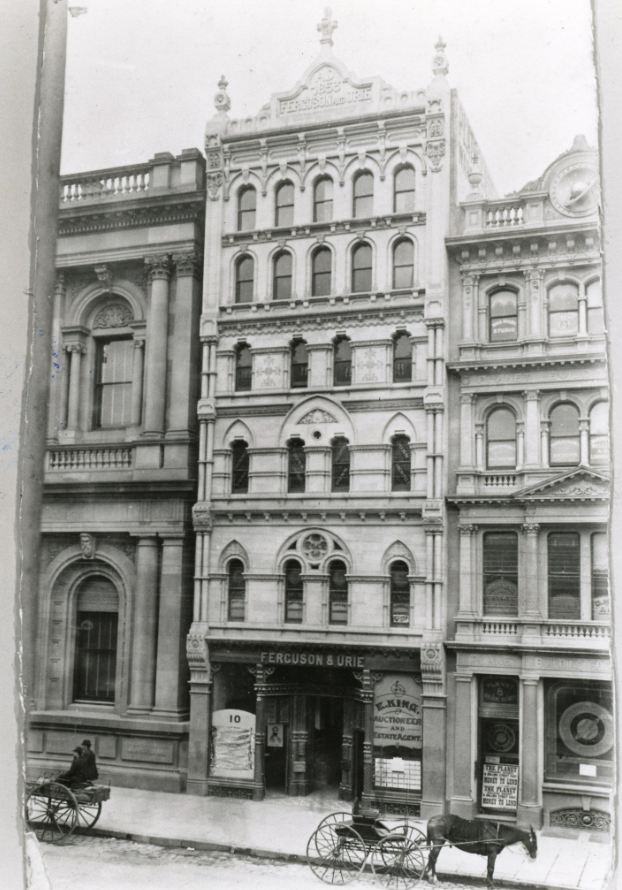
The Ferguson & Urie building is shown in the centre of the photo below. The National Bank is on the left and the Citizens Life Assurance Company is seen on the right as the Planet Building Society[1] which was brought by the Citizens Life Assurance Company in 1901.

The photo below is considered to be circa 1885. The Ferguson & Urie and Planet building are believed to have been demolished circa 1915 to make way for the Bank of Queensland (also demolished 1970).

The Ferguson & Urie Building at 10 Collins Street East.

The Ferguson & Urie Building at 10 (later 281-283) Collins Street East, Melbourne

Related posts:

30-09-1873: For sale, 10 Collins Street.

20-03-1884: Ferguson & Urie building facade approved to be made of Hydraulic Freestone.

22-08-1884: Ferguson & Urie New Premises at 281-283 Collins Street

14-11-1899: The Auction of 283 Collins Street.

Footnotes:

[1]  The Advertiser, Adelaide, SA, Wednesday 8th March 1899, page 7.   The Citizens Life Assurance Company: “…During the year the directors purchased the freehold premises of the late Planet Building Society, Collins Street, Melbourne. The premises are centrally situated, and the business of our Melbourne branch is now being conducted therein...”

© Copyright

24-11-1899: Dividends for Ferguson & Urie declared.

Victorian Govt Gazette 98, Friday 24th November 1899, page 4333.

“The Insolvency Acts.- In the Court of Insolvency, Melbourne District […]”.

“A DIVIDEND is intended to be declared in the matter of Ferguson and Urie, of 100 Franklin-street, Melbourne, in the colony of Victoria, glass stainers, whose estate was assigned on the 22nd day of June, 1899. Creditors who have not proved their debts by the 12th day of December, 1899, will be excluded. Dated this 24th day of November, 1899. J. DRYSDALE PURVES, Trustee. Australian Buildings, 49 Elizabeth-street, Melbourne.”

This nears the final stages of the Ferguson & Urie companies forty six year history as the first commercial stained glass company to have been established in the Australian colonies.

Victorian Govt Gazette 98, Date: Friday, November 24th 1899, page 4333

Related posts: 06-09-1899

06-09-1899: 100 Franklin Street warehouse To Let.

The Argus, Melbourne, Wednesday 6th September 1899, page 3.

“MAGNIFICENT WAREHOUSE, 100 Franklin-street, Lately Occupied by Ferguson and Urie, Suitable for factory or any class of trade, TO LET. TO LET. TO LET. Rent Moderate. Apply to DRYSDALE PURVES, Trustee, Australian-buildings, 49 Elizabeth-street.”

On the 17th October 1899, The Argus reported that Edward Keep and Co were going out of business because of a fire, (which had occurred at their Lonsdale premises) and “Messrs. Fras and Albert Keep, in conjunction with the departmental manager, Mr H. S. Wood, propose to continue the carriage ironmongery and agricultural implement business at 100 Franklin-street”.

Later the business would be known as “Keep Bros & Wood. Saddlers and Ironmongers”. On the 30th September 1899, the Argus reported that a number of buildings were being sold by the trustees of the estate of the late “Alfred Joseph” and the 100 Franklin street building was included for sale “subject to existing tenancies”.

In 1913, Keep Bros & Wood still advertised the business at 100 Franklin Street but have now advertised as “Keep Bros & Wood Wheel Factory, Franklin Street” producing wooden coach wheels. By 1916 they have diversified and are selling agents for the “Trumbull Car”.

In 1945, Keep Bros & Wood purchased several old properties in Elizabeth street for re-development as the new company premises and in the 1960’s started producing the “Hallmark” Bicycle.

Related posts: (about Franklin Street)

16-04-1891 > 10-07-1891 > 01-08-189129-07-1899 > 10-08-1899 > 06-09-1899

© Copyright

10-08-1899: The auction of the Ferguson & Urie stock at the Franklin Street premises.

The Argus, Melbourne, Thursday 10th August 1899, page 2.

A similar notice appeared in the Argus on the 10th of August 1899 with the only difference being the addition of office furniture and:

“TERMS – UNDER 100, NET CASH; ABOVE THAT SUM, CASH, LESS 2 ½ PERCENT DISCOUNT”

This is a continuation notice regards the sale of the firms stock.

Related posts: (about Franklin Street)

16-04-1891 > 10-07-1891 > 01-08-1891 > 29-07-1899 > 10-08-1899 > 06-09-1899