14-11-1885: Wesleyan Methodist Church, Ross, Tasmania.

The Mercury, Hobart, TAS, Saturday 14th November 1885, page 1s.

“ERECTIONS.- A church at Ross, in the Campbell Town circuit, which has been in process of erection for some time, has been finished, and may now be reported. It is a substantial structure of freestone, built in Gothic style of architecture, cruciform in shape, with gable spire. Two of the gables will contain handsome memorial windows of stained glass, one presented by Messrs. Geo. And Thos Parramore, and the other by Horton College. It occupies a commanding site, and is an ornament o the neighbourhood. The architect is Mr Percy Oakden…”

Launceston Examiner, Tasmania, Friday 1st January 1886, page 2.

“On Nov. 23 a new Wesleyan Church was opened at Ross. It is built of freestone, and cost £4241, and contains two stained glass windows, one presented by the old students of Horton College, and the other by the family of the late Mr. and Mrs. Thos. Parramore.”

Both triple light windows were created by Ferguson & Urie of Melbourne.

Photos taken 6th of October 2010.

This slideshow requires JavaScript.

The text and definitions of the Horton College window are as follows:

Cinqfoil light (above the three lancets):

PERSEVERANTA PALMAM OBTINE BIT

Corrected to: “Perseverantia Palman Obtinebit”. This translates to“Perseverance yields the prize.”

For many years prior to this the school motto was “Nil sine magno labore” (Nothing without great labour)

Left light:

SAMUEL PROPHETTA

PUER SAMUEL MINISTRABAT DOMINO CORAM HELI. 1.SAM.3.
(1 Samuel 3-1, “puer autem Samuhel ministrabat Domino coram Heli et sermo Domini erat pretiosus in diebus illis non erat visio manifesta” – “And the child Samuel ministered unto the LORD before Eli. And the word of the LORD was precious in those days; there was no open vision”)

Centre light:

INVENERUNT ILLUM IN TEMPLO LUCII46
(Luke 2-46 “et factum est post triduum invenerunt illum in templo sedentem in medio doctorum audientem illos et interrogantem” – “And it came to pass, that after three days they found him in the temple, sitting in the midst of the doctors, both hearing them, and asking them questions”.)

THIS WINDOW WAS PLACED HERE BY A NUMBER OF OLD STUDENTS OF HORTON COLLEGE AS A MEMORIAL OF THEIR CONNEXION WITH THAT SCHOOL

MDCCCLXXXIV (1884)

Right light:

TIMOTHEUS EPISCOPUS

AB INFANTIA NOSTI SACRAS LITTERAS II. TIMOTH
(2 Timothy 3-15 “et quia ab infantia sacras litteras nosti quae te possint instruere ad salutem per fidem quae est in Christo Iesu” – “And that from a child thou hast known the holy scriptures, which are able to make thee wise unto salvation through faith which is in Christ Jesus”.)

A collection of articles and history can be found here on my Evernote account about the historical Horton College (1852-1920)

The three light Parramore window text:

Left light:

BLESSED IS THE MAN THAT FEARETH THE LORD. PS EX??
(Psalm 112-1:  Praise ye the LORD. Blessed is the man that feareth the LORD, that delighteth greatly in his commandments).

Centre light:

IN LOVING MEMORY OF THOMAS & FRANCES PARRAMORE BY THEIR THREE CHILDREN

Text in the scroll:  I AM HE THAT LIVETH – I WAS DEAD & BEHOLD I AM – ALIVE FOR EVER MORE
(Revelation 1-18:  I  am he that liveth, and was dead; and, behold, I am alive for evermore, Amen; and have the keys of hell and of death).

Right Light:

A WOMAN THAT FEARETH THE LORD SHE SHALL BE PRAISED PROV? XXXI
(Proverbs  31-30: Favour is deceitful, and beauty is vain: but a woman that feareth the LORD, she shall be praised)

External links:

Obituary: Thomas Parramore (1840-1913)


Short link to this page: https://wp.me/p28nLD-CJ

© Copyright

07-12-1885: St. Stephens Roman Catholic Church, Brisbane, Queensland.

The Brisbane Courier, Queensland, Monday 7th December 1885, page 4
also, The Queenslander, Brisbane, Saturday 12th December 1885, page 943.

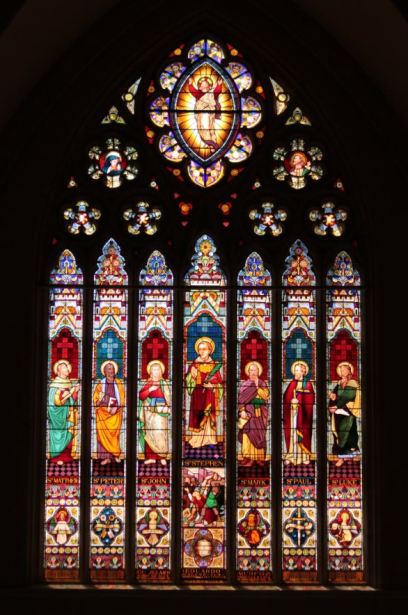
“The Murphy memorial window in St Stephen’s Roman Catholic Cathedral, Elizabeth-street, has just been completed, and enhances the interior beauty of the building to a degree that should be highly gratifying to those who subscribed so liberally for the work. The Gothic window is 35ft high by 14ft in width, whilst the long lights which form the lower square are about 18ft in length and seven in number. The stained glass work has been most artistically executed. The centre light bears a representation of St Stephen, whilst at the feet of he patron saint is a representation of his martyrdom. The other lights bear representations of Saints Matthew, Peter, Mark, Paul, and Luke, whilst the glass below their feet is decorated with evangelistic emblems – the representations of “The Keys” (St. Peter), “The Eagle” (St. John), “The Winged Lion” (St. Mark), “The Sword” (St. Paul), The Winged Bull” (St. Luke), and “The Angel” (St. Matthew) – all being separate studies. The chief feature of the graceful tracery is a beautifully stained representation of “The Ascension”, and on either side are medallions of Mary and Joseph. The other and smaller spaces in the tracery are suitably decorated with representations of Cherubim. The shading and wise combination of colour throughout the window produce a splendid effect, more especially when viewed from the body of the church. The decoration of the window is the design of Messrs. Ferguson and Urie, Collins-street, Melbourne. The artistic portion of the work was done in that city, whilst the fitting up, which has been well and carefully executed, was intrusted to Messrs. Alexander Young and W. Urie, jun, representatives of the contracting firm. The cost of the decoration of the window, which is the largest but one of its class in the colonies, was something like £1000”.

BRISB St Stephen's 01a

At thirty five feet in entire height, the Murphy Memorial window in Brisbane is undoubtedly the largest window ever created by Ferguson & Urie and also the most expensive. This must have also been considered one of the companies most important works as it’s also the only article mentioned to-date where representatives from the company travelled such a long distance to Queensland to supervise the installation of the window.

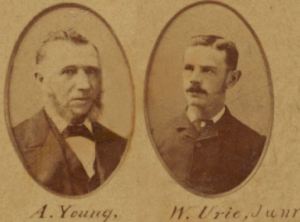
Alexander Young and William Urie were employees of the Melbourne firm Ferguson & Urie. William was the son of principal partner James Urie, and Alexander Young was James Urie’s brother in law.

Alexander Young & William Urie, from Ferguson & Urie. June 1887

St Stephens Cathedral also included a copy of my Ferguson & Urie company history in their newsletter of August 2011.St Stephen’s Brisbane [Newsletter August 2011]

The Cathedral “Guide News August 2011, page 1.

“[…] I am also very grateful to Ray Brown who is a descendant of James Ferguson of Ferguson & Urie fame. He provided the Ferguson & Urie story which features on pages 6 to 11 […]”

The photos were taken on the 1st of March 2011.

This slideshow requires JavaScript.


Short link to this page: https://wp.me/p28nLD-Co

© Copyright

20-10-1885: Christ Church, Frederick St, Launceston, Tasmania.

The Launceston City Baptist Church (former Prince’s Square Congregational and Christ Church Congregational Church) 11 Frederick Street, Launceston.

Launceston Examiner, Tasmania, Tuesday 20th October 1885, page 3.

“OPENING OF CHRIST CHURCH.”

“A handsome stained glass memorial window has been placed on the eastern side of the church near the north end, by Mr. C. S. Button, of Scottsdale, Mrs. Calvert, of Hobart, and Miss Helen Button, the present organist, in memory of their father, Mr. W. S. Button (first Mayor of Launceston), and their mother. The window was obtained from the firm of Messrs. Ferguson and Urie, Collins-street, Melbourne.”

Photos by Gavin Merrington taken 23rd June 2012.

This slideshow requires JavaScript.

William Stammers Button (1795-1876) was born in Nayland, Suffolk, England. He arrived in Van Diemens Land (Tasmania) with his brother Thomas and other family members in 1833 aboard the ship “Forth,”[1] and initially starting business as a brewer in partnership with his brother-in-law, Jonathan Stammers Waddell, at Norfolk Plains (later known as Longford), and then at Launceston as “Button & Waddell”[2].

On New Years day in 1853, under much controversy and accusations of collusive fraud, the first elections for Aldermen for the town of Launceston were conducted[3]. Seven men were elected, one of whom was William Stammers Button (as well as his brother Thomas). Prior to the Aldermen retiring to elect the position of Mayor, each took the stand to address the crowd;

“William Williams, alias William Stammers Button advanced amidst a tornado of yells, groans, and hisses, and from what we could hear, we understood him to say – Gentlemen, I shall attend to my duties as well as I can. The public good I shall always endeavour to keep in view, and I will maintain it. The interests of the working man shall occupy my especial attention, and I will do all in my power to find employment – remunerative employment – for the free poor of this town. Gentlemen, I heartily thank you for the honor you have done me. (A voice – ‘much obliged to you – well done ali-ass Mr. Williams,’)” followed by groans and hisses.”

“…The successful candidates then retired to one of the apartments at the back of the court house to elect the mayor, when after the absence of about half an hour, the Sheriff, to the astonishment of every one present, declared William Williams, alias WILLIAM STAMMERS BUTTON, (brewer) first mayor of Launceston.”[4]

The reference to William Stammers Button as being William Williams is shrouded in controversy. Ten years earlier, in 1843, Button successfully won a law suit against a William Lushington Goodwin for “printing and publishing a malicious libel” against him in the Cornwall Chronicle[5], to which Goodwin was convicted and fined. After the election in 1853, further publications appeared to cast aspersions as his origins as the unknown William Williams[6].

William Stammers Button held the position of the Mayor of Launceston for four consecutive years and was universally admired for his efforts in the advancement of Launceston. He held many other public and private positions and in 1856 was elected to represent the Tamar district in the Legislative Council[7]. He was a liberal donor to all deserving institutions, and a served as a deacon of the Congregational church for over 40 years[8].

William Stammers Button died on the 17th September 1876 and was buried in the Mulgrave Square Cemetery in Charles street Launceston. The cemetery was closed for further interments in 1925[9].

In October 1885[10], the surviving children of William Stammers Button erected a stained glass window to his and his wife Marianne’s memory, in the City Baptist Church (former Christ Church Congregational) in Frederick Street, Launceston.

The window was crafted by the Colonial Victorian stained glass firm Ferguson & Urie of Melbourne.

The Mercury, Hobart, Tasmania, Wednesday 21st October 1885, page 3

“…On each side of the organ alcove there are round openings in the end wall, filled with geometrical designs on stained glass. There is also a stained glass window with a tablet, marked, “In loving memory of William Stammers Button, M.L.C, for nearly 40 years deacon of this church, also the first Mayor of Launceston, and Marianne, his wife, this window is dedicated.” The window, which bears the inscriptions on stained glass, “Blessed are the dead who die in the Lord,” and “Honour thy father and thy mother,” has been erected by Mr. C. S. Button, of Scottsdale, Mrs. Calvert, of Hobart, and Miss Helen Button, the organist of the church, the children of the deceased deacon.…”

The Mercury, Hobart, Saturday 26th January 1907, page 8.

“…There are some interesting, and indeed historic, memorials in Christ Church. A marble tablet perpetuates the memory of Mr. West, the historian of Tasmania, and a stained-glass window is a memorial of Mr. William Stammers Button, the first Mayor of Launceston…”

“…The window to the memory of the first Mayor bears this inscription:- “In loving memory of William Stammers Button, M.L.C., for nearly 40 years deacon of this church, also the first mayor of Launceston, and Marianne, his wife, this window is dedicated.” There is also a stained-glass window to the memory of another mayor of Launceston, Mr. Landon Fairthorne, who died in 1890…”

The Mercury, Hobart, TAS, Saturday 7th March 1953, page 20.

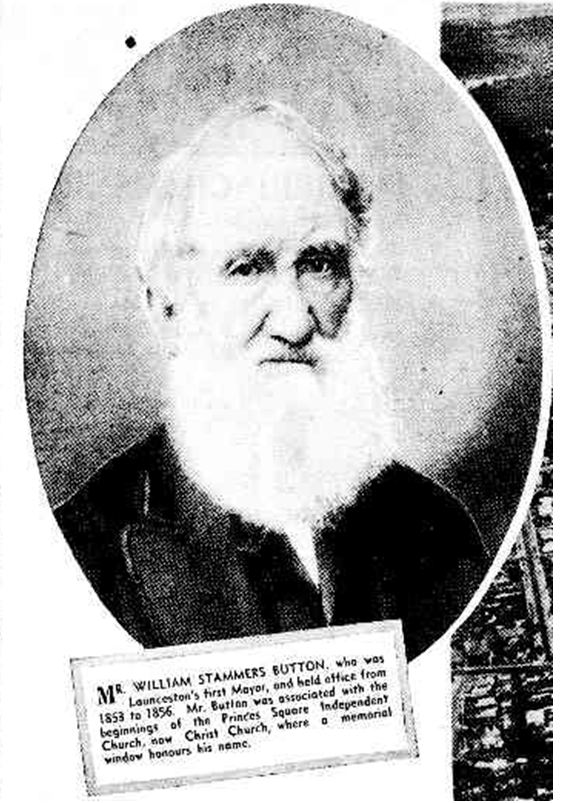
“MR. WILLIAM STAMMERS BUTTON, who was Launceston’s first mayor, and held office from 1853 to 1856. Mr. Button was associated with the beginnings of the Princes Square Independent Church, now Christ Church, where a memorial window honours his name.”

The Mercury, Hobart, TAS, Saturday 7th March 1953, page 20.

The Mercury, Hobart, TAS, Saturday 7th March 1953, page 20.

Launceston Examiner, Tasmania, Tuesday 19th September 1876, page 2.

“THE LATE MR W.S. BUTTON. (1876, September 19). Launceston

One more old colonist has finished his course. Mr. W. Button died peacefully at his residence, St. John-street, at a quarter-past eight on Sunday morning, aged 80 years, having lived in Tasmania 43 years. He was born at Nayland, in Suffolk, in the year 1795, where his early boyhood was spent, removing to Sudbury, in the same county, while yet young, in which place he was associated in business with his uncle, in whose service he frequently travelled to various parts of England, visiting also France and Flanders, when travelling by land and sea was attended by numerous perils. He was wont to recount to some of his friends the incidents of his wintry voyages and long journeys by coach, contrasting them with modern methods of conveyance. From his retentive memory he would sometimes recall the state of England in his youthful days during the awful struggles of the Peninsular war, and describe with the graphic power of a keen observer those days of dear bread, iron rule, and wearing anxiety. On his marriage he removed to Long Melford, a place historically famous like the other towns where he had lived. While there, he took an active part in politics, working hard on the liberal side, and especially seeking with others the repeal of “The Test and Corporation Acts,” which was happily accomplished in the year 1828. In 1833 he came to this colony in the ship Forth, bound to Circular Head and Launceston. He was accompanied by his brother Mr Thomas Button, Mr J. S. Waddell, and other members of his family. He first took up his residence at Norfolk Plains, removing to Launceston for business purposes. During his 40 years residence in Launceston he has been one of our most prominent and useful citizens. He was from the beginning one of the chief members of the Anti-Transportation League, giving cheerfully of his time and money. He was among the earliest promoters of the Cornwall Insurance Company in 1842, one of its first Directors, for many years Chairman of the Company, and to the last was warmly devoted to its interests. When Launceston was declared a municipality he was elected a member of the first Council and its first Mayor on January 1st, 1853. He filled the office by successive elections for four years, and during his mayoralty the chief portion of the work was done in supplying the town with water – a work that took up much of his time, yet by some strange oversight no notice is taken of his efforts on the commemorative fountain in Prince’s Square or on the pillar at St. Patrick’s River. Mr Button was appointed a justice of the peace in 1855, and has rendered good service in that capacity, his clear judicial mind eminently fitting him for the post. In October, 1856, he was elected a member of the Legislative Council for Tamar, and served in that capacity for six years. In the Council he was looked upon as a valuable member. His unobtrusive manners, wide experience, and extensive knowledge made him a man of power; he was firm and fearless – an independent member, one courteous and true. With the Launceston and Western Railway Mr Button was connected from the very beginning. Anxious to see the colony advance he gave labour and money to aid in improving our means of transit. For a while he was chairman of the Railway Company, till increasing years compelled him to retire. As one of the early shareholders of the Gas Company and a Director from its formation until his death, he took great interest in its working, and read carefully to qualify himself for his duties. Mr Button was also one of the chief agents in establishing the Launceston Examiner, though he never took an active part in the management; and was also one of the founders of the Launceston Mechanics’ Institute, of which he was subsequently President. It may be safely said that few men have ever striven more zealously and unselfishly than Mr Button did to advance the interests of our town, district, and colony. It cannot be expected that all his public actions will have secured the approval of all men, but there are none who will not admit that his integrity of purpose, his resolute method of work, his general wisdom, and his hearty sympathy with all onwards movements, were beyond question. Those who knew Mr Button best were most aware that he was distinguished for his religious zeal: he was a man who feared God, and sought to serve his day and generation as one who must give account at last. No notice of his life amongst us, even in a public newspaper like this, would be complete that passed over this aspect of his life. As a friend and fellow-worker of the late Rev. J. West, he greatly aided in the building and support of the Prince’s Square Independent Church. From the formation of the congregation until within a recent period he had served the church faithfully as Treasurer, for a short time was Superintendent of the Sunday school, and at his death was senior deacon. He also for many years acted as Treasurer of the Northern Branch of the Congregational Home Mission, and had taken an active interest in the working of the mission on the N.W. Coast. In his death the Bible Society loses an attached friend. As a working member of it’s local committee, and subsequently President for years, until failing health compelled him to resign, he gave one of the many proofs of the catholic nature of his religious principles and life. We have been given to understand that not withstanding the conservatism natural to old age, Mr Button had very considerable acquaintance and sympathy with many liberal forms of modern thought on religious matters. Mr Button’s family life is not a theme to dwell upon in a newspaper, but it may be mentioned that a few months ago his golden wedding was appropriately honored by a few friends, on which occasion he ascribed much of his public usefulness to his happy home life. He has left many sincere friends, who will cherish his memory to the very last. His interest in al things relating to colonial life was as fresh and strong as in his days of robust strength and willing work.

Though old, he still retained
His manly sense and energy of mind;
Virtuous and wise he was, but not severe,
He still remembered that once he was young.

Most of places of business wee partially closed yesterday as a mark of respect for the deceased gentleman, and the Municipal Council adjourned immediately after meeting for the same reason. The funeral will take place this afternoon, friends assembling at Prince’s Square Congregational Church at half-past three”.

The Mercury, Hobart, TAS, Tuesday 19th September 1876, page 3.

“OUR LAUNCESTON LETTER.
[From our own correspondent.]
LAUNCESTON, Monday morning.

“I regret to have to record the death, at about a quarter past eight o’clock on Sunday morning, at his residence St. John-street, of Mr. William Stammers Button, at the ripe age of 81 years. Mr. Button is a very old colonist, having arrived in the colony in 1832. He first settled in Longford, where he entered into partnership with a brother-in=law, the late Mr. William Waddell, in the establishment of a brewery on that township. After carrying on the business for some three years at Longford the firm removed to Launceston, taking the premises then known as Barnes’ brewery, opposite the gaol, and in this business Mr. Button continued til 1853. Up to this time he had been very active in taking part in all matters calculated to promote the advancement of the town, and initiating schemes of public utility. When municipal institutions were established in 1853, Mr. Button was one of the first members, and the first mayor elected. The election of mayor at that time was for two years, and Mr. Button was elected twice in succession, holding the office for four years. He then retired from the municipal council. In Oct., 1856 he was elected a representative of the Tamar in the Legislative Council, and filled that position til 1862. He had always been considered an industrious and energetic patron of Agricultural and Horticultural pursuits, and a liberal contributor to any institution calculated to improve the condition of his fellow townspeople. In public life he has taken a very active part. He was one of the founders of the Cornwall Insurance Company established in 1842, and has been connected with it ever since having occupied the position of chairman of directors till within a short time of his death. He was also one of the founders of the Mechanics’ Institute, established in the same year, and has ever since evinced a lively interest in its rise and progress. In the initiatory stages of the agitation for a water supply to the town he took a prominent part, and it was mainly through his instrumentality that the great boon of a waterworks was obtained. In the establishment of the Launceston Steam Navigation Company, which is now incorporated in the Tasmanian Steam Navigation Company, and in the support given to the Launceston Gas Company, of which he was for many years a director, he contributed greatly to their success. In all religious and philanthropic efforts Mr. Button was always to the fore, and amongst other positions he held for some time was that of the President of the Bible Society. He was connected with the Congregational denomination, and attended the Prince’s Square Church, of which the Rev. Wm. Law is the pastor. To the erection of this handsome and commodious edifice the deceased gentleman contributed largely, and continued his liberality up to the time of his death. He was generally esteemed by the townspeople as an honourable and upright man, and a steadfast friend, and his decease is universally regretted. Although the deceased gentleman’s health and strength had been visibly declining some time, it was not till a few days ago that any serious consequences were anticipated by his friends. He attended divine service on Sunday the 10th inst., and was working in his garden on Thursday last. On Thursday night, however, serious symptoms manifested themselves, and he then sank rapidly up to the time of his death, which took place on Sunday morning. The pastor of Prince’s Square Church, the Rev. Wm. Law, in his morning service, both in his prayer and sermon, alluded in feeling terms to the long connection of Mr. Button with the church, and his many excellent qualities, and then announced that the funeral service would take place on Tuesday afternoon, at three o’clock, at the church; and that on the following Sunday evening he should preach a memorial sermon.”

The Mercury, Hobart, TAS, Thursday 21st September 1876, page 3.

“The funeral of Mr. William Stammers Button left his late residence, St. John-street, at 25 minutes past 3 this afternoon, arriving at the Prince’s Square Congregational Church about half-past 3. During the passing of the funeral cortege to the church, the bell of St. Andrew’s Church was tolled. The funeral service was conducted by the Rev. J. Lindsay and the Rev. C. Price, after which the Rev. W. Law delivered a funeral oration in which he commented at length on the many estimable qualities of the deceased, and his long and useful career. The funeral was largely attended, and after leaving the church the procession was formed in the following order:- The Revs. W. Law, J. Lindsay, and C. Price; next Drs. Miller and Hardy; then the hearse with the following gentlemen acting as pall bearers:- Messrs. E. L. Diteham, H. Dowling, E. Dickens, J. Kemp, F.L. Fyah and J. Steer, senr. Alderman C. S. Button, son of the deceased gentleman, followed, and with him the other near relations and connections of the deceased. The Mayor, the Town Clerk, the members of the corporation and those of eh Maritime board cam next, and then followed a long procession, there being some 200 persons present. The remains were conveyed to their last resting place the cemetery in Mulgrave Square.”

The Cornwall Chronicle, Launceston, TAS, Monday 2nd October 1876, page 4.

“THE LATE MR. W. S. BUTTON

 Mr. William Stammers Button died at his residence, St. John street, Launceston, on the morning of Sunday, 17th September, a little after eight o’clock. His illness had been a very short one. He was about as usual on the 13th September, was taken unwell in the course of the evening, gradually sank into a comatose state, and passed quietly away. Mr. Button came to the colony 43 years ago, and after a short residence at Norfolk Plains came to Launceston, where he won for himself a large measure of general respect and confidence. His active public life has brought him into connection with most local objects. As the first mayor of Launceston from 1st January, 1853, to 31st December, 1857, Mr Button had a great amount of work to perform, and during his mayoralty the chief difficulties connected with the water supply of Launceston overcome. He was for some years a member of the Legislative Council of this Colony, in which capacity his services were highly valued. Mr Button was one of the promoters of the Launceston and Western Railway, for a long time chairman of the company, and was ever ready to aid in all public works. His devotion to the interests of the Cornwall Insurance Company was well known; as its chairman for many years, he was one of he most trusted counsellors. He was a director of the Launceston gas Company. We believe that few men amongst us were more zealous and useful in public life than the subject of our notice. All our local societies of a philanthropic and religious kind shared in his gifts and labors [sic]. Mr Button was also well known in association with Prince’s Square Independent Church, of which he had been a member and officer from its formation til the time of his death, and was always a liberal supporter of its funds. He was a man who early in life had received a good education, was gifted with considerable natural powers, and had always been a great reader. Mixed up as Mr Button had been in many questions in which considerable diversity of opinion prevailed, it cannot be expected that he always in his public life pleased everyone; but he was recognised throughout his long career as a man whose wish was to do good, and one who had fully identified himself with the land of his adoption. In private life Mr Button was an intelligent companion – a kind and faithful friend. He lived to reach the age of eighty years.”

The Mercury, Hobart, TAS, Tuesday 26th September 1876, page 3.

“At the Prince’s Square Congregational Church on Sunday evening, the Rev. Wm. Law delivered a memorial sermon on the death of the late Mr. William Stammers Button, choosing his text from Acts, xiii., 36. “For David after he had served his own generation by the will of God fell on sleep.” Both the body of the church and the galleries were filled. The rev. gentleman made the text the basis of an appropriate and impressive sermon, and concluded with an enumeration of the many acts of philanthropic and Christian usefulness, which had marked the long and honoured life of their departed townsman.”

Launceston Examiner, TAS, Saturday 14th January 1843, page 7.

“SUPREME COURT, CRIMINAL SITTINGS.
THURSDAY, JANUARY 12.
The Queen, at the instance of W. S. Button, v. W. L. Goodwin, for printing and publishing a malicious libel…”

On the 16th of April, William Lushington Goodwin published in the Cornwall Chronicle the following malicious libel against William Stammers Button:-

“In all transactions let us honest be,
And honour give to strict integrity,
Let bolters by their creditors be scouted,
And their professions afterwards be doubted;
In whatsoever clime they take their fight
Let them be doomed to everlasting night,
And honest men with them all business shun,
Fearful they might again up stick and run!
For Button may once more design,
For the same reason choose to cross the line,
Which once he crossed. God knows the reason –
Whether for highway robbery or treason.
But true it is, as Williams he did fly
He’s Button now – though folks say ‘tis a lie’;
Some day the truth will out, if not too late.
And that the bolter will not ‘scape his fate’;
Perhaps the hulks – perhaps a halter –
Exhibited to public gaze – this malster,
Newspaper-man, hypocrite and bolter.”

Goodwin was found guilty of the libelous slander against Button and ordered to pay a fine to the Queen of £30 and be imprisoned until it was paid. He paid it immediately!

Footnotes:

14-08-1885: St. Andrew’s Presbyterian Church, Sydney Rd, Brunswick, Melbourne, Victoria.

North Melbourne Advertiser, Friday 14th August 1885, page 3.

“BRUNSWICK PRESBYTERIAN CHURCH.”

“The new church erected by the Presbyterian congregation of Brunswick was opened on the 2nd inst.…”

“…The gable in the façade that faces Sydney road has a large and finely proportioned tracery window, filled in with a design in stained glass to the memory of the late Mrs. M. L. Hutchinson…”

St. Andrew’s Presbyterian Church was built by Evander McIver. All the stained glass in the church was created by Ferguson & Urie which also includes a memorial window to McIver’s wife in the chancel.

Photos taken 14th Nov 2010 on the church re-opening day.

This slideshow requires JavaScript.

Conservation & restoration work on the windows was conducted by the Wesley Vine studio c.2010.

Related posts: 03-03-1888: St Andrew’s Church, Sydney Road, Brunswick, Melbourne, Victoria.


Short link to this page: https://wp.me/p28nLD-BV

© Copyright

1885: The Linay Pavilion, Alfred Hospital, Melbourne.

The Alfred Hospital was the second public hospital to be built in Melbourne. It was designed by Charles Webb and opened in 1871 and named in honor of Queen Victoria’s son, Prince Alfred who had been the subject of an assassination attempt whilst visiting Sydney in 1869.

A generous benefactor to the Alfred Hospital was John Linay, an accountant/clerk with the Victorian Assurance Company from the time of his arrival in the Colony in 1853 until his retirement in 1875. Linay was a frugal bachelor described as being “abstemious in his habits” and lived in a modest four-roomed cottage in Fitzroy with his cousin James Firth. He seemed to have made most of his money by living a Spartan life and investing his money wisely in bank shares and minor interests in property. He died on the 1st of March 1883 whilst in Hobart and was buried in the Queensborough Sandy Bay cemetery in Hobart. In his will, he bequeathed an extraordinarily charitable amount of £11,000 each to the North Melbourne Benevolent Asylum (who erected their ‘Linay Wing’), the Alfred Hospital (who also erected a ‘Linnay Wing’), and the Melbourne Hospital in Swanston Street. The money bequeathed to the Alfred Hospital was used to build the ‘Linay Pavilion’ which opened on 6th April 1885. Only a portion of the Pavilion still exists (2012) which includes the two-story stairwell containing the huge Ferguson & Urie stained glass windows. Other nearby passageways, the chaplain’s room, and the chapel room also include stained glass windows by Ferguson & Urie.

Photos dated 14th January 2012.

This slideshow requires JavaScript.

The first two historical old photos are from the State Library Collections and show the triple light window of the Linay Pavilion on the far right. The remaining colour photos were taken 14th Jan 2012 and 2nd April 2012. With the exception of the stairwell window and the bird scene in the door of the chaplains’ office, all other windows are artificially lighted from behind.

As you enter the chapel room, there is a brass plaque on the wall with the following text:

CHAPEL WINDOWS
COME, O BLESSED OF MY FATHER, INHERIT THE KINGDOM PREPARED FOR YOU FROM THE FOUNDATION OF THE WORLD; FOR I WAS HUNGRY AND YOU GAVE ME FOOD, I WAS THIRSTY AND YOU GAVE ME DRINK, I WAS A STRANGER AND YOU WELCOMED ME, I WAS NAKED AND YOU CLOTHED ME, I WAS SICK AND YOU VISITED ME, I WAS IN PRISON AND YOU CAME TO ME” MATTHEW 25:34-36.
THESE WINDOWS ARE FROM THE ORIGINAL ALFRED HOSPITAL BUILDING WHICH WAS COMPLETED IN 1870.”

In the chapel room there are five windows in a row suspended in wire frames with fluorescent back-lighting and a roll up blind in front to cover them (supposedly to cater  non christian religions) . Each of the windows represents one of the five biblical scenes as depicted on the brass plaque. Only three of the chapel windows could be correctly photographed as the last two in front of the Muslim prayer mats have unfortunately had the fluorescent lighting removed. The order of the windows doesn’t reflect the order mentioned on the plaque.

John Linay:

According to the probate documents for John Linay, his total estate was valued at £35,499 and 16s.9p, after expenses. Of that amount, £19487 consisted of Bank Shares, £13,000 in bank deposits, £2,231 in real state and the remainder in rents, interest, dividends and incidentals.

Apart from the bequests to the three institutions, his cousin James Firth, who he had been living with at his Prince’s Street Fitzroy cottage, was left a mere £188. Other legatees, mostly his cousins, and the Hobart hospital, were left varying individual amounts under £100 each. His sole executor, the Rev Charles Strong received an amount under £100 plus additional expenses as the executor. The only personal item specified in his will was a silver watch he bequeathed to a Hannah Jamison.

John Linay was buried in the Queensborough Sandy Bay Cemetery at Hobart (which no longer exists). It served as the southern suburbs cemetery in Hobart, opening in 1873 and closed for burials in 1923. The area was cleared between 1960-63 to allow for the extension of Churchill Ave and development of Hutchins School. Headstones and human remains were re-located to the Cornelian Bay cemetery and re-erected in a special section. John Linay’s name and initial appears on one of the stainless steel plaques commemorating those whose graves were moved. Some headstones still remain at Sandy Bay and form a small memorial park. John Linay’s will included an amount of £71 for his cemetery monument but it’s not known whether this was relocated or even still exists.

The Australasian Sketcher, Melbourne, Monday 4th June 1883, page 111.

LINAY.- On the 13th inst.[sic: 1 May 1883], at Hobart, John Linay, of 4 Prince’s-street, Fitzroy, formerly accountant of Victoria Insurance Company, Melbourne, aged 62 years.

The Mercury, Hobart, Tasmania, Saturday 5th May 1883, page 4.

LINAY.- On May 1, at No.111, Collins-street [Note: Hobart], John Linay, of Fitzroy, Melbourne, formerly accountant of the Victoria Insurance Company, Melbourne, aged 62 years

The Argus, Melbourne, Wednesday 27th June 1883, page 5

“A very liberal bequest to Melbourne charities has been made by a Mr. John Linay, who recently died suddenly at Hobart, while on a short visit to Tasmania for the benefit of his health. It has been ascertained that the value of his estate amounted to no less a sum than £34,000. With the exception of about £1,000, bequeathed to his relatives in Scotland, the whole of his estate has been left to charitable institutions. The deceased arrived in Victoria in 1853, and was from that time until 1875 employed as a clerk in the Victoria Insurance Company’s office. He was unmarried, and of abstemious habits, but the very large amount of his bequest was quite a surprise. He has appointed the Rev. Charles Strong as his sole executor. The late Mr. Linay retired from Victoria Company’s office in 1875, and has since then lived a retired life in Melbourne, except during a short visit to London in the year 1876”.

South Australian Register, Adelaide, SA, Thursday 28th June 1883, page 6.

“A MUNIFICENT BEQUEST

[By Telegraph] Melbourne, June 27.

“Very substantial bequests have been made to several Melbourne charities by John Linay, who recently died at Hobart, whilst visiting Tasmania for the benefit of his health. The extent of his wealth has proved to be a great surprise even to his relatives. The value of his property is sworn under £35,499. By his will he directs that £100 should be given to the Rev. Charles Strong, his sole executor, and £50 to a charitable institution at Hobart. He leaves £100 each to six cousins in Scotland and £200 to a cousin in Fitzroy, with whom he lived during the past twenty-three years. The remainder of the money – £34,499 – he wishes to be divided equally between the Melbourne Hospital, the Alfred Hospital, and the Benevolent Asylum. Linay, who was very abstemious in his habits, arrived in Melbourne in 1853, and from that time until 1875 was employed as a clerk in the Victorian Insurance Company’s office”.

The Argus, Melbourne, Tuesday 3rd July 1883, page 10.

“THE LINAY BEQUEST AND THE MELBOURNE HOSPITAL.

TO THE EDITOR OF THE ARGUS.

Sir, – A few days ago it was announced in your columns that Mr. John Linay, who died recently in Hobart, had bequeathed nearly £34,500 to the Melbourne charities, this sum being divided equally between the Melbourne Hospital, Alfred Hospital, and the Benevolent Asylum. Each institution will therefore receive £11,500, and the question at once arises whether this sum should be converted into a permanent endowment of be devoted to the building funds. In the case of the Melbourne Hospital no doubt should exist; the agitation in favour of entire removal of the institution from the centre of the city has apparently been abandoned, but the necessity for partial reconstruction and general improvement becomes therefore undeniable. The central block of buildings has been unanimously condemned as radically and unalterably bad; the wards within it cannot be effectively ventilated; some of them are almost if not altogether untouched by the sun from year’s end to year’s end; they are approached only by winding staircases, and they communicate in most cases directly with closets whose defects are even more glaring than their own. The central block, therefore, should certainly come down, and its place should be taken by new pavilions, built with proper regard to sanitary requirements; the recognised faults in the existing pavilions should be corrected; the present wretched mortuary should give way to something a little less grossly defective; and detached quarters should be provided for the resident medical staff and for the whole administrative department. The present committee of management appears to be sweetness and light compared with that of time gone by, yet no watchfulness on its part, no precautions about cleanliness, no vigorous use of antiseptics, can atone for radical faults in the buildings themselves. Therefore I would urge that the present opportunity should not be passed by. Permanent endowment must yield to present needs. Let this 11,500, supplemented by Government aid and public liberality, be devoted to the reorganisation of the hospital on a sound sanitary basis, and then assuredly a charity so noble will not lack the funds necessary for its support.
– Yours, &c., MEDICUS, June 30”.

The Argus, Melbourne, Friday 11th May 1883, page 8.

“IN the SUPREME COURT of the COLONY of VICTORIA: In its Probate Jurisdiction.- In the will of JOHN LINAY, FORMERLY OF Fitzroy, near the City of Melbourne, in the Colony of Victoria, but late of Hobart, in the Colony of Tasmania, Gentleman, Deceased.- Notice is hereby given, that after the expiration of fourteen days from the publication hereof application will be made to the Supreme Court of the colony of Victoria, in its Probate jurisdiction, that PROBATE of the LAST WILL and TESTAMENT of the above named John Linay, deceased, may be granted to the Reverend Charles Strong, of Number 91 Collins street east, in the city of Melbourne, in the said colony of Victoria, Presbyterian minister, the sole executor named in and appointed by the said will.
Dated this eleventh day of May, A.D. 1883.
THOMAS JAMES WYBURN, 45 Elizabeth-street, Melbourne, proctor for the said Reverend Charles Strong”.

Note:

Probate for John Linay was granted on the 28th June 1883.

There were a number of articles written that refer to the benefactor of the Linay wing as the timber merchant named John Linay. These are all incorrect and there is no known direct relationship to the real benefactor, John Linay,  the “abstemious” accountant, to the Timber Merchant John Hay Linay who died in 1906.

Documents from the Heritage Council Registration Committee Hearing held on 9 March 2012 incorrectly states (at para 57) that “John Linay, a Prahran timber merchant who made a bequest in 1883 that funded the construction of the building…” Attachment 2 of the document also repeats the same incorrect information.

The North Melbourne Benevolent Asylum also used their portion of the Linay bequest to build the “Linay Wing” of the Asylum. The Asylum was eventually demolished by Whelan the Wrecker in 1911. Although the Ferguson & Urie stained glass workshops in Curzon Street were diagonally opposite the location of the Asylum, there has been no evidence found to date that any of their stained glass windows were installed there.


Short link to this page: https://wp.me/p28nLD-Bm

© Copyright

1872: The ‘Glenferrie’ window at the Melbourne Museum

Web Site, Museum Victoria, Window – Stained Glass, Ferguson & Urie, circa 1872, Reg. No: HT 521, accessed 1st Apr 2012.

“Stained glass window made for ‘Glenferrie’, Malvern, the residence of James Fergusson, a Melbourne manufacturing stationer and member of the Legislative Assembly, and Shire President 1871-72.’Glenferrie’ was a two-storey mansion with fourteen rooms and extensive grounds. Its land extended from Glenferrie Rd and Toorak Rds to the far side of the railway line. In 1903 the estate was subdivided, and the house was called Zeerust by a subsequent owner. The style of the window strongly indicates it was locally made by Ferguson & Urie, the main stained-glass manufacturers in Melbourne from the early 1860s to the 1890s. Following the demolition of Glenferrie in 1954, the window was purchased by a local resident, and subsequently installed in a modern home in the 1970s in Mernda Road, Kooyong”.

“A large leaded and stained glass window, 3.5 metres by 2 metres, attributed to Melbourne stained glass manufacturers Ferguson and Urie; dated c. 1872. Three tall panels, with three small panels above, which show a kangaroo and emu on either side of an early Australian coat of arms. Pride of place in the liddle [sic] window is given to the Fergusson Blazon of Arms, with three boars heads and a buckle. There are six hand-painted vignettes showing aspects of Victorian industry: shipping, farming, pastoral, printing, mining and railways. There are two female figures representing Agriculture and Commerce. Images of thistles, roses and the shamrock represent respectively Scotland, England and Ireland. All panels are bordered by a climbing floral pattern which is entwined around a gold covered rod”. –  MUSEUM VICTORIA STAFF WRITER

Dr. Richard Gillespie, curator of the  Melbourne Museum, talks about the ‘Glenferrie’ stained glass window.

(in-line link to Youtube video posted by the Melbourne Museum)

Photos taken 10 May 2011: (The window was extremely hard to photograph as it’s mounted in its own protective glass frame which causes a lot of reflection).

This slideshow requires JavaScript.

Related posts: 18-08-1951: Zeerust/Glenferrie Mansion, Malvern, Victoria.


Short link to this page: https://wp.me/p28nLD-AS

© Copyright

20-03-1884: Ferguson & Urie building facade approved to be made of Hydraulic Freestone.

The facade of the Ferguson & Urie building in Collins street was approved to be made of the ‘Patent Hydraulic Freestone’. In March 1884, Thomas Crouch (of Crouch & Wilson fame), architect for Ferguson & Urie’s new building, successfully appealed against the bylaws, and the city Surveyor, whom objected against the use of the new building product named “Hydraulic Freestone” for use in external walls.

The Argus, Melbourne, Thursday 20th March 1884, page 5.

 A decision of some interest has just been arrived at respecting the freestone made by the Patent Victoria Hydraulic Freestone Company Limited. On the city surveyor objecting to its use for external walls to buildings in the city, as not being either of the materials allowed in schedule C, part 2, of Bye-law 69, Mr. Crouch, the architect for Messrs. Ferguson and Urie’s new premises in Collins-street, appealed to the official referees, who gave the following award:- “Having carefully considered the matter, and having had the result of experiments specially instituted by us for the purpose of testing the tension of the stone reported to us, we do hereby, acting under the powers vested in us by Section 74 of the Building Act, certify and award that the material in question is a stone within the meaning of the above mentioned schedule C. part 2. Signed, JAMES BLACKBURN, CHARLES BARRET, Official Referees; E. G. FITZGIBBON, TOWN CLERK.”

The Mercury, Hobart, Tasmania, Thursday 28th August 1884, page 2.

“THE PATENT VICTORIA HYDRAULIC FREE-STONE. – The recognition this manufacture is obtaining among the building trade in Melbourne as a valuable and reliable material for house structure is shown in the following extract from the Argus of 23rd inst.: “amongst the new buildings approaching completion in Collins street is one conspicuous for its bright and cheerful facade, situated near the site of the old Clarence Hotel, and soon to be occupied by Messrs. Ferguson and Urie as a glass warehouse and offices. The attractive appearance of this building is mainly due to the novel material of which it is composed, viz., the hydraulic freestone manufactured at Port Melbourne, where the Patent Victoria Hydraulic Freestone Co., Limited, has erected extensive works on a five-acre block of purchased land, and obtained all the necessary machinery for a large output of stone. No chemicals are used in the manufacture of the stone, the component parts being 80 percent of clean sand, 10 percent of lime, and 10 percent of amorphous silicates. The only chemical action employed is the application of a moist heat, forming a cementing matrix of silicate of lime. When the manager of the company first proposed contracting for a building in the city, objections were raised on the ground that hydraulic freestone was not included under the heading of a building material. But on being subjected to a very severe test at Langlands’ Foundry by the city architect and building surveyor, with satisfactory results, all objections were removed, and the stone is now officially recognised as a material sanctioned by the Building Act. Messrs. Ferguson and Urie’s building is seven stories in height, including the basement. It has a front elevation of 80ft. to Collins-street, and the bright aspect of the manufactured freestone presents an agreeable contrast to the darker hues of the adjacent buildings. Continental Gothic is the style of architecture adopted. A good deal of elaborate carving has been introduced, the hydraulic freestone having been found to lend itself readily to this description of ornamental work. The process of moulding was partially adopted, but the tracery and stencilling were performed with the mason’s chisel. The last stone of the frontage was placed in position yesterday afternoon, and the building will be ready for occupation in about a month.” Mr. Holroyd, who holds the patent, has attempted, but as yet unsuccessfully, to introduce the base of this material by the building trade in Hobart. If positive proof of its utility is needed, the present instance should satisfy even the most sceptical.”

This photo below was found in a box of family history memorabilia in 2010. The State Library of Victoria also has another similar image (obviously taken at the same session by unknown photographer) in their records except the ‘ghosting’ of the people walking past the building shows them in different positions as they walk past it.

The Ferguson & Urie Building at 10 Collins Street East.

The Ferguson & Urie Building at 10 (later 283-285) Collins Street East.

Related posts:

30-09-1873: For sale, 10 Collins Street.

22-08-1884: The Ferguson & Urie Building, 281-283 Collins Street, Melbourne, Victoria

14-11-1899: The Auction of 283 Collins Street.

21-02-1901: The Citizens Life Life Assurance Company purchases the building.

© Copyright

22-08-1884: The Ferguson & Urie Building, 281-283 Collins Street, Melbourne, Victoria.

Ferguson & Urie began in 1853 as plumbers, slaters, and glaziers, in Curzon Street North Melbourne. In 1854 they had realised an emerging potential in stained glass in the colony and had successful experimented and exhibited stained glass in the exhibition of 1854. By 1861 they had completely transformed the plumbing business to become extremely successful as (arguably) the colonies first commercial stained glass craftsmen. With the gold rush flooding the colony with wealth, and the extraordinary rate that churches and mansions were being erected, the company was expanding so much that by 1884 they had decided to erect a magnificent headquarters building as a testament to their wealth and success. The Ferguson & Urie building was erected in Collins street in late 1884, but less than six years later the land boom had collapsed, the stock market had crashed, and the wealth of the colony was flattened.  The company attempted to sell the building in 1889 without success and it eventually fell into the hands of the mortgagees. It was eventually advertised for auction ten years later, in November 1899, but did not sell and was eventually sold to the adjoining Citizens’ Life  Assurance Company (shown as the Planet Building  Society on the right of photo) in February 1901 for an “undisclosed sum”.

The Ferguson & Urie building was eventually to succumb to the wreckers ball and was demolished by Melbourne’s infamous “Whelan the Wrecker” circa 1915.

This slideshow requires JavaScript.

The Argus, Melbourne, Friday 22 August 1884, page 7.
The Mercury, Hobart, Tasmania, Thursday 28th August 1884, page 2.

“MESSRS. FERGUSON AND URIE’S NEW PREMISES”

“Amongst the new buildings approaching completion in Collins-street is one conspicuous for its bright and cheerful façade, situated near the site of the old Clarence Hotel, and soon to be occupied by Messrs. Ferguson and Urie as a glass warehouse and offices. The attractive appearance of the building is mainly due to the novel materiel of which it is composed, viz, the hydraulic freestone manufactured at Port Melbourne, where the Patent Victoria Hydraulic Freestone Company Limited has erected extensive works on a five-acre block of purchased land, and obtained all the necessary machinery for a large output of stone. No chemicals are used in the manufacture of the stone, the component parts being 80 per cent of clean sand, 10 percent of lime, and 10 of amorphous silicates. The only chemical action employed is the application of a moist heat, forming a cementing matrix of silicate of lime. When the manager of the company first proposed contracting for a building in the city, objections were raised on the ground that hydraulic freestone was not included under the heading of building material. But on being subjected to a very severe test at Langland’s’ Foundry by the city architect and building surveyor, with satisfactory results, all objections were removed, and the stone is now officially recognised as a material sanctioned by the building act. Messrs. Ferguson and Urie’s building is seven stories in height, including the basement. It has a front elevation of 80ft to Collins-street, and the bright aspect of the manufactured freestone presents and agreeable contrast to the darker hues of the adjacent buildings. Continental Gothic is the style of architecture adopted. A good deal of elaborate carving has been introduced, the hydraulic freestone having been found to lend itself readily to this description of ornamental work. The process of moulding was partially adopted, but the tracery and stencilling were performed with the mason’s chisel. The last stone of the frontage was placed in position yesterday afternoon, and the building will be ready for occupation in about a month. Messrs. Ferguson and Urie will utilise the ground floor for their glass warehouse and the upper stories will be let as offices. Mr. T. J. Crouch was the architect of the building and Mr. W. Ireland the contractor.”

The Argus, Melbourne, Monday 24th November 1884, page 3

“T. J. CROUCH, architect and licensed surveyor, invites TENDERS for EXCAVATION and other works in extending cellar accommodation, for Messrs. Ferguson and Urie. Drawings and specifications may be seen at his offices, 46 Elizabeth-street.”

Related posts:

30-09-1873: For sale, 10 Collins Street.

20-03-1884: Ferguson & Urie building facade approved to be made of Hydraulic Freestone.

14-11-1899: The Auction of 283 Collins Street.

21-02-1901: The Citizens Life Life Assurance Company purchases the building.


Short link to this page: http://wp.me/p28nLD-Ai

© Copyright

26-08-1882: “Sylliot Hill”, “Ontario”, “Labassa”, Caulfield Nth, Victoria.

The first building of Sylliot Hill began in 1862-3 by Judge Richard Annesley Billing and was extended in 1873 into a twenty room mansion by Crouch and Wilson. After Billing’s death it was leased to Alexander William Robertson who eventually purchased it in 1887 and renamed it “Ontario” and extended further into a thirty-five room mansion circa 1890. In 1904 it was sold to mining magnate John Boyd Watson who restored it and renamed the property “Labassa”. In 1980 the national Trust purchased the mansion and the immediate adjoining blocks and demolished the houses that surrounded it to reveal the mansion at 2 Manor Grove, Caulfield as it is seen today.

The Argus, Melbourne, 26th August 1882.

“FOR SALE or TO LET”. “FAMILY MANSION known as SYLLIOT HILL, BALACLAVA and ORRONG ROADS, EAST ST. KILDA …”

“… The Residence of the Late Judge Billing, Q.C. The house is most substantially built, and elegantly furnished …”

“… spacious hall, leading to a very handsome staircase with elegantly stained glass windows by Ferguson and Urie …”

The magnificent three light stained glass window appears above the landing of the first flight of stairs and has four roundels in the centre light that represent the four seasons. These were likely to be the work of Ferguson & Urie’s senior stained glass artist, David Relph Drape in 1873 during the Crouch & Wilson extensions to the building.

Photos taken 16th February 2013.

This slideshow requires JavaScript.

The Argus, Melbourne, Thursday 22nd June 1882, page 8.

“DEATH OF JUDGE BILLING

Mr. Richard Annesley Billing, the recently appointed County Court judge, expired at his residence, Balaclava-road, at 25 minutes past 10 last night, after a short but severe illness.  Mr. Billing returned from the Western district circuit on Thursday, and though somewhat exhausted by lengthened sittings and continuous traveling, was in his usual health up to Friday. On that evening, while at dinner, he was seized with a fit of serous [sic] apoplexy, and though his medical attendants, Dr. Embling and Lampriere, were in constant attendance, he grew rapidly worse. The attack was followed by paralysis of the right side, which gradually extended to the left, and at the hour named he passed away very quietly. The deceased leaves a widow and one son. Mr. Richard Annesley Billing was born in the year 1814. He was called to the Irish bar in 1839, and practiced in Dublin for some years. In consequence of ill-health he left Ireland in the year 1856, and came to this country. In October of that year he was admitted as a member of the Victorian bar. He was appointed one of the lecturers in law at the Melbourne University, the subjects on which he treated being the law relating to real property and that relating to procedure. A few years ago there was an alteration in the course of law lectures at the university, and four lecturers were appointed instead of two, and Mr. Billing had therefore to deal with only one branch of the law. Mr. Billing’s classes at the University were always well attended, and he had an aptitude for imparting information to the students. For a number of years he gave a gold medal prize to the student who obtained the highest distinction in his classes. Mr. Billing took no part in the political world. He was asked several times to come forward as a candidate for Parliamentary honours, but always refused the proposals made to him. He had at one time a leading practice at the bar, and was usually retained in cases in which the Crown or the Board of land and Works was a party. As a barrister he showed that he could easily master the details of complicated transactions, although he was not one of those who could make an impassioned appeal to a jury. For the last three years Mr. Billing had retired from general practice. In 1878 he was appointed a Queen’s Counsel for Victoria. In April last he was appointed a judge of the County Court, and the western circuit was allotted to him. During his short career on the bench Mr. Billing displayed a courteous demeanor to the practitioners and suitors who frequented his court, and paid the greatest attention to every case that came before him”.

The Argus, Melbourne, Vic, Saturday 24th June 1882, page 12.

“THE Funeral of the late His Honour Judge BILLING, QC., is appointed to leave his late residence, Sylliott-hill, Balaclava road, this day, at 2.30, and will proceed to St. Mary’s Church, Caulfield, where a portion of the service for the burial of the dead will be read, after which the remains will be conducted to the place of interment in the St. Kilda Cemetery.
ALF. AUG. SLEIGHT. undertaker, 53 Collins=street east, and High-street, St. Kilda.”

Richard Annesley Billing was buried in the St. Kilda Cemetery, Church of England, Compartment C, Grave 363.

External links:

National Trust web site: Labassa

YouTube media about Labassa – February 2010.

Acknowledgements:

Thanks to Andrew Dixon and Bronwyn Worrall for their assistance regards photos at Labassa.


Short link to this page: http://wp.me/p28nLD-Ac

© Copyright


30-03-1882: David Relph Drape, Stained Glass Artist, (1821-1882)

In the nineteen year period between 1863 and 1882, an English artist by the name of David Relph Drape can lay claim to being one of the Ferguson & Urie stained glass companies most talented in the field of glass painting and staining.

Drape was born at Greenrow, Cumberland, England in 1821, the son of Quaker parents, Isaac Drape and Catherine Relph.
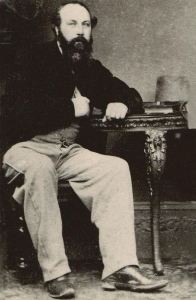
David Relph Drape c1880

David Relph Drape c1880

Little is known of his early life or what steered his artistic talents. His father Isaac (1790-1822) died when he was only one year old but his family would assure his education. Many members of his father’s family were from a long line of educators with interests in mathematics and navigational astronomy. A number of them had close ties to the Greenrow Academy which was founded in 1780 by his grandfather John Drape (1751-1793) who was a principal of the establishment until his death. It was then followed by John’s brother-in-law, Joseph Saul (1769-1842),  then Saul’s son John (1804-1853). Isaac Drape (1813-1870), a grandson of the academy’s founder, (David’s first cousin) took over as headmaster of the Academy in 1853 and it eventually closed after his death 1871.

It hasn’t been proven as to whether David was a student at the academy, but it would certainly seem highly likely during the period when his mother’s brother, Joseph Saul, was headmaster of the school until 1842.

Drape’s early thirties start to reveal his business exploits and talents. He was in the employ of a local Carlisle painter named William Atkinson from circa 1845 and in February 1854, Mrs Mary Atkinson, the widow of the late William Atkinson, decorative painter of 5 Abbey Street Carlisle, placed an advert in the Carlisle Patriot tabloid stating that she had engaged “Mr. David R. Drape, who was for a number of years Foreman for her late husband…” [1] Drapes association with William Atkinson may be the clue as to where he gained his first apprenticeship as a decorative artist, but his continuation as a foreman for the widow Mary Atkinson was very short. By early 1855 he had formed a partnership with another Carlisle tradesman named John Scott whose father, John Scott Snr, had retired and passed the business to his son. A dual advertisement for John Scott Snr’s retirement and the new Scott & Drape business appeared in the Carlisle Patriot, 3rd March 1855.

The Scott & Drape’s business advertisements began to appear in the Carlisle Patriot as:-

“SCOTT & DRAPE – PLAIN AND DECORATIVE HOUSE PAINTERS, ECCLESIASTICAL AND HERALDIC DECORATORS, ILLUMINISTS, GLASS STAINERS, CARVERS, GILDERS, GLAZIERS, &c., &c.” [2]

In November 1855 Scott & Drape created a stained glass window to the memory of Drape’s cousin, John Saul[3] who was principal of the Green Row Academy from 1842-1853. The window was to be erected in the west end of St Paul’s Church, Holme Cultram (now known as St Paul’s Causwayhead):

“ST. PAUL’S CHURCH, HOLME CULTRAM.- A very beautiful window of stained glass has just been inserted in the west end of this church, as a memorial to the late Mr. John Saul [4], of Green Row. The background is a rich mosaic of azure and ruby, upon which two large medallions are placed, representing the Adoration of the Shepherds, and the Presentation in the Temple; in the upper part of the window is a cross of a golden hue in the midst of a floriated ruby background, surrounded by the motto Hoc Signo Vinces[5]. A Latin inscription at the base states that the window has been placed there by the friends and pupils of Mr. Saul. The grouping, drapery, and expression of the various figures are remarkably fine, and reflect great credit upon the artists, Messrs. Scott and Drape, of this city.”[6]
[My research to-date indicates that this window no longer exists.]

A significant clue as to the style of glass painting Scott & Drape adopted is revealed in their advertisements; “S. and D., respectfully invite an inspection of their unique Specimens of Glass painting, in the style as now practiced by the Bavarian Artists at Munich.” This was undoubtedly in response to the debacle at Glasgow Cathedral in 1856 where the Cathedral authorities had awarded a large contract to the Royal Bavarian Glassworks to provide 60 or more stained glass windows for the Cathedral. English and Scottish stained glass craftsmen and artists were enraged with the decision and considered it as robbing them of their birth right. The Master Glazier to the Cathedral, David Kier, who installed the Bavarian windows, even felt compelled to adopt the same style of glass painting in his own windows and this seemed to force varying degrees of adaption to the Munich style that spread amongst the English and Scottish stained glass establishments until late into the 19th century.

Over the next four years Scott & Drape expanded their business and employed a number of tradesmen and apprentices. Their workshops at 23 Rickersgate, Carlisle, became well known and it was frequented numerous times by the local tabloids who were eager to report on their ecclesiastical decorations.

In 1855 Carlisle Cathedral was undergoing significant renovations but there was considerable debate amongst the authorities as to the proposed “highly ornamental” decorations which were opposed by the Bishop who had a preference for a more subdued tone. After a number of months had elapsed without a decision, the famous architect and designer Owen Jones was consulted to break the impasse; “Accordingly that gentleman visited Carlisle, examined the respective specimens and has just sent in his recommendation, which have been adopted, and are to be carried out forthwith by Messrs. Scott & Drape, carvers, gilders, and decorators, of this city.” [7] One of the major tasks to be undertaken for these renovations included the decoration of the Cathedral ceiling which Jones recommended to be in a blue azure dusted with gold stars and gilded angels;

“The panels are to have a ground work of bright azure, powdered with gold stars (that is the technical phrase); the ribs and bosses are to be painted various colours, red, blue, &c., and the coats of arms and other armorial bearings are to be restored after the most accurate heraldic designs; the angels which surround the cornices are to be gilded and coloured, and the large angels on the hammer beams are to be treated in a similar manner…” [8]

At the same time Scott & Drape were working on the Carlisle Cathedral renovations, they had completed a stained glass window for St Paul’s Anglican Cathedral, Dundee in April 1856 and they were permitted to display it in the north transept of the Carlisle Cathedral;

“A beautiful stained glass window, executed by Messrs. Scott & Drape, of this city, for the New Church, at Dundee, has been exhibited in the north transept of our [Carlisle] Cathedral during the past week…”[9]

The window was described as 18ft high, excluding tracery windows, and consisted of two lights. In the left light depicted the Good Shepherd with Christ’s Charge to Peter below and in the right light, the Saviour as the Sower with the Sermon on the Mount below.[10] As at August 2015, this window has been identified as extant in St Paul’s Cathedral at Dundee.

In July 1856 Scott & Drape completed a single light memorial window for a church at Brough, Westmorland. “The subject is a panel formed by the interlacing branches of the vine, and represents the resurrection of our Lord…” [11] Evidence as to the existence of this window has not yet been ascertained.

In January 1857 a letter was penned to the editor of the Carlisle Patriot by “A.B”. The writer was specifically making a point about “Powell’s Glass” being the most successful imitation of ancient glass and that the firm of Scott & Drape were “in the habit of using it for some considerable time…” The author mentions that Scott & Drape; “directed my attention to a Rose window in the north transept, and one in the clere-storey of our Cathedral, both executed by them with Powell’s Glass.” [12] This indicates that the Rose window in the north transept of Carlisle Cathedral and clerestory window(s) were also the work of Scott & Drape, but these windows were not of coloured or stained glass. A window of plain (Powell’s) glass, with lead lines forming the shape of the hexagram, recently removed (c.2011) from the clerestory of Carlisle Cathedral for restoration, revealed the following text scratched into the surface of the glass; “Scott & Drape decorated & glazed this Cathedral AD 1856.” Another window from the clerestory also included the surname of an apprentice named “Johnstone.”

In June of 1857 Scott & Drape completed a further three stained glass windows for St Paul’s Church, Holme Cultram;

“The three side windows in the chancel of St. Paul’s Church have, this week, been filled with stained glass by Messrs Scott and Drape of this city. The general design is a cross with crosslets, in a style which accords well with the architecture of the church and prevailed in the thirteenth century. The border is of azure, emerald, and ruby, and the colours are particularly brilliant. The east window also was inserted by the same artists some time ago, and is a work highly creditable to them.” [13]

In October 1857 Scott & Drape were paid a visit to their Rickersgate workshops by a reporter from the “Carlisle Journal.” The subject of their visit was to inspect a stained glass window that was nearing completion for the Cheltenham Proprietary College. The window was to be of seven lights, 25 feet high and 14 feet wide;

“The design comprises fourteen figures, representing our Saviour, the apostles, and evangelists, each about four feet high. The figures are arranged in two rows one above the other, and are surrounded by perpendicular canopies…” [14]

The tracery windows were to comprise monograms and sprigs of Ivy with the central light in the tracery to contain the armorial bearings of the principal of the College, the Rev William Dobson who had commissioned and paid for the window.

On the 24th February 1858 the Cheltenham “Proprietary College Chapel” was formally opened and their window was further described in the tabloids which also indicated that two other windows on the east side were the work of Scott & Drape, being commemorative of officers who were former pupils of the College and who had lost their lives in the Crimea and India.[15] The Cheltenham College Register of 1890 further described the window;

“The window above the altar is a large transomed composition of seven lights, and has a double row of figures. In the upper tier are St. John the Baptist and six of the Apostles in the lower, our Saviour and the other Apostles. Inscription on Brass beneath:- ‘The window over the Communion table was presented by Rev. W. Dobson, M.A., Principal of Cheltenham College. A.D. 1858.” [16]

Sadly there is no longer any trace of Rev Dobson memorial window today. The Cheltenham College Archivist provided the following correspondence in August 2015;

“A new chapel was consecrated in 1896 and the old building became the College library. The stained glass from the window above the altar was removed and replaced with plain glass to allow more light in. What happened to the original glass remains, I’m afraid, a mystery. The old chapel is now the College dining hall and retains all its stained glass except for the window you describe…” [17]

In January 1858, David Relph Drape, Painter and Glazier of Carlisle, placed an advertisement in the Carlisle Patriot giving notice that he will no longer be liable for any debts that his wife “AMELIA ARMSTRONG DRAPE” incurs. [18] Extracts from Drape’s diaries penned by his granddaughter Elizabeth Bradshaw in 1970, indicate that “Amelia” was his first wife who had suffered a mental breakdown after the birth of their son. Amelia supposedly never recovered and was eventually admitted to a Lunatic Asylum. Their son was brought up by Amelia’s parents and on completing his education, is supposed to have taken up a career in the Navy. [19]

By March1858, Drape had received a life changing letter from the Antipodes. His diary extracts record that he received a tempting offer of employment in the Colony of Victoria, Australia, from a businessman named James Ferguson from the plumbing and glazing firm Ferguson & Urie of North Melbourne. This firm was transforming their business to become the first commercial stained glass company in the Colony, and arguably the whole of Australia, and they offered Drape a contract to join the firm as a senior stained-glass artist. Ferguson & Urie promised him, that on his arrival in the colony, there would be a brand new building erected and fitted out for the purpose of stained glass production. This, in conjunction with the knowledge that they would have a local monopoly in the stained glass industry was undoubtedly tempting. His mother Catherine had died[20] the previous year, his wife was in a Lunatic Asylum and his son was in the care of his in-laws. He accepted the offer. [21]

By early April of 1858 Drape had officially dissolved his partnership with John Scott at Carlisle[22] and he departed England aboard the ship “Morning Light” on the 3rd July 1858.

The ship arrived in Hobson’s Bay, Victoria, on the 20th of September 1858, and Drape’s greeting by James Ferguson and James Urie was undoubtedly less promising than he had anticipated. The stained glass workshops had not been built and there was no work for him. The gold rush had caused a massive downturn in building and construction in Melbourne. Every able-bodied tradesman had left the city high on the prospects of making their fortune on the gold fields. Drape is supposed to have torn up his contract with Ferguson & Urie, but, resigned to the fact that the economic circumstances and the gold rush was the root cause of the situation, he decided to set out for the gold fields himself. [23]

Drape remained in the vicinity of the central Victorian town of Maldon for the next four years making a meager living as an Architect, during which time he designed many buildings, including the historical Beehive Mine Chimney, the Holy Trinity Church, and the Maldon Hospital, all of which still exist today.

In 1860 and 1861 he was appointed secretary of the Concord Quartz Mining Association in Maldon.[24] Other minor pursuits included writing poems for the Tarrangower Times, sketching, painting, illuminated testimonials and parchments, and even an occurrence of designing the gravestone of Maldon resident John Bentley in 1864.

By 1860-62, thousands of tradesmen and failed gold miners had flocked back to the city eager to find employment. This meant that Ferguson & Urie could resurrect their plans for the stained glass workshop in Curzon Street, North Melbourne and in 1863 they enticed Drape back to Melbourne where he took position as one of the firm’s senior stained glass artists alongside John Lamb Lyon. Drape’s diary extracts record: “Com. work at Messrs Ferguson & Uries Nov. 8th/63…” [25]

By this time Drape had received correspondence from England that his mentally ill wife Amelia had died. This undoubtedly released a huge burden from him and his vision for the future with Ferguson & Urie in North Melbourne became much clearer.

One of the earliest stained glass windows that Drape is likely to have been involved with before starting with Ferguson & Urie in late 1863, was for the Holy Trinity Church at Maldon which he had designed and supervised the construction of in 1861. Coincidentally, when Drape had been living in Maldon from late 1858, a Scottish stained glass artist named John Lamb Lyon was also in the area of Tarrengower and Maldon and it’s highly likely that they may have collaborated together on the design of the window, which Lyon is likely to have executed at the Ferguson & Urie glass workshop in Curzon Street North Melbourne. This window is extant in the west wall above the entrance to Holy Trinity.[26] Lyon had joined the firm in late 1861 and Drape had commenced with the firm on the precise date of 8th November 1863.

On the 27th of August 1864, Drape married Jane Selby, whose family he had known back in Carlisle. Jane had emigrated to Australia earlier to care for her younger brother Joseph who had emigrated for the sake of his health.

David designed his modest cottage to be built in Chapman Street, North Melbourne, within walking distance of the stained glass workshops at Curzon Street. Between 1866 and 1873 they had four sons, Isaac Selby, John Campbell, David Saul, and Horace. [27]

When Lyon departed Ferguson & Urie in 1873 the firm decided that they needed to foster and encourage the young men of Melbourne to attain the skills required for the stained glass business. They established the Hotham School of Art expressly for the purpose and Drape played a part as a teacher in the field of Ornamental shading and Landscape. Drape was also one of the founding members of the Victorian Academy of Arts and an active committee member of the Hotham School of Art from 1873 [28].

During Drape’s nineteen years with the firm, he painted many landscape and portrait scenes in ecclesiastical and secular windows. Many of the scenes depicted in the roundels and other intricate parts of secular stained glass windows have his name almost invisibly hidden within the pictures, such as the hunting scenes in the extant windows of Rupertswood Mansion in Sunbury and the garden with creek scene at Mandeville Hall in Toorak.

The Maldon Museum in Victoria also has a number of paintings and pencil drawings by Drape and the State Library at Melbourne has a folio in their manuscripts collection that contain some of his original pencil sketches and designs for ecclesiastical and secular windows. Of his sketches and fragments of drawings held at the library, a number have now been positively identified and matched to extant stained glass windows in Victoria and New Zealand. There is also a complete design of the window for the chapel of Sacred Heart Girls School in Newtown, Geelong, the James Maitland memorial window at St Matthews Anglican Church in Dunedin, New Zealand, and numerous partial sketches for elements of the “Season’s” window located in the stairwell and hallway of Mandeville Hall in Toorak.

David Relph Drape died at his Chapman Street cottage on the 30th March 1882 [29] and was buried in the Melbourne General Cemetery the following day[30]. His wife Jane died at her son David’s residence at Neerim Junction on the 8th of November 1920, aged 92.

The slide show images below depict a number of Drape’s original drawings that have been matched to existing stained glass windows known of to date. There are many other sketches that have not been identified and these obviously leave scope for continued research. Other photos show examples of his initials deliberately hidden within some of the secular stained glass windows.

The photo of David Relph Drape was kindly contributed by Drape’s descendant, Mrs Val Goller (nee Woolstencroft) in 2010. Other images from the State Library of Victoria and personal research data & photos.

This slideshow requires JavaScript.

[Show larger images]

Related posts:

1875: Rupertswood Mansion, Sunbury, Victoria.

19-02-1874: The Hotham (North Melbourne) School of Art.

Footnotes:

[1] Carlisle Patriot, Cumbria, England, Saturday 25th February 1854, page 1.
[2] Carlisle Patriot, Cumbria, England, Saturday 16th May 1857, page 4.
[3] John Saul (1804-1853), Davids’s 1st cousin 1x removed.
[4] John Saul (1804-1853), Headmaster of Greenrow Academy 1842-1853)
[5] Latin: “In this sign shalt thou conquer”.
[6] Carlisle Patriot, Cumbria, England, Saturday 10th November 1855, page 5.
[7] Chronicle, London, England, Monday 21st January 1856, page 3.
[8] Chronicle, London, England, Monday 21st January 1856, page 3.
[9] Carlisle Journal, Cumbria, England, Friday 25th April 1856, page 4.
[10] Carlisle Patriot, Cumbria, England, Friday 26th April 1856, page 5.
[11] Carlisle Patriot, Cumbria, England, Saturday 12th July 1856, page 5.
[12] Carlisle Patriot, Cumbria, England, Saturday 31st January 1857, page 7.
[13] Carlisle Patriot, Cumbria, England, Saturday 20th June 1857, p5.
[14] Carlisle Journal, Cumbria, England, Friday 23rd October 1857, page 5.
[15] Cheltenham Chronicle, Gloucestershire, England, Tuesday 23rd February 1858, p 5.
[16] The Cheltenham College Register, 1841-1889, Bell & Sons, Covent Garden, London 1890, page 15.
[17] Jill Barlow, Cheltenham College Archives, Gloucestershire, England 25 Aug 2015.
[18] Carlisle Patriot, Cumbria, England, Saturday 16th January 1858, page 4.
[19] David Relph Drape, Architect and Glass Stainer; E.M. Bradshaw 1970; Unpublished Manuscript, State Library of Victoria.
[20] Catherine Drape (nee Relph) died 2 Sep 1857, aged 67. She had re-married to Edward Richard in 1828.
[21] David Relph Drape, Architect and Glass Stainer; E.M. Bradshaw 1970; Unpublished Manuscript, State Library of Victoria.
[22] Carlisle Patriot, Cumbria, England, 3rd April 1858, page 4
[23] David Relph Drape, Architect and Glass Stainer; E.M. Bradshaw 1970; Unpublished Manuscript, State Library of Victoria.
[24] The Argus, Melbourne, Vic, Tuesday 9th October 1860, page 8.
[25] David Relph Drape, Architect and Glass Stainer; E.M. Bradshaw 1970; Unpublished Manuscript, State Library of Victoria.
[26] The Holy Trinity window includes the date 1863 on it: “PRESENTED A.D MDCCCLXIII BY W.S.T”
[27] Ferguson & Urie Employees; Family Tree research; Ancestry.com.au, Ray Brown 2015.
[28] The Argus, Melbourne, Vic, Tuesday 2nd May 1882, page 9.
[29] The Australasian Sketcher with Pen and Pencil, Melbourne, Saturday 22 April 1882, page 126.
[30] The Argus, Melbourne, Friday 31st March 1882, page 8.


Short link: http://wp.me/p28nLD-zl

Last edited: 02 Sept 2015 – This is a complete re-write from new research.

© Copyright