22-12-1864: Christ Church, Anglican, Myrniong, Victoria.

Located 72 kilometres west of Melbourne is the tiny township of Myrniong which lies less than a kilometer off the busy western freeway, 13km north west of Bacchus Marsh.

Amongst the many old historical buildings in the township is the Anglican ‘Christ Church’.

Built of bluestone nearly 150 years ago, the church’s most striking historical artifact is the remarkable three light stained glass window created by the Colonial Ferguson & Urie stained glass company in 1864.

Photos: Dated 12th January 2013.

This slideshow requires JavaScript.

The foundation stone of Christ Church was laid on the 25th October 1864 [1] and was formally opened three months later on the 22nd of December 1864 at a cost of £500 [2].

The Church of England Gazette of 2nd January 1865 [3] made a scant reference to the window at the church opening on the 22nd of December 1864 and reported;

“..the east window of three lights, in stained glass, is of a handsome design..”

The three light window above the altar is an exceptionally well preserved example of Ferguson & Urie’s work from 1864 which has survived intact for nearly 150 years.

The left light shows various stylised depictions of the passion flower in the diamond quarries and at the base of the window is a scrolling ribbon with the text “Love Thy Neighbour” surrounded with deep blue oak leaves. At the time of taking these photos a huge birds nest on the external lower portion of the left light shows a very dark patch in the photo of the window.

The centre light contains the Shield of the Trinity in the middle with the Latin texts,  “NON EST” (Is Not), “EST” (Is),  “PATER” (The Father),  “FILIUS” (The Son), “DEUS” (God), and “S.SANC” (‘SPIRITUS SANCTUS’ – The Holy Spirit).  At the base is an intricate Golden Chalice surrounded by a ribbon with the scriptural text, “This do in remembrance of me” (most likely to be from 1 Corinthians 11-24). The background of the chalice depicts vine leaves in crimson red and the outer depicts oak leaves in deep blue with interspersed small red passion flowers.

The right light is nearly identical to the left light with the exception of the ribbon at the base which has the text “Fear God”.

[1] The Bacchus Marsh Express, Vic, Saturday 17th November 1906, page 3.

[2] Church of England Gazette, Monday 2nd January 1865, page 267.

[3] ibid.

Acknowledgement:

Thanks to Wendy and Gordon Vearing of Myrniong for their assistance with access to the church and their enthusiasm for the history.


Short link to this page: https://wp.me/p28nLD-1xm

© Copyright

24-05-1884: St Michael’s Catholic Church, Little River, Victoria.

In 1884 Ferguson & Urie erected a two light stained glass window over the altar of St Michael’s Catholic Church at Little River, west of Melbourne. The window depicts Jesus in the left light in the Garden of Gethsemane praying to a chalice and St Michael in the right light also kneeling in prayer. The window was originally erected in the first bluestone church in 1884 at the instigation of a Miss Ellen Bannon[1], The original bluestone church was demolished in 1921 and a new red brick church was built in its place with some of the original bluestone from the old church used for the foundations. The stained glass window was also re-erected over the altar of the new church which opened in April 1922[2].

Photos were taken: 14th Dec 2012 & 2nd Jan 2013.

This slideshow requires JavaScript.

Advocate, Vol. XV, No. 801, 24 May 1884, p.15.

“GEELONG [From our own correspondent]

 The additions and improvements to the Catholic Church at Little River are now nearly completed.  A generous lady, Miss Banim[3], who has already contributed largely towards the funds of the church, last week sent an order to Messrs. Ferguson and Urie, of Melbourne, for a handsome stained glass window, to be erected over the altar; while another lady promises a carpet for the sanctuary, and a chest of drawers for the vestments, etc….”[4]

The memorial text across the bottom of the windows reads:

“TO THE GLORY OF GOD – AND IN HONOUR OF
THE REV M MURPHY – PASTOR OF THIS CHURCH
THIS WINDOW IS THE GIFT OF – ELLEN BANNON 1884”

The donor of the window, Miss Ellen Bannon/Bannin died two years later in 1886 at the Prince Alfred Hospital aged 46, and she was buried at the St Kilda General Cemetery[5]. The name of the “Rev M. Murphy” mentioned on the window is more elusive. The text says in “Honour” rather than “In Memory” so there is some conjecture as to whether the Rev M. Murphy was actually alive or not at the time of the window being commissioned by Ms Ellen Bannon in 1884. From the Catholic directories National Council of Priests[6], the only recorded name match is for a “Rev Michael Denis Murphy” who died 13/02/1939 and ministered in the parishes of “Meredith, Footscray, etc, Victoria” (no other specific detail known).

The Argus, Melbourne, Vic, Monday 8th March 1886, page 1.

“BANNON.- On the 6th inst., at Alfred Hospital, Ellen Bannon, late of Lara. Aged 46 years. R.I.P”.

“THE Friends of the late Miss ELLEN BANNON, late of Lara, are most respectfully invited to follow her remains to their last resting-place, in the St. Kilda General Cemetery. The funeral is appointed to leave the Alfred Hospital, THIS DAY (Monday), at 11 o’clock a.m.  BENJAMIN T. STEVENS, undertaker, 280 Church-street, near Swan-street, Richmond”.

http://www.standrewswerribee.org.au/little-river.htm

St Michael’s Little River Catholic community started in 1857, when Fr. Ranald Rankin was appointed resident priest by Melbourne’s first Archbishop, James Goold. Fr. Ranald Rankin came out to Australia from Scotland on the Marco Polo in 1853.  At that time, the Parish extended as far as Anakie and Footscray and it was the only church between Williamstown and Geelong. Fr. Rankin built St. Michael’s Church from local bluestone. During the week the church was also used as a denominational school. When Fr. Rankin died in February 1863, the parish was closed because of a shortage of priests. It was incorporated into the Geelong Mission. In 1906 Archbishop Thomas Carr created the parish of St. Andrews Werribee which incorporated St. Michael’s Little River. The old bluestone church was demolished and the present one was built. It was blessed and opened by Archbishop Daniel Mannix on the 2nd of April 1922… [7]

The death and burial of Ellen Bannon/Bannim in 1886:

Vic BDM: 3078/1886, Bannin, Ellen, age 46, died PRN ALF H (Prince Alfred Hospital). Parents listed as unknown.

St Kilda General Cemetery, Ellen Bannin, age 46, buried at ROMAN CATHOLIC, MONUMENTAL, COMPARTMENT D GRAVE 616.

There is obviously some confusion as to the spelling of her surname as either Bannin or Bannon. The stained glass window, obituary and funeral notice both have “Bannon” and the BDM Index entry and cemetery record both have “Bannin”.

Werribee Shire Banner, Vic, Thursday 6th April 1922, page 2.

“OPENING NEW R.C. CHURCH AT LITTLE RIVER.

“Nearly 2000 people witnessed the solemn blessing and opening of a new Roman Catholic Church at Little River on Sunday afternoon last by the Archbishop of Melbourne, Dr. Mannix. The sacred edifice, which cost in the vicinity of £2,500, may be recognised as a gift church, the late Huon McNaughton having left he sum of £2,300 for this purpose. The construction of the church was commenced some twelve months ago, but owing to unforseen circumstances it was not completed until recently, when work was finally executed by Mr. John Smith, of Meredith. The church which is built of brick, and neatly furnished, will accommodate about 200 people, and the parishioners of Little River can well feel proud of having one of the most handsome and elaborately equipped churches in the country parishes of Victoria…”

[1] Advocate, Vol. XV, No. 801, 24 May 1884, p.15.

[3] Ellen Bannon, as per dedication text on window. Interchangeably spelt as Bannin and Bannon on other notices.

[4] Article sent from Dr. Bronwyn Hughes, email, 14 Dec 2012.

[6] Sally Heath, NCP, email 4 Jan 2013.

17-02-1896: St. George’s Church, Carlton, Victoria.

St George’s Church in Carlton is a bluestone building built in 1855-6 to the design of architects George and Schneider, the foundation stone of which was laid by Bishop James Alipius Goold in 1855. The Church is located on the grounds of the Corpus Christi College in Carlton and now known as the Corpus Christi Chapel.

On Sunday the 16th of February 1896[1], a memorial stained glass window depicting the Crucifixion was unveiled in the south transept of St George’s to the memory of William Ievers, M.L.A[2], who died at Macartney’s private hospital, East Melbourne[3] on the 19th of February 1895.

William Ievers (1839-1895), was the son of William Ievers Snr[4] (1818-1901) and Mary Harrison (c.1819-1898). A native of Ireland, William arrived with his parents and siblings aboard the Rienzi on the 22nd April 1855[5].

An obituary written about him in February 1895[3] significantly details his life but makes no mention of his historical involvement as the Vice President of the Carlton Football Club between 1890-1894[6].

A plaque affixed to the gate of the Corpus Christie College gate in Drumond street Carlton includes a reference to the Ievers stained glass window as being by Ferguson & Urie;

…in 1896 a memorial stained glass window to local Councillor William Ievers, designed by the prominent firm of Ferguson and Urie was installed in the south transept…”

News articles from 1896 indicate that the stained glass window was designed by “Mr. Smyrk”, (Herbert Moesbury Smyrk (1861-1947), who was formerly of the stained glass firm of Smyrk & Rogers (partnership dissolved in 1888). At the time the Ievers memorial window was made, Smyrk was then in the employ of Ferguson & Urie.

On the 12th of November 1924, St George’s church was gutted by fire[7] and the William Ievers stained glass window is not known to have survived.

Other memorials to members of the Ievers family include the William Ievers memorial drinking fountain[8] erected in his name by his brother George Hawkins Ievers, in Macarthur Square, Rathdowne Street, Carlton. George also erected another fountain to his father William Ievers Snr in Argyle Square Carlton[9] and his own memorial fountain is at the Corner of Gatehouse Street and Royal Parade, Parkville[10]

The Ievers family home, named after their roots in Ireland,Mount Ievers”, was located at 521 Royal Parade in Parkville but was demolished circa 1975.

The Ievers family grave and monument still exists at the Melbourne General Cemetery,Roman Catholic,, Section Q, Grave 304/305.

These photos were taken on various dates in 2012. The photo of “Mount Ievers” mansion, at 521 Royal Parade Parkville is from from the SLV and dated prior to 1975.

This slideshow requires JavaScript.

Transcriptions:

The Argus, Melbourne, Vic, Wednesday 20th February 1895, page 5.

DEATH OF MR. IEVERS, M.L.A.

“Though not unexpected, the announcement of the death of Councillor William Ievers, jun., M.L.A, which occurred last night at Miss Macartney’s private hospital, East Melbourne, will be received generally with feelings of deep regret. A fortnight ago an operation of a painful and serious nature was performed upon Mr. Ievers, and though at the time he appeared likely to recover, he subsequently developed symptoms which alarmed his friends and caused his medical adviser, Mr. Charles Ryan, to fear that there was little hope that he would live. On Monday evening he improved somewhat, but yesterday morning suffered a relapse, and hope was finally abandoned. At 8 o’clock at night he died, surrounded by the members of his family. The cause of his death was urenic poisoning, due to failure of the kidneys. Mr. Ievers was born in Limerick, Ireland, in 1844 [sic: 1839[11]], and came with his father (who is still living and well known in Melbourne) to Victoria in 1855. As a junior he entered the warehouse of Messrs. William Watson and Sons, and remained there until about 1880. By that time he had mounted step by step to be head of one of the departments. When he left the warehouse he joined the firm of his father and brothers, Messrs. William Ievers and Sons, auctioneers, estate, and commission agents, of Collins-street and Carlton. About the same time he was elected a member of the City Council for Smith Ward, and retained the seat up to the time of his death. He sought to enter the Assembly for the Carlton electorate, but was twice beaten. Then when the electorate was subdivided he contested the seat for Carlton South, and after one unsuccessful attempt he unseated Mr. W. H. Leonard at the 1892 election. At the last election he held the seat against the opposition of Mr. Thompson, securing a large majority of votes. In the Assembly Mr. Ievers sat in the Ministerial Corner, and since he rose but seldom to address the House, and then only on subjects with which he was thoroughly conversant, he was invariably listened to with respect. During the last session he was appointed chairman of the banking Commission, but owing to his ill-health was unable to preside at their meetings. Mr. Ievers was a representative of the Melbourne City Council on the Metropolitan Board of Works, and he was also a justice of the peace. He was un-married, and resided with his parents at Mount Ievers, Sydney-road, Parkville. He was very much respected as an honourable and an upright man. He took part in many social organisations specifically formed to promote intellectual advancement, and always evinced a keen interest in the study of the great authors. For many years he was a prominent oarsman, but his exercise on the river had a very painful ending. He was sculling up stream one day, and was run into by another sculler, the bow of whose boat struck him on the spine, and caused what were for a time serious injuries.”

Advocate, Melbourne, Vic, Saturday 15th February 1896, page 16.

“ST. GEORGE’S, CARLTON
A stained glass window to the memory of the late Cr. Wm. Ievers, M.P., has been erected in St. George’s Church, with which the family of the deceased gentleman have been very intimately connected since the foundation of the building was laid. Mr. Wm. Ievers, jun., to whose memory this mark of respect is paid, was himself associated with St. George’s Church since his boyhood, and he and other members of his family have always taken a deep and practical interest in Catholic affairs in the district of Carlton. The memorial is a three light window, which replaces the one heretofore in the southern transept. The centre light contains a representation of the crucifixion, the side lights being filled with a modern treatment of ecclesiastical ornament. On the right of the crucifixion is the inscription:- “He was wounded for our iniquities, and by His bruises we are healed;” and on the left:- “Blessed are the dead who die in the Lord, for their works follow them.” The record reads:- “In memoriam, William Ievers, Jun., M.P., J.P.” The treatment of the crucifixion in the centre light does not show the Saviour in the hands of the Jew and Roman ignorantly and maliciously fulfilling the mysteries of Redemption, but is strictly devotional in character. Christ is depicted as dead, and the figures of the B. Virgin and St. John stand motionless on either side in subdued sorrow, while Magdalene kneels gravely at the foot of the cross. The colouring is very rich in treatment – yet with a beautiful soft harmony throughout. The work has been carried out by Messrs Ferguson and Urie, from the designs of Mr. H. Smyrk, and to the order of Cr. William Ievers, the father of the deceased gentleman. The memorial will be unveiled at the 11 o’clock Mass on Sunday, 16th inst., when panegyric of the deceased will be preached by the Rev. Isaac Moore, S.J.”

The Argus, Melbourne, Vic, Monday 17th February 1896, page 5.

“MEMORIAL TO THE LATE MR IEVERS, M.L.A.

SERMON BY FATHER MOORE.

A special service was rendered yesterday morning at St. George’s Church, Carlton, in memory of the late Mr. William Ievers, M.L.A., who died on February 19, 1895. A fine stained-glass window has been erected in the southern transept of the church by the members of the late Mr. Ievers’s family, and, while it harmonises well with the beautiful interior of the church, serves also as an enduring memorial of the deceased gentleman. It is a three-light window, the centre light showing the principal design, which consists of a representation of the Crucifixion. The colouring is rich but subdued, and the figures of the crucified Christ and of the mourners at the foot of the cross stand out sharp and distinct in every detail. A suggestion of the distant city of Jerusalem rising behind the hill of Calvary is a new feature introduced into the composition by the artist, Mr. Smyrk, who designed the work, which has been carried out by the well known firm of Messrs. Ferguson and Urie. There was a crowded congregation, and the special sermon was preached by the Rev. Isaac Moore, S. J….”

The Argus, Melbourne, Vic, Thursday 13th November 1924, page 8.

“Fire in Old Church”.

“An old Melbourne landmark will probably disappear as the result of a fire last evening, when the St. George’s Roman Catholic Church, in Drummond street, Carlton, which was built in 1855, and was used as a boy’s schoolroom, was almost completely destroyed. The cause of the outbreak is a mystery. The school was securely locked at a quarter to 5 o’clock, and at 6 o’clock the housekeeper of the Presbytery, which adjoins the old church, saw smoke issuing from a ventilator on the roof. Five minutes later the building was a mass of flame. The head fire station at Eastern Hill was notified, and a large detachment of men was soon on the spot. The firemen were greatly hampered in their work by the intense heat, for, although the outer walls of the church are constructed of bluestone blocks, it was lined with wood, and the roof was stayed with old wooden rafters, which burned fiercely. Many children were playing in the grounds at the time, and some were endangered by the flying sparks. Several hoses were played on the heart of the fire, which was at the eastern end of the building, but it was some time before the firemen were able to get close enough to break down the doors and enter. When they could do so they concentrated a stream of water on to the blazing rafters, and the outbreak was soon subdued. The building contained desks, black boards, and the usual furnishings of a school room, most of which were destroyed. The inner walls were severely damaged, and gaping holes were left in the roof. The building and contents were insured with the Catholic Church Insurance Co., for £1,500, but it is not thought that this amount will cover the damage. The chief fire officer (Mr. Harris B. Lee), who was early on the scene, said that it was extraordinary that although hundreds of people must have seen the flames, nobody gave the alarm until the fire was noticed by the housekeeper. The building, which was constructed as a schoolroom in 1897, accommodated 220 pupils”.

External links:

Biography: William Ievers Snr (1818-1901)

An interesting history of William Ievers Snr (1818-1901), is detailed in a book he wrote in 1894 titled  “Fifty Years After; or, Old Scenes Revisited.” Extracts were republished in The Old Limerick Journal under the titles of,  William Ievers: Old Scenes Revisited and A visit to Paris 1890. His son William Ievers Jnr (1839-1895), referred to as “Willie”, accompanied his father on the journey back to Ireland in 1890 and the book was a result of William Snr’s journals.

Footnotes:

22-05-1897: Presbyterian Church, Werribee, Victoria.

In the last three years of the history of the Ferguson & Urie stained-glass company of North Melbourne they were still performing regional glazing repairs. On Friday 14th May 1897 a storm went through Werribee and damaged a stained glass-window at the Presbyterian Church (now Cross Roads Uniting) which was repaired by a tradesman from Ferguson & Urie. There is no evidence that proves the window was one Ferguson & Urie’s original installations from when the church was built in 1884.

The Bacchus Marsh Express, Vic, Saturday 22 May 1897, page 3.
“The strong northerly gale that was blowing across these plains on the night of Friday of last week, with its occasional severe gusts, has unfortunately not passed over us without doing some damage; for, in addition to the unthatching of stacks, on many of the farms, the north window, high up in the spire of the Presbyterian church, which is exposed to the full force of wind from the north, has been very badly damaged, necessitating complete renewal of the lead work, and a great deal of the glass. The damage was first noticed by the Rev. John McIntosh on Saturday; pieces of the lead work and glass were blown in and were strewn over the floor of the belfry; while the window itself was just hanging together, vibrating with the wind, which by this time had fortunately veered round to the west. He at once communicated with Mr. Adam Hastie, Mr. G. T. Chirnside’s manager, informing him of the damage, and at the same time wrote in to Messrs. Ferguson & Urie, of Melbourne, to send out a man at the earliest moment. When the tradesman arrived it was at once seen that the window would require to be taken out as the joints of the lattice lead work were, for the most part, broken, and the rods and stays were loose, so that in order to make a secure job, the window will have to be re-leaded. The repairs will possibly cost over £3, so that ‘its an ill wind that blows nobody good!”

Photos taken: 30th Dec 2010.

This slideshow requires JavaScript.

As at 2012, the north an west facing belfry windows of the church are extremely unlikely to be of any original glass produced or at anytime repaired by Ferguson & Urie.

Related posts:

23-05-1896: Presbyterian Church, Werribee, Victoria.
1876: Werribee Park Mansion.


Short link to this page: https://wp.me/p28nLD-1w8

© Copyright

29-01-1879: St Thomas’s Anglican Church, Moonee Ponds, Melbourne, Victoria.

The foundation stone of the present St Thomas’s church in Mt. Alexander road, Moonee Ponds (formerly Essendon Parish), was laid in 1857 by the Governor of Victoria Sir Henry Barkly[1], and opened for worship on Sunday 6th March 1859 by the Rev R.B. Barlow[2]. The church was erected in the early English style to designs of architects Knight and Kerr[3] and was consecrated on Tuesday 2nd September 1862[4] The first incumbent was the Rev. Edward Puckle[5][6].

The centre stained glass window in the chancel of St Thomas’s contains an historic window created by Melbourne’s first colonial stained glass company, Ferguson & Urie of North Melbourne. The window depicts Christ as ‘The Good Shepherd’ and was erected to the memory of John Thomas Smith, M.L.A., who holds the record of having served as Mayor of Melbourne seven times between 1851 and 1864.

The memorial text at the foot of the window reads:

“DEDICATED BY HIS WIDOW TO THE MEMORY OF THE LATE HON. J. T. SMITH. M.P. ONE OF THE ORIGINAL TRUSTEES OF THIS CHURCH WHO DIED JAN 29 1879 AGED 63 YEARS”.

The date of death recorded on the window (29th) is at odds with that recorded elsewhere in the tabloids of the time and his official probate records, which all record the 30th.

Strangely there was also an occurrence of another memorial window erected to his memory in St John’s Church in Latrobe street!

In October 1883 Mrs Ellen Smith (nee Pender 1820-1886[7]), the widow of the Hon John Thomas Smith, M.L.A, dedicated a single light memorial window to her late husband in St John’s Church in Latrobe Street Melbourne. His funeral service was conducted at St John’s on Friday 31st January 1879 and four years later the following was reported in the Argus;

The The Argus, Melbourne, Vic, Thursday 18th October 1883, page 5.

“ST. JOHN’S CHURCH, LATROBE STREET. The interior of this Anglican church has been undergoing a process of renovation which has considerably improved its general appearance. A new stained glass memorial window has been placed in the northern wall of the chancel. It is the gift of Mrs. Smith, in memory of her deceased husband, the late Mr. John Thomas Smith…”

St John’s Church in Latrobe Street was demolished c.1920, re-erected nearby, and again demolished c.1957 but what became of the J. T. Smith window or any others is not known.

Photos taken 5th February 2012.

This slideshow requires JavaScript.

Who was John Thomas Smith?

John Thomas Smith (1816-1879)[8] was born and educated in Sydney. He married Ellen Pender in St James Cathedral, Melbourne on the 10th April 1839[9].

Having never been considered a true inspirational leader, he missed consideration of a Knighthood by the Queen in 1858, but astonishingly he served as Mayor of Melbourne seven times between 1851 and 1864[10], a record that  is unlikely to be repeated in Melbourne’s history.

His funeral service was conducted at St John’s Church in LaTrobe street in Melbourne on Friday 31st January 1879 and his Masonic Brethren were instructed to appear in full Masonic regalia to follow the remains of their brother, the late “Provincial Grand Master” to his final resting place in the Melbourne General Cemetery[11].

The Australasian Sketcher with pen and Pencil, Melbourne, Vic, Saturday 15th February 1879, page 183.

“THE LATE HON. J. T. SMITH, M.L.A.

The late Hon. John Thomas Smith, M.L.A. for West Bourke, who died on January 30, was in his way one of the most familiar of local landmarks. He was a native of Australia, having been born at Sydney, New South Wales, in 1816, so that at the time of his death he had passed his 62nd year. The education provided in the young colony in those days was not of the most liberal description, but his parents accorded him the benefit of the best obtainable, and he was educated at Cape’s school, Sydney. Referring to his youthful days, Mr. Smith has been heard to say, that though he had gained honours from his fellow Victorians of which he was proud, he felt certain that had his early instruction been more comprehensive and complete he would have occupied still higher positions. An impartial estimate, however, of the deceased’s natural abilities hardly justifies the belief that he could ever, under any circumstances, have taken a leading place in controlling the affairs of any large community of men, for though possessing great natural shrewdness, it cannot be said that he was endowed with a statesman’s breadth of intellect. Mr. Smith’s first start in life after leaving school was as a clerk in the bank of Australasia, where, however, he did not remain very long, resigning his position for a situation in the colonial store department. His next position explains the somewhat clerical dress which Mr. Smith has always worn in Victoria, and which often led those who saw him for the first time to believe that he was a minister of religion. In 1837 he was offered the position of assistant teacher in the Church of England Aboriginal Mission Station, Melbourne, the site of which is now occupied by the Botanical-gardens. Having from his early youth a great interest in the aborigines – who, he used to say, should be most kindly dealt as the real possessors of the soil, from which they were gradually driven by the steady advance of the tide of civilisation – Mr. Smith at once accepted the appointment, and came to Melbourne in the James Watt steamer, near the end of 1837; thus having been at the time of his death a citizen of Melbourne for over 40 years. Melbourne in those days was, it need hardly be said, but a very small place indeed – an oasis in the almost desert wilderness of forest-clad hills and plains; and to use Mr. Smith’s words in the Assembly only a few years ago, he had been one of those early pioneers who have had the happiness of living to see “a wilderness where the noble savage held almost undisputed sway transformed into a city almost second to none, and surpassing all who’s existence dates from (then) only 36 years ago.” He quitted the mission-station after having done good work to become manager for the late Hon. J. Hodgson, and subsequently entered into business on his own account. It is unnecessary in a notice of this kind to dwell upon the early business pursuits which the deceased in those rough times entered on, but it may be said that he was successful in his object of gaining a considerable competency. He catered for the entertainment of a not very aesthetic public; but among one of his enterprises which deserves to be remembered was his building of the Queen’s Theatre, of which Mr. George Coppin was among the early lessees. In 1842 Melbourne was incorporated a city, and Mr. Smith was one of the first councillors – a position he has continued to fill without intermission until his death. He has held the honourable office of mayor of Melbourne no less than seven times, but the majority of his elections to that post took place in the earlier years of the City Council, when there was not the same rivalry for the distinction which has for some years existed among the city fathers. At present it is well known there is little chance of any mayor being re-elected to the office, and a second re-election might be looked upon as an impossible occurrence. During the Ballarat riots the mayoralty of Melbourne was no sinecure, owing to the excitement which prevailed, and the rumours flying about of intended assaults on the Treasury and banks. Mr. Smith did good service in restoring the confidence of the population by organising a system of special constables, and for his energy on the occasion he received the thanks of the Governor, Sir Charles Hotham. When mayor in 1858 the deceased was delegated by the City Council to go to England for the purpose of presenting an address of congratulation to the Queen on the occasion of he marriage of the Princess Royal to the Crown Prince of Prussia. It was expected by many that Mr. Smith would return from his trip Sir John Smith, but the expected honours were not bestowed. If any disappointment was experienced by the mayor himself in the matter, it is but fair to say that he showed no traces of it. It will be mainly by his connexion with Melbourne, and the services which he rendered to the city in its youthful growth, that the deceased will be remembered; but it is needless to say, besides being a city councillor, Mr. Smith has, since the establishment of constitutional government in this colony, been a member of the Legislative Assembly. At the time of his death he was entitled to the name of Father of the Assembly, as since his first election for North Bourke, in 1851, to the old nominee-elective Assembly, he has never been out of Parliament. He has had a seat in one Government – viz., as Minister of Mines in the Macpherson Administration, in 1869. Notwithstanding his long parliamentary experience, however, the deceased could not be said ever to have taken a leading position in the House. His best work was done in other and less prominent places. His shrewdness and good humour and knowledge of colonial life made him a useful magistrate, and for many years he was a constant attendant at the City Bench, where his great delight was to talk to the persons to the suit in a private room, and induce them to sink their differences, and settle their disputes out of court. He was an official visitor at the lunatic asylums, and paid assiduous attention to his duties as a member of the Central Board of Health. In the establishment of our principal charities, such as the Melbourne Hospital, the Benevolent and Orphan Asylums, and others, he took an active part, and on several occasions when help was needed in other countries, and Victorians were appealed to, the deceased energetically applied himself to the task of collecting, always supplementing the collections with a liberal donation of his own. The deceased also took great interest in the initiation and progress of the friendly societies, and was a leading member of several of them, besides being a prominent Freemason. For many years he has been Provincial Grand master under the Irish Constitution. Mr. Smith leaves a widow and a family, the eldest of whom is Mr. J. T. T. Smith, Crown prosecutor. A full length portrait of Mr. John Thomas Smith in his robes of office is hung up in the town-hall, and no doubt he will occupy a place in local history as “seven times mayor.”

The reason for J. T, Smith being ignored for a Knighthood could be explained as follows:

Sunbury News, Vic, Saturday 25th March 1905, page 3.

“A VISIT TO THE MELBOURNE GENERAL CEMETERY.

(By Isaac Batey.)”

“…we will take stock of the tomb of J. T. Smith, who enjoyed the distinction of holding the mayoral chair for seven years. He was a live public man in early Melbourne times; then being elected M.L.A. for West Bourke, he became Minister of Lands. Just about the beginning of 1870, he was seen passing through Ballan, on a Ministerial tour, and my worthy old dad, who was evidently personally acquainted with him, told me who he was. Perhaps it will not be out of place to relate an incident about Mr Smith, even if it was given in former scribblings. Well, in 1859, the Princess Royal was married. “Jacky Tommy,” as “Punch” dubbed him, being Mayor of Melbourne, the City Council sent him to England to read an address to the Queen, congratulating Her Majesty on the happy event. The “Argus” had a dead-set on the Mayor. One of that paper’s proprietors (Mackinnon) was in London, and I have lately heard that he laid a trap for the Ambassador. Smith was a gay Lothario; in fact, in that direction, he was too intense, consequently he was an easily caught bird when the right sort of lime was prepared for him. To shorten -it is apparent that some woman was put in his way, and the presumption is, she was bribed to effectually damn Smith in the eyes of royalty. This I do know for a certainty, from the newspapers published in Victoria, that a female prosecuted him for misconduct in a London police court. However, he was thoroughly euchred with respect to the prospective Knighthood, for on reading his address to the Queen, in place of coming out with a handle to his name; he emerged plain Mr Smith. Without doubt the “Argus” had recourse to vile intrigue to block the Knighthood, not for the special reason that Mr Smith had faults and failings, but simply because he had sprung from the ranks’ still designated by some people afflicted with the mania of self-esteem, as “the lower orders.” However, J. T. S. believed that the “Argus” had played him a scurvy trick, because on his return he never allowed that journal to enter his house-a fact that can be vouched for, seeing that the information was derived from a gentleman who was an intimate friend of the family. The monument over the Smiths is a good one. The several inscriptions read as follows: “‘Hon. John Thomas Smith-died 30th January, 1879; aged 61.-Ellen, wife of the above-died 20th July, 1886. James, second son–died 27th May, 1878; aged 31.-Charles Melbourne, sixth son; died let. December, 1874, aged 19.-Harrie Smith, secretary V.A. Turf Club; died 10th July” 1895; aged 44.–J. T. Thorold Smith, L.L.B., and K.C., Crown Prosecutor, and eldest son; died 8th July, 1901; aged 61. Nellie, his wife died 2nd March, 1901; aged 60.” Mrs Smith, senior’s, age was not on tomb, and counting the K.C.’s wife, the life average of the family is 44 years…”

Also see: Biography John Thomas Smith (1816-1879)

About the Rev Edward Puckle:

The Argus, Melbourne, Vic, Saturday 11th December 1937, page 38

“Old Essendon Church.

The early history of St. Thomas’s parish, Essendon, shows that it was originally the charge of Dr. Hussey Burgh Macartney, later Dean of Melbourne. That was in 1849. A small wooden building served the parishioners for 10 years. The foundation of the present church in Mt. Alexander road was laid in 1857 by the Governor of Victoria Sir Henry Barklay, and the building as opened for worship in 1859. The first vicar was the Rev. Edward Puckle, who continued his work till 1878. He remained a parishioner till his death in 1898, aged 98 years. The present vicar (the Rev. C. Hedley Raymond succeeded the Rev. Canon J. T. Baglin in 1934…”

Otago Daily Times, New Zealand, Issue 11205, 30 August 1898, Page 6

“AN EX-NEW ZEALANDER.

The Rev. Edward Puckle, of Essendon, has just died at the ripe age of 98. His wife (86) died in April last, after a happy married companionship of no less than 68 years. Mr Puckle was one of the Canterbury pilgrims, landing in the Randolph at Lyttleton in 1850. He remained in New Zealand only five years, and then came to Victoria. He was in charge of the Essendon suburban parish here for 24 years, and continued to live is Essendon till the time of his death, another 18 years.”

The Rev Edward Puckle has his own memorial stained glass window in St Thomas’s which depicts the Ascension and is erected to the left of the  J. T. Smith window. This window was crafted by the stained glass craftsman William Montgomery of Melbourne c.1898. Another window in the nave is dedicated to his daughter, Mary Shaw Puckle, and was made by Brooks, Robinson & Co, Melbourne, and dedicated in 1934.

All the stained glass windows in St. Thomas’s were created locally in Melbourne. The J. T. Smith memorial window was made by the first colonial Victorian stained glass firm, Ferguson & Urie, and all  other later windows were created by William Montgomery, Mathieson & Gibson, and Brooks, Robinson & Co, between 1900 and 1956.

Other references:

Bendigo Advertiser, Vic, Saturday 1st February 1879, page 1s.

Bendigo Advertiser, Vic, Tuesday 4th February 1879, page 2.

Mercury and Weekly Courier, Vic, Saturday 5th April 1879, page 3.

The Argus, Melbourne, Vic, Saturday 11th December 1937, page 38

Web site of St Thomas’s Moonee Ponds

Foot Notes:

27-04-1862: St Giles Presbyterian Church, Geelong, Victoria.

Situated on the west side of Gheringhap Street, between Little Ryrie and Myers Street in Geelong, is the former St Giles Presbyterian Church, also known as the West End or High Church. Ferguson & Urie created the five-light west window, which is the third oldest extant window I’ve found by Ferguson & Urie, and it’s also one of the rare few that have the company name on it. There is also a window depicting the ‘Burning Bush’ (the Presbyterian Motto) at the east end, which includes the date “A.D. 1862”.

Geelong Advertiser, Vic, Tuesday 29th April 1862, page 3.

“…The windows in the front elevation (Gheringhap-street) will be of stained glass, five lights each and traceried; they are being prepared by Messrs Ferguson and Urie of Melbourne, a very handsome and elaborate design, and will not be ready for a few weeks…”

The designs of architect Nathaniel Billing were chosen as a result of a competition entry[1] and Boynton & Conway of Geelong were the building contractors. Although initial designs included a spire, this was never built. The foundation stone was laid on Tuesday the 9th of July 1861 by the treasurer of the new church, Thomas Brown Esq[2], and it was formally opened on Sunday 27th April 1862 [3]. By 1938 St Giles had no minister and it was suggested that it should be pulled down[4] and re-erected in place of the wooden Scots Church in Pakington street Geelong West. This never eventuated and the church continued to serve the congregation for another forty years. St Giles was last used for services in 1977 when the Uniting Church classed the building as redundant and it was sold in 1988. It was then used as an entertainment venue which hosted many live bands and performances by famous rockers such as Jimmy Barnes. How the stained glass windows survived unscathed during this period is remarkable! Photos taken 6th January 2012, except the last two photos in the slideshow which show the full perspective of the liturgical west window, and the Burning Bush window at the liturgical east end. These two photos have been contributed by Geoffrey Wallace, taken in 2006 before the internal office space construction began.

This slideshow requires JavaScript.

The latest transformation of the former St Giles church was it’s conversion to offices and it now hosts a medical clinic. The liturgical west window facing Gheringhap street still exists in fairly good condition and can be seen from inside from the landing of an internal staircase. The window is also one of a very rare few early Ferguson & Urie stained glass creations that has the company name on it, located at the base of the centre light. The four lobed round window at the east end depicts the Burning Bush with the motto of the Church of Scotland, “NEC TAMEN CONSUMEBATUR” (Latin – ‘Yet it was not consumed’, an allusion to Exodus 3:1-22 and Moses and the Burning Bush), and also has the year “A:D: 1862”.

Significant newspaper transcriptions:

The Sydney Morning Herald, NSW, Monday 15th July 1861, page 3

“The foundation stone of the new Presbyterian High Church of Victoria was laid on Tuesday, at Geelong, in the presence of a numerous concourse of people. The site of the new building is adjacent to the Presbyterian school on the western side of Gheringhap-street. The ceremony was performed by Mr. Thomas Brown, treasurer to the new church, the Rev. Mr. Fraser commencing the proceedings with singing and prayer. The design of the church is early gothic; it will hold 500 persons, and the entire cost of the edifice with steeple will be £5000. – Herald”

Geelong Advertiser, Vic, Tuesday 29th April 1862, page 3.

“HIGH CHURCH, GHERINGHAP STREET. THIS handsome structure which forms such a prominent feature amongst the ecclesiastical and public edifices of the “west end” of our town may now be pronounced complete. At least, it is complete in so far that it has been devoted to the purpose of its erection, having been consecrated to Divine Worship on Sunday last in presence of a very numerous congregation. The plan comprises the nave, transepts, vaulted recess for rostrum, vestry, two porches, and a tower and spire; and the style of architecture is of the “early decorated” period of Gothic. The tower, and spire, and vestry are not yet built, which, of course, give the edifice externally an unfinished appearance; nor are the nave and transepts, which are to provide the complete seat accommodation; but these are in progress and will be finished by the original contractors. The walls are of bluestone; while the gables, window and door coigns, copings, pinnacles, and dressings to buttresses, &c, generally are of Barrabool freestone. Interiorly – the roof is open to the ridge, supported by arched trusses, the wall-pieces bearing on moulded and carved stone corbels; and all the roof timbers and boarding is stained of a uniform colour and varnished. Ventilation is amply provided by a series of perforated pinnacles and louvred openings, in addition to which the side windows are each made to open partially, and gratings in the passages and in the plinth are arranged with slides to open or shut with pleasure as the state of the weather may require. The windows in the front elevation (Gheringhap-street) will be of stained glass, five lights each and traceried; they are being prepared by Messrs Ferguson and Urie of Melbourne, a very handsome and elaborate design, and will not be ready for a few weeks. The side windows have two lights each with traceried heads, and those to the transepts three lights each. There are also two small gable windows of chaste design. The rostrum and the precentor’s desk and their enclosing railing are of Australian cedar selected with exceeding taste to show the valuable adaptability of this favorite wood for ornamental purposes; and in design the whole is in strict keeping with the other parts of the church. The benches are open, with cut and moulded ends terminating with fleur de-lis; they are all stained and varnished. The whole of the workmanship of the building and its furnishings, inside and out, is of the most creditable character. Mr. Billing, of Melbourne, is the architect, and Boynton and Conway, of Geelong, the contractors for carrying out the works. The church occupies one of the most commanding sites of the town, and, approached by land or seas it will always form a prominent object in the view. It is capable of accommodating about fifteen hundred people.             As we said above, the church was consecrated for Divine Worship on Sunday last. The “opening services” of the day were three – morning, afternoon, and evening. The first and last were conducted by the Rev William Henderson, of Ballarat, and the afternoon service by the Rev Joseph Dare. As an earnest of the interest felt by the congregation in their new church, above L60 was contributed as the customary collections. The opening services will be continued next Sunday by the Rev T. W. K. Frazer, the pastor of the church, the Rev A. J. Campbell, and the Rev A. Love.”

Footnotes:


Short link to this page: http://wp.me/p28nLD-1uJ


05-08-1876: St Peters, Eastern Hill, Melbourne, Victoria.

The foundation stone of St Peter’s was laid by the Superintendent of the Port Phillip district, Charles Joseph La Trobe[1], on 18 June 1846[2], on the corner of Albert and Gisborne Streets on the eastern hill of Melbourne. The building was used for services as early as 1847, and was formally opened on the 6th August 1848[3].

The first stages of the church were designed by architect Charles Laing and the contractors were Ramsden & Brown (Samuel Ramsden – stone mason, and Charles & Henry Brown –bricklayers, contracted for a reported £820) [4]. In 1853-54 the Chancel & Transepts were added to the designs of Charles Vickers.

In June 1876, the chancel of St Peter’s was extended to the designs of architects Terry and Oakden, and the five figurative Ferguson & Urie windows were installed[5] at this time. An engraving showing the new chancel was published in the newspaper on the 5th August 1876[6] and it shows five single lancet figurative windows surrounding the chancel. The centre window of the five, depicting the “Ascension”, was moved to a small chapel in the south west corner of the church, possibly during further alterations in 1927-29[7]. Other single lancet windows in the nave are of Ferguson & Urie’s simple diamond quarry with stained glass borders.

Originally the chancel windows were installed (left to right) as, The Prophet Elias, St Peter, Christ & The Ascension, St Paul, and The Prophet Moses. The design and artwork of the Ascension window seems to be extremely at odds with that of the other flanking prophets and saints windows. Whether there has been been conservation on this window is not known but it’s design and artwork do not fit within the period equaling the other prophet and saint windows of the time.

Photos taken: 26th September 2010.

This slideshow requires JavaScript.

The Melbourne Argus, Vic, Friday 19th June 1846, page 2.

“The foundation stone of the new English Episcopal Church on the Eastern Hill was laid yesterday, in due form by his Honor the Superintendent, in the presence of a large concourse of people assembled to witness the ceremonial. The arrangements were presided over by the Rev. A.C. Thomson, Minister of St. James’s Church, who conducted the services, aided by the Rev. Mr. Collins, of Geelong. The inscription on the plate was as follows:- “The Foundation Stone of St. Peter’s Church, In the Town of Melbourne, District of Port Phillip, Colony of New South Wales, Built by Local Subscriptions, Aided by an equal amount from the Colonial Government, Was laid by His Honor Charles Joseph La Trobe, Esquire, Superintendent of Port Phillip, On the 18th day of June, A.D. 1846, And in the Ninth Year of the Reign of Queen Victoria. Adam Compton Thomson, Minister of St. James’ Parish of Melbourne. James Simpson, James Denham Pinnock, Robert Williams Pohlman, Esquires, Trustees. Charles Laing, Architect”

The Australasian Sketcher with Pen and Pencil, Melbourne, Vic, Saturday 5th August 1876, page 70.

THE INTERIOR OF ST. PETER’S CHURCH, EASTERN-HILL: THE NEW CHANCEL.

The alterations and improvements which have lately been made to St. Peter’s Church (Church of England), Eastern-hill, consist of the extension and completion of the chancel, which now includes an additional space of 31ft. from the east wall of the church. On the north side of this, and communicating with it, a vestry has been built for the use of clergymen and choristers, and at the south side a chamber has been erected for the organ, which formerly stood near the western entrance. The organ has been reconstructed in its chamber by Mr. Fincham, the organ builder, of Bridge-road, and is hidden from the greater part of the congregation. The choir seats are placed within the new chancel. By means of the alterations thus effected a s space is gained which furnishes 80 additional sittings, and in course of time still further room will be made by filling in with seats that part of the western gallery which was formerly blocked by the top of he organ. The addition is a great improvement to the church internally, and will add much to the convenience of the congregation as well as to that of the choir and clergy. The cost of these alterations, which have been carried out on the plans and under the supervision of Messrs. Terry and Oakden, architects, amounts to £920, of which £750 is the expense of the new building; the balance is for removing the organ and furnishing the choir. The opening of he chancel was celebrated on June 29, St. Peter’s Day, and the thirtieth anniversary of the laying of the foundation of the church. Divine service was held, the musical portion of which was under the control of Mr. Summers, and was admirably given.”

12-07-1877: St Matthew’s Anglican Church, Prahran, Victoria.

St Matthew’s Anglican Church in High street Prahran was built to the designs of architects Terry & Oakden, the contractors were Purves and Rankine[1], and local Prahran Councillor William Harrison was the clerk of works. Building commenced in July 1877[2] and the foundation stone was laid by Bishop James Moorehouse on Saturday the 1st of September 1877[3]. It was formally opened by Bishop Moorehouse on the afternoon of Friday 28th June 1878[4].

Just over a century later, in May 1982, a fire destroyed the majority of the centre section of the Nave. Rather than rebuild to its original state, the burnt out centre section was converted to an open court yard. The front section, (liturgical west) facing the street, was reconstructed with mezzanine floors and converted to three levels of office accommodation. The rear of the church (east), comprising the original chancel, remains as the congregation’s portion of the church for worship. Each section, either side of the central court yard is separated by modern glass walls. Many of the stained glass windows in the centre of the nave were destroyed by the fire but some of the original Ferguson & Urie stained glass survived. The main main five light west window facing High street is extant, as well as most of the simple stained glass bordered windows in the west end, and the triple light William Harrison memorial window in the north wall near the chancel.

Other surviving stained glass windows in the church are by the artists/studios of, Christian Waller (the Penitence, Pardon, & Peace window).

The five light chancel window to the memory of “Arthur Granger Langmore” (c.1839-1886) , is an anomaly and I was almost convinced this was the work of Lyon & Cottier of Sydney, (John Lamb Lyon) being a former partner in Ferguson & Urie circa 1866-1873).

On the thirteenth of January 2018 my friend Dr. Brownwyn Hughes provided the definitive clue as to who had made the langmore memorial window;

“I was looking through the notes I made while at the Victoria & Albert Design Archive in London and found the following reference in a James Powell a cash book. My notes are brief, but I think, conclusive.

JP-W Cash book Sept 1886 20 June 1887 3341/383 p86. Langmour & Co, FG 13 Great St Helens EC London. St Matthew’s Church, Prahran Vic. Australia. E window 5 lights & tracery Painted graisaille & quarries alternately, with coloured border. 3 large medallions with texts. Inscription etc. 1- 8.1 x 1.9 = 14.1 76’6″” 75.0.0 LB589 & No 56 27 & 28 Jan 1887 3.2.6 . . 1.1.0 2 export cases, 1 skeleton case 77.14.4 true cost was 81.13.6 less 5% discount.”

The “JP-W” refers to James Powell & Whitefriars stained glass. The designs have obviously been done to complement with the other Ferguson & Urie windows.

The triple light window in the south wall, east end, is by by Ferguson & Urie and was the gift of the church clerk of works, William Harrison, erected during the building of the church in 1878. William Harrison was an architect by profession and a local Prahran Councillor who had represented the rate-payers of Prahran for a period of nine years. A glowing tribute to his memory is unlikely to ever be written though. As a Councillor he was labelled with the unfortunate nickname of “Terrible Billy” [5]. At a church service in St Matthew’s in April 1878 he was the first on the scene to assist the dying Reverend Barnabas Walker who had collapsed during the Sunday service [6] .  After Harrison’s electoral defeat in August 1886 his life began its eventual downward slide with effects of acute alcoholism and he eventually lost contact with his friends and family and he slipped into obscurity. A sad, but inevitable set of circumstances saw him eventually buried as an UN-identified ‘john-doe’ after being found intoxicated and near death in a local park circa late 1886, but, sadly this was not realised until 1889 [7].

The centre lancet of the Harrison window contains the figure of a character looking like a saint but with no saintly Nimbus. Who it is, is a matter for debate. The character could be male or female and in his/her left hand is the bible and in the right hand is an engineering instrument identified as a “Geophysical Governator”[8] orCentrifugal governor, which was primarily used to regulate the speed of steam driven equipment or timing devices. The text below the character gives the impression that he maybe St Bennedict, but the lack of Nimbus around his head probably precludes him as any form of saint. The engineering “Governor” in his hand also adds the extra mystery as to whom the image is supposed to represent. The text below the figure reads:

ORA ET LABORA“, from the Latin: “Pray and Work”, (which is the “Rule of St Bennedict“).

A shield appears at the base of the window with the text:

“THE GIFT OF WM HARRISON CLERK OF WORKS

AT BUILDING OF THIS CHURCH 1878”

Photos taken: 13th November 2011.

This slideshow requires JavaScript.

The Argus, Melbourne, Vic, Thursday 12th July 1877, page 5.

“After some delay, the new church of St. Matthew’s, in High-street, Prahran, has been commenced. The contractors are Messrs. Rankin and Purvis, whose tender amounts to £6,150. The church is to be built of bluestone, with Waurn Ponds freestone dressings, and will accommodate 800 persons. It is to be ready for opening next Easter. The bishop of Melbourne is to be asked to lay the stone.”

The Argus, Melbourne, Vic, Monday 3rd September 1877, page 6.

“ST. MATTHEW’S CHURCH, PRAHRAN.”

“The ceremony of laying the memorial stone of the new St. Matthew’s Episcopal Church, High-street, Prahran, took place on Saturday, in the presence of a large concourse of people. This church has been in existence for the last 25 years, and during that period no fewer than three others have sprung from it, viz, St. John’s, Toorak; Christ Church, South Yarra; and All Saints’, St. Kilda. Singularly enough, however, while the children have enjoyed a large measure of prosperity, and built for themselves structures in keeping with the positions to which they have attained, the mother has hitherto continued in rather humble circumstances. The history of St. Matthew’s Church commenced in the old school-room in Chapel-street, and when the new school-room was erected in High-street, at the rear of the site of the new church, they proceeded thither, and have occupied that building ever since. During the past few years, and especially under the pastorate of the present incumbent, the rev. B.S. Walker, there have been symptoms of fresh vigour amongst the members, as well as a desire and necessity for a larger and more appropriate place of worship. Hence the present undertaking. The church is designed by Messrs. Terry and Oakden, architects, and is in the early decorated Gothic style of the 13th century…”

“…Mr. Black presented Dr. Moorhouse with a silver trowel, bearing the following inscription:- “Presented to the Right Rev. Dr. Moorehouse, Bishop of Melbourne, on the occasion of his laying the memorial stone of St. Matthew’s Church, Prahran, September 1, 1877…”

Laying of the foundation Stone of St Mathew’s Church, Prahran, 1st September 1877 (in-line image from Picture Victoria)

The Australasian Sketcher with Pen and Pencil, Saturday 11th May 1878, page 23.

“…the porch containing the main entrance to the nave, and a bold west (or rather south) window of five lights with rich geometric tracery. The side windows – with the exception of the first window on the east side of the nave, which is a four-light tracery window, elevated in a gable to rise above the gallery – are plain three-light windows with segmented pointed enclosing arches…”

The Argus, Melbourne, Vic, Saturday 29th June 1878, page 5.

“OPENING OF ST. MATTHEW’S CHURCH.”

The new church of St. Matthew, which is situated in High-street, Prahran, was opened for divine service last night by the Bishop of Melbourne. The church supercedes one that has been in existence for many years near the same site, and it has been erected by the parishioners in consequence of the wooden building formerly occupied having become too small for the wants of the congregation. The building has been completed with the exception of stuccoing and painting inside, and last night it was thoroughly crowded, about 1,000 persons being inside it, although it has been designed to seat only 700…”

Star, New Zealand, Issue 6470, 13th February 1889, page 3.

“A SENSATION.
EXTRAORDINARY DISAPPEARANCE OF A PROMINENT CITIZEN.
[FROM OUR OWN CORRESPONDENT.]
{Per s.s. Waihora, at the Bluff.)
MELBOURNE
, FEB. 7.”
“A sensation has been created at Prahran by a disclosure which last week made concerning the disappearance of a prominent citizen, named William Harrison, who has been missing for a period of two years. Harrison was an ex-Councillor of the city, and always took a keen interest in the public affairs of the district. He was an architect by profession, and his peculiar temperament, coupled with the enthusiasm he at all times displayed on public questions, gained him the title of “Terrible Billy,” and it is under this sobriety that he was generally known by the residents of the municipality. For a period of nine years Mr Harrison represented the ratepayers on the Council Board, and after remaining a private citizen for some years he, during the month of August, 1886, contested another election for a seat, and was defeated. This was probably due to his having given way to excessive drinking in conducting his candidature and it is about this time that he was lost sight of by his friends. A few days after the election he gave his relatives to understand that he purposed visiting Queensland, and since then he was not heard of until a few days ago, when his family connections placed his photograph in the hands of the detective police, who recognised it as the picture of a man who, about two years ago, died in a Melbourne hospital from the effects of drink. Deceased was discovered lying in one of the public gardens in a dying condition, with two brandy bottles at his side. He was never identified, and was buried as an unknown man. The police are fully persuaded that the deceased man was none other than Harrison. His relatives have been greatly distressed at the unfortunate man’s terrible fate.”

Excerpt from Prahran  Conservation Review document, HO126.

“In May 1982 part of the nave of the church and the south-west corner was destroyed by fire. Some reconstruction was carried out at this time but the original structure of the church was retained. The western transept has been replaced with a bluestone wall with brick quoins finishing the buttresses. An external steel staircase provides access to three levels of offices in this section of the church. The entry on the eastern side of the façade, with its ornate shafted jam has a new mirror door. A courtyard is a feature of the recent alterations to the church. The offices which occupy the front section of the church are separated from the rear section by the courtyard which is enclosed by the original nave walls. The rear walls of the church, including sanctuary and vestry are intact.”

Footnotes:

[8] Email from Dr. B. D. Hughes 7 Dec 2012.

External links:

Other historical images from Picture Victoria of St Matthew’s, include historical images and from the 1892 fire damage and reconstruction:

http://www.picturevictoria.vic.gov.au/site/stonnington/miscellaneous/11267.html
http://www.picturevictoria.vic.gov.au/site/stonnington/miscellaneous/13183.html
http://www.picturevictoria.vic.gov.au/site/stonnington/miscellaneous/13206.html
http://www.picturevictoria.vic.gov.au/site/stonnington/miscellaneous/13186.html
http://www.picturevictoria.vic.gov.au/site/stonnington/miscellaneous/13188.html
http://www.picturevictoria.vic.gov.au/site/stonnington/miscellaneous/13189.html


Short link to this page: http://wp.me/p28nLD-1tI

© Copyright

09-01-1885: Elm Street Hall, North Melbourne, Victoria.

The North Melbourne Presbyterian Church was initially founded in 1854 with the first services being conducted in a Blacksmiths shop near the site of the North Melbourne Town Hall. A temporary iron building was first erected for the congregation in Curzon street, and only a few years later a new bluestone church was erected, the foundation of which was laid by Sir Henry Barkly on Friday the 8th of April 1859[1].

In less than twenty years this church was deemed too small for the growing congregation and in the 1870’s plans were afoot to erect a new one. The designs of local Brunswick architect Evander McIver were chosen and the foundation stone for the new Union Memorial Church was laid on the corner of Curzon & Elm Streets North Melbourne by the Hon James MacBain, M.L.A, on the afternoon of Tuesday 14th January 1879[2]. In less than eight months the new Church was completed and was officially opened on Sunday 31st August 1879[3].

At the same time as the new church was to be erected, the old one was dismantled and, using most of the original building material, was re-erected about fifty meters to the rear of the site and would later become known as the Elm Street Hall. In May 1889 the Sabbath School was erected[4] to the rear of the church and the Elm Street Hall.

The Elm Street hall has a series of four single lancet stained glass windows that are a memorial to David Howat (1814-1885), the father[5] of the Sabbath School Superintendent William Howat (1850-1935). William was most likely the one who commissioned Ferguson & Urie to create the memorial windows to his father and it’s possible that these windows may have been originally erected in the Sabbath School at the time of it’s erection in 1889 and later moved to the Elm Street Hall where they exist to this day in the liturgical south wall.

Photos taken: 21st July 2012.

This slideshow requires JavaScript.

The four windows are in very poor condition and there are many pieces of modern uncomplimentary glass used to fill the gaps where pieces were broken at various times during their history. Three of the four pieces of text that describe the figurative depictions in each window are missing altogether and the memorial text at the base of each window is also missing a number of pieces. The only memorial text that can be ascertained at the base of each window is:

1.  “TO THE GLORY OF GOD AND IN MEMORY OF”
Depicts possibly someone as the teacher? A woman or apostle seated with an open book and two children either side. The text below the figure, which may explain the precise depiction, is missing.

2. “(missing piece) HOWAT (missing piece)”
Depicts a child kneeling in prayer at the foot of an apostle? The text below the figure, which may explain the precise depiction, is missing.

3. “WHO DIED 9th JAN 1885 AGED 71”.
This window has the well known figurative depiction of Christ as the Good Shepherd. It has the partial text “The Good Shepherd”, holding a lamb in one arm and his crook in the other with sheep at his feet, so I presume the missing word are “I Am” and “The” to make up “I Am The Good Shepherd”.

4. “(All the memorial text is missing from this window)”.
This window appears to have the figurative depiction usually associated with “Suffer Little Children To Come Unto Me.” But, below the figure is the partial text “…Remember Now Creator…”. This is most likely from Ecclesiastes 12-1 which says “Remember now thy Creator in the days of thy youth, while the evil days come not, nor the years draw nigh, when thou shalt say, I have no pleasure in them”.

The windows were a memorial to David Howat, at one time a session clerk of St. Andrew’s Presbyterian Church of Carlton. He was elected in 1872[6] and held office for more than twelve years until his death in 1885. He died at his residence at 180 William-street Melbourne on the 9th of January 1885 [7], in his 71st year. He was buried in the Melbourne General Cemetery on the 12th of January 1885 [8] and many other family members, including his wife Sarah, infant son David, only daughter Mary and son William are buried in the same family plot.

The Union Memorial Sabbath School and William Howat.

North Melbourne Advertiser, Vic, Saturday 18th May 1889, page 3.

“AN INTERESTING CEREMONY”
“Last Saturday afternoon a large number of ladies and gentlemen interested in the Sabbath school work, met by invitation to celebrate the opening of the new infant school, erected in connection with the Union Memorial denomination, North Melbourne…”
“…Owing to the energy of their superintendent who had not an equal in the colony – in fact there was no superintendent like him, his heart and soul were in the glorious work – they were as a school able to declare the building completed, seated, and opened free of debt…”

The stained glass windows in the Sabbath School were described in the newspapers as:

“It is lighted with ornamental cathedral lancet lights of stained glass, which when finally completed will give a softened and effective tone to the interior…”

The much revered Superintendent of the Sabbath School was William Howat (1850-1935), the son of David Howat (1814-1885) and Sarah Robertson (1814-1891). He was born in Ayrshire Scotland and arrived in Australia with his parents and elder siblings, George and Mary, aboard the Lady Octavia from Greenock on the 31st December 1855 [9][10].

He had been associated with the Y.M.C.A and the Sunday School Union movement from his early 30’s and had for more than 70 years, a long business association with four generations of the wealthy Clarke family of pastoralists[11].

He was first involved with the establishment of a Sabbath School in connection with St Andrew’s Presbyterian Church of Carlton (now zoned in Brunswick) which was opened in August 1884[12] and his efforts in that area made him well qualified to exert himself in the cause for a Sabbath School in North Melbourne.

Apart from being the revered Superintendant of the Union Memorial Sabbath School, William Howat was an avid and eclectic antiques collector and over a 65 year period had amassed an extraordinary collection of books and all manner of curios from all over the world[13]. His love of books also extended to the Sabbath School where he donated the vast majority of the books to its library. At the opening of the Sabbath School in 1889 it was described:

“The library is a model. It contains some 1800 volumes, mostly the gift the superintendent. The teacher’s library is a collection of the best works extant…”[14]

William Howat died unmarried on the 1st of August 1935[15], at his home ‘Glaisnock’ in William Street West Melbourne aged 85. He left an estate reported to be worth £9,912[16] and apart from many bequests to relatives and friends, and charitable institutions, he bequeathed a life interest in most of his estate to his housekeeper.

The William Howat collection of books, art, and curios, was put up for auction in November 1935[17] which consisted of over 20,000 volumes of rare old editions and modern works on all branches of literature as well as a collection of native weapons, Chinese artworks and curios[18]. It was described in the papers as “one of the Greatest Sales ever held in Melbourne[19].

Other References:

http://vhd.heritage.vic.gov.au/#detail_places;884

http://www.cv.vic.gov.au/stories/sound-in-space/12225/elm-street-hall-north-melbourne/

Foot notes:

[1] The Argus, Melbourne, Vic, Saturday 9th April 1859, page 5.

[5] Vic Births Deaths & Marriages No: 6681/1935. William Howat, son of David Howat and Sarah Robertson.

[9] Prov.vic.gov.au (Fiche 084 page 002)

Short link to this page: http://wp.me/p28nLD-1sO

© Copyright

02-10-1871: St George’s Church, Battery Point, Hobart, Tasmania

The foundation stone of St George’s Anglican Church was laid by Governor George Arthur[1] on the 19th October 1836 on land at Battery Point, previously known as ‘Kermode’s Hill’ that was purchased from William Kermode[2] for a reported £250.

St George’s has a Georgian facade and three-tiered bell tower which is quite unusual amongst the predominantly Gothic Architecture of other Hobart Churches.  The main body of the church was designed by the Government architect John Lee Archer[3] and the later tower and porch by the convict architect James Blackburn[4].  The church was consecrated in 1838[5] by the Bishop, Rev William Grant Broughton[6]The unusual three tiered bell tower designed by Blackburn is supposedly a copy of the ‘Temple of the Winds[7]in Athens.

In late 1871, it was reported that a Ferguson & Urie stained glass window was erected in the chancel of St George’s, but the current chancel window, seen as at 2012, does not resemble anything like other known Ferguson & Urie windows. The obscure description given in the tabloids of the time only described it as “neat and un-ostentatious”. That description could easily apply to the window seen in the chancel now, but such an obscure description could broadly apply to anything.

Photos taken: 13th August 2012.

This slideshow requires JavaScript.

On the 4th February 2012, the Rev John Langloise from St George’s wrote:

“The only record I am aware of is in a booklet on the history of the church which records this: Sanctuary Windows: Obtained from Germany in 1871, and said to be unique. It is of very thin German glass with the colours burnt in. The Greek key design surrounds it, and we remember that St. George is the patron saint of Greece. It is 8½ feet (2.59 metres) across at the bottom, and is now backed with plate glass. Please note that all the windows are of the same shape. The window is still there in its original condition, though the colour seems to me to be painted on rather than burnt in, But I am no expert : -)…”

This throws some confusion into the windows origins. There isn’t any actual evidence to confirm the window as being of “German glass” other than the obscure mention of , “Obtained from Germany in 1871,”  in the church history booklet. There is no source reference given. The mention of the windows as being “the same shape” is probably not quite correct either, as the bottom of the window is probably a good 20cm wider than the top and each of the ten panes on the left and right edge are each slightly smaller as they reach the top of the window.

In two separate instances, in October 1871, the Hobart Mercury reported that a window by Ferguson & Urie “has just been placed in the chancel of St. George’s Church, Battery Point”. There maybe three likely possibilities that explain this:

  1. Option 1: Possibly the newspaper reports of the time were incorrect.. This has been known to happen, but it seems highly unlikely in this case considering that they actually got the company name correct. There are also no known “letters to the editor” of the time that refute the claim that the makers were not Ferguson & Urie.
  2. Option two: If this is actually German glass, then it must have been installed many years later to replace the 1871 Ferguson & Urie window. How much later is another matter to consider! Between 1871 and 1942 is a reasonable guide.
  3. Option three: I consider this scenario to be the most likely and in fact I’m absolutely convinced of it!
    The original newspaper articles were indeed correct and the window was, as reported, supplied by Ferguson & Urie. I’m sure that the window is a very, very rare example of one of the companies transfers or transparencies on glass[8], of which no others are known to still exist. The transfers were of a similar process to the “Glacier” or “Crystograph” patent window film of which Ferguson & Urie were known to have done en-masse during the 1867 Royal Visit to Melbourne .The likelihood of this is plausible, but its longevity to this point in time is questionable, as any prolonged exposure to light (especially in the case of over a century or more) causes this window film to degrade and ‘craze’ so it looks like thousands of cracks as the window film deteriorates on the surface of the glass. In this case it could be possible as the chancel window is completely internal and doesn’t have any direct exposure to light. The other unusual factor to consider is the complete lack of any lead lines. There are none whatsoever! One of the closeup photos is the best clue as to the windows composition which shows a very distinct trait of a dull greyish film on the glass. An article in 1882 referred to the window as “the mansion staircase window behind the communion table”?

On Christmas day in 1905 an article about the Christmas decorations in St George’s included a short description of the chancel window which describes the designs seen in the window today.

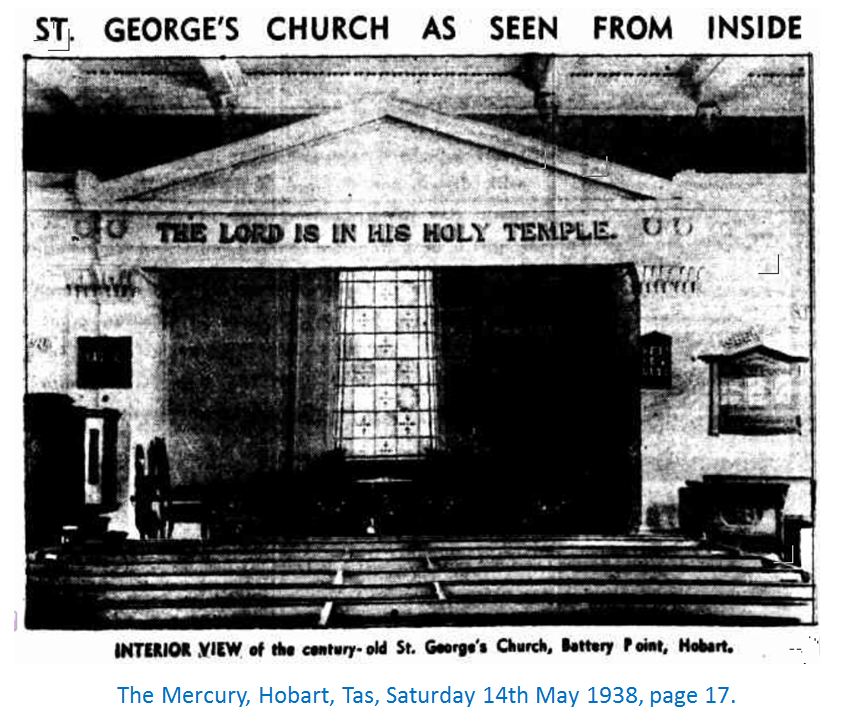
“…The principal decorative feature was the chancel, which, in its simplicity, resembles a tabernacle, across which runs the appropriate line, “The Lord is in this Holy Temple,” the effect being heightened by the lofty oblong window of pale white glass at the back, covered with differently coloured mathematical figures resembling crosses and stars…” [9]

Another unusual aspect of the window is its shape. The article from 1905 describes its shape correctly as an oblong. The frame gives the illusion that the window is a true rectangle but, it is wider at the bottom than at the top, which gives the impression that the window was possibly custom made to fit an opening that may have been the result of a building design flaw, or it was designed that way to give the illusion that it is taller than it really is!

In May 1938[10], the Hobart Mercury included a picture of the chancel of St George’s which, although black and white and poor quality, clearly shows the patterns in the window as seen in 2012.

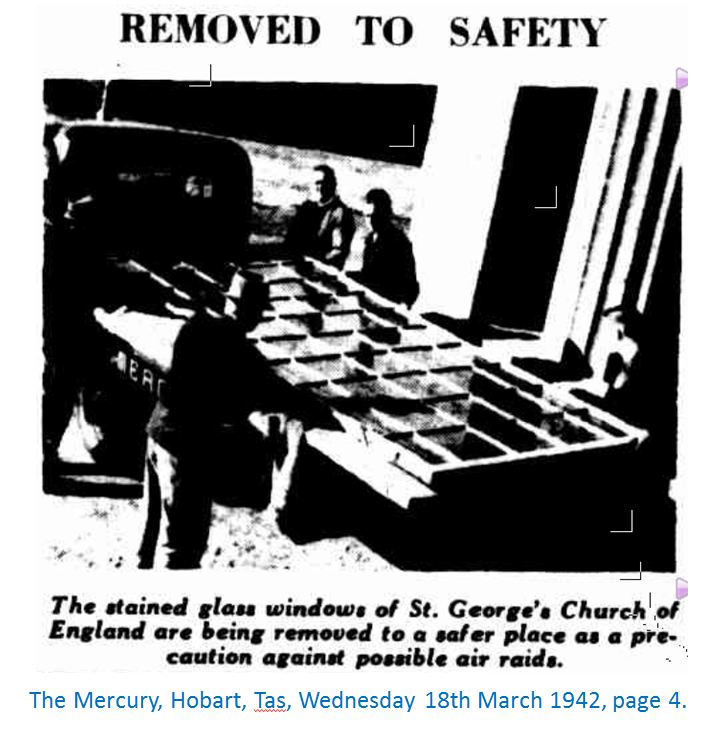
At the height of WWII, the civil defence regulations placed stringent rules on exposed plate glass windows. Whether these rules applied to the chancel window or not is not known but the church decided to remove the window as a precaution against air raids. In March 1942 the Hobart Mercury included a photo of workmen loading the entire window frame onto a truck with the caption:

“The stained glass windows of St. George’s Church of England are being removed to a safer place as a precaution against possible air raids”[11]

A close inspection of the newspaper picture shows that there are ten panes deep and five wide in the frame of the window, which exactly matches the number of panes seen in the chancel window as at 2012.

The Mercury, Hobart, Monday 2nd October 1871, page 2.

“ST. GEORGE’S, BATTERY POINT. – A neat and un-ostentatious stained glass window manufactured by Messrs. Ferguson, Urie, and Lyon, of Melbourne, has just been placed in the chancel of St. George’s Church, Battery Point. Most of the cost has been collected from the working classes by ladies of the congregation. Yesterday at both morning and evening services collections in aid of the same object were made. …”

The Mercury, Hobart, Tasmania, Saturday 7th October 1871, page 4.

“… Sermons were preached at St. George’s Church, Battery point, on the 21st inst., and collections made to supplement subscriptions (principally) by the working classes for a neat and unostentatious stained glass window, manufactured by Messrs. Ferguson, Urie, and Lyon, of Melbourne, and placed in the chancel of the church…”

The Mercury, Hobart, TAS, Friday 7th April 1882, page 3.

(About St Georges Church Hobart)

“…But the interior, elegant, well-arranged and admirably lighted, leaves little to be desired, except stained “ecclesiastical: glass to replace the “mansion staircase” window behind the communion table”

Foot notes: