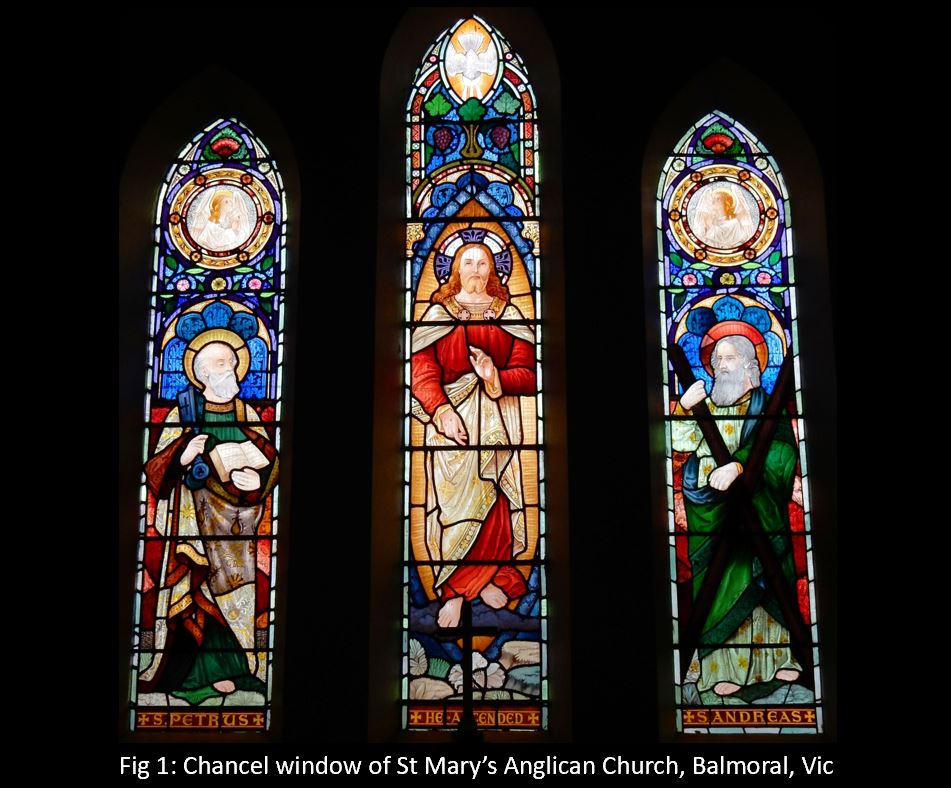
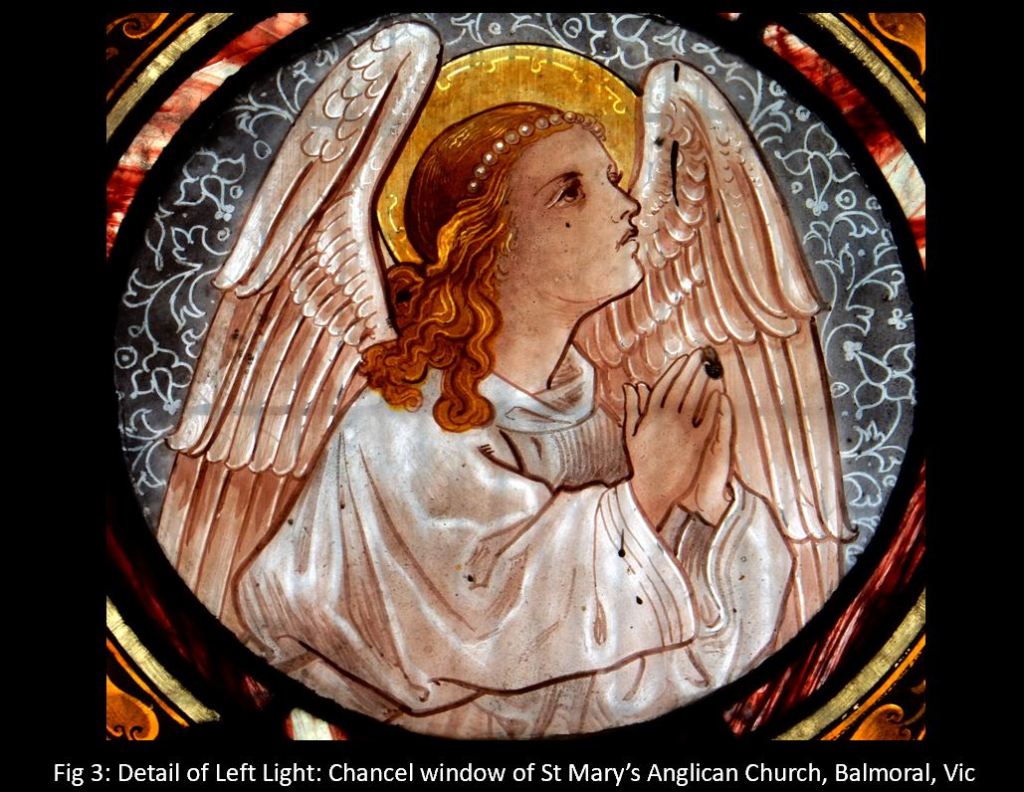
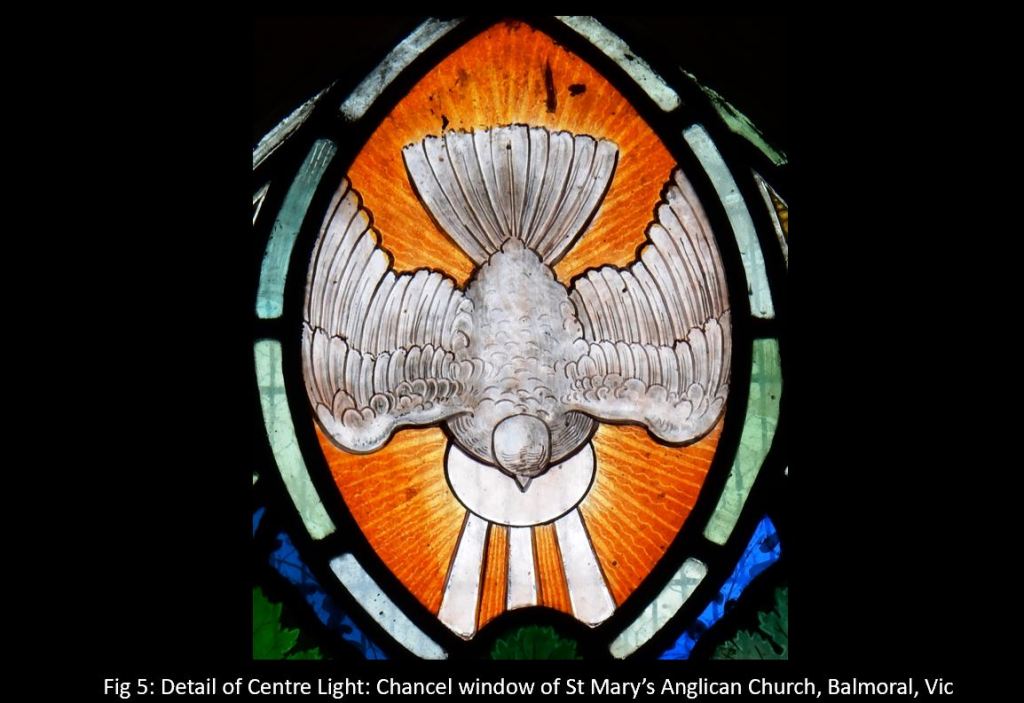
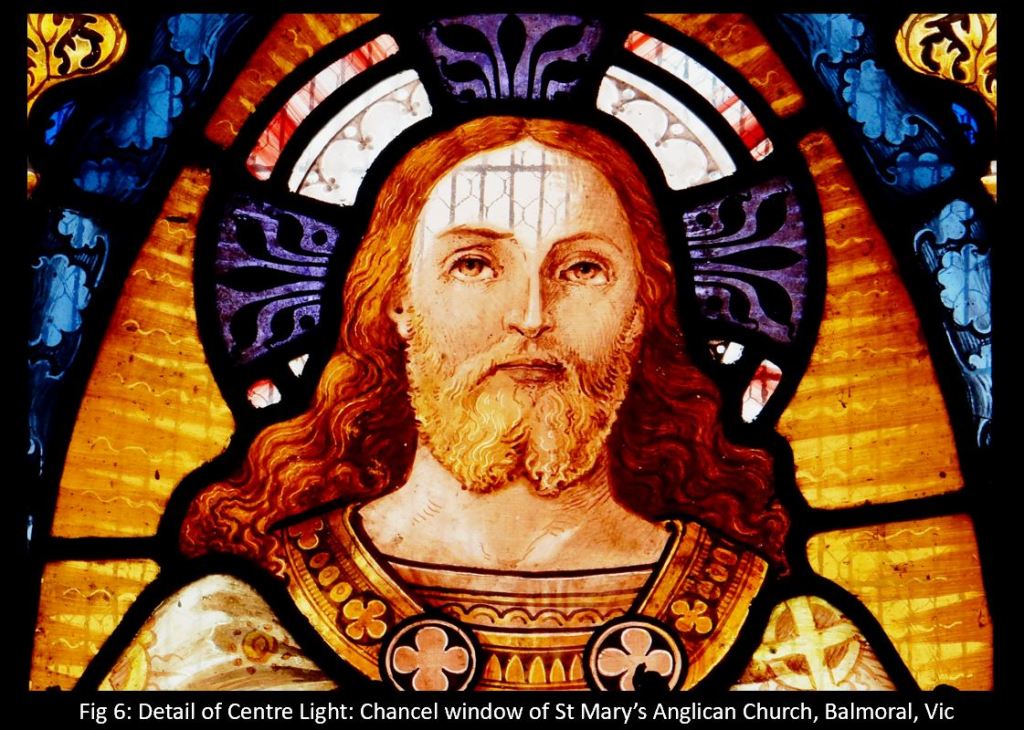
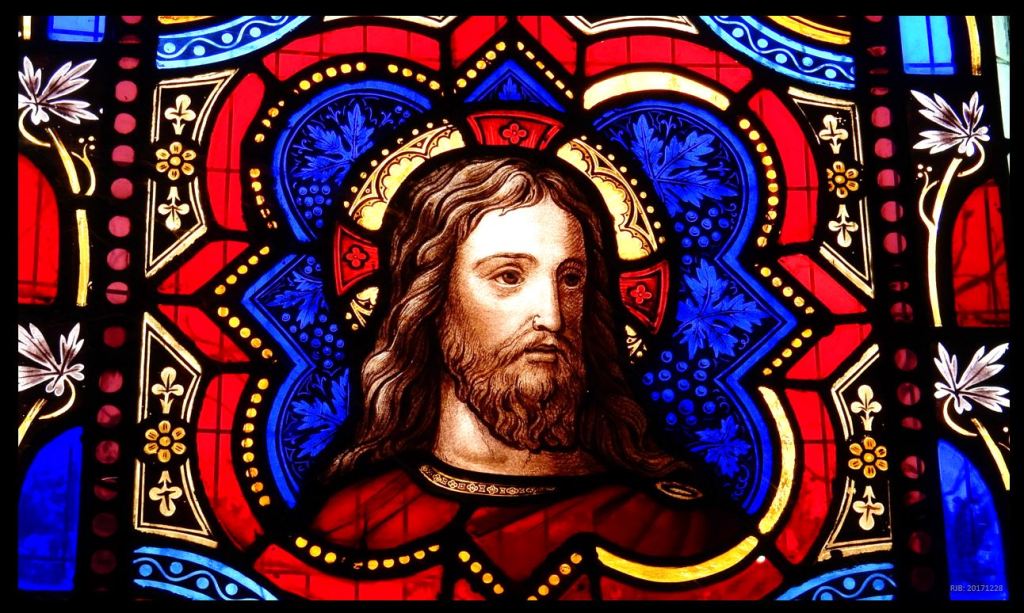
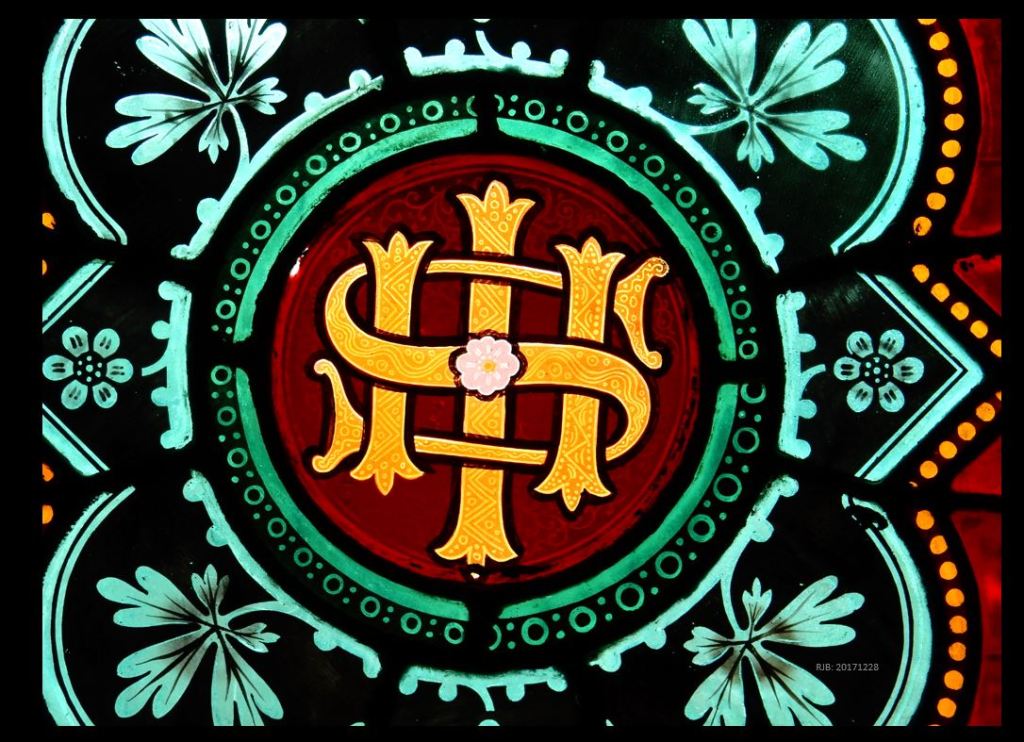
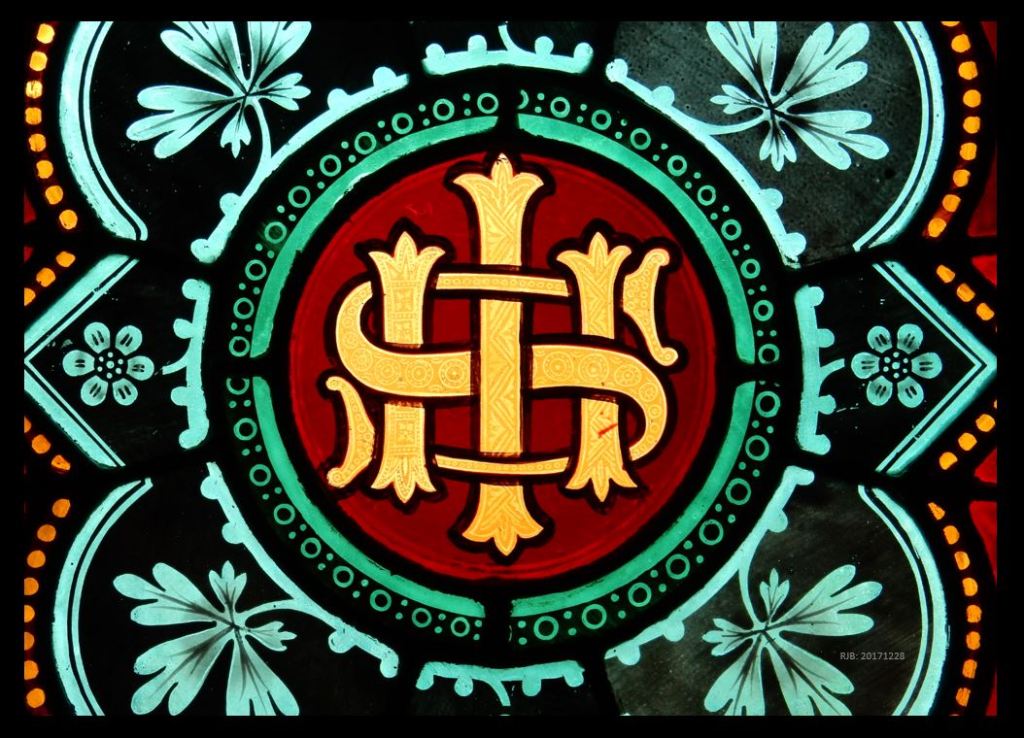
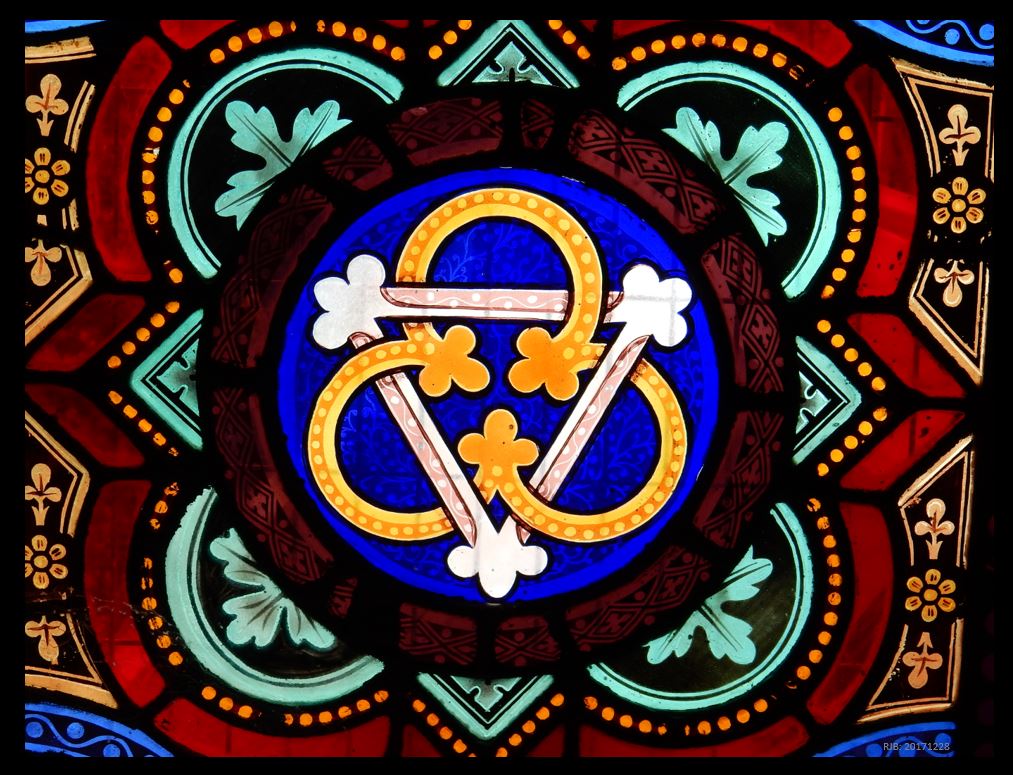
1894: St Mary’s Anglican Church, Balmoral, Victoria.

After 1894, finding extant stained-glass windows created by the historic stained-glass firm Ferguson & Urie of North Melbourne is rare. A mention of one of their windows at St Mary’s Anglican Church in the tiny township of Balmoral is a significant bonus for my research of the company.

Balmoral is a tiny town 73km northeast of Casterton and 80km South of Horsham in Western Victoria. It was settled in the early 1850s and today its population is under 300.

Caroline Armytage[1], the wife of Charles Henry Armytage laid the foundation stone of St Mary’s Anglican Church at Balmoral on the 27th of September 1894 [2] and the Bishop of Ballarat officially opened it on the 24th of January 1895. An account of the church furnishings and fittings was chronicled in detail but there was only a brief mention of the stained-glass window in the chancel;

“… a chancel in early English style, with handsome triple east window (presented by the Armytage family in memory of the late C. Armytage, Esq., of Fulham), by Ferguson and Urie…” [3]

There was no indication of what the window depicted so that just left me a mystery and enough curiosity to undertake a 260-kilometer trip to see if it still existed and if so, what was in it?

The date of the tabloid article indicates the window was likely made in late 1894. The Ferguson & Urie company closed in late December 1899, so finding extant examples of their stained glass in this period their final decade is rare.

At the time the Balmoral window was made, the original founders of the company had died. James Urie, in 1890 and James Ferguson, in 1894. The company was then in the hands of their sons, James Ferguson Jnr and William Urie. Neither founders nor their sons were stained-glass artists in the company, so at this late stage in the company’s history, identifying which of the firm’s remaining stained-glass artists who may have had a hand in the design and painting of the windows becomes vague.

We visited Balmoral in August 2017 to see the window at St Mary’s. The three-light window is the only stained glass in the church, others are generic lead-light.

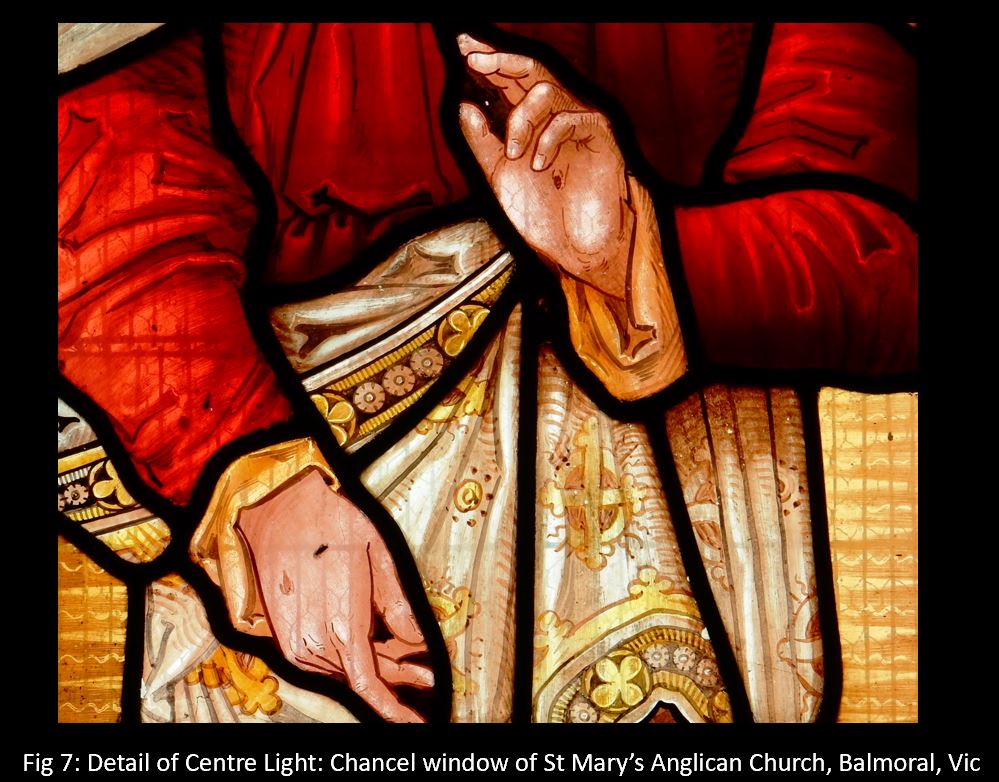
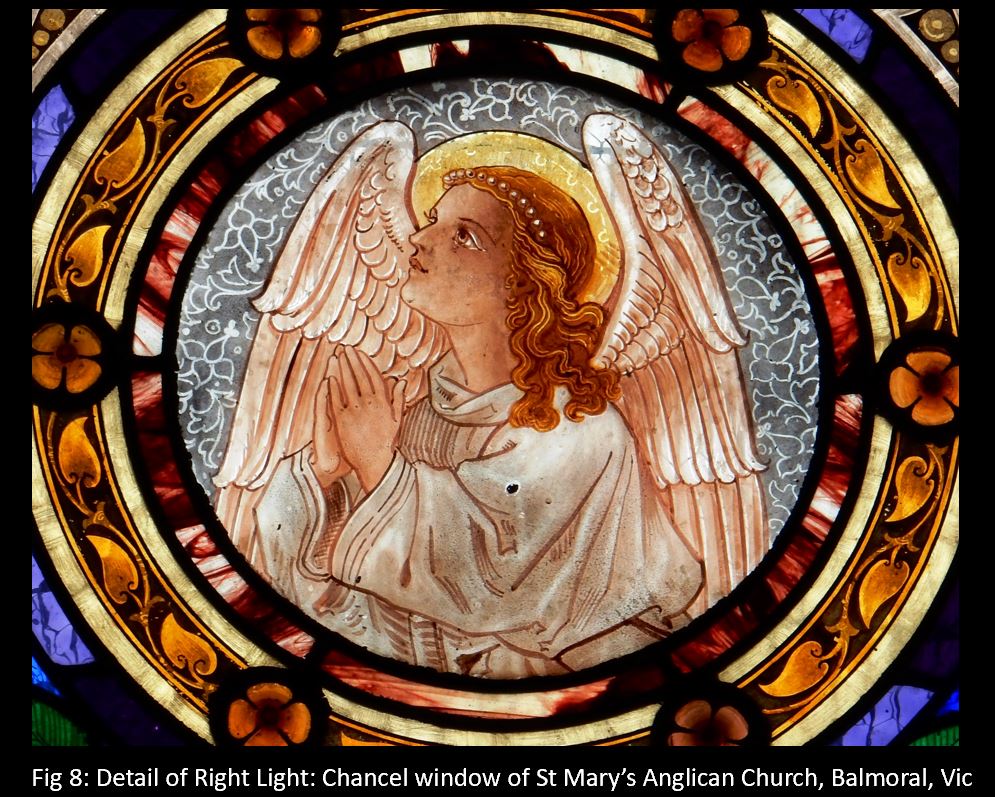
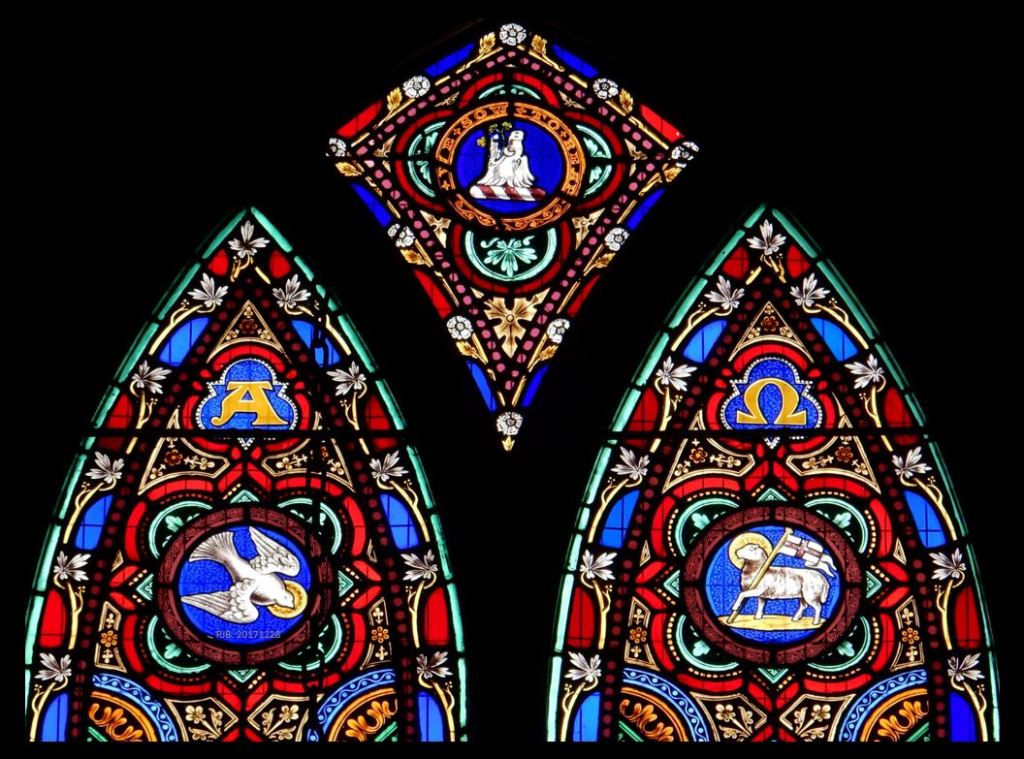
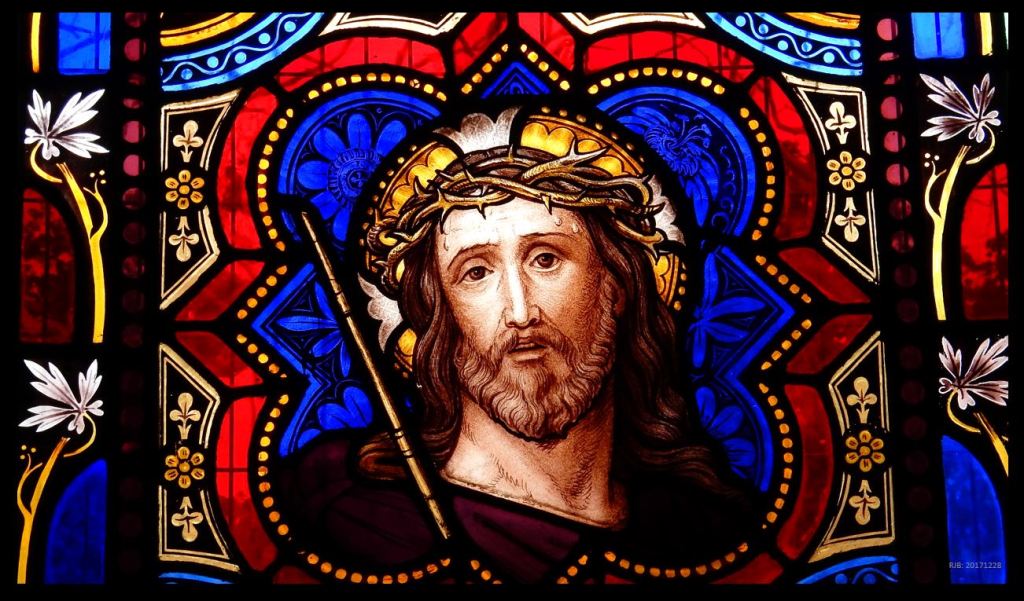
From left to right the window depicts St Peter, Christ, and St Andrew. There is no doubt it was a Ferguson & Urie window, but the figurative depictions of St Peter, Christ, and St Andrew were very different.  

The company’s early figurative style is easily recognisable in the period of their first two stained-glass artists with the company, John Lamb Lyon [4] (from 1861 to 1873), and David Relph Drape [5] (from 1863 until his death 1882). Windows made after Drape’s death in 1882 leave some mystery as to who the artists may have been.

Dr. Bronwyn Hughes OAM proposed that the Balmoral window could be the work of stained glass artist Herbert Moesbury Smyrk [6].

Whilst many parts of the window are typical of Ferguson & Urie’s company style, the figurative work in the faces of St Peter, Christ, and St Andrew are quite different. Smyrk’s painting style is very delicate and he was quite prolific at using the traditional silver stain to create varying shades from light yellow to deep gold. Some parts of his figurative images let through a lot of light which wasn’t prevalent in early Ferguson & Urie windows created in the Lyon and Drape era. A further study of my photo collection of stained glass windows in this same period has now revealed more of Smyrk’s style under the guise of Ferguson & Urie, and many other windows created during his time with Ferguson & Urie are now attributed to him. 

Positive evidence of Smyrk’s association with Ferguson & Urie is revealed in February 1896 when a memorial stained-glass window, dedicated to Councillor William Ievers MLA, was erected in St George’s church (now part of Corpus Christie) at Carlton. The window was executed by Ferguson & Urie and Smyrk was named as the designer [7]. The church was gutted by fire in 1924 and none of the original windows survived [8]

An obscure article in May 1896 provides further evidence of Smyrk’s connection to Ferguson & Urie when he writes to the editor of The Herald about the rules of Cricket. He signs off as; “H. Smyrk. 100 Franklin Street, 2nd May”. That address was the Ferguson & Urie Franklin Street Warehouse which they occupied in mid-1891.[9]

The window at St Mary’s, Balmoral has no memorial inscription on it but a nearby brass plaque records that it is dedicated to Charles Henry Armytage:

“In Loving Memory of Charles Henry Armytage, Died 26th April 1876”.

The Armytage family name is probably more well known to Melburnians for their period of ownership of the heritage-listed “Como House” in South Yarra where Charles died in 1876 [10]. It’s likely that his wife Caroline would have been the instigator for the erection of the stained-glass window at St Mary’s at Balmoral. It was also the first church to be built in the district.

Charles’ estate of £120,000 was left to his wife Caroline[11] with other complex divisions and trusts for his children. As was usual of the time, his will included archaic conditions that if Caroline remarried, her future husband could have no control of any of her estate, and nor would Caroline be liable for any future husband’s debts.

Image gallery:

Stained Glass Artists – Herbert Moesbury Smyrk 1861-1947:

Smyrk, seems to have passed through nearly every major Stained glass company in Australia between 1884 and 1947. His prolific association with so many companies makes attribution to his work very difficult.

Smyrk was born in Guildford, Surrey, England. At the age of fourteen was selected from hundreds of art students to be apprenticed to Powell and Shellard[12] as a stained glass artist and designer. [13]

On completion of his apprenticeship circa 1881, Smyrk stowed away on the ship ‘Queen’ at St Catherine’s docks in London which was bound for America. He began designing and painting windows for firms in New York and San Francisco. In 1884 he came out to Australia where he joined Brooks, Robinson & Co., in Melbourne.[14]

By March 1886 he was a partner of the Smyrk & Rogers stained glass company in Melbourne with Charles Rogers. That partnership was dissolved in September 1888 [15] and he returned to London to work with William Morris & Co.[16]

In later years, between many trips back to England, and America, and some years living a nomadic life in Tahiti, he returned to Australia where he designed and painted for Australian firms such as Ferguson & Urie in North Melbourne, E. F. Troy in Adelaide, Barnett Bros in Perth, R. S. Exton in Brisbane, James Sandy & Co in Sydney, and Frank G. O’Brien Ltd., at Waterloo in Sydney.

Herbert Moesbury Smyrk died at Woollahra, Sydney, in 1947 at the age of 85.

A more extensive biography of Herbert Moesbury Smyrk is in progress.

Acknowledgements:

My thanks to Helen Curkpatrick, the human history dynamo from the Wimmera National Trust, Ross & Pam from Longerenong, Denize Raggatt from the Balmoral Historical Society, Bronwyn & David Hughes for joining me on the Hamilton & Balmoral trip, and ABC Radio Horsham.

Footnotes:


[1] Caroline Morrell (nee Tuckwell), whom he married in 1856.

[2] Hamilton Spectator, Vic, Saturday 22nd September 1894, page 3.

[3] Hamilton Spectator, Vic, Saturday 26th January 1895, page 3.

[4] Biography: John Lamb Lyon (1835-1916)

[5] Biography: David Relph Drape (1821-1882)

[6] News, Adelaide, SA, Tuesday 3rd November 1925, page 8.

[7] Advocate, Melbourne, Vic, Saturday 15th February 1896, page 16.

[8] St. George’s Church, Carlton, Victoria 1896

[9] The Herald, Melbourne, Vic, Monday 4th May 1896, page 3.

[10] The Argus, Melbourne, Vic, Thursday 27th April 1876, page 1.

[11] Biography: Charles Henry Armytage (1824-1876)

[12] I believe this to be incorrect. The name of “Shellard & Powell” doesn’t exist.

[13] The Catholic Press, Sydney, NSW, Thursday 28th February 1935, page 24.

[14] News, Adelaide, SA, Tuesday 3rd November 1925, page 8.

[15] The Argus, Melbourne, Vic, Friday 21st September 1888, page 5.

[16] Building & Real Estate, Vol 15, No 86. 12th October 1914, page 3.


Short link to this page: https://wp.me/p28nLD-3bF

© Copyright


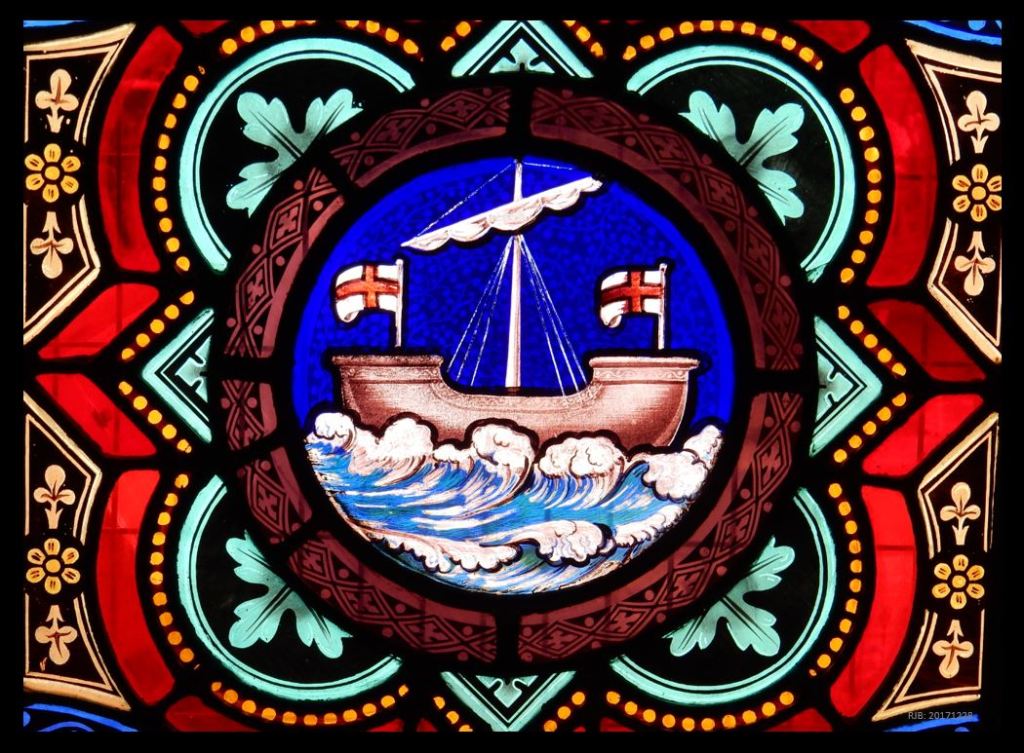
1863: Holy Trinity, Maldon, Victoria

#

The goldfield regions of Victoria are responsible for a lot of our pioneer history. A historic stained-glass window erected at Holy Trinity Anglican Church at Maldon in 1863 tells a significant part but in a historical perspective, a mere fraction of it. The window is now more than a century and a half old, it’s 157 as of 2020, the year of the worldwide COVID-19 virus pandemic.

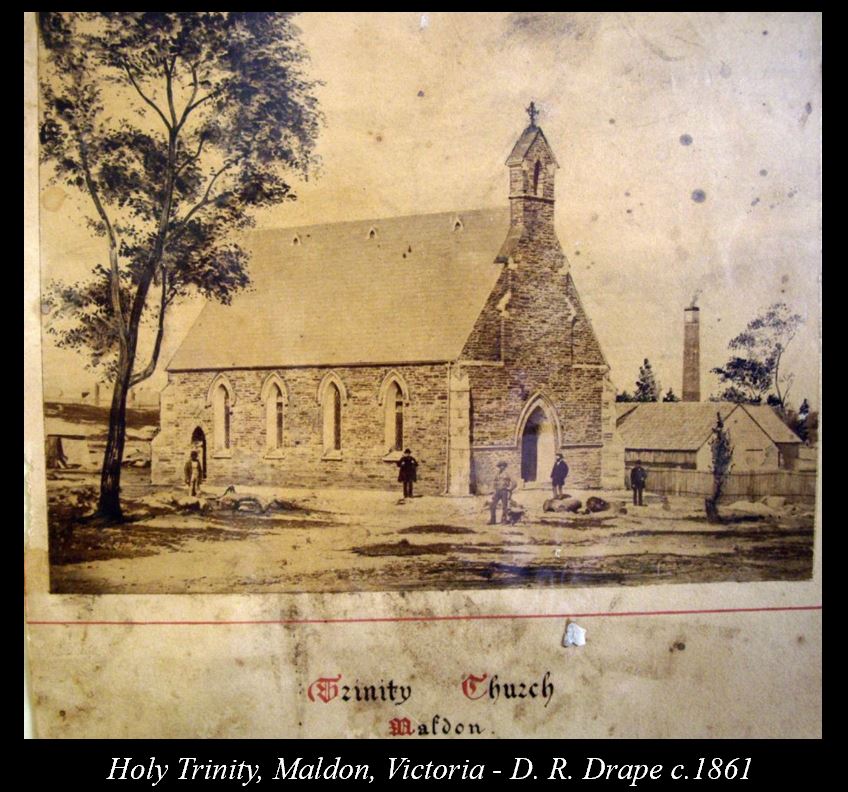
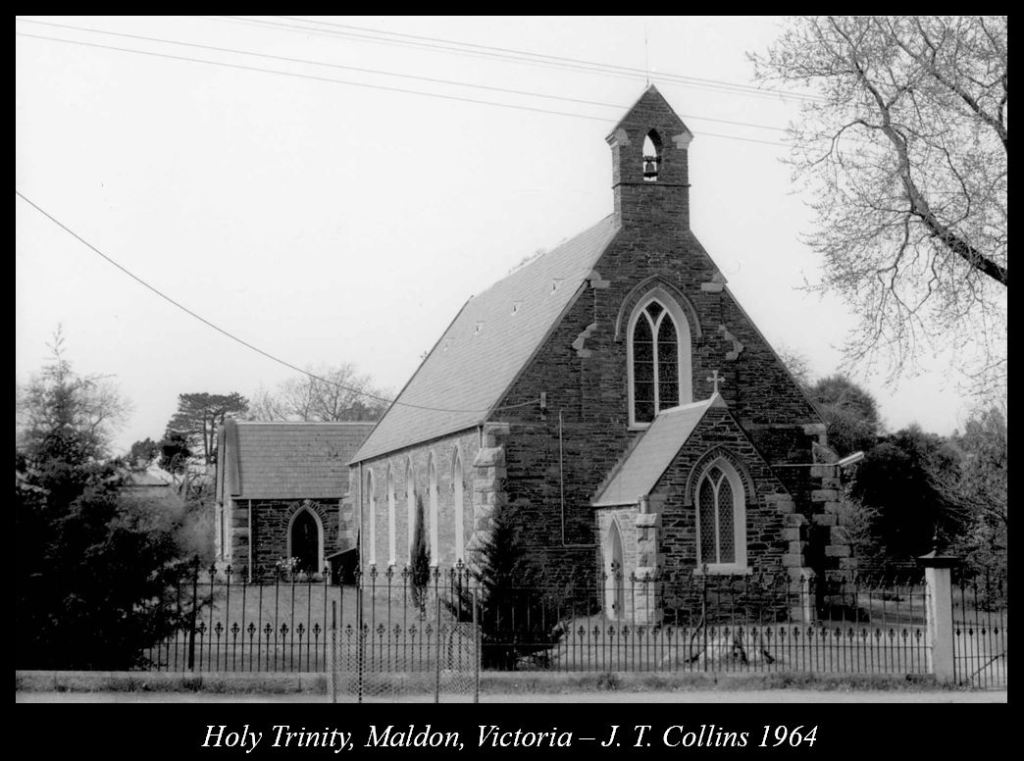
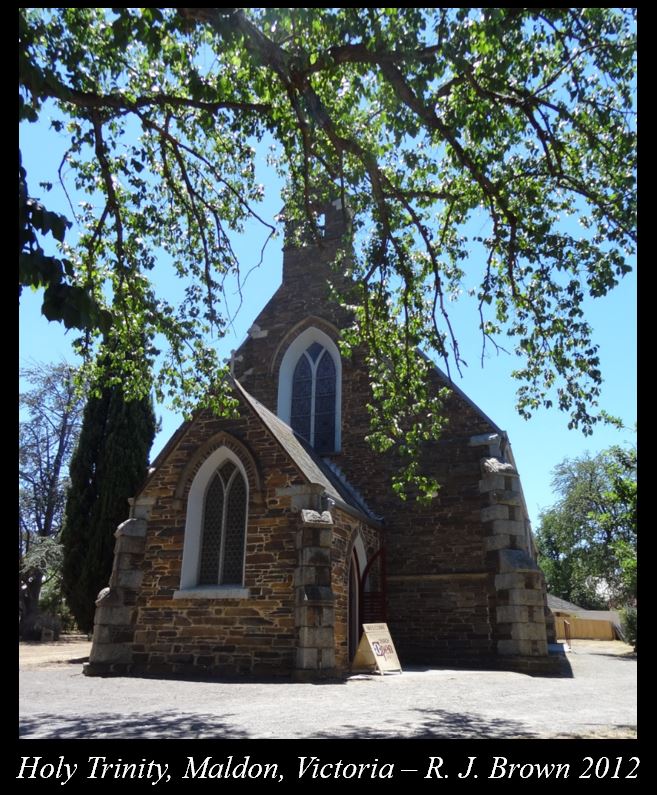
On the third of May 1861, the Tarrangower Times reported that the £750 tender of Hornsby & Briscoe was accepted for the construction of Holy Trinity Church at Maldon and would be built to the designs of David Relph Drape.[1]

The foundation stone was laid on Wednesday 19th June 1861 by Archdeacon Crawford of Castlemaine [2] and it opened in October of the same year.

In late 1863, a local mining investor from Maldon named William Samuel Threlfall donated a two-light stained-glass window for the west end of Holy Trinity Church. Given that architect of Holy Trinity David Relph Drape was primarily a stained-glass artist by trade you could be forgiven for thinking that he would have some input in the design of the window or even some hands-on work with it. This may not have been the case.

Five years earlier, in 1858, Drape accepted an offer from James Ferguson of the Ferguson & Urie company of North Melbourne to emigrate to Australia from Carlisle, England, and be the company’s stained-glass artist in their new venture producing locally-made Colonial stained-glass windows. He arrived aboard the ship ‘Morning Light’ on the 20th September 1858 only to find that Ferguson & Urie’s stained-glass workshop in Curzon Street North Melbourne had not been built and there was no employment for him, so he decided to head for the goldfields town of Maldon in Central Victoria.

Why Drape chose Maldon specifically is not known, but there was plenty of demand for his skills there. Back in Carlisle Drape had been well acquainted with the Selby family and coincidentally, John Selby, closely followed by his sister Jane, had migrated to Australia earlier and settled at nearby Castlemaine eighteen kilometers southeast of Maldon. It’s a fair assumption that Drape’s heartstrings for Jane were the reason for many of his trips to Castlemaine, often by foot.[3] He married Jane Selby at the Congregational Church in Melbourne in 1864.

Drape became well known in Maldon in many different pursuits. He was the architect of many local Maldon buildings and his other skills included, draftsmanship, art, painting, illuminated testimonials, tombstone, and memorial tablets. He was also a board member of the Concord Quartz Mining company. There is no record of him designing or fabricating stained-glass windows during his time at Maldon.[4] 

Coincidentally, in April 1861 a Scottish stained-glass artist named John Lamb Lyon arrived in Maldon with his wife Elizabeth. Why they chose Maldon is more obvious as John’s parents James and Janet had migrated to Australia earlier and established themselves as Maldon storekeepers and contractors for the local postal service.

A little over four months after their arrival in Maldon, John was in the process of submitting a design for a stained-glass window for the 1861 Melbourne Industrial Exhibition:

“Works of Art.- Mr John Lyon, lately arrived from England, on a visit to his father, a well-known old resident of this town, is now engaged on an elaborate design for an “Early English” stained glass window. It is intended for the forthcoming Exhibition, and space has been allotted him for that purpose. We consider Mr. Lyon a gentleman of great promise and sterling ability, and we cannot but hope that his work will attract such attention in Melbourne that he will be enabled to pursue his beautiful art in the colony with advantage to himself and the public. We are informed by gentlemen, we believe competent to judge that there is no Ecclesiastical glass painter of equal talent in the colony, at least not publicly known. Architects who in carrying out their designs have felt the want of such decorations will now have an opportunity of judging whether the talent of Mr. Lyon will fill the vacuum” [5]

I suspect that his stained-glass window design may have ended up being used as the design for the two-light window at St Margaret’s Church at Eltham in Nov/Dec 1861. That window is extant and currently the oldest Ferguson & Urie stained-glass window I have found to date. If a linotype or sketch of Lyon’s window for the 1861 exhibition were ever to be found it might solve or deny the mystery.

It would be incredulous not to think that Drape and Lyon did not become acquainted with each other in Maldon. Two stained-glass artists with similar tastes and artistic abilities in the medieval stained-glass craft in a small gold mining town in Australia is an extraordinary coincidence.

By late 1861 Lyon had joined the Ferguson & Urie stained glass company at North Melbourne and started the production of stained-glass from their new workshop in Curzon Street.

Drape had left Maldon by the end of October 1863 and started work alongside Lyon at Ferguson & Urie’s on the precise date of 8th November[6].

In late 1863 the stained-glass window for Holly Trinity had been completed and erected high in the liturgical west end. The exact date is not known. I can only broadly bracket it down to the latter half of 1863.  The first mention of it is in early February 1864. One thing is certain, the window had to have been fabricated at the new Ferguson & Urie workshop in Curzon Street North Melbourne. Ferguson & Urie had the only known stained-glass workshop in Victoria at the time. Lyon was quoted for an interview for the Australian Decorator and Painter in 1909 that their inception was primitive:

“In 1861, Mr. Lyon joined the firm of Ferguson and Urie, Melbourne. Their commencement was on a very primitive scale. They made their own colours and acid, and fired the glass in a colonial camp oven. They, however, soon got properly going, and produced good work under the firm name of Ferguson, Urie and Lyon.” [7][8]

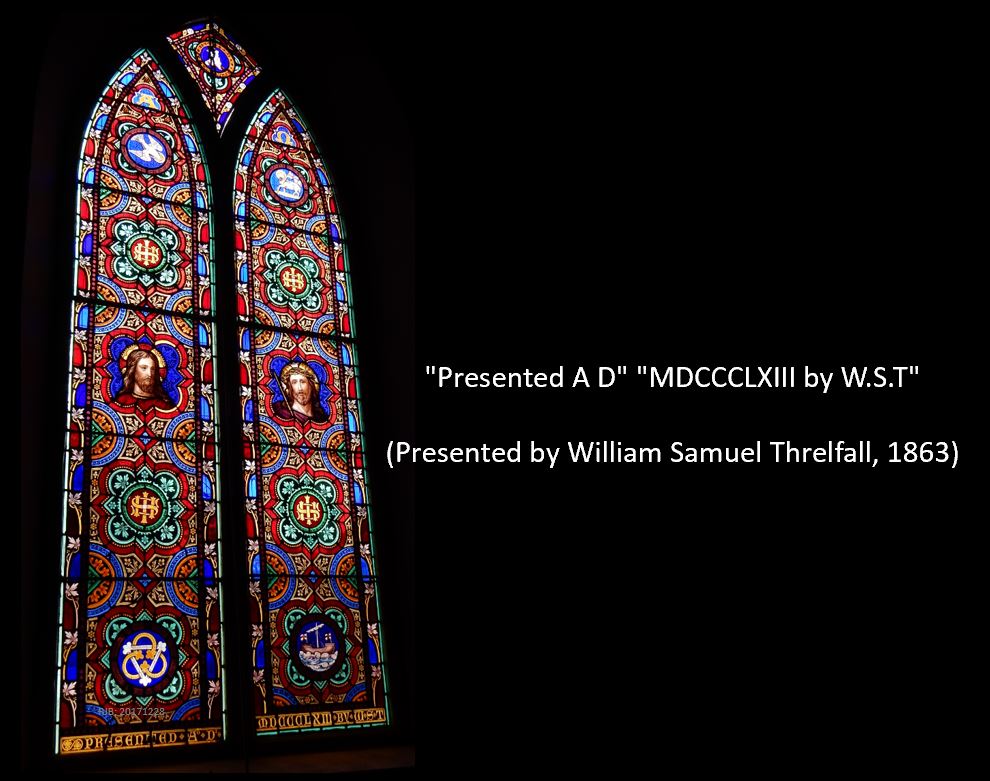
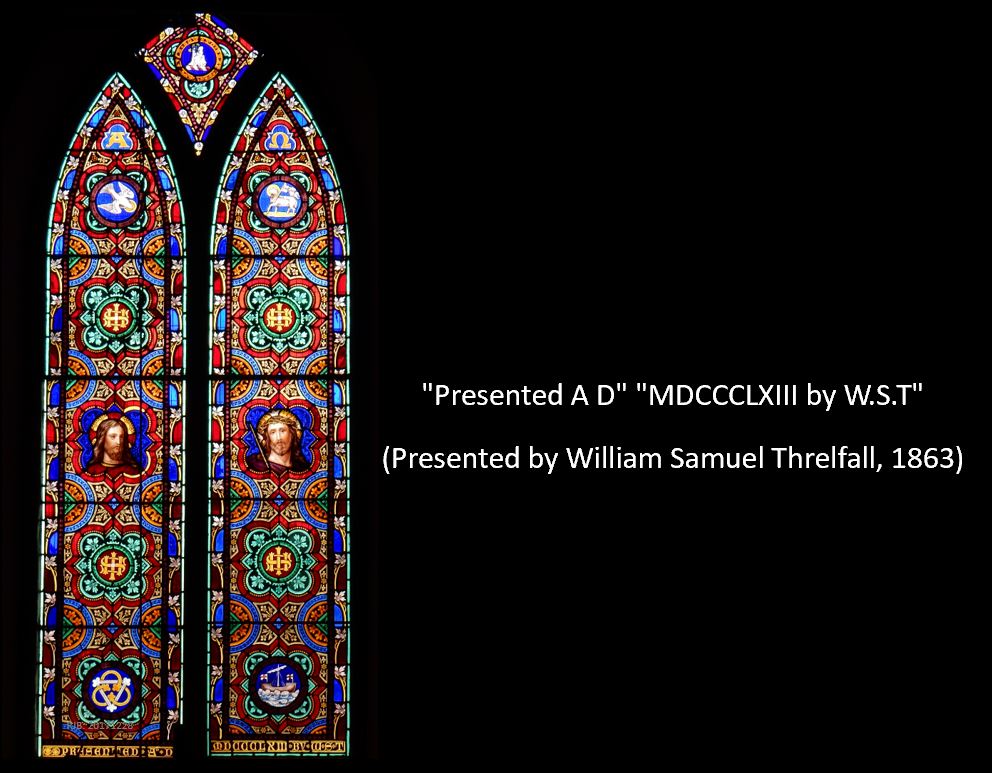
The Maldon window is a two-light in the English style and has the image of  Jesus in the centre of each light. It certainly looks like Lyon’s style and the overall arrangement bears similarities to his other windows at Holy Trinity, Kew, and Christ Church, Kilmore. An article published in the Tarrangower Times in February 1864 states the Maldon window is his work. Whether Drape had any input or hands-on work with Lyon on the window may never be known.

“A great many of our readers will no doubt have observed the very handsome painted window in Trinity Church, presented by W. Threlfall Esq. As regards its intrinsic beauty, and its value as an ornament to what was already considered (we quote the Bishop of Melbourne’s remark, on the occasion of his last visit to Maldon) one of the prettiest little churches out of Melbourne; there can but be one opinion, but perhaps it is not so generally known that this window, reflecting as much credit on the liberal and public spirited donor, may be considered, as in some degree, the work of a Maldon artist; it having been designed, and fabricated, by Mr J. L. Lyon, the son of our respected fellow townsman Mr Lyon, of Main Street”[9]


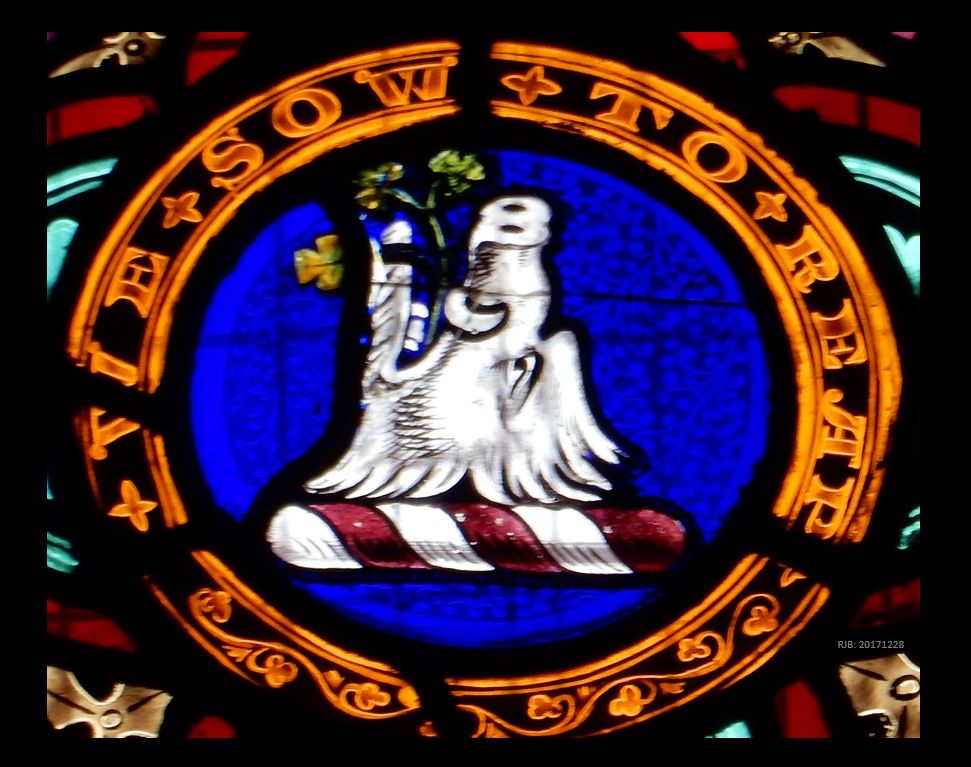
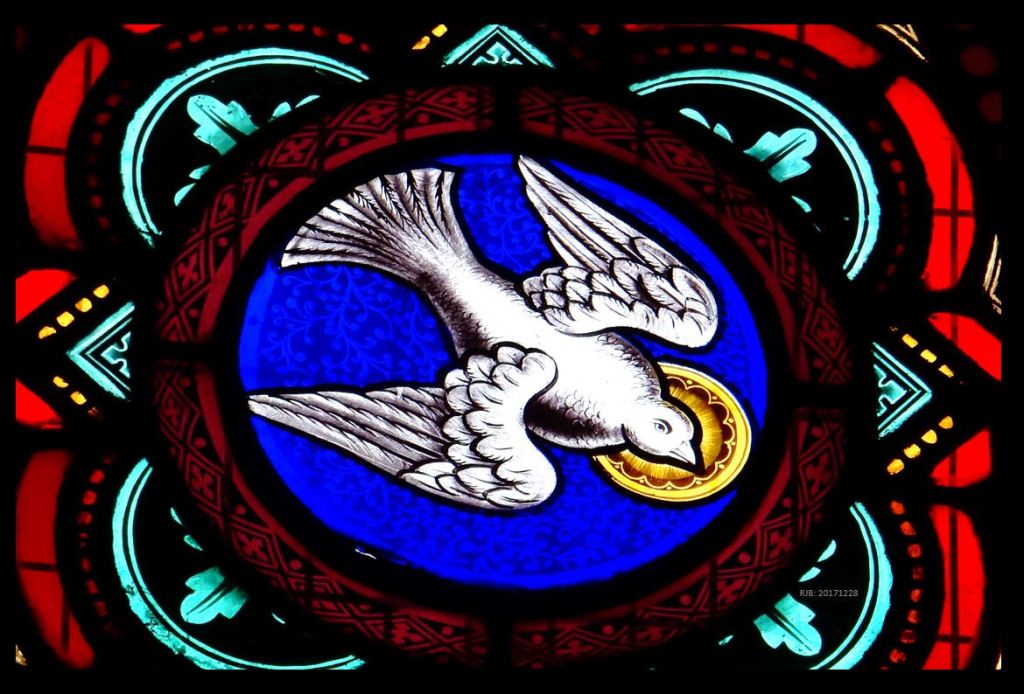
A perplexing thing about the design of the window is a family crest depicting a boar’s head in the apex, presumably that of the donor William Samuel Threlfall. The crest appears above two images of Christ, the Holy Dove and the Lamb of God. The text at the base reads “Presented A.D MDCCCLXIII by W.S.T” (William Samuel Threlfall 1863). It’s not unheard of to see a family crest appear at the top of an ecclesiastical church window, but above the image of Christ or his symbology is extremely rare. Similar instances I have come across during research indicate that where the donor has elevated him/herself above Christ in an ecclesiastical window, it’s usually been met with a very harsh response by the congregation or church committee. The windows were usually forced to be re-made or modified. In extreme cases, a window was summarily sent back to where it came from.

Who was William Samuel Threlfall?

Threlfall was a native of Lancashire, England, and was a small-time mining investor in the Maldon district who had shares in failed gold mining ventures. Many articles of the time paint him as often owing money.

On the 2nd June 1864 at the age of 65, he married the widow Mary Ann Spence[10] at Christ Church, Castlemaine[11]. By November of the following year, he and his wife have disappeared from the Maldon area and dead letters addressed to his wife Mary begin accumulating at the Emerald Hill (South Melbourne) Post Office[12]. Another advertisement in late November 1865 appeals to “Mr. Threlfall, late of Maldon, will put himself (directly or indirectly) in communication with the advertiser, he can receive some beneficial information”[13]. In May 1867 the court ruled that in Threlfall’s mysterious absence his one-eighth share in a quartz-claim at Maldon would be forfeited in favor of the claimants. He is not heard from again.

Related posts:

Biography: John Lamb Lyon (1835-1916)

Biography: David Relph Drape (1821-1882)

Footnotes:

[1] Tarrangower Times, Maldon, Vic, Friday 3rd May 1861, page 4.

[2] Tarrangower Times, Maldon, Vic, Friday 21st June 1861, page 2.

[3] David Relph Drape, Architect, and Glass Stainer; E.M. Bradshaw 1970; Unpublished Manuscript, State Library of Victoria.

[4] Biography: David Relph Drape (1821-1882)

[5] Tarrangower Times, Maldon, Vic, Friday 30th August 1861, page 3.

[6] David Relph Drape, Architect, and Glass Stainer; E.M. Bradshaw 1970; Unpublished Manuscript, State Library of Victoria.

[7] The Australasian Decorator and Painter, August 1st, 1909.

[8] The partnership name of “Ferguson, Urie, and Lyon” did not commence until October 1866.

[9] Tarrangower Times, Maldon, Vic, Tuesday 2nd February 1864, page 2.

[10]  Mount Alexander Mail, Vic, Friday 3rd June 1864, page 2.

[11] Victorian Birth Deaths & Marriages, 398/1864, Christ Church Castlemaine.

[12] The Argus, Melbourne, Vic, Monday 13th November 1865, page 1.

[13] The Argus, Melbourne, Vic, Monday 20th November 1865, page 1.


Short link to this page: https://wp.me/p28nLD-31h

© Copyright

1886: St Barnabas Anglican Church, Balwyn, Victoria.

The latest Ferguson & Urie stained glass window discovery is located at St Barnabas Anglican Church in the Melbourne suburb of Balwyn. The original part of this church was dedicated nearly a century and a half ago on the 22nd of December, 1872.

I was recently sent a small booklet about the stained glass windows of this church titled “Windows within Worship at St Barnabas” that was produced circa 1985. [1] There is barely any information about the artists or makers of the windows in the booklet, but on page five was the unmistakeable image of a Ferguson & Urie stained glass window.

Photos taken: 15th July 2015.

This slideshow requires JavaScript.

[View larger images]

The pioneer this window was dedicated to, a local Solicitor named George Henry Taylor, seemed vaguely familiar to me and further research reveals a remarkable coincidence to a tragic event that occurred 100 kilometres from Balwyn in 1866.

George Henry Taylor was a native of England and arrived in Melbourne with his wife Maria (nee O’Brien)[2] and their children aboard the “Blackwall” in September 1858. George established himself as a Solicitor in the Boroondarra area north of Melbourne and purchased land in the vicinity of Camberwell Junction. Circa 1865 he built his family home named “Mountfield” which fronted Burke and Mont Albert Road. The house still exists and has heritage listing.

In June 2012 I posted an article about a Ferguson & Urie stained glass window located at St Luke’s Anglican Church at Yea and this is the connection to the window at St Barnabas in Balwyn. The window at Yea is dedicated to an unfortunate boy named Edmund George Taylor who accidentally shot himself dead on the road to Yea in 1866. The George Henry Taylor mentioned in the window at St Barnabas at Balwyn turns out to be the boy’s father!

It’s a curious coincidence, and so is the design in the two windows. The central design in each window being a blue floriated cross on a crimson background. The Gothic geometric patterns and other design elements surrounding the cross in each window are different but there is an obvious similarity between them which makes you wonder whether it was deliberate or just purely coincidental.

The township of Yea is about 100km north of Balwyn and in 1866 the distance would probably seem like it was in another country. Finding two stained glass windows that far apart in Victoria with similar designs, one dedicated to a father and the other to his son, made twenty years apart is an unusual find.

A century and a half ago, on the 14th of December 1866, thirteen year old Edmund George Taylor accidentally shot himself whilst riding on a bullock dray near Yea. The bullock driver, John McCessey, and Edmunds older brother Charles were with him at the time but neither saw the gun go off. Unfortunately they witnessed his death almost immediately after Edmunds last words “Oh, Lord, I am shot.” The subsequent inquest returned the verdict of accidental death. Edmunds body was returned to his fathers home “Mountfield” at Upper Hawthorn and he was buried at the Kew, Boroondarra Cemetery on the 17th December.

Circa 1869, St Luke’s Anglican Church at Yea was only just being erected and presumably Edmunds father commissioned the Ferguson & Urie stained glass company of Melbourne to create his sons memorial window for St Luke’s at Yea.

Twenty years later, the Ferguson & Urie stained glass company were commissioned to create another stained glass window of similar design to be dedicated to Edmunds father, George Henry Taylor, and it would be erected at St Barnabas Anglican Church at Balwyn.

St Barnabas’ was dedicated on the 22nd of December 1872 and one of the main instigators for its erection was Herbert Edward Taylor, another son of George, who was studying for the ministry, collected £200 towards the church building fund. Herbert was later the minister of St Barnabas between 1883 and 1889.

George Henry Taylor died at his residence “Mountfield” on the 10th October 1886 aged 66 [3]. He was buried with his son Edmund and other family members at the Kew, Boroondarra Cemetery.[4] The grave stone still exists but is crumbling and barely readable.

As George’s son Herbert was the minister of St Barnabas at the time of his death, it’s probably fair to assume that Herbert would have been the instigator for the erection of the stained glass to be dedicated to his father.

On either side of the cross in the window is a piece of scripture from the King James Bible from Isaiah 26-3;

“Thou Wilt Keep Him in Perfect Peace”

At the base of the window is the memorial text;

“In Memoriam George Henry Taylor, Oct 10th 1886”.

Below the window a small brass plaque is affixed to the wall which reads; “Also in Memory of Maria, wife of the above, at rest 1912”

George’s other sons were well educated and became respected members of the community. His son Arthur Bertram Taylor 1857-1938 [5], was educated at Scotch College and founded the “Camberwell Grammar” School in February 1886, ten months before his father’s death. Charles Frederick Taylor 1849-1896 was educated at Scotch College and Melbourne University. He became a Barrister and was admitted to the Bar in 1871. He was also a prolific tabloid writer, a Captain in the militia, and represented Hawthorn in the Legislative Assembly 1889-1894.[6]

After a century and a half it’s unlikely that there would be anyone who would know of the connection between these two historic stained glass windows at Yea and Balwyn. The windows may be 100km apart in different towns but they are the last remaining historic artefacts connecting a father and his son.

Related posts:

The Edmund George Taylor window at St Lukes’ Anglican Church, Yea, Victoria.

Footnotes:

[1] Thanks to Marilyn Kenny from the Essendon Historical Society for the St Barnabas Church Booklet.
[2] Camberwell Historical Society, Newsletter 4, March 2011, P3.
[3] The Argus, Melbourne, Vic, Monday 11th Oct 1886, page 1
[4]
Kew Cemetery CofE C-1288: Edmund George Taylor, aged 14, interred 17th Dec 1866. Henry Michael Taylor, aged 35, interred 1st June 1881, George Henry Taylor, aged 65, interred 11th Oct 1886.
[5] The Argus, Melbourne Vic, Saturday 22nd October 1938, page 2
[6]
Web site; parliament.vic.gov.au, accessed 7 Jul 2015.

Short link to this post: http://wp.me/p28nLD-2Gi

© Copyright

1867: Presbyterian Church, Melton, Victoria.

The Presbyterians of Melton had previously held their services in a wooden building known as the “Union Church.” which was used by all of Melton’s Christian denominations until they had erected their own.

The foundation stone of the Presbyterian church was laid on the 27th December 1865[1] but it would be nearly two years before it would open for services and the proposed tower and spire in the original designs never eventuated

The stone for the church was quarried free of charge from the nearby property of a “Mr. Corr”[2], who was the first headmaster of the Melton Common School, secretary and treasurer of the Melton Cemetery Trust, Treasurer of the Wesleyan Church and Deputy Registrar of births deaths and marriages[3].

 The Presbyterians held their annual Soiree in the old Union church on the 8th October 1867 and later proceeded to the new incomplete church. Of the windows it was reported;

“…The windows of the church are particularly elegant, especially the principal one at the back of the pulpit, which is fitted with stained glass of a very rich description…”[4]

A month later the Age newspaper published an article specifically mentioning the Ferguson & Urie company of North Melbourne as the makers of the stained glass window in the liturgical east end;

“THE PRESBYTERIAN CHURCH AT MELTON is nearly completed, the glaziers being engaged with the windows. The Bacchus Marsh Express praises the stained glass, the design and colors being beautiful. “Messrs Ferguson and Urie, of North Melbourne, are entitled to great commendation for their workmanship in this respect…[5]

Photos taken: 7th September 2014.

This slideshow requires JavaScript.

[View larger images]

The window is of four lights with smaller tracery windows above to complete the design and is a typical design by Ferguson & Urie from that period. The two centre lights have the ribbons/scrolls in the centre with the following two pieces of scripture:

“Christ is all and in all” – (Colossians 3:11)
“Worship God in the Spirit” – (Philippians 3:3)

The original bluestone nave of the church now sits sandwiched between two newer buildings with doorways to each at the ends. The single light windows in the nave are works of art by the Brooks, Robinson & Co stained glass company from the early 1900’s and later. These windows were originally likely to have been Ferguson & Urie’s simple stained glass bordered designs that have been replaced over more than a century and a half. The historic Ferguson & Urie stained glass window at the east end still lights the nave of the old church building the same as it has since 1867 and creates an amazing kaleidoscope of coloured patterns over the floor when the sunlight strikes it at the right time

Significant transcriptions:

The Age, Melbourne, Vic, Monday 14th October 1867, page 6.

“THE PRESBYTERIAN CHURCH AT MELTON is nearly completed, the glaziers being engaged with the windows. The Bacchus Marsh Express praises the stained glass, the design and colors being beautiful. “Messrs Ferguson and Urie, of North Melbourne, are entitled to great commendation for their workmanship in this respect. It is expected the church will be opened in a month for public worship. The cost is £1000, of which only £100 has to remain as a debt on the building. This speaks well for the Presbyterians of Melton.”

Bacchus Marsh Express, Vic, Saturday 14th September 1867, page 2.

“OPENING OF THE NEW PRESBYTERIAN CHURCH, MELTON.

THE Presbyterians of Melton district have for some years back held divine service in a wooden building known as the Union Church, owing to it having been erected and afterwards used by all denominations. On Sunday last, however, the Presbyterian congregation took possession of their own Church, when the Rev. H. Darling, of Emerald Hill, and the Rev. James Lambie, pastor of the congregation, conducted the services. The former preached in the absence of the Rev. T. McKenzie Frazer, who had been announced to do so. The Wesleyans, who used to use the Union Church, have now a building of their own, and the Church of England congregation have also completed the erection of a handsome Church, with the exception of the windows and seats, so that in a short time the Union Church will be devoted to school purposes only.

THE SOIREE.

The annual soire of the congregation was celebrated in the building known as the Union Church, and after the eatables had been disposed of, the partakers proceeded to the new Church, a short distance away, where the Rev. James Lambie, pastor of the congregation, took the chair. Of the building itself we are not disposed to give elaborate particulars which are perhaps well known to those interested in the matter. Its dimensions are stated to be 50ft. [unreadable characters…] It is apparent to any observer, however that the new Melton Presbyterian Church, both externally and internally, would be a credit to any community; and although it is not yet finished, as a steeple is intended to be erected, yet the absence of this ornament is scarcely noticeable. The windows of the church are particularly elegant, especially the principal one at the back of the pulpit, which is fitted with stained glass of a very rich description. The building is entirely of bluestone, with a slate roof, and the ceiling is a groined one, thereby affording the greatest possible loftiness for ventilation, besides adding to the general ecclesiastical appearance of the interior. The pulpit and platform surrounding it is of a massive kind, having nothing paltry in its appearance, although the usual amount of French polish has not yet been applied. The seats, too, for the congregation are strong roomy ones, made upon a good pattern; and altogether the Church bears evidence that what has been attempted has been done in the best manner, and so far from there being any reason for surprise that the Church has been two years in course of construction, the wonder is that such thorough progress has been made in the time. These preliminary remarks may well be concluded by the addition of a word of praise to the efforts of the choir upon the occasion of the soire, as their performances were really enjoyable.

The CHAIRMAN remarked that while congratulating those assembled, he did not intend to specially address them; he would leave that to his brethren on the platform. It was two years last month since they commenced to built the Church. They had proceeded slowly, but surely. He submitted a statement of the Building Fund.

The subscriptions had amounted to £470. 7s. 4½d.; bazaars, £265.17s.7d.; grant from Assembly , £189.7s.9d.; foundation stone collection, £32. 10s.; loan from Bank, £100. He had little to say further than that the subscriptions had been raised almost entirely from members and adherents of the Church. He did not mention this boastingly. The ladies had purchased the lamps, and the children furnished the precentor’s desk. There had been expended £1049. 11s. 8d., leaving a balance of £11. 0s. 8½.

Mr. BLACKWOOD then read the treasurer’s report for the past year, from which it appeared that the receipts had been £126. 2s. 11d., and the expenditure £124. 0s.5½d., leaving a balance of £2. 2s. 5½d. The speaker referred to the lotting of the seats, and that accommodation would be made for those who did not rent seats. He wished some of the reverend gentlemen to take up the question of whether the congregation should stand or sit at singing. He wished to see uniformity.

The CHAIRMAN intimated that some of the reverend gentlemen who had been invited were absent. They were the Revs. J. Clarke, A McNicol, W. A. Lind, and J. C. Sabine. [Mr. Sabine had desired us to mention that he intended to be present, but the heat of the day prevented him, and he delayed sending an apology hoping that it would moderate].

The Rev. R. HENDERSON was the next speaker. He said that although several gentlemen were absent, he felt assured there would be no lack of speakers. They had Mr. Inglis, who was a host in himself. He would take his cue from Mr. Blackwood, and endeavour to comply with his desire that those learned in Church matters should enlighten them regarding the posture in worship. He believed it had been the practice of their Church for 300 years to sit during singing; but the General Assembly allowed congregations to make their own rules in regard to such matters. If they were unanimous in resolving to stand at singing, there was nothing to prevent them. So far as he was concerned, he preferred to see the congregation standing during singing, as it enabled them to execute their psalmody in a better manner than while sitting. The rev. gentleman then commented upon the necessity of improving the psalmody as much as possible, and was favourable to the use of a harmonium. Many congregations had introduced them, and others were merely putting off the consideration of the question. He agreed with all the encomiums upon their Church bestowed by the Rev. H. Darling, and suggested that all Presbyteries should adopt some definite system in regard to architectural style. He recommended the congregation to assume a reverential demeanour upon entering their Church, and exhorted them also to realise that, although Christians were divided into seats, yet they all had one heaven to receive them. Before sitting down, he must congratulate Mr. Lambie upon his success in raising money to build this Church. As a co-presbyter with him, he desired publicly to acknowledge his earnest and inudable endeavours in this matter. He rejoiced in being present this evening, and wished them God speed in their endeavours.

The Rev. J. W. INGLIS commenced by some humorous remarks, depreciatory of the laudatory manner in which the previous speaker had referred to him, and said that the expectation of the assemblage had been unduly raised. It was twelve years ago since he had attended his first tea meeting at Melton, and there were only five persons present. In fact, he had boiled his billy on the bank of the creek. His next meeting was with their present pastor, and now once again he had the pleasure of meeting them under prosperous circumstances, in their own Church. The Union Church had answered its purpose well, but now Melton possessed three substantial Churches, which they must all rejoice at. Their Church was certainly a handsome one, but no doubt no handsomer than they thought it to be; and he might say that Presbyteries were only beginning to pay proper attention to architectural effect; still they must never forget the higher object of their Church buildings. The speaker exhorted the congregation to take special interest in all that appertained to their Church, and to guard against the deadness which would fall upon a congregation which did not regularly attend at worship every Sabbath. He was more than pleased to hear that they had contributed to all the funds for which the Assembly sought their aid, and he trusted that they would always recollect the claims of such objects. Although a Presbyterian, he was no sectarian, and did not wish his sympathies to remain with that Church only; for there was but one Shepherd, one fold, one House of many mansions, and they should remember that this building was God’s house – not theirs – but dedicated to the God of Zion. Let them enter it as the gate of heaven, thinking of God’s words, “Come to me, all ye that are heavy laden;” and there was nothing which would cheer the adversities of this life but seeking the house of God every Sabbath, where they could have communion with God the Father and His Son Jesus Christ, and feel that there was a place prepared for them where the inhabitants know no tears, and which was the land of everlasting bliss. If they did this, truly this place would be a blessed place. He had but one word to say, in regard to their indebtedness to God for all they had. If they realised this, and were honest in their religious convictions, neither he nor any other minister would have occasion to ask them to give of their substance to the purposes of God’s worship. He hoped that for many years they would worship here, and may the faith they had imbibed enable them to enter into the joy of the kingdom of their Lord. A collection was then taken up, during which the choir sang “How Beautiful upon the Mountain.” They also sang at the conclusion of each speech.

The Rev. J. MEEK would simply make a few remarks in his own way. He had watched their progress as a congregation with considerable satisfaction, and he was here to confess that the career of this congregation had taught him one or two useful lessons. He had at one time serious misgivings as to the success of the effort to establish this congregation, but their prosperity had rebuked him, and taught him to remember that it was right to do one’s duty, and leave the results to God. We at Gisborne would not feel flattered by being compared to Melton; yet they worshipped in a temporary wooden building. He hoped their success in Melton would induce the Gisborne congregation to at least consider the matter of beginning to do likewise. He looked upon this Church as a testimony to the zeal and devotedness of their minister, and as a monument of their liberality; and he trusted most earnestly that on the great day of accounts, their minister might have many from among them as a crown of glory.

The Rev. J. SCOTT had been admonished by the departure of many that the patience of the audience was well-nigh exhausted. He had not come with any desire of speaking, but rather to hear others. However, he must join his congratulations with those of the speakers who had preceded him. Their minister had done what few of his brethren would have attempted. He felt that they had done great things in the past, and he believed it would be an incentive for them to buckle with a will to attend with zeal to all those observances which proved them a Christian people. The rev. gentleman urged the congregation to train their children to build up Christ’s cause in this young country, and concluded by hoping that they and their pastor would enjoy many such meetings as the present.

The CHAIRMAN announced the collection to be £5. 18s. 4d., making upwards of £20 with the collection of the previous day, for which the committee gave their hearty thanks.

Mr. BUCHANAN proposed a vote of thanks to the ladies, and made one of the best speeches of the evening. Carried by acclamation. Mr. BLACKWOOD proposed a vote of thanks to Mr. Corr, for having allowed the Committee to take the stone for building the Church from his property, free of charge. The vote was carried, and ordered to be conveyed to Mr. Corr. The vote of thanks to the visitors was also proposed by Mr. Blackwood.

The Rev. J. W. INGLIS, the Rev. R. HENDERSON, and the Rev. H. DARLING replied. The latter remarked that he was in favour of the congregation standing during singing and sitting during prayer, with the head upon the book board, as the attention was not then distracted as when standing. His congregation followed this practice.

Mr. MACINTOSH replied to a vote of thanks to the trustees. He was delighted to see what had been done, and he hoped that they would all recollect what had been said respecting regular attendance at Church. He was of opinion that the congregation should agree for the future to sit at prayer and stand at singing.

Mr. McPHERSON paid some deserved compliments to the choir in proposing a vote of thanks to them and their leader, Mr. Merchant.

The CHAIRMAN here presented Mr. Oldershaw, a member of the choir, a splendidly-bound edition of Cassell’s Illustrated Bible, as a testimony from the committee of their appreciation of his services.

Mr. OLDERSHAW expressed his thanks in a feeling manner, but was scarcely audible enough. The Rev. J. MEEK proposed a vote of thanks to the Chairman, which was briefly responded to, and the rev. gentleman remarked that henceforth he would be able to give more time to the spiritual wants of the congregation than hitherto.

The proceedings were closed by the choir singing a hymn. The proceeds of the sale of tickets amount to £16.”

Footnotes:

[1] The Australasian, Melbourne, Vic, Saturday 30th December 1865, page 12.

[2] Bacchus Marsh Express, Vic, Saturday 14th September 1867, page 2.

[3] Shire of Melton Heritage Study, Vol 5, page 3.

[4] Bacchus Marsh Express, Vic, Saturday 14th September 1867, page 2.

[5] The Age, Melbourne, Vic, Monday 14th October 1867, page 6.


Short link to this page: http://wp.me/p28nLD-2Fz

© Copyright

13-05-1885: St. Paul’s Cathedral, Sale, Gippsland, Victoria

The Edward Crooke stained glass memorial window at St Paul’s Anglican Cathedral, Sale, Victoria.

Edward Crooke was born in Liverpool, Lancashire in 1810 and arrived in Sydney in 1837. In the 1840’s he ran cattle and sheep in the Holey Plains area near Rosedale in Gippsland. He married Maria Matilda Jamison in 1860 and moved to Melbourne with his family in 1870. His son E.J. Crook later took over the Holey Plains station. Edward Crook died at his home “Rockley” in South Yarra on the 7th November 1873 and in 1885 his wife Maria initiated the erection of a stained glass memorial to him in the chancel of St Paul’s Church of England in Sale, Gippsland. The window was created by Ferguson & Urie and was erected in September 1886 beside the Dr. Floyd Minter Peck window that Ferguson & Urie had created two decades earlier in 1867.

Photos dated: 23 April 2011.

This slideshow requires JavaScript.

The left light in the group of three is the Edward Crooke memorial window described in the articles below. The centre light is a memorial to Dr. Floyd Minter Peck which was also created by Ferguson & Urie some twenty years earlier in 1867 and originally installed in the previous church building. The right light, ‘Good Shepherd’, window was made by William Montgomery, Melbourne; “The right hand light was by William Montgomery c.1888.  It was one of the first group he made for the Anglicans after he arrived in Melbourne in December 1886”.- (Dr. Bronwyn Hughes, Stained Glass Historian, email, 25 Sept 2012).

Gippsland Times, Vic, Wednesday 13th May 1885, page 3.

“Our readers will no doubt remember that when the Church of England in Cunningham-street was built, the stained glass window that had been put in the old church to the memory of the late Dr. Peck was removed and placed in the central light in the chancel of the new church. We are now pleased to learn that Mrs Crooke, of Holey Plains, is about to fill one of the side lights with a similar window in memory of the late Mr Crooke. The subject chosen will be one that will harmonise with the present window, and will greatly improve that end of the church. It will, however, to complete it, need the other side light filling, and perhaps some member of the church will consider the propriety of doing this. We are sure that no more suitable memorial of departed friends than one of this kind can be found.”

Gippsland Times, Vic, Monday 20th September 1886, page 3.

“In our columns some months ago we mentioned that Mrs Crooke, of Holey Plain, had intimated her intention of putting a stained glass window in St. Paul’s, in memory of her late husband. This has been done, and a rich and beautiful work now adorns the left opening of the chancel window. The central panel is a life-size figure representing the Saviour as the Light of the World. The outer flowing robe around the body is of rich antique ruby, the folds fall gracefully round, while the inner garment has a cream-like tinge. Over the head there is a canopy of blue. Under the figure are the words, “I am the Way, and the Truth, and the Life.” In the top panel appears the sacred monogram I.H.S., surrounded by a Crown. On the lower panel there is a medallion exhibiting a lamb with a banner and cross, and on either side are the words “Agnus Dei.” We need scarcely say that the window was very much admired by the congregation yesterday. The third light should now be filled in, and then the large window at the eastern end would be complete. Perhaps the good example set by Mrs Crooke will be followed by some other members of he community. The work was done by Messrs Fergusson [sic] and Urie, of Melbourne.”

Gippsland Times, Vic, Wednesday 2nd February 1887, page 3.

“ST. PAULS CHURCH OF ENGLAND”

“The yearly meeting of the congregation of St. Paul’s Church of England was held in the old church building on Monday evening. There was a moderate attendance, and the Rev. Canon Watson occupied the chair. The following report was read:-…”

“…The board are glad to report that during the year a very handsome stained glass window was placed in the chancel by Mrs Crooke, of Holey Plain, to the memory of her late husband…”

Gippsland Times, Vic, Tuesday 11th November 1873, page 3.

“CROOKE.- On the 7th inst., at Rockley, Toorak, Edward Crooke, of Holey Plain, Gippsland.”

Related posts:

21-09-1867: St Paul’s Cathedral, Sale, Gippsland, Victoria, Australia.

External links:

Biography: Edward Crooke (1810-1873)


Short link to this page: http://wp.me/p28nLD-1gW

© Copyright


26-07-1885: St John’s Anglican Church, Port Albert, Victoria.

On the 14th of January 1884 the tiny wooden church of St John’s at Port Albert was burnt to the ground as a result of a bushfire. Less than a month later a tender of £262 was accepted for its re-construction with the official opening ceremony taking place on the 26th of July 1884.

The Ferguson & Urie three light stained glass window in the chancel is dedicated to Foster Griffiths, the infant son of Griffith Griffiths and Charlotte McCall, who died in October 1872. Griffith commissioned Ferguson & Urie of Melbourne to create a memorial window to his son with the intention of it being installed at a church in the nearby town of Foster but at that time a church had not yet been built at the town. After many years had passed without any action to have one erected it was eventually passed to the Reverend Betts who had it installed in the new St John’s Church at Port Albert in 1885. As at 2012 this is the only Ferguson & Urie window known to still exist in a wooden building.

Photos taken 24th April 2011.

This slideshow requires JavaScript.

The text in the ribbons of the central window reads: “I KNOW THAT MY REDEEMER LIVETH Job 19-25”.

The scene depicting the empty tomb has the text below: “HE IS NOT HERE”. The scene does not specify a particular verse and could be one of four accounts of the resurrection written by Matthew, Mark, Luke or John.

Church Booklet – St John’s Anglican Church Port Albert – Melva F. James, Yarram & District Historical Society 2011, page 20.

“Stained Glass Window – In the Chancel of the Church is a magnificent stained glass window, the principal subject of which is the Saviour’s Resurrection.  The inscription on the bottom states “In Memory of Foster Griffith, died October 5th 1872.” Foster Griffiths was the infant son of Griffith Griffiths who was a prospector at Foster. On the death of his son at the age of six months, Griffiths obtained this window for the nearby town of Foster, but as there was no church in Foster, it was given to Rev. Betts, (who conducted services in the Foster Mechanic’s Hall), and was placed in the Port Albert Church when it was re-built after the fire.”

The window was restored in 1999 and a brass plaque to the left of the window reads:

“This window was restored in memory of Maud Robinson by the ladies guild and her family, in recognition of her service to this church”.

After the restoration of the windows, the memorial text at the bottom of the left lancet no longer has the first few words “In Memory of”, and instead, a duplication of the windows border colours were filled in its place which leads me to assume that this was not any kind of professional restoration but more like a local lead light enthusiast who merely filled the broken gap.

If Griffith had possibly commissioned Ferguson & Urie to create the window in 1873, but not installed until 1885, there would appear to be a 12+ year gap missing in the windows history. The design and grisaille pattern work employed in the window is typical of Ferguson & Urie’s early 1870’s work with the floriated cross. Other extant examples of the floriated cross in Ferguson & Urie windows can be seen at St Luke’s at Yea, St Barnabas at Balwyn, St John’s at Port Fairy, and St James at Drysdale.

Gippsland Times, Vic, Wednesday 29th July 1885. Page 3

“The opening of the new Church of England at Port Albert, which was built to replace the structure that was destroyed by fire in January, 1884, took place on Sunday last, when sermons were preached morning and evening by the Rev. C. P. Thomas, of Rosedale. The choir sang Jackson’s service and hymns appropriate to the occasion in a highly finished manner. There was a large congregation, filling the church both morning and evening to its utmost capacity. Next Sunday the Rev. Mr Groundwater will preach”.

Gippsland Times, Vic, Wednesday 16th January 1884, page 3.

EXTENSIVE FIRES
(BY ELECTRIC TELEGRAPH)
(FROM OUR OWN CORRESPONDENTS)

“PORT ALBERT, Tuesday Evening.

The most destructive fire that has ever occurred in this district was burning from about ten o’clock until sundown yesterday. The fierce north wind commenced to blow early in the morning, and a small fire that sprung up early in the day in the vicinity of the Old Port, increased in power, and came rushing madly on towards Port Albert, sweeping over many miles of country. Mr George Hastings and Mr John Rossiter, of the Standard office, had narrow escapes of losing their houses, situated on the Alberton road, as the wind kept veering round at intervals. However, owing to the timely assistance of a number of residents who turned out, the only loss sustained there was that of a fence enclosing one of Mr Rossiter’s paddocks, the fire being prevented from reaching a stack of hay and house close at hand. From here the fire crossed a metal road, destroying a wooden culvert, and making towards the township. The bells of the English Church were rung as an alarm, but a spark caught the wooden blocks and then the shingle roof, and in less than half an hour the church was completely demolished. The harmonium and seats were saved. The police buildings at Palmerston also caught fire, but they were with great difficulty saved. The escape of the township and the residences in the vicinity of Palmerston is hard to be accounted for”.

South Australian Register, Adelaide, Tuesday 15th January 1884, page 5.

“A destructive bush fire is now raging in the neighbourhood of Port Albert, South Gippsland. The English Church, a wooden building, was seized by the flames and burned to the ground in spite of the great exertions made to save it by the inhabitants.”

The Maffra Spectator, Vic, Thursday 7th February 1884, page 3.

“A special collection will be made at St. John’s, on Sunday evening, to assist in the rebuilding of the church burnt at Port Albert.”

Gippsland Times, Vic, Friday 13th February 1885, page 3.

“The tender of Mr. J. Avery, jun, has been accepted for the erection of the new church of England at Port Albert, the price being £262”.

Gippsland Times, Vic, Friday 29th February 1884, page 3.

“It will be very gratifying to our readers (says the Standard) to learn that the Rev Canon Chase, incumbent of St John’s Church, Melbourne, (acting of course in conjunction with the committee) has paid a very graceful compliment to the Rev. H. A. Betts, who formerly filled the office of curate at St. John’s. Since the destruction of the Port Albert Church by fire Mr Betts has exerted himself in various ways to aid the building fund, and he wrote to some old friends who attended St. John’s Church in Latrobe street during his curacy, asking them for a little private help. But this request appears to have been the signal for combined action, and on Sunday evening last, at a full choral service and harvest thanks-giving, a special collection was made “in aid of the building fund of the rev. H. A. Betts Church at Port Albert,” and the sum of £12 2s was the result. This agreeable surprise comes to us all the more acceptably on account of it’s warm-hearted and spontaneous mode of inception and consummation, and a word of commendation is due to the rev. Canon Chase and his committee (as also to the congregation as a whole) for this proof of good fellowship and kind remembrance towards their late curate, in the practical step they have taken to help a small congregation in the country to erect a building to take the place of that which was reduced to ashes by a bush fire on the 14th ultimo.”


Short link to this page: http://wp.me/p28nLD-175

© Copyright
29-01-1866: St George’s Anglican Church, Queenscliff, Victoria. Australia.

The Anglican Church of St George at Queenscliff contains a magnificent chancel window made by Ferguson & Urie that was installed in early 1866. The original design for this window was also found amongst the State Library collections and images of it are included in this article.

The Australasian, Melbourne, Vic, Saturday 3rd February 1866, page 6.

“A stained-glass window, admittedly the handsomest ever manufactured in the colony, has just been placed in the Anglican church of St. George, at Queenscliff. It is a three-light window, and contains illustrations of some fifteen different subjects, all memorable passages in the life of Christ, arranged in the order in which they are mentioned in the Litany of the Church of England; the sentences from which, together with the prayer, “Good Lord deliver us.” being included in the design. It is the work of Messrs. Urie and Co., of North Melbourne. The window cost about 300, and was presented to the church by the Hon. T. H. Fellows, M.L.C.”

This is undoubtedly my favorite window of all Ferguson & Urie windows. It’s also the only stained glass window I have seen, so far, that depicts the ‘Devil’ in a modern recognizable form in fiery red with wings resembling the prehistoric Pterodactyl.  The window has fifteen scenes from the litany starting from the immaculate conception to the Holy Ghost coming down.

The entire window is displayed in the slideshow below with detailed photos of each element of the fifteen scenes from the litany displayed in order as they appear in the window. The order of each appears to be correct but there are doubts about the ‘Bloody Sweat” being after the “Agony in the garden” scene.

This slideshow requires JavaScript.

The newspaper article was also published in;

The Argus, Melbourne, Monday 29th January 1866, page 4.
The Sydney Morning Herald, Friday 2nd February 1866, page 2.

Related posts about the Ferguson & Urie windows at St George’s:
22-02-186429-01-186613-08-186712-02-1881 07-04-1882 >18-10-1884 > 30-12-1893


Short link to this page: http://wp.me/p28nLD-5l

© Copyright
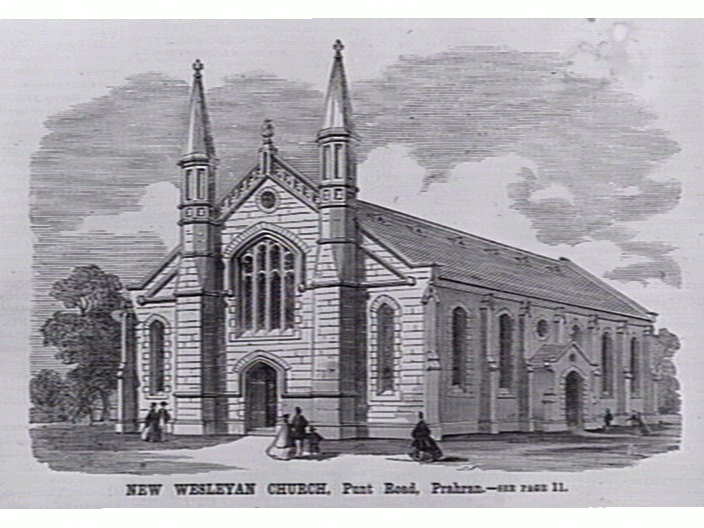
05-01-1865: The Wesleyan Church, Punt Road, Prahran.

The Wesleyan church was opened on the 4th of January 1865.

All glazing, including the principal four light stained glass window over the main entrance facing Punt Road, were executed by the Ferguson & Urie stained glass company of Curzon Street North Melbourne.

As at 2011 or earlier, this church is now a block of apartments with original west window still extant in the façade. The location is in the vicinity of 272 Punt Rd,  now zoned in the suburb of South Yarra.

The Argus, Melbourne, Thursday 5th January 1865, page 5.

 “The opening of the new building erected for the accommodation of the congregation of the Wesleyan Church, Punt-road, Prahran, was celebrated last evening by a tea meeting, given by the ladies of the congregation, in the old church. About 500 or 600 persons took tea, after which a public meeting was held in the new building, Mr. J. Price, the commander of the Great Victoria, in the chair. The chair having been taken, the Rev. F. Neale read a brief financial statement, showing that the erection of the new church had cost on the whole about £2,350, of which £1,100 was yet unpaid. Addresses were then delivered by the Revs. D. J. Draper, J. Eggleston, J. Dare, and G. Mackie, and in the intervals of speaking several anthems were very well given by the choir of he church. The new building is a neat substantial-looking erection, in the perpendicular style; constructed of bluestone, with white brick and cement dressings, from the designs of Messrs. Crouch and Wilson, architects. The contractor for the building itself was Mr. Whatmough, and the glazing, including a very handsome window over the main entrance, and facing the road, was executed by Messrs. Ferguson and Urie. The opening sermons were preached on Sunday, the Revs. D. J. Draper, J. Taylor, and J. Dare preaching in the morning, afternoon, and evening respectively. The services were largely attended, some 800 persons being present in the evening. The building supplies comfortable sitting accommodation for 600 persons.”

This slideshow requires JavaScript.

Wesleyan Church, Punt Rd, South Yarra – Prahran, 25th August 1864. (State Library of Victoria Image No: b48863)


Short link to this page: https://wp.me/p28nLD-51

© Copyright

22-02-1864: St George’s Anglican Church, Queenscliff, Victoria, Australia.

In 1864 the liturgical west three light stained glass window of St George’s Anglican Church at Queenscliff was donated by Dr. David John Williams (1819-1902). He was Trustee and Vestryman of St George’s Church and the first Mayor of the Borough of Queenscliffe in 1863-64. He had served in Russia as part of the English Medical Service and was appointed personal medical officer to Czar Nicholas 1st who awarded him the order of St Ann in 1842. The Czar presented him with an engraved jewel encrusted ring (which sold at auction in 1951 for £270 and at auction in 2012 for $51,000).  Dr Williams also had a lead medical role at the Eureka Stockade at Ballarat in 1854 as well as other government appointed medical positions.

All the Ferguson & Urie stained glass windows were installed  in St. George’s Church at Queenscliff between 1864 and 1892. The window described in this article is the liturgical ‘West’ window which fronts the street and was the first to be erected in the Church and donated by Dr. Williams. The window depicts the Evangelists. Matthew, Mark. Luke and John and the Shield of the Trinity or Apostles Creed.

Photos taken 25th September 2010.

This slideshow requires JavaScript.

The Argus, Melbourne, Monday 22nd February 1864, page 5.

“COUNTRY NEWS. QUEENSCLIFF”.

 ST.GEORGE’S CHURCH. – A large proportion of the visitors to Queenscliff will be well pleased to hear that the episcopal church is completed, and open for public worship. It has been erected – after the designs of Mr. Albert Purchas, of Melbourne – on the summit of Swan-hill, the highest part of the borough …”

 “…At the west end is a three light window, filled with stained glass, designed and executed by Messrs. Ferguson and Urie of North Melbourne…”.

The Australasian Sketcher, Melbourne, Saturday 12th February 1881, page 54.

“ST. GEORGE’S CHURCH, QUEENSCLIFF”

“THE church of St. George, Queenscliff, was begun to be built at the end of 1862 through the energy of Dr. Williams, the recent Government health officer at Queenscliff. It was completed in 1863, and opened for divine worship in January, 1864, by the Rev. R. Cummins, of St. Paul’s, Ballarat. In May of the same year the Rev. H. J. Wilkinson, the present incumbent, was appointed. It was consecrated by Bishop Perry in January, 1868. Its length is 67ft., and its breadth 36ft. 3in.; its height from apex of roof about 40ft. Mr. Purchas, of Melbourne, is the architect. Soon after the commencement of the church the late Judge Fellows took an active interest in it, and continued his liberal help until his death. An Estey organ has just been procured from Messrs, Glen and Co., and is at the entrance of the church. The description of the interior was recently given in a Melbourne daily journal in the following terms:- In Queenscliff itself the principal object is, undoubtedly, St. George’s Church of England, not alone from its internal beauty and perfection of arrangement, but from its being the “outward and visible sign” of the charity of one who was never weary in well doing – the late Judge fellows. The chancel window is of stained glass, and is illustrative of a portion of the Litany, each pane bearing underneath it the words of some appropriate quotation. It consists of 15 panes. The reredos is beautifully coloured, and the whole of the floor of the sanctuary is tiled. There is a marbled credence table, and the sacramental and offertory vessels are of silver, appropriately engraved. There are seats for the assistant priests within the sanctuary, one on the Episcopal, and one on the decanal side. The reading-desk, pulpit, and altar rails are all of polished oak. Over the reading-desk is painted “Pray now unto the Lord,” and over the pulpit, “Preach the Kingdom of God.” There are twelve stained glass windows dedicated to the Twelve Apostles, with suitable texts from the Epistles over each. The pews are slightly raised, as in All Saints’ Church, East St. Kilda, and are arranged so as to leave a centre aisle from the altar gate. Almost immediately over the pulpit is a plain white marble slab, bearing the inscription, “In Memory of Thomas Howard Fellows, Born 21st October 1822 Died 8th April 1878. If you seek his memorial look around.”

The Argus, Melbourne, Vic, Monday 20th January 1902, page 1.

“WILLIAMS.- On the 18th January, at Queenscliff, David John Williams, M.D., F.R.C.S., aged 84.”

The Argus, Melbourne, Vic, Tuesday 19th June 1951, page 3.

THIS jewel of Russia’s Czarist days will be auctioned in Melbourne on Thursday. Czar Nicholas I gave it to Dr. David John Williams, a Victorian surgeon, for service aboard the Imperial yact Queen Victoria in 1847. It is set in gold and diamonds, with an amethyst centre. Dr. Williams, born in Glamorganshire in 1816, came to Australia in 1844 as surgeon-superintendent on the Templar. Two years later he was appointed to the Queen Victoria, which Nicholas had built in England. Dr. Williams returned to Melbourne in 1852. He attended wounded men at Eureka Stockade. Leonard Joel Pty. Ltd. will conduct the auction”.

The Argus, Melbourne, Vic, Friday 22nd June 1951, page 5.

“Czar’s relic for £270.”
“A jewelled order presented to a Victorian surgeon in 1847 by Czar Nicholas I yesterday passed into the keeping of a Malvern art dealer for £ 270.
For the buyer, Mr. John A. Hogan, the value of the order lies in its historic interest. Set in diamonds, with an amethyst centrepiece, it is faced with green enamel. At the base is a double-headed eagle holding a sceptre. “If I break it up the jewels will probably bring only from £10 to £20 each,” Mr. Hogan said. I would have done that a few years ago, but now historic pieces like this find New Australian buyers. They are far keener on them than old Australians.” The inscription on the red leather case reads “Presented by His Majesty, the Emperor of All the Russians, to Dr. J. Williams. MD, surgeon on His Majesty’s yacht, Queen Victoria.” Dr Williams came to Australia in 1844. Two years later he was appointed ship’s surgeon on Czar Nicholas’ yacht. He returned to Melbourne in 1852.”

Fifty seven years later, in July 2008, the Dr D. J. Williams ring, the gift from Czar Nicholas the 1st, again went up for auction. This time it sold for a staggering $51,000.

Noble Numismatics Pty Ltd, Sale 88, Lot 741. 22-24 Jul 2008, Dallas Brooks Centre Melbourne.

“Provenance: The current owner acquired this piece in the late 1950s from a direct descendant of Dr D.J.Williams. David John Williams (1819-1902) Born in Glamorganshire, Wales, in 1819, he studied medicine in England and Scotland, graduating M.R.C.S. Eng., 1841; L.S.A. Lond., 1845; M.D. St Andrews, 1848; F.R.C.S. Eng., 1861. In 1844 he sailed aboard the `Templar’ as Surgeon-Superintendent arriving in Sydney in August of that year. On his return to England he served in Russia as part of the English Medical Service. He was appointed personal medical officer to Czar Nicholas I and spent the summer sailing with the Czar aboard his yacht `Queen Victoria’, and the winter serving in hospitals in St Petersburg. On leaving Russia Dr Williams was presented with the Order of St Anne by Czar Nicholas. Arriving in Melbourne aboard the `Bride’ in May 1853 Williams went first into private practice, then Government service before being posted to the Quarantine Station at Point Nepean in September 1853. Williams was transferred to Ballarat as District Surgeon, whilst there he conducted the inquest into the death of James Scobie on 7 October 1854 and, later that of Henry Powell on 9 December 1854 (who was wounded during the Eureka rebellion). As Camp Doctor Williams attended to the wounded from the Eureka rebellion. Dr Williams remained in Ballarat as coroner when the position of District Surgeon was abolished. He resigned in March 1855, visited England and on his return settled in Queenscliffe serving first as Assistant Health Officer at the Heads in 1858, then as Health Officer in 1867. Whilst in Queenscliffe he took an active part in civic and church affairs, being elected to the Council and becoming the first Mayor of the Borough of Queenscliffe in 1863. Williams died in 1902 and was buried in Queenscliffe. St George’s Church vestry erected a rear window as a memorial to Dr Williams in recognition of his long and invaluable contribution to the church. (References: `Goldrush Doctors at Ballarat’ by Keith Macrae Bowden, Mulgrave, 1977; `Great News Stories of Queenscliff’)”.

(in-line image from noble.com.au)

(in-line image from noble.com.au)

Related posts:
22-02-186429-01-186613-08-186712-02-1881 07-04-1882 >18-10-1884 > 30-12-1893

External Links:

Noble Numismatics:  On leaving Russia Dr Williams was presented with the Order of St Anne by Czar Nicholas.


Short link to this page: https://wp.me/p28nLD-44

© Copyright

03-04-1863: Holy Trinity Church, Kew, Melbourne, Victoria.

Only five extant windows by the historic Ferguson & Urie stained glass company of North Melbourne have the company name on them. This one at Holy Trinity Church at Kew was installed in the chancel in 1863 but later extensions to the church saw the window relegated to the liturgical north transept where it still is today. The signature mark can’t be seen with the naked eye unless you have a scissor lift or a very tall ladder, which is not advisable. Image-stabilized binoculars will work, but the best bet is a good-quality digital camera with a decent zoom lens and viewing the images on a good-quality computer screen.

The South Bourke Standard, Friday 3rd April 1863, page 2

 “Messrs. Ferguson and Urie, glass stainers, North Melbourne, have just completed the stained glass windows for the chancel of Trinity Church, Kew. The centre light contains an elaborately executed emblem of the Trinity, in which the three primary colours only are used. In the top of the same light is the word “Jehova” inscribed in Hebrew characters. The principal medallion in the dexter light has the “Agnus dei” – that sinister light the “Dove”, each surmounted by an appropriate monogram. The ground work is of cathedral tints, enriched with early English ornament, all the details of which is emblematic of the Trinity. – Herald”

Photos were taken 2nd January 2011.

This slideshow requires JavaScript.

Related posts: 24-03-1864 > 29-04-1864 > 13-08-1867


Short link to this page: https://wp.me/p28nLD-3n

© Copyright