1890: DEATH OF AN AYRSHIRE MAN IN AUSTRALIA

It’s been a long-running joke that there may have been a family relationship connection between my third Great Grandfather James Ferguson, and James Urie, who were business partners in the historic Ferguson and Urie stained-glass company in North Melbourne between 1853-1899.

Some years ago I started a family tree for James Urie to assist me with writing up his biography and one of the coincidental curiosities I found was that his mother’s maiden name was Jean Ferguson who married William Urie at Kilmarnock, Scotland, in 1814. During my research it felt like every second person in Scotland was named Ferguson, so I dismissed it very early as there was no other credible information or family links to join the dots.

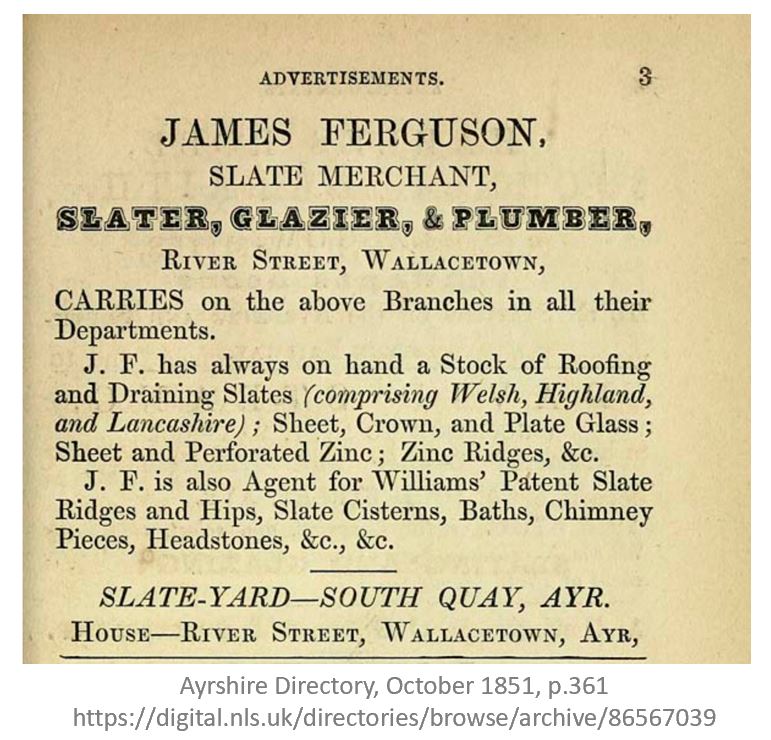
On my own family tree research I found a curiosity in the March 1851 Scotland Census, where James Urie was listed as a visitor at James Ferguson’s house in John Street, Wallacetown, Ayr, on the evening the census was conducted. Their professions were listed as Slater & Glaziers and my reasonable assumption was that James Ferguson and James Urie worked for, and had been apprentices of, James’ father, James Ferguson Snr (1777-1886) who had a significant slating and glazing business in Wallacetown and a large slate yard along the river between the Old Bridge and New Bridge.

In 2015 I was looking for research material to post an article about James Urie’s house named ‘Glencairn‘ which was built in Wellington Street, Flemington in 1885. Knowing that many of the old colonists were prolific at naming their houses in Australia after a town or landmark near their place of birth, Kilmarnock was the obvious target area to focus on.

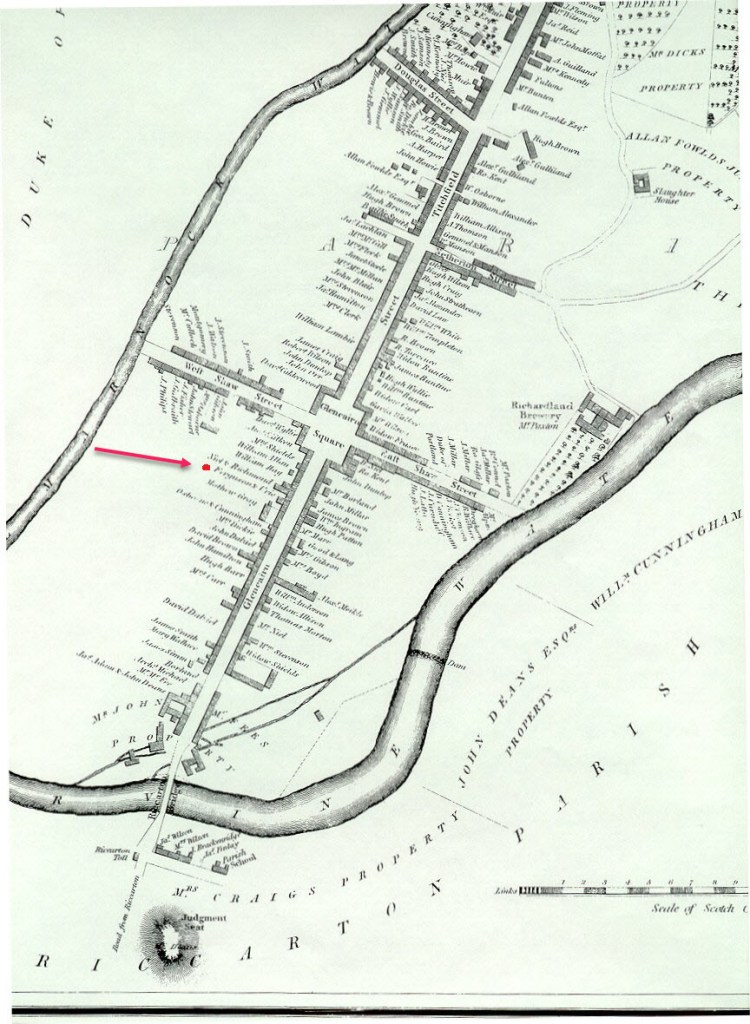
It didn’t take long to find a place in the middle of Kilmarnock named ‘Glencairn Square’ at the intersection of Glencairn and Shaw Streets East and West. This seemed to be a reasonable clue as to the vicinity of where James Urie grew up. The second lucky find was an old map I found online (undated) which not only showed Glencairn Square but also the names of the householders along the streets. Seven houses south of Glencairn Square on the east side of Glencairn Street was the name “Ferguson & Urie”.

Kilmarnock map circa 1828

This resurrected the credibility of the old relationship joke, but it still didn’t prove anything. It seemed credible that this was where the Urie family must have lived in Kilmarnock but the coincidental name combination of “Ferguson & Urie” on the old map was way ahead of its time. When James and David Ferguson and James Urie arrived in North Melbourne in April 1853 they logically named their plumbing, slating, and glazing firm “Ferguson & Urie”.

There were no other clues to make any positive family tree connection but in May 2021 something remarkable surfaced in the British Newspaper Archives. Here was an article in the Ayr Advertiser in September 1890 titled “Death of an Ayrshire man in Australia” squarely claiming that the men were cousins:

“…It states that Mr Urie was born in Kilmarnock, Ayrshire, in May, 1828, so that at the time of his death he was 62 years of age. Early in 1853 he came out to Victoria, with his cousins, the Messrs Ferguson, and other. Mr Urie and Mr James and David Ferguson [sons of the late Mr James Ferguson, slater and glazier, River Street Ayr,] entered into partnership under the title of Ferguson and Urie, commencing business as plumbers and glaziers…”

A jackpot? Not quite.

Despite all the clues and this astonishing article claiming James & David Ferguson and James Urie were cousins, I still haven’t been able to find out how. The first assumption was they were first cousins, but despite my best efforts I haven’t established that James & David’s father, James Ferguson Snr, had a sister named Jean Ferguson, and no luck looking in other directions to find relationships via any second or third cousins relationships either.

The mystery continues.

Ayr Advertiser Thursday 5th September 1890, page 4.

“DEATH OF AN AYRSHIRE MAN IN AUSTRALIA”

“THE ‘West Bourke (Victoria) Times” [1] of July 25 contains a long obituary notice of Councillor James Urie [2], who died their (sic) after a short illness, on Monday the 21st of July. It states that Mr Urie was born in Kilmarnock, Ayrshire, in May, 1828, [3] so that at the time of his death he was 62 years of age. Early in 1853 he came out to Victoria, with his cousins, the Messrs Ferguson, and others. Mr Urie and Messrs James [4] and David Ferguson[5] [sons of the late Mr James Ferguson, slater and glazier, River Street Ayr,] [6] entered into partnership under the title of Ferguson and Urie, commencing business as plumbers and glaziers in Curzon-street, Hotham[7]. In course of time their business assumed very large proportions and a palatial factory was erected. [8] Mr Urie entered the municipal arena about five years ago. In the discharge of his public duties. Mr Urie displayed most commendable zeal, and much ability. He won the esteem of his fellow councillors, as he had won the respect of the rate payers by the amiability of his disposition, the uprightness of his character, and a tendency to speak with candour, and judge with impartiality. After being a councilor for two years, he was elected mayor, and performed arduous duties appertaining to that position intelligently, zealously, and ably. When deputation after deputation waited upon the Premier, the well-known form of Mayor Urie was always to the fore, and his gentlemanly bearing and quiet earnestness of manner never failed to exert a beneficial influence. When his term of office as councilor expired, he sought re-election and was triumphantly returned at the top of the poll. His popularity never waned, and the confidence placed in him has never been shaken. His efforts for the welfare of the people of his borough will long be remembered with gratitude. He was a gentleman whom any community could ill-afford to lose. When he was mayor he laid the foundation stone of the Flemington Presbyterian Church [9], of which he was a member, and greatly assisted in the work of its erection. He was never backward in lending a helping hand in every deserving cause. He was Justice of the Peace, a member of the Kensington Masonic Lodge, and also an Oddfellow. His cheering voice, pleas and smile, and kindly presence will be greatly missed by a large circle of friends and acquaintances. He leaves a wife and nine children – three sons and six daughters. The funeral took place on Wednesday afternoon, and the procession was one of the largest ever seen in the borough.” [10]

Footnotes:


[1] As at 20210530, the West Bourke Times tabloid has not been included in the Australian National Archives ‘Trove’ Collection.

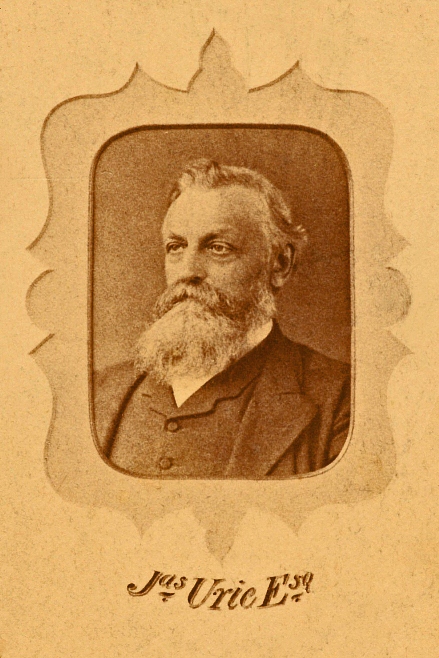
[2] Biography: James Urie (1828-1890)

[3] James Urie was born in Kilmarnock 14th May 1828, to William Urie and Jane Ferguson.

[4] Biography: James Ferguson (1818-1894)

[5] Biography: David Ferguson (1825-1872)

[6] Sons of James Ferguson Snr (1777 – 1866) & Janet Kay (1791-1860)

[7] Later to be known as North Melbourne

[8] See https://fergusonandurie.wordpress.com

[9] James Urie laid the Presbyterian Church foundation in 1888

[10] The late Councillor Urie, 25th July 1890

Other related posts:

23-07-1890: James Urie (1828-1890)

1890: DEATH OF AN AYRSHIRE MAN IN AUSTRALIA

18-09-1885: James Urie’s house “Glencairn”, Wellington Street, Flemington.


Short link to this page: https://wp.me/p28nLD-37O

© Copyright

1888: James Urie lays the Foundation Stone of the Flemington and Kensington Presbyterian Church.

James Urie was not only a much respected public figure as a Councillor, Mayor of Flemington and a principal partner of the Ferguson & Urie stained glass firm; he is also credited with being one of the lead instigators for the erection of the Flemington and Kensington Presbyterian Church.

On the afternoon of Monday 25th June 1888 he was bestowed with the honour of laying the foundation stone of the new church in Norwood Street. The ceremony was reported as a grand affair and prior to him laying the foundation stone there was a procession by the Sunday school children after which he generously presented each one of them with a specially struck medallion as a memento of the historic occasion;

“…Prior to the commencement of the ceremony, about 450 Sabbath School children, nicely dressed, and with flags flying marched in procession from the new hall to the ground in Norwood street. Before leaving the mayor presented each child with a neat medal with a design of the church on one side commemorative of the event…”

– Images from private collections, the Melbourne Museum and the State Library of Victoria.

This slideshow requires JavaScript.

The medal included a picture of the proposed church on one side with the words:

“FLEMINGTON AND KENSINGTON PRESBYTERIAN CHURCH.”

On the reverse are the words:

“TO COMEMORATE THE LAYING OF THE FOUNDATION STONE. 25 JUNE 1888. BY JAS. URIE ESQ. J.P. MAYOR OF THE BOROUGH.”

An example of one these historical medallions can be seen at the Melbourne Museum in Carlton. [1] The Downies Numismatic Auction House also sold one of the medals at auction 308, item 945 for $200 circa 2012.

The Presbyterians originally intended to erect a smaller church costing only £1,400 but James Urie was adamant that it was worth the cost and effort to construct a more substantial building that would serve the congregation for many years;

“…Mr. Duguid, the architect for the building, stated in a brief speech that originally it was intended to erect a church costing only £1400 but Mr. Urie was so desirous of seeing a really good building worthy of the district put up, that at length it was agreed to adopt his advice, with the result that eventually the present design was accepted….”

“…Mr Thomson introduced the Mayor (Cr. Urie), who had been connected from the first with the church in the district, and had done all in his power for its advancement. He presented Mr. Urie amidst applause with a very handsome silver trowel, and invited him to lay the foundation stone of the church he had always advocated should be erected…”

“…He always believed in building a good church when they did build one, as it would serve all requirements for a long time to come, which a smaller one would not do. The design, he thought was most appropriate and suitable in every respect, and when completed they would have a church to be proud of. The height from the ground would be 10 feet to the spire, and with the seating the church would cost £2,500. He expressed his thanks for the silver trowel presented to him, and it would be a fitting souvenir of the important ceremony he was about to perform…”

James Urie exhibited the time capsule box, containing the newspapers of the day and undoubtedly many other artifacts. He then placed the box beneath the stone and declared the foundation stone “…to be well and truly laid amidst loud applause…”

His subsequent speech referred to their need to pay off the building as quickly as possible so they could be free of debt. He pointed out the collection plate and once again, as he done so liberally over the years, displayed his generosity;

“He set a most excellent example by placing what looked like two ten pound notes into the plate, and invited those present to follow suit…” [2]

It could be reasonable assumed that the windows for the church would be manufactured by the Ferguson & Urie stained glass company. It’s probably even reasonable to suggest that the designs for the windows would have been the suggestion of James Urie himself and that, as he’d so generously demonstrated in his contribution to the collection plate during the foundation stone ceremony, the windows were probably donated by the firm without cost.

The only obscure clues as to the stained glass windows were published in the North Melbourne Advertiser on the 7th July 1888 where it was stated;

“…The church will be lighted by ten double-light stained glass windows in the side walls, besides a large gable window…”[3]

On Monday the 10th of March 1889 the church was officially opened but very little detail was recorded in the tabloids about the occasion, except for the mention that they had purchased a – ‘”powerful’ bell, whose tones will no doubt remind the people of the borough of the ‘decent church that tops the neighbouring hill’.” .[4]

The Presbyterian Church in Norwood Street Flemington was only a short walk around the corner from James Urie’s house “Glencairn” in Wellington Street. Undoubtedly he would have been proud of the church they had constructed but he would not share long in its history.

James Urie died seventeen months later, on the 21st of July 1890 aged 62. His funeral was recorded as being one of the most imposing ever seen in the Borough of Flemington and Kensington;

“…The employės of Messrs Ferguson & Urie marched in front of the hearse, then came four mourning coaches and upward of fifty vehicles. Immediately following the mourning coaches came a hansom, in which the Hon Alfred Deakin was seated, then next in order a buggy containing the deceased gentleman’s council colleagues…”[5]

Alfred Deakin, later to be Prime Minister of Australia, also played a part as a pall bearer at the grave site.

The last known mention of additional stained glass windows occurred in 1924 when the congregation decided to erect a memorial to the fallen WW1 soldiers from the parish [6]. If the memorial window was actually created as intended then it would most likely have been created by the Brooks, Robinson & Co., stained glass company of Melbourne.

The church survived 81 years before unfortunately being destroyed by fire on the 24th April 1970. It’s not known if any significant historical artifacts survived the fire and there is nothing further known of the stained glass windows.

The whereabouts of the silver trowel presented to James Urie to lay the foundation stone remains a mystery. It was Willed to his daughter Maria as indicated in her mother Grace’s Will of 1899. Maria died a spinster in 1915 but the research trail has ended there and nothing further is known.

Significant tabloid transcriptions:

North Melbourne, Advertiser, Vic, Saturday 30th June 1888, page 4.

“FOUNDATION STONE CEREMONY

The foundation stone of the new Presbyterian Church, at Flemington, of which the above drawing is an excellent representation, was laid on Monday afternoon, by the Mayor (Councillor James Urie), in the presence of a very large assemblage of residents and visitors amongst whom were the Rev. G. D. Buchanan. S. Robinson and James; Professors MacDonald and Rentoul, and other prominent divines. Prior to the commencement of the ceremony, about 450 Sabbath School children, nicely dressed, and with flags flying marched in procession from the new hall to the ground in Norwood street. Before leaving the mayor presented each child with a neat medal with a design of the church on one side commemorative of the event. The proceedings were commenced by the choir singing the hymn “Brightly gleams our Banner,” and afterwards the Rev. John Thomson offered up an earnest prayer for the success of the undertaking.
Professor Rentoul, who was briefly introduced by the Rev. John Thomson, said it gave him very great pleasure to be present at the laying of the foundation stone of such a magnificent church, but especially so because he had the deepest regard for their worthy pastor, the Rev John Thomson, whom he had known years ago as a most earnest worker in the ministry in England. It was a great blessing to a congregation to have such a good and able pastor who took so deep an interest in the welfare of his flock, and it was also a boon to have a good church. Referring to the past career of the Presbyterian Church, Professor Rentoul pointed out that it had never been afraid to stand up for God’s truth when necessity arose, as history proved. It was the church of the people, as it was free to all and fell in more with their ideas of Christianity. Dr. Martineau had even advised his Unitarian congregation in England to embrace the Presbyterian form of Church government, and, in fact, he (Professor Rentoul) considered the Presbyterian Church of Scotland came nearest the beau ideal of what a Christian church ought to be. The grand old German Emperor who so recently passed away was a Presbyterian, and from the rapid manner in which the church was everywhere progressing, it would be, he thought, the church of the future. The foundation stone they were about to lay, was he was glad to say, a proof of the advancement of the Presbyterian cause in the district of Flemington and Kensington. He eulogised the efforts and liberality of the congregation in subscribing toward the erection of such a beautiful church, and referred particularly to Mr. Urie, as being worthy of special thanks for the part he had taken in the movement. He urged all to continue their exertions, and no doubt they would soon succeed in clearing off the remaining portion of the cost. If it had been the proper place, he should have felt impelled to call for three cheers for Mr and Mrs Thomson, and also for Mr. Urie who had been mainly instrumental in having such a splendid edifice built, but as at the present time he could not do this, he would conclude by congratulating the congregation on the success already attained, and urge them all to work in harmony for the good of the church.
Mr Thomson introduced the Mayor (Cr. Urie), who had been connected from the first with the church in the district, and had done all in his power for its advancement. He presented Mr. Urie amidst applause with a very handsome silver trowel, and invited him to lay the foundation stone of the church he had always advocated should be erected. Cr. Urie, who was well received, said that about five years ago the Presbyterians agreed to hold their services in the Flemington and Kensington Hall. They had been exceedingly fortunate in securing the services of their respected pastor, the Rev. John Thomson, and through his excellent capabilities and energy n the cause, the congregation became so numerous that it was thought advisable to take steps for the erection of a suitable church. The congregation were not at all backward in coming forward with donations, and the present site was accordingly purchased at £6 per foot. He always believed in building a good church when they did build one, as it would serve all requirements for a long time to come, which a smaller one would not do. The design, he thought was most appropriate and suitable in every respect, and when completed they would have a church to be proud of. The height from the ground would be 10 feet to the spire, and with the seating the church would cost £2,500. He expressed his thanks for the silver trowel presented to him, and it would be a fitting souvenir of the important ceremony he was about to perform. He then proceeded to mix the mortar, and after exhibiting a box, in which he had stated the periodicals of the day were encased, placed it under the stone, which he then, with great care and in a most workmanlike manner, declared to be well and truly laid amidst loud applause. The Mayor next drew attention to the collection plate, pointing out that paper money, sovereigns or silver would be thankfully received in aid of the building fund, which it was most desirable to pay off as quickly as possible so as to be perfectly free and clear from any encumbrance. He set a most excellent example by placing what looked like two ten pound notes into the plate, and invited those present to follow suit, with the result that for the next few minutes there was a decided rush of well wishers of the church and the Sunday school scholars were very conspicuous with their offerings, in fact it was pleasing to see the eagerness of some of the children to part with their money. At length the funds of the onlookers ‘having been well and truly laid,’ the Rev. John Thomson announced that several gentlemen would like to make a few remarks.
Duguid, the architect for the building, stated in a brief speech that originally it was intended to erect a church costing only £1400 but Mr. Urie was so desirous of seeing a really good building worthy of the district put up, that at length it was agreed to adopt his advice, with the result that eventually the present design was accepted. The land on which the church was to be erected was 80 feet by 180, and had been purchased at £6 per foot. The building would cost £2500, of which sum £900 had been subscribed, and another £150 was promised, provided that an additional £50 was collected by six months.
The Rev. Samuel Robinson, of St. Kilda, said he was pleased to say he been present at the initiation of the movement for the erection of the church, and he could assure them that Mr. Urie deserved the greatest credit for the interest he had taken in the matter throughout, while the Misses Urie, by their exertions in aid of the funds, were entitled to equal praise. Both Mr. and Mrs. Thomson had also by their untiring efforts brought the church to its present state of prosperity, and were deserving of the most hearty thanks of the congregation. He earnestly hoped all would continue to work together without and heartburnings, not only for the erection of the church, but for its after prosperity.
Professor McDonald expressed his pleasure at being present on such an eventful occasion, as it proved that Mr. Thomson had not laboured in vain for the district. The congregation were most fortunate in having Mr. Thomson as their pastor, as there were few superior or more devoted and earnest men in the service of God and man. His thought and scholarly attainments were well-known and appreciated, in fact, he possessed qualifications that entitled him to seek higher places, but he had chosen instead to cast his lot with them. He was truly happy to see that Mr. Thomson’s labours had been so successful and borne such good fruit.

 TEA AND PUBLIC MEETING.

 In the evening a very successful tea meeting was held in the New Hall, and was followed by a public meting and concert, at which there was a very large attendance. The Mayor (Cr. Urie) presided, and on the platform were the Revs. Alex Marshall, Buchanan, Burchett, James and Smith. The meeting having opened with prayer.
The chairman gave an interesting address, in which he described the past history of the Presbyterian Church at Kensington, and the difficulties that at first had to be contended with. Five years ago the congregation commenced to hold services in the new hall, and after some time the Rev. John Thomson was persuaded to cast in his lot with them, and accept a call to the church. The congregation largely increased under his ministration and it was then decided to make an offer to purchase a block of land on which to erect a suitable church. Subscriptions came in the most liberal manner, and a very successful cake fair was also held which materially increased the funds, and with other donations, they were at length in a position to purchase a valuable site in Norwood street at a cost of £520. Designs were then invited for a church to cost about £1400, but the congregation ultimately decided to erect a more imposing building, and the present design by Mr. Duguid was accepted. He believed in erecting a good church while they were about it, as the extra cost, he thought, would be subscribed without very much difficulty, and it was far better to have a building with which they would all be quite satisfied instead of a smaller one, which would not so well answer requirements. He thought if they all did their best the balance of the building fund would soon be collected and then they would have a church free of debt of their own, which they could be proud of (Applause.) The choir then sang the anthem ‘Then wilt thou show’ with excellent affect and Mr. Boreham followed with ‘Nil Desperandum.’
G. D. Buchanan next gave a spirited address, and congratulated the congregation on being able to erect such a splendid church, which proved that they appreciated the efforts of their worthy pastor, who was entitled to their hearty thanks for the energetic manner he had worked to bring the church in the district to its present prosperous state. He urged them all to stick together and do their best to pay off the remaining debt on the church, and if they remained united there was no doubt they would succeed in surmounting all difficulties, and become a strong congregation.
The Rev. Alexander Marshall, of Scot’s Church, the Rev. Jas. Burchett and James also addressed the meeting, and wished the congregation success in their undertaking.
The singing of the choir under the able conductorship of Mr. Townsend was much appreciated, the anthems – ‘Arise and shine’ and ‘I will wash my hands’ being particularly well rendered. A trio – ‘Thou shalt love the Lord’ by Miss Clayton and Messrs. Clayton and Townshend was very nicely given, and a song ‘Calvery,’ by Miss Gray was most successfully rendered. The meeting, which was most enjoyable and successful, closed with the benediction.”

North Melbourne Advertiser, Vic, Saturday 7th July 1888, page 4.

“FLEMINGTON PRESBYTERIAN CHURCH.

The following is a description of the above building. The church when finished will form a handsome and conspicuous addition to the architecture of the borough. In plan it is an amphitheatre in form; the pews radiating from the pulpit in five blocks, and providing accommodation for 360 worshipers. The extreme internal dimensions are 54 ft. wide, 48 ft. long. The width is arranged in a central nave 36 ft. wide, and side aisles 9 ft wide for three fourths of the length. The roof of the nave is supported on cast iron columns, and consist of four massive curved principals, giving a clear height of 28 ft. from floor to ceiling. Running along the top of the columns are heavily moulded beams, supported by curved gothic brackets springing from the caps of the columns, and similar beams and brackets run from the columns to the walls, to carry the roof of the side aisles. The whole of the ceiling will be finished in stained and varnished kauri pine, and the side walls will have a dado of same all round. The principal entrance are by the tower door on the right hand side, and a similar door in a porch on the left, these being connected by a commodious vestibule outside the main building. Besides these doors, there are four others intended more as a means of egress, and those arrangements have met with the fullest approval of Central Board of Health. The church will be lighted by ten double-light stained glass windows in the side walls, besides a large gable window. The main feature of the design externally is, of course, the spire, which rises in graceful proportions to the height of 100 ft. above the floor level, the upper part being slated and surmounted by a handsome cast iron finial. The main gable rises to a height of about 45 feet, and contains the large window before referred to. It is well balanced in effect by a flanking buttress carrying a small pinnacle, and the apex is filled in by coloured tiles. The back gable is filled in with wood and lath and plaster at present, to permit of future extensions, but the rest of the walls are all of brick, tuck-pointed, and having bands, arches, &c., of coloured bricks. It is no discredit to the other churches in the neighbourhood to say that when finished it will be beyond question the most handsome church in the borough, and reflects great credit on the skill and economical planning of the architect that a building of such proportions and style could have been undertaken for the very modest sum of £2150, which is the amount of the contract. The sum does not include fittings, but it includes an ornamental front fence, and a good deal of asphalting in the grounds.”

North Melbourne Advertiser, Vic, Saturday 8th September 1888, page 2.

“In connection with the Flemington and Kensington Presbyterian Church, it has been decided to substitute Victorian patent stone for timber and seating in the erection of the spire of the above building. This will add greatly to the appearance, and also to the durability of the structure. In spite of the scarcety of bricks the erection of the building is making good progress, and it is intended to open it about the middle of December.”

North Melbourne Advertiser, Vic, Saturday 2nd February 1889, page 3.

Summary – On the evening of Thursday the 31st January 1889, the wife of the minister, Mrs. J. Thompson was entertained on the eve of her intended journey to return temporarily to the old country for the benefit of her health. The going away party was organised by the Flemington congregation at which time she was presented with a small token of sovereigns. After some refreshments many songs were sung, including James Urie’s rendition of ‘Oh, steer my bark.’

North Melbourne, Advertiser, Vic, Saturday 23rd February 1889, page 2.

“It has been decided that the opening services in connection with the new Presbyterian Church at Flemington will take place on Monday 10th March. The denomination has purchased a ‘powerful’ bell, whose tones will no doubt remind the people of the borough of the ‘decent church that tops the neighbouring hill’.

The Argus, Melbourne, Vic, Wednesday 30th April 1924, page 9.

“It has been decided by the congregation of the Flemington and Kensington Presbyterian Church to have a memorial window placed in the church in memory of fallen soldiers of the parish.”

Related posts:

23-07-1890: James Urie (1828-1890)

18-09-1885: James Urie’s house “Glencairn”, Wellington Street, Flemington.

Footnotes:

[1] Museum Victoria, Carlton Gardens, Melbourne (accessed 14-08-2014).

[2] North Melbourne, Advertiser, Vic, Saturday 30th June 1888, page 4.

[3] North Melbourne Advertiser, Vic, Saturday 7th July 1888, page 4.

[4] North Melbourne, Advertiser, Vic, Saturday 23rd February 1889, page 2.

[5] The North Melbourne Advertiser, Friday 25th July 1890, page 2

[6] The Argus, Melbourne, Vic, Wednesday 30th April 1924, page 9.


Short link to this page: http://wp.me/p28nLD-2wL

© Copyright
1853: The Ferguson brothers arrive aboard the Tamerlane

After a jovial night at the “Robert Burns Arms Inn” at Wallacetown in early December 1852, James & David Ferguson departed their native Scotland for a new life in Australia.

The ‘Tamerlane’ departed from Greenock in December 1852 with James and David Ferguson amongst the 110 intermediate and steerage passengers. Their friend and business partner James Urie was not on the same ship but was known to have departed the day prior, yet nothing has yet been found as to which ship he was on or which port he arrived at in Australia. By coincidence, James Urie’s future brother in law, John Yeaman, was also on the ‘Tamerlane’ with the Ferguson brothers.

When James and David boarded the Tamerlane they must have known that their odds of reaching Australia alive were not favourable. In the mid-19th century nearly 1 in 5 children and 1 in 60 adults died on a voyage to Australia[1].

The Ferguson brothers would have been enticed by the many letters from their friends who had departed the old country bound for the “golden land of promise.” There would also have been mixed reports of those that were making their fortune in the Colony and those who perished at sea trying to get there. Yet they still took their chance. James would have been particularly aware of the consequences as he had the most to lose. He was leaving behind a wife and five children with the hope that they would join him once he had established the business in Melbourne ( Jane and the five children arrived aboard the ‘Emma’ in November 1855).

After four and a half months at sea the ‘Tamerlane’ eventually arrived in Port Phillip Bay on the 29th April 1853.

The Argus, Melbourne, Vic, Saturday 30th April 1853, page 4.

“April 29.- Tamerlane, ship 750 tons, Geo. Caldwell, from Glasgow December 12th. Passengers – Cabin: Mr. and Mrs. J. Robertson, Mr. and Mrs. F. Donaldson, Mr. and Mrs. D. Miller, Mrs. Wylie and child, Messrs Davidson, A. Dawson, P. Dawson, D. Fraser, McIntosh, McDonald, Newbigging, Rowley, Rowan, Shirra, A. M. Wylie, Esq., Surgeon, and one hundred and ten in the intermediate and steerage. Dickson , Gilchrist, and Co. agents.”

It was very common for literate passengers on long voyages like this to keep a diary of their once-in-a-lifetime journey to the Antipodes and there are many remarkable diaries in museums and libraries all over Australia. Unfortunately no example of a diary by any passenger of the Tamerlane to Australia in 1852-53 has yet been found during my research.

The first recorded account of the Ferguson brothers’ voyage comes five days after the arrival of the Tamerlane in Port Phillip Bay on the 29th April 1853.

The cabin and steerage passengers of the Tamerlane penned letters of gratitude to Captain Caldwell of the Tamerlane, which were published in the Melbourne Argus on the 4th of May 1853. The Cabin passengers are specifically mentioned by name as signatories to their testimonial, but the letter by those who traveled in steerage is simply mentioned as by the “Committee of the Steerage Passengers.”

The Argus, Melbourne, Vic, Wednesday 4th May 1853, page 12.

“Ship Tamerlane, May 2, 1853.

TO CAPTAIN CALDWELL,

SIR, – We, the undersigned, beg leave respectfully to present you these few lines to testify our approbation of your meritorious and exemplary conduct during the voyage, namely from Clyde to Australia. Allow us to say that you have displayed not only the abilities of a skilful commander, but the manners of a gentleman; also you have faithfully discharged your duties toward us to our entire satisfaction, and your good conduct secured to us that order and contentment which we anticipated. We sincerely wish you all success and happiness. We now bid you heartily adieu, with our thanks to Almighty God for bringing us safely to our destination, after a pleasant and successful passage across the wide ocean in the good ship Tamerlane.

For the cabin passengers.

George McDonald,
Alex Davidson,
John Shirra,
Patrick Dawson, jun,
John McKenzie, A. M.

Ship Tamerlane, Port Phillip.

To Captain Caldwell, Commanding Tamerlane.

Sir,- The steerage passengers beg to thank you for the kindness and attention shown to them during this passage. The length and tediousness of the voyage has in great degree been unfelt from the general opportunities for every kind of amusement, compatible with the situation in which they were placed, and this, they hope, without in any degree interfering with the working of the ship. In an early part of the voyage, you were kind enough to sanction the appointment of a committee of themselves, for the purpose of attending to cleanliness and order. The few regulations which the committee drew up, met your approval, and were enforced by the weight of your authority. All have felt the benefit of this arrangement, and at the same time it may have saved you from being annoyed with petty complaints, which, without doubt, would have arisen among so may crowded together in such a small place. The result of your kind indulgence, attention, and encouragement, by keeping up the spirits of all, together with strict attention to cleanliness and order, is shown in the healthy condition which all have shown during the voyage. With best wishes for your welfare and prosperity, we remain, Sir, your most obedient servants,

Signed by a Committee of the Steerage Passengers.

Report of the Ship Tamerlane, Capt. Caldwell, from Glasgow.

Sailed from Rothsay Bay, January 14th. At the Equator, February 15th. Spoke the ship Sophia Moffat, from London to Adelaide, out 32 days. February 23. Lat. 18 S., long. 25 W., barque Nepaul, from London to the Cape,last from Lisbon; out 77 days. February 27. Sir Henry Pottinger, from Liverpool to Shanghae, in lat. 24 S., long. 28W,; out 45 days. March 8. Arethusa, from Hartlepool to Ade?, lat. 27, long. 26; out 58 days. March 25. Lat 37S., long 29E, barque Halifax from London to madras; out 67 days. April 18. Barque Victor, from Swansea to King George’s Sound; out 109 days. Experienced much calm weather on the passage, and strong easterly winds off the Cape.”

The Journey:

Our pioneering ancestors took gambles with their lives just to have the chance of a new beginning in the Australian Colonies. Many of them died at sea and not even their bodies would make it to their new homeland.

In the mid 19th Century a voyage from Europe to Australia was a perilous journey of sometimes more than four months, depending on your luck with the weather. Fortunately for some, the length of the voyages were often broken by one or more port calls for provisions along the way but the last leg of the voyage to Australia would be the most grueling.

A death at sea was all too common with as many as one in five children and one in sixty adults perishing before they reached their destination. Those who died were buried at sea without delay to prevent the spread of disease. The dispatch of a body at sea was conducted quickly and efficiently. It was was sewn into a canvas sack, or if it was a crew member, his own hammock, and then weighted down with a piece of ballast to help it sink. The body was then placed on a plank and covered with the ensign of their homeland. The plank was balanced over the side of the ship and after a brief service by the Captain, (or clergy if there was one amongst the passengers), it was then tilted towards the water and the body slipped along the plank beneath the ensign and into the depths of the ocean.

Passengers in steerage would have been the most likely to succumb to disease due to the cramped, dark and unsanitary conditions below deck which was a breeding ground for disease. The lucky survivors who made it to the colony would often suffer ill health for many months after. Even on arrival at their destination the ships were often quarantined in the bay for some length of time, preventing  any passengers from going ashore and spreading any disease.

Fortunately the Ferguson brothers survived their voyage to Australia, as did James’ wife and children in 1855.

David Ferguson only lasted four years in the Colony, having decided to return to Scotland in early 1857. James Urie died in Flemington in 1890, followed by James Ferguson in 1894.

The fate of the Ferguson & Urie stained glass company was then in the hands of their sons, James Ferguson Jnr (1861-1945) and William Urie (1864-1907) until it eventually folded in 1899 after a 46 year history.

Footnotes:

[1] Web site; Museum Victoria, “Life at Sea” (accessed 21 Apr 2014)

© Copyright

19-11-1886: Auction of the Curzon Street Cottages.

By the mid 1880’s James Ferguson & James Urie had built their substantial new homes in Parkville and Flemington and their humble cottages in Curzon street near their workshop were obviously no longer required.  James Urie’s cottage was at 28 Curzon Street and  James Ferguson’s at No 24 Curzon street. The company’s first business premises was situated in very close proximity to the two cottages and was diagonally opposite the Union Memorial Presbyterian Church in Curzon Street.

In todays terms (2018) the address is 42 Curzon Street and the majority of the facade of the original building still exists.

In November 1886 they placed their cottages in the hands of Barrett & Co Auctioneers.

The Argus, Melbourne, Friday 19th November 1886, page 3.In

“SATURDAY, NOVEMBER 20. At Three O’Clock.

On the Premises, Little Curzon-street, Hotham. 2 BRICK COTTAGES. By Order of Messrs. Ferguson and Urie.

BARRETT and Co. will SELL by AUCTION, on the premises, as above, land having frontage of 55ft. to Little Curzon-street by a good depth, on which is erected two brick cottages, containing six rooms, outhouses, &c. Terms at sale.

The auctioneers would call special attention to this sale the property being well-built, near the omnibus and cab route, and within a few minutes’ walk of the city. Barrett and Co., auctioneers, corner of Queensberry and Abbotsford street, Hotham, and Racecourse-road, Newmarket”.

The partial municipal map below from 1878 shows the three key addresses in Curzon & Little Curzon street in North Melbourne.

Curzon St map [1878] [c1]

Curzon Street Municipal plans 1878


Short link to this page: https://wp.me/p28nLD-P8

© Copyright

21-11-1865: James Urie’s Invention

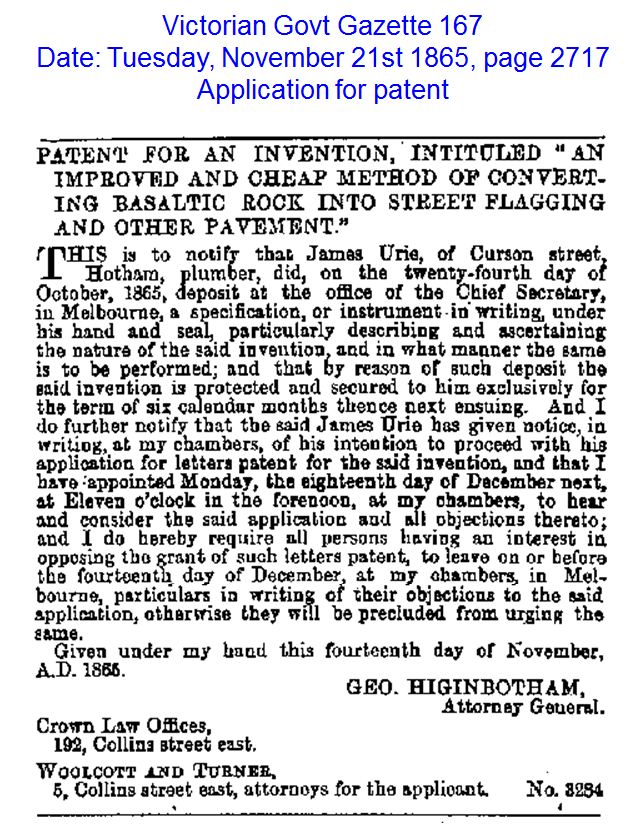
Victorian Govt Gazette 167, Tuesday, November 21st 1865, page 2717

“PATENT FOR AN INVENTION, INTITLED “AN IMPROVED AND CHEAP METHOD OF CONVERTING BASALTIC ROCK INTO STREET FLAGGING AND OTHER PAVEMENT.”

THIS is to notify that James Urie, of Curzon street, Hotham, plumber, did, on the twenty-fourth day of October, 1865, deposit at the office of the Chief Secretary, in Melbourne, a specification, or instrument in writing, under his hand and seal, particularly describing and ascertaining the nature of the said invention, and in what manner the same is to be performed; and that by reason of such deposit the said invention is protected and secured to him exclusively for the term of six calendar months thence next ensuing. And I do further notify that the said James Urie has given notice, in writing , at my chambers, of his intention to proceed with his application for letters patent for the said invention, and that I have appointed Monday, the eighteenth day of December next, at Eleven o’clock in the forenoon, at my chambers, to hear and consider the said application and all objections thereto; and I do hereby require all persons having an interest in opposing the grant of such letters patent, to leave on or before the fourteenth day of December, at my chambers, in Melbourne, particulars in writing of their objections to the said application, otherwise they will be precluded from urging the same.

 Given under my hand this fourteenth day of November, A.D. 1865.

 GEO. HIGINBOTHAM, Attorney General.

Crown Law Offices, 192 Collins street east.

WOOLCOTT AND TURNER,

5, Collins street east, attorneys for the applicant. No. 3254″.

Victorian Govt Gazette 167, Tuesday, November 21st 1865, page 2717, James Urie’s application for patent.

Related posts: 19-02-1874 > 18-09-1885  > 25-07-1890 > 29-08-1890 > 20-07-1899


Short link to this page: https://wp.me/p28nLD-Mn

© Copyright

31-08-1855: James Urie marries Grace Hardie Young.

At North Melbourne, in 1855, the twenty two year old James Urie married eighteen year old Grace Hardy Young.

James arrived in Victoria in late April or early May of 1853 from Scotland and in partnership with James Ferguson (1818-1894) started the the ‘Ferguson & Urie’ company from premises in Curzon Street in North Melbourne.

The Argus, Melbourne, 12th September 1855, page 4.

“On the 31st ult, at Curzon-street, North Melbourne, by the Rev. William Millar, Mr. James Urie, formerly of Ayr Scotland, to Grace Hardie, youngest daughter of the late Mr. Benjamin Young, Clackmannan, Scotland”.

Based on historical dates and the assumption that they married in the Curzon street Presbyterian Church in North Melbourne, the church building would have been the first temporary prefabricated iron church in North Melbourne. The first permanent structure wasn’t constructed until 1859. In 1879 the current Union Memorial Presbyterian Church was built on the same site, opposite the Ferguson & Urie stained glass workshops. Unsurprisingly this church would later have stained glass by the firm erected in it that were made in the workshops on the opposite side of the street.

Related posts:

20-07-1899: The death of Grace Urie.

29-08-1890: Letter of Condolence from the Borough Council to Grace Urie.

23-07-1890: James Urie (1828-1890)


SHort link to this page: https://wp.me/p28nLD-Ml

© Copyright

23-07-1890: James Urie (1828-1890)


Undoubtedly the Colonist who was the driving force behind the success of the Ferguson & Urie stained glass company was James Urie.

His business acumen and enthusiasm made Ferguson & Urie the most successful commercial stained glass company in Australian Colonial history.

The Argus, Melbourne, 23rd July 1890, page 1.

“URIE – On the 21st inst, at his late residence, Wellington-street, Flemington, James, the beloved husband of Grace Urie (and of the firm Ferguson and Urie, Collins-street), aged 62.”

The memorial photos were taken at the Melbourne General Cemetery, 27th Dec 2009.

This slideshow requires JavaScript.

James Urie (1828-1890) was born in Kilmarnock, Ayrshire, Scotland on the 14th May 1828, to William Urie and Jane Ferguson.

On the night of the Scottish census record of March 1851, James Urie (age 22), was indicated as being a visitor to James Ferguson’s (age 33) home at John Street Wallacetown in Ayr. Their professions were listed as Slater and Glaziers. As James Ferguson was 11 years older than Urie, the age difference leads me to believe that he may have formerly been an apprentice of James Ferguson or James Ferguson Snr.

Was the night of the census a meeting to discuss their bold plans to emigrate to Australia? Who knows! What we do know is that that their decision would cement them firmly in history as the founders of Australia’s most prolific and talented stained glass studio.

By late 1852 their decision had been made and they would set sail for Australia.  James Urie departed first and was followed a day later by James & David Ferguson. Which ship James Urie departed on  has not been established but James & David Ferguson departed Greenock on the 12th Dec 1852 aboard the ‘Tamerlane’. In a speech at the Company dinner held in North Melbourne in 1886, James Urie stated: “..it was just 34 years since he left the old country for the colony and Mr. Ferguson left a day after him”.

On arrival in Melbourne the men set about establishing their business as Plumbers, Slaters and Glaziers from premises in Curzon street North Melbourne. For a short time James Urie took up residence at the Tam O’Shanter Hotel in North Melbourne, whilst James Ferguson and his brother David found cottage accommodation in Little Curzon street.

On the 31st August 1855 James Urie married ‘Grace Hardie Young’ at the first Curzon Street Presbyterian church in North Melbourne and they took up residence in a small cottage at 28 Curzon Street North Melbourne, only a short distance from the Ferguson brothers and the business’s workshop. Between 1856 and 1882 James and Grace had fourteen children, five of whom unfortunately died as infants.

After the initial pioneering hard work of establishing the business and transforming the business to stained glass production in 1861, James took the lead as the enterprising salesman of the business and traveled far and wide to the eastern states as far north as Queensland, west to South Australia and as far south as Tasmania and possibly New Zealand to establish the company name “Ferguson & Urie” as Australia’s premier colonial stained glass firm. James was an an astute business man and had an inventive streak as well. On the 24th of October 1865 he registered a patent for “An invention of an improved and cheap method of converting Basaltic Rock into Street Flagging and other pavement”. By 1888 he had established a substantial two storey family home in Wellington Street Flemington named “Glencairn” after the name of “Glencairn Square” near his family home back in Kilmarnock, Scotland.

Outside of the business James actively participated in public life. He was a Justice of the Peace as well as a Councillor of Flemington and Kensington from August 1886 to August 1888, and Mayor of the Borough from August 1887 to August 1888.

On the afternoon of Monday 25th June 1888 he laid the foundation stone of the Presbyterian Church in Norwood Street Flemington.

On the 21st of July 1890, after a brief illness, James Urie died at the age of 62.

On Thursday the 28th August 1890 the Mayor and members of the Flemington council visited his wife Grace at their houseGlencairnin Wellington Street and presented Grace Urie with an illuminated letter of condolence.

James Urie’s funeral was one of the largest ever seen in Flemington:

“…the procession being the most imposing seen in the borough. The employės of Messrs Ferguson & Urie marched in front of the hearse, then came four mourning coaches and upward of fifty vehicles. Immediately following the mourning coaches came a hansom, in which the Hon Alfred Deakin was seated, then next in order a buggy containing the deceased gentleman’s council colleagues…”.

The Honorable Alfred Deakin (later to be the second, fifth and seventh Prime Minister of Australia) played the part as a pall bearer at the grave site.

James Urie was buried at the Melbourne General Cemetery with the five children who died as infants, and his wife Grace who died in 1899.

Table Talk, Melbourne, Vic, Friday 12th September 1890, page 8.

“James Urie, formerly of Curzon-street, North Melbourne, but latterly of Wellington-street, Flemington, one of the partners of the firm of Messrs. Fergusson [sic] and Urie glass importers, Collins-street East, Melbourne, by his will dated, November 24, 1870, and presented for probate by, Messrs. Madden and Butler, solicitors, appointed his wife, Grace Hardie, executrix. He gave her a life interest in his estate as long as she remains his widow; on her death or re-marriage the estate passes to his children in equal shares. ‘The testator died July 21, 1890, and his will was sworn at 34,808 real and £12,798 personal. Total, £47,606.”

In 2013, more than 120 years after his death, a lane-way between 17 and 19 Waltham Street in Flemington was  named in honor of James Urie [See: Photo | Map]. The lane-way is less than one hundred meters down Waltham street from James Urie’s homeGlencairn(now St Brendan’s Presbytery) on the corner of Waltham and Wellington Street.

Related posts: 21-11-1865 >19-02-1874 > 18-09-1885  > 25-07-1890 > 29-08-1890 > 20-07-1899


Short link to this page: http://wp.me/p28nLD-GV

© Copyright

29-08-1890: Letter of Condolence from the Borough Council to Grace Urie.

On the 21st July 1890 James Urie, a principal partner of the Ferguson & Urie stained glass company died.

As a mark of respect, the Flemington Council presented his wife Grace with a leather bound letter of condolence from the members of the council. James had not only been a principal partner in the Ferguson & Urie stained glass firm,  but also a very prominent member of the Flemington & Kensington council and Mayor in 1887-1887.

It’s not known whether the letter of condolence may possibly still exists somewhere, but if it was ever found it would be a remarkable piece of history worthy of being displayed in a museum for all to see.

North Melbourne Advertiser, Friday 29th August 1890, page 2.

“THE LATE COUNCILLOR URIE”

 “Yesterday afternoon the mayor of Flemington, Cr Rigby, the ex-Mayor, Mr Thomas Millar, Cr Barrett, and Mr Cattanach, town clerk, waited on Mrs Urie at her residence, Wellington street, and presented her with a ‘Letter of Condolence’ from the Borough Council, worded as follows:-

‘To Mrs Grace Urie, Wellington street, Flemington – Dear Madam, We the Mayor and Councillors of Flemington and Kensington, desire to express our deep sense of the loss you and your family have sustained through the lamented death of your beloved husband, our esteemed friend and colleague, Councillor James Urie, whose death is universally deplored and has cast gloom over the whole district. While asking you to receive our warmest and most sincere sympathy in your sad bereavement, we trust that the loving influence of the dear departed one will still sustain you under your heavy burden. Again assuring you of our deepest sympathy for you in the loss of one to whom you were so fondly and deeply attached, We are, dear madam, yours sincerely T. Millar (Mayor), R. C. Barrett, J. E. Rigby, M. J. Hardiman, F. Melville, W. Blackwell, J. M. Dalglish, R. Mitchell, Wm Cattanach’.
The letter of condolence has the seal of the Borough Council attached. It is beautifully illuminated by Messrs Arnall and Jackson, and is bound in morocco leather, the cost of the testimonial being borne by the gentlemen whose signatures are appended. Mrs Urie thanked the gentlemen who made the presentation in feeling and appropriate terms.”

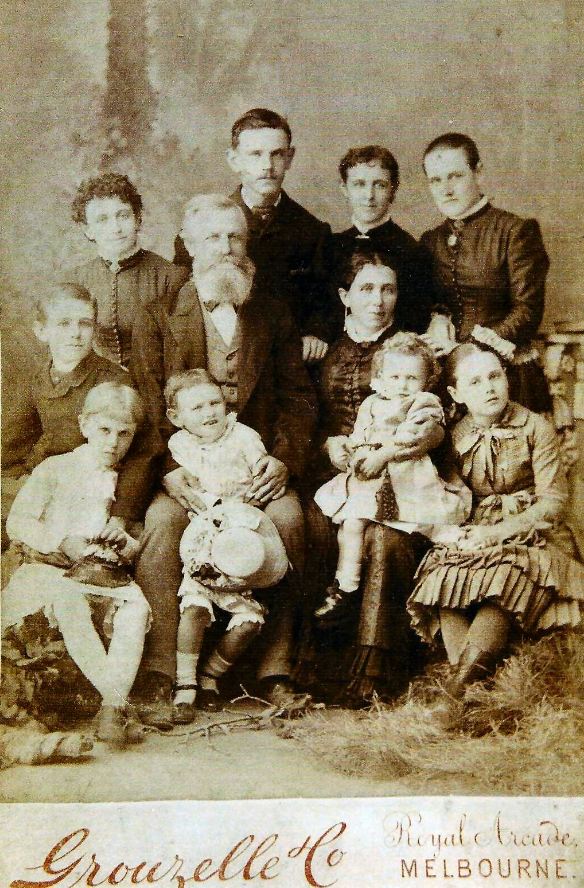
Photo of the Urie family kindly contributed by Mrs Noelle Nathan 26 Apr 2010.

The James & Grace Urie family, Flemington 1884.

Related posts:

23-07-1890: James Urie, principal partner in the firm Ferguson & Urie dies.

25-07-1890: The late Councillor Urie.


Short link to this page: http://wp.me/p28nLD-H2

© Copyright

25-07-1890: The late Councillor Urie, Flemington, Victoria.


The North Melbourne Advertiser, Friday 25th July 1890, page 2

“THE LATE COUNCILLOR URIE”

“Councillor James Urie died at his residence, Wellington Street, Flemington, on Monday evening, after an illness which barely extended over a week and which, in its first appearance, gave no indication or warning of fatal termination. The family of the deceased gentleman – and never was there a family more united or more affectionate – were led to expect the worst only a day or so before the end came, but it needed the exercise of true Christian resignation to enable them to bear up under the dreadful visitation. The people of Flemington and Kensington received the announcement of Cr Urie’s death with unfeigned sorrow. Outside the municipality the sad item of intelligence was discussed in terms that gave indubitable evidence of the general esteem in which the deceased was held. By the removal of a prominent public man such as Cr Urie the borough and district have sustained a grievous loss. Relatives, friends, and acquaintances have just cause to deplore the demise of one endeared to them by reason of innumerable good qualities, kindly disposition, and upright character. In commercial circles too, where his unswerving rectitude and sterling honesty in all matters of business were well known, the deceased merchant will be greatly missed.

            Mr Urie came to the colony from Scotland (his native land) early in the fifties and, after ‘roughing it’ in the usual pioneer fashion, started in trade in Curzon street, North Melbourne, and, by dint of genuine hard work, laid the foundation of the flourishing  Collins street firm of Ferguson and Urie. Some 17 years ago Mr Urie purchased the land in Wellington Street, on which his late residence now stands, and erected thereon a house for his mother. On the death of the old lady he enlarged the house, removed there with his family, and continued to reside there for the remainder of his days. The deceased took deep interest in the progress of the borough, and when the agitation for the removal of the cattle yards was begun he joined in the crusade with all the ardour of an enthusiast. For six years he occupied a seat in the Borough Council, and once held the position of Mayor. As a councillor he performed his duties without fear or favour, bringing with him to the Council table the same honesty of mind and singleness of purpose which characterised all his actions outside, His return at the head of the poll at the last municipal election may be taken as evidence of the popularity of the deceased gentlemen. CR Urie was a staunch supporter of the present member for the district, Mr Deakin, and at the general elections last year acted as chairman of the committee for the Flemington district. The deceased was a leading member of the Presbyterian Church and chiefly to his exertions and assistance is due the presence of ‘the Kirk’ in Norwood Street. In private life Mr Urie was distinguished for his imperturbable good humour, his lack of ostentation, and for general all-round ‘goodness’.

            The funeral left Wellington Street about half-past three on Wednesday afternoon, the procession being the most imposing seen in the borough. The employės of Messrs Ferguson & Urie marched in front of the hearse, then came four mourning coaches and upward of fifty vehicles. Immediately following the mourning coaches came a hansom, in which the Hon Alfred Deakin was seated, then next in order a buggy containing the deceased gentleman’s council colleagues. Crs Millar (mayor) and Barrett. The other members of the council, Mr Cattanach (town clerk), Mr McIver (surveyor), Mr Elmslie (valuer), Mr Glyn (foreman of works), Mr Ryan (borough inspector), were also in attendance. Essendon Council was represented by the Mayor and Cr Hanna, and North Melbourne Council by Cr Fogarty. Rev J. Thomson, minister, and the adherents of the Presbyterian Church, the president and leading members of the Australian Natives Association, the business people of the borough, and a number of private citizens also followed the remains to the cemetery. The funeral arrangements were conducted by Mr A. Allison, of Victoria street, in his usual efficient manner.

            Deceased was interred in the Presbyterian section of the Melbourne Cemetery, the pall bearers being Messrs James and William Urie, Ferguson, Yeaman, G. Young, Cr Millar, and the Hon A. Deakin. Rev J. Thompson delivered a brief address at the grave.”

This photo is a portion of the Ferguson & Urie employee poster kindly provided by Mrs Noelle Nathan via Mrs Valma Jean McPhail, April 2011.

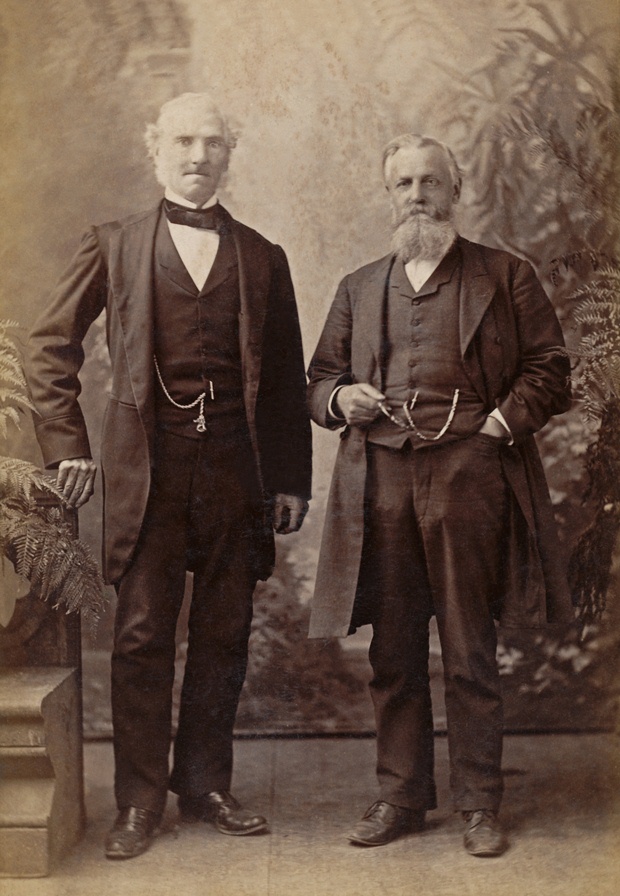
James Urie, June 1887

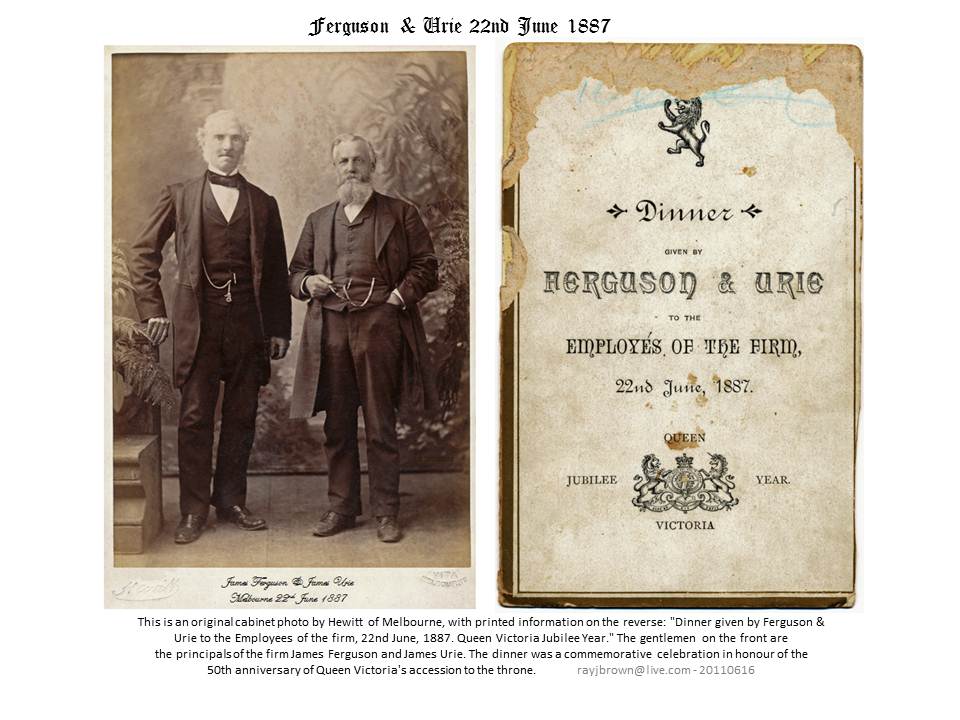
The photo below is from my family history collection and shows James Ferguson and James Urie in a portrait taken specifically for the occasion of the company dinner held at the North Melbourne Mechanic’s Institute on the evening of the 22nd June 1887.

James Ferguson & James Urie 1887


Related posts:

31-08-1855: James Urie marries Grace Hardie Young.

23-07-1890: James Urie, principal partner in the firm Ferguson & Urie dies.

29-08-1890: Letter of Condolence from the Borough Council to Grace Urie.

External links:

‘Urie, James (1828–1890)’, Obituaries Australia, National Centre of Biography, Australian National University, http://oa.anu.edu.au/obituary/urie-james-14449/text2553.
(Transcription originally submitted by Ray Brown – Feb 2012)

Short link to this page: https://wp.me/p28nLD-GX

© Copyright

29-10-1886: James Urie’s house in Wellington Street, Flemington

North Melbourne Advertiser, Vic, Friday 29th October 1886, page 4.

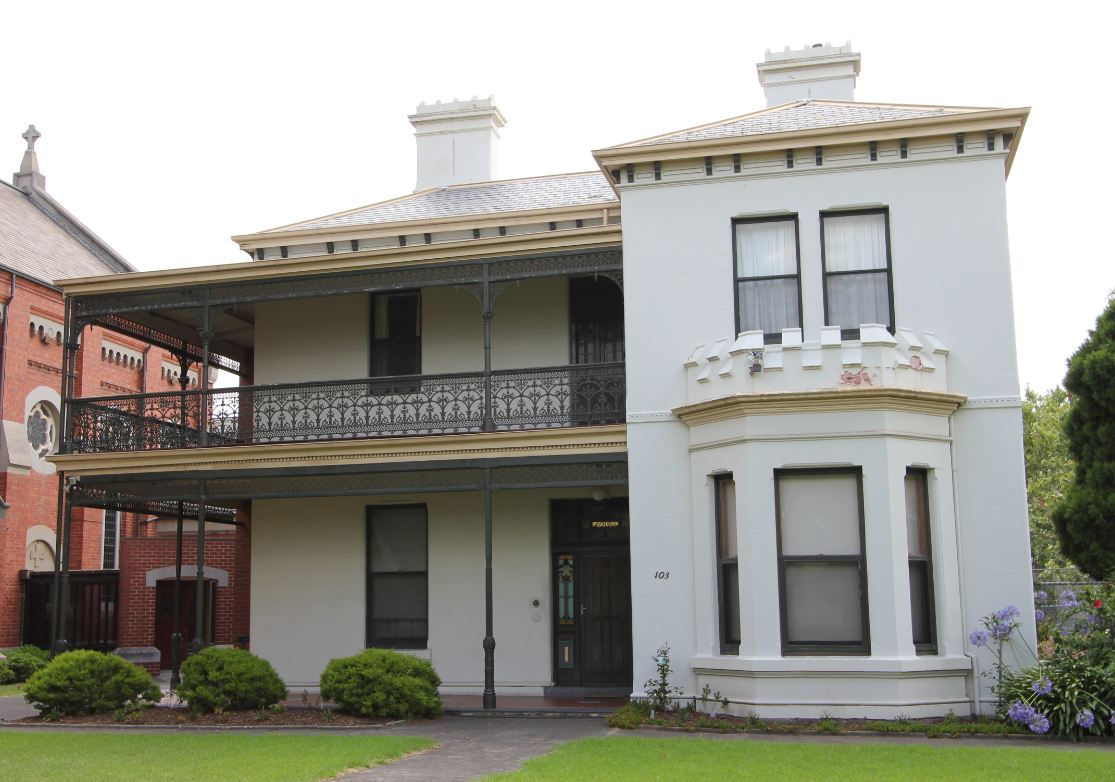
“… a fine balcony house (Glencairn) with patent white stone front (very effective), built by Cr. James Urie in Wellington street. A grand view can be obtained from here as the house stands on one of the highest points of the suburbs…”

Photo of James Urie’s Wellington street, Flemington house “Glencairn”. Possibly circa 1900. Photo from Roslyn Hyde, December 2011.

Note: The lower half of the ground floor windows clearly show that there was original stained glass but this no longer exists (2012).

‘Glencairn’, now known as St Brendan’s Presbytery, as seen in 2012.

Related posts: 21-11-1865 >19-02-1874 > 18-09-1885  >  23-07-1890 > 25-07-1890 > 29-08-1890 > 20-07-1899


Short link to this page: https://wp.me/p28nLD-Ee

© Copyright