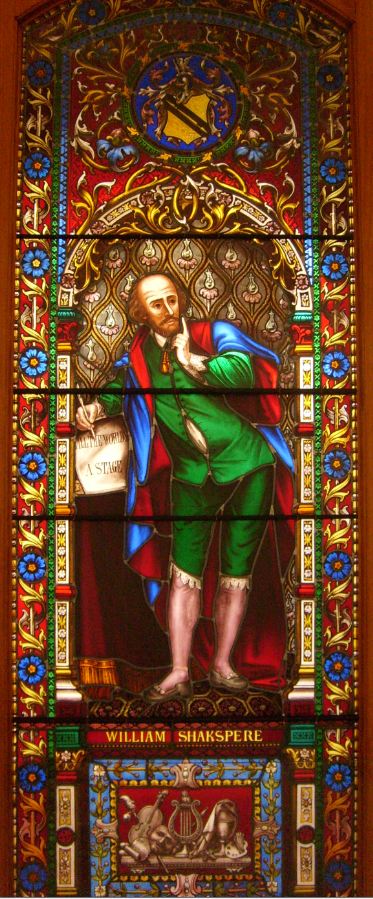
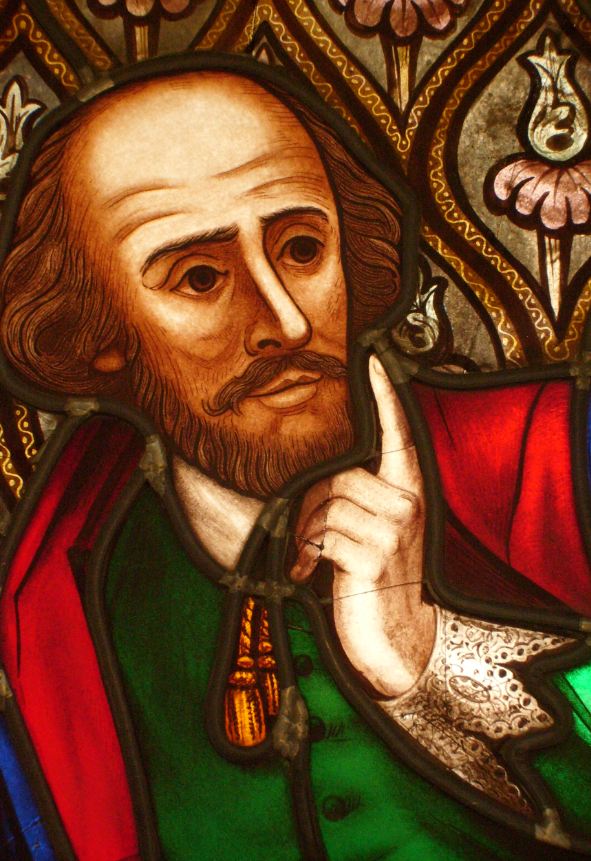
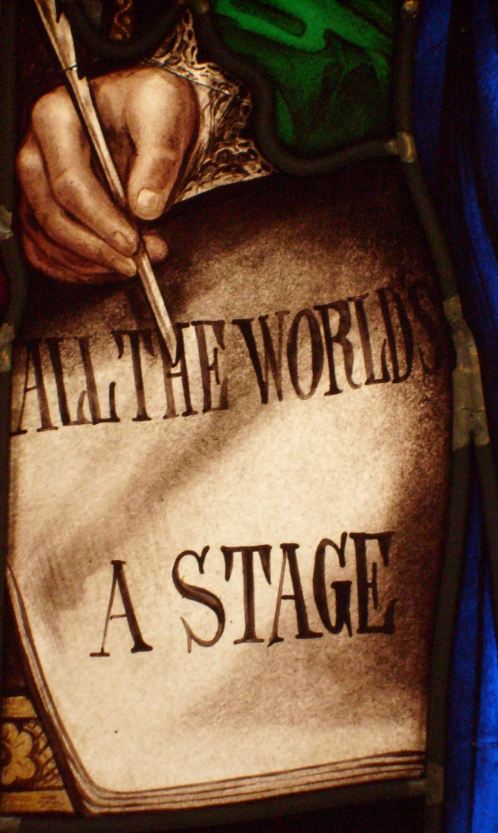
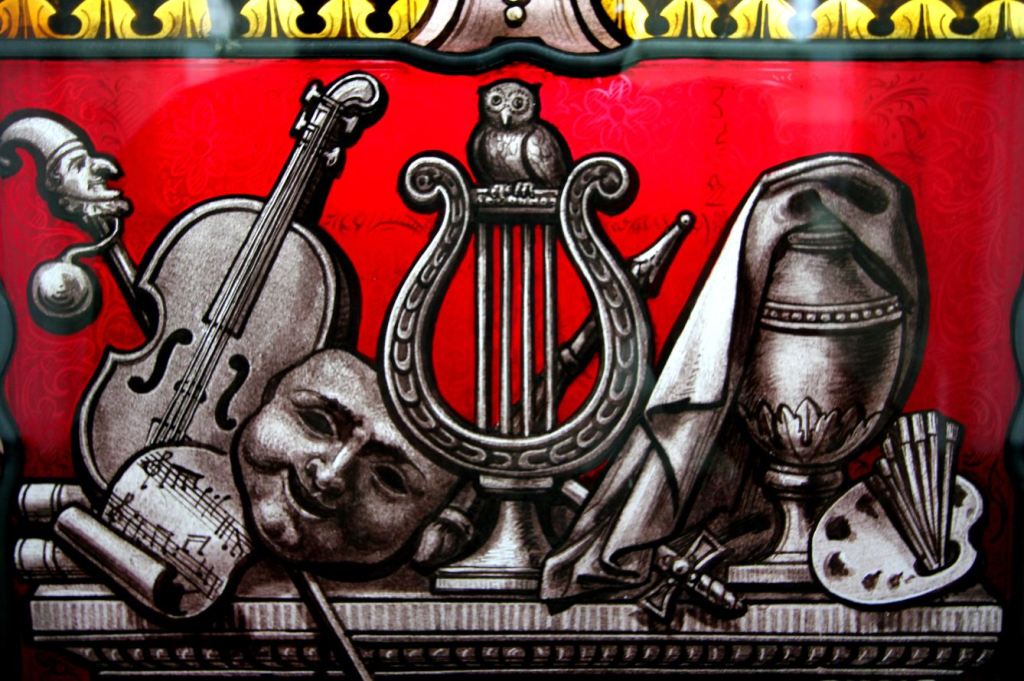
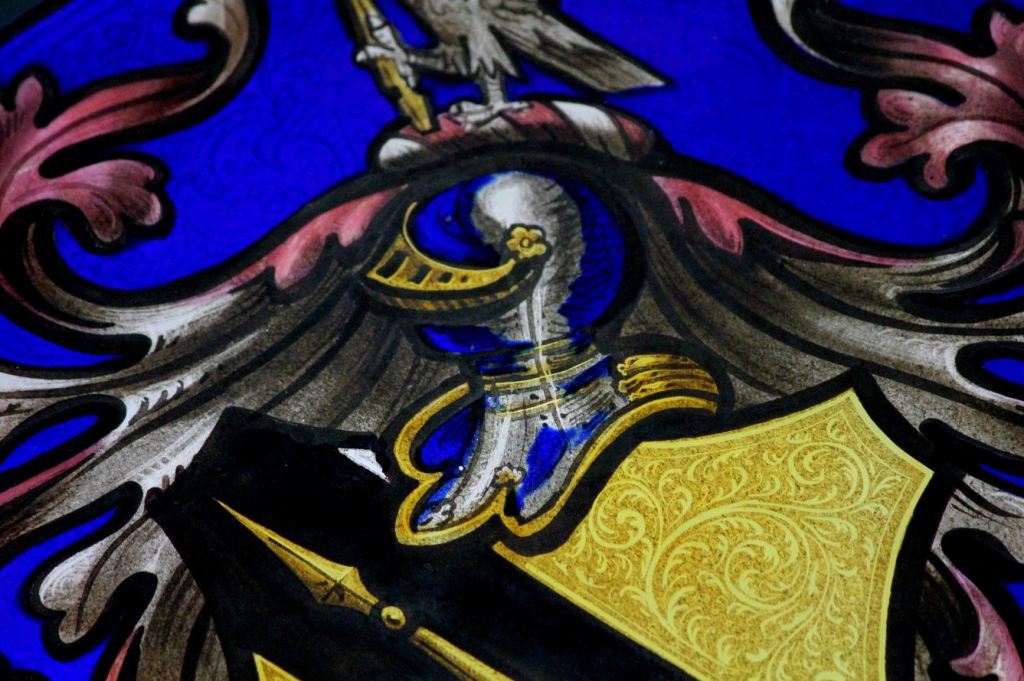
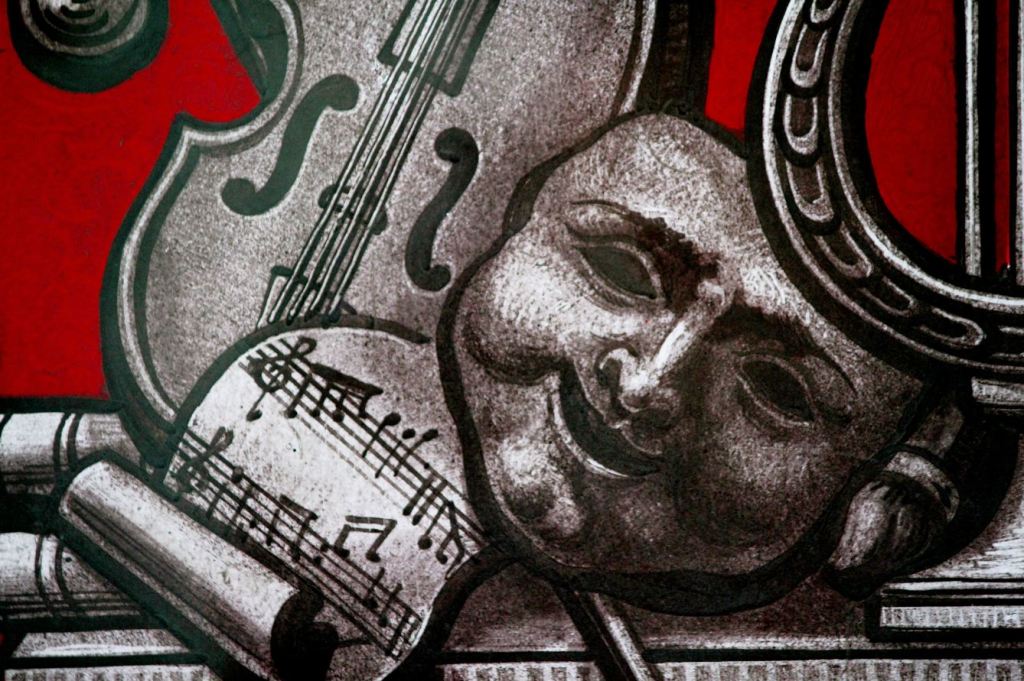
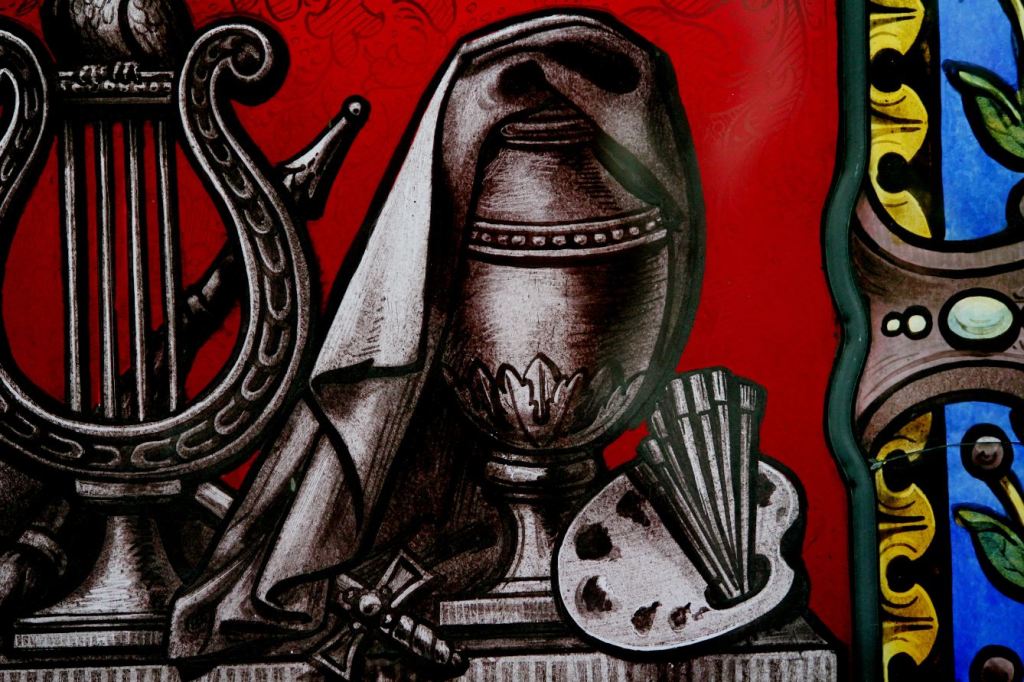
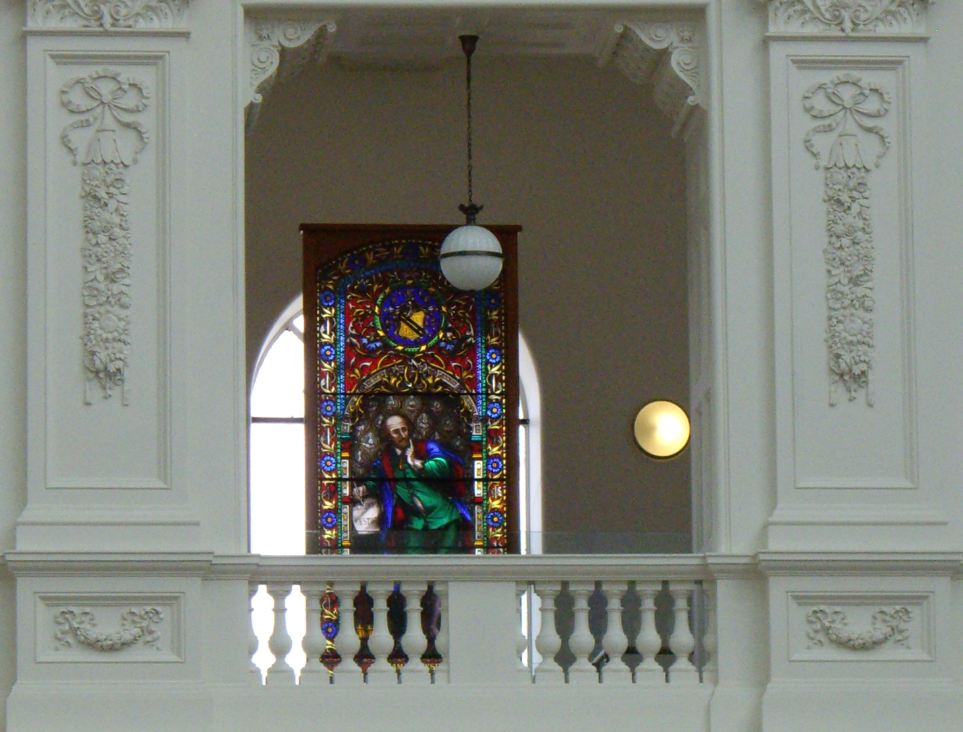
06-08-1862: The Apollo Music Hall Shakespeare window.

The Argus, Melbourne, Wednesday 6th August 1862, page 5.

WEDNESDAY, AUGUST 6, 1862. (1862, August 6). The Argus (Melbourne, Vic: 1848 – 1956), p. 4. Retrieved February 22, 2012, from http://nla.gov.au/nla.news-article5719688

“A creditable specimen of art-manufacture has just been completed by Messrs. Ferguson and Urie, of Curzon street, North Melbourne, at the Apollo Concert Hall in this city. It is a stained glass window, in three compartments; the centre representing a full-length portrait of Shakespeare, copied from Roubillac’s faulty statue; and the side lights being filled with figures of Hamlet, Falstaff, Beatrice, and Lady Macbeth. The primary colours employed are brilliant and transparent; and the upper and lower portions of the central window, as well as its border, possess much merit both as regards design and colour; but the figures have been less successfully treated. That of Lady Macbeth is deformed, and resembles a washerwoman much more than the sublime sleep-walker. Hamlet and Beatrice appear to be portraits of John Kemble and Mrs. Mowatt respectively, and are less open to objection. But the skill of he artist is chiefly shown, as we have said, in the subordinate details of the window; and remembering the difficulties under which this art is pursued, even in Europe, owing to the nice proportions which require to be observed in the composition of the fluxes and the colouring matter, and the extreme care which has to be bestowed upon every stage of the process, the colonial manufacturers are to be complimented on the success which they have already achieved, and on the execution of a work which contains the promise of future excellence in the management of an intractable material and in the employment of delicate agencies”.

Quite an amusing description of the window I must say!
Also see related posts:

05-07-1862

12-07-1862 (photos)

External links:

Lady Macbeth (Sleepwalking scene)

08-05-1868: Advertisement for Brassworker.

The Argus, Melbourne, Thursday 8th May 1868, page 1.

“BRASSWORKERS.- WANTED, a first-class BRASS WORKER, accustomed to church work. Ferguson, Urie, and Lyon, Curzon-street, Hotham.”

20-11-1867: The fire in Curzon Street, North Melbourne.

The Argus, Melbourne, Wednesday 20th November 1867, page 5.

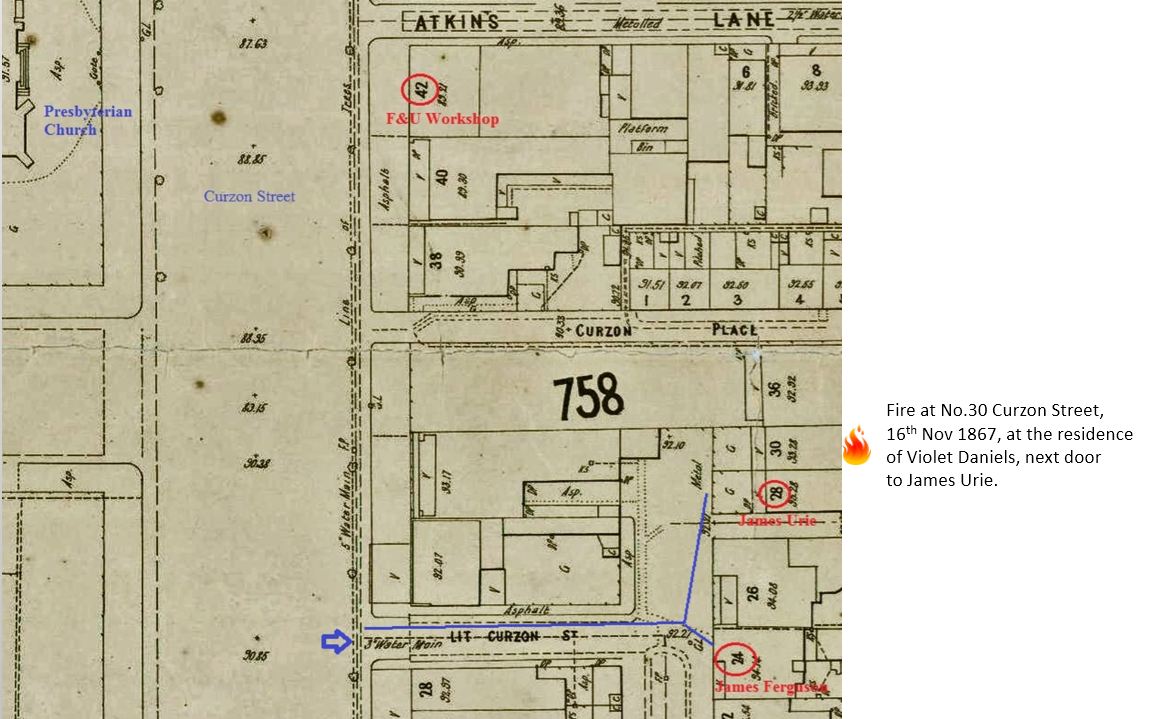
“Dr. Youl held an inquiry yesterday into the origin of a fire which burned down the premises No. 30 Curzon-street, Hotham, on 16th inst. The premises had been occupied by a Mrs. Violet Daniels who retired to bed on the evening of the 16th inst., having previously extinguished the fire and removed the matches. About twelve o’clock a constable discovered the fire and alarmed the inmates and all subsequent efforts to extinguish the fire proved unsuccessful. The flames afterwards spread to the adjoining premises and consumed a fowl-house valued at 5, and also damaged the premises of Mr. J. Urie, glass-stainer, to the extent of £20. About eleven o’clock on the night of the fire, a lodger in the house of Mrs. Daniels took a candle into an unoccupied room, for thee purpose of obtaining a drink of milk, but brought the candle back to his room. At that time there was no sign of fire. Urie’s premises were insured for £1,250, and Daniels’ for £200, and the furniture for £100. The loss beyond the insurance money was estimated by Mrs. Daniels at £100. A verdict of “Accidental Fire” was recorded”.

Curzon Street Fire 16 Nov 1867

James Urie’s cottage was at No.28 Little Curzon Street and James Ferguson’s at No 24 Little Curzon street which were only a short distance to the rear of the companies stained glass workshops opposite the Union Memorial Church. 

As at 2012 the original workshop building (basically only the shell and facade under redevelopment) still exists opposite the Union Memorial Presbyterian Church but is now numbered 42 Curzon street.  Prior to its residential transformation it was used as the North Melbourne Masonic Lodge. As at 2013 the front section of the original workshops has been completed as a private residence with further work to be completed to the rear section.

James Ferguson & James Urie offered up their Little Curzon Street cottages for auction in November 1886 as both partners had by this time built their new two storey mansions in Parkville and Flemington.

James Ferguson had his mansionAyr Cottagebuilt in Leonard Street Parkville and James Urie had builtGlencairn‘ in wellington Street in Flemington.


Short link to this page: https://wp.me/p28nLD-9P

© Copyright

20-07-1867: St Jude’s Church, Carlton, Melbourne, Victoria, Australia.

The foundation stone of St Jude’s Anglican Church at Carlton was laid on the 18th October 1866 by Bishop Charles Perry.

The church was designed by architects Reed & Barnes and built by John Pigdon and it was officially opened on the 3rd March 1867.

Amongst the many historical artifacts in the church are the original liturgical east and west stained glass windows by the Ferguson & Urie stained glass company of North Melbourne.

Illustrated Australian News for Home Readers, Saturday 20th July 1867, page 4.
(Repeated , Saturday 27th July 1867, page 4).

 “ST. JUDES CHURCH, CARLTON”

 “The foundation stone of St. Jude’s Church was laid by the Lord Bishop of Melbourne, on the 18th of October, 1866; and that portion of the building now erected was opened for public worship on the 3rd of March, 1867 …”

 “… The windows are glazed with Cathedral glass, and neatly bordered with stained glass. The chancel window, which is of beautiful proportions, is further ornamented with the emblems of Faith, Hope and Charity, chaste in design, brilliant in coloring, and effective in execution. The artists were Messrs Ferguson, Urie and Lyon, who obtained great credit at the recent Intercolonial Exhibition …”

Photos taken: 26th September 2010.

This slideshow requires JavaScript.

[View larger images]

The historic “Faith, Hope and Charity” window was restored in February 2009 by Geoffrey Wallace Stained glass at Caulfield.

In the early hours of Saturday 18th October 2014 a suspicious fire broke out at the liturgical east end of the church and a large portion of the historical 147 year old Ferguson & Urie “Faith, Hope and Charity” stained glass window was destroyed.

See Sky News report about the fire:

I went to Carlton on Sunday 19th for a look and it appears to me that something flammable has been thrown through the window or a heavy object first and then something flammable. As recently as 20th July 2014 I took a photo of the outside of the window which surprisingly did not have any external wire or perspex protection at all. If it did have protection then the vandals would probably have failed or not even attempted this mindless destruction in the first place.

A Chanel 7 news report on Sunday 19th indicated that two men had been questioned over the fire but have been released without charge.

Related posts:

10-06-1867 – The 1867 Melbourne Intercolonial Exhibition.

Short Link to this page: http://wp.me/p28nLD-7I

10-06-1867: The late 1866 Melbourne Intercolonial Exhibition.

The 1867 Melbourne Intercolonial Exhibition.

Results of the late Intercolonial Exhibition – Special Awards made on behalf of the commissioners by the council of chairman or jurors.

The Argus, Melbourne, Monday 10th June 1867, page 7.

In Class V: “[…] Ferguson, Urie & Lyon. – For enterprise and skill in the production of stained glass for ecclesiastical purposes, and for their liberal contributions to the Medieval Court […]”.

02-05-1867: Presbyterian Church, William Street, West Melbourne

The Portland Guardian and Normanby General Advertiser, Thursday 2nd May 1867, page 2.

“NEW PRESBYTERIAN CHURCH IN MELBOURNE.”

“The new West Melbourne Presbyterian Church, at the corner of Lonsdale and William-streets, says the Herald, was opened yesterday[…]”

“… There are fourteen large beautifully stained glass windows, which, in addition to the ordinary devices, contain short texts of Scripture, in English, and towards the top of each is a stained glass ventilator, bearing severally as a design the rose, the thistle, the shamrock, and the burning bush, the emblem of the Church of Scotland. The windows, which are all the work of Messrs. Ferguson and Urie, of this city, cost £700.”

The West Melbourne Church was dismantled in 1935 and re-erected as St Andrew’s at Box Hill.
For a complete slideshow of the Ferguson & Urie windows, see: 27-04-1935: St. Andrew’s, Box Hill.

West Melbourne Presbyterian Church 1870-75

West Melbourne Presbyterian Church 1870-75 (in-line image to State Library NSW)

Related posts: 29-04-1867 > 02-05-186727-04-1935 > 09-09-1935 > 16-12-1935 > 01-02-1936

29-04-1867: Presbyterian Church, William Street, West Melbourne, Victoria.

The Presbyterian Church, William Street, West Melbourne was opened for public service on Sunday 28th April 1867.

The Argus, Melbourne, Monday 29th April 1867, page 5.

 The new Presbyterian Church, William-street, West Melbourne, was opened for public service yesterday. The sermon in the morning was preached by the Rev. A. Robertson, the pastor; in the afternoon, by the Rev. J. Dare; and in the evening, by the Rev. Dr. Cairns. On each occasion the church was crowded. The building is of the later English Gothic, known as the Tudor style, and is constructed of bluestone, with freestone and pressed cement dressings. Inside it measures eighty-four feet by fifty-four feet, and it is forty-five feet high. It is arranged in amphitheater form, all of the seats being curved in shape, the curves of all being shrunk from one centre, and each rising above the one before it. The arrangement is commodious and effective. The seats afford sitting accommodation for 750 persons. The roof is one of open-timbered construction. The building is found well adapted for giving the fullest effect to the voice of the speaker.  It is lighted by seven large windows on each side, and these are glassed with stained glass. The beauty of the design and harmony of the colouring render these admirable specimens of the art. They are the work of Messrs Ferguson and Urie, to whom the colony is indebted for many artistic productions of the same kind. By night the building will be lighted from the ceiling by three powerful sunlight reflectors, the brilliancy of which will dispense with the need of pulpit lights. The architects for the church are Messrs. Smith and Watts, the contractors Messrs. Corben, Wilson, and Rankine. It is only the body of the edifice that has been erected, and the plan includes the erection of a tower at the end towards William-street, and vestry-rooms at the other. The part which has been built cost about £7,000; the estimated cost of the entire building is upwards of £12,000. The church commences its career with most favourable prospects, as upwards of 500 of the sittings have been already let. It may be added that on Tuesday evening a tea-meeting will be held in the old building (now to be used as a school-house), in celebration of the opening. The amount of the collections during yesterday was £114 18s 10d.

WEST MELBOURNE Presbyterian Church 01a

The West Melbourne Presbyterian Church was pulled down circa 1936 and re-erected stone by stone as St Andrews Church at Box Hill. Eleven of the original 14 nave windows were re-installed in the Box Hill church in the nave, one was donated to the Camberwell Presbyterian Church, and the remainder re-fashioned to fit other parts of the Box Hill Church. As a fund raising venture the decided to allow parishioners, at a nominal cost, to have new memorial dedications placed in the lower edge of the Ferguson & Urie stained glass windows.

The entire cycle of windows were crafted by Ferguson & Urie and when the Box Hill Church was being built, the church devised a fund raising exercise, that included the addition of new memorial dedications  in the lower portions of the original stained glass windows. From an historical point of view this has confused many historians as to who could have made the windows as the memorial dedications had dates indicated much later than the Ferguson & Urie company existence.

The full cycle of stained glass windows can be see on the article about St Andrews Church at Box Hill.

Related posts: 29-04-1867 > 02-05-186727-04-1935 > 09-09-1935 > 16-12-1935 > 01-02-1936


Short link to this page: https://wp.me/p28nLD-7m

© Copyright

14-03-1867: Application for land in Curzon street, North Melbourne, Victoria.

The Argus, Melbourne, Thursday 14th March 1867, page 2S.

 James Ferguson and James Urie apply for transfer of an allotment of land in Curzon street Hotham adjoining their current Curzon street premises.

“TRANSFER of LAND STATUTE – No. 1222

JAMES FERGUSON and JAMES URIE, each of Curzon-street, in the Borough of Hotham, plumbers and glaziers, have APPLIED to bring the land described at the foot hereof under the above statute; and the Commissioner of Titles has directed notice of the application to be advertised in “The Argus” newspaper, and has appointed fourteen days from such advertisement after which time the land will be brought under the operation of the statute, unless a caveat shall be lodged forbidding the same. Dated the 12th day of March, 1867.

 LAND REFERRED TO.

Part of the Crown allotment 13, section 1, town of Melbourne, parish of Jika Jika, county of Bourke, commencing at a point 65 feet east from the south-west corner, thence further east 25 feet, thence north 58 feet, thence west by a road or way 90 feet, thence south by Curzon street 20 feet, thence east 65 feet, and thence south 20 feet to commencing point.

W. K. HUGHES, Registrar of Titles, Malleson and England, 24 Queen-street, applicant’s solicitors”.

19-02-1867: Advertisement for Lead-Light Glazier.

 The Argus, Melbourne, Tuesday 19 February 1867, page 1.

 “WANTED, a good lead-light GLAZIER. Apply Ferguson, Urie & Lyon, Curzon-street, North Melbourne”

20-12-1866: The Medieval Court at the 1866 Melbourne Exhibition

The Chancel windows of Christ Church Anglican at Casterton in Western Victoria were displayed at the 1866 Melbourne Exhibition.

The Ferguson & Urie stained glass company created and decorated an entire chancel for the Exhibitions ‘Medieval Court’ display and the stained glass windows were the central exhibit before being installed in the Casterton Church. Who was actually contracted to install them is still a mystery as the first two windows were installed out of sequence with the ‘Passion’ preceding the ‘Nativity’. Also of note is that Joseph does not appear in the Nativity scene.

The coloured photos were taken 8th January 2011.

This slideshow requires JavaScript.

The Australian News for Home Readers, Vic, Thursday 20th December 1866, page 8.

“MEDIEVAL COURT”

“One would scarcely expect to find a Medieval Court in an exhibition of the products, of a new colony; but such a court there is, intended to illustrate portions of ecclesiastical architecture; and it constitutes, perhaps, the most pictorially effective part of the whole building. Messrs Ferguson, Urie and Lyon, glass stainers, Curzon-street, North Melbourne, exhibit a decorated chancel, the ceiling of which has for a centrepiece the Agnus Dei, surrounded with scriptural texts and gothic clouds. The other portion of the ceiling is divided into twelve compartments, having the emblems of the twelve Apostles. The walls are diapered with simple but chaste pattern. It is lighted with five stained glass windows, the subjects of which are the Nativity, Passion, Crucifixion, Resurrection and Ascension. These windows are made for the chancel of the church at Casterton, and are exhibited by permission of the Rev. Dr. Russell. At the altar are two richly illuminated tablets of the commandment, Lords prayer and creed; also an illuminated painting of the Last Supper. A considerable quantity of stained glass is exhibited, consisting of ecclesiastical and domestic styles; also, numerous samples of stained and embossed borders and small subjects. On the right hand side of the court is a carved baptismal font in Caen stone, designed and executed by Mr John Young, contractor, Melbourne. It is all colonial workmanship. The upper portion is octagonal, representing the four Evangelists. At the top of the shaft are masses of carved foliage with heads interspersed, while at each angle of the shaft, which is double, are buttresses wreathed and moulded. The outer one has got headed open panels cut entirely through showing the centre shaft of the interior. In the splays of he base are clusters of foliage carved from real flowers and leaves, but Gothicised after the decorated period. The base represents evil spirits in the form of dragons, emblematical of the Sacrament of baptism casting them down. The lid of the font is of carved colonial blackwood, polished, ornamented with wrought iron to suit the general workmanship of the whole. In this department are also some highly ornate water fonts, sculptured by Mr. F. Utyco; a number of figures carved in wood for the internal decoration of St. Patrick’s cathedral, an altar and fittings, some hand rails, and several statues of saints.”

The 1866 Melbourne Intercolonial Exhibition was held in a specially built ‘Great Hall’ on a site behind the State Library’s Queens Hall in Swanston Street Melbourne.

Casterton Christ Church 99A


Short link to this post: https://wp.me/p28nLD-6V

© Copyright