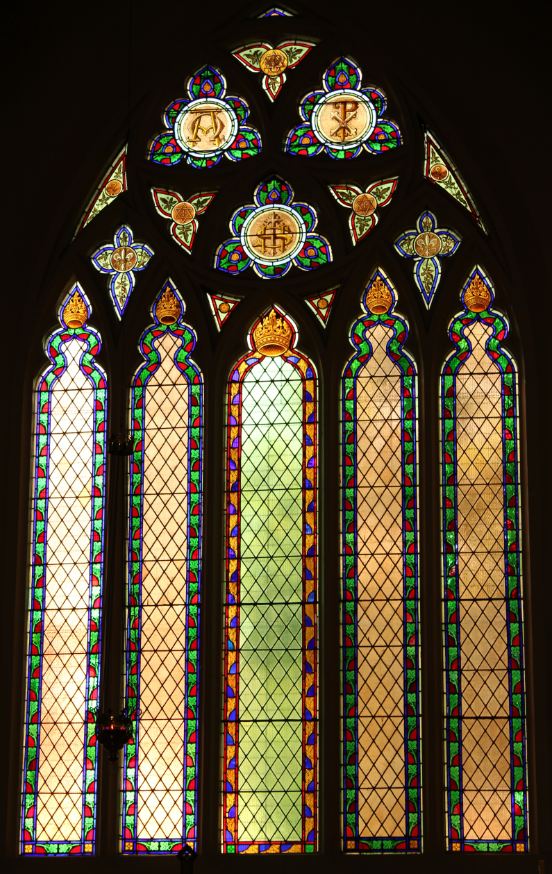
10-03-1888: The 1888 Ferguson & Urie Employee Dinner.

North Melbourne Advertiser, Saturday 10th March 1888, page 2

“Messrs. Ferguson and Urie gave their Annual Dinner to their employės in the North Melbourne Town Hall, last evening, when a most enjoyable time was spent, and a number of songs and recitations were indulged in. One of he principal toasts was the health of Mr. William Urie, who with his uncle, Mr, John Yeaman, leaves by the R.M.S. Victoria to-day, on a nine months trip to the old country. A full report will appear in our next issue.”


Related pages: (Full transcriptions of the dinners).

The 1886 Employee Dinner
The 1887 Employee Dinner
The 1888 Employee Dinner

25-06-1887: The 1887 Ferguson & Urie Employee Dinner.

The North Melbourne Advertiser, Saturday 25th June 1887, Page 3

“MESSRS FERGUSON AND URIE’S DINNER TO THEIR EMPLOYEES.”

The 1887 Employee dinner was probably one of the most significant occasions in the company history as there is some magnificent pictorial evidence. Two significant historical photos were discussed at the beginning of the dinner and copies of both still exist.

The first photo mentioned was the portrait of James Ferguson and James Urie together and the second one was a large poster collage of James Ferguson & James Urie in the centre surrounded by 29 photos of the employees of the time and the three business premises at Collins Street Melbourne, Curzon Street North Melbourne and Yarra Bank South (which burnt down on the 31st Jan 1888).

The full transcription of the evenings proceeds can be seen here: The 1887 Employee Dinner

The magnificent 1887 employee poster was kindly provided via Mrs. Noelle Nathan from the James Urie family line, 17th Apr 2011 and the James Ferguson & James Urie portrait is from my family history collections.

This slideshow requires JavaScript.

Related pages:

1886: The 1886 Employee Dinner
1887: The 1887 Employee Dinner
1888: The 1888 Employee Dinner

19-04-1886: Jane Ferguson (nee Lawson) (1820-1886)

Jane Williamson Lawson (1820-1886) was the eldest daughter of Gavin Lawson and Margaret Williamson of Ayrshire Scotland. At the age of 21 Jane married Master Slater and Glazier James Ferguson (1818-1894) on the 13th June 1841 in St Quivox, Ayrshire, Scotland.

Between 1842 and 1852 James and Jane had five children; Margaret (mentally disabled from birth) born 1842, Janet Kay 1844, Jane Williamson 1846, Marion 1948, James 1851 (died as an infant) and Antonia Wallace in 1852.

On the 12th December 1852, her husband James and his younger brother David departed Greenock, Scotland,  aboard the “Tamerlane” bound for Melbourne, Australia. A very patient Jane would wait in the “old country” for three years with the children whilst James established the business in Melbourne with his business partner James Urie.

In November 1855 Jane and the five girls arrived in Port Melbourne aboard the “Emma”. A further three children were born in Melbourne; Barbara in 1856, Sarah Campbell in 1859 and James Jnr in 1861.

In 1886 James had his two storey gothic design house built  in Leonard street Parkville by local architect Harry Lording, but Jane would never step foot in.

Jane died on the 17th of April 1886 and  James would eventually move into the Parkville mansion as a widower, accompanied by his bachelor son James Jnr, and eldest mentally disabled daughter, Margaret.

Photos from the family history collection.

This slideshow requires JavaScript.

The Argus, Melbourne, Monday 19th April 1886, page 1.

“FERGUSON – On the 17th inst, at her residence, 24 Little Curzon-street, Hotham, Jane, the dearly beloved wife of Mr. James Ferguson, aged 66 years”.

“THE Friends of Mr. JAMES FERGUSON, of Ferguson and Urie, are respectfully invited to follow the remains of his late beloved wife, Jane, to the place of interment in the Melbourne General Cemetery. The funeral will leave his residence, 24 Curzon street, Hotham, at half-past 4 o’clock, THIS DAY. ALFRED ALLISON, undertaker, 40 Victoria-street west, Melbourne”.

16-04-1886: The 1886 Ferguson & Urie Employee Dinner.

There was a consecutive three year period where the Ferguson & Urie company held annual dinners for their employees, between 1886 and 1888. Each occasion was extremely well documented in the North Melbourne Advertiser which wrote in extraordinary detail of the evenings festivities. Each of these historic events is a truly remarkable account of the Ferguson & Urie company history.

Each dinner was held in the “Hotham Mechanics Institute” which was part of the North Melbourne Town Hall. When North Melbourne merged with the Melbourne City Council  in 1905, it was no longer officially the Town Hall and the building now hosts the North Melbourne Post Office, the Arts House, Conference and Events, and a number of small businesses at the street level.

The first Ferguson & Urie company dinner was held  on the 9th of April 1886, and the evenings festivities were documented in, “The North Melbourne Advertiser, Friday 16th April 1886″, which published an article titled  “A PLEASANT GATHERING”.

To read the full transcript of the dinner see: The 1886 Employee Dinner

Photos of the North Melbourne Town Hall dated 13th Nov 2011.

This slideshow requires JavaScript.

For a full transcription of the other dinners see:

The 1887 Employee Dinner
The 1888 Employee Dinner


Short link to this page: https://wp.me/p28nLD-D6

© Copyright


29-04-1882: “Lisava”, 13 Chetwynd Street, North Melbourne.

John Daly, Esq, sells his house “Lisava” in Chetwynd Street North Melbourne by public auction.

The Argus, Melbourne, Saturday 29th April 1882, page 14.

“THURSDAY, MAY 18. At Twelve O’Clock. HOTHAM. Chetwynd-street, Close to Victoria-street. HANDSOME RESIDENCE, known as LISAVA, Ten minutes walk from general Post-office […]”

“[…] The lobby window and hall fanlights are of stained glass, beautifully constructed by Messrs. Ferguson and Urie […]”

The house no longer exists. Nothing further known about the fate of the stained glass windows.

30-03-1882: David Relph Drape, Stained Glass Artist, (1821-1882)

In the nineteen year period between 1863 and 1882, an English artist by the name of David Relph Drape can lay claim to being one of the Ferguson & Urie stained glass companies most talented in the field of glass painting and staining.

Drape was born at Greenrow, Cumberland, England in 1821, the son of Quaker parents, Isaac Drape and Catherine Relph.
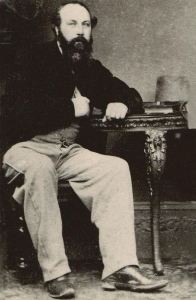
David Relph Drape c1880

David Relph Drape c1880

Little is known of his early life or what steered his artistic talents. His father Isaac (1790-1822) died when he was only one year old but his family would assure his education. Many members of his father’s family were from a long line of educators with interests in mathematics and navigational astronomy. A number of them had close ties to the Greenrow Academy which was founded in 1780 by his grandfather John Drape (1751-1793) who was a principal of the establishment until his death. It was then followed by John’s brother-in-law, Joseph Saul (1769-1842),  then Saul’s son John (1804-1853). Isaac Drape (1813-1870), a grandson of the academy’s founder, (David’s first cousin) took over as headmaster of the Academy in 1853 and it eventually closed after his death 1871.

It hasn’t been proven as to whether David was a student at the academy, but it would certainly seem highly likely during the period when his mother’s brother, Joseph Saul, was headmaster of the school until 1842.

Drape’s early thirties start to reveal his business exploits and talents. He was in the employ of a local Carlisle painter named William Atkinson from circa 1845 and in February 1854, Mrs Mary Atkinson, the widow of the late William Atkinson, decorative painter of 5 Abbey Street Carlisle, placed an advert in the Carlisle Patriot tabloid stating that she had engaged “Mr. David R. Drape, who was for a number of years Foreman for her late husband…” [1] Drapes association with William Atkinson may be the clue as to where he gained his first apprenticeship as a decorative artist, but his continuation as a foreman for the widow Mary Atkinson was very short. By early 1855 he had formed a partnership with another Carlisle tradesman named John Scott whose father, John Scott Snr, had retired and passed the business to his son. A dual advertisement for John Scott Snr’s retirement and the new Scott & Drape business appeared in the Carlisle Patriot, 3rd March 1855.

The Scott & Drape’s business advertisements began to appear in the Carlisle Patriot as:-

“SCOTT & DRAPE – PLAIN AND DECORATIVE HOUSE PAINTERS, ECCLESIASTICAL AND HERALDIC DECORATORS, ILLUMINISTS, GLASS STAINERS, CARVERS, GILDERS, GLAZIERS, &c., &c.” [2]

In November 1855 Scott & Drape created a stained glass window to the memory of Drape’s cousin, John Saul[3] who was principal of the Green Row Academy from 1842-1853. The window was to be erected in the west end of St Paul’s Church, Holme Cultram (now known as St Paul’s Causwayhead):

“ST. PAUL’S CHURCH, HOLME CULTRAM.- A very beautiful window of stained glass has just been inserted in the west end of this church, as a memorial to the late Mr. John Saul [4], of Green Row. The background is a rich mosaic of azure and ruby, upon which two large medallions are placed, representing the Adoration of the Shepherds, and the Presentation in the Temple; in the upper part of the window is a cross of a golden hue in the midst of a floriated ruby background, surrounded by the motto Hoc Signo Vinces[5]. A Latin inscription at the base states that the window has been placed there by the friends and pupils of Mr. Saul. The grouping, drapery, and expression of the various figures are remarkably fine, and reflect great credit upon the artists, Messrs. Scott and Drape, of this city.”[6]
[My research to-date indicates that this window no longer exists.]

A significant clue as to the style of glass painting Scott & Drape adopted is revealed in their advertisements; “S. and D., respectfully invite an inspection of their unique Specimens of Glass painting, in the style as now practiced by the Bavarian Artists at Munich.” This was undoubtedly in response to the debacle at Glasgow Cathedral in 1856 where the Cathedral authorities had awarded a large contract to the Royal Bavarian Glassworks to provide 60 or more stained glass windows for the Cathedral. English and Scottish stained glass craftsmen and artists were enraged with the decision and considered it as robbing them of their birth right. The Master Glazier to the Cathedral, David Kier, who installed the Bavarian windows, even felt compelled to adopt the same style of glass painting in his own windows and this seemed to force varying degrees of adaption to the Munich style that spread amongst the English and Scottish stained glass establishments until late into the 19th century.

Over the next four years Scott & Drape expanded their business and employed a number of tradesmen and apprentices. Their workshops at 23 Rickersgate, Carlisle, became well known and it was frequented numerous times by the local tabloids who were eager to report on their ecclesiastical decorations.

In 1855 Carlisle Cathedral was undergoing significant renovations but there was considerable debate amongst the authorities as to the proposed “highly ornamental” decorations which were opposed by the Bishop who had a preference for a more subdued tone. After a number of months had elapsed without a decision, the famous architect and designer Owen Jones was consulted to break the impasse; “Accordingly that gentleman visited Carlisle, examined the respective specimens and has just sent in his recommendation, which have been adopted, and are to be carried out forthwith by Messrs. Scott & Drape, carvers, gilders, and decorators, of this city.” [7] One of the major tasks to be undertaken for these renovations included the decoration of the Cathedral ceiling which Jones recommended to be in a blue azure dusted with gold stars and gilded angels;

“The panels are to have a ground work of bright azure, powdered with gold stars (that is the technical phrase); the ribs and bosses are to be painted various colours, red, blue, &c., and the coats of arms and other armorial bearings are to be restored after the most accurate heraldic designs; the angels which surround the cornices are to be gilded and coloured, and the large angels on the hammer beams are to be treated in a similar manner…” [8]

At the same time Scott & Drape were working on the Carlisle Cathedral renovations, they had completed a stained glass window for St Paul’s Anglican Cathedral, Dundee in April 1856 and they were permitted to display it in the north transept of the Carlisle Cathedral;

“A beautiful stained glass window, executed by Messrs. Scott & Drape, of this city, for the New Church, at Dundee, has been exhibited in the north transept of our [Carlisle] Cathedral during the past week…”[9]

The window was described as 18ft high, excluding tracery windows, and consisted of two lights. In the left light depicted the Good Shepherd with Christ’s Charge to Peter below and in the right light, the Saviour as the Sower with the Sermon on the Mount below.[10] As at August 2015, this window has been identified as extant in St Paul’s Cathedral at Dundee.

In July 1856 Scott & Drape completed a single light memorial window for a church at Brough, Westmorland. “The subject is a panel formed by the interlacing branches of the vine, and represents the resurrection of our Lord…” [11] Evidence as to the existence of this window has not yet been ascertained.

In January 1857 a letter was penned to the editor of the Carlisle Patriot by “A.B”. The writer was specifically making a point about “Powell’s Glass” being the most successful imitation of ancient glass and that the firm of Scott & Drape were “in the habit of using it for some considerable time…” The author mentions that Scott & Drape; “directed my attention to a Rose window in the north transept, and one in the clere-storey of our Cathedral, both executed by them with Powell’s Glass.” [12] This indicates that the Rose window in the north transept of Carlisle Cathedral and clerestory window(s) were also the work of Scott & Drape, but these windows were not of coloured or stained glass. A window of plain (Powell’s) glass, with lead lines forming the shape of the hexagram, recently removed (c.2011) from the clerestory of Carlisle Cathedral for restoration, revealed the following text scratched into the surface of the glass; “Scott & Drape decorated & glazed this Cathedral AD 1856.” Another window from the clerestory also included the surname of an apprentice named “Johnstone.”

In June of 1857 Scott & Drape completed a further three stained glass windows for St Paul’s Church, Holme Cultram;

“The three side windows in the chancel of St. Paul’s Church have, this week, been filled with stained glass by Messrs Scott and Drape of this city. The general design is a cross with crosslets, in a style which accords well with the architecture of the church and prevailed in the thirteenth century. The border is of azure, emerald, and ruby, and the colours are particularly brilliant. The east window also was inserted by the same artists some time ago, and is a work highly creditable to them.” [13]

In October 1857 Scott & Drape were paid a visit to their Rickersgate workshops by a reporter from the “Carlisle Journal.” The subject of their visit was to inspect a stained glass window that was nearing completion for the Cheltenham Proprietary College. The window was to be of seven lights, 25 feet high and 14 feet wide;

“The design comprises fourteen figures, representing our Saviour, the apostles, and evangelists, each about four feet high. The figures are arranged in two rows one above the other, and are surrounded by perpendicular canopies…” [14]

The tracery windows were to comprise monograms and sprigs of Ivy with the central light in the tracery to contain the armorial bearings of the principal of the College, the Rev William Dobson who had commissioned and paid for the window.

On the 24th February 1858 the Cheltenham “Proprietary College Chapel” was formally opened and their window was further described in the tabloids which also indicated that two other windows on the east side were the work of Scott & Drape, being commemorative of officers who were former pupils of the College and who had lost their lives in the Crimea and India.[15] The Cheltenham College Register of 1890 further described the window;

“The window above the altar is a large transomed composition of seven lights, and has a double row of figures. In the upper tier are St. John the Baptist and six of the Apostles in the lower, our Saviour and the other Apostles. Inscription on Brass beneath:- ‘The window over the Communion table was presented by Rev. W. Dobson, M.A., Principal of Cheltenham College. A.D. 1858.” [16]

Sadly there is no longer any trace of Rev Dobson memorial window today. The Cheltenham College Archivist provided the following correspondence in August 2015;

“A new chapel was consecrated in 1896 and the old building became the College library. The stained glass from the window above the altar was removed and replaced with plain glass to allow more light in. What happened to the original glass remains, I’m afraid, a mystery. The old chapel is now the College dining hall and retains all its stained glass except for the window you describe…” [17]

In January 1858, David Relph Drape, Painter and Glazier of Carlisle, placed an advertisement in the Carlisle Patriot giving notice that he will no longer be liable for any debts that his wife “AMELIA ARMSTRONG DRAPE” incurs. [18] Extracts from Drape’s diaries penned by his granddaughter Elizabeth Bradshaw in 1970, indicate that “Amelia” was his first wife who had suffered a mental breakdown after the birth of their son. Amelia supposedly never recovered and was eventually admitted to a Lunatic Asylum. Their son was brought up by Amelia’s parents and on completing his education, is supposed to have taken up a career in the Navy. [19]

By March1858, Drape had received a life changing letter from the Antipodes. His diary extracts record that he received a tempting offer of employment in the Colony of Victoria, Australia, from a businessman named James Ferguson from the plumbing and glazing firm Ferguson & Urie of North Melbourne. This firm was transforming their business to become the first commercial stained glass company in the Colony, and arguably the whole of Australia, and they offered Drape a contract to join the firm as a senior stained-glass artist. Ferguson & Urie promised him, that on his arrival in the colony, there would be a brand new building erected and fitted out for the purpose of stained glass production. This, in conjunction with the knowledge that they would have a local monopoly in the stained glass industry was undoubtedly tempting. His mother Catherine had died[20] the previous year, his wife was in a Lunatic Asylum and his son was in the care of his in-laws. He accepted the offer. [21]

By early April of 1858 Drape had officially dissolved his partnership with John Scott at Carlisle[22] and he departed England aboard the ship “Morning Light” on the 3rd July 1858.

The ship arrived in Hobson’s Bay, Victoria, on the 20th of September 1858, and Drape’s greeting by James Ferguson and James Urie was undoubtedly less promising than he had anticipated. The stained glass workshops had not been built and there was no work for him. The gold rush had caused a massive downturn in building and construction in Melbourne. Every able-bodied tradesman had left the city high on the prospects of making their fortune on the gold fields. Drape is supposed to have torn up his contract with Ferguson & Urie, but, resigned to the fact that the economic circumstances and the gold rush was the root cause of the situation, he decided to set out for the gold fields himself. [23]

Drape remained in the vicinity of the central Victorian town of Maldon for the next four years making a meager living as an Architect, during which time he designed many buildings, including the historical Beehive Mine Chimney, the Holy Trinity Church, and the Maldon Hospital, all of which still exist today.

In 1860 and 1861 he was appointed secretary of the Concord Quartz Mining Association in Maldon.[24] Other minor pursuits included writing poems for the Tarrangower Times, sketching, painting, illuminated testimonials and parchments, and even an occurrence of designing the gravestone of Maldon resident John Bentley in 1864.

By 1860-62, thousands of tradesmen and failed gold miners had flocked back to the city eager to find employment. This meant that Ferguson & Urie could resurrect their plans for the stained glass workshop in Curzon Street, North Melbourne and in 1863 they enticed Drape back to Melbourne where he took position as one of the firm’s senior stained glass artists alongside John Lamb Lyon. Drape’s diary extracts record: “Com. work at Messrs Ferguson & Uries Nov. 8th/63…” [25]

By this time Drape had received correspondence from England that his mentally ill wife Amelia had died. This undoubtedly released a huge burden from him and his vision for the future with Ferguson & Urie in North Melbourne became much clearer.

One of the earliest stained glass windows that Drape is likely to have been involved with before starting with Ferguson & Urie in late 1863, was for the Holy Trinity Church at Maldon which he had designed and supervised the construction of in 1861. Coincidentally, when Drape had been living in Maldon from late 1858, a Scottish stained glass artist named John Lamb Lyon was also in the area of Tarrengower and Maldon and it’s highly likely that they may have collaborated together on the design of the window, which Lyon is likely to have executed at the Ferguson & Urie glass workshop in Curzon Street North Melbourne. This window is extant in the west wall above the entrance to Holy Trinity.[26] Lyon had joined the firm in late 1861 and Drape had commenced with the firm on the precise date of 8th November 1863.

On the 27th of August 1864, Drape married Jane Selby, whose family he had known back in Carlisle. Jane had emigrated to Australia earlier to care for her younger brother Joseph who had emigrated for the sake of his health.

David designed his modest cottage to be built in Chapman Street, North Melbourne, within walking distance of the stained glass workshops at Curzon Street. Between 1866 and 1873 they had four sons, Isaac Selby, John Campbell, David Saul, and Horace. [27]

When Lyon departed Ferguson & Urie in 1873 the firm decided that they needed to foster and encourage the young men of Melbourne to attain the skills required for the stained glass business. They established the Hotham School of Art expressly for the purpose and Drape played a part as a teacher in the field of Ornamental shading and Landscape. Drape was also one of the founding members of the Victorian Academy of Arts and an active committee member of the Hotham School of Art from 1873 [28].

During Drape’s nineteen years with the firm, he painted many landscape and portrait scenes in ecclesiastical and secular windows. Many of the scenes depicted in the roundels and other intricate parts of secular stained glass windows have his name almost invisibly hidden within the pictures, such as the hunting scenes in the extant windows of Rupertswood Mansion in Sunbury and the garden with creek scene at Mandeville Hall in Toorak.

The Maldon Museum in Victoria also has a number of paintings and pencil drawings by Drape and the State Library at Melbourne has a folio in their manuscripts collection that contain some of his original pencil sketches and designs for ecclesiastical and secular windows. Of his sketches and fragments of drawings held at the library, a number have now been positively identified and matched to extant stained glass windows in Victoria and New Zealand. There is also a complete design of the window for the chapel of Sacred Heart Girls School in Newtown, Geelong, the James Maitland memorial window at St Matthews Anglican Church in Dunedin, New Zealand, and numerous partial sketches for elements of the “Season’s” window located in the stairwell and hallway of Mandeville Hall in Toorak.

David Relph Drape died at his Chapman Street cottage on the 30th March 1882 [29] and was buried in the Melbourne General Cemetery the following day[30]. His wife Jane died at her son David’s residence at Neerim Junction on the 8th of November 1920, aged 92.

The slide show images below depict a number of Drape’s original drawings that have been matched to existing stained glass windows known of to date. There are many other sketches that have not been identified and these obviously leave scope for continued research. Other photos show examples of his initials deliberately hidden within some of the secular stained glass windows.

The photo of David Relph Drape was kindly contributed by Drape’s descendant, Mrs Val Goller (nee Woolstencroft) in 2010. Other images from the State Library of Victoria and personal research data & photos.

This slideshow requires JavaScript.

[Show larger images]

Related posts:

1875: Rupertswood Mansion, Sunbury, Victoria.

19-02-1874: The Hotham (North Melbourne) School of Art.

Footnotes:

[1] Carlisle Patriot, Cumbria, England, Saturday 25th February 1854, page 1.
[2] Carlisle Patriot, Cumbria, England, Saturday 16th May 1857, page 4.
[3] John Saul (1804-1853), Davids’s 1st cousin 1x removed.
[4] John Saul (1804-1853), Headmaster of Greenrow Academy 1842-1853)
[5] Latin: “In this sign shalt thou conquer”.
[6] Carlisle Patriot, Cumbria, England, Saturday 10th November 1855, page 5.
[7] Chronicle, London, England, Monday 21st January 1856, page 3.
[8] Chronicle, London, England, Monday 21st January 1856, page 3.
[9] Carlisle Journal, Cumbria, England, Friday 25th April 1856, page 4.
[10] Carlisle Patriot, Cumbria, England, Friday 26th April 1856, page 5.
[11] Carlisle Patriot, Cumbria, England, Saturday 12th July 1856, page 5.
[12] Carlisle Patriot, Cumbria, England, Saturday 31st January 1857, page 7.
[13] Carlisle Patriot, Cumbria, England, Saturday 20th June 1857, p5.
[14] Carlisle Journal, Cumbria, England, Friday 23rd October 1857, page 5.
[15] Cheltenham Chronicle, Gloucestershire, England, Tuesday 23rd February 1858, p 5.
[16] The Cheltenham College Register, 1841-1889, Bell & Sons, Covent Garden, London 1890, page 15.
[17] Jill Barlow, Cheltenham College Archives, Gloucestershire, England 25 Aug 2015.
[18] Carlisle Patriot, Cumbria, England, Saturday 16th January 1858, page 4.
[19] David Relph Drape, Architect and Glass Stainer; E.M. Bradshaw 1970; Unpublished Manuscript, State Library of Victoria.
[20] Catherine Drape (nee Relph) died 2 Sep 1857, aged 67. She had re-married to Edward Richard in 1828.
[21] David Relph Drape, Architect and Glass Stainer; E.M. Bradshaw 1970; Unpublished Manuscript, State Library of Victoria.
[22] Carlisle Patriot, Cumbria, England, 3rd April 1858, page 4
[23] David Relph Drape, Architect and Glass Stainer; E.M. Bradshaw 1970; Unpublished Manuscript, State Library of Victoria.
[24] The Argus, Melbourne, Vic, Tuesday 9th October 1860, page 8.
[25] David Relph Drape, Architect and Glass Stainer; E.M. Bradshaw 1970; Unpublished Manuscript, State Library of Victoria.
[26] The Holy Trinity window includes the date 1863 on it: “PRESENTED A.D MDCCCLXIII BY W.S.T”
[27] Ferguson & Urie Employees; Family Tree research; Ancestry.com.au, Ray Brown 2015.
[28] The Argus, Melbourne, Vic, Tuesday 2nd May 1882, page 9.
[29] The Australasian Sketcher with Pen and Pencil, Melbourne, Saturday 22 April 1882, page 126.
[30] The Argus, Melbourne, Friday 31st March 1882, page 8.


Short link: http://wp.me/p28nLD-zl

Last edited: 02 Sept 2015 – This is a complete re-write from new research.

© Copyright

03-09-1879: Presbyterian Union Memorial Church, Curzon Street, North Melbourne.

The North Melbourne Presbyterian Church was initially founded in 1854 and the congregation used a temporary iron building until a new bluestone church was erected, the foundation of which was laid by Sir Henry Barkly on Friday the 8th of April 1859[1].

In less than twenty years the church was deemed too small for the growing congregation and plans were afoot to build a new one. The local Brunswick architect Evander McIver was selected as the preferred designer and it was officially opened on Sunday 31st August 1879[2]

Diagonally opposite the church was the Ferguson & Urie stained glass workshops, and it was this firm that the architect Evander McIver chose to create the entire cycle of stained glass windows for the church. As at 2012 the original stained glass workshops building still exists as number 42 Curzon Street but only the facade of the workshop is recogniseable.

Above the Apse of the Union Memorial church is a stained glass wheel window with an outer border of red and blue with a flower separating the alternating colours . The central roundel depicts the motto of the church of Scotland, the “Burning Bush” with the text “nec tamen consumebatur” (‘Yet it was not consumed’). The outer eight lobes surrounding the Burning Bush depict the four reformers and founders of the Presbyterian Church, Martin Luther, John Calvin, John Knox and Alexander Henderson. Each is separated by a roundel with the a geometric trefoil design in the centre. Flanking the wheel window are two single light lancet shaped windows depicting on the left  “The Good Shepperd” and on the right, “Suffer Little Children”.

The Church is closed for renovation as at 2012 and the windows are in storage. The Elm street Hall, located at the rear of the church, is the original church and was removed and re-erected a short distance to the rear to make way for the new 1879 church.

Chancel window Photographs by Adam Cawood (2004) with permission from the Congregation of Mark the Evangelist. Taken for the Sesquicentenary in 2004.

This slideshow requires JavaScript.

As early as 1871 the old Presbyterian Church was the target of vandals and the article below provides an account of the damage to its stained glass windows. Whether the windows in this original church were made by Ferguson & Urie is not known but the Ferguson & Urie stained glass workshop was only across the street facing the church from circa 1860.

The Queenslander, Brisbane, QLD, Saturday 16th September 1871, page 9.

“THE MELBOURNE Age, in a recent issue, reports the following monstrous outrage:—”Last evening, whilst Divine service was being conducted in the Presbyterian Union Church, Hotham, a stone was launched with considerable violence through one of the large stained glass windows in the midst of the congregation. The Rev. A. D. Kinninmont, who was at the time delivering his discourse, remarked that during his thirty years’ experience as a minister of the gospel he never before witnessed an act like this in a civilised community. The church officer and one of the managers immediately made their exit, where they beheld about a dozen half grown men, who scampered away in every direction.”

In 1879 the new Church has been erected and, as expected, the Ferguson & Urie company provided all the glazing for the church.

The Argus, Melbourne, Wednesday 3rd September 1879, page 3.

“NEW PRESBYTERIAN CHURCH, HOTHAM.”

“The new Union Presbyterian Church at Hotham, which was opened for public worship for the first time on Sunday last, forms a prominent and handsome feature in architecture of the town…”.

 “… The church is well lighted from sides and front, with large windows filled with cathedral glass and stained margins, while there are three very handsome memorial windows at the rear end of the church, which are perhaps the most striking features of the edifice. The centre one is a large circular window, alternately filled with floras, and containing the medallions of the reformers, Martin Luther, John Knox, John Calvin, and Alexander Henderson. Another of the stained glass windows has representation of “Christ blessing little children,” with the companion text, “He carrieth His lambs in His arms, and folds them in His bosom …”.

 “…Messrs. Ferguson and Urie executed all the glazing…”

The Argus, Melbourne, Wednesday 15th January 1879, page 6

“UNION MEMORIAL CHURCH, NORTH MELBOURNE.

The congregation attending the Presbyterian Church in Curzon street, Hotham, the foundation stone of which was laid by Sir Henry Barkly in April, 1859 having for some time past felt the need of a larger and more commodious building, determined upon raising the necessary funds for the erection of a new church. Their efforts happily proved successful, and the memorial stone of the new church was laid yesterday afternoon by Mr. James MacBain, M.L.A, in the presence of a large number of spectators. The proceedings were commenced by the suiting of five verses of a metrical version of the 102nd Psalm. The Rev John Clark of Williamstown, then read a chapter from the Book of Kings, descriptive of the manner in which the Temple of Solomon was built. Prayer was offered by the Rev John Cooper of Coburg, and a hymn was sung, after which Dr Gilchrist presented Mr MacBain with an elegantly chased silver trowel, bearing the usual inscription, and a mallet similarly inscribed, and formally requested him to lay the stone. The stone having been declared to be well and truly laid, Mr. MacBain delivered an address congratulating the congregation on the courage they bad displayed in undertaking to build such a large church, which would, when erected, be at the same time an ornament to the town of Hotham, and a credit to the denomination. He was entitled to say that the Presbyterian Church of Victoria had always been a missionary church, and he hoped and believed that the pastor of the church the, the Rev. Dr. Gilchrist, would always be inspired by a missionary spirit. The Presbyterian Church had further claims on public support inasmuch as it had always been identified with educational progress, and had taken a foremost place in the struggle for civil and religious freedom. In the building of this church there would be some difficulties to be met with but he could not doubt that they would be overcome when he saw the crowd that had assembled to witness this ceremony and remembered what had been done towards establishing a college for theological students affiliated to the University. At the conclusion of his address another hymn was sung and a collection vas made in aid of the building fund.
The new church will occupy the same site as the old one which has been pulled down, viz., at the corner of Curzon and Elm streets with frontage to both.  The Early English style of architecture, has been adopted and when finished it will present an elegant and imposing appearance. The principal front of the building is towards Curzon street with a tower and spire at the angle 150ft high. The gable is in height 63ft,, having for its principal feature a large four light traceried window filled with cathedral glass and stained margins, with the main entrance door underneath and a lancet on each side of the door for lighting the main vestibule or corridor. In addition to the main entrance two separate exit doors are to be provided for the galleries, one in the tower, which contains a staircase at the end of the corridor, and the other in a porch, which also contains a staircase at the other end of the corridor. Two exit doors are also provided at the rear of the building, The interior of the church is divided widthways in three parts by columns of iron, which run up to carry the roof, and also support the side and end galleries. The roof over the side galleries and also centre roof are to be boarded and panelled, with deal, varnished. The front of the galleries, choir, stair and platform are to be of light ironwork on a deal base. The church will be 70ft long in the clear by 49ft. wide (exclusive of the area of gallery allotted for the choir and which is placed on the plan immediately behind the platform with, with a stair leading to one of the exit doors at the rear of the church), well lighted with windows in both sides and front filled with cathedral glass and stained margins and at the rear with a large circular window, filled with stained glass. A vestry is also provided contiguous to the platform. The height of the ceiling in the centre is 42ft., and to the side compartments 30ft. The sittings in area will accommodate 560, and in the galleries 350, making a total of 910. The materials for construction are of the best Brunswick bricks faced with the best black and white dressings on a concrete and bluestone foundations. Mr. J. Thurgood, of Hotham is the contractor for the building at the sum of £5,819, and Mr. Evander McIver of Brunswick is the architect. The new church will bear the same name as the old one, viz., the Union Memorial Church, which was built to commemorate the union of the different branches of the Presbyterian Church in the colony. The materials of the old buildings are being utilised in the erection of a commodious schoolhouse at the rear of the church. In the evening a tea meeting was held in the Hotham town hall which was largely attended. General satisfaction was expressed at the excellent manner in which purveying arrangements were carried out by Mr. Thurgood of Swanston-street. The tables being cleared, a public meeting was held at winch the Rev Dr Gilchrist presided and delivered an address Addresses were also delivered by Mr. James MacBain, Mr. Laurens, Mr. Cook, Rev. Duncan Fraser, Mr. Hutchison (mayor of Hotham), and the Rev. J. M. Abernethy. Some choice selections of music were rendered by the church choir”.

The Argus, Melbourne, Vic, Monday 27th September 1954, page 13.

“This was born in a hotel”
By Jim Usher

NORTH MELBOURNE Presbyterian Union Memorial Church, 100 years old yesterday, was born in an hotel. It followed a meeting of 29 Scotsmen in the old Ayrshire Hotel in Chetwynd st. Two publicans, seven stonemasons and a waiter were among the founders. And yesterday more than 700 people attended the 11 a.m. centenary service. There were few seats left in the huge stately church. Worshippers heard Sir Dallas Brooks, Governor, and Mr. Shepherd, Education Minister, read the lessons. The Right Rev. F. W. Rolland, Moderator General of the Presbyterian Church of Australia, said in his sermon that people should never forget the church was a vital part of their daily life. The present church, built in 1879 in a gothic style, has a spire 135 ft. high. An upstair balcony inside the church – and unusual feature of the building – held more than a quarter of yesterday’s congregation. The original church – a sturdy brick building – still stands and is used as a Sunday school. The present church is a memorial to the uniting of the Presbyterian Church in Victoria. It was the first act of “The United Presbyterian Church of Victoria,” which was formed from three sections of the Church – The Church of Scotland, The Free Church and the united Presbyterian Church.”

Related posts:

03-03-1888: St Andrew’s, Brunswick, (F&U window to the memory of Evander McIvor’s wife, Mary)

Foot Notes:

[1] The Argus, Melbourne, Vic, Saturday 9th April 1859, page 5.

[2] The Argus, Melbourne, Wednesday 3rd September 1879, page 3.


Short link to this page: https://wp.me/p28nLD-t3

© Copyright

31-08-1868: St. Mary’s Church, Queensberry street, North Melbourne, Victoria.

In 1868 it was reported that the Ferguson & Urie stained glass company had prepared the designs for a 22ft high five light window depicting the Virgin Mary and the Crucifixion for St Mary’s church in Queensberry Street, Hotham, at an estimated cost of £375. The window was never actually created by Ferguson & Urie!

The Argus Melbourne, Monday 31st August 1868, page 6.

ST MARY’S CHURCH, HOTHAM…”

“… One of the noticeable features of this church is its windows. Those in the gables of the transepts are “four-light” windows, and of good size, but the finest of all is that of the chancel, which is the principal window of the church and one of the largest in Melbourne. It is twelve feet wide, and twenty-two feet high, and contains five “lights,” the mullions being of free-stone, beautifully carved. It is intended, when funds permit, to fill this window with stained glass, each “light” or compartment containing a design illustrative of some memorable scriptural incident in the life of the Virgin Mary. The design for the centre light will be the Crucifixion of the Saviour, with the Virgin Mary and St. John at the foot of the cross, and the subjects for the other compartments will include the Annunciation, the Adoration of the Magi, &c. The designs for this window have already been partly prepared by Messrs. Ferguson and Urie, and the estimated cost of carrying them out is £375. The remainder of the windows will be fitted with plain cathedral glass….”

Although it was reported that Ferguson & Urie had ‘prepared’ the designs, the window was never made by them. The window remained as plain cathedral glass for a further twenty years before being made by Smyrk & Rogers of Little-Collins street east in 1888 who were also responsible for most of the others in the church.

St. Mary's, Hotham, Nth Melbourne, Rogers & Co stained glass

St. Mary’s, Hotham, Nth Melbourne, stained glass by Smyrk & Rogers in 1888 (Photo: 12 Dec 2012)

See Stained Glass Australia web site post: 27-10-1888 St Mary’s Anglican Church, North Melbourne, Victoria, Australia.

© Copyright

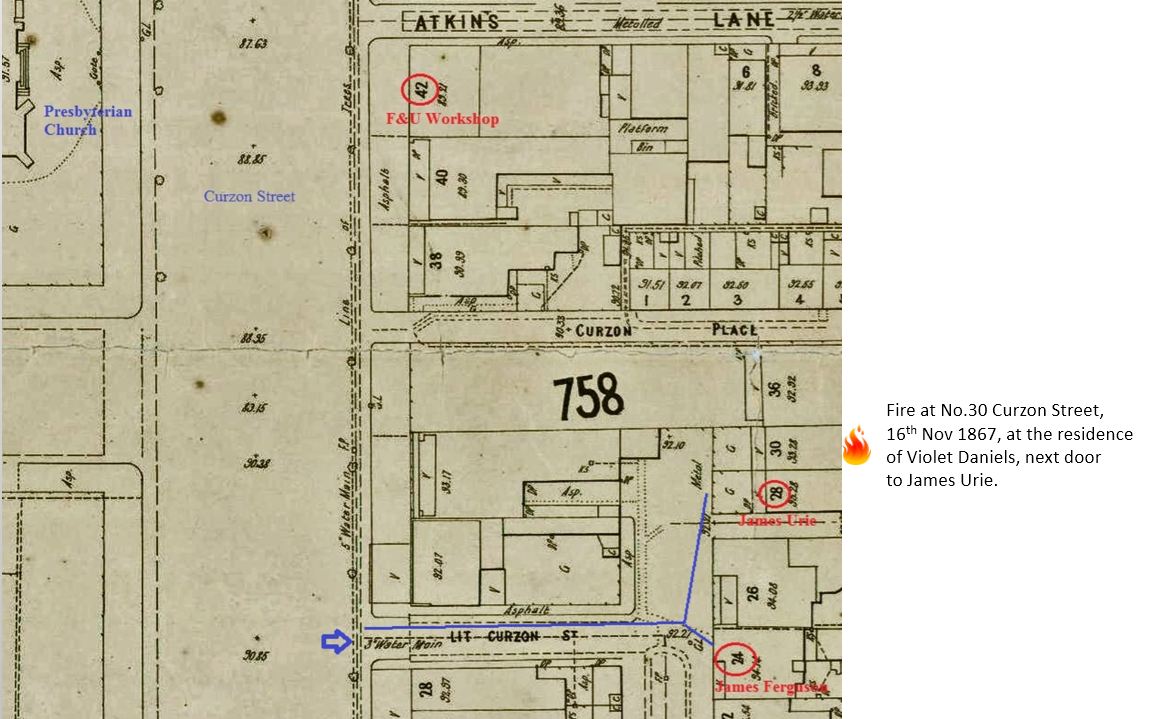
20-11-1867: The fire in Curzon Street, North Melbourne.

The Argus, Melbourne, Wednesday 20th November 1867, page 5.

“Dr. Youl held an inquiry yesterday into the origin of a fire which burned down the premises No. 30 Curzon-street, Hotham, on 16th inst. The premises had been occupied by a Mrs. Violet Daniels who retired to bed on the evening of the 16th inst., having previously extinguished the fire and removed the matches. About twelve o’clock a constable discovered the fire and alarmed the inmates and all subsequent efforts to extinguish the fire proved unsuccessful. The flames afterwards spread to the adjoining premises and consumed a fowl-house valued at 5, and also damaged the premises of Mr. J. Urie, glass-stainer, to the extent of £20. About eleven o’clock on the night of the fire, a lodger in the house of Mrs. Daniels took a candle into an unoccupied room, for thee purpose of obtaining a drink of milk, but brought the candle back to his room. At that time there was no sign of fire. Urie’s premises were insured for £1,250, and Daniels’ for £200, and the furniture for £100. The loss beyond the insurance money was estimated by Mrs. Daniels at £100. A verdict of “Accidental Fire” was recorded”.

Curzon Street Fire 16 Nov 1867

James Urie’s cottage was at No.28 Little Curzon Street and James Ferguson’s at No 24 Little Curzon street which were only a short distance to the rear of the companies stained glass workshops opposite the Union Memorial Church. 

As at 2012 the original workshop building (basically only the shell and facade under redevelopment) still exists opposite the Union Memorial Presbyterian Church but is now numbered 42 Curzon street.  Prior to its residential transformation it was used as the North Melbourne Masonic Lodge. As at 2013 the front section of the original workshops has been completed as a private residence with further work to be completed to the rear section.

James Ferguson & James Urie offered up their Little Curzon Street cottages for auction in November 1886 as both partners had by this time built their new two storey mansions in Parkville and Flemington.

James Ferguson had his mansionAyr Cottagebuilt in Leonard Street Parkville and James Urie had builtGlencairn‘ in wellington Street in Flemington.


Short link to this page: https://wp.me/p28nLD-9P

© Copyright

25-01-1867: Advertisement – Wanted – A boy to blow bellows.

The Argus, Melbourne, Friday 25th January 1867, page 1.

“WANTED, a BOY, to blow bellows, Apply to Ferguson, Urie, and Lyon, Curzon-street, North Melbourne”.

Oh my! What a way to start a career! Close to 150 years later nothing much has changed though. The equivalent these days is the boy in the Asian sweat shop making vinyl sand shoes for multimillion dollar sports companies. The difference in this case is that the ‘Bellows’ boy was highly likely to have been given the opportunity for advancement in the company to improve his prospects in life. During the existence of the company many employees shared in its prosperity and were allowed all the opportunities for advancement.