15-07-1862: Mr Robson’s Shop, Ballarat, Victoria.

The Star, Ballarat, VIC, Tuesday 15th July 1862, page 2.

“In the window of Mr Robson, the painter and decorator, Sturt street, is a stained glass centrepiece of a window, the subject being the Crucifixion. The picture is best seen from inside the shop, and worth looking at. The colouring is clear and brilliant, and the shading well managed. Messrs Ferguson and Co., of Melbourne, are the producers of the work.”

Nothing further is known as to where this window may have been eventually erected, if at all. Although there are other windows in the Ballarat area by Ferguson & Urie, there is not enough information to place this feeble description to any particular window known in that region for the date period.

Thomas Robson was well known as the Ballarat agent for Ferguson & Urie Stained Glass and instrumental in the commissioning of the chancel window for St Paul’s Church in Bakery Hill, Ballarat.

In January 1867 Robson was declared insolvent due to losses by fire and bad debts.

Related posts:

29-03-1862 > 14-04-1862 > 19-05-1862 > 04-06-1862 > 24-06-1862 > 15-07-1862 > 01-03-1863 > 07-08-1863


Short link to this page: https://wp.me/p28nLD-1hK

© Copyright

13-05-1885: St. Paul’s Cathedral, Sale, Gippsland, Victoria

The Edward Crooke stained glass memorial window at St Paul’s Anglican Cathedral, Sale, Victoria.

Edward Crooke was born in Liverpool, Lancashire in 1810 and arrived in Sydney in 1837. In the 1840’s he ran cattle and sheep in the Holey Plains area near Rosedale in Gippsland. He married Maria Matilda Jamison in 1860 and moved to Melbourne with his family in 1870. His son E.J. Crook later took over the Holey Plains station. Edward Crook died at his home “Rockley” in South Yarra on the 7th November 1873 and in 1885 his wife Maria initiated the erection of a stained glass memorial to him in the chancel of St Paul’s Church of England in Sale, Gippsland. The window was created by Ferguson & Urie and was erected in September 1886 beside the Dr. Floyd Minter Peck window that Ferguson & Urie had created two decades earlier in 1867.

Photos dated: 23 April 2011.

This slideshow requires JavaScript.

The left light in the group of three is the Edward Crooke memorial window described in the articles below. The centre light is a memorial to Dr. Floyd Minter Peck which was also created by Ferguson & Urie some twenty years earlier in 1867 and originally installed in the previous church building. The right light, ‘Good Shepherd’, window was made by William Montgomery, Melbourne; “The right hand light was by William Montgomery c.1888.  It was one of the first group he made for the Anglicans after he arrived in Melbourne in December 1886”.- (Dr. Bronwyn Hughes, Stained Glass Historian, email, 25 Sept 2012).

Gippsland Times, Vic, Wednesday 13th May 1885, page 3.

“Our readers will no doubt remember that when the Church of England in Cunningham-street was built, the stained glass window that had been put in the old church to the memory of the late Dr. Peck was removed and placed in the central light in the chancel of the new church. We are now pleased to learn that Mrs Crooke, of Holey Plains, is about to fill one of the side lights with a similar window in memory of the late Mr Crooke. The subject chosen will be one that will harmonise with the present window, and will greatly improve that end of the church. It will, however, to complete it, need the other side light filling, and perhaps some member of the church will consider the propriety of doing this. We are sure that no more suitable memorial of departed friends than one of this kind can be found.”

Gippsland Times, Vic, Monday 20th September 1886, page 3.

“In our columns some months ago we mentioned that Mrs Crooke, of Holey Plain, had intimated her intention of putting a stained glass window in St. Paul’s, in memory of her late husband. This has been done, and a rich and beautiful work now adorns the left opening of the chancel window. The central panel is a life-size figure representing the Saviour as the Light of the World. The outer flowing robe around the body is of rich antique ruby, the folds fall gracefully round, while the inner garment has a cream-like tinge. Over the head there is a canopy of blue. Under the figure are the words, “I am the Way, and the Truth, and the Life.” In the top panel appears the sacred monogram I.H.S., surrounded by a Crown. On the lower panel there is a medallion exhibiting a lamb with a banner and cross, and on either side are the words “Agnus Dei.” We need scarcely say that the window was very much admired by the congregation yesterday. The third light should now be filled in, and then the large window at the eastern end would be complete. Perhaps the good example set by Mrs Crooke will be followed by some other members of he community. The work was done by Messrs Fergusson [sic] and Urie, of Melbourne.”

Gippsland Times, Vic, Wednesday 2nd February 1887, page 3.

“ST. PAULS CHURCH OF ENGLAND”

“The yearly meeting of the congregation of St. Paul’s Church of England was held in the old church building on Monday evening. There was a moderate attendance, and the Rev. Canon Watson occupied the chair. The following report was read:-…”

“…The board are glad to report that during the year a very handsome stained glass window was placed in the chancel by Mrs Crooke, of Holey Plain, to the memory of her late husband…”

Gippsland Times, Vic, Tuesday 11th November 1873, page 3.

“CROOKE.- On the 7th inst., at Rockley, Toorak, Edward Crooke, of Holey Plain, Gippsland.”

Related posts:

21-09-1867: St Paul’s Cathedral, Sale, Gippsland, Victoria, Australia.

External links:

Biography: Edward Crooke (1810-1873)


Short link to this page: http://wp.me/p28nLD-1gW

© Copyright


19-09-1874: Holy Trinity Church of England, Williamstown, Victoria.

The first Holy Trinity Church at Williamstown was a prefabricated iron building known as an “Iron Pot” (freezing in winter and boiling in summer). There were many of these “Iron Pot” churches imported from England and erected throughout the colony and this one was erected in Nelsons Place in Williamstown. The Rev. George Wilkinson was obviously not happy with this poor excuse for the house of the lord and began the movement to have a respectful stone church erected for his congregation in 1859. The foundation stone for the new Leonard Terry designed church was eventually laid on the 11th of February 1871 by Bishop Charles Perry and was opened on the 7th October 1874. The “pretty chancel window” described as being made by Ferguson & Urie, circa 1874, no longer exists and was replaced by the Charlotte & William Holten memorial window circa 1941. According to the Holy Trinity’s newsletter (The Pilot, Vol 2, Issue 3, April 2012, page 4): “The artist for this window is unknown. We do know it was made in England and brought to Williamstown by Mrs Dorothy Raverty 2nd, step mother of Reverend J. Raverty who had it installed in Memory of her parents.”

This newsletter item is not correct. The Holten memorial window was actually made by the Brooks, Robinson & Co stained glass company of Melbourne, who also made other windows in Holy Trinity.

All the original windows in the nave of Holy Trinity have also been replaced over the course of a century and are made by the artists and studios of William Montgomery, Napier Waller, Brooks Robinson & Co, and Alan Sumner.

The west four light window, with rose window above, and those in the clerestory, with the simple coloured borders and plain diamond quarries, are very likely be some of the original circa 1874 installations by Ferguson & Urie of North Melbourne.

Photos taken: 11th September 2010.

This slideshow requires JavaScript.

Williamstown Chronicle, Vic, Saturday 19th September 1874, page 2.

“THE NEW CHURCH OF ENGLAND.- The new place of worship which the adherents of the Church of England have just erected in Williamstown is one of the most handsome and commodious churches in the colony. With the exception of the tower and spire the building is now complete, and the conspicuous position it occupies makes it a prominent and pleasing feature in the town as seen from the Bay. The cost, as it stands, is £5000, and the erection of such a noble structure speaks well for the energy and liberality of the Episcopalians in our comparatively small parish, particularly as the new church when entered upon will be but slightly involved financially. The church, including the chancel, is 110 feet in length, and is from a design by Mr. Leonard terry, in the gothic style, with nave and aisles of lofty proportions. The material employed is bluestone, with freestone dressings. The interior has a very handsome appearance, which is heightened by the tone of the glazing, the body colour being amber with varicoloured margins. A pretty chancel window, made by Ferguson and Urie, imparts to that portion of the interior a very pleasing effect, which is continued in the rich yet simple decorations of the ceiling. The seating, to which the greatest attention has been given, is very convenient and comfortable. The material used is lightly stained Oregon pine. A lectern, from one of the best medieval workers in England, and the gift of Sir George Verdon, will shortly be added, and from the known liberality of the donor and the high reputation of the makers, will no doubt prove a further ornament. The substitution of a nice front picket fence for the old palings which have so long done duty has also contributed to the fine appearance of the church. The new place of worship will be opened on Friday, the 2nd prox, by the rev. pastor, Mr. Wilkinson.”

Also See:

Holy Trinity web site.

Flickr Photo album of Holy Trinity’s stained glass.

17-05-1865: Kings Shop, Pall Mall, Bendigo, Victoria.

Bendigo Advertiser, Vic, Wednesday 17th May 1865, page 2.

“COLONIAL GLASS PAINTING.- In the shop of Mr King, Pall Mall, is to be seen a very handsome specimen of glass painting, or glass staining as it is commonly termed. The work was executed by Messrs Ferguson and Urie, of North Melbourne, who have, we are informed, within the last twelve months brought the art of glass painting to a very high standard in the colony. Previous to that time, the greater portion of the stained glass windows for places of worship, was imported from Europe. Now, the manufacturers referred to are able to produce painted glass windows at the same prices at which they can be imported, and according to the opinion of connisseurs [sic] in the art, with as much taste and skill. The sample to be seen at Mr King’s warrants that opinion.”

King’s of Pall Mall Bendigo was a dealer of Paperhangings, Borderings, Varnishes and Oil and Lamp merchant. In 1864 his shop in the Bendigo Pall Mall area was described as wooden and was saved from being burnt down in a fire that started in the early hours of 9th May 1864. Nothing further is known about the stained glass window created by Ferguson & Urie described as being on display in King’s shop in Pall Mall in May 1865.

07-04-1879: Christ Church, Castlemaine, Victoria.

The Church of England Messenger, 7th April 1879, page 5.

“CASTLEMAINE.- The friends of the late Ernest Walter Crawford seem desirous that his memory may not fade. A subscription set on foot in Castlemaine has resulted in the erection of two handsome and lasting memorials. The first is a monument over his grave in Castlemaine cemetery, consisting of a slab of Malmsbury bluestone, firmly fixed and railed in, and bearing a white marble cross the whole length of the grave. The second is a beautiful stained-glass window, recently placed in Castlemaine Church by Messrs. Ferguson and Urie, containing representations of the resurrection and ascension of our blessed Lord. Both Memorials have suitable inscriptions”.

Photos dated: 7th January 2012. (Date of historical photo unknown).

This slideshow requires JavaScript.

The Argus, Melbourne, Tuesday 9th July 1878, page 1.

“CRAWFORD.- On the 8th inst., at Christ Church Parsonage, Castlemaine, Ernest Walter, son of Archdeacon Crawford, aged 18 years.”

Note: Extensive conservation work was done on the window by the Glenn Mack Studio circa 2012.

22-04-1869: Christ Church, Warrnambool, Victoria.

This post covers the Stevens and Bateman window memorial windows by Ferguson & Urie erected in Christ Church at Warrnambool in 1869.

The Church of England Messenger, 22nd April 1869, page 7-8.

“WARRNAMBOOL.- The church here has recently been presented with some beautiful windows of stained glass, from the manufactory of Messrs. Urie, Ferguson and Lyon, of Melbourne. The east window (one of three lights) has been presented by F. P. Stevens, Esq., as a tribute to the memory of his deceased wife. It represents the baptism, crucifixion, and resurrection of our Lord; underneath which, and distributed through all three divisions, is the representation of the Last Supper. The three lights at the eastern end of the north aisle, together with the round window in the gable, have been presented by W. Bateman, Esq., as a memorial of his deceased parents. The first three represent the raising of Jairus’ daughter, the transfiguration of our Lord, and His agony in the garden of Gethsemane”.

Photos were taken 7th January 2011.

This slideshow requires JavaScript.

The Stevens Window:

The Argus, Melbourne, Vic, Wednesday 5th August 1868, page 4.

STEVENS.- On the 26th ult., at the Cottage, Warrnambool, Jane, the beloved wife of F. P. Stevens, aged forty-seven years.”

The three light window above the High Altar was presented by Frederick Perkins Stevens in memory of his wife Jane (nee Rule) who died on the 26th July 1868 at the age of 47. The windows depict the Baptism, Crucifixion and Ascension with the lower scenes depicting the Last Supper.

A brass plaque in the church also reads:

“The Three Bells erected / in this Tower were / presented to Christ Church Warrnambool by FP Stevens / Member for Villiers & Heytesbury / of the Legislative Council of / Victoria 1852 / In Memory of his younger Son / FS Stevens who died at his Station / Tintinchilla Queensland / 26th May 1880 Aged 30 Years”.

The bells presented to Christ Church were brought to Melbourne for the 1881 Melbourne Exhibition where they were awarded 1st prize.

The Bateman Window:

Illustrated Australian News for Home Readers, Melbourne, Vic, Saturday 25th April 1868, page 15.

“BATEMAN.- On the 30th March, at his residence, Fern Cottage, Warrnambool, Mr. William Bateman, sen., aged 79″.

The Argus, Melbourne, Vic, Tuesday 25th August 1868, page 4.

“BATEMAN.- On the 24th inst., at Spring-gardens, Warrnambool. Mrs. Bateman, sen., aged sixty-nine years”.

William Bateman Snr was born in Bradford, Yorkshire circa 1794 and married Sarah Smith in 1815 in the same town. They migrated to Australia with their four children circa 1853 and set up business in Warrnambool as Bateman & Co in the name of their son William Jnr. The company became one of the districts largest mercantile businesses but eventually ran into financial difficulty during the time of the land speculation boom when William Jnr ran up huge debts in land holdings which eventually saw the collapse of the small family empire.

In 1869 William Bateman Jnr presented Christ Church Warrnambool with the three light window in memory of his parents, William & Sarah Bateman. William Jnr died in 1913.


Short link to this page: https://wp.me/p28nLD-1ew

© Copyright

03-12-1869: Christ Church, Moorabool St, Geelong, Victoria.

The first Ferguson & Urie stained glass window to be erected in Christ Church at Geelong was the five light Chancel window which depicts Christ in the centre light, flanked by the four evangelists, Matthew, Mark, Luke & John with their biblical alter egos beneath their figures. This window gained quite a bit of notoriety and comment in the tabloids of the time of its erection. Despite significant vandalism in the past 145 years, the most recent attack being in November 2011, it has somehow survived the test of time and is certainly a significant artifact for Christ Church and should be considered for heritage listing.

The Church of England Messenger, 3rd December 1869, page 7

“CHRIST CHURCH, GEELONG.- A handsome chancel window has recently been put up in this church, at a cost of £120, from the workshops of Messrs. Ferguson, Urie and Lyon, of Curzon-street. The style of architecture is that known as late perpendicular, the complicated mullions and tracery admitting as many as eight-and-twenty lights. Of these, the five principal compartments are thus appropriated:- In the centre, to accord with the designation of the church, the Saviour is represented enthroned, having in his left hand the globe and cross, and elevating the right in the attitude of blessing; whilst the compartments on either hand are occupied with erect figures of the four Evangelists. Those who have examined former efforts of this enterprising firm will be struck by the improved purity and brilliancy of colour displayed. The utmost skill has been shown in the harmony of arrangement”.

Photos taken 24th Oct 2010. (Date of Historical photo unknown).

This slideshow requires JavaScript.

Geelong Advertiser, Vic, Wednesday 10th November 1869, page 2.

“A gratifying specimen of colonial art may be seen in the chancel window, recently put up in Christ Church, by Messrs Ferguson, Urie and Lyon, of Melbourne. The window, which is about fourteen feet high by ten feet wide, belongs to the order of Gothic, which architects term late perpendicular. it consists mainly of three rows of light, the lower row containing five openings eight feet and a half in height, the mullions of which rise perpendicularly to the top of the window. The second row contains a continuation of these lights, divided into twelve by narrow mullions, these openings being two feet in height; above these is a row consisting of three pairs, rather higher than the middle row. There remain seven small openings supplementary to the complete design. The great feature of a window of this style, and involving a manifest difficulty with which the glass-stainer has to grapple, is the large proportion of stone in the mullions, probably not less than a third of the entire surface. The designer has in this instance shewn his judgement in not attempting a general subject, which would have been broken by the heavy stone framing, as he has made each opening a complete picture in itself, and to a certain extent, independent of the adjoining ones. At the same time there is not wanting a unity of subject. The five principal lights are appropriated to the glorified Saviour, flanked on either side by two Evangelists. At the foot of each of these five figures, is introduced the corresponding symbol, viz., in the centre the pelican wounding her own breast to feed her young; and the evangelistic symbols, the human head, the lion, the ox, and the eagle, under Matthew, Mark, Luke, and John, respectively. The three pairs of lights at the top of the window are appropriately filled up with three cardinal graces and their emblems, viz., faith and the cross, hope and the anchor, charity and the heart. The quatrefoil at the apex of the arch is filled in with the dove. The twelve smaller windows in the middle row remained to exercise the designer’s ingenuity, their small size and large number having occasioned some apparent difficulty. On these we find national emblems, the rose, shamrock, and thistle, besides stars, which may be regarded as generally emblematic of whatsoever things are lovely and of good report. Those who have examined former efforts of this enterprising firm will be struck with the improved purity and brilliancy of colour displayed. The utmost skill has been shown in the harmony of arrangement. The draperies of all the principal figures are particularly well managed, that of the centre being a brilliant mass of ruby red, carried off to the margin in each in each direction by yellows and greens of intermediate warmth terminating at the circumference in cold blue or grey. The effect at the western entrance into the church is a rich flow of light and colour, on which the eye rests with pleasure, and has to complain of no unequal predominance of any one tint. The individual figures are alike bold and dignified in outline, but the execution of the features while in the highest degree creditable, falls short of that depth and sublimity of expression with which the old masters have familiarised us. It is indeed the merit of the whole composition that it attempts the symbolical and heraldic rather than the historical. Its excellences are such as can be best appreciated from a distant point of view. We are told that the entire cost of the window is £120, to meet which collections are to be made on Sunday next.”

Note: The head of Christ in the centre light is not original Ferguson & Urie. This is possibly the third replacement since the window was created in 1869.

Restoration/Conservation:

The east five light window underwent restoration and conservation work in 2004 by Geoffrey Wallace’s stained glass studio.

This window and many others were unfortunately vandalised in November 2013 and will again be in the hands of Geoffrey Wallace for expert repair.

For updated and detailed photos of the full cycle of Ferguson & Urie windows at Christ Church in Geelong, See: http://www.flickr.com/photos/raysalmanac/sets/72157637900257313/


Short link to this page: https://wp.me/p28nLD-1ez

© Copyright

27-01-1868: Royal Victorian Institute for the Blind, Melbourne, Victoria, Australia.

The Victorian Asylum and School for the Blind was formed at a public meeting in Prahran, Melbourne on 21 August 1866. Less than two years later, on the 25th of January 1868 the Hon. George Harker laid the foundation stone for the new building to be erected on St Kilda road. The architects chosen for the asylums design were Crouch & Wilson.

In 1891 the Asylums name was formally changed to the “Royal Victorian Institute for the Blind” (RVIB) and as at 2012,  the original building now hosts a Belgian Beer Hall and Restaurant.

The most historical, and striking feature, is the original Ferguson & Urie stained glass window in the stairwell.

Photos kindly contributed by Mrs Noelle Nathan, taken 16th July 2012.

This slideshow requires JavaScript.

The Argus Melbourne, Monday 27th January 1868, page 6.

“THE ASYLUM AND SCHOOL FOR THE BLIND”

“On Saturday the memorial stone of the Asylum and School for the Blind – a building now being erected on the St. Kilda road was laid by the Hon. G. Harker. It had been originally intended that the ceremony should be performed some weeks ago by Prince Alfred, and we are informed that a promise to that effect was made by the Royal Reception Commission; but shortly before His Royal Highness’s departure a communication was received to the effect that it would be impossible for him to fulfill the promise…”

“…This institution was started about eighteen months since, but it is only about a year since it was brought to working order…”

Illustrated Australian News for Home Readers, Melbourne, Tuesday 3rd March 1868, page 4.

“…The third storey will be devoted to paying pupils, and the staircase window is to be of stained glass…”

The Argus, Melbourne, Saturday 1st August 1891, page 5

“… PROPOSED CHANGE OF TITLE. Mr. Alston moved that the title of the institution be changed to “The Royal Victorian Institute for the Blind: subject to the consent of Her Majesty to the use of the prefix. It had been felt that under its present title some misapprehension existed in regard to the objects of the institution, which were primarily to supply an education of a scholastic, musical, and industrial character to its inmates. Mr. Crews seconded the motion, which was carried…”


Short link to this article: http://wp.me/p28nLD-1c7

© Copyright

13-08-1867: St Peter & St Paul, Geelong, Victoria.

In the later half of 1867 James Urie of the stained glass firm ‘Ferguson & Urie’ of North Melbourne traveled to Tasmania to further expose the business throughout the Colonies. The Hobart Mercury provided detailed reports of his travels as well as mentioning  some of the establishments the company had gained commissions for, or those they had recently completed. One of those mentioned was the church of St Peter & St Paul in Geelong.

The foundation stone of the church was laid by Bishop Goold on the 17th January 1864 and was designed by architect William Wardell in the 13th Century Gothic form. The superintending architect was  J. A. Denny and the contractor was a Mr. Nash, of Geelong. The total cost of the construction exceeded £6000.

Photos taken 23rd August 2009.

This slideshow requires JavaScript.

The three light window was erected as the principal east window in the chancel. The left light depicts St Peter with his crossed Keys to heaven. the centre light depicts Jesus in the act of the Ascension with the Holy Dove above and the right light depicts St Paul holding his book and sword and another symbol of the book below.

Freman’s Journal, Sydney, NSW, Saturday 21st July 1866, page 451.

“…The stained window of the altar was designed and executed by Messrs. Ferguson and Weir [sic] of North Melbourne, whose artistic talents have been successfully deployed in depicting not only a work of art, but one also befitting the dedication of the edifice. The window is the history: the ecclesiastical symbols, combined with the figures of the saints, are in severe taste, and the adjuncts in selection consistent. The coloring is cheerful yet sober, and the effect of that nature that shades come up reminding one of historic memories…”

“..Reverting to the stained window we may mention that it is a gift of the Very Rev. Dean Hayes, and we have ascertained that his munificence – not dwarfish on other occasions – has been exemplified in this instance by the outlay of £112…”

“The architect of this unique building is W. W. Wardell, Esq – the superintending architect, J. A. Denny, Esq and the contractor, Mr. Nash, of Geelong, to whom for promptitude and excellelence in workmanship every praise is due. The total cost of the erection exceeds £6000”.

“…The subdued light fell on the altar through the stained glass with just sufficient power to bring into relief the golden woven vestments of the celebrants…”

Unfortunately the images in the slideshow are from my earlier photographic attempts back in the days when I only had a pocket digital camera.

Related posts: 13-08-1867: James Urie visits Tasmania on Ferguson and Urie business.

© Copyright

1890: Curzon Street, Ferguson & Urie Employees circa 1890.

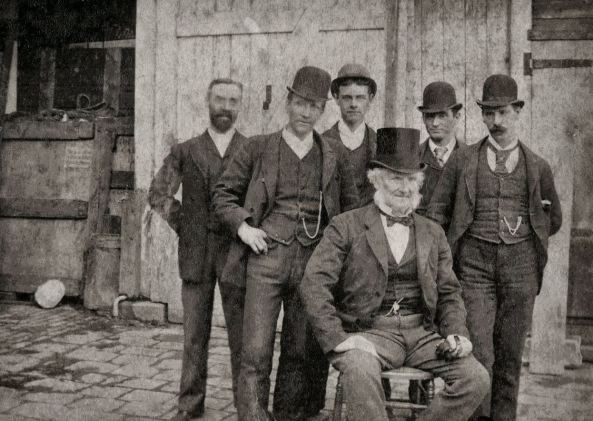
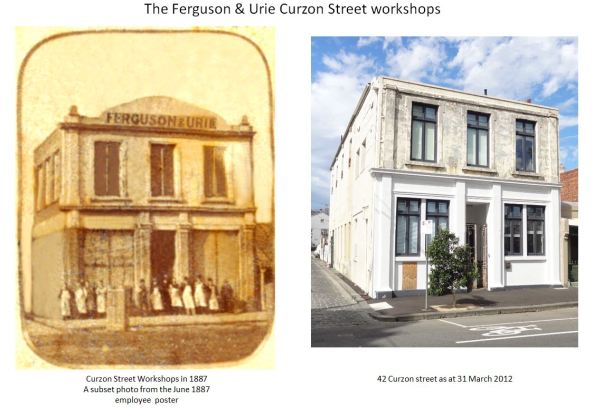
This is a magnificent historical photo of James Ferguson and five of the Ferguson & Urie employees circa 1890. I would guess this photo may have been taken at the rear of the Curzon street workshops North Melbourne which was their first workshops when they started business in 1853. They advertised from the site as early as 1853 but the workshop building wasn’t erected until after 1858 as indicated in the diaries of stained glass artist David Relph Drape. The building still exists as at 2012 but the interior has been converted to individual apartments and only the shell and facade remain as it appeared in the Ferguson & Urie employee photos of June 1887.

The only two positively identified men in the photo are, James Urie Jnr,  James Ferguson Snr and James Ferguson Jnr. The other identifications are based on a likeness from the 1887 employees photos that were taken for the company dinner held on the 22nd January 1887.

CURZON Street Photos 01a

1.D. Morris, 2. unknown, 3. James Urie Jnr (1870-1896), 4. James Ferguson Snr (1818-1894), 5. J. M. Gilligan, 6. James Ferguson Jnr (1861-1945). Photo kindly contributed by my 3rd cousin Errol Vincent from New Zealand 2010.

CURZON Street Photos 02a

The Curzon Street workshop building as it appeared in June 1887 and photo taken 2012.

When the building was being converted to apartments in 2012 the sales brochures indicated that the building had been “remodeled circa 1875 to become the North Melbourne Masonic Lodge”. This incorrect. Ferguson & Urie retained the building as their workshops until the company demise in 1899.

18990506

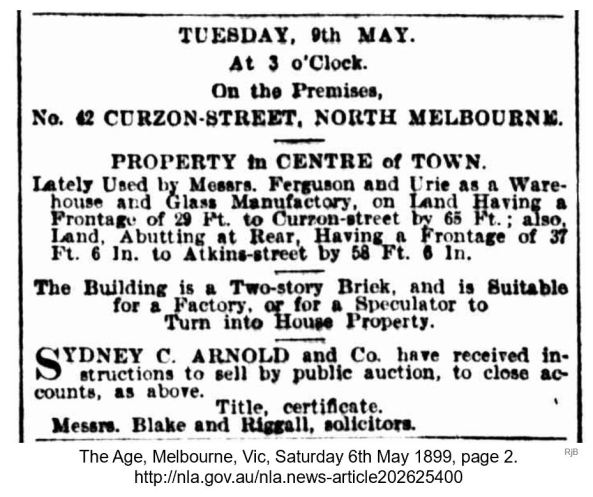
In May 1899 an advertisement was placed in the Melbourne Age advertising the auction of their stained glass workshops at 42 Curzon Street would occur at 3p.m. on the 9th of May 1899.

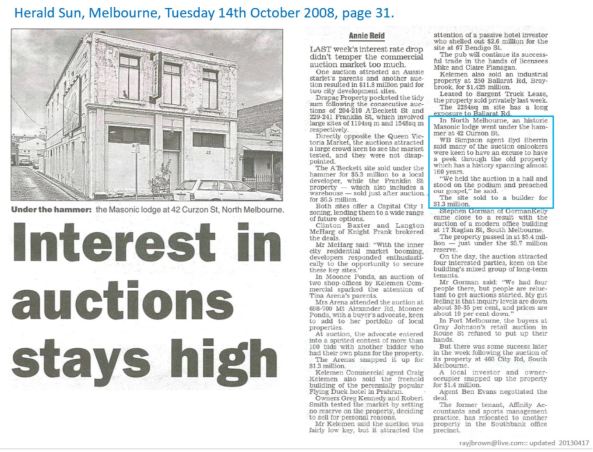
The first tabloid article indicating the building had become the North Melbourne Masonic Lodge appeared in the North Melbourne Courier & West Melbourne Advertiser in September 1902 and it remained in their possession until 2008 when it was put up for auction and sold for $1.3m.

20081014 Curzon

Related posts:

1887 Ferguson & Urie Company Dinner


Short link to this page: https://wp.me/p28nLD-1aP

© Copyright