21-09-1867: St Paul’s Cathedral, Sale, Gippsland, Victoria, Australia.

The Dr. Floyd Minter Peck memorial stained glass window was created by the Ferguson & Urie stained glass company of North Melbourne and was erected in St Paul’s Anglican Cathedral, Sale, Victoria, in September 1867.

Gippsland Times, Saturday September 21st 1867, page 2.

“During the past week the central lights of the east window in the chancel of St. Paul’s has been filled with stained glass. The window, which is sixteen feet high and three feet wide, has been erected by a few friends as a memorial to Dr. Peck, one of the earliest trustees and an earnest supporter and benefactor of the church. The painful circumstances of his death, in the prime of his manhood, are still fresh in the recollections of the inhabitants of the district. His death was caused by disease in conducting a post-mortem examination, and was justly regarded as a public misfortune. A subscription was initiated to erect a tablet to his memory, but it was afterwards resolved that a testimonial to his worth would be most appropriately placed in the new church, for which he had worked so long and zealously in raising funds; the present form of memorial was then wisely determined on. The general effect is extremely pleasing; the hues are clear, brilliant, and admirably arranged, and give to the church the colour so much needed. It is lancet shaped; the border is of green leaves; the lancet contains a fine scroll, with the words “Blessed are the dead which die in the Lord.” The centre is filled with a large figure of Christ as the Saviour of the world, with a nimbus round the head, and holding and orb typical of sovereignty; underneath are the words “Salvator mundi;” the lower part is filled with grisaille, enclosing a shield with the following inscriptions, in early English characters:- “Erected by subscription, in pious memory of Floyd Minter Peck, surgeon of this town, who died January 17 [sic], 1864.” A bright monogram of the Alpha and Omega shine at the apex of the window. The diapering and tracery generally are, very light and effective, and reflect great credit on the artists who executed them. It is a further subject of congratulation that this splendid window has been designed and chiefly manufactured in the colony by Messrs. Ferguson, Urie, and Lyon, of North Melbourne, who have been for some time past actively engaged on the work, which they have now brought to such a creditable conclusion.”

The centre light of the three windows in the chancel is the Dr. Floyd Minter Peck memorial window by Ferguson & Urie. It originally came from the first church built in Raymond Street Sale. The article above has the date he died incorrect and so does the memorial text on the window. He actually died on the 7th of January 1863. The left light is also by Ferguson & Urie and is a memorial to Edward Crooke, but was created nearly two decades later and erected in September 1886. In 1887 Melbourne stained glass craftsman William Montgomery created the right light depicting the Good Shepherd and is a memorial to Menie Peck, the second wife of Dr. Ffloyd Minter Peck.

This slideshow requires JavaScript.

Geelong Advertiser, Vic, Thursday 26th September 1867, page 2.

“During the past week the central light of the east window in the chancel of St. Paul’s Church, Sale, has been filled with stained glass. A local contemporary explains that the window, which is nineteen feet high and and three feet wide, has been erected by a few friends as a memorial to Dr Peck, one of the earliest trustees and earnest supporter and benefactor of the church, and whose death was caused by disease incurred by conducting a post mortem examination, and was justly regarded as a public misfortune. The general effect of the work is said to be extremely pleasing; the hues are clear, brilliant, and admirably arranged, and give to the church the colour so much needed. It is lancet shaped; the border is of green leaves; the lancet contains a fine scroll, with the words, “Blessed are the dead which die in the Lord.” The centre is filled with a large picture of Christ as the Saviour of the world, with a nimbus round the head, and holding an orb typical of sovereignty; underneath are the words “Salvator maudi;” [sic] the lower part is filled with grisaille, enclosing a shield with the following inscription in early English characters:- “Erected by subscription, in pious memory of Floyd Minter Peck, surgeon, of this town, who died January 17, 1864.” It is a subject of congratulation, as our contemporary remarks, that this splendid window has been designed and chiefly manufactured in the colony by Messrs Ferguson, Urie and Lyon, of North Melbourne.”

Monumental memories : Sale Cemetery / by Glenys Wain, Kylie Rhodes, Linda Barraclough:

"Dr. Floyd Minter Peck (c1818-1861) was the son of a doctor from Newmarket, England. He came to Australia with his brother in law Dr. Hedley, Dr. Reeve of Snakes Ridge and his brother James Peck. Dr. Peck married Anna Maria Robertson (1823-1859) who died in Sale soon after her arrival there, following the birth of her sixth child. Dr. Peck then married Menie Campbell (1820-1884), a sister in law of Robert Thomson. However shortly after their wedding Dr. Peck contacted an infection while performing an autopsy, and died five days later. Dr. Hedley took over his practice afte his sudden death. James Peck (c. 1833-1884) was the younger brother of Dr. Floyd Minter Peck, and lived at "Bowerette" near "Grassdale". He married Ada Minter (C.1846-1918), the daughter of a doctor from Mount Moriac, and became a successful stock agent. Near these two family plots are family plots for the Smith and Minters, who are related. All plots have similar fences, with gateways."

Related posts:

The 1885 Edward Crooke memorial window at St. Paul’s Cathedral, Sale by Ferguson & Urie.

External links:

Paul Saban: “The Medical History of Newmarket”, Ffloyd Minter Peck (1820-1867)

The 1887 Menie Peck memorial window at St Paul’s Cathedral, Sale, by William Montgomery.

Homestead: Grassdale. Home of Floyd Minter Peck


Short link to this page: https://wp.me/p28nLD-9g

© Copyright

13-08-1867: James Urie visits Tasmania on Ferguson and Urie business.

In August 1867, James Urie of the Melbourne stained glass firm ‘Ferguson & Urie’, traveled to Tasmania with a portfolio of the companies designs for ecclesiastical and secular stained glass. As of May 2013, over twenty-five Tasmanian buildings have been identified as having one or more extant stained glass windows by the firm. The newspaper article below contains a gold mine of clues for Ferguson & Urie windows erected in Tasmania and in Victoria and I have included my comments as to what have found on each clue.

The Mercury, Hobart Tasmania, Tuesday 13th August 1867, page 5.

 “STAINED WINDOWS – A few days since we stated that Mr. Urie of the firm of Ferguson, Urie, and Lyon, glass stainers, &c, Melbourne, was on a professional visit to Hobart Town. This gentleman is now in Launceston, and we were much gratified yesterday by inspecting a large portfolio of designs for church and other windows which his firm has executed or has in hand. Amongst the most elegant we may mention the chancel window of St. George’s Church, Queenscliff, the subject being taken from the Litany, whilst the side lights represent the twelve Apostles and the west window other emblems; chancel window of St. Peter’s, Wooloomooloo (Sydney), embracing nine events in the life of St. Peter; Roman Catholic Church of St. Peter and St. Paul, Geelong; St Joseph’s Roman Catholic Church, Collingwood; St. Patrick’s Church, Duneed; the Melbourne Convent; the Presbyterian Churches at West Melbourne and Ballan; the Wesleyan Churches at Daylesford and Kent Town (S. Australia). They have also erected some very elegant memorial windows including one for the late Prince Consort at Kew; Rev. R. W. Needham, at Mount Gambier; Dr. Peck, at Sale; Judge Pohlman’s wife, and wife of Mr Stoddart both in Melbourne. We have already referred to Dr. Moore’s at New Norfolk, and the two windows in St. John’s, Launceston. One of the most elegant windows is in the house of Mr. George Stevenson, at Toorak; it represents the four seasons with figures of Art, Science, Agriculture, and Commerce, with Faith and Hope, coat of arms, and crest. This window cost £250. This firm also supplied a staircase window for the new mansion of the Hon. R. Q. Kermode at Mona Vale, but it has been decided to substitute one much more elaborate. They are also to fit up two windows for the new Wesleyan Church of this town – one at either end, which will be very handsome. Several private homes in this town, and a large number in Victoria, have been ornamented in this way, and no doubt the practice will extend when it is known how skilfully the art is carried out by Messrs. Ferguson & Co.”

Notes:

1. Queenscliff, Victoria, St Georges, All windows extant.
Related posts: 22-02-186429-01-1866 > 12-02-1881 07-04-188230-12-1893

2. Wooloomooloo, Sydney, NSW, St Peter’s (Darlinghurst), now part of Sydney Church of England Girls Grammar School.
Related posts: 1867: St Peter’s Anglican Church, Woolloomooloo, Sydney, New South Wales.

3. Geelong, Victoria, St Peter & Paul Catholic. Three light principal east window.
Related post: 13-08-1867: St Peter & St Paul, Geelong, Victoria.

4. Collingwood, Melbourne, Roman Catholic (St Joseph’s) destroyed by fire in 2007.
See: 1863: St Joseph’s Catholic Church, Collingwood, Victoria.

5. Duneed, Victoria, St Patrick’s (Mt Moriac) foundation laid in 1858. Ferguson & Urie east window erected in 1866 but was destroyed my a massive hail storm in 1887. The church was rebuilt in 1950’s and sold at auction in February 2017..

6. Melbourne, Victoria, the “Melbourne Convent”. This is likely to be the “Convent of Our Immaculate Lady of Mercy” in Nicholson street Fitzroy. My correspondence with the Convent has revealed nothing.

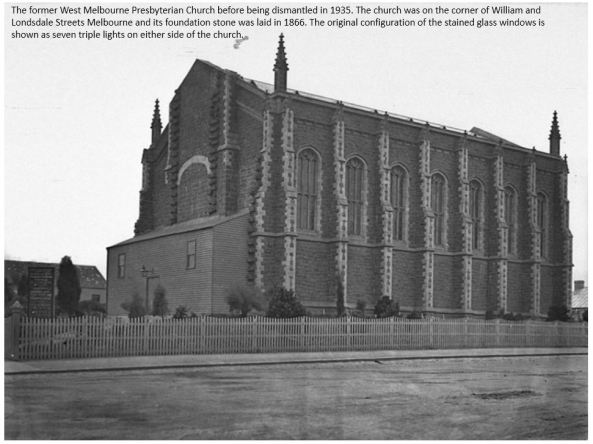
7. West Melbourne, Presbyterian. Dismantled in 1935 and re-erected as St Andrews at Box Hill in 1936. It contains the original F&U windows except for one which went to the Camberwell Church on Riversdale Road.
Related posts: 27-04-1935

8. Ballan, Victoria, Presbyterian (St Paul’s). All windows are extant.
Related posts: > 22-07-1866 > 28-07-1866 > 13-08-1867

9. Daylesford, Victoria, Wesleyan. Only small ‘stock’ windows in the porch exist in poor condition. See photos <here>

10. Kent Town, South Australia, Wesleyan. Nothing further known.
Related posts: 26-10-1864

11. Kew, Melbourne. The Prince Consort window at Holy Trinity is extant and recently restored.
Related posts: 08-06-1881

12. Mount Gambier, Christ Church, Rev Needham memorial window and others are extant.
Related posts: 02-11-1867

13. Sale, Victoria, St Paul’s Anglican Cathedral. Dr. Peck memorial window is extant.
Related post: 29-01-1867

14. Melbourne, Pohlman and Stoddart memorial windows.
Nothing found in regards to the Pohlman window but the Stoddart window exists.
Related post: South Yarra Presbyterian 1867

Pohlman:

Judge Robert Williams Pohlman (1811-1877): Biography | Obit 1877 | Funeral | Obit 1878 His funeral was in St Stephen’s in Richmond and he was buried in the Melbourne General Cemetery on the 8th Dec 1877. He was married twice. His second wife, Mercy Clifton Bachelor died of an embolism at age 26 on the 21st January 1876 only a couple of weeks after giving birth to a stillborn daughter on the 5th of January 1876. He only had one daughter to his second wife named Annie who married Navy Commander Frederick Owen Pike at St John’s in Toorak on the 27th December 1893.

This would mean that the stained glass window would have been a memorial to his first wife “Eliza” who died at Richmond on the 11th Feb 1856.

Stoddart/Stodart:

This is James Dickson Stodart (c1825-1867), Mayor of Prahran 1864/65 and councilor 1858/59-1859/60, 1863/64-1864/65.

Arrived from Edinburgh in 1853. Was later a financial agent for Cornish & Bruce railway contractors. See: Yarra Presbyterian 1867

An active member of the Scotch Presbyterian Church in Punt Road South Yarra, where his memorial stained glass window resides.

He died on Wednesday 12th June 1867. The window has been found at the South Yarra Presbyterian Church See: http://wp.me/p28nLD-2I3.

15. New Norfolk, Tasmania, St Matthew’s, Dr. Moore memorial window is extant.
Related posts: 04-03-1882

16. Launceston, St John’s: The window is extant but no longer in its original position. The canopy glass above the main three lights no longer exists but an original design for the window shows that it contained the descending Dove and the symbols for Alpha and Omega.
Full details see  post: 25-09-1866

17. George Stevenson’s house at Toorak was named “Trawalla” and is located at 22 Lascelles Avenue Toorak. Window is extant.

18. Ross, Tasmania, Kermode’s Mona Vale Mansion. This window still exists. Images are shown in various historical books written in the last 30 years.

19. Launceston, Wesleyan, (Pilgrims Uniting), window facing Patterson street is extant but nothing seen in the opposite end. Gavin Merrington from Hobart has confirmed that a wheel window exists above the organ loft.

Also see: 07-08-1867: Decorative Art. James Urie sojourning in Tasmania.

Other related posts: 03-03-1868 , 29-01-1866, 20-06-1867, 29-04-1864,


Short link to this page: http://wp.me/p28nLD-98

07-08-1867: Decorative Art. James Urie sojourning in Tasmania.

The following historical tabloid transcriptions contain a wealth of clues for my research on Ferguson & Urie stained glass.

In 1867 James Urie has traveled to Tasmania on the quest to further the company’s interests. By all accounts it would seem that his business acumen was extremely successful and there have been quite a few tabloid articles written which trace his movements. For many years after his venture to Tasmania the company would receive commissions from all over the state.

Each of the obscure clues in the following articles has been researched in great depth and links to other detailed posts on the windows mentioned have been included.

The Mercury, Hobart Tasmania, Wednesday 7th August 1867, page 2.

“DECORATIVE ART – The admirers of art workmanship will be glad to hear that there has for the last couple of weeks been sojourning in Tasmania, a partner of the Victorian firm of Ferguson, Urie, and Lyon, to whom many ecclesiastical and private edifices in this and the neighboring colonies are indebted for some of the finest specimens of pictorial decoration on glass, of which they have yet become the possessors. The objects of the visit have been to fulfil some orders previously given and to obtain others, and it is satisfactory to know that in the latter design the gentleman referred to, Mr. Urie, has not been unsuccessful. The name of the firm of which Mr. Urie is a member will be familiar to all visitors to the late Intercolonial Exhibition in Melbourne, in which a court furnished by them to illustrate the ornamentation of churches constituted a very interesting and pleasing feature. Mr. Urie has brought with him a portfolio of designs prepared in his establishment for the embellishment of ecclesiastical windows, and inspection of which is quite sufficient to establish the claim of the house he represents to consideration at the hands of all persons of cultivated taste, who may have made this branch of the art a subject of special study. The appropriateness with which the conventional religious symbols of the ancient church are introduced, the fidelity with which scriptural incidents are treated, and the beauty of the drawing and colouring combine to render the collection at once suggestive to the mind, and pleasing to the eye; and a familiarity with it, on the part of the rising generation of Tasmanians, would do much towards engendering and fostering a healthy appreciation of one of the highest forms of art workmanship amongst the community. The decorations already supplied by Messrs. Ferguson, Urie, and Lyon to churches in Tasmania, include a stained window erected in St Luke’s Church, Launceston, and another which has been placed in the Episcopalian Church, New Norfolk. The former contains a representation of the “Ascension,” supplemented by groups of the apostles, the entire constituting a most ornate adjunct of the building, and being completed at a cost of £130. The latter has been contributed by Dr. Moor as a memorial of gratitude for his preservation from shipwreck in the City of Launceston, steamer. The central group of figures in the latter represents the baptism of Christ. In addition to these the firm are in receipt of commissions from John Foster, Esq, for a memorial window to be placed in All Saints’ church, Hobart Town, remembrance of the donor’s deceased son, and from A. Kennerley Esq, for other decorated windows for the same church. They have also executed commissions for hall and staircase windows, some of them of highly artistic design, for R. Q. Kermode Esq, of Mona Vale, which afford evidence of the attention paid by them to the profane as well as to the religious style of decoration in the branch of pictorial art to which they devote themselves.”

Geelong Advertiser, Vic, Thursday 15th August 1867, page 3.

“A Tasmanian paper thus refers to the success of an enterprising Melbourne firm: -“Mr Urie, of the firm of Ferguson, Urie and Lyon, of Melbourne, who, it will be remembered, designed and executed one of the stained-glass decorations in St. John’s Church, is now visiting Hobart Town, having fitted up a window in the Episcopalian Church, New Norfolk, which has been contributed by Dr Moore as a memorial of gratitude for his preservation from shipwreck in the City of Launceston steamer. The central group of figures represents the baptism of Christ. In addition to these the firm are in receipt of commissions from John Foster, Esq., for a memorial window to be placed in All Saints’ Church, Hobart Town, in remembrance of the donor’s deceased son, and from. A. Kennerley, Esq., for other decorated windows for the same church. They have also executed commissions for hall and staircase windows, some of them of highly artistic design, for R. Q. Kermode, Esq, of Mona Vale.”

All the windows mentioned in the historical articles are extant:

1. St John’s window Launceston (incorrectly mentioned as St Luke’s in the first article).

2. The Episcopalian Church, New Norfolk, is St Matthews and has the Moore window.

3. The Foster memorial window at All Saints Anglican Hobart.

4. The A. Kennerley windows are in the ‘Kennerley’ aisle in All Saints.

5. The Kermode window at Mona Vale is extant but only copyright photos exist.

Also see: 13-08-1867: James Urie visits Tasmania on Ferguson and Urie business.


Short link to this page: http://wp.me/p28nLD-95

© Copyright

20-07-1867: St Jude’s Church, Carlton, Melbourne, Victoria, Australia.

The foundation stone of St Jude’s Anglican Church at Carlton was laid on the 18th October 1866 by Bishop Charles Perry.

The church was designed by architects Reed & Barnes and built by John Pigdon and it was officially opened on the 3rd March 1867.

Amongst the many historical artifacts in the church are the original liturgical east and west stained glass windows by the Ferguson & Urie stained glass company of North Melbourne.

Illustrated Australian News for Home Readers, Saturday 20th July 1867, page 4.
(Repeated , Saturday 27th July 1867, page 4).

 “ST. JUDES CHURCH, CARLTON”

 “The foundation stone of St. Jude’s Church was laid by the Lord Bishop of Melbourne, on the 18th of October, 1866; and that portion of the building now erected was opened for public worship on the 3rd of March, 1867 …”

 “… The windows are glazed with Cathedral glass, and neatly bordered with stained glass. The chancel window, which is of beautiful proportions, is further ornamented with the emblems of Faith, Hope and Charity, chaste in design, brilliant in coloring, and effective in execution. The artists were Messrs Ferguson, Urie and Lyon, who obtained great credit at the recent Intercolonial Exhibition …”

Photos taken: 26th September 2010.

This slideshow requires JavaScript.

[View larger images]

The historic “Faith, Hope and Charity” window was restored in February 2009 by Geoffrey Wallace Stained glass at Caulfield.

In the early hours of Saturday 18th October 2014 a suspicious fire broke out at the liturgical east end of the church and a large portion of the historical 147 year old Ferguson & Urie “Faith, Hope and Charity” stained glass window was destroyed.

See Sky News report about the fire:

I went to Carlton on Sunday 19th for a look and it appears to me that something flammable has been thrown through the window or a heavy object first and then something flammable. As recently as 20th July 2014 I took a photo of the outside of the window which surprisingly did not have any external wire or perspex protection at all. If it did have protection then the vandals would probably have failed or not even attempted this mindless destruction in the first place.

A Chanel 7 news report on Sunday 19th indicated that two men had been questioned over the fire but have been released without charge.

Related posts:

10-06-1867 – The 1867 Melbourne Intercolonial Exhibition.

Short Link to this page: http://wp.me/p28nLD-7I

10-06-1867: The late 1866 Melbourne Intercolonial Exhibition.

The 1867 Melbourne Intercolonial Exhibition.

Results of the late Intercolonial Exhibition – Special Awards made on behalf of the commissioners by the council of chairman or jurors.

The Argus, Melbourne, Monday 10th June 1867, page 7.

In Class V: “[…] Ferguson, Urie & Lyon. – For enterprise and skill in the production of stained glass for ecclesiastical purposes, and for their liberal contributions to the Medieval Court […]”.

02-05-1867: Presbyterian Church, William Street, West Melbourne

The Portland Guardian and Normanby General Advertiser, Thursday 2nd May 1867, page 2.

“NEW PRESBYTERIAN CHURCH IN MELBOURNE.”

“The new West Melbourne Presbyterian Church, at the corner of Lonsdale and William-streets, says the Herald, was opened yesterday[…]”

“… There are fourteen large beautifully stained glass windows, which, in addition to the ordinary devices, contain short texts of Scripture, in English, and towards the top of each is a stained glass ventilator, bearing severally as a design the rose, the thistle, the shamrock, and the burning bush, the emblem of the Church of Scotland. The windows, which are all the work of Messrs. Ferguson and Urie, of this city, cost £700.”

The West Melbourne Church was dismantled in 1935 and re-erected as St Andrew’s at Box Hill.
For a complete slideshow of the Ferguson & Urie windows, see: 27-04-1935: St. Andrew’s, Box Hill.

West Melbourne Presbyterian Church 1870-75

West Melbourne Presbyterian Church 1870-75 (in-line image to State Library NSW)

Related posts: 29-04-1867 > 02-05-186727-04-1935 > 09-09-1935 > 16-12-1935 > 01-02-1936

29-04-1867: Presbyterian Church, William Street, West Melbourne, Victoria.

The Presbyterian Church, William Street, West Melbourne was opened for public service on Sunday 28th April 1867.

The Argus, Melbourne, Monday 29th April 1867, page 5.

 The new Presbyterian Church, William-street, West Melbourne, was opened for public service yesterday. The sermon in the morning was preached by the Rev. A. Robertson, the pastor; in the afternoon, by the Rev. J. Dare; and in the evening, by the Rev. Dr. Cairns. On each occasion the church was crowded. The building is of the later English Gothic, known as the Tudor style, and is constructed of bluestone, with freestone and pressed cement dressings. Inside it measures eighty-four feet by fifty-four feet, and it is forty-five feet high. It is arranged in amphitheater form, all of the seats being curved in shape, the curves of all being shrunk from one centre, and each rising above the one before it. The arrangement is commodious and effective. The seats afford sitting accommodation for 750 persons. The roof is one of open-timbered construction. The building is found well adapted for giving the fullest effect to the voice of the speaker.  It is lighted by seven large windows on each side, and these are glassed with stained glass. The beauty of the design and harmony of the colouring render these admirable specimens of the art. They are the work of Messrs Ferguson and Urie, to whom the colony is indebted for many artistic productions of the same kind. By night the building will be lighted from the ceiling by three powerful sunlight reflectors, the brilliancy of which will dispense with the need of pulpit lights. The architects for the church are Messrs. Smith and Watts, the contractors Messrs. Corben, Wilson, and Rankine. It is only the body of the edifice that has been erected, and the plan includes the erection of a tower at the end towards William-street, and vestry-rooms at the other. The part which has been built cost about £7,000; the estimated cost of the entire building is upwards of £12,000. The church commences its career with most favourable prospects, as upwards of 500 of the sittings have been already let. It may be added that on Tuesday evening a tea-meeting will be held in the old building (now to be used as a school-house), in celebration of the opening. The amount of the collections during yesterday was £114 18s 10d.

WEST MELBOURNE Presbyterian Church 01a

The West Melbourne Presbyterian Church was pulled down circa 1936 and re-erected stone by stone as St Andrews Church at Box Hill. Eleven of the original 14 nave windows were re-installed in the Box Hill church in the nave, one was donated to the Camberwell Presbyterian Church, and the remainder re-fashioned to fit other parts of the Box Hill Church. As a fund raising venture the decided to allow parishioners, at a nominal cost, to have new memorial dedications placed in the lower edge of the Ferguson & Urie stained glass windows.

The entire cycle of windows were crafted by Ferguson & Urie and when the Box Hill Church was being built, the church devised a fund raising exercise, that included the addition of new memorial dedications  in the lower portions of the original stained glass windows. From an historical point of view this has confused many historians as to who could have made the windows as the memorial dedications had dates indicated much later than the Ferguson & Urie company existence.

The full cycle of stained glass windows can be see on the article about St Andrews Church at Box Hill.

Related posts: 29-04-1867 > 02-05-186727-04-1935 > 09-09-1935 > 16-12-1935 > 01-02-1936


Short link to this page: https://wp.me/p28nLD-7m

© Copyright

14-03-1867: Application for land in Curzon street, North Melbourne, Victoria.

The Argus, Melbourne, Thursday 14th March 1867, page 2S.

 James Ferguson and James Urie apply for transfer of an allotment of land in Curzon street Hotham adjoining their current Curzon street premises.

“TRANSFER of LAND STATUTE – No. 1222

JAMES FERGUSON and JAMES URIE, each of Curzon-street, in the Borough of Hotham, plumbers and glaziers, have APPLIED to bring the land described at the foot hereof under the above statute; and the Commissioner of Titles has directed notice of the application to be advertised in “The Argus” newspaper, and has appointed fourteen days from such advertisement after which time the land will be brought under the operation of the statute, unless a caveat shall be lodged forbidding the same. Dated the 12th day of March, 1867.

 LAND REFERRED TO.

Part of the Crown allotment 13, section 1, town of Melbourne, parish of Jika Jika, county of Bourke, commencing at a point 65 feet east from the south-west corner, thence further east 25 feet, thence north 58 feet, thence west by a road or way 90 feet, thence south by Curzon street 20 feet, thence east 65 feet, and thence south 20 feet to commencing point.

W. K. HUGHES, Registrar of Titles, Malleson and England, 24 Queen-street, applicant’s solicitors”.

19-02-1867: Advertisement for Lead-Light Glazier.

 The Argus, Melbourne, Tuesday 19 February 1867, page 1.

 “WANTED, a good lead-light GLAZIER. Apply Ferguson, Urie & Lyon, Curzon-street, North Melbourne”

25-01-1867: Advertisement – Wanted – A boy to blow bellows.

The Argus, Melbourne, Friday 25th January 1867, page 1.

“WANTED, a BOY, to blow bellows, Apply to Ferguson, Urie, and Lyon, Curzon-street, North Melbourne”.

Oh my! What a way to start a career! Close to 150 years later nothing much has changed though. The equivalent these days is the boy in the Asian sweat shop making vinyl sand shoes for multimillion dollar sports companies. The difference in this case is that the ‘Bellows’ boy was highly likely to have been given the opportunity for advancement in the company to improve his prospects in life. During the existence of the company many employees shared in its prosperity and were allowed all the opportunities for advancement.