1869: Presbyterian Church, Coimadai, Victoria.

Tracing the locations of Ferguson & Urie stained glass windows has revealed many interesting stories and facts and taken me to places I’ve never even heard of before. Some quaint little churches exist in tiny townships that are within an hour from home and yet I’ve never been to some of these towns and if I had, I probably blinked and missed it on the way through.

The latest obscure clues on my search for Ferguson & Urie stained glass leads to the historic township of ‘Coimadai’, located about 10km north of Bacchus Marsh and 65km west of Melbourne.

Some of these tiny communities only existed as a result of the 19th century gold rush era, or as a result of fertile farming land, mining or production of a commodity that that would eventually dissipate.

The tiny township of Coimadai in western Victoria still exists on today’s maps but little of its ecclesiastical history or original historic buildings still exist. Its greatest claim to fame would have been the quarrying of lime deposits originally discovered by John Hopgood in the 1850’s and after many later owners was floated in the 1880’s as a public company by the Alkemade Bros as the “Alkemade Hydraulic Lime Company.”[1] There was also the historic Coimadai Brick Works which existed up until the 1960’s.

In early 1868, the Presbyterians of Coimadai began open air church services after having the doors to the Common School at Coimadai closed against them.

After nine months of braving all weather conditions a public meeting was held at Willow Bank on Tuesday the 18th August 1868 for the purpose of discussing the possibility of erecting their own church[2].

Although the word ‘public’ conjures up the idea of the entire township turning up for the discussion, there were actually only eight of the Presbyterians at the meeting. Those present were Malcolm Cameron, Alex Hardy, Hutchinson Allen, George Greive, William McKelvie, Peter W. Train, and David D. Bower. The Rev. James Scott was elected to the chair[3].

Less than three months after that meeting the Hon. Sec, David D. Bower, advertised for tenders for the erection of the Coimadai Presbyterian Church[4] and in February 1869 the Presbytery appointed David D. Bower, Peter Train, Malcolm Cameron, Alexander Hardie, and Hutcheson M. Allen as Trustees for the Church property[5].

The tender of Althorne and Taylor was accepted for the erection of a Brick Church at a cost of about £320, half of which would be covered by the state aid to religion. Additional volunteer labour came from other denominations, including the members of the Catholic and Church of England congregations.

On Sunday 20th June 1869 the Church was opened with the Rev. J. Meek of Gisborne conducting the first service and apart from the religious side of the formalities the committee gave some descriptions of the building and fittings which included the leadlight windows with stained glass borders[6].

“…The church is a neat edifice of brick, occupying a prominent position close to Mr. Bower’s residence. Its dimensions are 40ft. x 20ft., with plastered ceiling and walls. At the rear are two small rooms, with fireplaces, which will be found very convenient for the use of the minister and the committee of management. There are three windows on each side filled with the usual lead lights with a stained glass border. There is also a window on each side of the entrance door and a louvre ventilator above. The angles of the building, the door jambs, and the windows, are faced with pretty freestone of the district, and altogether the building has a very neat and finished appearance…”[7]

The committee’s first annual financial statement for the Coimadai Presbyterian Church for 1869-70 indicated that the Ferguson & Urie Stained Glass Company of Melbourne was paid £19 for windows[8]. Based on the description and the cost of the glass, this leads me to believe that the windows were the company’s simple stock windows containing the simple red and blue stained glass borders with yellow or white flower alternating between each colour. These were the exact same design found in many churches and were usually the first windows to be installed and later replaced when parishioners donated memorial windows. Many of these original stock windows still exist in a small number of suburban and country churches to this day.
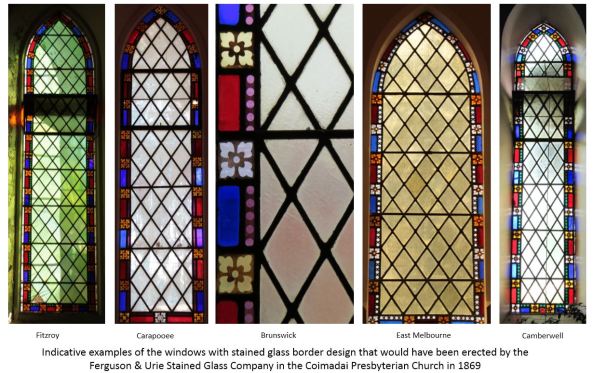
COIMADAI Indicative examples


Unfortunately the Coimadai Presbyterian Church no longer exists. Less than thirty years after the first service was conducted in 1869 the building was sold to the Alkemade Brothers in 1898 and was subsequently demolished to make way for a house.

“Alkemade Bros. seem to be doing well in the lime trade. One of them recently purchased the old Presbyterian church, and is now busy taking it down and I believe it is with the intention of erecting a brick villa. We shall have no other place to hold divine service in excepting the school room, which has been kindly lent by Mr. Borlase, the teacher. Week evening services are now held there by the Rev. F. H. Gibbs, which are well attended by the young people of Coimadai. The next service is to be held on August 25th. No doubt when the warm weather comes the Rev. J. A. Stuart will also assist, as in former days…”[9]

Much of the original historic township area of Coidamai is now nearly completely submerged under the Lake Merrimu Reservoir.

Significant tabloid transcriptions:

Bacchus Marsh Express, Vic, Saturday 22nd August 1868, page 2.

“A public meeting of the residents of Coimadai was held at Willow Bank on the evening of Tuesday, the 18th inst., for the purpose of taking into consideration the desirability of erecting a Church in connection with the Presbyterian cause in Victoria. The Rev. J. Scott, on taking the chair, stated the object of the meeting, and requested those present to express their views in the matter…”

The Bacchus Marsh Express, Vic, Saturday 7th November 1868, page 2.

“TENDERS ARE Requested for the erection of the Presbyterian Church, Coimadai, labour only. Bricklayer’s and carpenters work jointly or separately. Plans and specifications may be seen at the office of Mr. James Young, Bacchus Marsh. Tenders, addressed to the undersigned, Post-office, Coimadai, will be received up to 6 p.m. on Thursday, 26th inst., from whom all necessary information may be obtained. The Committee do not bind themselves to accept the lowest of any tender. DAVID D. BOWER, Hon. Sec.”

Bacchus Marsh Express, Vic, Saturday 20th February 1869, page 3.

“The Presbytery appointed the following persons as Trustees for the Church property at Coimadai – Messrs. David D. Bower, Peter Train, Malcolm Cameron, Alexander Hardie, and Hutcheson M. Allen.”

Bacchus Marsh Express, Vic, Saturday 26th June 1869, page 2.

“PRESBYTERIAN CHURCH COIMADAI.

 This place of worship was opened by Divine service being conducted in it on Sunday last by the Rev. J. Meek, of Gisborne, who preached from the text – “And the children of Israel, the priests and the Levites, and the rest of the children of the captivity, kept the dedication of this house of God with joy” – Ezra vi. 16. The sermon was highly appreciated by those who had the privilege of hearing it, and these were not few in number as many persons attended from Melton and Bacchus Marsh…”

“…The church is a neat edifice of brick, occupying a prominent position close to Mr. Bower’s residence. Its dimension are 40ft. x 20ft., with plastered ceiling and walls. At the rear are two small rooms, with fireplaces, which will be found very convenient for the use of the minister and the committee of management. There are three windows on each side filled with the usual lead lights with a stained glass border. There is also a window on each side of the entrance door and a louvre ventilator above. The angles of the building, the door jambs, and the windows, are faced with pretty freestone of the district, and altogether the building has a very neat and finished appearance…”

“…The cost of it will be about £320, of which half is contributed by grant-in-aid…”

“…On the evening of the 11th August, 1868, seven adherents of the Presbyterian Church being in the neighbourhood met, and having called you, sir to the chair, a provisional committee was nominated, whose names I may here mention were – Malcolm Cameron, Alex Hardy, Hutchinson Allen, George Greive, William McKelvie, Peter W. Train, and David D. Bower. I should state that in consequence of having the doors of the Common School closed against us for holding public worship, we felt it our immediate duty to set about erecting a house wherein we (as Presbyterians) might worship the God of our fathers. Since that date, about nine months ago, ladies and gentlemen, our respected Chairman has been holding fortnightly Sabbath services in the open air, and, I think with one exception, in the face of all weathers…”

The Bacchus Marsh Express, Vic, Saturday 13th August 1870, page 3.

“THE PRESBYTERIAN CHURCH, COIMADAI.”
“…First annual statement of the Coimadai Presbyterian Church for 1869-70…”
“…Ferguson, Urie, & Lyon, for windows, £19…”

The Bacchus Marsh Express, Vic, Saturday 6th August 1898, page 3.

“Alkemade Bros. seem to be doing well in the lime trade. One of them recently purchased the old Presbyterian church, and is now busy taking it down and I believe it is with the intention of erecting a brick villa. We shall have no other place to hold divine service in excepting the school room, which has been kindly lent by Mr. Borlase, the teacher. Week evening services are now held there by the Rev. F. H. Gibbs, which are well attended by the young people of Coimadai. The next service is to be held on August 25th. No doubt when the warm weather comes the Rev. J. A. Stuart will also assist, as in former days…”

Additional tabloid articles of interest:

The Bacchus Marsh Express, Vic, Saturday 15th April 1905, page 4.

“COIMADAI AND THE ALKEMADE HYDRAULIC GROUND LIME…”


Footnotes:

[1] The Bacchus Marsh Express, Vic, Saturday 18th November 1916, page 3.

[2] Bacchus Marsh Express, Vic, Saturday 22nd August 1868, page 2.

[3] Bacchus Marsh Express, Vic, Saturday 26th June 1869, page 2.

[4] The Bacchus Marsh Express, Vic, Saturday 7th November 1868, page 2.

[5] Bacchus Marsh Express, Vic, Saturday 20th February 1869, page 3.

[6] Bacchus Marsh Express, Vic, Saturday 26th June 1869, page 2.

[7] Bacchus Marsh Express, Vic, Saturday 26th June 1869, page 2.

[8] The Bacchus Marsh Express, Vic, Saturday 13th August 1870, page 3.

[9] The Bacchus Marsh Express, Vic, Saturday 6th August 1898, page 3.


© Copyright

1869: Christ the King Anglican Cathedral, Ballarat, Victoria.

The Chancel of the Ballarat Anglican Cathedral contains an historic three light stained glass window created by the Ferguson & Urie stained glass company of North Melbourne. The window depicts the Nativity, Crucifixion and Resurrection and was erected in the later half of October 1869.

Photos taken between: 19th Sept 2010 and 28th Sept 2013.

This slideshow requires JavaScript.

[View larger images]

Construction of the first Anglican Church in Ballarat, known as Christ Church, commenced in 1854 in Lydiard Street, a year before Ballarat was proclaimed a Municipality and in the same year as the infamous Eureka Rebellion. The first stage of the church was completed by contractors Backhouse[1] and Reynolds in 1857 at a cost of more than £2000.[2]

In a mere ten years the congregation had outgrown the church and the plans were to enlarge it by the addition of transepts. On the 20th August 1867 the building committee of Christ Church accepted the tender of Mr Jonathon Coulson for the construction of the north and south transepts for £1655 to the plans prepared by architect Edward James.[3] The construction of these extensions began a month later.[4]

As part of the extensions and the beautification of the church was the idea of placing a locally made stained glass window in the chancel and on the 19th October 1867 it was reported;

We are informed that the stained window for the chancel at Christ Church is to be the gift of Mr. E. A. Wynne[5]. Messrs Urie and Ferguson, of Melbourne, will most likely supply the glass. The subject for the window has not yet, however, been determined on.”[6]

Edward Agar Wynne (1823-1898).

Edward Agar Wynne, was a mining pioneer in the Ballarat region. He was Chairman of Directors of the Scottish and Cornish Gold Mining Company[7], a founder and director of the Ballarat Gas Company (established in 1858), and one of the first shareholders in the Black Hill mine, of which he still held 1200 shares in at the time of his death[8]. He took a leading role in the laying out of Ballarat’s botanic gardens as well as being a member of the Acclimatisation Society[9].

He married Sarah Maria Palmer in London in c.1849 and migrated to Australia with his family c.1851-54.

In the mid 1870’s he had decided to leave Ballarat and move to the Melbourne suburb of Balaclava and his substantial home on the shores of Lake Wendouree was subsequently purchased by the ‘Loreto Sisters’ for use as part of their newly formed Convent in 1875[10].

His wife Sarah died on the 15th February 1882 at their home ‘View Hill,’ Balaclava[11], and in 1884, at the age of 60, he married 26 year old Rebecca Israel Samuel[12].

Edward died at his home ‘Montacute,’ Grey Street St Kilda, on the 9th December 1898 aged 75[13]. He was buried at the St Kilda Cemetery with his first wife Sarah and two of their children[14]. One of his sons from his first marriage, Agar Wynne (1850-1934), became a prominent Victorian politician.

Edward would not end up being the benefactor of the window and the enthusiasm for its creation lost momentum. It would be a further two years before the window would actually be created and more than a year after the 1867-68 extensions of Christ Church were completed.

By April 1868 the extensions to Christ Church were nearing completion and the local tabloid, ‘The Ballarat Star’ reported;

“The alterations at Christ Church are now nearly finished. Both transepts have been erected, and the northern one has been occupied already. The south one requires some completing touches, and the chancel is also unfinished, the window not yet being glazed. We believe the organ is to be erected in the southern transept. It seems a pity the chancel could not have been deepened and widened, so as to have made it serve as for a cathedral choir, and thus have provided room there for the singers, instead of taking space for the choir out of the too small area of the church, even with its transepts added.” [15]

The 6th of May 1868 heralded the re-opening of Christ Church and a series of celebrations were organised for the dedication of the new transepts and chancel. The services were conducted by Archdeacon Stretch[16] at the morning services and the Rev Handfield [17] at the afternoon services. The decorations in the church at this point indicated that the chancel window was still in an un-glazed state.

“The opening of Christ Church is to be celebrated this day, as the first of a series of days appropriated to the solemnities in question. Our advertising columns contain particulars as to the services, from which it will be seen that the venerable Archdeacon Stretch will officiate at the dedication of the transepts and chancel this morning, and that the Rev. H. H. P. Handfield will officiate in the afternoon. Full choral services will be sung on both occasions, and we may state apropos to this matter, that, the organ has been re-erected, and is now located in the southern transept. The church has been decorated with evergreens, wreaths depending about the transept arches and the chancel, and boughs screening the unglazed chancel window.”[18]

It wasn’t until November 1869 that the creation of a stained glass window for the chancel came to fruition, but where it had been reported earlier in 1867 that the donor of the window was to be Edward Agar Wynne, it was now reported that the benefactor was William Henry Barnard, who had made the gift of the window at a cost in the vicinity of £200.

On the 30th of October 1869 ‘The Ballarat Star’, gave an in-depth description of the window. Where it had been intimated earlier in 1867 that the Ferguson & Urie stained glass company were likely to supply the window, it was eventually created by them and depicts the Nativity, Crucifixion and Resurrection;

“A very beautiful stained glass window has this week been erected in the east or chancel end of Christ Church. Mr. W. H. Barnard has made a gift of the window to the church, and the munificent donation is a rich and very appropriate adornment of the sacred edifice. The design includes the three leading events in our Lord’s life, the middle compartment figuring the crucifixion, the two sides the nativity and resurrection respectively, each grouping, and especially that of the nativity, displaying fair accuracy in drawing, and a glorious wealth of colour. At the bottom is a half length figure of Christ giving thanks, and at the top is a dove, the symbol of the Holy Spirit. The subsidiary details, such as borderings, geometrical figures, and florials are in excellent keeping. Messrs Urie and Ferguson, of Melbourne, supplied and erected the window at a cost of some £200, and we have heard an opinion freely expressed, that though there may be larger there are no better windows than this one anywhere in the colony.”[19]

A week later it was further reported;

“A very beautiful stained glass window has been erected in the east or chancel end of Christ Church, Ballarat. Mr W. H. Barnard has made a gift of the window to the church, and the munificent donation is a rich and very appropriate adornment of the sacred edifice. Messrs Urie and Ferguson, of Melbourne, supplied and erected the window at a cost of some £200.”[20]

William Henry Barnard (1830-1900)

The donor of the stained glass window, William Henry Barnard, was born in Surrey, England 1830, the son of John Barnard and Harriet Burrows.

On the 4th February 1859 he married Caroline Lawrence at St John’s Church in Launceston, at which time he was employed by the colonial treasury as the Receiver and Paymaster at Portland in Western Victoria[21].

In February 1865 he was appointed receiver and paymaster, land officer, and gold receiver at Ballarat[22]. His wife Caroline died only a few weeks later aged 28 on the 25th February 1865[23].

On the 23rd April 1867, at Christ Church at Ballarat, he married Bessie Lynn, sixth daughter of local solicitor Adam Loftus Lynn[24]. Bessie died on the 3rd of September 1881 aged 36 at Ballarat giving birth to a daughter, the new born did not survive either[25].

He married a third time to Ellen Barnard, his first cousin and fifth daughter of his uncle George William Barnard of Landfall, Tasmania. They married at  St Peter’s Church in Sturt Street Ballarat on the 29th August 1883.

On the 28th May 1886, at St Paul’s Church Melbourne, he married a fourth time, to Flora who was again a first cousin and younger sister of his third wife Ellen [26].

Barnard resigned from the Government Treasury positions in 1878 to become Secretary-treasurer of the Ballarat Cemetery Trust and he retained that position until his death in 1900. He was also registrar of the Ballarat School of Mines[27].

He died on the 12th January 1900 at his Errard-street home at Ballarat West aged 70 and was buried in the Ballarat old cemetery[28].

An original engraving depicting the chancel of Christ Church, circa 1874, shows the three light chancel window, and in the engraving are painted the words around the chancel arch:

“HEAR THOU IN HEAVEN THY DWELLING PLACE AND WHEN THOU HEAREST FORGIVE.” (1 Kings 8:30)

Text surrounding the arch around the top of the Ferguson & Urie stained glass window reads:

“WE WORSHIP THY NAME, EVER WORLD WITHOUT END”

(From the Book of Common Prayer).

None of this original text around the arches exists anymore.

By 1886 the idea of erecting an Anglican Cathedral in Ballarat had gained momentum with the Rev Samuel Thornton[29] (the first Bishop of Ballarat) as lead instigator. On the 18th March 1886 it was resolved to erect a Cathedral to the rear of the site of the current church;

“At a meeting of the Church of England Assembly in Ballarat on Thursday, it was resolved to build a cathedral on the church site in Lydiard-street. A resolution was also carried that the building should be of stone, and the cost was limited to £35,000, exclusive of the tower and spire.”[30]

“The Right Rev. Dr. Thornton has for some time been actively promoting the erection of a cathedral in the chief town of his diocese. At the suggestion of the bishop, the vestry of Christ Church consented to unite cordially with the diocese in the erection of a cathedral upon the site of their present parish church in Lydiard-street…”[31]

The laying of the foundation stone of the new cathedral was performed on St Andrews day[32] by the Governor of Victoria, Sir Henry Brougham Loch[33]. Sir Henry and Lady Lock arrived by special train at Ballarat on Thursday 29th of November[34] and the following day, St Andrew’s Day, he laid the foundation stone of the new cathedral in the presence of the Bishops of Sydney, Melbourne, Bathurst and the Riverina[35] and a large assembly of the Ballarat Anglicans. Contributions exceeding £540 were placed on the foundation stone on the day[36].

The plan for the cathedral was that its construction would begin on the lower east side of the current church and the current church would then eventually form one of the transepts of the cathedral when completed.

By April 1890 construction of the cathedral had stalled. Unforeseen circumstances occurred with the foundations at the eastern end because of the steep slope and the lack of funds to rectify it had halted further work. In Bishop Thornton’s address to the Annual Church Assembly at the Ballarat City Hall on the 6th May 1890 he outlined his concerns and the expenditure to-date[37]

Sadly, nothing further transpired. The desire for an Anglican Cathedral in Ballarat did not gain the support it required and in 1931, forty years later, the Melbourne ‘Argus’ reported;

“…The ambition of Bishop Thornton was to see the Ballarat cathedral completed. The foundation-stone was laid by Sir Henry – afterwards Lord – Loch, when he was Governor of Victoria. It has not yet been finished, but cathedrals grow with the centuries rather than with the years. Some day it will be completed and an enthusiastic vicar may address his mind to the task of writing its history. In that history should be reserved and honoured place for the name of Dr. Thornton. He died in Lancashire, still in the service of his Church…”[38]

The cathedral would never be completed. Bishop Thornton died in England in 1917 and all that exists to recognise his efforts is a memorial brass tablet erected in the liturgical south west corner of the church which reads;

“TO THE GLORY OF GOD AND IN MEMORY OF THE RIGHT REVd SAMUEL THORNTON, D.D. FIRST BISHOP OF BALLARAT 1875-1900 WHO WAS A WISE MASTER BUILDER LAID THE FOUNDATIONS OF THIS DIOCESE AND FOR 25 YEARS LOVINGLY AND UNSPARINGLY DEVOTED TO ITS WELFARE ALL THE MANY TALENTS WHICH GOD HAD GIFTED HIM. DIED IN ENGLAND 25th. NOV 1917. THIS TABLET IS ERECTED BY THE DIOCESE.”

It is now more than 125 years since the then Governor Sir Henry Lock laid the foundation stone for the cathedral and evidence still remains of it to this day at the rear of the original bluestone church in Lydiard Street.

The lower basement of the cathedral which had been constructed before works were halted was known as the ‘Chapter House’ and was used as the Diocesan office for many years and later sold to private enterprise circa 1980’s. It was later used as a night club and is now a private residence.

The original church building facing Lydiard Street became the Anglican Cathedral of Ballarat and carries the title of the Church of ‘Christ the King’.

The historic Ferguson & Urie stained glass window still exists in the chancel of the church in the exact same position it was erected in 1869.

As at 2016 the cathedral and associated buildings have been advertised for sale by the Anglican authorities.

Footnotes:

[5] Edward Agar Wynne (1823-1898).

[8] Edgar Agar Wynne, Vic Probate record 75/159, dated 17th May 1900.

[12] Vic BDM: 284/1884.

[14] St Kilda Cemetery, CofE, Compartment A-327.


Short link to this article: http://wp.me/p28nLD-2ax

© Copyright

1869: William Hornby & the Artillery Brewery, Williamstown, Victoria.

An unusual pencil sketched design for a stained glass window exists in the State Library or Victoria.  Amongst a collection of drawings, on fragile torn tracing paper is the design and associated sketches for a stained glass window intended for William Hornby’s historic Artillery Brewery at Williamstown in Victoria. The design is by the hand of the English stained glass artist David Relph Drape (1821-1882) who came to Australia in 1858 and worked as Ferguson & Urie’s senior stained glass artist from 1863 until his death in 1882.

The central picture depicted in the windows design is a coastal artillery gun taken from the exact depiction of the Sir William Armstrong Rifled Muzzle Loading Fortress Gun. Two of these historic old guns still exist along John Morley Reserve on The Strand at Williamstown across the bay from Melbourne. The guns date from 1867 and were originally installed at Fort Gellibrand circa 1867 where there are still two guns.

This slideshow requires JavaScript.

Despite significant research, to this day it’s not known whether the stained glass window was ever actually created, and if so, what was its fate? Did it get destroyed or, like many historical artefacts, is it hidden away in an old garage or attic somewhere ready to be found again in years to come?

So who was William Hornby?

William Hornby (1821-1898) was the son of Anthony Hornby and Catherine Kelly. As a 22 year old Iron Moulder from Liverpool, he would begin his life in the Australian Colonies as a convict in Van Diemens Land.

Hornby was tried and convicted at Lancaster, Liverpool, on the 25th July 1842 for housebreaking and was sentenced to ten years in Van Diemens land (Tasmania) for his crime.

The convict ship ‘Cressy’ departed Plymouth on the 28th March 1843 and arrived off the coast and into Lagoon Bay on the 17th August 1843, having ‘overshot’ the entrance to Storm Bay. Coincidentally the new Lieutenant-Governor of the Colony, Sir Eardley Wilmot (1783-1847) was on the same ship[1]. Hornby was immediately sent to work with the convict gangs at Fingal for a period of five years.

In 1848 the Convict Department granted him a ticket-of-leave[2] and in July 1849  Lieutenant Governor, Sir William Thomas Dennison (1804-1871) made recommendation for Hornby’s conditional pardon[3] which wasn’t granted until October 1850[4]

At the age of 29 he married 22 year old Frances Hopson in Hobart on the 21st of June 1852[5]. Their first child, Fanny Hopson Hornby was born in Hobart on the 30th March 1853[6], followed by William Anthony in 1855[7], Alfred Arthur in 1856[8], Emily Maria in 1859[9], and Walter John in 1862[10].

At a Publican’s Licensing meeting at Hobart in August 1852 William Hornby was granted the transfer of the victuallers licence, vice Joseph Riches, of the “Oporto Wine Vaults” in Liverpool street Hobart[11].

By 1856 he has established himself as a respected businessman in Hobart and had taken an active role amongst the publicans and innkeepers of the town in the reforms of the Licensing Act,[12] and is by 1858 a brother of the Hobart Macquarie-street Masonic Lodge No.345[13]

Shortly before two o’clock on the 10th January 1862, a fire broke out between the Oporto Wine Vaults and the adjacent Salier’s drapery store. The stock from both premises was saved but the upper floor and roof of both buildings was destroyed. A later inquest[14] determined that the fire broke out in the roof of Hornby’s premises but the cause was unknown. Both premises were fortunately insured[15] The damage to both properties was eventually repaired but lengthy legal disputes continued into 1864 as to who was liable to pay certain amounts for the repair of the party walls and other damage between the two premises[16].

Only two days after the fire Hornby’s son Walter John was born on the 12th January 1862[17]

Hornby continued in the liquor trade despite some confusion which arose regards his use of the appointed liquor licence to operate from another temporary premise as a result of the fire[18].

On the 30th October 1864 he undertook a short trip to Melbourne aboard the Southern Cross[19] and returned via the same on the 10th November. This would be one of many trips to the mainland in the next three years as he plans his exit from Tasmania to Melbourne. Less than six months later tragedy would strike the family. His eldest, Fanny Hopson, was struck with a serious illness and after suffering a mere two days she died on the 7th April 1865 at the age of twelve.[20]

In July 1865 Hornby conducted a sweep for the Melbourne Cup which was to be drawn at 8 o’clock on the evening of 3rd July at “Hornby’s Hotel” (the Oporto Wine Vaults) in Liverpool street[21]. The sweep was so popular that it increased the patronage at his hotel significantly. Deciding to expand on the idea, he again offered a second sweep in August with a prize of 100 sovereign’s[22]. The individuals or syndicates, who had drawn “Torboy”, the Cup winner, would receive handsome rewards. Later in December he again offered another sweep of 300 sovereigns on the Melbourne and Launceston Champion Races[23]. Not content to stick to horse racing he offered a sweep in the Champion Rifle Match competition held on the 26th February 1866[24].

He chose not to restrict his business ventures to the publican’s arena and in August 1865 he decided to expand his interests to gold mining. In accordance with the “Gold Fields Regulation Act”, he was granted a one-month lease of 60 acres of land in the district of Fingal[25]. Further financial interests in the stock market were included amongst which was a shareholding in the Tasmanian Steam Navigation Company in March 1866 [26].

In April 1866 he offers a £5 reward for the conviction of the malicious person who fired a shot into his property at Battery Point, breaking several panes of glass[27].

By 1867 he was earnestly planning his exit from Tasmania and in February of 1867, he transferred the licence of his Oporto Wine Vaults to John Hanson.[28]

On the 16th of October 1867[29] he made another short trip to Melbourne and presumably, this is one of the last ventures to the mainland to secure accommodation and establish future business ventures in Melbourne. In an attempt to reign in debts owed to him, numerous legal proceedings are initiated in Hobart, one of which, in March 1868,  included one of a sizeable sum of £250 owed to him by the insolvent William Hurley[30]

On 27th Feb 1868, the Hobart auction agents Roberts & Co were“… favored with instructions from Mr. Hornby, who is about to leave the Colony, to sell by public auction, on the premises, Liverpool-street, on FRIDAY, 6th March, at eleven o’clock…”[31]

William Hornby and his family departed for Melbourne aboard the ‘Southern Cross’ on Saturday 7th March 1868[32], which arrived at the Port of Melbourne two days later on the 9th“Mr. and Mrs. Hornby and family (four)…”[33]

The family’s household furniture and effects at Melville-street Hobart went up for Auction on Friday 13th March 1868[34].

December of 1868 appears to be the first indication of Hornby’s exploits as a brewer at Emerald Hill (now known as South Melbourne).  Publican George Sefton was taken to court by Hornby because he had paid ten percent less for goods supplied to him by Hornby, a practice which Sefton claimed as the accepted practice between Publicans and Brewers. The court awarded in favour of Sefton[35].

By 1869 Hornby had partnered with another brewer named William John Disher and together they took over the existing brewing business of John Breheny who had established himself making “Artillery” beer in the former volunteer Artillery Drill Hall (near the Steam Packet Hotel) at Williamstown. The old drill hall was at that time quite famous in its own right as the former stockade building which had accommodated the convicts working on the Gellibrand pier in the early 1850s.

Intent on updating the brewing equipment, on the 20th May 1869 “Hornby & Co” advertised the “second hand brewer’s plant for sale” from premises at Williamstown[36]

The partnership with Disher only lasted a short period and on the 12th Aug 1869 a notice was gazetted advising of the dissolution of partnership between him and Disher in the “Williamstown Brewery”. [37] [38]

By 1875 the Hornby and his brewing operations are very well known and the Williamstown Chronicle published a lengthy article about the Hornby Brewery, its operations, and the history of the old convict building it was erected in.

“Amongst the recognised institutions of Williamstown, one of the most popular is “Hornby’s beer.” We find it literally “in the mouths” of all classes of the community, and the establishment from which it emanates takes rank with the foremost of our local industries…” [39]

On the 8th of May 1878 his second son, Alfred Arthur Hornby married Sophia Victoria Hall at St John’s Church in Colac Victoria[40].

In 1886, at the age of 65 William Hornby is still making improvements to the brewery and machinery, although his son Alfred is by this time taking a managerial position in the company[41].

On the 28th of January 1898 William Hornby died destitute at the Masonic Home in Prahran at the age of 77.[42]

Numerous failed investments and an overly generous purse would seem to have been the reason for his fall from prosperity. On his death he was described as:

“Charitable to the core, he endeared himself to those who knew and respected him in his days of affluence, and regret remains that the unkind hand of fate or fortune should have stricken him in the latter days of his career

“…no man could say that his purse was closed when an appeal for help was made; yet, the man who was the friend of many found himself not deserted in his own hour of need, for Masonic brethren smoothed his quickly downward path. As a man, his one fault was that he possessed a generous heart which ultimately led to his impoverishment…”[43]

His son Alfred Arthur Hornby continued to run the brewery briefly but it eventually fell into the hands of the Carlton Brewery conglomerate.

The historic convict stockade building that housed the brewery was demolished in the 1950s. Another piece of history was lost to the wrecker’s ball.

No evidence of the stained glass window has ever been found other than the original design sketches by the artist David Relph Drape from the Ferguson & Urie stained glass company.

Significant Article Transcriptions & Sources:

Victorian Government Gazette, 40, Friday August 20th 1869, page 1275.

“DISOLUTION OF PARTNERSHIP

NOTICE is hereby given that the partnership heretofore carried on by us, the undersigned William Hornby and William John Disher, at the Williamstown Brewery, Williamstown, under the style of “W. Hornby and Co.,” has this day been dissolved by mutual consent, and that all debts and liabilities owing to and by the said partnership will be received and paid by the undersigned William Hornby.

Dated this twelvth day of August, 1869.

WM. HORNBY

WM. JOHN DISHER

Witness-

H. HEDDERWICK,

Solicitor, Melbourne.

No. 1712”.

Williamstown Chronicle, Vic, Saturday 20th March 1875, page 3.

“HORNBY’S BREWERY”

“Amongst the recognised institutions of Williamstown, one of the most popular is “Hornby’s beer.” We find it literally “in the mouths” of all classes of the community, and the establishment from which it emanates takes rank with the foremost of our local industries. The brewery is not of recent origin, and although all along it has boasted of the pretentious title of the “Artillery Brewery,” the townsfolk have ignored the martial designation in preference for the name of the spirited proprietor, and so long as he has anything to do with it, it is likely to be known only as “Hornby’s brewery.” Everyone knows its location – near the Steampacket hotel. The building has a history of its own, and is one of those old-day landmarks which assist the early residents of Williamstown in recapitulating the infantile circumstances of the “village.” The building was originally erected for the accommodation of the prisoners employed o the works at Gellibrand’s point, and indeed its sturdy proportions would lead the most casual spectator to attribute its design to a Government architect. The transfer of the prisoners to the penal hulks rendered the building available for other purposes, and when the Rifle Corps was established, the recruits of the “grey brigade” were put through their facings on the first floor, where fermenting vats, &c., now reign supreme. For many years the building continued to reveal its primitive character in its name, but it has long since lost its appellative “Stockade” and become known to us only as Hornby’s brewery. There are few purposes for which it is better adapted than that to which it is now devoted. Bare, spacious, unpartitioned rooms, indifferently lighted, massive walls, iron barred windows, and a very retired position are qualifications which do admirably for a brewery, although not appropriate for most other business uses. The premises cover half-an-acre of ground, which of course affords ample accommodation for the multifarious out-buildings, &c., essential to such and establishment. The building is so high that there is no necessity for pumping or raising the liquid to higher levels by any other means, during the process of brewing – the water is first boiled by steam in a vat at the very top of the building, and from that time till the beer is casked it passes from one vessel to another by gravitation, travelling from roof to cellar. The “hot liquor vat,” of which we have made mention as being at the top of the building, is some 30 feet from the ground. Into it the aqua pura is supplied by a Yan Yean supply pipe. The water is heated by means of a tubular worm lying in the vat, through which passes a current of steam direct from the boiler. A thermometer hung under a tap in the vat enables the brewer to ascertain when the water has attained the requisite temperature. From the hot liquor vat, the water is turned into the mash tun, where the mashed malt has already been deposited. The malt is crushed or mashed between iron rollers, worked by a ten-horse horizontal engine; and after being so crushed the grain without the flour is lifted by a series of cups or elevators (such as are seen in flour mills) to a hopper on a higher level near the mash-tun. The ensure the thorough saturation of the malt in the mash-tun, an ingenious contrivance known by the brewer as a “sparging machine” is employed. It revolves by centrifugal force, throwing out innumerable jets of water, so that the grain in every part of the tun is thoroughly soaked. After the liquor has remained in the mash-tun a sufficient length of time – and in determining this, the judgement of the brewer is relied upon – it is filtered off through a perforated false bottom into the copper, great care being taken to prevent any of the grains getting away with the liquor. This grain is afterwards taken out, and sold to dairymen and others for fattening cattle, pigs, &c. The “copper” is a large vat, constructed of wood, in which is another copper worm tube, charged with steam for the purpose of boiling the liquor, as is done in the hot liquor vat. Before the liquor is boiled this time, however, the hops is added, and during the process another ingredient – sugar – is introduced. The sugar is boiled before being used, the necessary heat being obtained by steam as in other cases. Leaving the copper almost at boiling heat, the worts is carried over the refrigerator – a number of pipes kept cool by an incessant stream of cold Yan Yean passing through them – and enters the “gyle,” or fermenting vat, at the very mild temperature of 74 degrees. To keep down the heat generated by the process of fermentation, a temperator is used. This is a framework of piping lowered into the “gyle,” through which a stream of Yan Yean passes. The hops does not accompany the liquor into the fermenting vat, but is retained in the copper, any virtue which might remain in the hops is extracted by its being “squozen” in a hop-press, and the extract added to the liquor in the fermenting vat. The liquor remains in the fermenting vats – there are two, each 7 feet deep, by 7 feet in diameter, made of Kauri pine staves, 3in thick – for from 30 to 50 hours, according to circumstances, and from these it is carried by piping to hogsheads ranged up and down the cellar. Each brew is marked, and no liquor permitted to go out till it has remained at least eight days in the cellar, and sometimes nearly three weeks. When we paid our visit there were nearly 200 hogsheads in the cellar, which is 30 feet by 66ft in extent. The floor is bricked, and gas and water laid on. Adjoining there is another cellar of almost equal proportions. There is every requisite for such an establishment. The patronisers of Hornby’s brew would derive considerable satisfaction from seeing the care taken to ensure cleanliness in each operation. The casks are scoured by steam everytime they are wanted; and the very best materials are employed in the manufacture of the ale. Excellent sugar is used; the best Kent or Gipps Land hops; and the best malt purchasable. And the skill and attention devoted to the operation of brewing are attained by the excellent results obtained. We are informed that Mr Hornby purposes increasing his establishment by building a kiln, and doing his own malting on the premises.”

Williamstown Chronicle, Vic, Saturday 11th December 1886, page 3.

“IMPROVEMENTS AT THE ARTILLERY BREWERY, WILLIAMSTOWN.”

“THE present is an age of improvement and progress, and we are glad to observe that Williamstown tradesmen and business people are no exception to the rule. This may be gathered from the excellent external appearance of our shops and the amiable arrangement for the accommodation of the public when making their purchases. Amongst; others we notice Messrs. Hornby and Co., of the Artillery Brewery, are endeavouring to keep pace with the times, by the introduction of improved machinery into their works…”

Williamstown Chronicle, Vic, Saturday 29th January 1898, page 3.

“OBITUARY

AN OLD FREEMASON”

“INTIMATION of the decease of Mr Hornby, who departed this life in the Masonic Home yesterday, will be received with deep regret by all those in Williamstown who knew him in his palmiest days. Charitable to the core, he endeared himself to those who knew and respected him in his days of affluence, and regret remains that the unkind hand of fate or fortune, should have stricken him in the latter days of his career. For over 45 years he conducted a prosperous business in our midst, and no man could say that his purse was closed when an appeal for help was made; yet, the man who was the friend of many found himself not deserted in his own hour of need, for Masonic brethren smoothed his quickly downward path. As a man, his one fault was that he possessed a generous heart which ultimately led to his impoverishment, but when the Great Architect of he Universe comes to cast up his account, may the record read – “Thus mote it be; go thou and receive thy reward.”

The Argus, Melbourne, Vic, Monday 7th February 1898, page 1.

“HORNBY.-On the 28th January, at his late residence, Punt-road, Prahran, William Hornby, brewer, late of Williamstown, aged 77 years.”

Family:

William Hornby (age 29), married Frances Hopson (age 22) at Hobart 21st June 1852, Tas BDM:675/1852.

William Hornby:

Died: Prahran, Victoria, age 77, 28th January 1898. Vic BDM: 4331/1898.

Parents: Anthony Hornby & Catherine Kelly.

The Argus, Melbourne, Vic, Monday 7th February 1898, page 1.

Children:

Fanny Hopson Hornby:

Born: Hobart, 30 March 1853, Tas BDM: 2248/1853

Parents: William Hornby & Frances Hopson.

Died: Hobart, 7th April 1865, age 12, Tas BDM: 4945/1865.

“After a brief illness of only 2 days”

The Mercury, Hobart, Tas, Saturday 8th April 1865, page 1.

William Anthony Hornby:

Born: 20 Jun 1855, Tas BDM: 191/1855.

Alfred Arthur Hornby:

Born: 1856 TAS BDM: 1861/1856

Alfred Arthur Hornby married Sophia Victoria Hall in Colac, Victoria in 1878.
VIC BDM: 1373/1878

Married at St John’s, Colac, Vic, 8th May 1878.

The Mercury, Hobart, Tas, Saturday 1st June 1878, page 1.

Emily Maria Hornby:

Born: Hobart 4th Sept 1859, Tas BDM: 2770/1859

The Hobart Town Daily Mercury, Tas, Friday 9th September 1859, page 2.

She died: 1st July 1881 at ‘Atherstone’, Albert Park (reg as Eastern Hill), Melb, in 1881 aged  21, VIC BDM: 7244/1881

The Argus, Melbourne, Vic, Monday 4th July 1881, page 1.

Walter John Hornby:

Born: 12 Jan 1862, Tas BDM: 4973/1862

The Mercury, Hobart, Tas, Tuesday 14th January 1862, page 2.

He died: 17th July 1951, aged 89, at 14 Melrose-street, Richmond Victoria. Vic BDM: 7932/1951.

The Argus, Melbourne, Vic, Wednesday 18th July 1951, page 14.

Wife: Bertha?

Footnotes:

[5] TAS BDM:675/1852

[6] TAS BDM: 2248/1853

[7] TAS BDM: 191/1855.

[8] TAS BDM: 1861/1856

[9] TAS BDM: 2770/1859

[10] TAS BDM: 4973/1862

03-09-1869: St John’s Anglican Church, Heathcote, Victoria.

St John’s Anglican Church at Heathcote was constructed by local builders Flee and Bell to the design of Bendigo based architects Vahland & Getzschmann.

The foundation stone was laid by Bishop Charles Perry[1] on the afternoon of Monday the 11th May 1868[2] and officially opened for services on the 3rd October 1869[3]. Nearly twenty years later, Bishop, James Moorhouse[4] consecrated the church on the evening of the 14th August 1889[5].

The three light east and west end stained glass windows are of geometric designs with Passion Flower and Fleur-de-lis patterns and were made by Ferguson & Urie of North Melbourne. The newspaper report of the opening ceremony of the church in 1869 referred to the company as “famous throughout the colonies for skill and designs in this particular art”.

Photos taken: 26th December 2010.

This slideshow requires JavaScript.

McIvor Times & Rodney Advertiser, Heathcote, Vic, Friday 3rd September 1869, page 2.

“THE OPENING OF THE NEW EPISCOPALIAN CHURCH.

[COMMUNICATED]”

“This neat edifice will be opened for Divine service by the Bishop of Melbourne on Sunday, 3rd October (assisted by one or two clergymen), who will preach both morning and evening. The choir have been very active in practicing some new chants and anthems for the occasions, which will add to the solemnity of the services materially. A building of this nature has for years past been greatly needed by the members of that body, and that now erected, when properly furnished, will seat 250 persons comfortably, and although it has cost more time and money to bring it to its present condition than was at first anticipated, yet both the work and material used is of the first quality, and would stand the test of the closest inspection. The coloured windows are from the glassworks of Messrs. Ferguson, Urie, and Lyon, of Curzon Street, Melbourne, which firm is now become famous throughout the colonies for skill and designs in this particular art. The building is roofed with best Bangor slates, and altogether it may be considered and ornament to the town. A polished cedar altar rail and reading desk, which are being constructed, will add to the rich effect of the whole of the interior. A font, carved in New Zealand free stone, will also shortly be added. The bell is the gift of Messrs Christie and Spinks”.

The Ballarat Star, Vic, Tuesday 7th September 1869, page 2.

“The McIvor Times gives an account of the new Episcopalian Church in that locality. It will seat 250 persons comfortably. The colored windows are from the glassworks of Messrs Ferguson, Urie, and Lyon, of Curzon street, Melbourne, which firm has now become famous throughout the colonies for skill and designs in this particular art. The building is roofed with best Bangor slates, and  altogether it maybe considered an ornament to the town, A polished cedar altar rail and reading desk, which are being constructed, will add to the rich effect of the whole of the interior. A font, carved in New Zealand freestone, will also shortly be added. The bell is the gift of Messrs Christie and Spinks”.

Footnotes:

22-04-1869: Christ Church, Warrnambool, Victoria.

This post covers the Stevens and Bateman window memorial windows by Ferguson & Urie erected in Christ Church at Warrnambool in 1869.

The Church of England Messenger, 22nd April 1869, page 7-8.

“WARRNAMBOOL.- The church here has recently been presented with some beautiful windows of stained glass, from the manufactory of Messrs. Urie, Ferguson and Lyon, of Melbourne. The east window (one of three lights) has been presented by F. P. Stevens, Esq., as a tribute to the memory of his deceased wife. It represents the baptism, crucifixion, and resurrection of our Lord; underneath which, and distributed through all three divisions, is the representation of the Last Supper. The three lights at the eastern end of the north aisle, together with the round window in the gable, have been presented by W. Bateman, Esq., as a memorial of his deceased parents. The first three represent the raising of Jairus’ daughter, the transfiguration of our Lord, and His agony in the garden of Gethsemane”.

Photos were taken 7th January 2011.

This slideshow requires JavaScript.

The Stevens Window:

The Argus, Melbourne, Vic, Wednesday 5th August 1868, page 4.

STEVENS.- On the 26th ult., at the Cottage, Warrnambool, Jane, the beloved wife of F. P. Stevens, aged forty-seven years.”

The three light window above the High Altar was presented by Frederick Perkins Stevens in memory of his wife Jane (nee Rule) who died on the 26th July 1868 at the age of 47. The windows depict the Baptism, Crucifixion and Ascension with the lower scenes depicting the Last Supper.

A brass plaque in the church also reads:

“The Three Bells erected / in this Tower were / presented to Christ Church Warrnambool by FP Stevens / Member for Villiers & Heytesbury / of the Legislative Council of / Victoria 1852 / In Memory of his younger Son / FS Stevens who died at his Station / Tintinchilla Queensland / 26th May 1880 Aged 30 Years”.

The bells presented to Christ Church were brought to Melbourne for the 1881 Melbourne Exhibition where they were awarded 1st prize.

The Bateman Window:

Illustrated Australian News for Home Readers, Melbourne, Vic, Saturday 25th April 1868, page 15.

“BATEMAN.- On the 30th March, at his residence, Fern Cottage, Warrnambool, Mr. William Bateman, sen., aged 79″.

The Argus, Melbourne, Vic, Tuesday 25th August 1868, page 4.

“BATEMAN.- On the 24th inst., at Spring-gardens, Warrnambool. Mrs. Bateman, sen., aged sixty-nine years”.

William Bateman Snr was born in Bradford, Yorkshire circa 1794 and married Sarah Smith in 1815 in the same town. They migrated to Australia with their four children circa 1853 and set up business in Warrnambool as Bateman & Co in the name of their son William Jnr. The company became one of the districts largest mercantile businesses but eventually ran into financial difficulty during the time of the land speculation boom when William Jnr ran up huge debts in land holdings which eventually saw the collapse of the small family empire.

In 1869 William Bateman Jnr presented Christ Church Warrnambool with the three light window in memory of his parents, William & Sarah Bateman. William Jnr died in 1913.


Short link to this page: https://wp.me/p28nLD-1ew

© Copyright

03-12-1869: Christ Church, Moorabool St, Geelong, Victoria.

The first Ferguson & Urie stained glass window to be erected in Christ Church at Geelong was the five light Chancel window which depicts Christ in the centre light, flanked by the four evangelists, Matthew, Mark, Luke & John with their biblical alter egos beneath their figures. This window gained quite a bit of notoriety and comment in the tabloids of the time of its erection. Despite significant vandalism in the past 145 years, the most recent attack being in November 2011, it has somehow survived the test of time and is certainly a significant artifact for Christ Church and should be considered for heritage listing.

The Church of England Messenger, 3rd December 1869, page 7

“CHRIST CHURCH, GEELONG.- A handsome chancel window has recently been put up in this church, at a cost of £120, from the workshops of Messrs. Ferguson, Urie and Lyon, of Curzon-street. The style of architecture is that known as late perpendicular, the complicated mullions and tracery admitting as many as eight-and-twenty lights. Of these, the five principal compartments are thus appropriated:- In the centre, to accord with the designation of the church, the Saviour is represented enthroned, having in his left hand the globe and cross, and elevating the right in the attitude of blessing; whilst the compartments on either hand are occupied with erect figures of the four Evangelists. Those who have examined former efforts of this enterprising firm will be struck by the improved purity and brilliancy of colour displayed. The utmost skill has been shown in the harmony of arrangement”.

Photos taken 24th Oct 2010. (Date of Historical photo unknown).

This slideshow requires JavaScript.

Geelong Advertiser, Vic, Wednesday 10th November 1869, page 2.

“A gratifying specimen of colonial art may be seen in the chancel window, recently put up in Christ Church, by Messrs Ferguson, Urie and Lyon, of Melbourne. The window, which is about fourteen feet high by ten feet wide, belongs to the order of Gothic, which architects term late perpendicular. it consists mainly of three rows of light, the lower row containing five openings eight feet and a half in height, the mullions of which rise perpendicularly to the top of the window. The second row contains a continuation of these lights, divided into twelve by narrow mullions, these openings being two feet in height; above these is a row consisting of three pairs, rather higher than the middle row. There remain seven small openings supplementary to the complete design. The great feature of a window of this style, and involving a manifest difficulty with which the glass-stainer has to grapple, is the large proportion of stone in the mullions, probably not less than a third of the entire surface. The designer has in this instance shewn his judgement in not attempting a general subject, which would have been broken by the heavy stone framing, as he has made each opening a complete picture in itself, and to a certain extent, independent of the adjoining ones. At the same time there is not wanting a unity of subject. The five principal lights are appropriated to the glorified Saviour, flanked on either side by two Evangelists. At the foot of each of these five figures, is introduced the corresponding symbol, viz., in the centre the pelican wounding her own breast to feed her young; and the evangelistic symbols, the human head, the lion, the ox, and the eagle, under Matthew, Mark, Luke, and John, respectively. The three pairs of lights at the top of the window are appropriately filled up with three cardinal graces and their emblems, viz., faith and the cross, hope and the anchor, charity and the heart. The quatrefoil at the apex of the arch is filled in with the dove. The twelve smaller windows in the middle row remained to exercise the designer’s ingenuity, their small size and large number having occasioned some apparent difficulty. On these we find national emblems, the rose, shamrock, and thistle, besides stars, which may be regarded as generally emblematic of whatsoever things are lovely and of good report. Those who have examined former efforts of this enterprising firm will be struck with the improved purity and brilliancy of colour displayed. The utmost skill has been shown in the harmony of arrangement. The draperies of all the principal figures are particularly well managed, that of the centre being a brilliant mass of ruby red, carried off to the margin in each in each direction by yellows and greens of intermediate warmth terminating at the circumference in cold blue or grey. The effect at the western entrance into the church is a rich flow of light and colour, on which the eye rests with pleasure, and has to complain of no unequal predominance of any one tint. The individual figures are alike bold and dignified in outline, but the execution of the features while in the highest degree creditable, falls short of that depth and sublimity of expression with which the old masters have familiarised us. It is indeed the merit of the whole composition that it attempts the symbolical and heraldic rather than the historical. Its excellences are such as can be best appreciated from a distant point of view. We are told that the entire cost of the window is £120, to meet which collections are to be made on Sunday next.”

Note: The head of Christ in the centre light is not original Ferguson & Urie. This is possibly the third replacement since the window was created in 1869.

Restoration/Conservation:

The east five light window underwent restoration and conservation work in 2004 by Geoffrey Wallace’s stained glass studio.

This window and many others were unfortunately vandalised in November 2013 and will again be in the hands of Geoffrey Wallace for expert repair.

For updated and detailed photos of the full cycle of Ferguson & Urie windows at Christ Church in Geelong, See: http://www.flickr.com/photos/raysalmanac/sets/72157637900257313/


Short link to this page: https://wp.me/p28nLD-1ez

© Copyright

1869: The Alfred Kennerley Mansion ‘Rouseville’, Davey Street, Hobart, Tasmania.

The two storey sandstone mansion named “Rouseville” was built in Davey Street Hobart in 1869 for Politician and Philanthropist Alfred Kennerley (1810-1897).

The 900 sq meter mansion was built by Tasmania’s famous architect Henry Hunter who also designed Hobart’s Town Hall. Rouseville cost of £3,400 and was named after Kennerley’s wife, Jane Rouse.

The mansion still stands on the corner of Davey and Elboden Streets in South Hobart and contains a large Ferguson & Urie stained glass window in the stairwell and a stained glass transom light  above the front entry door. The side lights either side of the door were vandalised many years ago but pieces of the sidelights are still in the possession of the current owner.

Photos taken: 13th August 2012.

This slideshow requires JavaScript.

In 1867 Alfred Kennerley had also donated a pair of, two light stained glass windows depicting the apostles ‘St Matthew & St Luke’ and ‘St Mark & St Peter’ to the All Saints Church at the same time as his friend and fellow parliamentarian, John Foster, had commissioned Ferguson & Urie to create a stained glass memorial to his seven year old son who died in December 1866 as a result of a coach accident.

The Mercury, Hobart Tasmania, Wednesday 7th August 1867, page 2
“…the firm [Ferguson & Urie] are in receipt of commissions from John Foster, Esq, for a memorial window to be placed in All Saints’ church, Hobart Town, in remembrance of the donor’s deceased son, and from A. Kennerley Esq, for other decorated windows for the same church…”

The Foster memorial window and those donated by Alfred Kennerley were all crafted by the Melbourne stained Glass firm Ferguson & Urie and are all located along the north side of All Saints Church in what is known as the “Kennerley Aisle”.

In late 2012 the Ferguson & Urie stained glass windows will be restored by Tasmania’s heritage stained glass conservator, Gavin Merrington. As at August 2012 restoration and conservation work has commenced on the three light west window of the church created in 1864 by the London stained glass firm of Charles Clutterbuck.

The Mercury, Hobart, TAS, Tuesday 16th November 1897, page 3.

“DEATH OF HON. ALFRED KENNERLEY”

“The Hon. Alfred Kennerley, on of the most philanthropic and high principled men of Hobart, died yesterday at his residence, Elboden-place[i], in his 88th year, of old age and general decay, accelerated to some extent by the results of a stroke of paralysis having for some years prevented him getting about. He had spent a long and exemplary life in seeking to promote the good of others. A man who used to like to give expression to Tennyson’s lines – “Howe’er it be, it seems to me Tis only noble to be good; Kind hearts are more than coronets, And simple faith than Norman blood.”

He was no ordinary man, and has done an immense amount of good in his time. Mr. Kennerley was an English gentleman of means, who came out in the early days to New South Wales, where he acquired some property and was soon made a magistrate. Finding that the climate there was very trying, he and Mrs. Kennerley removed to Hobart, and permanently took up their residence in this city. Mrs. Kennerley, to whom he was devotedly attached, died 28 ye; ars ago, and shortly afterwards everyone heard with deep regret that Mr. Kennerley had suffered a paralytic stroke. He rallied wonderfully, though the effects never wholly disappeared, and few expected that his life would have been spun out to the great age he has attained. Being a man of means and leisure, upright and shrewd, with a very active mind, his good counsel was soon sought in public affairs. He was elected an alderman of the city early in his sixties, and was Mayor of Hobart in 1862 and 1863, and again in 1871 and 1872. He was also returned to Parliament, and was Premier of the colony from August 4, 1873, to July 20, 1876, his Ministry being composed of: Mr. Chapman, Colonial Secretary, to April 1, 1876, when he resigned; Mr. G. Gilmore, Colonial Secretary, from April 10, 1876; Mr. P. O. Fysh, Colonial Treasurer, to March 12, 1875, then without office; Mr. F. M. Innes, Colonial Treasurer, from March 13, 1875; Mr. Giblin, Attorney-General; Mr. W. Moore, Minister of Lands and Works. The munificent acts of the deceased have been numerous; he has aided very many good objects in a very generous manner. Mr. Kennerley was first and foremost a staunch adherent of the Church of England, and has been a very liberal supporter of All Saints’ Church for many years, giving an annual sum towards the salary of the incumbent, another annual sum towards the offertory, and also contributing towards the improvements of the edifice. The poor of the parish he was also ever mindful of. He purchased the property, and founded and endowed the Boys’ Home at a cost of about £3,000. The deceased gentleman leaves no children, his nearest relatives being his two nephews, Messrs. R. R. and Edward Terry, who resides in New South Wales, but who are well-known to a large circle of friends in Hobart. They are now on their way here to attend their uncle’s funeral.”


External links:

Australian Dictionary of Biography: Alfred Kennerley (1810 – 1897)

Wiki: https://wikivisually.com/wiki/Alfred_Kennerley


Short link to this page: http://wp.me/p28nLD-1dP

© Copyright

11-10-1869: Immaculate Conception, Grace-Park, Hawthorn, Melbourne, Victoria.j

The Argus, Melbourne, Monday 11th October 1869, page 5.

“The Opening of the Church of he Immaculate Conception, Grace-park, Hawthorn, took place yesterday forenoon. …”

 “… With the view of having the church ready for the ceremony of yesterday, some work had to be left undone. For instance, only the windows in the clerestory have been permanently filled in. They are filled in with stained glass having various emblems of the Virgin Mary, St Joseph and the Apostles. This is the work of Messrs Ferguson and Urie. The stained glass for the lower windows has yet to be filled in. It will be of a larger and more handsome pattern, and will represent different incidents in the life of Jesus…”

Photos taken 13th March 2011.

This slideshow requires JavaScript.

Note: There is some confusion about this window. The window described as being by Ferguson & Urie above contains the Virgin Mary, St Joseph and the Apostles but it is obviously not installed as a clerestory window. The church has this great west window recorded as being by Mayer of Munich, which is correct and was not installed in readiness for the church opening in October 1869. No ‘clerestory’ windows were identified with similar depictions. The liturgical west window was erected in 1875 and most likely only installed by Ferguson & Urie.

The noticeboard just inside the church records the following information:

Immaculate Conception Church, Hawthorn, Noticeboard historical articles, 13th March 2011.

“THE ASCENSION WINDOW”

The large window at the back of the ICC is called the Ascension Window since it depicts this event. Mary and the eleven apostles are shown in the lower part of the window.(Mathias has not yet been been chosen to replace Judas). In the upper part of the window, angels welcome and escort the ascended Christ into heaven. It was made by Mayer of Munich (Germany). It represents the Ascension of Our Lord copied from a celebrated painting by the artist Raphael. The window was installed in the church in readiness for the opening in October 1869 [sic]”.

Related Posts:

19-08-1870 (The eight Ferguson & Urie windows in the nave)

© Copyright

04-10-1869: St Matthew’s Uniting Church, Scallan Street, Stawell, Victoria.

St Matthew’s Presbyterian church at Stawell was designed by Architect R.A. Love, formerly of Sandhurst (Bendigo). The foundation stone was laid on the 21st of May 1868 and officially opened in 1869. The apse stained-glass window, created by Ferguson & Urie, cost £120.

St. Matthew’s also contains a chancel window and a single light window in the nave window by Ferguson and Urie which is a memorial to the infant Florence Grant, The the subject of the nave window being “Suffer little children”.

This slideshow requires JavaScript.

Illustrated Australian News for Home Readers, Melbourne, Monday 4th October 1869, page 195.

 “THE PRESBYTERIAN CHURCH, PLEASANT CREEK.”

 “Another instance of our architectural progress is presented in the new Presbyterian Church which was opened at Pleasant Creek in May last …”

 “… The building is lighted by a double row of windows containing diamond lights, with variously colored borders; of these there are fourteen on either side, in addition to one beautifully stained window, inserted in the apse immediately behind the minister’s platform, which is placed in a recess, at the extreme end of the edifice…”

Florence was the two year old daughter of Edmund Craigie Grant and Elizabeth Ann Parkinson. She was born at Pleasant Creek (Stawell) in 1867 and died at the age of 2 years and sixteen days on the 2nd of October 1869.

The Argus, Melbourne, Friday 8th October 1869, page 4.
“GRANT.-On the 2nd inst., at the Quartz Reefs, Pleasant Creek, of inflammation of the lungs, Florence, infant daughter of Edmund and Elizabeth Grant, aged two years and 16 days.”

The Florence Grant window was one of the first stained glass windows to be erected in the nave of the church and has the following text:
“Suffer Little Children to Come Unto Me”
“SACRED TO THE MEMORY OF FLORENCE GRANT”

An entry in the St Matthews church  booklet about this window has (as at 2010) incorrectly recorded Florence as the wife of Edward Grant instead as being his  infant daughter.

Her father, Edmund Craigie Grant, was a wealthy gold miner who formed the firm of Grant, Lamont & Co in 1856 and was the first to erect a Chilean Mill quartz crushing machinery at Concongella Creek in 1857. He also had built their now heritage listed home “Alvie” in 1868 and was also generous patron of St Matthews Church in Stawell to which he donated the funds for the Spire and the organ.  He is also remembered by a marble memorial plaque in the church.

Florence’s’ younger brother William was born the year after she died. William was Brigadier-General William Grant who led the famous charge of the 4th Light Horse Brigade at Beersheba in World War I.

As personally seen on the 11th of June 2011, the Ferguson & Urie apse window can only be partially viewed as an organ has been installed directly in front of it and a brick wall has been erected behind it which has completely obscured any outside light whatsoever. It would have been much more palatable if the church had considered donating the historical window to a state museum rather than bricking it in and obscuring completely.  The current property manager understands the historical significance of the apse window and has made his own attempts to try and install flood lights behind the window in the brick cavity but as a noble attempt this is, it’s essentially fruitless unless the entire organ gallery is removed from in front of the window.

The clerestory windows with simple colored borders all look to be original by Ferguson & Urie.


Short link to this page: https://wp.me/p28nLD-cz

© Copyright

03-07-1869: St. John’s Anglican Church, Ross, Tasmania.

St John’s Anglican Church in Ross, Tasmania, was erected to the designs of architect Henry Hunter using some of the sandstone from the original church built in 1835.  The building was completed in 1868 and consecrated the following year on the 14th of May 1869  by the Bishop of Tasmania, Charles Henry Bromby (1814-1907).

Launceston Examiner, Tasmania, Saturday 3rd July 1869, page 4.

“THE NEW CHURCH AT ROSS.- From the Church News..”

 “… The nave is lighted on each side by cusped lancet windows, placed in couplets. The west end has three plain lancets, over which is a circular window filled with geometrical tracery; and a small circular window is placed in the gable of the transept. The east window is of three lights, the head being filled with rich tracery. The masonry throughout is of fine Ross free-stone. The roofs are of high pitch, finished internally with pine boarding, panelled and moulded. All the windows are filled with stained pattern-glass, manufactured by Ferguson & Urie, of Melbourne…”

 “… Everything was done by workmen employed by the chief benefactor of the church, Mr. Kermode, under the general direction of its designer and architect. Mr. Hunter…”

Photos: (updated) taken 12th August 2012. There are also some photos of restoration work, by Gavin Merrington. between June 2006 and Jan 2007. The August 2012 photos were taken during an awesome historical stained glass road trip with Gavin on the 12th Aug 2012.

This slideshow requires JavaScript.

Note: Robert Quayle Kermode (1812-1870) also owned the mansion “Mona Vale” near the town of Ross in Tasmania, and it also contains stained glass windows made by Ferguson & Urie.

The Mercury. Hobart, Tas, Wednesday 12th May 1869, page 2.

“CONSECRATION OF ROSS’ CHURCH.- The Lord Bishop of Tasmania is to consecrate the new church at Ross on Friday, 14th inst., when divine service will be held at 11 o’clock. The clergy are invited to meet in the vestry at half-past ten and to bring their surplices”.


Short link to this page: http://wp.me/p28nLD-cu

© Copyright