1884-George Francis Smith (1870-1927)


The cameo image of a young George Francis Smith appears amongst thirty-one images of employees in a portrait collage for the Ferguson & Urie stained glass company[1] dinner in 1887.

George Francis Smith (1870-1927)

The historic collage of photos was commissioned by the employees as a gift to the founders of the company, James Ferguson[2] and James Urie[3]. It was presented at the company dinner held at the Mechanics Institute within the North Melbourne Town Hall on the 22nd of June 1887.[4] A large copy was on display in the foyer on the night and many smaller copies about 8×10 size were created and given to each employee, as well as a reporter from the North Melbourne Advertiser who had been invited to chronicle the evening’s proceedings.

Ferguson & Urie employees 22 June 1887

It can only be surmised that George was apprenticed to Ferguson & Urie as a glass-cutter around the time he turned fourteen in 1884. His father had died at Castlemain in 1882 and his mother and younger siblings moved to North Melbourne in close proximity to his elder siblings. His mother’s house, in Errol Street North Melbourne, was within walking distance to the Ferguson & Urie workshop in Curzon Street.

Other than George’s image in the poster collage, not much is known of his time with Ferguson & Urie but it turns out that he was not very lucky in life.

George Francis Smith was the son of David Samuel Smith and Alicia Carey. He was born in 1870 in the tiny town of Vaughan, fifteen kilometers south of Castlemaine in Victoria.

In 1894 George married Elizabeth Jane Bence in North Melbourne. George and Elizabeth took up residence in a tiny cottage at 49 Percy-street in West Brunswick. The following year Elizabeth became seriously ill and died of enteric pneumonia fever at the Melbourne Hospital on the 27th of December 1895. She was only twenty-two years old and they had no children. Elizabeth was buried at the Melbourne General Cemetery on the 29th of December.

At the end of 1899, the Ferguson & Urie stained glass company closed its doors and the employees were scattered to the winds. Many sought employment at other glazing, stained glass, plumbing, and masonry firms. George had spent sixteen years with Ferguson and Urie and he had now been a widower for the last five years.

In 1907 George married thirty-seven-year-old Emma Valice Deacon at Prahran, and there were no children from this marriage either.  By 1912 George & Emma were residing at 46 Nicholson Street in South Yarra. The electoral roll of the time still recorded George’s profession as a glass cutter.

Outside of his employment as a glass-cutter at Ferguson & Urie, he was a member of the Stanhope I.O.O.F. at Malvern and the Captain of their lawn bowls team.

By 1917 George and Emma were living at “Albert Villa” on Balaclava Road, Caufield East. Emma died there on the 16th of March 1917. She was fifty-three years old.

George was now a widower for the second time. He never married again. His last run of bad luck would be his own demise a decade later when he attempted to board a moving train at Flinders street station in Melbourne on the 24th of October 1927.

“FATAL DASH FOR TRAIN. Body Badly Mutilated
MELBOURNE, Nov. 7. In making an attempt to board a moving train on October 24, George Francis Smith, 56, glazier, residing at Caulfield, missed his footing and fell between the train and the platform. He was dragged some yards before the train was stopped. The accident proved fatal. At the inquest to-day Albert Francis Brown, railway porter, said he saw deceased dart across the platform and attempt to board the train, which was travelling at about 15 miles per hour. The deceased missed his footing and fell under the train, which was then stopped. His body was badly mutilated. The Coroner, Mr. Berriman, found death to be due to being crushed by a train.” [5]

Melbourne General Cemetery, CofE, T-757

Melbourne General Cemetery, CofE, T-757

George was buried with his wives Elizabeth and Emma at the Melbourne General Cemetery on the 29th October 1927 – Melbourne General Cemetery, CofE, T-757. His probate was granted on 2nd December 1927.


Footnotes:

[1] Ferguson & Urie: Colonial Victoria’s Historic Stained Glass Craftsmen 1853-1899.

[2] Biography: James Ferguson (1818-1894)

[3] Biography: James Urie (1828-1890)

[4] North Melbourne Advertiser, Saturday 25th June 1887, Page 3.

[5] Geelong Advertiser, Vic, Tuesday 8th November 1927, page 5.


Short link to this page: https://wp.me/p28nLD-3cX

© Copyright

1889: Alexander Lumsden Young (1833-1889)

Alexander Lumsden Young (1833-1889) played a significant role in the Ferguson & Urie stained glass company.

He was born in Scotland circa 1833-34 to Benjamin Young and Isabella Cumming. He married Elizabeth Belle Gray on the 27th December 1864 in Melbourne at the age of 30, at which time his profession was cited as being a plumber.

His early business interests were with Urie, Young & Co producing by-products from maize such as ‘maizena starch’, which won awards at the 1866-67 Intercolonial Exhibition. 

Sometime in the 1860s or 70s joined his brother in law, James Urie, and became a member of the stained glass firm Ferguson & Urie. His sister Grace Hardy Young had married James Urie in Nth Melbourne in 1855 . In late 1885 he traveled to Brisbane with his nephew, William Urie (son of James Urie, principal of Ferguson & Urie), to supervise the installation of the companies largest stained glass window known to have been created by the firm  (35 feet in height) which was erected at the west end of St Stephen’s Catholic Cathedral in Brisbane.

At the 1886, 87, and 88 Ferguson & Urie company dinners he played the part of Vice-Chairman for the formalities on each occasion.

His portrait appears amongst the 31 photographs in the collage created for the occasion of the Ferguson & Urie company dinner held on the evening of the 22nd of June 1887 at the North Melbourne Mechanics Institute.

Alexander Lumsden Young died at his residence, “Dean-Bank” 21 Abbotsford St, North Melbourne, on the 1st August 1889 aged 56. His probate (intestate) was not applied for until more than seven years later, by his wife Elizabeth, who cited her eldest son, George Watson Young, as the reason and that the entire matter was left in his hands, which he had neglected. Elizabeth died 36 years later in 1925.

Alexander Lunsden Young [1887 Company Dinner]

Alexander Lumsden Young on the occasion of the Ferguson & Urie Company Dinner held on 22 June 1887.

The Argus, Melbourne, Vic, Friday 30th December 1864, page 4.

“YOUNG-GRAY.- On the 27th inst, at the Manse of the Presbyterian Church of Scotland, Collins-street, by the Rev. Irving Hetherington. Alexander Lumsden Young, plumber, Melbourne, to Elizabeth Bell Gray, late of Stockbridge, Edinburgh”.

The Argus, Melbourne, Vic, Friday 2nd August 1889, page 1.

“YOUNG.- On the 1st inst., at Deanbank, Abbotsford-street, North Melbourne. Alexander, the beloved husband of Elizabeth Young, aged 56 years. Home papers please copy”.

The Argus, Melbourne, Vic, Saturday 3rd August 1889. page 1.

“THE Friends of the late Mr. ALEXANDER L, YOUNG are respectfully invited  to follow his remains to the place of interment in the Melbourne General Cemetery. The funeral will leave his late residence, “Dean-Bank”, Abbotsford-street, North Melbourne, THIS DAY (Saturday, 3rd inst), at 3 o’clock. ALFRED ALLISON, undertaker, 221 Victoria-street, West Melbourne; Mount Alexander road, Moonee Ponds; and Racecourse-road, Newmarket, Telephone 980″.

The Argus, Melbourne, Vic, Monday 9th March 1925, page 1.

“YOUNG.- On the 6th March (passed peacefully away), at her late residence, Dean Bank, Beaconsfield parade, Croxton, Elizabeth Belle, widow of the late Alexander Young, much loved mother of Isabelle (Mrs. Arthur H. Padley, Bacchus Marsh, Vic). In God’s Care”.


Short link to this page: https://wp.me/p28nLD-1NI
 

1890: Curzon Street, Ferguson & Urie Employees circa 1890.

This is a magnificent historical photo of James Ferguson and five of the Ferguson & Urie employees circa 1890. I would guess this photo may have been taken at the rear of the Curzon street workshops North Melbourne which was their first workshops when they started business in 1853. They advertised from the site as early as 1853 but the workshop building wasn’t erected until after 1858 as indicated in the diaries of stained glass artist David Relph Drape. The building still exists as at 2012 but the interior has been converted to individual apartments and only the shell and facade remain as it appeared in the Ferguson & Urie employee photos of June 1887.

The only two positively identified men in the photo are, James Urie Jnr,  James Ferguson Snr and James Ferguson Jnr. The other identifications are based on a likeness from the 1887 employees photos that were taken for the company dinner held on the 22nd January 1887.

CURZON Street Photos 01a

1.D. Morris, 2. unknown, 3. James Urie Jnr (1870-1896), 4. James Ferguson Snr (1818-1894), 5. J. M. Gilligan, 6. James Ferguson Jnr (1861-1945). Photo kindly contributed by my 3rd cousin Errol Vincent from New Zealand 2010.

CURZON Street Photos 02a

The Curzon Street workshop building as it appeared in June 1887 and photo taken 2012.

When the building was being converted to apartments in 2012 the sales brochures indicated that the building had been “remodeled circa 1875 to become the North Melbourne Masonic Lodge”. This incorrect. Ferguson & Urie retained the building as their workshops until the company demise in 1899.

18990506

In May 1899 an advertisement was placed in the Melbourne Age advertising the auction of their stained glass workshops at 42 Curzon Street would occur at 3p.m. on the 9th of May 1899.

The first tabloid article indicating the building had become the North Melbourne Masonic Lodge appeared in the North Melbourne Courier & West Melbourne Advertiser in September 1902 and it remained in their possession until 2008 when it was put up for auction and sold for $1.3m.

20081014 Curzon

Related posts:

1887 Ferguson & Urie Company Dinner


Short link to this page: https://wp.me/p28nLD-1aP

© Copyright

27-07-1930: George James Coates (1869-1930)

George James Coates was born at Emerald Hill (South Melbourne) on the 9th August 1869, the son of John Robert Coates (1842-1877) and Elizabeth Mina Irwin (1847-1902).

His father died when he was eight years old and his mother allowed him to be apprenticed to the Ferguson & Urie stained glass company at age fifteen, circa 1884.

George studied at the North Melbourne School of Design and Hotham School of Art and attended classes under Frederick McCubbin. He won a scholarship in 1896 that enabled him to travel to London then Paris and in 1903 he married artist Dora Meeson (they had no issue). He was also the Australian Governments unofficial war artist during WW1.

In 1937 his wife Dora wrote his biography; George Coates, ‘His Art and His Life’, in which she makes minor mention of his time with the Ferguson & Urie stained glass company and that he had a distaste for the coarse jokes from the other employees.

In all of the Ferguson & Urie windows found to-date,  it is impossible to know which of them, within George’s era at the company, may contain examples of his artwork. The exception to this may be in the house of his employer, James Ferguson, whose house ‘Ayr Cottage,’ in Parkville has a stairwell window containing a detailed portrait of the Scottish bard ‘Robbie Burns‘ which I reasonably suspect may have been done by a young 17 year old George Coates in 1886.

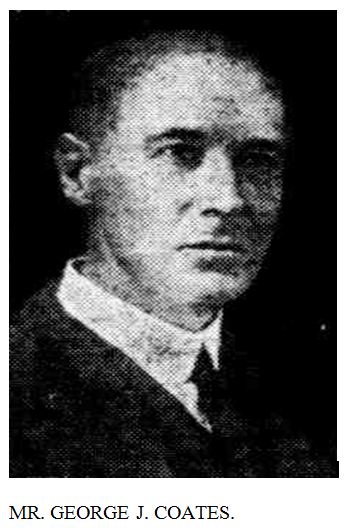
The photo below is of a young George, age 17, as he appeared in the Ferguson & Urie employee poster created for the 1887 company dinner, held at the North Melbourne Mechanics Institute hall on the 22nd June 1887.

George James Coates. Photo taken for Ferguson & Urie company dinner June 1887.

The Register, Adelaide, 23rd September 1921, page 7.

Transcription of article “NOTABLE ARTISTS’ RETURN”

“In the realm of the arts, Australia is proving herself a keen contestant for honours, and during the past few years many Australian painters have obtained public recognition. Mr. and Mrs. George J. Coates (nee Miss Dora Meeson), of Melbourne, went abroad to study, and now have returned to their native land covered with honours. They arrived in Adelaide by the Melbourne express on Wednesday, having reached their own city some months ago. It is 24 years since Mr. Coates set out for the great adventure, and, like many other Australians, he found it a stressful road, full of obstacles, and necessitating the most frugal mode of living. But the painter felt that he had something to impart to lovers of beauty, and so he persevered in London, and then migrated to Paris with such success that to-day he can boast of more significant letters after his name than any other Australian artist.
Among his distinctions may be mentioned:- Member of the International Society of painters, Sculptors, and Gravers, London; Member of the National Portrait Society, London; On the Council of the Royal Portrait Society, London; Member of the Royal Society of Oil Painters, London; Associate of the Nationale des Beaux Arts (New Salon), Paris; Hon. Member Royal Society of Arts, Sydney; and also of he Victorian Artists of Australia. Asked about his first works, Mr. Coates said that as he evinced a leaning towards art at the age of 11 years it was definitely decided that he should be given his chance. That this decision was justified was revealed when the youthful painter won the Victorian Travelling Scholarship, and set out for London.

– The Road to Fame –

After hard work he went on to Paris and studied under Jeans Paul Laurens, Constant, and others. From 1897 to 1900 he exhibited in the salon des Artistes Fracaise (old Salon), and then returned to London, where he and his wife engaged upon some illustrations for the Encyclopedia Brittanica [sic] and the Historian’s History of the World (an American publication). They also contributed to the Royal Academy and the Paris Salon. In 1910 the well-known “Walker Brothers,” a group, was accepted by the Royal Academy of London, and in 1912 by the Associate de Nationale de Beaux Arts (new salon). By some mistake it was sent to the new Salon in stead of the Champ Elysees, as first intended, and was accepted and brought an Associate ship in its ?rain. “So much for a happy accident,” as the creator of the picture modestly remarked. A portrait of Miss Strubelle, an American singer, also won recognition in the old Salon of Paris. At the Grand International Exhibition, Pittsberg, a Diploma of Honour was conferred upon Mr. Coates’s work; and he had the honour to

be specialty incited to again contribute last year and this year too. The Carnegie Institute exhibits only 300 works, and these come from brushes of artists selected by a jury from England, Europe, and America. In reply to a request for further details, Mr. Coates said, “I have painted for the Australian Commonwealth a portrait of Gen. Sir Neville Smythe, V.C., and with natural pride I heard this usually reserved and cold type of man break out into eulogy of the gallantry of the Australians in the war; and, during the sittings he told me that he considered their deeds were equal to those heroic achievements of the Greeks at Salamis and Marathon. I also painted Capt. Jacka, the first Australian V.C; Gen Griffiths, C.O, Australian headquarters in London; Gen. Tivey, Gen. Foott, and other notabilities of the war. These were commissions by the Australian Commonwealth for the War Museum. During the war I spent four years in the R.A.M.C., and so came into personal contacts with realities. I was official war artist to the Canadian Government and to the Australian Commonwealth. It is pleasant to return to our homeland and feel that appreciation awaits my wife and me. When I return to Melbourne various commissions will occupy me, including a group of generals who went to Gallipoli. We have had exhibitions of our work in Melbourne, Sydney, and Brisbane, and in each capital some of our works have been purchased by the national Galleries. Next week we intend to hold an exhibition in Adelaide.” Mrs. Coates (Miss Dora Meeson) has no love for the limelight either; but she had to confess to membership of the Royal Institute of Oil Paintings, London, and also membership of the Mural Decoration and Tempera Society.

– Australia Revisited –

In reply to a query, Mr. Coates said that, of course, he observed a great advance all over Australia, and whether for good or for evil, he was struck with the gradual assertion of independent characteristics in the race as a whole, that seemed to be crowding out English characteristics. Asked about impressionism in art, Mr. Coates said he did not consider that belonged to any particular age or craze, but should be regarded merely as the ordinary impressions of an artist’s mind. The works of men like Manet, Monet, and Pissaro, of the so-called impressionistic school, would live forever. These men gave exquisite beauty through their brushes, and sincerity too. The futurists and cubists were all dead.  It was wisdom, indeed, that made people judge a nation by its art, for literature had no eyes. The Elgin marbles of ancient Greece showed the visitor to the British Museum what a vision that nation had held. Australia was young and immature, but in her natural talent was ahead of the other dominions; and her representatives were in all the big “shows” in England. The Australian climate was so much like that of Italy or Greece, which were the home of fresco, that Mrs. Coates was sure that fresco painting would be a happy style of decoration here. It was an art entirely suited to the dry climate, and Mrs. Coates gave a demonstration in Melbourne with a lecture at the Victorian Artists’ Galleries. Mrs. Coates painted a picture at Southampton of the last Australian wounded to leave England, which has been purchased by the Sydney Gallery. In Australia this gifted couple are represented in the galleries of Adelaide, Melbourne, Sydney, Brisbane, and Bendigo. They look forward to viewing Adelaide from the hills, of which they have heard much. Among many interesting incidents that have occurred in Mr. Coates’s career, none was more remarkable than that associated with a portrait of George Claridge, who sat as a “wounded Tommy,” and then went back to the trenches, won his commission, and was killed. His fiancé in Adelaide recognised his portrait in a catalogue, and sent home to purchase it. It was being exhibited in the Royal Academy. The portrait “King and Empire,” a lovely piece of work, is on loan in our own gallery”.

George Coates, ‘His Art and His Life’, Dora Meeson Coates, Dent & Sons Ltd, London, 1937:

“Lionel Lindsay, in an article on George Coates in Art in Australia, mentions his prowess with the gloves and how a trainer had begged him to give up art and take up a ‘mans’ work, i.e. boxing,’ instead, and become a professional…” [p3]

“He was twelve when he first went to North Melbourne Art School, and at the age of fifteen was apprenticed by his mother to the leading firm of glass-stainers in Melbourne, Messrs. Ferguson & Urie, and he worked there for seven years…” [p5]

“The years in the glass-staining workshop were a great ordeal. Though the work was congenial enough, as good models were set up to be carried out in glass, he hated the coarse jokes of the men, for he had a woman’s sensitive refinement along with his masculine strength.” [p5]

Related posts:

19-02-1874: The Hotham (North Melbourne) School of Art.

External links:

Obituary: George James Coates.

Biography: George James Coates.


Short link to this page: http://wp.me/p28nLD-MD

© Copyright