20-03-1884: Ferguson & Urie building facade approved to be made of Hydraulic Freestone.

The facade of the Ferguson & Urie building in Collins street was approved to be made of the ‘Patent Hydraulic Freestone’. In March 1884, Thomas Crouch (of Crouch & Wilson fame), architect for Ferguson & Urie’s new building, successfully appealed against the bylaws, and the city Surveyor, whom objected against the use of the new building product named “Hydraulic Freestone” for use in external walls.

The Argus, Melbourne, Thursday 20th March 1884, page 5.

 A decision of some interest has just been arrived at respecting the freestone made by the Patent Victoria Hydraulic Freestone Company Limited. On the city surveyor objecting to its use for external walls to buildings in the city, as not being either of the materials allowed in schedule C, part 2, of Bye-law 69, Mr. Crouch, the architect for Messrs. Ferguson and Urie’s new premises in Collins-street, appealed to the official referees, who gave the following award:- “Having carefully considered the matter, and having had the result of experiments specially instituted by us for the purpose of testing the tension of the stone reported to us, we do hereby, acting under the powers vested in us by Section 74 of the Building Act, certify and award that the material in question is a stone within the meaning of the above mentioned schedule C. part 2. Signed, JAMES BLACKBURN, CHARLES BARRET, Official Referees; E. G. FITZGIBBON, TOWN CLERK.”

The Mercury, Hobart, Tasmania, Thursday 28th August 1884, page 2.

“THE PATENT VICTORIA HYDRAULIC FREE-STONE. – The recognition this manufacture is obtaining among the building trade in Melbourne as a valuable and reliable material for house structure is shown in the following extract from the Argus of 23rd inst.: “amongst the new buildings approaching completion in Collins street is one conspicuous for its bright and cheerful facade, situated near the site of the old Clarence Hotel, and soon to be occupied by Messrs. Ferguson and Urie as a glass warehouse and offices. The attractive appearance of this building is mainly due to the novel material of which it is composed, viz., the hydraulic freestone manufactured at Port Melbourne, where the Patent Victoria Hydraulic Freestone Co., Limited, has erected extensive works on a five-acre block of purchased land, and obtained all the necessary machinery for a large output of stone. No chemicals are used in the manufacture of the stone, the component parts being 80 percent of clean sand, 10 percent of lime, and 10 percent of amorphous silicates. The only chemical action employed is the application of a moist heat, forming a cementing matrix of silicate of lime. When the manager of the company first proposed contracting for a building in the city, objections were raised on the ground that hydraulic freestone was not included under the heading of a building material. But on being subjected to a very severe test at Langlands’ Foundry by the city architect and building surveyor, with satisfactory results, all objections were removed, and the stone is now officially recognised as a material sanctioned by the Building Act. Messrs. Ferguson and Urie’s building is seven stories in height, including the basement. It has a front elevation of 80ft. to Collins-street, and the bright aspect of the manufactured freestone presents an agreeable contrast to the darker hues of the adjacent buildings. Continental Gothic is the style of architecture adopted. A good deal of elaborate carving has been introduced, the hydraulic freestone having been found to lend itself readily to this description of ornamental work. The process of moulding was partially adopted, but the tracery and stencilling were performed with the mason’s chisel. The last stone of the frontage was placed in position yesterday afternoon, and the building will be ready for occupation in about a month.” Mr. Holroyd, who holds the patent, has attempted, but as yet unsuccessfully, to introduce the base of this material by the building trade in Hobart. If positive proof of its utility is needed, the present instance should satisfy even the most sceptical.”

This photo below was found in a box of family history memorabilia in 2010. The State Library of Victoria also has another similar image (obviously taken at the same session by unknown photographer) in their records except the ‘ghosting’ of the people walking past the building shows them in different positions as they walk past it.

The Ferguson & Urie Building at 10 Collins Street East.

The Ferguson & Urie Building at 10 (later 283-285) Collins Street East.

Related posts:

30-09-1873: For sale, 10 Collins Street.

22-08-1884: The Ferguson & Urie Building, 281-283 Collins Street, Melbourne, Victoria

14-11-1899: The Auction of 283 Collins Street.

21-02-1901: The Citizens Life Life Assurance Company purchases the building.

© Copyright

22-08-1884: The Ferguson & Urie Building, 281-283 Collins Street, Melbourne, Victoria.

Ferguson & Urie began in 1853 as plumbers, slaters, and glaziers, in Curzon Street North Melbourne. In 1854 they had realised an emerging potential in stained glass in the colony and had successful experimented and exhibited stained glass in the exhibition of 1854. By 1861 they had completely transformed the plumbing business to become extremely successful as (arguably) the colonies first commercial stained glass craftsmen. With the gold rush flooding the colony with wealth, and the extraordinary rate that churches and mansions were being erected, the company was expanding so much that by 1884 they had decided to erect a magnificent headquarters building as a testament to their wealth and success. The Ferguson & Urie building was erected in Collins street in late 1884, but less than six years later the land boom had collapsed, the stock market had crashed, and the wealth of the colony was flattened.  The company attempted to sell the building in 1889 without success and it eventually fell into the hands of the mortgagees. It was eventually advertised for auction ten years later, in November 1899, but did not sell and was eventually sold to the adjoining Citizens’ Life  Assurance Company (shown as the Planet Building  Society on the right of photo) in February 1901 for an “undisclosed sum”.

The Ferguson & Urie building was eventually to succumb to the wreckers ball and was demolished by Melbourne’s infamous “Whelan the Wrecker” circa 1915.

This slideshow requires JavaScript.

The Argus, Melbourne, Friday 22 August 1884, page 7.
The Mercury, Hobart, Tasmania, Thursday 28th August 1884, page 2.

“MESSRS. FERGUSON AND URIE’S NEW PREMISES”

“Amongst the new buildings approaching completion in Collins-street is one conspicuous for its bright and cheerful façade, situated near the site of the old Clarence Hotel, and soon to be occupied by Messrs. Ferguson and Urie as a glass warehouse and offices. The attractive appearance of the building is mainly due to the novel materiel of which it is composed, viz, the hydraulic freestone manufactured at Port Melbourne, where the Patent Victoria Hydraulic Freestone Company Limited has erected extensive works on a five-acre block of purchased land, and obtained all the necessary machinery for a large output of stone. No chemicals are used in the manufacture of the stone, the component parts being 80 per cent of clean sand, 10 percent of lime, and 10 of amorphous silicates. The only chemical action employed is the application of a moist heat, forming a cementing matrix of silicate of lime. When the manager of the company first proposed contracting for a building in the city, objections were raised on the ground that hydraulic freestone was not included under the heading of building material. But on being subjected to a very severe test at Langland’s’ Foundry by the city architect and building surveyor, with satisfactory results, all objections were removed, and the stone is now officially recognised as a material sanctioned by the building act. Messrs. Ferguson and Urie’s building is seven stories in height, including the basement. It has a front elevation of 80ft to Collins-street, and the bright aspect of the manufactured freestone presents and agreeable contrast to the darker hues of the adjacent buildings. Continental Gothic is the style of architecture adopted. A good deal of elaborate carving has been introduced, the hydraulic freestone having been found to lend itself readily to this description of ornamental work. The process of moulding was partially adopted, but the tracery and stencilling were performed with the mason’s chisel. The last stone of the frontage was placed in position yesterday afternoon, and the building will be ready for occupation in about a month. Messrs. Ferguson and Urie will utilise the ground floor for their glass warehouse and the upper stories will be let as offices. Mr. T. J. Crouch was the architect of the building and Mr. W. Ireland the contractor.”

The Argus, Melbourne, Monday 24th November 1884, page 3

“T. J. CROUCH, architect and licensed surveyor, invites TENDERS for EXCAVATION and other works in extending cellar accommodation, for Messrs. Ferguson and Urie. Drawings and specifications may be seen at his offices, 46 Elizabeth-street.”

Related posts:

30-09-1873: For sale, 10 Collins Street.

20-03-1884: Ferguson & Urie building facade approved to be made of Hydraulic Freestone.

14-11-1899: The Auction of 283 Collins Street.

21-02-1901: The Citizens Life Life Assurance Company purchases the building.


Short link to this page: http://wp.me/p28nLD-Ai

© Copyright

26-08-1882: “Sylliot Hill”, “Ontario”, “Labassa”, Caulfield Nth, Victoria.

The first building of Sylliot Hill began in 1862-3 by Judge Richard Annesley Billing and was extended in 1873 into a twenty room mansion by Crouch and Wilson. After Billing’s death it was leased to Alexander William Robertson who eventually purchased it in 1887 and renamed it “Ontario” and extended further into a thirty-five room mansion circa 1890. In 1904 it was sold to mining magnate John Boyd Watson who restored it and renamed the property “Labassa”. In 1980 the national Trust purchased the mansion and the immediate adjoining blocks and demolished the houses that surrounded it to reveal the mansion at 2 Manor Grove, Caulfield as it is seen today.

The Argus, Melbourne, 26th August 1882.

“FOR SALE or TO LET”. “FAMILY MANSION known as SYLLIOT HILL, BALACLAVA and ORRONG ROADS, EAST ST. KILDA …”

“… The Residence of the Late Judge Billing, Q.C. The house is most substantially built, and elegantly furnished …”

“… spacious hall, leading to a very handsome staircase with elegantly stained glass windows by Ferguson and Urie …”

The magnificent three light stained glass window appears above the landing of the first flight of stairs and has four roundels in the centre light that represent the four seasons. These were likely to be the work of Ferguson & Urie’s senior stained glass artist, David Relph Drape in 1873 during the Crouch & Wilson extensions to the building.

Photos taken 16th February 2013.

This slideshow requires JavaScript.

The Argus, Melbourne, Thursday 22nd June 1882, page 8.

“DEATH OF JUDGE BILLING

Mr. Richard Annesley Billing, the recently appointed County Court judge, expired at his residence, Balaclava-road, at 25 minutes past 10 last night, after a short but severe illness.  Mr. Billing returned from the Western district circuit on Thursday, and though somewhat exhausted by lengthened sittings and continuous traveling, was in his usual health up to Friday. On that evening, while at dinner, he was seized with a fit of serous [sic] apoplexy, and though his medical attendants, Dr. Embling and Lampriere, were in constant attendance, he grew rapidly worse. The attack was followed by paralysis of the right side, which gradually extended to the left, and at the hour named he passed away very quietly. The deceased leaves a widow and one son. Mr. Richard Annesley Billing was born in the year 1814. He was called to the Irish bar in 1839, and practiced in Dublin for some years. In consequence of ill-health he left Ireland in the year 1856, and came to this country. In October of that year he was admitted as a member of the Victorian bar. He was appointed one of the lecturers in law at the Melbourne University, the subjects on which he treated being the law relating to real property and that relating to procedure. A few years ago there was an alteration in the course of law lectures at the university, and four lecturers were appointed instead of two, and Mr. Billing had therefore to deal with only one branch of the law. Mr. Billing’s classes at the University were always well attended, and he had an aptitude for imparting information to the students. For a number of years he gave a gold medal prize to the student who obtained the highest distinction in his classes. Mr. Billing took no part in the political world. He was asked several times to come forward as a candidate for Parliamentary honours, but always refused the proposals made to him. He had at one time a leading practice at the bar, and was usually retained in cases in which the Crown or the Board of land and Works was a party. As a barrister he showed that he could easily master the details of complicated transactions, although he was not one of those who could make an impassioned appeal to a jury. For the last three years Mr. Billing had retired from general practice. In 1878 he was appointed a Queen’s Counsel for Victoria. In April last he was appointed a judge of the County Court, and the western circuit was allotted to him. During his short career on the bench Mr. Billing displayed a courteous demeanor to the practitioners and suitors who frequented his court, and paid the greatest attention to every case that came before him”.

The Argus, Melbourne, Vic, Saturday 24th June 1882, page 12.

“THE Funeral of the late His Honour Judge BILLING, QC., is appointed to leave his late residence, Sylliott-hill, Balaclava road, this day, at 2.30, and will proceed to St. Mary’s Church, Caulfield, where a portion of the service for the burial of the dead will be read, after which the remains will be conducted to the place of interment in the St. Kilda Cemetery.
ALF. AUG. SLEIGHT. undertaker, 53 Collins=street east, and High-street, St. Kilda.”

Richard Annesley Billing was buried in the St. Kilda Cemetery, Church of England, Compartment C, Grave 363.

External links:

National Trust web site: Labassa

YouTube media about Labassa – February 2010.

Acknowledgements:

Thanks to Andrew Dixon and Bronwyn Worrall for their assistance regards photos at Labassa.


Short link to this page: http://wp.me/p28nLD-Ac

© Copyright


30-03-1882: David Relph Drape, Stained Glass Artist, (1821-1882)

In the nineteen year period between 1863 and 1882, an English artist by the name of David Relph Drape can lay claim to being one of the Ferguson & Urie stained glass companies most talented in the field of glass painting and staining.

Drape was born at Greenrow, Cumberland, England in 1821, the son of Quaker parents, Isaac Drape and Catherine Relph.
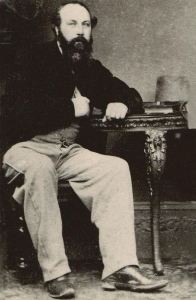
David Relph Drape c1880

David Relph Drape c1880

Little is known of his early life or what steered his artistic talents. His father Isaac (1790-1822) died when he was only one year old but his family would assure his education. Many members of his father’s family were from a long line of educators with interests in mathematics and navigational astronomy. A number of them had close ties to the Greenrow Academy which was founded in 1780 by his grandfather John Drape (1751-1793) who was a principal of the establishment until his death. It was then followed by John’s brother-in-law, Joseph Saul (1769-1842),  then Saul’s son John (1804-1853). Isaac Drape (1813-1870), a grandson of the academy’s founder, (David’s first cousin) took over as headmaster of the Academy in 1853 and it eventually closed after his death 1871.

It hasn’t been proven as to whether David was a student at the academy, but it would certainly seem highly likely during the period when his mother’s brother, Joseph Saul, was headmaster of the school until 1842.

Drape’s early thirties start to reveal his business exploits and talents. He was in the employ of a local Carlisle painter named William Atkinson from circa 1845 and in February 1854, Mrs Mary Atkinson, the widow of the late William Atkinson, decorative painter of 5 Abbey Street Carlisle, placed an advert in the Carlisle Patriot tabloid stating that she had engaged “Mr. David R. Drape, who was for a number of years Foreman for her late husband…” [1] Drapes association with William Atkinson may be the clue as to where he gained his first apprenticeship as a decorative artist, but his continuation as a foreman for the widow Mary Atkinson was very short. By early 1855 he had formed a partnership with another Carlisle tradesman named John Scott whose father, John Scott Snr, had retired and passed the business to his son. A dual advertisement for John Scott Snr’s retirement and the new Scott & Drape business appeared in the Carlisle Patriot, 3rd March 1855.

The Scott & Drape’s business advertisements began to appear in the Carlisle Patriot as:-

“SCOTT & DRAPE – PLAIN AND DECORATIVE HOUSE PAINTERS, ECCLESIASTICAL AND HERALDIC DECORATORS, ILLUMINISTS, GLASS STAINERS, CARVERS, GILDERS, GLAZIERS, &c., &c.” [2]

In November 1855 Scott & Drape created a stained glass window to the memory of Drape’s cousin, John Saul[3] who was principal of the Green Row Academy from 1842-1853. The window was to be erected in the west end of St Paul’s Church, Holme Cultram (now known as St Paul’s Causwayhead):

“ST. PAUL’S CHURCH, HOLME CULTRAM.- A very beautiful window of stained glass has just been inserted in the west end of this church, as a memorial to the late Mr. John Saul [4], of Green Row. The background is a rich mosaic of azure and ruby, upon which two large medallions are placed, representing the Adoration of the Shepherds, and the Presentation in the Temple; in the upper part of the window is a cross of a golden hue in the midst of a floriated ruby background, surrounded by the motto Hoc Signo Vinces[5]. A Latin inscription at the base states that the window has been placed there by the friends and pupils of Mr. Saul. The grouping, drapery, and expression of the various figures are remarkably fine, and reflect great credit upon the artists, Messrs. Scott and Drape, of this city.”[6]
[My research to-date indicates that this window no longer exists.]

A significant clue as to the style of glass painting Scott & Drape adopted is revealed in their advertisements; “S. and D., respectfully invite an inspection of their unique Specimens of Glass painting, in the style as now practiced by the Bavarian Artists at Munich.” This was undoubtedly in response to the debacle at Glasgow Cathedral in 1856 where the Cathedral authorities had awarded a large contract to the Royal Bavarian Glassworks to provide 60 or more stained glass windows for the Cathedral. English and Scottish stained glass craftsmen and artists were enraged with the decision and considered it as robbing them of their birth right. The Master Glazier to the Cathedral, David Kier, who installed the Bavarian windows, even felt compelled to adopt the same style of glass painting in his own windows and this seemed to force varying degrees of adaption to the Munich style that spread amongst the English and Scottish stained glass establishments until late into the 19th century.

Over the next four years Scott & Drape expanded their business and employed a number of tradesmen and apprentices. Their workshops at 23 Rickersgate, Carlisle, became well known and it was frequented numerous times by the local tabloids who were eager to report on their ecclesiastical decorations.

In 1855 Carlisle Cathedral was undergoing significant renovations but there was considerable debate amongst the authorities as to the proposed “highly ornamental” decorations which were opposed by the Bishop who had a preference for a more subdued tone. After a number of months had elapsed without a decision, the famous architect and designer Owen Jones was consulted to break the impasse; “Accordingly that gentleman visited Carlisle, examined the respective specimens and has just sent in his recommendation, which have been adopted, and are to be carried out forthwith by Messrs. Scott & Drape, carvers, gilders, and decorators, of this city.” [7] One of the major tasks to be undertaken for these renovations included the decoration of the Cathedral ceiling which Jones recommended to be in a blue azure dusted with gold stars and gilded angels;

“The panels are to have a ground work of bright azure, powdered with gold stars (that is the technical phrase); the ribs and bosses are to be painted various colours, red, blue, &c., and the coats of arms and other armorial bearings are to be restored after the most accurate heraldic designs; the angels which surround the cornices are to be gilded and coloured, and the large angels on the hammer beams are to be treated in a similar manner…” [8]

At the same time Scott & Drape were working on the Carlisle Cathedral renovations, they had completed a stained glass window for St Paul’s Anglican Cathedral, Dundee in April 1856 and they were permitted to display it in the north transept of the Carlisle Cathedral;

“A beautiful stained glass window, executed by Messrs. Scott & Drape, of this city, for the New Church, at Dundee, has been exhibited in the north transept of our [Carlisle] Cathedral during the past week…”[9]

The window was described as 18ft high, excluding tracery windows, and consisted of two lights. In the left light depicted the Good Shepherd with Christ’s Charge to Peter below and in the right light, the Saviour as the Sower with the Sermon on the Mount below.[10] As at August 2015, this window has been identified as extant in St Paul’s Cathedral at Dundee.

In July 1856 Scott & Drape completed a single light memorial window for a church at Brough, Westmorland. “The subject is a panel formed by the interlacing branches of the vine, and represents the resurrection of our Lord…” [11] Evidence as to the existence of this window has not yet been ascertained.

In January 1857 a letter was penned to the editor of the Carlisle Patriot by “A.B”. The writer was specifically making a point about “Powell’s Glass” being the most successful imitation of ancient glass and that the firm of Scott & Drape were “in the habit of using it for some considerable time…” The author mentions that Scott & Drape; “directed my attention to a Rose window in the north transept, and one in the clere-storey of our Cathedral, both executed by them with Powell’s Glass.” [12] This indicates that the Rose window in the north transept of Carlisle Cathedral and clerestory window(s) were also the work of Scott & Drape, but these windows were not of coloured or stained glass. A window of plain (Powell’s) glass, with lead lines forming the shape of the hexagram, recently removed (c.2011) from the clerestory of Carlisle Cathedral for restoration, revealed the following text scratched into the surface of the glass; “Scott & Drape decorated & glazed this Cathedral AD 1856.” Another window from the clerestory also included the surname of an apprentice named “Johnstone.”

In June of 1857 Scott & Drape completed a further three stained glass windows for St Paul’s Church, Holme Cultram;

“The three side windows in the chancel of St. Paul’s Church have, this week, been filled with stained glass by Messrs Scott and Drape of this city. The general design is a cross with crosslets, in a style which accords well with the architecture of the church and prevailed in the thirteenth century. The border is of azure, emerald, and ruby, and the colours are particularly brilliant. The east window also was inserted by the same artists some time ago, and is a work highly creditable to them.” [13]

In October 1857 Scott & Drape were paid a visit to their Rickersgate workshops by a reporter from the “Carlisle Journal.” The subject of their visit was to inspect a stained glass window that was nearing completion for the Cheltenham Proprietary College. The window was to be of seven lights, 25 feet high and 14 feet wide;

“The design comprises fourteen figures, representing our Saviour, the apostles, and evangelists, each about four feet high. The figures are arranged in two rows one above the other, and are surrounded by perpendicular canopies…” [14]

The tracery windows were to comprise monograms and sprigs of Ivy with the central light in the tracery to contain the armorial bearings of the principal of the College, the Rev William Dobson who had commissioned and paid for the window.

On the 24th February 1858 the Cheltenham “Proprietary College Chapel” was formally opened and their window was further described in the tabloids which also indicated that two other windows on the east side were the work of Scott & Drape, being commemorative of officers who were former pupils of the College and who had lost their lives in the Crimea and India.[15] The Cheltenham College Register of 1890 further described the window;

“The window above the altar is a large transomed composition of seven lights, and has a double row of figures. In the upper tier are St. John the Baptist and six of the Apostles in the lower, our Saviour and the other Apostles. Inscription on Brass beneath:- ‘The window over the Communion table was presented by Rev. W. Dobson, M.A., Principal of Cheltenham College. A.D. 1858.” [16]

Sadly there is no longer any trace of Rev Dobson memorial window today. The Cheltenham College Archivist provided the following correspondence in August 2015;

“A new chapel was consecrated in 1896 and the old building became the College library. The stained glass from the window above the altar was removed and replaced with plain glass to allow more light in. What happened to the original glass remains, I’m afraid, a mystery. The old chapel is now the College dining hall and retains all its stained glass except for the window you describe…” [17]

In January 1858, David Relph Drape, Painter and Glazier of Carlisle, placed an advertisement in the Carlisle Patriot giving notice that he will no longer be liable for any debts that his wife “AMELIA ARMSTRONG DRAPE” incurs. [18] Extracts from Drape’s diaries penned by his granddaughter Elizabeth Bradshaw in 1970, indicate that “Amelia” was his first wife who had suffered a mental breakdown after the birth of their son. Amelia supposedly never recovered and was eventually admitted to a Lunatic Asylum. Their son was brought up by Amelia’s parents and on completing his education, is supposed to have taken up a career in the Navy. [19]

By March1858, Drape had received a life changing letter from the Antipodes. His diary extracts record that he received a tempting offer of employment in the Colony of Victoria, Australia, from a businessman named James Ferguson from the plumbing and glazing firm Ferguson & Urie of North Melbourne. This firm was transforming their business to become the first commercial stained glass company in the Colony, and arguably the whole of Australia, and they offered Drape a contract to join the firm as a senior stained-glass artist. Ferguson & Urie promised him, that on his arrival in the colony, there would be a brand new building erected and fitted out for the purpose of stained glass production. This, in conjunction with the knowledge that they would have a local monopoly in the stained glass industry was undoubtedly tempting. His mother Catherine had died[20] the previous year, his wife was in a Lunatic Asylum and his son was in the care of his in-laws. He accepted the offer. [21]

By early April of 1858 Drape had officially dissolved his partnership with John Scott at Carlisle[22] and he departed England aboard the ship “Morning Light” on the 3rd July 1858.

The ship arrived in Hobson’s Bay, Victoria, on the 20th of September 1858, and Drape’s greeting by James Ferguson and James Urie was undoubtedly less promising than he had anticipated. The stained glass workshops had not been built and there was no work for him. The gold rush had caused a massive downturn in building and construction in Melbourne. Every able-bodied tradesman had left the city high on the prospects of making their fortune on the gold fields. Drape is supposed to have torn up his contract with Ferguson & Urie, but, resigned to the fact that the economic circumstances and the gold rush was the root cause of the situation, he decided to set out for the gold fields himself. [23]

Drape remained in the vicinity of the central Victorian town of Maldon for the next four years making a meager living as an Architect, during which time he designed many buildings, including the historical Beehive Mine Chimney, the Holy Trinity Church, and the Maldon Hospital, all of which still exist today.

In 1860 and 1861 he was appointed secretary of the Concord Quartz Mining Association in Maldon.[24] Other minor pursuits included writing poems for the Tarrangower Times, sketching, painting, illuminated testimonials and parchments, and even an occurrence of designing the gravestone of Maldon resident John Bentley in 1864.

By 1860-62, thousands of tradesmen and failed gold miners had flocked back to the city eager to find employment. This meant that Ferguson & Urie could resurrect their plans for the stained glass workshop in Curzon Street, North Melbourne and in 1863 they enticed Drape back to Melbourne where he took position as one of the firm’s senior stained glass artists alongside John Lamb Lyon. Drape’s diary extracts record: “Com. work at Messrs Ferguson & Uries Nov. 8th/63…” [25]

By this time Drape had received correspondence from England that his mentally ill wife Amelia had died. This undoubtedly released a huge burden from him and his vision for the future with Ferguson & Urie in North Melbourne became much clearer.

One of the earliest stained glass windows that Drape is likely to have been involved with before starting with Ferguson & Urie in late 1863, was for the Holy Trinity Church at Maldon which he had designed and supervised the construction of in 1861. Coincidentally, when Drape had been living in Maldon from late 1858, a Scottish stained glass artist named John Lamb Lyon was also in the area of Tarrengower and Maldon and it’s highly likely that they may have collaborated together on the design of the window, which Lyon is likely to have executed at the Ferguson & Urie glass workshop in Curzon Street North Melbourne. This window is extant in the west wall above the entrance to Holy Trinity.[26] Lyon had joined the firm in late 1861 and Drape had commenced with the firm on the precise date of 8th November 1863.

On the 27th of August 1864, Drape married Jane Selby, whose family he had known back in Carlisle. Jane had emigrated to Australia earlier to care for her younger brother Joseph who had emigrated for the sake of his health.

David designed his modest cottage to be built in Chapman Street, North Melbourne, within walking distance of the stained glass workshops at Curzon Street. Between 1866 and 1873 they had four sons, Isaac Selby, John Campbell, David Saul, and Horace. [27]

When Lyon departed Ferguson & Urie in 1873 the firm decided that they needed to foster and encourage the young men of Melbourne to attain the skills required for the stained glass business. They established the Hotham School of Art expressly for the purpose and Drape played a part as a teacher in the field of Ornamental shading and Landscape. Drape was also one of the founding members of the Victorian Academy of Arts and an active committee member of the Hotham School of Art from 1873 [28].

During Drape’s nineteen years with the firm, he painted many landscape and portrait scenes in ecclesiastical and secular windows. Many of the scenes depicted in the roundels and other intricate parts of secular stained glass windows have his name almost invisibly hidden within the pictures, such as the hunting scenes in the extant windows of Rupertswood Mansion in Sunbury and the garden with creek scene at Mandeville Hall in Toorak.

The Maldon Museum in Victoria also has a number of paintings and pencil drawings by Drape and the State Library at Melbourne has a folio in their manuscripts collection that contain some of his original pencil sketches and designs for ecclesiastical and secular windows. Of his sketches and fragments of drawings held at the library, a number have now been positively identified and matched to extant stained glass windows in Victoria and New Zealand. There is also a complete design of the window for the chapel of Sacred Heart Girls School in Newtown, Geelong, the James Maitland memorial window at St Matthews Anglican Church in Dunedin, New Zealand, and numerous partial sketches for elements of the “Season’s” window located in the stairwell and hallway of Mandeville Hall in Toorak.

David Relph Drape died at his Chapman Street cottage on the 30th March 1882 [29] and was buried in the Melbourne General Cemetery the following day[30]. His wife Jane died at her son David’s residence at Neerim Junction on the 8th of November 1920, aged 92.

The slide show images below depict a number of Drape’s original drawings that have been matched to existing stained glass windows known of to date. There are many other sketches that have not been identified and these obviously leave scope for continued research. Other photos show examples of his initials deliberately hidden within some of the secular stained glass windows.

The photo of David Relph Drape was kindly contributed by Drape’s descendant, Mrs Val Goller (nee Woolstencroft) in 2010. Other images from the State Library of Victoria and personal research data & photos.

This slideshow requires JavaScript.

[Show larger images]

Related posts:

1875: Rupertswood Mansion, Sunbury, Victoria.

19-02-1874: The Hotham (North Melbourne) School of Art.

Footnotes:

[1] Carlisle Patriot, Cumbria, England, Saturday 25th February 1854, page 1.
[2] Carlisle Patriot, Cumbria, England, Saturday 16th May 1857, page 4.
[3] John Saul (1804-1853), Davids’s 1st cousin 1x removed.
[4] John Saul (1804-1853), Headmaster of Greenrow Academy 1842-1853)
[5] Latin: “In this sign shalt thou conquer”.
[6] Carlisle Patriot, Cumbria, England, Saturday 10th November 1855, page 5.
[7] Chronicle, London, England, Monday 21st January 1856, page 3.
[8] Chronicle, London, England, Monday 21st January 1856, page 3.
[9] Carlisle Journal, Cumbria, England, Friday 25th April 1856, page 4.
[10] Carlisle Patriot, Cumbria, England, Friday 26th April 1856, page 5.
[11] Carlisle Patriot, Cumbria, England, Saturday 12th July 1856, page 5.
[12] Carlisle Patriot, Cumbria, England, Saturday 31st January 1857, page 7.
[13] Carlisle Patriot, Cumbria, England, Saturday 20th June 1857, p5.
[14] Carlisle Journal, Cumbria, England, Friday 23rd October 1857, page 5.
[15] Cheltenham Chronicle, Gloucestershire, England, Tuesday 23rd February 1858, p 5.
[16] The Cheltenham College Register, 1841-1889, Bell & Sons, Covent Garden, London 1890, page 15.
[17] Jill Barlow, Cheltenham College Archives, Gloucestershire, England 25 Aug 2015.
[18] Carlisle Patriot, Cumbria, England, Saturday 16th January 1858, page 4.
[19] David Relph Drape, Architect and Glass Stainer; E.M. Bradshaw 1970; Unpublished Manuscript, State Library of Victoria.
[20] Catherine Drape (nee Relph) died 2 Sep 1857, aged 67. She had re-married to Edward Richard in 1828.
[21] David Relph Drape, Architect and Glass Stainer; E.M. Bradshaw 1970; Unpublished Manuscript, State Library of Victoria.
[22] Carlisle Patriot, Cumbria, England, 3rd April 1858, page 4
[23] David Relph Drape, Architect and Glass Stainer; E.M. Bradshaw 1970; Unpublished Manuscript, State Library of Victoria.
[24] The Argus, Melbourne, Vic, Tuesday 9th October 1860, page 8.
[25] David Relph Drape, Architect and Glass Stainer; E.M. Bradshaw 1970; Unpublished Manuscript, State Library of Victoria.
[26] The Holy Trinity window includes the date 1863 on it: “PRESENTED A.D MDCCCLXIII BY W.S.T”
[27] Ferguson & Urie Employees; Family Tree research; Ancestry.com.au, Ray Brown 2015.
[28] The Argus, Melbourne, Vic, Tuesday 2nd May 1882, page 9.
[29] The Australasian Sketcher with Pen and Pencil, Melbourne, Saturday 22 April 1882, page 126.
[30] The Argus, Melbourne, Friday 31st March 1882, page 8.


Short link: http://wp.me/p28nLD-zl

Last edited: 02 Sept 2015 – This is a complete re-write from new research.

© Copyright

05-03-1882: Presbyterian (Uniting) Church, 603 Toorak Rd. Toorak, Victoria.

Mary Ormond (nee Greeves), the wife of the Hon Francis Ormond, died at “Ognez”, Toorak, on the 6th of July 1881 and she was buried at the Geelong Eastern cemetery. In early 1882 Francis commissioned the Ferguson & Urie stained glass company of North Melbourne to create her memorial stained glass window to be erected in the liturgical west wall of the Toorak Presbyterian Church.

The Australasian Sketcher with Pen and Pencil, Melbourne. Saturday 25th March 1882, page 91.

“A VERY handsome memorial window has just been placed in the Toorak Presbyterian Church. The donor is the Hon. Francis Ormond, and it has been erected in memory of his late wife. Occupying as it does the gable of the church, it enhances the appearance of the whole interior. The whole work has been carried out with great taste by Messrs. Ferguson and Urie, of Collins-street.”

Photos taken 1st November 2010.

This slideshow requires JavaScript.

[View larger images]

The window depicts the following biblical representations and text:

First light:
Pictorial representation: “HE HAD COMPASSION ON HIM” (Luke 10:33)
Quatrefoil with text: “I AM THE LIGHT OF THE WORLD” (John 8:12)
Pictoral representation of Jairu’s daughter being raised from the dead with text: “DAMSEL I SAY UNTO THEE RISE” (Mark 5: 41)

Centre Light:
Depiction of the Good Shepherd with text: “I AM THE GOOD SHEPHERD” (John 10:11)
Quatrefoil with Text: “THE GOOD SHEPHERD GIVETH HIS LIFE FOR THE SHEEP” (John 10:11)

Third Light:
Pictorial representation with text “I WAS SICK & YE VISITED ME” (Matthew 25:36)
Quatrefoil with text: “I AM THE WAY THE TRUTH AND THE LIFE” (John 14:6)
Pictorial representation: “MARY HATH CHOSEN THAT GOOD PART” (Luke 10:42)

The memorial text across the bottom of all three lights reads:
“IN LOVING MEMORY OF | MARY WIFE OF FRANCIS ORMOND | OF BORRINALLOAK DIED 6th JULY 1881”

External Links:

Biography: Francis Ormond (1829-1889) ( Includes some detail about his first wife Mary).

This window was restored by Geoffrey Wallace Stained Glass Studio of Caulfield North in 2000.

© Copyright

04-03-1882: St Matthew’s Church, New Norfolk, Tasmania.

The Anglican Church of St Matthew is in Bathurst Street New Norfolk, opposite Arthur Square. It was built in 1823 and is the oldest church in Tasmania. The church was consecrated in 1828 by Archdeacon Scott from Sydney and has been altered a number of times since. In 1833 extensive additions transformed it significantly. The tower was added in 1870 (no longer exists) and in 1894,the chancel was added and the windows, roof and transepts also altered. All that remains of the original church are the walls, floor of the nave, and part of the western transept.

The church contains many historical stained glass windows, among which are the ‘Moore’ and ‘Sharland’ stained glass windows crafted by Ferguson & Urie of North Melbourne.

Photos taken 7th October 2010:

This slideshow requires JavaScript.

[View all images]

The Mercury Hobart, Tasmania, Saturday 4th March 1882, page 3.

“… The church is without pretentions to good looks – it is neither imposing nor elegant. Yet with all its plainness it is a building endeared to many by sacred associations; and also contains features of interest to the visitor. Over the communion table is a stained glass window, representing our lord’s interview with the two disciples at Emmaus, and erected by Mr. W. S. Sharland, in memory of his first wife. Another stained glass window, placed at the back of the font, and representing the baptism of Christ in the River Jordan, was presented by the late Dr. Moore and his son, to commemorate their escape from shipwreck on the occasion of the loss of the s.s. City of Launceston in Hobson’s Bay…”

The Dr. Moore window:

On the evening of 20th November 1865 the ‘SS City of Launceston’ departed Launceston and within two hours of departure it had collided with the SS Penola from Adelaide in Hobson’s Bay. All passengers and crew were rescued by the severely damaged Penola before the Launceston sank.

“…One cabin passenger, Dr. Moore, got his portmanteau, containing £100 in money, into the boat, but it fell overboard [1]

It was thought that the SS City of Launceston could be raised and tenders were called for the work however this never eventuated. Although there were many newspaper reports in 1865 that appeared to describe the exact location of where the ship sank, the Maritime Archaeologists Association of Victoria only found the intact wreck in 1980.

Dr. John Anthony Moore died on the 6th of July 1878 at New Norfolk aged 62[2].

The text on the Moore memorial window reads:

“S. Mark 1:9” “ERECTED BY J. A. MOORE, SENr & JUNr, TO COMMEMORATE A DELIVERANCE FROM SHIPWRECK, NOVr 19th, 1865”.

The window depicts St. John the Baptist, Babtising Christ in the river Jordan.

The Sharland window:

The text on the Sharland memorial window reads:

“TO THE GLORY OF GOD  AND IN MEMORY OF FRANCES SARAH WIFE OF WILLIAM STANLEY SHARLAND WHO DIED ON THE VIIIth DAY OF MARCH IN THE YEAR OF OUR LORD MDCCLIX” (8th March 1859).

Although the biblical scene the window represents is not written anywhere on the window, Janice Ball, from New Zealand, has identified it (07 Apr 2012) as “Emmaus” (Luke 25: 13-37) where Christ is seen breaking bread with two disciples who were walking from Jerusalem to Emmaus .

WikipediaThe two disciples have heard the tomb of Jesus was found empty earlier that day. They are discussing the events of the past few days when a stranger asks them what they are discussing. “Their eyes were kept from recognizing him.” He soon rebukes them for their unbelief and gives them a Bible study on prophecies about the Messiah. On reaching Emmaus, they ask the stranger to join them for the evening meal. When he breaks the bread “their eyes were opened” and they recognize him as the resurrected Jesus. Jesus immediately vanishes”.

The top third of the window has the symbol letters “IHS”. The centre depicts three men with Christ in the middle with a disciple on either side and Christ is breaking bread. The lower has a rather unusual depiction of the Hexagram or Star of David.

Related posts: 07-08-1867 > 13-08-1867

External Links:

Web Site: Diving the City of Launceston Shipwreck

Obit: Dr Moore (no mention of his past shipwreck though!)

Bio: William Stanley Sharland (1803-1877)

Obit: William Stanley Sharland (1801-1877)

Footnotes:

Short link to this page: http://wp.me/p28nLD-xr

© Copyright

30-12-1893: St Georges Church Queenscliff, Victoria, Australia.

Charles Cheney Simpson (1835-1892) was born in Derbyshire in 1835, the son of Edward Lloyd Simpson and Maria Cade.

He arrived in Melbourne on the Angelsey in December 1856 at the age of 20. He came to Queenscliff in 1859 and in 1861 married Rebecca Jane Vary (1844-1929) at St Paul’s church in Geelong.

He established himself in Queenscliff as a Chemist opposite the current Queenscliff museum in 1862 and was an avid diarist, photographer, Mason, and treasurer of St George’s Anglican Church. He was elected Mayor of Queenscliff for the period 1882-83.

He died at Queenscliff on the 23rd of December 1892 aged 57 and was buried in the Queenscliff cemetery. In late 1893 a stained glass window to his memory was created by Ferguson & Urie Company of North Melbourne and unveiled in the St George the Martyr church in Queenscliff on Sunday 24th December 1893. Their only child Charles Edward died in September 1879 at the age of 17. His wife Rebecca died in July 1929 aged 85.

Photos were taken 25 September 2010.

This slideshow requires JavaScript.

[View larger images]

Queenscliff Sentinel, Drysdale, Portarlington & Sorrento Advertiser, Saturday 30th December 1893, page 1.

“The window representing St. John the Baptist made by Ferguson and Urie appeared in St. George’s Church on Sunday last and was much admired. Many of Mr C C Simpson’s old friends, and some of the Masonic brethren,

(un-readable line here)

preached by the Rev J H Gregory, which alluded to Mr Simpson in the following terms – “The effigy which represents the Herald of Christ appears for the first time in the window of this church today. It is put up in memory of an esteemed member of this community and of this congregation, Charles Simpson, whom I knew well. I may be permitted to say that our excellent friend resembled the Baptist in one particular, in constantly speaking the truth, and, without which speaking the truth is valueless, in doing the truth. He was for many years manager and treasurer of church affairs. In this capacity he displayed untiring industry, and he also manifested an extreme conscientiousness which would not suffer him to let the church promises and engagements remain for a single day unfulfilled. Requiescat in peace.”

 Queenscliff Sentinel, Drysdale, Portarlington & Sorrento Advertiser, Victoria, Saturday 24th December 1892, page 1.

 “Death of Mr Charles C. Simpson.

 It is with deep regret we record the death of Mr. C. C. Simpson. Although he had been ailing for some time, a fatal termination to his illness was not feared, as he had purchased tickets for trip to New Zealand. But within the past few days serious symptoms set in, and yesterday afternoon he closed a life of usefulness in connection with local affairs which will scarcely be replaced. Born in 1835, Mr Simpson was a native of Derby in England. In 1859 he came to Queenscliff, and started in business as a druggist. His ability was soon appreciated, for shortly after his arrival here he was elected a councillor of the borough, which position he held for 20 years. During that time he was made mayor, and interested himself strenuously in the improvement of the Public Reserves. Appointed Justice of the Peace, he unremittingly fulfilled his duty with care and marked intelligence. But Mr. Simpson, whose death we deplore, was an all round man. Whether as a councillor or in any other capacity, Queenscliff was his home and heart. He lived in and for Queenscliff. Whatever he undertook seemed to prosper in his hands – Library, Church, Bowling Green, and anything else, all were successful, if he gave it his attention. Whether on the magisterial bench or at local meetings, in his own business or anything which had for its end the advancement of the town, his energy was never failing. We must make special mention of the unceasing interest he took in the Public Library. In this respect we scarcely know where to look for his successor. But all the public institutions of the borough will miss his intelligent mind and marked business capacity, especially in the matters of finance. In the death of Mr. Charles C. Simpson, Queenscliff has lost an able man, and we trust that his worth may not be wanting in the younger generation”.

The Sentinel, Queenscliff, Saturday, December 31, 1892, page 1.

“The funeral of Mr C. C. Simpson took place on Sunday and was largely attended. A Masonic service was held in the Lodge room, and then the brethren adjourned to St. George’s, where the coffin was laid in the chancel. Here and at the grave the Rev. H. J. Wilkinson conducted the services. As the procession left the church the sight was a very impressive one, the Masons heading the cortege. A large number of Freemasons belonging to Geelong Lodges were present. The funeral procession was one of the largest ever seen on Queenscliff”.

Related posts:
22-02-186429-01-186613-08-186712-02-1881 07-04-1882 >18-10-1884


Short link to this page: https://wp.me/p28nLD-uT

© Copyright

1881: St. Saviour’s Church, Templeton, New Zealand.

St Saviour’s was built by a Mr Dethier of Christchurch to the designs of Speechly and Crisp on land donated by E. M. Templar for just over ₤400.

In 1867 the New Zealand press wrote the following of the windows:

“…It is well lighted, the east window being a rose over five lancets, and a large circular window at the west end…”[1]

St Saviour’s opening service occurred on Sunday the 3rd of November 1867[2] and it consecrated on Thursday 17th December 1868[3] by the Bishop of the Diocese.

A page from St Saviour’s history book includes the following entry:

“1881: Stained glass for east window arrives from Melbourne.”[4]

This entry gives the impression that the windows that were in place in 1867 may have only been plain or cathedral glass and the stained glass that exists today were erected circa 1881.

In 1998 the New Zealand Stained Historian, Fiona Ciaran, attributes these windows to Ferguson & Urie in her book Stained Glass Windows of Canterbury, New Zealand [5].

Photos taken 03/10/2010, courtesy of Errol Vincent, New Zealand.

This slideshow requires JavaScript.

[1] Press, Volume XII, Issue 1560, 6 November 1867, Page 2

[4] St Saviour’s Church, Templeton, New Zealand, church history book page 31.

[5] Stained Glass Windows of Canterbury, New Zealand. Fiona Ciaran, University of Otago Press, 1998. page 175.

Acknowledgements:

Special thanks to Errol & Ann Vincent for their enthusiasm for this family history and for undertaking the 1500 round trip to Templeton for the photos. Errol is a 2xGreat Grandson of James Ferguson of the Ferguson & Urie stained glass company.


Short link to this page: https://wp.me/p28nLD-us

© Copyright

07-05-1880: St. George’s Presbyterian Church, St. Kilda East, Victoria.

St George’s Presbyterian East St Kilda opened for divine service on Sunday 3rd October. This was the second opening of the church after extensions. It includes the burning bush window in the north transept. All other windows were also made by Ferguson & Urie.

The Argus, Melbourne, Friday 7th May 1880, page 5.

“The foundation-stone of the enlargement of St. George’s Presbyterian Church, St Kilda East, will be laid at 4 o’clock this afternoon by Sir James McCulloch, in presence of the moderator and other leading clergy of the General Assembly. This church is little more than three years old. Since the arrival from England of its first clergyman, the Rev. J.L. Rentoul, M.A., in June of last year, the building has become overcrowded, and it is now to be enlarged to twice its present size. The nave is to be extended, and chancel and transepts added. The organ chamber will be at the end of the south transept. The chancel will have a beautiful stained-glass memorial window, the gift of lady McCulloch.”

The Australasian Sketcher with Pen and Pencil, Melbourne, Saturday 23 October 1880, page 278.

“… All the windows are filled with stained glass by Ferguson & Urie, the principal windows being gifts from friends of the church…”
“…This church was commenced in 1877, the memorial stone being laid by Sir James McCulloch on 21st April in that year…”

A considerable number of the original Ferguson & Urie windows still exist in St George’s and these are all included in the slideshow.

Photos taken: 6th March 2011.

This slideshow requires JavaScript.

An interesting coincidental note:

The son of the Rev John Laurence Rentoul, John Noel Rentoul, married James Ferguson’s granddaughter, Elsie May Auld, in 1911. Elsie was my Great Grandmothers sister.

RENTOUL Elsie May Auld - John Noel Rentoul 01a

RENTOUL:  Elsie May Auld &  John Noel Rentoul, married Melbourne 1911

External links:

Biography: Sir James McCulloch (1819-1893)

Biography: Rev John Laurence Rentoul (1846-1926)


Shortlink to this page: https://wp.me/p28nLD-tR

© Copyright


26-04-1879: St Paul’s Presbyterian Church, Creek Street, Brisbane, Queensland.

In April 1879  Ferguson & Urie stained glass was represented in the Creek Street Presbyterian Church in Brisbane and was the gift of the Premier of Queensland, Sir Thomas McIllwraith (1835-1900).

In 1885 the Creek Street Presbyterian congregation were persuaded to sell their land to the Queensland National Bank for the sum of ₤18,750. As a result, the congregation acquired the Spring Hill property, which had been the site of the first Children’s Hospital. Much of the stonework from the demolished Creek Street Church was used in the new building as well as iron railings and gates, and the stained glass windows.

The foundation stone of the new church was laid at Spring Hill on the 8th of October 1887 and was dedicated in May 1889. The church is now known as St Paul’s, Spring Hill and still contains the original historic Ferguson & Urie windows which are now installed in pairs high up on the right and left above the chancel. The windows are arranged in pairs with the old testament characters ‘Isaiah’ & ‘Jeremiah’ on the left and ‘Ezekiel’ & ‘Daniel’ on the right.

Photos taken 01/03/2011.

This slideshow requires JavaScript.

The Brisbane Courier, Queensland, Saturday 26th April 1879, page 5.

 “A HANDSOM donation in the shape of four stained glass windows, has recently been made by a member of he congregation of the Creek-street Presbyterian Church. The windows which have been placed in the southern end of the building over the pulpit contain representations of the four Major Prophets – Isaiah, Jeremiah, Ezekiel, and Daniel – the distinctive characteristics of each being beautifully illustrated, while the colors in each instance are so arranged as to have a very pleasing effect. The space in each window surrounding the design itself is filled in with an elegant geometric pattern, the whole being edged with a chaste bordering. In size the windows are each 12ft by 2ft, and are certainly on the whole the finest specimens of this branch of he art as yet to be seen in this city. The manufacturers are Messrs. Ferguson and Urie, of Melbourne, and their style in which they have turned out their work will compare favourably with that shown by the best English makers”.

Western Star and Roma Advertiser, Toowoomba, QLD, Monday 21st April 1879, page 2.

“Brisbane. [from our own correspondent] April 20.
VALUABLE PRESENTATION BY THE PREMIER
The hon T. McIllwraith, Premier and Colonial Treasurer, has just presented a stained glass window to the Creek-street Presbyterian Church.”

External links:

Biography: Sir Thomas McIllwraith (1835-1900)


Short link to this page: https://wp.me/p28nLD-tj

© Copyright