1879: St Luke’s Church, Bothwell, Tasmania, Australia.

The chancel of St Luke’s Church at Bothwell in Tasmania has a magnificent memorial stained glass window by Ferguson & Urie created circa 1879.

The memorial subject of the window is ‘Hunter Young’ (1823-1878) who died in his sleep at the age of 54 in the historic town of Bothwell in Tasmania on Sunday the 19th of May 1878. Hunter had the unfortunate employment title of “Scab Inspector for Bothwell.” His unenviable task was to inspect and fine any farmer found to be selling diseased sheep from the local properties. By all accounts, despite his job, he was well respected and had many friends who later subscribed for the erection of the window. His gravestone still exists at Bothwell Municipal Cemetery.
.
Photos taken: 12th  August 2012.
.

This slideshow requires JavaScript.

The memorial text on the window reads: “ERECTED IN AFFECTIONATE REMEMBRANCE OF HUNTER YOUNG BY SOME OF HIS NUMEROUS FRIENDS. A.D. 1879”.

Historic newspaper transcriptions:

Launceston Examiner, TAS, Monday 20th May 1878, page 2.

“TASMANIA (From our own correspondent) Bothwell, May 19”.

“Mr. Hunter Young, Scab Inspector for this district, was found dead in his bed this morning. An inquest will be held at noon to-morrow”

The Mercury, Hobart, TAS, Tuesday 21st May 1878, page 1.

FAMILY NOTICES

“YOUNG.- On May 19, at Bothwell, Hunter Young, aged 54”.

Launceston Examiner, Wednesday 22 May 1878, page 3.

“DEATH OF MR. HUNTER YOUNG.- A telegram from Bothwell in yesterday’s Mercury gives additional particulars to those already published by us. It states that Mr Hunter Young, Inspector of Sheep, was found dead in his bed at his lodgings at Bothwell on Sunday morning. Mr Bumford knocked at his door a little before church time, and receiving no answer, he entered his room and found Mr. Young lying apparently asleep, but quite dead.”

Launceston Examiner, TAS, Friday 24th May 1878, page 3.

“BOTHWELL. (From our own Correspondent.)”

“An inquest was held at the Council Chambers on Monday last, before A. Reid, Esq., and a jury of seven, on the body of Hunter Young, late sheep inspector of this district, who died suddenly at his lodgings early on Sunday morning last. The principal witness examined was Mr Edward Bumford, who deposed – I am a householder residing at Bothwell; I knew the deceased Hunter Young, the subject of this enquiry; I have seen his body this morning in presence of the coroner; he lodged at my house; his duties as inspector of sheep called him from home frequently; he returned home on Saturday afternoon last, having been away since Tuesday; he appeared well and more cheerful than usual; he took a hearty supper after he came home, and went out about 5 p.m., but returned about 8 o’clock and asked if his watch had been sent home, but on being told that it had not said, that he must go and enquire about it; after I had been in bed a good while I heard Mr Young return and slam the door to, but I do not know what time it was; as he did not rise at the usual hour on Sunday morning I knocked at his bedroom door about half-past ten, and receiving no answer I opened it and went inside and found deceased apparently asleep but quite dead; I closed the door and reported the circumstance to the Superintendant of Police. The superintendant of Police and Constable Bumford were also examined, Dr Naylor having made a post mortem examination gave evidence as to the cause of death – he described in professional language the result of his examination, the purport of which was that deceased had died from natural causes, namely, cerebral apoplexy. A verdict to that effect was returned accordingly.

The remains of the deceased gentleman were interred at the Bothwell cemetery on Tuesday afternoon, when a large concourse of friends attended the funeral, Mr Young was a very old resident of the Clyde and Ouse districts and was well known and much respected by settlers generally.  May 21st.”

The Mercury, Hobart, TAS, Saturday 8th June 1878, page 2s.

“OBITUARY”

“Mr. Hunter Young died suddenly at Bothwell on the 18th may. He was a son of the late Captain Young, formerly of the Ouse, and brother-in-law to William Tarleton, Esquire, the present Police Magistrate of Hobart Town. He held the office of Inspector of Sheep for the Western portion of Tasmania for many years, and not withstanding the disagreeable duties pertaining to his office, which he had occasionally to carry out, it is not known that he ever made and enemy. He will be much missed in the Bothwell district, and, in fact, everywhere else where he was known, which was everywhere on the south side of the island”.
Restoration/Conservation:
This Ferguson & Urie window underwent restoration and conservation work by Tasmania’s stained glass expert, Gavin Merrington of ‘Original Stained Glass’, Hobart. Tasmania, in June 2004.


Short link to this page: http://wp.me/p28nLD-1dg

27-01-1868: Royal Victorian Institute for the Blind, Melbourne, Victoria, Australia.

The Victorian Asylum and School for the Blind was formed at a public meeting in Prahran, Melbourne on 21 August 1866. Less than two years later, on the 25th of January 1868 the Hon. George Harker laid the foundation stone for the new building to be erected on St Kilda road. The architects chosen for the asylums design were Crouch & Wilson.

In 1891 the Asylums name was formally changed to the “Royal Victorian Institute for the Blind” (RVIB) and as at 2012,  the original building now hosts a Belgian Beer Hall and Restaurant.

The most historical, and striking feature, is the original Ferguson & Urie stained glass window in the stairwell.

Photos kindly contributed by Mrs Noelle Nathan, taken 16th July 2012.

This slideshow requires JavaScript.

The Argus Melbourne, Monday 27th January 1868, page 6.

“THE ASYLUM AND SCHOOL FOR THE BLIND”

“On Saturday the memorial stone of the Asylum and School for the Blind – a building now being erected on the St. Kilda road was laid by the Hon. G. Harker. It had been originally intended that the ceremony should be performed some weeks ago by Prince Alfred, and we are informed that a promise to that effect was made by the Royal Reception Commission; but shortly before His Royal Highness’s departure a communication was received to the effect that it would be impossible for him to fulfill the promise…”

“…This institution was started about eighteen months since, but it is only about a year since it was brought to working order…”

Illustrated Australian News for Home Readers, Melbourne, Tuesday 3rd March 1868, page 4.

“…The third storey will be devoted to paying pupils, and the staircase window is to be of stained glass…”

The Argus, Melbourne, Saturday 1st August 1891, page 5

“… PROPOSED CHANGE OF TITLE. Mr. Alston moved that the title of the institution be changed to “The Royal Victorian Institute for the Blind: subject to the consent of Her Majesty to the use of the prefix. It had been felt that under its present title some misapprehension existed in regard to the objects of the institution, which were primarily to supply an education of a scholastic, musical, and industrial character to its inmates. Mr. Crews seconded the motion, which was carried…”


Short link to this article: http://wp.me/p28nLD-1c7

© Copyright

22-11-1873: St Mark’s, Warwick, Queensland, Australia.

Warwick Examiner& Times, QLD, Saturday 22 November 1873, page 2.

 “ST. MARK’S CHURCH.- The stonework of St. Mark’s church was completed yesterday. The masons, Messrs. Knott, Sewell, and Hutcheon, have done their work in the most faithful manner, and we would not feel surprised if St. Mark’s church were to prove one of their best recommendations to those about to build. The full effect of the improved style of windows and porch is now seen to advantage. The carpenters have also completed the roof, and have placed the ridge cap upon it. The only considerable portion of their work that remains is the flooring, and with the number of experienced joiners employed, this cannot occupy many days. It may be interesting to note that the church from end of chancel to western porch in 94 feet, and the transepts from porch to porch are 68 feet. The church will accommodate 500 people comfortably – even 600, on a pinch – and will have cost when completed, apart from the proposed tower and peal of bells, nearly £3000. Cathedral glass, with coloured margins, has been ordered from Messrs. Ferguson and Urie, stained glass manufacturers, Curzon-street, Melbourne, and will add much to the beauty and comfort of the church. When and organ has been added – and it will be, we hope, at no very distant date – St. Mark’s church will, if we except the new cathedral in Brisbane, be the finest and most complete ecclesiastical edifice in the colony. A small balance of the subscriptions to the building fund are still unpaid, and we must urge the subscribers to pay it to the Treasurer, Wm. Thompson, Esq., Bank of New South Wales, during the next week, so that all claims for the completion of the church may be satisfied as soon as presented. We shall give full particulars in an early issue in reference to the opening services.”

Warwick Examiner & Times, QLD, Saturday 17th January 1874, page 2.

“ST. MARK’S CHURCH.- There is a pleasant surprise in store for the parishioners of St. Mark’s Church to-morrow morning. The windows have arrived, and have been put into their places during the present week, though all the work connected therewith is hardly yet finished. They are from the Stained Glass Factory of Messrs. Ferguson and Urie, Melbourne, and reflect great credit on that firm. The workmanship is such as we should hardly expect to find in the colinies, and well deserves a visit of inspection from those who are interested in such matters. The centre portion of he windows is composed of cathedral glass, diamond shaped, fitted in lead, and strengthened at every angle by soldering. The margins of nave windows are composed of coloured glass of different shades, so harmonised that the effect is most pleasing. The light is softened and subdued, and the colours so blended, that there is nothing “loud” nor glaring. Nor has the important item of ventilation been forgotten. There are six ventilators which open and shut in the simplest manner, and admit currents of fresh air at such a height as to refresh, and yet not to alarm the most susceptible to colds. But perhaps the most prominent object of attraction is the window in the gable. The centres of the different circles and figures are of Cathedral glass, whicle the margins are stained. The colours are exceedingly rich and effective. Altogether the windows of St. Mark’s Church, while comparatively cheap, are most beautiful and attractive. They give a character and a gracefulness to the Church not often met with. They bespeak excellent judgement as well as chastened taste on the part of those who have designed, selected, and arranged them. The Bishop, on his way to Stanthorpe, preached last night”.

The Queenslander, Brisbane, QLD, Saturday 7th February 1874, page 10.

“St. Mark’s church is completed so far as externals are concerned. The windows, made by a Melbourne house, are very beautiful, and the church is greatly admired. New seats are being made, and grounds are about to be laid out.”


Short link to this page: https://wp.me/p28nLD-1c4

© Copyright

09-08-1881: Christ Church, South Yarra, Melbourne, Australia.

 The Argus, Melbourne, Tuesday 9th August 1881, page 5

“An effort is being made by the vestry of Christ Church, South Yarra, to take advantage of the present renovation of the church to place a stained glass window in the south transept, as a tribute to the memory of the late Mr. Justice Fellows, and we are requested to draw attention to the advertisement, which appears in another column, inviting subscriptions. We understand that the window to be replaced is not one interfered with by the alterations now in progress, but the vestry consider the present a very fitting opportunity for carrying their praiseworthy object into effect”.

Photos dated: 25th March 2012.

This slideshow requires JavaScript.

The memorial stained glass window in Christ Church, South Yarra was created by Ferguson & Urie.

Justice Thomas Howard Fellows died at Sout Yarra on the 8th April 1878. He had also donated the chancel window and the twelve apostle windows in the nave for St George’s Church in Queenscliff.

Related posts:

07-04-1882: St George’s Church, Queenscliff, Victoria.
04-10-1881: Christ Church South Yarra, Melbourne, Victoria.
17-03-1882: Christ Church, South Yarra. Melbourne, Victoria.

YouTube: My basic 360 degree internal view of Christ Church taken with an iPhone 3GS.

External links:

Biography: Thomas Howard Fellows (1822-1878)

Obituary: Justice Fellows. The Argus, 9th April 1878, page 5

13-08-1867: St Peter & St Paul, Geelong, Victoria.

In the later half of 1867 James Urie of the stained glass firm ‘Ferguson & Urie’ of North Melbourne traveled to Tasmania to further expose the business throughout the Colonies. The Hobart Mercury provided detailed reports of his travels as well as mentioning  some of the establishments the company had gained commissions for, or those they had recently completed. One of those mentioned was the church of St Peter & St Paul in Geelong.

The foundation stone of the church was laid by Bishop Goold on the 17th January 1864 and was designed by architect William Wardell in the 13th Century Gothic form. The superintending architect was  J. A. Denny and the contractor was a Mr. Nash, of Geelong. The total cost of the construction exceeded £6000.

Photos taken 23rd August 2009.

This slideshow requires JavaScript.

The three light window was erected as the principal east window in the chancel. The left light depicts St Peter with his crossed Keys to heaven. the centre light depicts Jesus in the act of the Ascension with the Holy Dove above and the right light depicts St Paul holding his book and sword and another symbol of the book below.

Freman’s Journal, Sydney, NSW, Saturday 21st July 1866, page 451.

“…The stained window of the altar was designed and executed by Messrs. Ferguson and Weir [sic] of North Melbourne, whose artistic talents have been successfully deployed in depicting not only a work of art, but one also befitting the dedication of the edifice. The window is the history: the ecclesiastical symbols, combined with the figures of the saints, are in severe taste, and the adjuncts in selection consistent. The coloring is cheerful yet sober, and the effect of that nature that shades come up reminding one of historic memories…”

“..Reverting to the stained window we may mention that it is a gift of the Very Rev. Dean Hayes, and we have ascertained that his munificence – not dwarfish on other occasions – has been exemplified in this instance by the outlay of £112…”

“The architect of this unique building is W. W. Wardell, Esq – the superintending architect, J. A. Denny, Esq and the contractor, Mr. Nash, of Geelong, to whom for promptitude and excellelence in workmanship every praise is due. The total cost of the erection exceeds £6000”.

“…The subdued light fell on the altar through the stained glass with just sufficient power to bring into relief the golden woven vestments of the celebrants…”

Unfortunately the images in the slideshow are from my earlier photographic attempts back in the days when I only had a pocket digital camera.

Related posts: 13-08-1867: James Urie visits Tasmania on Ferguson and Urie business.

© Copyright

1890: Curzon Street, Ferguson & Urie Employees circa 1890.

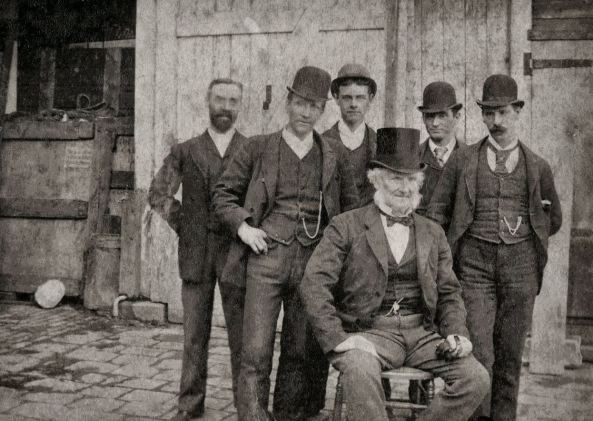
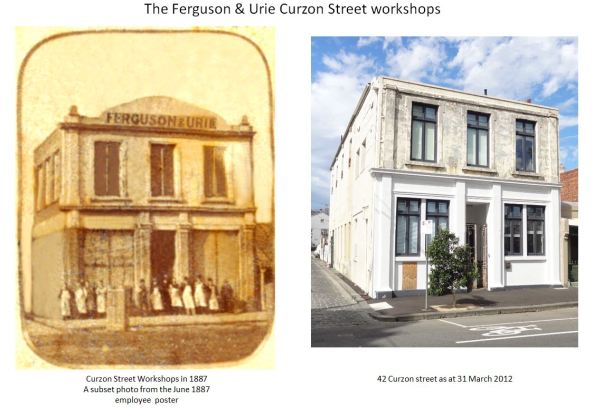
This is a magnificent historical photo of James Ferguson and five of the Ferguson & Urie employees circa 1890. I would guess this photo may have been taken at the rear of the Curzon street workshops North Melbourne which was their first workshops when they started business in 1853. They advertised from the site as early as 1853 but the workshop building wasn’t erected until after 1858 as indicated in the diaries of stained glass artist David Relph Drape. The building still exists as at 2012 but the interior has been converted to individual apartments and only the shell and facade remain as it appeared in the Ferguson & Urie employee photos of June 1887.

The only two positively identified men in the photo are, James Urie Jnr,  James Ferguson Snr and James Ferguson Jnr. The other identifications are based on a likeness from the 1887 employees photos that were taken for the company dinner held on the 22nd January 1887.

CURZON Street Photos 01a

1.D. Morris, 2. unknown, 3. James Urie Jnr (1870-1896), 4. James Ferguson Snr (1818-1894), 5. J. M. Gilligan, 6. James Ferguson Jnr (1861-1945). Photo kindly contributed by my 3rd cousin Errol Vincent from New Zealand 2010.

CURZON Street Photos 02a

The Curzon Street workshop building as it appeared in June 1887 and photo taken 2012.

When the building was being converted to apartments in 2012 the sales brochures indicated that the building had been “remodeled circa 1875 to become the North Melbourne Masonic Lodge”. This incorrect. Ferguson & Urie retained the building as their workshops until the company demise in 1899.

18990506

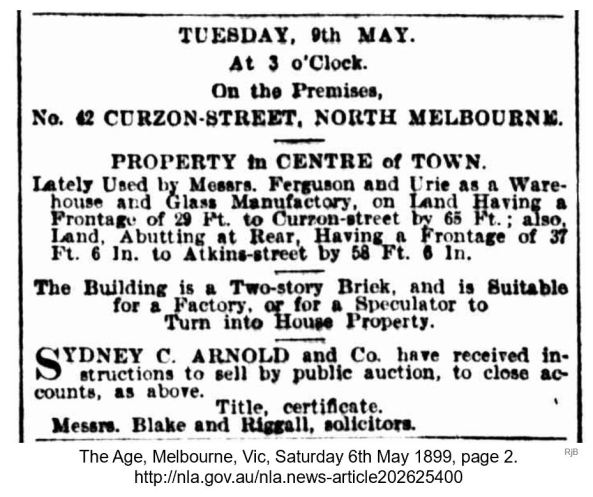
In May 1899 an advertisement was placed in the Melbourne Age advertising the auction of their stained glass workshops at 42 Curzon Street would occur at 3p.m. on the 9th of May 1899.

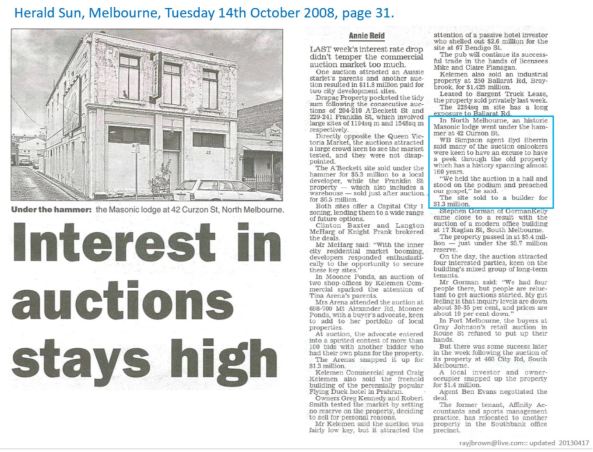
The first tabloid article indicating the building had become the North Melbourne Masonic Lodge appeared in the North Melbourne Courier & West Melbourne Advertiser in September 1902 and it remained in their possession until 2008 when it was put up for auction and sold for $1.3m.

20081014 Curzon

Related posts:

1887 Ferguson & Urie Company Dinner


Short link to this page: https://wp.me/p28nLD-1aP

© Copyright

02-09-1861: Tarrengower Victoria. John Lamb Lyon stained glass.

The Argus, Melbourne, Monday 2nd September 1861, page 5.

“Amongst the contributions which Tarrengower will forward to the forthcoming Exhibition will be a stained-glass window, in the Early English style, the work of Mr. John Lyon, of Maldon”.

There is obviously insufficient detail in the article to distinguish the description of this window from many other windows described as of “Early English style” and there have been no other articles of the time to associate it by dates.  The only other extant window from the same period of late 1861,  is the Ferguson & Urie two light chancel window of St Margaret’s Church in Eltham which is the earliest known extant window by the firm with evidence of communication with Ferguson & Urie and the church in November 1861.

Lyon is not known to have joined Ferguson & Urie until late 1861, making this ‘Tarrengower’ window his own work, but collaboration is possible. If he had created the window completely of his own accord it could only have been done on a very small scale, assuming he did not have any commercial sized kiln for firing the glass in the tiny township of Maldon. Interestingly the exhibition list of awards published in December 1861, mentions Lyon’s entry as a ‘design for stained glass’ and not actually a window!

The English stained glass artist David Relph Drape is known to have been in Maldon at the exact same time as Lyon and they are both likely to have collaborated in the design and manufacture of the two light west window of the Holy Trinity church in Maldon in 1863. Drape was also the architect of Holy Trinity and commenced work with Ferguson & Urie as a stained glass artist on the 8th November 1863.

Related posts:

John Lamb Lyon, Stained Glass Artist, (1835-1916)

External links:

Biography: John Lamb Lyon (1835–1916)


Short link to this page: https://wp.me/p28nLD-19t

© Copyright

1880: St Mary’s Anglican Church, Sunbury, Victoria.

St Mary’s Anglican Church in Sunbury was designed by architect Leonard Terry and tenders were advertised for its construction in July 1866. The Church contains many excellent examples of stained glass by Ferguson & Urie. The triple light east window is a memorial to the infant Agnes Petrea Josephine Clarke circa 1879. 

Photos taken 6th February 2011.

This slideshow requires JavaScript.

[View larger images]

In 1880 the chancel was added to St Mary’s and it’s at this time that the Clarke memorial window was most likely installed. The window is a memorial to Agnes Petrea Josephine Clarke, the infant daughter of Sir William John Clarke and Janet Marion Snodgrass. She was born at the family home, “Rupertswood” mansion in Sunbury on the 3rd of September 1877 but died on the 20th of March 1879 and was buried in the family grave at the Melbourne General Cemetery.

The left lancet of the window depicts St Agnes with the text below: “IN MEMORIAM”wholly

Above the centre lancet is the dove within trefoil tracery. The central scene in the centre light is Christ depicted from Luke 18-16; “Suffer little children to come unto me”. Below that is a cherubic angel, presumably to depict the young Agnus Clarke and it was most likely painted by Ferguson & Urie’s senior stained glass artists David Relph Drape. The bottom edge of the window has the infant’s name: “AGNES PETREA JOSEPHINE CLARKE”.

The right lancet depicts St Mary with the text below “OBIIT MDCCCLXXIX” (1879).

The Argus, Melbourne, Tuesday 4th September 1877, page 1.

“CLARKE.- On the 3rd inst, at Rupertswood, Sunbury, the wife of W. J. Clarke of a daughter.”

The Argus, Melbourne, Monday 24th March 1879, page 1

“CLARKE.- On the 20th inst, at Rupertswood, Sunbury, Agnes Petrea Josephine, beloved youngest daughter of William John and Janet Marion Clarke, aged 18 months”.

St Mary’s Web Site (accessed 22 June 2012)

“… The building of St Mary’s was begun in August 1866 according to the plans of Leonard Terry, which provided for a blue-stone gothic church.  Only the nave was built at this stage for the cost of £1013/10/1.  The building was opened for public worship on 24 November 1867, by Archdeacon McCartney (later Dean of Melbourne). A year later (1868) the church bell was erected at the cost of £22/10/-. The chancel and vestry were added in 1880…”.

“… The stained glass windows behind the altar are believed to have been installed in 1880, when the chancel was added.  They are dedicated to Agnes Clarke, younger daughter of Sir William and Lady Janet Clarke, named after Lady Janet’s mother Agnes Snodgrass.  The left pane depicts St Agnes, who herself died young at the age of twelve and is the patron saint of girls.  The right pane depicts Mary, mother of our Lord Jesus, while the centre panel depicts Jesus welcoming little children…”.

The other small windows in the nave and chancel:

The other smaller windows in the nave and porch are of Ferguson & Urie’s simple stock windows comprising of plain diamond quarries and the red, blue and yellow borders. These would have been the original windows installed at the time of the churches construction in 1866-67. Those in the porch appear to be replicas of the originals.

Related posts:

1884: St Mary’s Anglican Church, Sunbury, Victoria.

1875: Rupertswood Mansion, Sunbury, Victoria.

External links:

Biography: Janet Marion Clarke (nee Snodgrass) (1851–1909)

Biography: Sir William John Clarke (1831-1897)


Short link to this page: http://wp.me/p28nLD-19w

© Copyright

1875: Rupertswood Mansion, Sunbury, Victoria.

At the Victorian Intercolonial Exhibition of 1875, Ferguson & Urie exhibited a “…Portion of Staircase Window for Mr. Clarke’s mansion Sunbury…”

The foundation stone for Rupertswood was laid on the 29th of August 1874 and officially opened in the presence of over 1,000 people on the 16th of March 1876.

The windows at Rupertswood are the largest known collection of privately commissioned stained glass created by Ferguson & Urie. Six sets of windows span two floors, three on the bottom floor and three on the top floor. The windows are all of secular design with the bottom floor windows having intricately designed hunting scenes painted by the firm’s senior stained glass artist David Relph Drape. Three of the scenes include Drape’s name or initials near the bottom right corner of each scene.

Photos taken 6th February 2011.

This slideshow requires JavaScript.

[View all images]

The Bacchus Marsh Express, Vic, Saturday 31st July 1875, page 4.

“PAINTED windows are not confined to cathedrals, churches and other places of worship. Mr. W. J. Clarke, whose mansion on the Sunbury estate is now in course of completion, under the architectural supervision of Mr. Geo. Brown, has given a large order to Messrs. Fergusson [sic] and Urie, glass-stainers of Collins-street east. What between elaborately embossed side windows in the hall door entrance – very pleasing to the eye – the various shades of colored glass in the ante-rooms, conservatory and billiard-room, and the lantern light above the main staircase, the spectator cannot be struck with the brilliant effect produced. There are three large stained windows on each landing of the grand staircase, those on the lower landing representing sporting scenes, the most prominent figure being “The stag at bay,” boldly and faithfully done after the late Sir Edwin Landseer. Coursing is well depicted in the same window, as are other field sports. Floral decorations occupy the panels on the upper staircase. Altogether, Mr. W. J. Clarke may be congratulated in his absence upon having his ideas so well carried out. Messrs. Chirnside are also adopting stained glass decorations; and if the design submitted be approved of, they will have “The twelve months of the year,” each representing the class of game obtainable here and in the old country, have made an elegant border. Many sketches, all in colors, some lay, others ecclesiastical, are to be seen in the establishment of Messrs. Fergusson [sic] and Urie, the bulk of which have been accepted and executed.- Age.”

The Argus, Melbourne, Friday 17th March 1876, page 7.

“…Mr. W. J. Clarke had issued invitations to upwards of a thousand persons to participate in a fete – one of a series, we believe – given to celebrate the completion of a handsome mansion he has erected on his Sunbury estate, from the plans of Mr. George Browne, the architect of the Theatre Royal in this city. It was literally open house to all comers, and no expense was spared to provide for the entertainment of the guests. The day was everything that could be wished, the sky veiled by grey clouds, and fresh breeze tempering the atmosphere sufficiently to render out of doors not merely tolerable but enjoyable. In the morning the children of the three local schools assembled in front of the house, and signalised the raising of the Victorian flag for the first time on the tower of Rupertswood by giving three lusty cheers…”

Australian Town an Country Journal, NSW, Saturday 3rd March 1877, page 28.

“…Mr. Clarke’s magnificent mansion is situate at Sunbury, about two hours’ ride by train from Melbourne. The foundation stone of this fine building was laid on the 29th August, 1874…”

Victorian Heritage council document (viewed 19 Feb 2012).

“The foundation stone for Rupertswood was laid on 29 August 1874 with some 1000 people in attendance. The mansion was built by contractors George Sumner & Co. from designs prepared by architect George Brown…”.

“… During the ownership of Sir William Clarke, Rupertswood became one of the principal social centres in Victoria, with hundreds of guests arriving at the estate’s private railway platform to attend hunt meets, balls and house parties. Clarke was one of the most prominent people in the colony. He was a member of the Legislative Council and received the colony’s first baronetcy. He was so prominent that he was able to have the Mt Alexander rail line diverted past his property. Hence, the Rupertswood Railway station. The estate also had its own half battery of horse artillery when Sir William Clarke formed a small permanent force in 1885. The drill hall and the vault remain as reminders of this privately sponsored regiment”.

The Birthplace of the Ashes (Rupertswood.com.au – viewed 19 Feb 2012).

“Rupertswood” holds a place in the great sporting rivalry between Australia and England, as it was on a field at “Rupertswood” that the “Ashes” were created. On Christmas Eve of 1882, after a congenial lunch, Sir William Clarke suggested a social game between the English Cricket team and a local side, made up largely of Rupertswood staff. By all accounts, it was an enjoyable game with no one really keeping score, however, it was generally agreed that the English won. Pat Lyons, a worker at “Rupertswood”, clearly remembered the afternoon many years later. It was his understanding that Lady Clarke, at dinner that evening, had presented Ivo Bligh with a pottery urn. It was purported to contain the ashes of a burnt bail. This was a light hearted gesture to commemorate England’s win at “Rupertswood”.

In 1926 the Catholic Salesian Order purchased Rupertswood and 700 acres from the estate of William Naughton to establish a school for the poor. The mansion was restored for used as a convention centre and boutique accommodation and was opened to the public on the 27th January 2002 under the management of Rupertswood Mansions Pty. Ltd.

As at mid 2014 the Salesian Order have not renewed the Rupertswood Mansions Pty, Ltd. contract and have resumed control of the mansion. The entire contents of the mansion was sold at auction in July 2014 and it is no longer open to the public.

Related posts:

30-03-1882: Death of stained glass artist David Relph Drape.

External links:

Biography: Sir William John Clarke (1831-1897)

Biography: Janet Marion Clarke (1851 – 1909)

ABC News, Rupertswood Auction, 9 July 2014.

The Age on-line, Rupertswood Auction, 5 July 2014.

[i] Victorian Intercolonial Exhibition Catalogue 1875, Group 4, page 47.


Short link to this page: https://wp.me/p28nLD-17J

© Copyright


1877: Holy Trinity Anglican Church, Coleraine, Victoria.

The three Ferguson & Urie windows in the chancel of Holy Trinity Coleraine are a memorial to the Reverend Francis Thomas Cusack Russell who died aboard the ‘Hampshire’ on his return voyage from England on the 7th of February 1876. The windows depict the Nativity, Crucifixion and Resurrection and were donated by George Trangmar of “Toolang”, Coleraine. Three other Ferguson and Urie windows originally installed in the South wall of the nave were donated by Richard Lewis of “Rifle Downs”, Digby. Another memorial window to Rev. Russell also exists at the former Anglican Church at Merino, also made by Ferguson & Urie.

Photos taken 9th January 2011.

This slideshow requires JavaScript.

The memorial text at the base of the Crucifixion window reads:

“These windows were presented to Holy Trinity Church Coleraine by GEORGE TRANGMAR in loving memory of the late Revd F. T. CUSACK RUSSELL, L.L.D. for nearly twenty five years Clergyman of this Parish 1877”.

The Holy Trinity Church at Coleraine was consecrated by Bishop Thornton on Thursday 30th October 1884[1]. The Ferguson & Urie oriel windows, formerly installed in the clerestory, are now mounted within the plain glass windows of the newly constructed south wall.

National Trust Database, File B0667, Holy Trinity Anglican Church & Organ.

“The foundation stone for Holy Trinity Church, Coleraine was laid on 8 February 1865 by the Rev. Dr Francis Thomas Cusack Russell and the first service held on 4 November 1866.…”

“…The three windows in the chancel, The nativity, The Crucifixion and the Resurrection were a memorial to Rev. Dr. Russell donated by local merchant George Trangmar and manufactured by Melbourne firm Ferguson & Urie. The symbolic oriel windows were by Ferguson & Urie.…”

Holy Trinity Coleraine, Church booklet, page 27.

“The three Sanctuary windows were presented to Holy Trinity by George Trangmar of “Toolang” in memory of Dr. Russell when the chancel was built in 1877. The left window depicts the stable at Bethlehem, the centre one the Crucifixion with Jesus at the Last Supper below, and the window on the right shows the resurrection. The Clerestory windows depict various Christian symbols and were the gift of Mr. Richard Lewis, of “Rifle Downs”, Digby”.

GEORGE TRANGMAR 1825-1917

The Argus, Melbourne, Wednesday 25th April 1917, page 8.

“The death is announced this morning of a very old resident of the Western district. Mr, George Trangmar, formerly of Toolang, Coleraine. Mr. Trangmar, who was born at Brighton, England, in 1825, arrived in Victoria in 1849. He joined his brother, Mr. James Trangmar, in business in Portland, but in 1851 went to Coleraine, and opened a store there. He was in business for 25 years at Coleraine, where he took a leading part in local affairs. He was a member of the Wannon Shire Council for very many years, and filled the presidential chair. Some forty years ago he acquired the Toolang estate, ten miles from Coleraine, which he used for sheep farming until about 14 years ago when he sold the property, and came to live in Melbourne with his daughter, Mrs. J. M. Gillespie. The funeral will take place at Coleraine on Friday”.

RICHARD LEWIS (1815-1890)

Richard Lewis was a Sea Captain & later a pastoralist who settled at Emu Creek (later to be named Digby). He built the Wool Pack Inn at Digby in 1843 and purchased the Rifle Downs and later Pleasant Hills, Glenlivet and Hilgay properties. He died at Casterton aged 76 on the 25th of September 1890[2] and was buried in the South Portland cemetery.

Portland Guardian, Vic, Friday 26th September 1890, page 2

“Intelligence has been received here to-day of the death of Mr. Richard Lewis of “Bryngola”. The deceased gentleman succumbed to the terrible complaint Bright’s disease, but was well advanced in years, his age, we understand, being 76. Mr. Lewis was one of the oldest of the pioneers, his connection with this district, we believe, having reached a period of very close on the half-century. He owned at one period Rifle Downs, Pleasant Hills, Glenlivet and Hilgay stations. In accordance with his expressed wish Mr. Lewis’ remains will be brought to Portland for interment, and will be buried tomorrow in the South Cemetery. The funeral leaves the North Station at 1.30 p.m.”

Related posts:

08-12-1867: St Peter’s, Merino (another memorial to Rev. Russell)

External links:

Biography: Francis Thomas Cusack Russell (1823–1876)


short link to this page: https://wp.me/p28nLD-17p

© Copyright