1873: Christ Church Anglican, Geelong, Victoria.

The John Rendall Morris (1820-1872) Memorial Window.

In October 1872 the committee of Christ Church in Moorabool Street, Geelong, requested the Ferguson & Urie stained glass company of North Melbourne to provide some designs for a memorial window to be erected in the liturgical north transept.

“Members of almost every denomination have contributed to the memorial window which it is proposed to place in Christ Church to the memory of the late Mr. J. R. Morris, the total amount received to date being about £112. About £40 more will be required, but, as several friends of the deceased have not sent in their subscription, and as others have intimated their willingness to increase their subscriptions, if found necessary to do so, the committee have requested Messrs Urie and Ferguson to furnish two designs, which are expected to arrive shortly.”[1]

The window was to be a memorial the memory of their much respected Church Warden and Trustee, John Rendall Morris who died aged 53 on the 15th September 1872.

An extraordinary list of prominent citizens of Geelong, including the Mayor, Sir Charles Sladen, was formed as the committee for the erection of the window[2].

By the end of November 1872 a total of £145 had been subscribed for the window of its reported total cost of £160[3] and by early December a design by the Ferguson & Urie stained glass company was on public display at the establishment of Henry Franks, stationer and book seller, of Malop Street in Geelong:

“The coloured design for the stained glass window to be placed in the north transept of Christ Church as a memorial of the late Mr J. R. Morris is now being exhibited at Mr Franks’s. In the centre of the design there is a representation of the Transfiguration of our Saviour, Moses and Elias being on either side, and Peter, James, and John underneath as witnesses. In the tracery there are figures of Abraham, Joshua, and David – representative characters of the patriarchs, judges, and kings of Israel. Next are busts of the twelve minor prophets, and on the outer side lights there are figures of the four greater prophets – Isaiah, Jeremiah, Ezekiel, and Daniel.”[4]

On the 23rd of December 1872 a meeting of the subscribers was held at the Market-Square offices of Geelong accountant, George Bowes Fraser (1810-1881)[5] , for the purpose of approving Ferguson & Urie’s proposed design[6].

The extremely ambitious and complex design contains the figures of twenty six prophets and saints and has the memorial text at the base;

“TO THE GLORY OF GOD – AND IN MEMORY OF – JOHN RENDALL MORRIS – CHURCHWARDEN & TRUSTEE – WHO DIED SEPTR 15 1872”

Exactly when the window was erected or dedicated in early 1873 has not yet been determined but 140 years later, in November 2013, mindless vandals managed to smash the lower centre area of this window and many others with bricks.

The Caulfield stained glass studio of Geoffrey Wallace is undertaking the repair and conservation work.

Photos taken between 2010 and 2013.

This slideshow requires JavaScript.

[View larger images]

The twenty six saints and prophets depicted in the window with Christ are:

Top Row:

ABRAM, ISAAC, JACOB, JOSHUA, SAMUEL, DAVID

2nd Row:

JOEL, AMOS, OBADIAH, JONAH, MICAH, NAHUM, ZEPHANIAH, HABAKKUK, HAGGAI, ZECHARIAH

3rd Row:

ISAIAH, MOSES, (CHRIST) IMMANUEL, ELIJAH, EZEKIEL,

4th (bottom) Row:

JEREMIAH, ST JAMES, ST PETER, ST JOHN, DANIEL


John Rendall Morris (1820-1872).

John Rendall Morris was born 23rd January 1820, Islington, Middlesex, England, the son of John Morris and Jane Frances Watkins[7].

As a young man in his early 20’s he immigrated to Australia where, on the 6th of April 1843, he married Annie Wesley Morris nee Howe (c.1824-1866), daughter of a founder of the Sydney Gazette, Robert Howe, at St Lawrence Church, in Sydney[8].

Circa 1852 they moved to Geelong where he was appointed manager of the Bank of Australasia[9]. He was very active in community and church circles and in 1860[10], 1862[11] and 1869[12] he held appointments as Territorial Magistrate for Geelong. In 1861 he was a member of the Committee of Management for the Geelong Infirmary and Benevolent Asylum[13] but known to be involved in some capacity with that institution as early as 1858. He was also a well-respected member of the Anglican Church community and held the position of Trustee and Warden of Christ Church Geelong where his memorial window is located.

On the 5th June 1866 his wife Annie died at the age of 42[14] and two years later he married Priscilla Emily Ryland at Christ Church Geelong, on the 12th November 1868[15].

John Rendall Morris died on the 15th September 1872 aged 53[16]. He was buried at the Geelong Eastern cemetery on the 17th with his first wife Annie, who died in 1866 and second wife Priscilla, who died in 1891[17]. He is not known to have had any children by either marriage.


Significant transcriptions:

Geelong Advertiser, Vic, Tuesday 24th September 1872, page 2.

“It is proposed to place a large stained glass window in the north transept of Christ Church, in memory of the late Mr J. R. Morris, who was a constant attendant at the church, and an indefatigable office-bearer. That the window will be a valuable one may be judged from the fact that the following influential committee has been formed to carry out the object in view, and will receive subscriptions in its aid, viz:- The Hon. C. Sladen, the mayor of Geelong, and Messrs D. C. Macarthur, J. Bell, M. Elliott, E. Morrah, F. G. Smith, J. Galletly, J. Simpson, A. Buchanan, S. V. Buckland, S. A. Bryant, F. Shaw, M.D., J. B. Wilson, M.A., G. F. Belcher, T. C. Harwood, A. Douglass, C. Ibbotson, T. Roadnight, H. Franks, and G. A. Stephen. Mr A. S. Park, of the Colonial Bank, has been appointed treasurer, and Mr. G. Fraser, hon. secretary of the committee.”

Geelong Advertiser, Vic, Friday 18th October 1872, page 2.

“Members of almost every denomination have contributed to the memorial window which it is proposed to place in Christ Church to the memory of the late Mr. J. R. Morris, the total amount received to date being about £112. About £40 more will be required, but, as several friends of the deceased have not sent in their subscription, and as others have intimated their willingness to increase their subscriptions, if found necessary to do so, the committee have requested Messrs Urie and Ferguson to furnish two designs, which are expected to arrive shortly.”

Geelong Advertiser, Vic, Thursday 19th December 1872, page 3.

“A MEETING of Subscribers to the Memorial Window to be placed in Christ Church, in memory of the late Mr. J. R. Morris, will be held at the office of Mr. G. B. Fraser, Market-Square, on Monday, 23rd instant, at 4 o’clock, to approve of the design. A. STEELE PARK, Hon. Treasurer.”

Other historic Ferguson & Urie windows in Christ Church:

1869: The Chancel window.

1872: The Anglican Diocese 25th Anniversary window.

Footnotes:

[1] Geelong Advertiser, Vic, Friday 18th October 1872, page 2.

[2] Geelong Advertiser, Vic, Tuesday 24th September 1872, page 2.

[3] Geelong Advertiser, Vic, Saturday 30th November 1872, page 2.

[4] Geelong Advertiser, Vic, Monday 9th December 1872, page 2.

[5] Vic BDM: 4555/1881, age 71. Geelong Eastern Cemetery EAS-COE-OLD-A-807-355.

[6] Geelong Advertiser, Vic, Thursday 19th December 1872, page 3.

[7] Vic BDM: 6921/1872.

[8] The Sydney Morning Herald, NSW, Friday 7th April 1843, page 3.

[9] The Argus, Melbourne, Vic, Monday 16th September 1872, page 5.

[10] Victorian Govt Gazette 58, Friday 11th May 1860, page 881.

[11] Victorian Govt Gazette 140, Tuesday 9th December 1862, page 2507.

[12] Victorian Govt Gazette 1, Tuesday 5th January 1869, page 4

[13] Ninth Annual Report of the Committee of Management, Geelong, 1861.

[14] The Argus, Melbourne, Vic, Wednesday 6th June 1866, page 4.

[15] The Argus, Melbourne, Vic, Monday 7th December 1868, page 4.

[16] The Argus, Melbourne, Vic, Tuesday 17th September 1872, page 4.

[17] The Argus, Melbourne, Vic, Friday 16th October 1891, page 1.
 

1869: Christ the King Anglican Cathedral, Ballarat, Victoria.

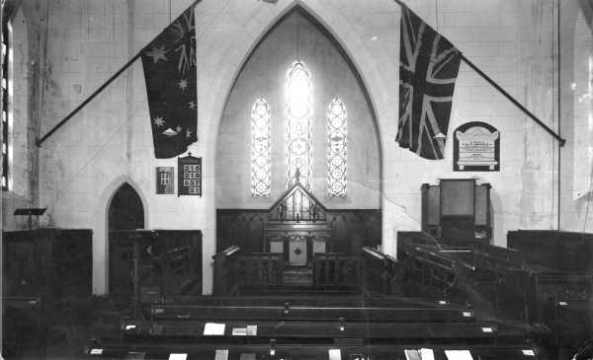
The Chancel of the Ballarat Anglican Cathedral contains an historic three light stained glass window created by the Ferguson & Urie stained glass company of North Melbourne. The window depicts the Nativity, Crucifixion and Resurrection and was erected in the later half of October 1869.

Photos taken between: 19th Sept 2010 and 28th Sept 2013.

This slideshow requires JavaScript.

[View larger images]

Construction of the first Anglican Church in Ballarat, known as Christ Church, commenced in 1854 in Lydiard Street, a year before Ballarat was proclaimed a Municipality and in the same year as the infamous Eureka Rebellion. The first stage of the church was completed by contractors Backhouse[1] and Reynolds in 1857 at a cost of more than £2000.[2]

In a mere ten years the congregation had outgrown the church and the plans were to enlarge it by the addition of transepts. On the 20th August 1867 the building committee of Christ Church accepted the tender of Mr Jonathon Coulson for the construction of the north and south transepts for £1655 to the plans prepared by architect Edward James.[3] The construction of these extensions began a month later.[4]

As part of the extensions and the beautification of the church was the idea of placing a locally made stained glass window in the chancel and on the 19th October 1867 it was reported;

We are informed that the stained window for the chancel at Christ Church is to be the gift of Mr. E. A. Wynne[5]. Messrs Urie and Ferguson, of Melbourne, will most likely supply the glass. The subject for the window has not yet, however, been determined on.”[6]

Edward Agar Wynne (1823-1898).

Edward Agar Wynne, was a mining pioneer in the Ballarat region. He was Chairman of Directors of the Scottish and Cornish Gold Mining Company[7], a founder and director of the Ballarat Gas Company (established in 1858), and one of the first shareholders in the Black Hill mine, of which he still held 1200 shares in at the time of his death[8]. He took a leading role in the laying out of Ballarat’s botanic gardens as well as being a member of the Acclimatisation Society[9].

He married Sarah Maria Palmer in London in c.1849 and migrated to Australia with his family c.1851-54.

In the mid 1870’s he had decided to leave Ballarat and move to the Melbourne suburb of Balaclava and his substantial home on the shores of Lake Wendouree was subsequently purchased by the ‘Loreto Sisters’ for use as part of their newly formed Convent in 1875[10].

His wife Sarah died on the 15th February 1882 at their home ‘View Hill,’ Balaclava[11], and in 1884, at the age of 60, he married 26 year old Rebecca Israel Samuel[12].

Edward died at his home ‘Montacute,’ Grey Street St Kilda, on the 9th December 1898 aged 75[13]. He was buried at the St Kilda Cemetery with his first wife Sarah and two of their children[14]. One of his sons from his first marriage, Agar Wynne (1850-1934), became a prominent Victorian politician.

Edward would not end up being the benefactor of the window and the enthusiasm for its creation lost momentum. It would be a further two years before the window would actually be created and more than a year after the 1867-68 extensions of Christ Church were completed.

By April 1868 the extensions to Christ Church were nearing completion and the local tabloid, ‘The Ballarat Star’ reported;

“The alterations at Christ Church are now nearly finished. Both transepts have been erected, and the northern one has been occupied already. The south one requires some completing touches, and the chancel is also unfinished, the window not yet being glazed. We believe the organ is to be erected in the southern transept. It seems a pity the chancel could not have been deepened and widened, so as to have made it serve as for a cathedral choir, and thus have provided room there for the singers, instead of taking space for the choir out of the too small area of the church, even with its transepts added.” [15]

The 6th of May 1868 heralded the re-opening of Christ Church and a series of celebrations were organised for the dedication of the new transepts and chancel. The services were conducted by Archdeacon Stretch[16] at the morning services and the Rev Handfield [17] at the afternoon services. The decorations in the church at this point indicated that the chancel window was still in an un-glazed state.

“The opening of Christ Church is to be celebrated this day, as the first of a series of days appropriated to the solemnities in question. Our advertising columns contain particulars as to the services, from which it will be seen that the venerable Archdeacon Stretch will officiate at the dedication of the transepts and chancel this morning, and that the Rev. H. H. P. Handfield will officiate in the afternoon. Full choral services will be sung on both occasions, and we may state apropos to this matter, that, the organ has been re-erected, and is now located in the southern transept. The church has been decorated with evergreens, wreaths depending about the transept arches and the chancel, and boughs screening the unglazed chancel window.”[18]

It wasn’t until November 1869 that the creation of a stained glass window for the chancel came to fruition, but where it had been reported earlier in 1867 that the donor of the window was to be Edward Agar Wynne, it was now reported that the benefactor was William Henry Barnard, who had made the gift of the window at a cost in the vicinity of £200.

On the 30th of October 1869 ‘The Ballarat Star’, gave an in-depth description of the window. Where it had been intimated earlier in 1867 that the Ferguson & Urie stained glass company were likely to supply the window, it was eventually created by them and depicts the Nativity, Crucifixion and Resurrection;

“A very beautiful stained glass window has this week been erected in the east or chancel end of Christ Church. Mr. W. H. Barnard has made a gift of the window to the church, and the munificent donation is a rich and very appropriate adornment of the sacred edifice. The design includes the three leading events in our Lord’s life, the middle compartment figuring the crucifixion, the two sides the nativity and resurrection respectively, each grouping, and especially that of the nativity, displaying fair accuracy in drawing, and a glorious wealth of colour. At the bottom is a half length figure of Christ giving thanks, and at the top is a dove, the symbol of the Holy Spirit. The subsidiary details, such as borderings, geometrical figures, and florials are in excellent keeping. Messrs Urie and Ferguson, of Melbourne, supplied and erected the window at a cost of some £200, and we have heard an opinion freely expressed, that though there may be larger there are no better windows than this one anywhere in the colony.”[19]

A week later it was further reported;

“A very beautiful stained glass window has been erected in the east or chancel end of Christ Church, Ballarat. Mr W. H. Barnard has made a gift of the window to the church, and the munificent donation is a rich and very appropriate adornment of the sacred edifice. Messrs Urie and Ferguson, of Melbourne, supplied and erected the window at a cost of some £200.”[20]

William Henry Barnard (1830-1900)

The donor of the stained glass window, William Henry Barnard, was born in Surrey, England 1830, the son of John Barnard and Harriet Burrows.

On the 4th February 1859 he married Caroline Lawrence at St John’s Church in Launceston, at which time he was employed by the colonial treasury as the Receiver and Paymaster at Portland in Western Victoria[21].

In February 1865 he was appointed receiver and paymaster, land officer, and gold receiver at Ballarat[22]. His wife Caroline died only a few weeks later aged 28 on the 25th February 1865[23].

On the 23rd April 1867, at Christ Church at Ballarat, he married Bessie Lynn, sixth daughter of local solicitor Adam Loftus Lynn[24]. Bessie died on the 3rd of September 1881 aged 36 at Ballarat giving birth to a daughter, the new born did not survive either[25].

He married a third time to Ellen Barnard, his first cousin and fifth daughter of his uncle George William Barnard of Landfall, Tasmania. They married at  St Peter’s Church in Sturt Street Ballarat on the 29th August 1883.

On the 28th May 1886, at St Paul’s Church Melbourne, he married a fourth time, to Flora who was again a first cousin and younger sister of his third wife Ellen [26].

Barnard resigned from the Government Treasury positions in 1878 to become Secretary-treasurer of the Ballarat Cemetery Trust and he retained that position until his death in 1900. He was also registrar of the Ballarat School of Mines[27].

He died on the 12th January 1900 at his Errard-street home at Ballarat West aged 70 and was buried in the Ballarat old cemetery[28].

An original engraving depicting the chancel of Christ Church, circa 1874, shows the three light chancel window, and in the engraving are painted the words around the chancel arch:

“HEAR THOU IN HEAVEN THY DWELLING PLACE AND WHEN THOU HEAREST FORGIVE.” (1 Kings 8:30)

Text surrounding the arch around the top of the Ferguson & Urie stained glass window reads:

“WE WORSHIP THY NAME, EVER WORLD WITHOUT END”

(From the Book of Common Prayer).

None of this original text around the arches exists anymore.

By 1886 the idea of erecting an Anglican Cathedral in Ballarat had gained momentum with the Rev Samuel Thornton[29] (the first Bishop of Ballarat) as lead instigator. On the 18th March 1886 it was resolved to erect a Cathedral to the rear of the site of the current church;

“At a meeting of the Church of England Assembly in Ballarat on Thursday, it was resolved to build a cathedral on the church site in Lydiard-street. A resolution was also carried that the building should be of stone, and the cost was limited to £35,000, exclusive of the tower and spire.”[30]

“The Right Rev. Dr. Thornton has for some time been actively promoting the erection of a cathedral in the chief town of his diocese. At the suggestion of the bishop, the vestry of Christ Church consented to unite cordially with the diocese in the erection of a cathedral upon the site of their present parish church in Lydiard-street…”[31]

The laying of the foundation stone of the new cathedral was performed on St Andrews day[32] by the Governor of Victoria, Sir Henry Brougham Loch[33]. Sir Henry and Lady Lock arrived by special train at Ballarat on Thursday 29th of November[34] and the following day, St Andrew’s Day, he laid the foundation stone of the new cathedral in the presence of the Bishops of Sydney, Melbourne, Bathurst and the Riverina[35] and a large assembly of the Ballarat Anglicans. Contributions exceeding £540 were placed on the foundation stone on the day[36].

The plan for the cathedral was that its construction would begin on the lower east side of the current church and the current church would then eventually form one of the transepts of the cathedral when completed.

By April 1890 construction of the cathedral had stalled. Unforeseen circumstances occurred with the foundations at the eastern end because of the steep slope and the lack of funds to rectify it had halted further work. In Bishop Thornton’s address to the Annual Church Assembly at the Ballarat City Hall on the 6th May 1890 he outlined his concerns and the expenditure to-date[37]

Sadly, nothing further transpired. The desire for an Anglican Cathedral in Ballarat did not gain the support it required and in 1931, forty years later, the Melbourne ‘Argus’ reported;

“…The ambition of Bishop Thornton was to see the Ballarat cathedral completed. The foundation-stone was laid by Sir Henry – afterwards Lord – Loch, when he was Governor of Victoria. It has not yet been finished, but cathedrals grow with the centuries rather than with the years. Some day it will be completed and an enthusiastic vicar may address his mind to the task of writing its history. In that history should be reserved and honoured place for the name of Dr. Thornton. He died in Lancashire, still in the service of his Church…”[38]

The cathedral would never be completed. Bishop Thornton died in England in 1917 and all that exists to recognise his efforts is a memorial brass tablet erected in the liturgical south west corner of the church which reads;

“TO THE GLORY OF GOD AND IN MEMORY OF THE RIGHT REVd SAMUEL THORNTON, D.D. FIRST BISHOP OF BALLARAT 1875-1900 WHO WAS A WISE MASTER BUILDER LAID THE FOUNDATIONS OF THIS DIOCESE AND FOR 25 YEARS LOVINGLY AND UNSPARINGLY DEVOTED TO ITS WELFARE ALL THE MANY TALENTS WHICH GOD HAD GIFTED HIM. DIED IN ENGLAND 25th. NOV 1917. THIS TABLET IS ERECTED BY THE DIOCESE.”

It is now more than 125 years since the then Governor Sir Henry Lock laid the foundation stone for the cathedral and evidence still remains of it to this day at the rear of the original bluestone church in Lydiard Street.

The lower basement of the cathedral which had been constructed before works were halted was known as the ‘Chapter House’ and was used as the Diocesan office for many years and later sold to private enterprise circa 1980’s. It was later used as a night club and is now a private residence.

The original church building facing Lydiard Street became the Anglican Cathedral of Ballarat and carries the title of the Church of ‘Christ the King’.

The historic Ferguson & Urie stained glass window still exists in the chancel of the church in the exact same position it was erected in 1869.

As at 2016 the cathedral and associated buildings have been advertised for sale by the Anglican authorities.

Footnotes:

[5] Edward Agar Wynne (1823-1898).

[8] Edgar Agar Wynne, Vic Probate record 75/159, dated 17th May 1900.

[12] Vic BDM: 284/1884.

[14] St Kilda Cemetery, CofE, Compartment A-327.


Short link to this article: http://wp.me/p28nLD-2ax

© Copyright

1871: Christ Church, Anglican, Beechworth, Victoria.

The foundation stone of the Anglican ‘Christ Church’ at Beechworth, was laid by Justice Thomas Spencer Cope (1821-1891) on Saturday 13th November 1858[1] and was built to the designs of prominent Melbourne Architect Leonard Terry (1825-1884). The foundation stone is now hidden beneath the tower which was erected in 1864[2].

Many 19th Century Australian Stained Glass artists and companies are now represented by later stained glass windows erected in Christ Church but only two of the original windows remain which were created by the Ferguson & Urie stained glass company of Curzon Street North Melbourne.

Photos dated 18th December 2011.

This slideshow requires JavaScript.

At the liturgical north-west corner of the nave, near the tower entrance, are the remaining two original examples of Ferguson & Urie stained glass. These are just plain single light windows with the simple red and blue stained glass border designs with plain in-fill diamond quarries. These simple designs can be found in many Victorian Churches from c.1861 – c.1888. It’s likely that all the original windows in the church were created by the Ferguson & Urie Company at the time of its erection, but the course of time sees these original windows inevitably being replaced by memorial windows.

At the base of one of the two original windows is an obscure clue as to its donor. The lower edge of one window has the text;Presented 1871 BTW. A small pink and yellow flower appears on the bottom left of the text and the heraldic symbol of a demi-wolf on the bottom right. The Latin text below the wolf reads Res Non Verba, meaning “things, not words” or “facts instead of words,” but probably more commonly known in modern times as “actions speak louder than words.”

This a very clever, simple, and very conservative adaption of one of Ferguson & Urie’s plain ‘stock’ windows. In most cases these simple windows with coloured borders were the first windows to be erected in a new church but this particular modified window is the only one found to date that has the bottom edge modified, very simply, to include the text of the donor and his coat of arms.

Although the clues at the base of the window are obscure, a logical process of elimination has narrowed down the donor of this stained glass window as extremely likely to be ‘Bowes Todd Wilson’ (c.1812-1882), Superintendent of Police for the Beechworth district Apr 1869 – Dec 1870.

Who was Bowes Todd Wilson?

In 1857 Bowes Todd Wilson (1812-1882) was Inspector of Police and District Paymaster at Kyneton[3]. In May 1859 he was appointed Territorial Magistrate for Swan Hill by His Excellency, H. S. Chapman[4] which he resigned in February1861[5]. In April 1869 he was appointed Superintendent of Police for the Beechworth District and retired in December 1870[6] with a Government pension of £186 p.a[7]. He remained in Beechworth for a short period after his retirement and later removed to Melbourne where he died at the ‘Parade Hotel’, East Melbourne on the 12th August 1882[8], aged 70 years[9].

The heraldic symbol and associated Latin text in the stained glass window is identified as being the armorial crest of the “Wilson” family name;  “..This Lion is actually a “Demi Wolf”, and the motto is associated with the families names Wilson, as is the Demi Wolf…”[10]

About Christ Church:

On the 6th of November 1856, Major-General Macarthur had approved the appointment of the trustees of land set apart for the Church of England purposes at Beechworth. Those he appointed as Trustees were; Melnoth Hall, William Gore Brett, Edward Graves Mayne, Charles King and Samuel George Hogg. [11]

Two years later, William Gore Brett, was bestowed with the responsibility for the official invitations to the laying of the foundation stone of Christ Church and his invitation to the Beechworth Shire Council was read at the council meeting the previous day, 12th November 1858[12].

At the appointed time of two o’clock on Saturday the 13th November 1858, Judge Cope laid the foundation stone and immediately after the ceremony a Bazaar to raise money for the building fund was held in the former El Dorado Hotel “…which has been tastefully decorated with evergreens, and colors of all traditions, (including the Chinese)…

Significant tabloid transcriptions:

Ovens & Murray Advertiser, Beechworth, Wednesday 10th November 1858, page 3.

“THE NEW CHURCH OF ENGLAND.- The foundation stone of the new edifice, the erection of which has just commenced, will be formally laid this day by his Honor Judge Cope. The ceremony will take place at 2 o’clock p.m. and will doubtless attract a large number of visitors to witness it.”

Ovens & Murray Advertiser, Beechworth, Thursday 11th November 1858, page 3.

“THE FOUNDATION STONE OF THE NEW CHURCH OF ENGLAND.- A mistake occurred in our notice yesterday as to the day on which the interesting ceremony would take place, but the fault in this case was not ours. The foundation stone will be laid on Saturday (D.V.) with the formalities usual on the occasion of this nature, by His Honor Judge Cope. Two o’clock in the afternoon is the hour named and the event will we have no doubt attract a large concourse of persons.”

Ovens & Murray Advertiser, Beechworth, Saturday 13th November 1858, page 3

“THE FOUNDATION STONE of the Church of England in course of erection, will be laid at 2 o’clock this afternoon by his Honor Judge Cope.”

The Argus, Melbourne, Vic, Monday 14th Aug 1882, page 1.

“WILSON.- On the 12th inst., at the Parade Hotel, East Melbourne, Bowes Todd Wilson, formerly Superintendent of police.”

Footnotes:

[1] Ovens & Murray Advertiser, Beechworth, Saturday 13th November 1858, page 3

[7] prov.vic.gov.au, Will & Probate documents, Bowes Todd Wilson, 1882.

[9] Bowes Todd Wilson, Vic BDM: 9368/1882, age 70.

[10] Stephen Michael Szabo, Hon. Secretary, The Australian Heraldry Society– email, June 2012.

1872: Christ Church Anglican, Birregurra, Victoria.

The Ferguson & Urie stained glass window in the chancel of Christ Church, Birregurra, was erected to the memory of the colonial pioneer John Davenport Bromfield who died on the 20th of May 1870 aged 52.[1]

Photos taken 28th December 2010.

This slideshow requires JavaScript.

Geelong Advertiser, Vic, Friday 3rd January 1873, page 2.

“The village of Birregurra is prettily situated, on rising ground, on the banks of the river Barwon, at the termination of Ripple Vale, and can boast of a commodious two story parsonage built of brick, and a handsome stone church which has been erected at a cost amounting to some 2,500. The church was further embellished on Christmas Eve by the addition of a handsome memorial window of stained glass. In the centre compartment is the representation of our Saviour ascending on the clouds of glory. On the right hand is the figure of St. John, and on the left that of St. Peter. In the centre trefoil is the triangle an dove, emblematicical of the Trinity; on one side is the Pelican and on the other the Agnus Dei. The colors are rich and the general appearance is pleasing. At the bottom, in old English letters, is the following inscription:- “To the Glory of God.” “To the memory of John Davenport Bromfield, died 20th May, 1870; erected by his widow.” The chancel is laid with encaustic tiles in a handsome pattern.”

The historic township of Birregurra lies approximately 135km west of Melbourne. In 1837 the Englishman John Davenport Bromfield arrived in the colony and took up land west of Geelong.

“…It may be interesting to note that Mr. Bromfield pitched his first camp in the district in 1837, on the present site of the Anglican Church, Birregurra, which church he had the distinguished honor of laying the foundation stone thereof (April 6th, 1870), thirty years prior to which event he had conducted shearing operations within a few yards of said building…”[2]

In August 1838 Bromfield was granted a licence to “depasture” stock in the South-western Geelong region[3] in the area originally known as “Bowden’s Point” and later as known as “Birregurra on the Barwon”. In 1839 the Wesleyan Missionary Society established the Aboriginal “Buntingdale Mission” in the area which caused much resentment between warring tribes. Bromfield’s station was within a short distance of the mission and he made a detailed account of one of the savage conflicts between the Barabool Hill and Mount Rouse tribes, the deadly results of which he described in June 1942 as; “such a disgusting scene can scarcely be imagined”[4]

Geelong Advertiser, Vic, Monday 13th June 1842, page 2.

“A FIGHT BETWEEN THE BLACKS.
TO THE EDITOR OF THE GEELONG ADVERTISER.
Ion Court, Geelong, June 4, 1842.

SIR.- I have to state to you the particulars of an affray which took place last Tuesday night, the 31st instant, the particulars of which are as follow:- “On the evening above-mentioned, two parties of aborigines encountered each other within a mile and  half of my station, part of the Barrabool Hill natives and part of the Mount Rouse tribe, which immediately gave battle, but were defeated with the loss of three men and two unfortunate young females. On the Wednesday morning the few natives immediately belonging to my neighbourhood arrived bearing this intelligence, evidently in a great state of excitement, and dreadfully afraid to return to their encampment without the protection of myself and servants, who were to be well armed. Directly after breakfast, I started, accompanied by the natives to within a short distance of their huts, where they all remained, and I proceeded forward myself, and on reaching the spot found their report to be perfectly correct. Such a disgusting scene can scarcely be imagined, the whole encampment deluged with blood, first lay the body of a middle aged man named Codjajah, speared through the breast in many places, his bowels taken off them, and a few pieces cut out of his thigh. The next was that of a woman speared in many places, quite dead. A short distance from her stood a young lubra with two spears through the belly, the whole of her intestines hanging to the ground – she was perfectly sensible – it would have been a charity to have shot her then, but she departed this life in the evening. Besides these three, within a short distance of the huts lay the bodies of two more men, known by the names of Jim and Big-one Tom, they were partly eaten, the fat being taken by their Christian brethren. These are the civilised aborigines who have been well instructed by our assistant protectors, and certainly have profited no little by the time and expense that have been lavished upon them. Such are the particulars of this affair, by the insertion of which, you will much oblige,

Your’s &c.,
JOHN DAVENPORT BROMFIELD”.

Although the Wesleyan Missionaries held the belief that their concept for aboriginal protectionism was a success, white man’s diseases became more devastating than the effects of their own tribal conflicts and the Buntingdale Mission eventually failed. By late 1847 there were calls for the resignation[5] of the missionary Francis Tuckfield and by 1850 the site had been abandoned altogether.

John Davenport Bromfield remained in the Birregurra area and in 1860 he was appointed as a Territorial Magistrate for the Colac district[6] as well as a trustee of the Colac Cemetery[7]. In January 1864 he was appointed as a Returning Officer for the district of Polwarth & South Grenville[8], but resigned the position in January 1870[9].

In 1865 he built his (now Heritage listed) home “Elliminook” at Birregurra.

In 1867 he was appointed as one of the “trustees of the land set apart on the 12th of November, 1866, for Church of England purposes, at Birregurra[10]. In January 1869 he was appointed as a magistrate for the general session’s district of Geelong[11].

On the 6th of April 1870 John Davenport Bromfield laid the foundation stone of Christ Church at Birregurra[12], which would only a short time later contain his lasting memorial stained glass window created by the Ferguson & Urie stained glass company of Melbourne.

Illustrated Australian News for Home readers, Vic, Saturday 16th April 1870, page 84.

“CHRIST CHURCH BIRREGURRA

This pretty church will be built substantially of bluestone in the decorated style, the windows having freestone tracery and mullions. The foundation-stone will be laid in a few days. The church will consist of a nave forty-seven feet long by twenty-four broad. The chancel will be sixteen feet square. The tower will be fifteen feet square, and the height will be fifty-seven feet to the parapet. The size of the vestry is twelve feet by ten. The contract has been taken by Messrs. Trovana and Gubly, of Geelong, at £1998, without fittings. Mr. Terry, of Melbourne, is the architect”.

Less than a month and a half later, on the 20th May 1870, John Davenport Bromfield died from an aneurism aged 52[13].

The Argus, Melbourne, Vic, Wednesday 25th May 1870, page 4.

“BROMFIELD.- On the 20th inst., at Birregurra, near Colac, from aneurism of the aorta, after a lingering illness, John Davenport Bromfield, aged 52; arrived in the colony 1837; eldest son of the late John Davenport Bromfield, formerly of Pershore, Worcestershire, England.”

Christ Church was opened just over seven months later on the 5th of February 1871 at a total cost of £3000[14]. The first incumbent of the Church was the Rev. Thomas Sabine.

The Argus, Melbourne, Vic, Monday 27th February, 1871, page 7.

“One of the finest buildings in the Western District,” says the Geelong Advertiser, “has recently been erected at Birregurra; this is the new Church of England, which was completed about a fortnight ago. The church is constructed of bluestone, ornamented profusely with freestone from Pettavel. The sides of the windows and doors are lined with this material, which offers a beautiful contrast to the darker shades of the building. Situated to the west of the township, on a rise above the Barwon, it presents and imposing appearance. The interior is capacious, and well finished, and the total cost £3000. It was opened on the 5th instant, the services being conducted by the Bishop of Melbourne. There was a large assemblage, no less 1000 persons being computed to be present on the occasion.”

(The tower and spire of Christ Church were added in 1890 and the “Buntingdale” Aboriginal Mission bell is still located in the Church)

After John Davenport Bromfield’s death, his widow Eliza commissioned the Melbourne stained glass firm “Ferguson & Urie” to create the chancel window of Christ Church in his memory.

The three light window depicts the Ascension of Christ in the centre light with St Peter in the left light holding an open book in his left hand and the Key in his right. St John appears in the right light holding the poisoned chalice containing a serpent and a book in his right hand, his alter ego, the Eagle appears at his feet. The memorial inscription at the base of the windows reads:

“TO THE GLORY OF GOD

IN MEMORY OF JOHN DAVENPORT BROMFIELD DIED 2OTH MAY 1870

ERECTED BY HIS WIDOW”

Three years after Bromfield’s death, his widow Eliza married William Edmundson at St John’s Church in Colac, on the 8th of January 1873[15].

The Argus, Melbourne, Vic, Friday 10th January 1873. page 4.

“EDMUNDSON-BROMFIELD.- On the 8th inst., at St. John’s Church, Colac, by the Rev. Thos. Sabine, William Edmundson, of Birregurra, to Lizzie, relict of the late John Davenport Bromfield, of Colac.”

Interestingly, William Edmundson’s name appears in John Davenport Bromfield’s Probate documents as signatory to the documents. Undoubtedly Edmundson, who was wealthy and well known in his own right, was also well known to Bromfield!

The Colac Herald, Vic, Tuesday 3rd September 1889, page 2.

“A contract (writes the local correspondent of the Geelong Advertiser) has been let for the completion of the steeple of Christ Church at Birregurra, and the whole of the work will, it is expected, be carried out by the end of November. The steeple is being erected as a memorial to the late Mrs. J. F. Strachan. Mr. Laird, one of the partners of the contracting firm, visited the township a few days ago for the purpose of making preliminary arrangements in connection with the work. The architects are Messrs. Reid, Henderson and Co., of Melbourne. The building of a Sunday-school, to be erected by Mrs. Edmundson, of “Eliminook,” in memory of her late husband, will also shortly be commenced. On the completion of the school, Christ Church will well deserve the compliment paid to it by Bishop Moorhouse, when he designated it “the prettiest and most compact country Church of England in the colony.”

Camperdown Chronicle, Vic, Thursday 29th April 1920, page 4.

“BIRREGURRA.

“The past week has been an important and memorable one for the Anglicans of Birregurra. The foundation stone of the fine stone church, with its Norman tower and spire, was laid in April, 1870, and the parishioners have been celebrating the jubilee…”

“…The vicar who opened the church, Rev. Thos. Sabine, died thirty years ago, but the people are very thankful to have had every other of their pastors with them in their jubilee each occasion the service was conducted by the present vicar, Rev. G. D. Frewin.” 

The Argus, Melbourne, Vic, Wednesday 3rd June 1931, page 12.

“BIRREGURRA.- Christ Church of England celebrated its diamond jubilee on Sunday. The Bishop of Ballarat (Dr. Crick) was the preacher.”

Footnotes:

22-12-1864: Christ Church, Anglican, Myrniong, Victoria.

Located 72 kilometres west of Melbourne is the tiny township of Myrniong which lies less than a kilometer off the busy western freeway, 13km north west of Bacchus Marsh.

Amongst the many old historical buildings in the township is the Anglican ‘Christ Church’.

Built of bluestone nearly 150 years ago, the church’s most striking historical artifact is the remarkable three light stained glass window created by the Colonial Ferguson & Urie stained glass company in 1864.

Photos: Dated 12th January 2013.

This slideshow requires JavaScript.

The foundation stone of Christ Church was laid on the 25th October 1864 [1] and was formally opened three months later on the 22nd of December 1864 at a cost of £500 [2].

The Church of England Gazette of 2nd January 1865 [3] made a scant reference to the window at the church opening on the 22nd of December 1864 and reported;

“..the east window of three lights, in stained glass, is of a handsome design..”

The three light window above the altar is an exceptionally well preserved example of Ferguson & Urie’s work from 1864 which has survived intact for nearly 150 years.

The left light shows various stylised depictions of the passion flower in the diamond quarries and at the base of the window is a scrolling ribbon with the text “Love Thy Neighbour” surrounded with deep blue oak leaves. At the time of taking these photos a huge birds nest on the external lower portion of the left light shows a very dark patch in the photo of the window.

The centre light contains the Shield of the Trinity in the middle with the Latin texts,  “NON EST” (Is Not), “EST” (Is),  “PATER” (The Father),  “FILIUS” (The Son), “DEUS” (God), and “S.SANC” (‘SPIRITUS SANCTUS’ – The Holy Spirit).  At the base is an intricate Golden Chalice surrounded by a ribbon with the scriptural text, “This do in remembrance of me” (most likely to be from 1 Corinthians 11-24). The background of the chalice depicts vine leaves in crimson red and the outer depicts oak leaves in deep blue with interspersed small red passion flowers.

The right light is nearly identical to the left light with the exception of the ribbon at the base which has the text “Fear God”.

[1] The Bacchus Marsh Express, Vic, Saturday 17th November 1906, page 3.

[2] Church of England Gazette, Monday 2nd January 1865, page 267.

[3] ibid.

Acknowledgement:

Thanks to Wendy and Gordon Vearing of Myrniong for their assistance with access to the church and their enthusiasm for the history.


Short link to this page: https://wp.me/p28nLD-1xm

© Copyright

07-04-1879: Christ Church, Castlemaine, Victoria.

The Church of England Messenger, 7th April 1879, page 5.

“CASTLEMAINE.- The friends of the late Ernest Walter Crawford seem desirous that his memory may not fade. A subscription set on foot in Castlemaine has resulted in the erection of two handsome and lasting memorials. The first is a monument over his grave in Castlemaine cemetery, consisting of a slab of Malmsbury bluestone, firmly fixed and railed in, and bearing a white marble cross the whole length of the grave. The second is a beautiful stained-glass window, recently placed in Castlemaine Church by Messrs. Ferguson and Urie, containing representations of the resurrection and ascension of our blessed Lord. Both Memorials have suitable inscriptions”.

Photos dated: 7th January 2012. (Date of historical photo unknown).

This slideshow requires JavaScript.

The Argus, Melbourne, Tuesday 9th July 1878, page 1.

“CRAWFORD.- On the 8th inst., at Christ Church Parsonage, Castlemaine, Ernest Walter, son of Archdeacon Crawford, aged 18 years.”

Note: Extensive conservation work was done on the window by the Glenn Mack Studio circa 2012.

22-04-1869: Christ Church, Warrnambool, Victoria.

This post covers the Stevens and Bateman window memorial windows by Ferguson & Urie erected in Christ Church at Warrnambool in 1869.

The Church of England Messenger, 22nd April 1869, page 7-8.

“WARRNAMBOOL.- The church here has recently been presented with some beautiful windows of stained glass, from the manufactory of Messrs. Urie, Ferguson and Lyon, of Melbourne. The east window (one of three lights) has been presented by F. P. Stevens, Esq., as a tribute to the memory of his deceased wife. It represents the baptism, crucifixion, and resurrection of our Lord; underneath which, and distributed through all three divisions, is the representation of the Last Supper. The three lights at the eastern end of the north aisle, together with the round window in the gable, have been presented by W. Bateman, Esq., as a memorial of his deceased parents. The first three represent the raising of Jairus’ daughter, the transfiguration of our Lord, and His agony in the garden of Gethsemane”.

Photos were taken 7th January 2011.

This slideshow requires JavaScript.

The Stevens Window:

The Argus, Melbourne, Vic, Wednesday 5th August 1868, page 4.

STEVENS.- On the 26th ult., at the Cottage, Warrnambool, Jane, the beloved wife of F. P. Stevens, aged forty-seven years.”

The three light window above the High Altar was presented by Frederick Perkins Stevens in memory of his wife Jane (nee Rule) who died on the 26th July 1868 at the age of 47. The windows depict the Baptism, Crucifixion and Ascension with the lower scenes depicting the Last Supper.

A brass plaque in the church also reads:

“The Three Bells erected / in this Tower were / presented to Christ Church Warrnambool by FP Stevens / Member for Villiers & Heytesbury / of the Legislative Council of / Victoria 1852 / In Memory of his younger Son / FS Stevens who died at his Station / Tintinchilla Queensland / 26th May 1880 Aged 30 Years”.

The bells presented to Christ Church were brought to Melbourne for the 1881 Melbourne Exhibition where they were awarded 1st prize.

The Bateman Window:

Illustrated Australian News for Home Readers, Melbourne, Vic, Saturday 25th April 1868, page 15.

“BATEMAN.- On the 30th March, at his residence, Fern Cottage, Warrnambool, Mr. William Bateman, sen., aged 79″.

The Argus, Melbourne, Vic, Tuesday 25th August 1868, page 4.

“BATEMAN.- On the 24th inst., at Spring-gardens, Warrnambool. Mrs. Bateman, sen., aged sixty-nine years”.

William Bateman Snr was born in Bradford, Yorkshire circa 1794 and married Sarah Smith in 1815 in the same town. They migrated to Australia with their four children circa 1853 and set up business in Warrnambool as Bateman & Co in the name of their son William Jnr. The company became one of the districts largest mercantile businesses but eventually ran into financial difficulty during the time of the land speculation boom when William Jnr ran up huge debts in land holdings which eventually saw the collapse of the small family empire.

In 1869 William Bateman Jnr presented Christ Church Warrnambool with the three light window in memory of his parents, William & Sarah Bateman. William Jnr died in 1913.


Short link to this page: https://wp.me/p28nLD-1ew

© Copyright

03-12-1869: Christ Church, Moorabool St, Geelong, Victoria.

The first Ferguson & Urie stained glass window to be erected in Christ Church at Geelong was the five light Chancel window which depicts Christ in the centre light, flanked by the four evangelists, Matthew, Mark, Luke & John with their biblical alter egos beneath their figures. This window gained quite a bit of notoriety and comment in the tabloids of the time of its erection. Despite significant vandalism in the past 145 years, the most recent attack being in November 2011, it has somehow survived the test of time and is certainly a significant artifact for Christ Church and should be considered for heritage listing.

The Church of England Messenger, 3rd December 1869, page 7

“CHRIST CHURCH, GEELONG.- A handsome chancel window has recently been put up in this church, at a cost of £120, from the workshops of Messrs. Ferguson, Urie and Lyon, of Curzon-street. The style of architecture is that known as late perpendicular, the complicated mullions and tracery admitting as many as eight-and-twenty lights. Of these, the five principal compartments are thus appropriated:- In the centre, to accord with the designation of the church, the Saviour is represented enthroned, having in his left hand the globe and cross, and elevating the right in the attitude of blessing; whilst the compartments on either hand are occupied with erect figures of the four Evangelists. Those who have examined former efforts of this enterprising firm will be struck by the improved purity and brilliancy of colour displayed. The utmost skill has been shown in the harmony of arrangement”.

Photos taken 24th Oct 2010. (Date of Historical photo unknown).

This slideshow requires JavaScript.

Geelong Advertiser, Vic, Wednesday 10th November 1869, page 2.

“A gratifying specimen of colonial art may be seen in the chancel window, recently put up in Christ Church, by Messrs Ferguson, Urie and Lyon, of Melbourne. The window, which is about fourteen feet high by ten feet wide, belongs to the order of Gothic, which architects term late perpendicular. it consists mainly of three rows of light, the lower row containing five openings eight feet and a half in height, the mullions of which rise perpendicularly to the top of the window. The second row contains a continuation of these lights, divided into twelve by narrow mullions, these openings being two feet in height; above these is a row consisting of three pairs, rather higher than the middle row. There remain seven small openings supplementary to the complete design. The great feature of a window of this style, and involving a manifest difficulty with which the glass-stainer has to grapple, is the large proportion of stone in the mullions, probably not less than a third of the entire surface. The designer has in this instance shewn his judgement in not attempting a general subject, which would have been broken by the heavy stone framing, as he has made each opening a complete picture in itself, and to a certain extent, independent of the adjoining ones. At the same time there is not wanting a unity of subject. The five principal lights are appropriated to the glorified Saviour, flanked on either side by two Evangelists. At the foot of each of these five figures, is introduced the corresponding symbol, viz., in the centre the pelican wounding her own breast to feed her young; and the evangelistic symbols, the human head, the lion, the ox, and the eagle, under Matthew, Mark, Luke, and John, respectively. The three pairs of lights at the top of the window are appropriately filled up with three cardinal graces and their emblems, viz., faith and the cross, hope and the anchor, charity and the heart. The quatrefoil at the apex of the arch is filled in with the dove. The twelve smaller windows in the middle row remained to exercise the designer’s ingenuity, their small size and large number having occasioned some apparent difficulty. On these we find national emblems, the rose, shamrock, and thistle, besides stars, which may be regarded as generally emblematic of whatsoever things are lovely and of good report. Those who have examined former efforts of this enterprising firm will be struck with the improved purity and brilliancy of colour displayed. The utmost skill has been shown in the harmony of arrangement. The draperies of all the principal figures are particularly well managed, that of the centre being a brilliant mass of ruby red, carried off to the margin in each in each direction by yellows and greens of intermediate warmth terminating at the circumference in cold blue or grey. The effect at the western entrance into the church is a rich flow of light and colour, on which the eye rests with pleasure, and has to complain of no unequal predominance of any one tint. The individual figures are alike bold and dignified in outline, but the execution of the features while in the highest degree creditable, falls short of that depth and sublimity of expression with which the old masters have familiarised us. It is indeed the merit of the whole composition that it attempts the symbolical and heraldic rather than the historical. Its excellences are such as can be best appreciated from a distant point of view. We are told that the entire cost of the window is £120, to meet which collections are to be made on Sunday next.”

Note: The head of Christ in the centre light is not original Ferguson & Urie. This is possibly the third replacement since the window was created in 1869.

Restoration/Conservation:

The east five light window underwent restoration and conservation work in 2004 by Geoffrey Wallace’s stained glass studio.

This window and many others were unfortunately vandalised in November 2013 and will again be in the hands of Geoffrey Wallace for expert repair.

For updated and detailed photos of the full cycle of Ferguson & Urie windows at Christ Church in Geelong, See: http://www.flickr.com/photos/raysalmanac/sets/72157637900257313/


Short link to this page: https://wp.me/p28nLD-1ez

© Copyright

09-08-1881: Christ Church, South Yarra, Melbourne, Australia.

 The Argus, Melbourne, Tuesday 9th August 1881, page 5

“An effort is being made by the vestry of Christ Church, South Yarra, to take advantage of the present renovation of the church to place a stained glass window in the south transept, as a tribute to the memory of the late Mr. Justice Fellows, and we are requested to draw attention to the advertisement, which appears in another column, inviting subscriptions. We understand that the window to be replaced is not one interfered with by the alterations now in progress, but the vestry consider the present a very fitting opportunity for carrying their praiseworthy object into effect”.

Photos dated: 25th March 2012.

This slideshow requires JavaScript.

The memorial stained glass window in Christ Church, South Yarra was created by Ferguson & Urie.

Justice Thomas Howard Fellows died at Sout Yarra on the 8th April 1878. He had also donated the chancel window and the twelve apostle windows in the nave for St George’s Church in Queenscliff.

Related posts:

07-04-1882: St George’s Church, Queenscliff, Victoria.
04-10-1881: Christ Church South Yarra, Melbourne, Victoria.
17-03-1882: Christ Church, South Yarra. Melbourne, Victoria.

YouTube: My basic 360 degree internal view of Christ Church taken with an iPhone 3GS.

External links:

Biography: Thomas Howard Fellows (1822-1878)

Obituary: Justice Fellows. The Argus, 9th April 1878, page 5

1864: Christ Church, Anglican, Kilmore, Victoria.

There are two historically significant stained glass windows by Ferguson & Urie at Christ Church, Kilmore, Victoria.

The three light chancel window and the “Clifton” memorial window at the liturgical west end are both by the Ferguson & Urie company circa 1864.

The first stone of Christ Church, Kilmore was laid by Bishop Charles Perry on 19th November 1857 and the first service was held in January 1861. The church was consecrated on Monday 20th May 1867 by Bishop Perry.

Photos were taken on 26th December 2011.

This slideshow requires JavaScript.

Kilmore Free Press & Counties of Bourke & Dalhousie Advertiser, Thursday 23rd May 1867, page 2.

“On Monday Morning His Lordship the Bishop of Melbourne, assisted by the Rev. Mr. Watson, the trustees and church wardens, went through the ceremony of consecrating Christ Church, Kilmore. The affair was conducted in a most solemn manner”.

The following two extracts from the Anglican Church Gazette were kindly provided by Catherine Turnbull, Hon Archivist, Kilmore Anglican Parish, 8th Feb 2011.

The Anglican Church Gazette 1864

“…The chancel windows at once attract attention. The principal devices of the side lights are the ruby crosses on a purple ground, with the leaves and fruit of the vine interspersed, the one having the Scripture words, in Anglo-Saxon letters, “I am the Vine,” the other “Ye are the Branches.” In the centre light, over a beautifully finished head of the Saviour, a dove, emblematic of the Holy Spirit, descends, whilst this is surmounted by the ancient sign of the Trinity, the hexalpha or interlacement of two equilateral triangles. The appearance is very rich and splendid, if not gorgeous, and is highly creditable to the artists, Messrs. Ferguson and Urie. The side windows (seven on each side) are diamond-shaped, lead quarry lights, filled in with muffed glass, the borders being of stained glass of various tints …”

The Anglican Church Gazette, June 16, 1864.

“…A very beautiful Memorial Window has been lately erected in Christ Church, Kilmore. In its general construction it is, as intended, emblematical of sorrow, while a rich golden blue, particularly on a sombre day, pervades it. The centre piece is a light blue cross on a crimson ground, entwined by a wreath, on which is inscribed that well known sentence of the Bible, so comfortable to the Christian, “Blessed are the Dead that die in the Lord.” Over and under this are the family crest and coat of arms, elegantly and conspicuously finished.  Underneath is the following inscription annealed in the glass:- “Erected by Wm. Snow Clifton, in memory of his brother, Henry Clifton, who died June 21, 1853, aged 31 years, and was buried in the Kilmore Cemetery. ” The whole is enclosed by a handsome bordering of purple and crimson alternately, with dark leaves between, connected by golden stalks, which form the inner boundary of the border, the outer one being of green. The design and workmanship do great credit to the contractors , Messrs. Ferguson and Urie…”.

Note: There is no known gravestone for Henry Snow Clifton at the Kilmore General Cemetery.

Kilmore Free Press, Vic, Thursday 3rd March 1932, page 2.

(In reference to Christ church, Kilmore)

“…The first place of worship was a building of brick, but as the population was increasing it was deemed imperative that money should be raised to erect a building of much larger and more pretentious character, and the first incumbent the Rev, John Singleton was soon travelling many miles in interviewing squatters and people in outlying parts to collect the necessary money. Soon sufficient funds were in hand to warrant a start with the building which, it was anticipated, would cost some thousands of pounds stirling. The foundation stone was laid by Lord Bishop Perry on the 19th November 1857. The scarcity of funds, however, held up the work from time to time and it was not till 1864 that the church was finished when the Dean of Melbourne, the Rev. Dean Macartney preached the occasional sermon. A writer in the Church gazette of this day states that Christ Church is on an elevated position on the western hill and the style of architecture is English or Lanie of the latter part of the 12th or beginning of the 13th centuries. The architect was a Mr Rudt[1], who gratuitously gave his services. Later the work was carried out by Mr Flury [sic][2], a well known architect of Kilmore. Entering the church the beautiful stained glass windows erected to the memory of loved ones who sleep in that long last sleep command the attention. One is to William Clifton[3] and his brother Henry, the date on which is 1853. It is adorned with the family crest, and bears the motto “Tenez de Droit” [sic] – Hold the Right[4]. This is a very beautiful work of art, and is emblematic of sorrow. The centre piece is a light blue cross on a crimson ground enclosed by a wreath on which is inscribed and appropriate passage of scripture of scripture, and over and under this is the family crest and coat of arms. The designers were Messrs. Fergurson [sic][5] and Urie[6]. “

kilmore-christ-church-1920

The Chancel of Christ Church, Kilmore c.1920

William Snow Clifton and his brother Henry Clifton took up the “Arcadia” run[7] in 1848 which was an estimated 80,000 acres along the Goulburn River.

Foot notes:

[1] No record of an architect by the name of Rudt. Three architects were involved in Christ Church being W. Z. Perrot, Charles Kingk and James Fleury,

[2] James Fleury – Architect Sydney Street Kilmore.

[3] William Snow Clifton was the donor of the window. Commanding Officer of the Victorian Yeomanry Corps Melbourne circa 1856.

[4] “Tenez le Droit” – French – ‘Uphold the Right’. (The motto used by the Victorian Police Force to this day)