1867: South Yarra Presbyterian Church, Victoria

In August 1867 the ‘Hobart Mercury’ newspaper published an article about the travels of Mr James Urie who was a principal partner of the Ferguson & Urie stained glass company of North Melbourne.

James was travelling throughout Tasmania with a portfolio of the company’s stained glass designs to garner commissions for secular and ecclesiastical windows. The tabloids published numerous articles of his “Sojourne” throughout the apple isle;

“STAINED WINDOWS – A few days since we stated that Mr.Urie of the firm of Ferguson, Urie, and Lyon, glass stainers, &c, Melbourne, was on a professional visit to Hobart Town. This gentleman is now in Launceston, and we were much gratified yesterday by inspecting a large portfolio of designs for church and other windows which his firm has executed or has in hand…”[1]

The article briefly mentioned a number of windows the company had recently made and I’ve posted many articles about the ones I have found from those clues. A couple of the windows have eluded me for some time as they merely mentioned names and the location as Melbourne and nothing else such as this obscure one:

…Judge Pohlman’s wife, and wife of Mr Stoddart [sic] both in Melbourne…[2]

Clues to other windows included church names and their locations which have helped to pin point exactly where some of the windows could be found, but the obscure mention of “Melbourne” in relation to the Polman and Stoddart windows was very little to go on.

In our Colonial times, the number of churches that were being erected throughout Melbourne and suburbs was phenomenal. The vast majority of these old churches are still standing but over the course of a century and a half many were burnt to the ground, demolished, moved and re-built, or in recent times, sold to developers. If these Pohlman and Stoddart windows still existed somewhere it was likely to take a long time to locate them whilst concurrently researching the locations of many other Ferguson & Urie stained glass windows. Since finding the historic newspaper article I have visited more than a hundred churches and nothing further has come to light in regards to these particular windows.

The names “Pohlman” and “Stoddart” were significant clues on their own, and in the case of Judge Pohlman it was easy to ascertain that he was Judge Robert Williams Pohlman (1811-1877). But even armed with the knowledge of his faith, being of the Church of England, nothing has been found of his stained glass window.

The name Stoddart presented further challenges, as the newspaper had spelt his name incorrectly on multiple occasions, and so I was looking for the wrong person. The tabloids mentioned that he had been buried in the Melbourne General Cemetery, which seemed like a decent clue, but the cemetery records had nothing for that name. It seems that when I get fixated on a particular direction or clue I miss the obvious things such as misspellings.

By sheer coincidence, a friend recently sent me some photos of the stained glass windows from the South Yarra Presbyterian Church, which, despite me having passed the church numerous times over the years, I had not yet managed to set foot in. Among the photos was a window to the memory of “James Dickson Stodart” (spelt with one letter‘d’).

This was undoubtedly the window that had eluded me for the past few years. Its design and the date of death mentioned for James Dickson Stodart leaves no doubt that it is the original Ferguson & Urie stained glass window from nearly a century and a half ago and not dedicated to Stodart’s wife as the tabloid incorrectly eluded.

[Photos kindly contributed by Paul Danaher, dated Sept 2015]

This slideshow requires JavaScript.

[View larger images]

James Dickson Stodart (c1825-1867)

In late 1867 the congregation of the South Yarra Presbyterian Church resolved to erect a stained glass window to the memory of their esteemed Church committee member and liberal supporter, James Dickson Stodart.

The window is of two lights with a small English red rose in the tracery above. The apexes of the cusp headed lancets feature the images of ‘Faith’, holding the cross, and ‘Hope’ with the anchor. Below these are the words “Post Nubes Lux,” meaning “After Darkness Light” or “Out of Darkness Light,” which is the motto of the Scottish Stodart/Stoddart family.

The memorial text across the central region of each window reads:

“ERECTED BY THE CONGREGATION IN AFFECTIONATE REMEMBRANCE OF”
“JAMES STODART ESQ, WHO DIED 12th JUNE 1867, AGED 42 YEARS”

At the base of each window are angels holding a scroll with the words:

“BLESSED ARE THE DEAD” “WHICH DIE IN THE LORD”

James Dixon Stodart was born in Edinburgh, Scotland c.1825 to merchant Alexander Stodart and Elizabeth Gray.

James married Maria Louisa Margaretha Meincke in Scotland c.1848. He departed Liverpool for Australia on the 17th March 1854 aboard the “Golden Era” which arrived in Hobson’s Bay three months later on the 13th June 1854 [3]. His family would arrive later.

He had been sent out from Scotland to wind up the business affairs of the “famous Mr. Boyd” (Benjamin Boyd) and on completion of the task he accepted the position as finance manager for the infrastructure and railway contracting firm of Cornish & Bruce in Melbourne.

He was active in local political affairs and was elected a Councillor of Prahran between 1858-1860 and 1863-1865 and served as Mayor of the municipality in 1864-65 [4].

His relationship with the principals of the Cornish & Bruce Company must have been very close. In 1861 he even named one of his daughters, “Margaret Vans Agnew Bruce Stodart”, after one of the principals of the firm, John Vans Agnew Bruce. Unfortunately Margaret died as an infant on the 3rd August 1863.

Stodart was a liberal supporter and member of the Scotch Presbyterian Church in Punt Road South Yarra. The foundation stone of this church was laid on a rainy day, 14th November 1865 [5] by Captain Tyler, Aide-De-Camp to the Governor, Sir Charles Darling. The Governor was unavoidably absent on the day and so J. D. Stodart presented Captain Tyler with the silver trowel to lay the foundation stone in the presence of Lady and Miss Darling,

After a long battle with tuberculosis, James Dixon Stodart died at his home “Yarra-Bank” at South Yarra on Wednesday 12th June 1867 [6]. His substantial funeral cortege crossed Melbourne’s iconic Princes Bridge at 2pm on Saturday the 15th to deliver him to his final resting place at the Melbourne General Cemetery [7].

There is no gravestone to be found for James Dickson Stodart and so the stained glass window in the South Yarra Presbyterian Church is the only lasting memorial bearing his name. The window represents a significant reminder of a colonist who contributed much to the history of Victoria and it is a remarkably intact example of Ferguson & Urie stained glass workmanship from our Colonial past.

Significant tabloid transcriptions:

The Age, Melbourne, Vic, Thursday 13th June 1867, page 5.

“We regret to have to announce the death of Mr James Stodart, which took place at ten o’clock last night, at his residence, South Yarra. Mr. Stodart was manager for the firm of Cornish and Bruce, and is understood to have contributed not a little to the success of its operations. His uprightness and amiability secured him many friends, and his somewhat sudden death will be a great grief to them.”

The Argus, Melbourne, Vic, Friday 14th June 1867, page 8.

“THE Friends of the late JAMES D. STODART, Esq., are invited to follow his remains to the place of interment, Melbourne Cemetery.
            Funeral to move from his residence, Yarra bank, South Yarra, on Saturday, 15th inst, at 1 p.m., passing Prince’s-bridge about 2 o’clock.
            JOHN ROMANIS, undertaker, Gardiner’s Creek road, South Yarra.”

The Argus, Melbourne, Vic, Friday 14th June 1867, page 4.

“It is a melancholy duty to record the very sudden death, on Wednesday evening last, at a late hour, of Mr. James Stoddart, who has been for many years past so well known and respected as the financial agent of the firm of Messrs. Cornish and Bruce, railway contractors. Up to a very few days ago Mr. Stoddart had been in the enjoyment of vigorous health. He was in charge, on the part of the firm he represented, of the arbitration now going on between the executors of Messrs. Cornish and Bruce and the Government, as to the balance due to the firm, and he was to have given his evidence before the arbitrators this day. Early in the week, however, he complained of symptoms indicative of internal disease. For a day or two he was confined to his room; but on Wednesday evening, feeling slightly better, he rose from his bed, made a step or two, and dropped down dead. Mr. Stoddart was a native of Edinburgh. Trained to business in a good school, and showing an uncommon capacity for finance, he was selected in 1853 to come out to this colony and wind up the multitudinous affairs of the then famous Mr. Boyd. He accomplished the arduous task successfully, and when Messrs. Cornish and Bruce entered on their gigantic enterprise, Mr. Stoddart was recommended to them by the contracting banks as the ablest man whose services they could retain as their financial agent. His labours in that capacity were most onerous; and he had all but completed successfully what may be called the task of a life, when death overtook him. He was one of the earliest promoters of building societies in the colony, and they owe much to his shrewdness, experience, and sagacity. He was for a season mayor of Prahran, and at the time of his death was a councillor of that borough. He took a very active interest in the affairs of the Scotch Church of the district in which he resided, and to his exertions the congregation are mainly indebted for the beautiful new Scotch Presbyterian Church in South Yarra, in which the Rev. George Mackie officiates as pastor. Many will lament in Mr. Stoddart the sudden and untimely death of an able, warm-hearted, and genial man.”

The Age, Melbourne, Vic, Wednesday 15th November 1865, page 6.

“SOUTH YARRA PRESBYTERIAN CHURCH.

The foundation stone of the above new church was laid yesterday afternoon, on the ground adjacent to the present building. It had been expected that the Governor would be present to perform the ceremony, but his Excellency was prevented from attending by indisposition. Shortly after three o’clock, however, Lady Darling, accompanied by Miss Darling and Captain Tyler, arrived on the ground; but, as it was then raining hard, the company assembled had to adjourn to the church. The proceedings were then commenced by singing and prayer, after which,      
            The Rev. GEORGE MACKIE, pastor of the church remarked that he had much pleasure in stating that they had that day assembled for the purpose of laying the foundation stone of the new building. Rain, which was most propitious for the country, would compel them to perform most of the preliminary part of the proceedings in the old one. He regretted that the absence of his Excellency the Governor, and still more, that he was prevented by disposition from attending. He was, however, happy to be able to say that he was represented by Lady Darling, Miss Darling, and several other members of the family, as well as by Captain Tyler; so that, although he was not himself present, he was with them by deputy. He thought it needless to explain that the members of the church had had great difficulties to overcome. At one time a large debt rested thereon, but through the praiseworthy liberality of their friends, it had now been cleared off. He had no doubt that many, with himself, felt gratified in being spared to witness the laying of the foundation stone of the new building, which would long stand as a memorial of the Christianity and piety which existed amongst the present generation.
            The Rev. Mr McDONALD, of Emerald-hill, then came forward to address the meeting, and during his speech remarked that he had been associated with the congregation of this church since its formation. He then dwelt upon the difficulties that had been overcome, and the advances that had been made in the cause of religion. He was pleased to know that they had missions at home and missions abroad, and that steps were being taken to establish a theological hall. He trusted that all that could be done would be done to bring about a satisfactory state of things, and that they would hereafter see such a revival as would speedily fill the new building as soon as it was erected.
            The Rev. Mr. BROWN, moderator of the presbytery, then delivered a dedicatory prayer; after which the assembly adjourned to the spot where the stone was to be laid.

            On arriving there,
            The Rev. GEORGE MACKIE read the following copy of a memorial record, which had been engrossed on parchment and enclosed in the case which was laid in the cavity of the stone, together with a copy of each of the Melbourne daily papers and Prahran Telegraph, and the various coins of the realm:-
            “Memorial record deposited in the foundation stone of the Presbyterian Church, South Yarra, within the boundary of the corporation of the city of Melbourne, in the colony of Victoria, laid on the fourteenth day of November, in the year of our Lord one thousand eight hundred and sixty-five, and the twenty-ninth year of the reign of her majesty Queen Victoria, by his Excellency Sir Charles Henry Darling, K.C.B., Governor and Commander-in-Chief of the colony. This congregation was organised on the third day of July, one thousand eight hundred and fifty-four, under the Ministry of the reverend George Divorty, A.M. The committee consisted of T. Dickson, J. Thompson Paterson, T. Finlayson, D. Walker, D. Ross, W. Adamson, J. Cameron, and J. Gair; T. Finlayson, secretary; T. Dickson, treasurer. For some time, as a provisional arrangement, the congregation worshipped in a large tent; afterwards, and until now, in a wooden church imported from Scotland, and erected on the present site at a cost of four thousand five hundred pounds, having accommodation for four hundred persons. On the seventh day of April, one thousand eight hundred and fifty-nine, the union of the different sections of the Presbyterian church in this colony took place. The Rev. James Clow was elected moderator of the first general assembly. In the year one thousand eight hundred and sixty-one, the Reverend George Divorty was obliged to resign this charge through failing health, and returned to Scotland. In May, one thousand eight hundred and sixty-two, the Reverend George Mackie was inducted as successor to the Reverend George Divorty. The communion roll at present numbers two hundred and eighty-five, and the church being overcrowded, the congregation resolved to build a more commodious and substantial edifice, of which this is the foundation stone, intended to accommodate eight hundred seat holders. The office bearers of the congregation at this date are as follows:- Minister: The Reverend George Mackie. Trustees: The Rev. George Mackie, David Ross, John Thompson, John Spence Ogilvy. Elders: David Ross, John Spence Ogilvy, John Stevens Miller, George Bell, Charles Anderson. Managers: James Stodart, Robert Mackechney, David J. Moorehead, James Munro, William Stronach, John Reid, James Edwards, Joseph Harris, Francis Bell, Thomas Donaldson, George Espie, John Romanis. Treasurer: John Spence Ogilvy. Secretary: William Stronach. Building committee: The office bearers, J. Brown, junr., W. Coulter, J. McPherson, W. Robb, A. Murray, D. Connacher, J. Drew, W. K. Ross, James Scott, T. J. Connor, A. Anderson, M. Stewart, J. Ferguson. Architect: Lloyd Tayler. Contractor: William Ireland. Moderator of the General Assembly: rev. James Nish, Sandhurst. Moderator of the Presbytery of Melbourne: Rev. Peter Brown, Hawthorn. The motto of the builders is “Jehova Shammah,” and their prayer, that the Lord would make this house the birthplace of many souls. In the name of the Father, the Son, and the Holy Spirit, the one God for ever and ever. Amen.”

            Captain Tyler then came forward and performed the ceremony of laying the foundation stone, a silver trowel having been presented to him by Mr. Stodart.

            The National Anthem was sung by the whole company, and three cheers were then given for Her Majesty the Queen; three for his Excellency the Governor and Lady Darling, and three for the Rev. Mr Mackie, which brought the proceedings to a close.”

Related biographical information:

Biography: James Stodart (1849-1922), Son of James Dickson Stodart.

Footnotes:

[1] The Mercury, Hobart Tasmania, Tuesday13th August 1867, page 5.

[2] Ibid

[3] Public Records Office Victoria, Inwards Unassisted passengers Fiche 68, page 001

[4] The Argus, Melbourne, Vic, Saturday 3 June 1865, page 5.

[5] The Age, Melbourne, Vic, Wednesday 15th November 1865, page 6.

[6] The Argus, Melbourne, Vic, Friday 14th June 1867, page 5.

[7] The Argus, Melbourne, Vic, Friday 14th June 1867, page 8.


Short link to this post: http://wp.me/p28nLD-2I3
© Copyright

1867: Presbyterian Church, Melton, Victoria.

The Presbyterians of Melton had previously held their services in a wooden building known as the “Union Church.” which was used by all of Melton’s Christian denominations until they had erected their own.

The foundation stone of the Presbyterian church was laid on the 27th December 1865[1] but it would be nearly two years before it would open for services and the proposed tower and spire in the original designs never eventuated

The stone for the church was quarried free of charge from the nearby property of a “Mr. Corr”[2], who was the first headmaster of the Melton Common School, secretary and treasurer of the Melton Cemetery Trust, Treasurer of the Wesleyan Church and Deputy Registrar of births deaths and marriages[3].

 The Presbyterians held their annual Soiree in the old Union church on the 8th October 1867 and later proceeded to the new incomplete church. Of the windows it was reported;

“…The windows of the church are particularly elegant, especially the principal one at the back of the pulpit, which is fitted with stained glass of a very rich description…”[4]

A month later the Age newspaper published an article specifically mentioning the Ferguson & Urie company of North Melbourne as the makers of the stained glass window in the liturgical east end;

“THE PRESBYTERIAN CHURCH AT MELTON is nearly completed, the glaziers being engaged with the windows. The Bacchus Marsh Express praises the stained glass, the design and colors being beautiful. “Messrs Ferguson and Urie, of North Melbourne, are entitled to great commendation for their workmanship in this respect…[5]

Photos taken: 7th September 2014.

This slideshow requires JavaScript.

[View larger images]

The window is of four lights with smaller tracery windows above to complete the design and is a typical design by Ferguson & Urie from that period. The two centre lights have the ribbons/scrolls in the centre with the following two pieces of scripture:

“Christ is all and in all” – (Colossians 3:11)
“Worship God in the Spirit” – (Philippians 3:3)

The original bluestone nave of the church now sits sandwiched between two newer buildings with doorways to each at the ends. The single light windows in the nave are works of art by the Brooks, Robinson & Co stained glass company from the early 1900’s and later. These windows were originally likely to have been Ferguson & Urie’s simple stained glass bordered designs that have been replaced over more than a century and a half. The historic Ferguson & Urie stained glass window at the east end still lights the nave of the old church building the same as it has since 1867 and creates an amazing kaleidoscope of coloured patterns over the floor when the sunlight strikes it at the right time

Significant transcriptions:

The Age, Melbourne, Vic, Monday 14th October 1867, page 6.

“THE PRESBYTERIAN CHURCH AT MELTON is nearly completed, the glaziers being engaged with the windows. The Bacchus Marsh Express praises the stained glass, the design and colors being beautiful. “Messrs Ferguson and Urie, of North Melbourne, are entitled to great commendation for their workmanship in this respect. It is expected the church will be opened in a month for public worship. The cost is £1000, of which only £100 has to remain as a debt on the building. This speaks well for the Presbyterians of Melton.”

Bacchus Marsh Express, Vic, Saturday 14th September 1867, page 2.

“OPENING OF THE NEW PRESBYTERIAN CHURCH, MELTON.

THE Presbyterians of Melton district have for some years back held divine service in a wooden building known as the Union Church, owing to it having been erected and afterwards used by all denominations. On Sunday last, however, the Presbyterian congregation took possession of their own Church, when the Rev. H. Darling, of Emerald Hill, and the Rev. James Lambie, pastor of the congregation, conducted the services. The former preached in the absence of the Rev. T. McKenzie Frazer, who had been announced to do so. The Wesleyans, who used to use the Union Church, have now a building of their own, and the Church of England congregation have also completed the erection of a handsome Church, with the exception of the windows and seats, so that in a short time the Union Church will be devoted to school purposes only.

THE SOIREE.

The annual soire of the congregation was celebrated in the building known as the Union Church, and after the eatables had been disposed of, the partakers proceeded to the new Church, a short distance away, where the Rev. James Lambie, pastor of the congregation, took the chair. Of the building itself we are not disposed to give elaborate particulars which are perhaps well known to those interested in the matter. Its dimensions are stated to be 50ft. [unreadable characters…] It is apparent to any observer, however that the new Melton Presbyterian Church, both externally and internally, would be a credit to any community; and although it is not yet finished, as a steeple is intended to be erected, yet the absence of this ornament is scarcely noticeable. The windows of the church are particularly elegant, especially the principal one at the back of the pulpit, which is fitted with stained glass of a very rich description. The building is entirely of bluestone, with a slate roof, and the ceiling is a groined one, thereby affording the greatest possible loftiness for ventilation, besides adding to the general ecclesiastical appearance of the interior. The pulpit and platform surrounding it is of a massive kind, having nothing paltry in its appearance, although the usual amount of French polish has not yet been applied. The seats, too, for the congregation are strong roomy ones, made upon a good pattern; and altogether the Church bears evidence that what has been attempted has been done in the best manner, and so far from there being any reason for surprise that the Church has been two years in course of construction, the wonder is that such thorough progress has been made in the time. These preliminary remarks may well be concluded by the addition of a word of praise to the efforts of the choir upon the occasion of the soire, as their performances were really enjoyable.

The CHAIRMAN remarked that while congratulating those assembled, he did not intend to specially address them; he would leave that to his brethren on the platform. It was two years last month since they commenced to built the Church. They had proceeded slowly, but surely. He submitted a statement of the Building Fund.

The subscriptions had amounted to £470. 7s. 4½d.; bazaars, £265.17s.7d.; grant from Assembly , £189.7s.9d.; foundation stone collection, £32. 10s.; loan from Bank, £100. He had little to say further than that the subscriptions had been raised almost entirely from members and adherents of the Church. He did not mention this boastingly. The ladies had purchased the lamps, and the children furnished the precentor’s desk. There had been expended £1049. 11s. 8d., leaving a balance of £11. 0s. 8½.

Mr. BLACKWOOD then read the treasurer’s report for the past year, from which it appeared that the receipts had been £126. 2s. 11d., and the expenditure £124. 0s.5½d., leaving a balance of £2. 2s. 5½d. The speaker referred to the lotting of the seats, and that accommodation would be made for those who did not rent seats. He wished some of the reverend gentlemen to take up the question of whether the congregation should stand or sit at singing. He wished to see uniformity.

The CHAIRMAN intimated that some of the reverend gentlemen who had been invited were absent. They were the Revs. J. Clarke, A McNicol, W. A. Lind, and J. C. Sabine. [Mr. Sabine had desired us to mention that he intended to be present, but the heat of the day prevented him, and he delayed sending an apology hoping that it would moderate].

The Rev. R. HENDERSON was the next speaker. He said that although several gentlemen were absent, he felt assured there would be no lack of speakers. They had Mr. Inglis, who was a host in himself. He would take his cue from Mr. Blackwood, and endeavour to comply with his desire that those learned in Church matters should enlighten them regarding the posture in worship. He believed it had been the practice of their Church for 300 years to sit during singing; but the General Assembly allowed congregations to make their own rules in regard to such matters. If they were unanimous in resolving to stand at singing, there was nothing to prevent them. So far as he was concerned, he preferred to see the congregation standing during singing, as it enabled them to execute their psalmody in a better manner than while sitting. The rev. gentleman then commented upon the necessity of improving the psalmody as much as possible, and was favourable to the use of a harmonium. Many congregations had introduced them, and others were merely putting off the consideration of the question. He agreed with all the encomiums upon their Church bestowed by the Rev. H. Darling, and suggested that all Presbyteries should adopt some definite system in regard to architectural style. He recommended the congregation to assume a reverential demeanour upon entering their Church, and exhorted them also to realise that, although Christians were divided into seats, yet they all had one heaven to receive them. Before sitting down, he must congratulate Mr. Lambie upon his success in raising money to build this Church. As a co-presbyter with him, he desired publicly to acknowledge his earnest and inudable endeavours in this matter. He rejoiced in being present this evening, and wished them God speed in their endeavours.

The Rev. J. W. INGLIS commenced by some humorous remarks, depreciatory of the laudatory manner in which the previous speaker had referred to him, and said that the expectation of the assemblage had been unduly raised. It was twelve years ago since he had attended his first tea meeting at Melton, and there were only five persons present. In fact, he had boiled his billy on the bank of the creek. His next meeting was with their present pastor, and now once again he had the pleasure of meeting them under prosperous circumstances, in their own Church. The Union Church had answered its purpose well, but now Melton possessed three substantial Churches, which they must all rejoice at. Their Church was certainly a handsome one, but no doubt no handsomer than they thought it to be; and he might say that Presbyteries were only beginning to pay proper attention to architectural effect; still they must never forget the higher object of their Church buildings. The speaker exhorted the congregation to take special interest in all that appertained to their Church, and to guard against the deadness which would fall upon a congregation which did not regularly attend at worship every Sabbath. He was more than pleased to hear that they had contributed to all the funds for which the Assembly sought their aid, and he trusted that they would always recollect the claims of such objects. Although a Presbyterian, he was no sectarian, and did not wish his sympathies to remain with that Church only; for there was but one Shepherd, one fold, one House of many mansions, and they should remember that this building was God’s house – not theirs – but dedicated to the God of Zion. Let them enter it as the gate of heaven, thinking of God’s words, “Come to me, all ye that are heavy laden;” and there was nothing which would cheer the adversities of this life but seeking the house of God every Sabbath, where they could have communion with God the Father and His Son Jesus Christ, and feel that there was a place prepared for them where the inhabitants know no tears, and which was the land of everlasting bliss. If they did this, truly this place would be a blessed place. He had but one word to say, in regard to their indebtedness to God for all they had. If they realised this, and were honest in their religious convictions, neither he nor any other minister would have occasion to ask them to give of their substance to the purposes of God’s worship. He hoped that for many years they would worship here, and may the faith they had imbibed enable them to enter into the joy of the kingdom of their Lord. A collection was then taken up, during which the choir sang “How Beautiful upon the Mountain.” They also sang at the conclusion of each speech.

The Rev. J. MEEK would simply make a few remarks in his own way. He had watched their progress as a congregation with considerable satisfaction, and he was here to confess that the career of this congregation had taught him one or two useful lessons. He had at one time serious misgivings as to the success of the effort to establish this congregation, but their prosperity had rebuked him, and taught him to remember that it was right to do one’s duty, and leave the results to God. We at Gisborne would not feel flattered by being compared to Melton; yet they worshipped in a temporary wooden building. He hoped their success in Melton would induce the Gisborne congregation to at least consider the matter of beginning to do likewise. He looked upon this Church as a testimony to the zeal and devotedness of their minister, and as a monument of their liberality; and he trusted most earnestly that on the great day of accounts, their minister might have many from among them as a crown of glory.

The Rev. J. SCOTT had been admonished by the departure of many that the patience of the audience was well-nigh exhausted. He had not come with any desire of speaking, but rather to hear others. However, he must join his congratulations with those of the speakers who had preceded him. Their minister had done what few of his brethren would have attempted. He felt that they had done great things in the past, and he believed it would be an incentive for them to buckle with a will to attend with zeal to all those observances which proved them a Christian people. The rev. gentleman urged the congregation to train their children to build up Christ’s cause in this young country, and concluded by hoping that they and their pastor would enjoy many such meetings as the present.

The CHAIRMAN announced the collection to be £5. 18s. 4d., making upwards of £20 with the collection of the previous day, for which the committee gave their hearty thanks.

Mr. BUCHANAN proposed a vote of thanks to the ladies, and made one of the best speeches of the evening. Carried by acclamation. Mr. BLACKWOOD proposed a vote of thanks to Mr. Corr, for having allowed the Committee to take the stone for building the Church from his property, free of charge. The vote was carried, and ordered to be conveyed to Mr. Corr. The vote of thanks to the visitors was also proposed by Mr. Blackwood.

The Rev. J. W. INGLIS, the Rev. R. HENDERSON, and the Rev. H. DARLING replied. The latter remarked that he was in favour of the congregation standing during singing and sitting during prayer, with the head upon the book board, as the attention was not then distracted as when standing. His congregation followed this practice.

Mr. MACINTOSH replied to a vote of thanks to the trustees. He was delighted to see what had been done, and he hoped that they would all recollect what had been said respecting regular attendance at Church. He was of opinion that the congregation should agree for the future to sit at prayer and stand at singing.

Mr. McPHERSON paid some deserved compliments to the choir in proposing a vote of thanks to them and their leader, Mr. Merchant.

The CHAIRMAN here presented Mr. Oldershaw, a member of the choir, a splendidly-bound edition of Cassell’s Illustrated Bible, as a testimony from the committee of their appreciation of his services.

Mr. OLDERSHAW expressed his thanks in a feeling manner, but was scarcely audible enough. The Rev. J. MEEK proposed a vote of thanks to the Chairman, which was briefly responded to, and the rev. gentleman remarked that henceforth he would be able to give more time to the spiritual wants of the congregation than hitherto.

The proceedings were closed by the choir singing a hymn. The proceeds of the sale of tickets amount to £16.”

Footnotes:

[1] The Australasian, Melbourne, Vic, Saturday 30th December 1865, page 12.

[2] Bacchus Marsh Express, Vic, Saturday 14th September 1867, page 2.

[3] Shire of Melton Heritage Study, Vol 5, page 3.

[4] Bacchus Marsh Express, Vic, Saturday 14th September 1867, page 2.

[5] The Age, Melbourne, Vic, Monday 14th October 1867, page 6.


Short link to this page: http://wp.me/p28nLD-2Fz

© Copyright

1867: St Peter’s Anglican Church, Woolloomooloo, Sydney, New South Wales

The foundation stone of St Peter’s Anglican Church was laid on the 1st of May 1866[1] on the corner of Anne and Bourke streets at Woolloomooloo (now Darlinghurst) by the Governor Sir John Young (1807-1876) and was officially opened on the 25th of July 1867[2] by the Bishop of Sydney, Frederick Barker (1808-1882).

The great east window of St Peters is a 16ft high triple light window of Gothic design with the centre light taller than the outer two. The window was the gift of the ministers Church Warden and Treasurer of the building fund, James Gordon[3], to commemorate the installation of the first incumbent of the church, the Rev George Harman Moreton (1826-1902).

The window was made by the “Ferguson, Urie, and Lyon”[4] stained glass company of Melbourne for £182[5] and was placed on display at the company’s workshops in Curzon-street, North Melbourne. Between the 20th and 22nd of June 1867 the public were invited to view it until 4.p.m on the Saturday before it was to be shipped to Sydney[6].

St Peter’s was deconsecrated in 1993 and subsequently purchased by the Sydney Church of England Girls Grammar School (SCEGGS) and is now known as the “Great Hall” of the School at Darlinghurst.

Photos taken 6th May 2011.

This slideshow requires JavaScript.

[View larger images]

The window is described as follows:

The base of each window bears the following inscriptions:

“PRESENTED BY JAMES GORDON, ST PETERS DAY A.D. 1867”.

“TO BEAUTIFY THE HOUSE OF GOD AND TO COMMEMORATE THE”

“INSTALLATION OF THE REVd G. H. MORETON AS FIRST INCUMBENT OF THIS CHURCH”.

There are nine biblical scenes and three symbols depicted in the windows. Each of the nine figurative scenes has the text reference below it to a chapter and verse from the King James Bible.

Left light:

“John – 1:42”“And he brought him to Jesus. And when Jesus beheld him, he said, Thou art Simon the son of Jona: thou shalt be called Cephas, which is by interpretation, A stone.” This refers to Peter, also known as Simon Peter.

“Luke – 9:32”“But Peter and they that were with him were heavy with sleep: and when they were awake, they saw his glory, and the two men that stood with him”.
The depiction is of the ‘Transfiguration’ which is one of five major milestones in the life of Jesus.

“Matw – 8:25”“And his disciples came to him, and awoke him, saying, Lord, save us: we perish.” The scene depicts the disciples pending shipwreck in the rough seas calling for the Lord to save them.

Centre Light:

The apex of the centre light window contains the Hexagram symbol, more commonly recognised as the Star of David.

“Matw – 26:36”“Then cometh Jesus with them unto a place called Gethsemane, and saith unto the disciples, Sit ye here, while I go and pray yonder”. The scene depicted is commonly recognised as ‘The Agony in the Garden’.

“SALVATOR MUNDI.” –  (Meaning, “Saviour of the World”). This is the central image of the centre light and depicts Christ standing and wearing crimson robes. In his left hand is the “Globus Cruciger” (representing the world or earth) which is surmounted by a cross. His right hand depicts the early Byzantine hand gesture of the benediction or blessing.

“P X” – Below Christ is the stylized letters P & X which are the Greek for Christ.

“Mark – 14:22” “And as they did eat, Jesus took bread, and blessed, and brake it, and gave to them, and said, Take, eat: this is my body.” The scene depicted is commonly recognised as “The Last Supper.”

“IHS” – Below the Last Supper Scene is the letters “IHS”, the 8th century abbreviation for “IHESUS,” the way Christ’s name was spelled in the Middle Ages.

Right light:

“Matw – 14:29” – “And he said, Come. And when Peter was come down out of the ship, he walked on the water, to go to Jesus.” The image depicts Peter walking on the water towards Jesus who had sent the disciples to the Sea of Galilee, but their ship became caught in a storm. Jesus was seen walking upon the water and gave Peter the courage to walk upon the sea towards him.

“John – 19:26” – “When Jesus therefore saw his mother, and the disciple standing by, whom he loved, he saith unto his mother, Woman, behold thy son!” The scene depicted is the Crucifixion where Jesus is nailed to the cross and says to his mother, “Woman, behold your son.”

“John – 21:17” – “He saith unto him the third time, Simon, son of Jonas, lovest thou me? Peter was grieved because he said unto him the third time, Lovest thou me? And he said unto him, Lord, thou knowest all things; thou knowest that I love thee. Jesus saith unto him, Feed my sheep.” Christ is depicted as the Good Shepherd with his sheep and Peter is seen kneeling before him with his key.

Significant historical newspaper transcriptions:

The Argus, Melbourne, Thursday 20th June 1867, page 5.

There is now in view at the stained glass manufactory of Messrs. Ferguson, Urie and Lyon, Curzon Street, North Melbourne, a memorial window for St. Peter’s Church, Woolloomooloo. The window has been presented by Mr. James Gordon, on the occasion of the installation of the first incumbent, and bears an inscription to that effect. It represents five episodes in the history of St. Peter, and is designed in the early English style of art, the execution of the figures and the harmony of colours reflecting great credit on the artist employed. The window is divided into three lights, and is 16ft by 7ft in size, the middle division containing a well executed figure of our Saviour, with the motto, “Salvatore mundi”. The public will be admitted until Saturday next.”

The Argus, Melbourne, Saturday 22nd June 1867, page 3.

“NOTICE – The STAINED GLASS CHANCEL WINDOW for St. Peter’s Church, Woolloomooloo, will be ON VIEW, at the premises of Ferguson, Urie and Lyon, Curzon-street, North Melbourne, from Wednesday, the 19th, until Saturday, the 22nd inst, at 4 p.m. All interested in stained glass and church decorations are invited to inspect it.”

Empire, Sydney, Friday 12th July 1867, page 4.

“CHANCEL WINDOW IN ST. PETER’S CHURCH, WOOLLOOMOOLOO – A beautiful stained window has just been erected over the chancel at the eastern end of St Peter’s Church, Ann-street, Wooloomooloo. This window is the gift of Mr. James Gordon. It is the workmanship of Messrs. Ferguson and Urie, glass stainers, Melbourne. The colouring is rich and the general effect striking. In the centre of the window is a large figure of the saviour, with the robes and insignia of royalty, and underneath the inscription “Salvator Mundi”. At the top is the agony in Gethsemane, and at the foot the Lord’s Supper. The other lights represent scenes in which St. Peter had part. On the left hand, at the top, is the calling of St. Peter and St. Andrew; and under it, the Transfiguration and the storm on the Lake of Gennesaret. On the right hand, at the top, is represented Christ walking on the water and rescuing St. Peter from the waves; below this is the Crucifixion, and then, under, the delivery of the keys to St. Peter. Along the foot of the window is the inscription:-“Presented by James Gordon, on St. Peter’s Day 1867, to beautify the House of God, and to commemorate the installation of the Rev. G. H. Moreton as first incumbent of this Church”.

The Sydney Morning Herald, NSW, Tuesday 6th August 1867, page 5.

“…Mr. JAMES GORDON, the minister’s churchwarden, then rose, as the treasurer of the building fund, to make a statement of the moneys received for and expended on the building…”

 “…the chancel window, which cost £182…”

The Sydney Morning Herald, NSW, Saturday 5th July 1902, page 9.

“THE LATE CANON MORETON”

Here passed away shortly before midnight on Thursday the venerable Canon George Harman Moreton, one of the early ministers of the Church of England in this State. The late Canon was born at Highway Wycombe, Buckinghamshire, in 1826, and his early history as a minister was one of indomitable perseverance and zeal. At the age of 17 Mr. Moreton announced to his guardian that he desired to enter the ministry. His intention was thwarted at every turn, and at last the youth left home and walked to London. He presented himself to the London City Mission, but his youth was considered a bar to his engagement. Young Moreton however, asked that he might be allowed to enter for the examinations, and after some time his request was granted. The youth passed the examinations with great credit, and was one of the youngest missionaries accepted. He received an appointment in the eastern mission field, and after his marriage went to Loo Choo, on the island of Lapa, Japan, in 1853. He laboured there three years, and was invalided home after a paralytic seizure. While at Japan, Mr. Moreton received new of British success in the Crimea from a Russian man-of-war. Mr. Moreton was ordained deacon at Trinity Church, Shanghai, by the first Bishop of Victoria, on October 9, 1853, and raised to the priesthood at the Chapel Royal, Whitehall, by Bishop Tait, of London, on December 20, 1857. He became curate of Pertenhall, Ely, in 1857, and in that year received an invitation from Bishop Barker to visit Australia. The long voyage of six months to Australia restored the young clergyman’s health, and Sydney was reached in 1858. Mr. Moreton preached in St. Philip’s Church the evening after he landed in Sydney, and was then appointed curate at St. James’ under Canon Allwood. This position he held till 1867 when he was asked by the late Mr. Charles Kemp to start a Church at Woolloomooloo. Mr. Moreton immediately set to work to found the Church of St. Peter’s, and in a short time the church, schools, and parsonage were built. In 1878 Mr. Moreton was elected a canon of St. Andrew’s Cathedral. The duties of the parish being rather heavy Canon Moreton left St. Peter’s in 1882, and went to St. Like’s, Burwood, which was then vacant. The debt on St. Luke’s was at that time 600, but in a little time this incubus was wiped out and a parsonage was built. With the aid of Miss Fadith [sic?] Walker a parish hall was built and an organ was placed in the church. During Canon Moreton’s incumbency at St. Luke’s two district churches connected with the parish were built. These were St Mary’s, Mortlake, and St. Peter’s Croydon, and they were erected free of debt. In 1897 Canon Moreton resigned his position at St. Luke’s, failing health having weakened his mental vigour. Canon Moreton was a ripe scholar, particularly in Hebrew, Greek, and Latin. On Thursday night the Canon succumbed to an apoplectic seizure at his residence, Holchester, Burwood-street, Burwood. He had been confined to his room for many months. To-day shortly after 1 o’clock a funeral service is to be conducted by the Rev. A. E. Bellingham at St. Luke’s, Burwood, after which the body will be conveyed to Rookwood by rail when the Rev. H. Bryant will conduct the burial service. Mrs. Moreton died in 1896. Mr. P. H. Moreton is the only son of the late canon.”

Related post: 13-08-1867: James Urie visits Tasmania on Ferguson and Urie business

Footnotes:

01-01-1867: The Infant Jesus Catholic Church, Koroit, Victoria.

The township of Koroit lies 275 kilometres west of Melbourne and is located on the northern slopes of the dormant Tower Hill Volcano.

The Catholic Church of the Infant Jesus was built in two stages; the first stage was erected in the Gothic style by architect William Wardell, between 1867-70. In 1914 the second stage began and the architect Augustus Andrew Fritsch (1864-1933) advertised for tenders for the extensions and the erection of a tower[1].

The church contains many stained glass windows by the North Melbourne firm Ferguson & Urie. The triple light chancel window is the largest window in the church. It is at the east end behind the altar and the designs for the figurative emblems in each compartment were from the ideas of the Rev James Parle, who instigated the erection of the church in 1867:

“…the subject for each compartment for the glass-stainers was the conception of his fertile brain…”[2]

Photos taken 7th January 2011.

This slideshow requires JavaScript.

[View image gallery]

The Rev James Parle (1811-1870) arrived in Victoria aboard the “Avalanche”[3] from Liverpool on the 13th June 1862[4], under recommendation from the Rev Thomas Furlong, Bishop of Fern, County Wexford, Ireland[5].

Empire Sydney, NSW, Saturday 9th July 1864, page 2.

“LETTERS OF THE RIGHT REV. DR. FURLONG, ROMAN CATHOLIC BISHOP OF FERN, COUNTY WEXFORD, IRELAND.
To all whom it may concern, we testify and declare that JAMES PARLE, a secular priest of this diocese, who is about to proceed to foreign countries, for religious and laudable purpose, approved of by us, is in the highest sense to be commended for his zeal and piety and unwearied labour in the Church of God. Hence, we recommend him with all our soul, in God to all ecclesiastical superiors, earnestly requesting that they receive him kindly and hospitably, and that they permit him to celebrate the Divine Sacrifice of the Mass. Given at Wexford, Ireland, on the second of February, 1862. ┼ THOMAS FURLONG”.

The Rev Parle immediately began his campaign of collecting funds for his home diocese of Ferns in Ireland, much to the annoyance of the Bishop Goold of Victoria. In 1863 in the face of increasing criticism Parle decided to try his efforts in New Zealand but within six months he had returned to Australia and went to New South Wales where he clashed with Archbishop Polding and the church authorities. On his return to Victoria he again clashed with Bishop Goold for the same reasons. The Sydney ‘Empire’ tabloid wrote:

“The Rev. James Parle, a Catholic priest, who has come to Australia to raise funds for industrial schools in the diocese of Ferns, Ireland, and is aserecied [?] by the Right Reverend Dr. Furlong Bishop of Ferns, is now at Goulburn. The ecclesiastical authorities of Victoria and New South Wales have opposed his mission.” [6]

As tensions cooled in the following years, Bishop Goold appointed the Rev Parle to the parish of Richmond in Melbourne and shortly after in 1866, to Port Fairy (then known as Belfast). It’s here that Parle began to exert his efforts for the completion of St Patricks Church in Port Fairy. Another church was also needed at nearby Koroit and with the approval of the church authorities he put his collecting skills to work by establishing fund raising committees for the construction of the Koroit Catholic Church which was estimated to cost £12,000.

The Argus, Melbourne, Vic, Saturday 30th March 1867, page 5.

“According to the local paper, the township of Koroit is making rapid progress, the fertility of the soil having stimulated settlement, and produced general prosperity. Buildings of a substantial character are being erected, and changes in the aspect of the place are continually noticeable. The Roman Catholic Church, of which the foundation-stone was laid on New Year’s Day, will be a large, handsome building, the estimated cost of its completion being £12,000. The town is also beautifully situated and surrounded – the scenery is romantic and picturesque; and with its lake, its botanic gardens, the remarkable old crater of Tower-hill, and the view thence obtained across the bay of Belfast to Moon-light Heads, and even to Cape Otway, when the weather is clear, forms a landscape which, for interest and loveliness, is unsurpassed.”

The foundation stone of the “Infant Jesus” Catholic Church at Koroit was laid on New Years Day 1867[7] by the Bishop of Victoria, the Rev James Alipius Goold, assisted by the Rev’s Hayes, Slattery, and Parle[8].

The Rev Parle was said to have “very high standards” when it came to church building and in the following two and a half years he meticulously oversaw the construction of his Koroit church to ensure that it was to going to be the most admired in the district. In August 1869 Parle became seriously ill and never truly recovered and eight months before his church was to be consecrated he died at the Belfast (Port Fairy) presbytery on the 29th March 1870 aged 58.

The Argus, Melbourne, Vic, Thursday 31st March 1870, page 5.

“BELFAST, Wednesday.
The Rev. Father Parle, who has been long seriously ill, died last night. His remains will be interred on Friday in the Tower-hill cemetery”.

Shortly after his death the ‘Banner of Belfast’ reported:

“…From the greatest architectural outline to the minutest detail everything was conceived and arranged by him; not only the sculpture of the chancel windows but the subject for each compartment for the glass-stainers was the conception of his fertile brain”.[9]

On Sunday the 13th of November 1870 the Koroit Church was officially opened and consecrated by the Vicar-General, James Fitzpatrick (1810-1890), assisted by the Rev George Vincent Barry.

The Argus, Melbourne, Vic, Thursday 17th November 1870, page 1s.

“A fine new Roman Catholic Church at Koroit was opened on Sunday last by Dr. Fitzpatrick, vicar-general, assisted by the Rev. G. V. Barry.”

During the opening and consecration ceremony it was suggested that the remains of Rev Parle should be interred inside the Koroit church. This never occurred and he and his monument remain at the Tower Hill Cemetery, but the church did act upon erecting a befitting memorial to him and commissioned Ferguson & Urie to create a set of three stained glass windows in his memory which were erected in the nave.

On the 15th of November 1870, The Warrnambool Examiner mentioned the chancel window:

“…The large stained glass triple lancet window above its altar, furnished by Fergusson [sic] and Urie of Melbourne, is harmonious in colour…”[10]

Apart from the chancel window, and the memorial windows to Rev Parle, there is another set of Ferguson & Urie windows in the nave as well as a remarkable cycle of twelve pairs of small windows high up in the clerestory. The detail in these windows is difficult to see with the naked eye, but high quality digital images reveal the consistent attention to detail employed by the company which aptly earned them the title of being known as “…famous throughout the colonies for skill and designs in this particular art…”[11]

 The three light chancel window: [View]

The three light chancel window is the centrepiece of the church and is possibly more than twenty feet in height. The left lancet contains images of the Tabernacle, the Crucifixion, and the Pelican feeding its blood to its young. The centre light depicts the Holly Dove, the Magi and the Lamb sleeping upon the Book of the Seven Seals. The right window depicts an angel offering communion, the Ascension of Christ, and the Phoenix in flames.

Reverend James Parle memorial windows: [View]

There are three single light windows together in the nave that were erected in memory of the Reverend James Parle. The windows each depict St. Patrick, St. Mary Magdalene and St. Mary. The memorial text across the foot of the windows reads:

“IN MEMORIAM REV J. PARLE – WHO COMMENCED THIS CHURCH – OBIT 1870”

Tabernacle window: [View]

Behind the tabernacle is a two light window with round window above. The round window contains a crimson cross with purple background of oak leaves and is surrounded by a crimson border with eight blue stars. The two windows below depict the Mother and Child and the other is possible St Anthony? (Holding a Lily).

Clerestory windows:

Each window in the clerestory has the names of sixteen saints and Latin terms related to the Seven Gifts of the Holy Spirit.

1. “SEPTIFORMIS” – “MUNERE” [View]
2. “SPIRITUS SAPIENTIAE” – “INTELLECTUS” [View]
3. “S. PHILLIP” – “S. PETER” [View]
4. “S. JAMES YE GREAT” – “S. JOHN” [View]
5. “S. JUDE” – “St. ANDREW” [View]
6. “St. PATRICK” – “St. BRENDAN” [View]
7. “St. MALACHY” – “St. COLUMBANUS” [View]
8. “St. BARTHOLOMEW” – “St. THOMAS” [View]
9. “St. MATTHEW” – “S. JAMES YE LESS” [View]
10. “S. SIMON” – “S. PAUL” [View]
11. “ET FORTITUDINIS” – “SPIRITUS CENSILIO” [View]
12. “SPIRITUS DOMINI” – “REQUIESCIT SUPER EUM” [View]

Some very detailed history of the stained glass at the church was written in 1991 by the Rev. Michael Linehan; “Stories in Glass, The Stained Glass Windows in the Church of the Infant Jesus Koroit, M. J. Linehan, 1991.”

In the Rev Linehan’s accounts of all the historic windows there is some very detailed information about the history of the Ferguson & Urie glass;

“…the Clerestory windows. There are 24 of them, arranged in pairs, 6 pairs in each wall…”
“…In the 1990 storm, 10 of the 12 western clerestory  windows were damaged. One had been damaged before. The only original one is the window which displays the word “Intellectus” (understanding) which is one of the gifts of the Holy Spirit. The central circular panes in all the others were made in Koroit in December 1990 or January-February 1991. They are copies of the panes that were originally placed in the church, except for the window of St Jude which was both designed and manufactured following the storm of November 1990. Some years before that, the original pane had been replaced with a piece of red fibreglass and there is no record of what the original looked like. Of the eastern clerestory windows, the only new one is the one commemorating St Paul. In all the “new” clerestory windows, it is the central circular pane that really is new as well as some 30% to 60% of the other pieces of glass. All the lead which holds the pieces of glass together is also new…”

“…The artists responsible for the restoration work that was necessary after the 1990 hailstorm are Ruth Ball and Jill Edwards of Ti Glynna the leadlight and stained glass studio at Koroit…”

Footnotes:

[1] The Argus, Melbourne, Vic, Wednesday 4th March 1914, page 3.

[3] Index to Unassisted Inward Passenger Lists to Victoria: Parle, Jas Rev, age 50, Jun 1862, “Avalanche”, Fiche 203, page 001.

[8] Warrnambool Examiner, Vic, Tuesday 4th January 1867.

[10] Warrnambool Examiner, Vic, Tuesday 15th November 1870.

17-04-1867: St Paul’s Anglican Church, Latrobe Terrace, Geelong, Victoria.

St Paul’s Anglican Church in Latrobe Terrace, Geelong has a two light Ferguson & Urie stained glass window dedicated to the memory of Frederick & Emma Hawkes who perished in the wreck of the ‘Jane Elizabeth’ off the coast of Tasmania in 1867.

The window depicts Christ as the Saviour of the doomed, appearing at the scene of the wreck of the ‘Jane Elizabeth’. It has the memorial text:

“IN MEMORY OF FREDERICK HAWKES AGED 35 YEARS AND HIS WIFE EMMA AGED 30 YEARS WHO WERE LOST AT SEA APRIL 17, 1867”.

Photos taken: 18th December 2010.

This slideshow requires JavaScript.

[View larger images]

On the afternoon of the 17th of April 1867 the schooner, ‘Jane Elizabeth’, left the Circular Head wharf for Launceston at half-past 1 o’clock with a light westerly wind [1]. Later in the evening the ship was seen just off ‘Table Cape”. The wind had changed to west nor’-west and soon reached a gale. Amongst the passengers were the Geelong couple, Frederick Hawkes and his wife Emma (nee Horwood) who had only eighteen months earlier married in London.[2]

The following day some wreckage from the Jane Elizabeth was found near Tamar Heads, amongst which, was a broken case with a shirt marked “F. Hawkes” and a lady’s handkerchief marked “E. Horwood.”[3]

These were the only remaining identifying items of the couple.

No survivors or bodies were ever found.

The stained glass memorial window depicting St Peter and St Paul was erected in St Paul’s by Thomas Hawkes, who was Frederick’s brother and also a member of the Geelong hardware an Iron Mongers firm “Hawkes Bros” [4], to whom Frederick also belonged.

Significant transcriptions:

The Cornwall Chronicle, Launceston, Tas, Wednesday 24th April 1867, page 3.

“The following telegram was received from the Tamar Heads at one o’clock yesterday. Messrs. J. H. and B. H. Stutterd of table Cape report the following list of crew and passengers per “Jane Elizabeth.” Crew – Mr. Andrew Soresson, (master and owner); Seamen – Miller, and cook known as George. Passengers from Table Cape – Frederick Hawkes, aged 32; Emma Hawkes, age 30; Charlotte Rebecca Stutterd, aged 16. From Circular Head – One man from the wrecked schooner Rose Ann, Constable Shanassy and Michael Dempsey a prisoner.”

The Argus, Melbourne, Vic, Friday 26th April 1867, page 5.

“It is believed at Geelong that there is great reason to fear that Mr. and Mrs. Frederick Hawkes of that town, were amongst the passengers of the schooner Jane Elizabeth, which is supposed to have been lost during the recent gales on the passage from Circular Head to Launceston.

The Cornwall Chronicle, Launceston, Tas, Wednesday 1st May 1867, page 5.

“The Melbourne Age says – There is some reason to fear that Mr. and Mrs. Frederick Hawkes, of Geelong, were amongst the passengers of the schooner Jane Elizabeth, which is supposed to have been lost during recent gales, on her passage from Circular Head to Launceston. Ten days ago, as we learn from the ‘Advertiser,’ Mr. Thomas Hawkes received a letter from his brother, who was then staying at Circular Head with his wife’s uncle, Mr. Stutterd, to the effect that there were no other means of reaching Launceston to catch the steamer than by making a journey across the country which would have to be done on horseback, and would occupy six days, or to go round in the schooner, and that he would come by the latter route, if the weather was fine. Among other articles found on the beach was a pocket-book, evidently belonging to young Mrs. Stutterd, Mr. Hawkes cousin. From subsequent accounts, it would appear that the rumoured loss of Mr. and Mrs. Frederick Hawkes is only too true. This young couple had not been long from England, and were very happy and prosperous in Geelong.”

The Argus, Melbourne, Vic, Wednesday 1st May 1867, page 4.

“HAWKES.- Lost at sea, on the 17th ult., by the wreck of the schooner Jane and Elizabeth, Frederick Hawkes, of the firm of Hawkes Brothers, of Geelong, aged thirty-five. Also, at the same time, his wife Emma, daughter of the late Henry Horwood, Esq., London, aged thirty. Both sincerely regretted by a large circle of friends.”

Geelong Advertiser, Vic, Tuesday 18th February 1868, page 3.

ST. PAUL’S CHURCH, GEELONG.

This church has during the last week received an addition to its treasures in the form of a handsome stained glass window, placed in the north aisle opposite to the reading-desk, the work of Messrs Ferguson and Urie of Melbourne. This window represents the figures of St Paul and St Peter, both life size – St Paul habited in a dark tunic and holding the double headed sword of the Spirit in his hand; his more delicate features (drawn from reliable authority), seeming to indicate tenderness of feeling and depth of thought. St Peter, a more ordinary figure, according to the usual tradition. with the keys of the Church in his hand. Over their heads an angel is holding a scroll with these words upon it, “Praise ye the Lord.” Below is the inscription of the window;- “Erected by the brethren of the Masonic Order and Geelong Volunteer Fire Brigade and other friends, in affectionate remembrance of Thomas Thompson, who died march 20, 1887, aged 35 years.” Immediately above the inscription are the emblems of the Masonic Order and the initials of the Geelong Volunteer Fire Brigade.   It is in contemplation to complete the series of windows in the church, numbering twenty-four loghts. The subjects are to represent the rest of the Apostles, and scenes from Scripture alternately.  At the present time Messrs Ferguson and Urie are executing a window to be erected in Memory of Mr and Mrs Frederick Hawkes, who perished last year by drowining on the coast of Tasmania.”

Geelong Advertiser, Vic, Saturday 25th April 1868, page 3.

“ST. PAUL’S CHURCH.

Sometime ago we gave our readers a description of the “Thompson Memorial Window” which has been placed in this church by the friends, of the deceased. Another window has, been placed by the side of this- to the memory of Mr and Mrs Frederic Hawkes, who perished at sea, off the coast of Tasmania, about this time last year, a disastrous event which was generally so much deplored. In looking at the window we are much struck with the appropriateness of the design, as well as the manner of its execution. The window is divided into two lights; in the eastern light there is an illustration of the narrative of the “Walking on the sea,” as given by St. Matthew, in his Gospel, (chapter 14, verses 22—33). The artist has thrown into St. Peter’s face an expression of terror as he feels himself sinking, and as we view the figure of the Saviour laying hold of the doubting disciple with His left hand, while he has the forefinger of His right hand erect, we feel that the illustration brings out the idea of the sacred words—”And immediately Jesus stretched forth His hand, and caught him, and said unto him, ‘Oh thou of little faith, wherefore didst thou doubt?” In this light, of course, the chief figures are those of the Saviour— which is 3 ½ feet in length—and that of St. Peter, but in the distance can be seen the boat which St. Peter has just left, and three men, brother disciples, in charge of it. In the western light there is an artistic description of the miraculous “Stilling of the Tempest,” founded on the narrative of St. Matthew (chap. 8, vers. 23—28). The expression of the sleeping Christ in the fishing boat, weary with the toils of the day, is well given, and the fear in the hearts of the disciples, and the possible consequences resulting from the “great tempest in the sea,” may be read from the marked expression of their countenances while we can well imagine their earnest words, “Lord save us, we perish.” At the top of these two lights is an angel with outstretched wings, holding a, scroll with the divine inscription, “The sea gave up the dead.” The filling up is good in design, and the colours harmonise well throughout. There are twelve figures in all in this window, with floral decorations. At the base of the window is the following inscription:—” In memory of Frederic Hawkes, aged 35 years, and his wife Emma, aged 30 years, who were lost at sea, April 17,1867.” – This window has been placed in this church by Mr Thomas Hawkes, of this town, as a small tribute of brotherly affection for the many estimable qualities they both possessed.”

Note: The Thompson memorial window described in the first part of the report is included in another article which can be seen [here]

Related posts:

14-02-1868: The Thomas Thompson window at St Paul’s Anglican Church, Latrobe Terrace, Geelong.

Foot notes:


Short link to this page: http://wp.me/p28nLD-1py
© Copyright

13-08-1867: St Peter & St Paul, Geelong, Victoria.

In the later half of 1867 James Urie of the stained glass firm ‘Ferguson & Urie’ of North Melbourne traveled to Tasmania to further expose the business throughout the Colonies. The Hobart Mercury provided detailed reports of his travels as well as mentioning  some of the establishments the company had gained commissions for, or those they had recently completed. One of those mentioned was the church of St Peter & St Paul in Geelong.

The foundation stone of the church was laid by Bishop Goold on the 17th January 1864 and was designed by architect William Wardell in the 13th Century Gothic form. The superintending architect was  J. A. Denny and the contractor was a Mr. Nash, of Geelong. The total cost of the construction exceeded £6000.

Photos taken 23rd August 2009.

This slideshow requires JavaScript.

The three light window was erected as the principal east window in the chancel. The left light depicts St Peter with his crossed Keys to heaven. the centre light depicts Jesus in the act of the Ascension with the Holy Dove above and the right light depicts St Paul holding his book and sword and another symbol of the book below.

Freman’s Journal, Sydney, NSW, Saturday 21st July 1866, page 451.

“…The stained window of the altar was designed and executed by Messrs. Ferguson and Weir [sic] of North Melbourne, whose artistic talents have been successfully deployed in depicting not only a work of art, but one also befitting the dedication of the edifice. The window is the history: the ecclesiastical symbols, combined with the figures of the saints, are in severe taste, and the adjuncts in selection consistent. The coloring is cheerful yet sober, and the effect of that nature that shades come up reminding one of historic memories…”

“..Reverting to the stained window we may mention that it is a gift of the Very Rev. Dean Hayes, and we have ascertained that his munificence – not dwarfish on other occasions – has been exemplified in this instance by the outlay of £112…”

“The architect of this unique building is W. W. Wardell, Esq – the superintending architect, J. A. Denny, Esq and the contractor, Mr. Nash, of Geelong, to whom for promptitude and excellelence in workmanship every praise is due. The total cost of the erection exceeds £6000”.

“…The subdued light fell on the altar through the stained glass with just sufficient power to bring into relief the golden woven vestments of the celebrants…”

Unfortunately the images in the slideshow are from my earlier photographic attempts back in the days when I only had a pocket digital camera.

Related posts: 13-08-1867: James Urie visits Tasmania on Ferguson and Urie business.

© Copyright

1868: All Saints Anglican Church, South Hobart, Tasmania.

The Colonial Victorian Stained Glass firm, Ferguson & Urie created the John Henry Foster Memorial Window, and the ‘St Matthew & St Luke’ and ‘St Mark & St Peter’ windows at All Saints Anglican Church, South Hobart, Tasmania.

The vast majority of our historical stained glass memorial windows have an element of tragedy and mystery surrounding them, but over the course of more than a century the story behind who they were memorials to has long faded from memory.

In August 1867, James Urie, a principal partner in the Colonial Victorian Stained Glass firm, Ferguson & Urie, was travelling Tasmania with a portfolio of the companies secular and ecclesiastical stained glass designs. Amongst the many commissions he had received for stained glass windows, was one for Mr John Foster Esq, to be erected as a memorial to his eldest son, John Henry Foster[1].

 “DECORATIVE ART– The admirers of art workmanship will be glad to hear that there has for the last couple of weeks been sojourning in Tasmania, a partner of the Victorian firm of Ferguson, Urie, and Lyon, to whom many ecclesiastical and private edifices in this and the neighbouring colonies are indebted for some of the finest specimens of pictorial decoration on glass, of which they have yet become the possessors…”[2]

“…the firm are in receipt of commissions from John Foster, Esq, for a memorial window to be placed in All Saints’ church, Hobart Town, in remembrance of the donor’s deceased son, and from A. Kennerley Esq[3], for other decorated windows for the same church…” 

Photos taken 8th October 2010.

This slideshow requires JavaScript.

The two light Foster memorial window for All Saints Anglican Church in Hobart was created by Ferguson & Urie and erected circa 1868.

A trefoil above both lights depicts the Lamb of God (Latin ‘Anus Dei”) carrying the Christian banner.

The central figures in each light depict beautifully coloured and intricately designed figures that correspond with verses from Mark 11:22, with the text below: “HAVE FAITH IN GOD” and Luke 18:16 with the text, “SUFFER LITTLE CHILDREN TO COME UNTO ME”.

Above each figure is an angel carrying a ribbon with text from Revelations 14:13 “Blessed are the dead” and “Which die in the lord”

The bottom edge of the window has the memorial text:

“ERECTED BY JOHN FOSTER ESQ. IN MEMORY OF HIS DEAR SON”.

The memorial text on the window doesn’t reveal much information, but the prominent Tasmanian newspapers of the time reveal the sad story of the boys demise.

On the evening of the 3rd of December 1866 a tragic accident occurred near the Foster family home at 94 Davey street Hobart. In the vicinity of the barrack gates in Davey street, the young John Henry Foster was knocked from his pony by a coach and subsequently run over by its wheels and he died shortly after.

“DISTRESSING AND FATAL ACCIDENT.- One of the most distressing and fatal accidents, which it has for some time past been our lot to record, occurred in Davey-street at about half past four o’clock yesterday afternoon. It appears that Master Foster, son of John Foster, Esq., of Davey-street, a promising little lad between six and seven years of age, was riding on his piebald pony along Barrack-street, being accompanied by Master Hinsby, who was also on horseback. When nearing the corner opposite the barrack gate a cab was observed coming down Davey-street at full speed. Master Hinsby kept his right side, taking a full sweep, and passing the cab. He was closely followed by Master Foster, but the cab took rather a wide sweep in turning the corner and ran right into the poor lad, who was struck it is believed by the pole, knocked off his pony and the wheels of the cab passing over him. He was at once picked up, and under the direction of the Hon. R. Q. Kermode, Esq., and Dr. Benson, who were passing at the time, he was conveyed into a cottage near the residence of Captain Clinch…”[4]

Young John Henry Foster was subsequently dispatched to hospital and Dr Bright was in attendance within half an hour but “…on his arrival the poor little fellow had breathed his last.”[5] Equally tragic was the fact that the boys parents were away in Melbourne at the time and it was left to the Hon R. Q. Kermode to contact them and advise of the tragedy.

“Mr. Kermode has, we believe, written to the bereaved gentleman informing him of his terrible loss.” [6]

An inquest was held in the absence of the boys parents, at the Greyhound Inn on Wednesday the 5th of December 1866 [7] before A. B. Jones, Esq,. and a jury of seven. The jury foreman was none other than the long time friend of John Foster, the Hon Alfred Kennerley, Esq.

The inquest found that the cab was not speeding as previously reported and that the pole brace attached to the collar of the cabs outside horse had bumped the rear of the boys pony causing the boy to fall off and go under the wheels. No blame was attributed to any anyone for the accident.

“…The jury would not call upon the coroner to go through the evidence, and returned a verdict that deceased had been accidentally killed, requesting that it might be noticed by the press that no blame was attached to John Newhey, the driver of the cab, nor did the jury attribute any blame to Mr. Hinsby, junior. The inquest was then closed.” [8]

The funeral of Master John Henry Foster didn’t occur until his parents had arrived back from Melbourne some twelve days later and was interred in the Foster family vault at Cornelian Bay Cemetery, Hobart, on the 15th of December 1866 [9].

 Over 144 years has passed since the tragic event and the windows creation by Ferguson & Urie. The newspaper article from 1867 also mentioned that Alfred Kennerley had also commissioned Ferguson & Urie for other decorative windows:

“…and from A. Kennerley Esq[10], for other decorated windows for the same church…”

The windows donated by Alfred Kennerly are the ‘St Matthew & St Luke’ and ‘St Mark & St Peter’ windows. None of these windows appear to be memorials as such and are likely to have been erected at the same time as the Foster memorial window.

Biographies:

John Foster (1792-1875)

Alfred Kennerley (1810-1897)

End Notes:

[1] John Henry Foster, born 27th January 1860. (date as per memorial at Cornelian Bay Cemetery, Hobart)

[2] The Mercury, Hobart Tasmania, Wednesday 7th August 1867, page 2.

[3] The Hon. Alfred Kennerley. Alfred Kennerley (1810-1897)

[4] The Mercury, Hobart, Tasmania, Tuesday 4th December 1866, page 2.

[5] ibid

[6] ibid

[7] The Mercury, Hobart, Tasmania, Thursday 6th December 1866, page 3.

[8] Ibid

[9] The Mercury, Hobart, Tasmania, Saturday 15th December 1866, page 1.

[10] The Hon. Alfred Kennerley.

Restoration/Conservation:

The Ferguson & Urie windows are undergoing restoration in 2013 by Gavin Merrington. The Foster memorial is the first in the series to be restored and has been removed as at May 2013.


Short link o this page: https://wp.me/p28nLD-1a3

© Copyright

08-12-1867: St Peter’s Anglican Church, Merino, Victoria.

The opening of St Peter’s Church at Merino was supposed to occur on Sunday the 8th of December 1867[1] but was postponed due to unforseen circumstances. The service was re-scheduled for Sunday the 22nd [2] just before Christmas and the Rev. Dr. Russell officiated. No mention was made of any stained glass window in any articles found to date but the three light east window facing the township was made by Ferguson & Urie of North Melbourne sometime after the Rev Russell’s death in 1876.  St Peter’s is no longer a consecrated church and as at 2011 was undergoing renovation and conversion to a private house.

The triple light window faces the township and the centre light has figurative and geometric designs of stained glass which is flanked by two shorter lancets of plain diamond quarries and red and yellow stained glass borders.

At the top of the central window is the holy spirit depicted by the Dove. Below that is Christ carrying the lamp in the well known depiction of Holman Hunt’s “Light of the world”. Further down is Christ depicted as the “Good Shepherd” carrying  a Lamb and the Crook and surrounded by a flock of sheep. Geometric quatrefoil  designs separate each figurative picture and the very bottom of the window bears gold text on a black background with the memorial text:

“AFFECTIONATE REMEMBRANCE OF THE REV F. T. CUSACK RUSSELL D.C.L WHO DIED AT SEA FEB 7th 1876 AGED 53 YEARS”

The nave of St Peter’s also has a number of other single lancet windows by Ferguson & Urie of plain diamond quarries and coloured borders. Unfortunately all the windows are in extremely poor condition and are in desperate need of restoration.

Photos taken 9th January 2011.

This slideshow requires JavaScript.

Portland Guardian, Vic, Thursday 2nd January 1868, page 2.

“… St PETER’S CHURCH – The opening of this church on the Sunday before Christmas, will form a memorable ere in the history of our town. On this occasion we had influential visitors from all the surrounding towns of Casterton, Coleraine and Digby. The concourse of carriages was immense. At 11 a.m., the hour for divine service, the interior of he church was crowded many unable to find seats. F. Henty, Esq., Merino Downs furnished a harmonium for the occasion, and this in connexion with the singing added considerably to the impressiveness of the services. The Rev. Dr. Russell preached from the text:- “Except the Lord build the house, &c.,” an excellent sermon after which a collection amounting to £24 was made in aide of the building fund.”

Related posts:

1877: Holy Trinity Anglican Church, Coleraine, Victoria.
1864: St John’s Anglican Church, Digby, Victoria.

External links:

Biography: Francis Thomas Cusack Russell (1823-1876)

Parsonage on the Wannon: Rev. Dr. Francis Thomas Cusack RUSSELL 1823-1876

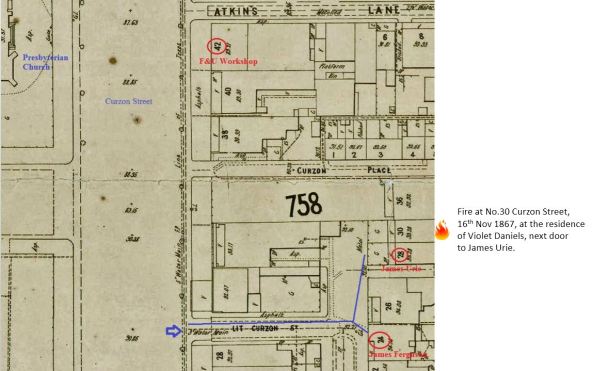
20-11-1867: The fire in Curzon Street, North Melbourne.

The Argus, Melbourne, Wednesday 20th November 1867, page 5.

“Dr. Youl held an inquiry yesterday into the origin of a fire which burned down the premises No. 30 Curzon-street, Hotham, on 16th inst. The premises had been occupied by a Mrs. Violet Daniels who retired to bed on the evening of the 16th inst., having previously extinguished the fire and removed the matches. About twelve o’clock a constable discovered the fire and alarmed the inmates and all subsequent efforts to extinguish the fire proved unsuccessful. The flames afterwards spread to the adjoining premises and consumed a fowl-house valued at 5, and also damaged the premises of Mr. J. Urie, glass-stainer, to the extent of £20. About eleven o’clock on the night of the fire, a lodger in the house of Mrs. Daniels took a candle into an unoccupied room, for thee purpose of obtaining a drink of milk, but brought the candle back to his room. At that time there was no sign of fire. Urie’s premises were insured for £1,250, and Daniels’ for £200, and the furniture for £100. The loss beyond the insurance money was estimated by Mrs. Daniels at £100. A verdict of “Accidental Fire” was recorded”.

Curzon Street Fire 16 Nov 1867

James Urie’s cottage was at No.28 Little Curzon Street and James Ferguson’s at No 24 Little Curzon street which were only a short distance to the rear of the companies stained glass workshops opposite the Union Memorial Church. 

As at 2012 the original workshop building (basically only the shell and facade under redevelopment) still exists opposite the Union Memorial Presbyterian Church but is now numbered 42 Curzon street.  Prior to its residential transformation it was used as the North Melbourne Masonic Lodge. As at 2013 the front section of the original workshops has been completed as a private residence with further work to be completed to the rear section.

James Ferguson & James Urie offered up their Little Curzon Street cottages for auction in November 1886 as both partners had by this time built their new two storey mansions in Parkville and Flemington.

James Ferguson had his mansionAyr Cottagebuilt in Leonard Street Parkville and James Urie had builtGlencairn‘ in wellington Street in Flemington.


Short link to this page: https://wp.me/p28nLD-9P

© Copyright

02-11-1867: Christ Church, Mount Gambier, South Australia, Australia.

The Rev. R. W. Needham memorial window.

 South Australian Register, Adelaide, Saturday 2nd November 1867, page 3.

 “MOUNT GAMBIER”

 “NEEDHAM MEMORIAL WINDOW.- Some time ago it was proposed to fill in with stained glass the chancel window of Christchurch, as a memorial of the late Rev. Mr. Needham; but owing to the want of funds the centre light as yet has only been completed. The subject chosen was that of the Ascension, which has been artistically carried out in the ‘atelier’of Messrs. Ferguson, Urie, and Lyon, of Melbourne, to whom too much praise cannot be awarded for their masterly rendering of the subject. The grouping and drawing of the figures are in excellent taste, and the principal figure – that of our Saviour – is a glorious conception, and stands out from the background with a relieve almost stereoscopic. The purple drapery of this figure is one of the most magnificent pieces of colouring we have ever seen. On a hand under the figure of the Saviour is His promise:-“I go to prepare a place for you, that where I am ye may be also;” and in the lower part of the window, under the group of Apostles, &c., is a shield with the following inscription:- “In memoriam R. W. Needham, died 3rd Decr., 1865. First incumbent of this Church.”

 Note: Christ Church Mount Gambier also has many other Ferguson & Urie stained glass windows. All are displayed in this slide show along with the east ‘Needham’ memorial window.

This slideshow requires JavaScript.

[View larger images]

Border Watch, Mount Gambier, SA, Saturday 19th October 1867, page 2.

“MEMORIAL WINDOW CHRIST CHURCH.-We were yesterday permitted to inspect a memorial window which has been placed in the east front of the Church of England over the Communion table, in memory of the Rev. R. W. Needham. The work which is of a very high is in the medieval style and the colored glasses of which the window is composed are so admirably matched and graduated in shade that the whole might very readily be taken for a painting by an artist of no mean attainments. The upper portion of the window is descriptive of teh ascension. Between these compartments are two angels bearing a scroll on which is inscribed the words, “Jesus shal so come as ye have seen him go into heaven.” Beneath the lower compartment are the words, “I go to prepare a place for you that where I am ye may be also.” At the base of the window, the object of the memorial is expressed by the words “In memory of the Rev. R. W. Needham who died December 3rd, 1866, first Incumbant [sic] of this Church.” The memorial window is alike creditable to those who subscribed the fund for its erection, the designer, Mr. T. W. Gore, and the artists who executed the work in Melbourne.”


Short link to this page: http://wp.me/p28nLD-9r